What is Millais — Ophelia / Wildflower Pre-Raph?
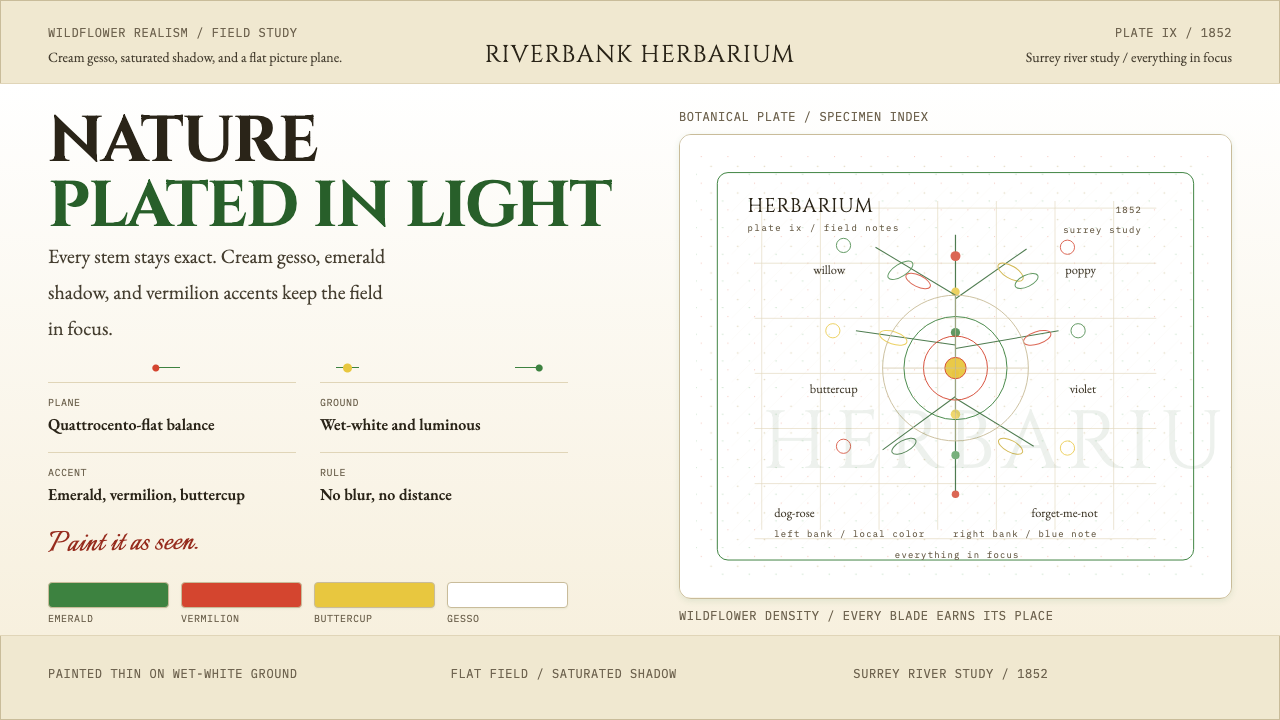
Millais painted every wildflower as if a botanist's life depended on it — and the result was the most saturated, everything-in-focus surface Victorian England ever put on canvas.
Millais — Ophelia / Wildflower Pre-Raph in brief
The Millais Pre-Raphaelite aesthetic — anchored by the 1851–1852 painting Ophelia — is an extreme form of botanical realism fused with medieval decorative flatness. Where the Old Masters built atmospheric depth through darkening glazes and soft focus, Millais and his Brotherhood stripped every compositional device that simulated air or distance. The result is a surface where foreground and background compete with equal vividness: emerald river-weed, vermilion poppies, butter-yellow watercrowfoot, and violet-tipped loosestrife all declare themselves simultaneously at the same crisp focus.
Technically, the approach depended on painting directly onto a wet white ground — a practice Millais borrowed from Quattrocento Flemish technique — which allowed thin, jewel-bright pigments to glow with a stained-glass translucency rather than sinking into the warm brown tonality that dominated academic painting. Color was not modeled into shade; it was stated. Each petal, each grass blade, each floating hair was isolated and rendered with the same attention as the object beside it, producing what critics called a horror vacui surface: every inch earned, nothing abbreviated.
Conceptually, the style is inseparable from John Ruskin's directive to be faithful to nature — not to a generalized ideal of nature, but to the specific organism in front of the painter's eyes on a particular afternoon. This makes the aesthetic at once scientific and poetic: it carries the density of a naturalist's field plate and the emotional weight of Pre-Raphaelite literary symbolism. Applied to contemporary design, this translates into layouts that are richly detailed, botanically warm in palette, and committed to showing rather than suggesting.

See the Millais — Ophelia / Wildflower Pre-Raph design system
Where does Millais — Ophelia / Wildflower Pre-Raph come from?
The Pre-Raphaelite Brotherhood was founded in London in 1848 by seven young men, three of whom — John Everett Millais, Dante Gabriel Rossetti, and William Holman Hunt — became its defining voices. They named themselves in deliberate opposition to the teaching of the Royal Academy, which they believed had calcified around the methods and tonal conventions of Raphael and his successors. Raphael, in the Brotherhood's view, represented the moment when European painting turned away from the precise, spiritually earnest work of earlier centuries and began the long drift toward idealization and formulaic grandeur. The solution was to look before Raphael: to the Flemish primitives, to Botticelli, to the quattrocento fresco tradition — anywhere that observation still preceded convention.
Millais was the youngest founding member and, at eighteen, the most technically precocious. He had entered the Royal Academy Schools at eleven, the youngest student in the institution's history. His early Brotherhood works — Christ in the House of His Parents (1849–1850) and Mariana (1851) — already demonstrated the compressed, everything-in-focus botanical attention that would reach its fullest expression in Ophelia. For Ophelia, begun in the summer of 1851, Millais spent five months painting the background outdoors beside the Hogsmill River in Ewell, Surrey — working in all weathers, securing the vegetation with string when flooding threatened to disturb the composition. Every plant species visible in the finished canvas — weeping willow, stinging nettle, dog-rose, forget-me-not, pansy, daisy, loosestrife, crow-flower — can be identified botanically, not because Millais invented the plants but because he painted what was actually there.
The theoretical scaffolding for this practice came largely from John Ruskin, the era's most influential critic. Ruskin had been developing his theory of 'truth to nature' since the 1840s in the first volume of Modern Painters, arguing that the greatness of any painter lay in the fidelity with which they recorded the particulars of visible creation. When the Brotherhood showed their first works at the Royal Academy exhibition of 1850, the critical response was largely hostile — Charles Dickens famously attacked Christ in the House of His Parents as grotesque. Ruskin came to the Brotherhood's defense in 1851, writing two letters to The Times that effectively reframed their project as the most honest form of naturalism available to contemporary art. His patronage, and his specific directive to 'go to nature in all singleness of heart,' became inseparable from what the Brotherhood understood itself to be doing.
Millais's brotherhood phase was concentrated and brief: from 1849 to roughly 1853, when his intimate friendship with Ruskin fractured following Millais's marriage to Ruskin's former wife, Effie Gray. In 1853 Millais was elected an Associate of the Royal Academy — the institution the Brotherhood had defined itself against — and his work shifted progressively toward the domestic sentimentality and social portraiture that would define his later career. The aesthetic captured in Ophelia and the works immediately surrounding it represents a singular moment: the fullest realization of the Brotherhood's botanical ambition before its founder members diverged into separate careers and separate styles. It is this 1849–1853 window that the Millais Pre-Raphaelite design language draws upon.
What defines the Millais — Ophelia / Wildflower Pre-Raph look?
Color Palette
The palette is organized around saturated botanical hues — deep emerald greens, warm vermilion reds, soft cream whites, and clear cadmium yellows — deployed against one another without atmospheric softening. There is no 'Old Master brown sauce': the shadows are colored rather than neutral, pulling toward cooler greens or deeper purples. Creamy off-white serves as the ground tone, keeping the botanical colors from competition with a stark, neutral backdrop. The overall effect is closer to stained glass or illuminated manuscript than to oil painting as the nineteenth century knew it.
Universal Focus
Unlike academic painting, which typically assigns one zone of the picture plane the honor of sharp definition while degrading the rest into softness, the Pre-Raphaelite surface maintains consistent crispness at every depth. A blade of grass in the far corner receives the same rendering attention as the figure in the center. This total-field clarity creates an almost diagrammatic quality — every element reads as equally important — and produces the visual density characteristic of a botanist's plate or a medieval tapestry.
Botanical Density
The surface tolerates no empty or generalized passages. Foliage is not a green blur but a specific species rendered leaf by leaf; water is not a blue tone but a particular reflection of a particular sky on a particular afternoon. This horror vacui discipline — the refusal to leave any area loosely gestured — creates a texture of extreme visual abundance. In design applications, this translates into richly layered compositions: botanical illustration motifs, multiple overlapping organic forms, and a density of considered detail that rewards sustained looking.
Quattrocento Flatness
Despite the hyper-detailed surface, the spatial construction is deliberately shallow. The Brotherhood drew on Italian and Flemish painting before the systematic development of linear perspective — a tradition in which figures and objects are arranged in a compressed lateral spread rather than receding convincingly into deep space. This produces a decorative flatness that sits in productive tension with the extreme botanical detail: everything is described precisely, but nothing recedes convincingly into distance. The effect is more like a vertical tapestry than a window into nature.
Literary Symbolism
Each plant in Ophelia carries traditional symbolic weight: the forget-me-not for true love, the violet for faithfulness and early death, the poppy for sleep and oblivion, the daisy for innocence. The Brotherhood inherited this emblematic tradition from medieval manuscript illustration and Shakespearean botanical convention alike. In contemporary design, this symbolic layering translates into an approach where decorative elements are not merely ornamental — they carry legible meaning for an audience familiar with the visual language of botanical and literary illustration.
Warm Light and Wet Ground
The characteristic warmth of the Pre-Raphaelite surface comes partly from the white ground preparation, which reflects light back through the pigment layers like a source of internal illumination, and partly from the plein-air observation of damp, richly vegetated English riverbank in summer. The light in Ophelia is overcast and diffused — no strong directional shadows — which means color intensity is uniform across the surface rather than bleached by direct sunlight on one side. This even, enclosed luminosity is one of the style's most immediately recognizable qualities.
Meticulous Line
Edges in the Pre-Raphaelite system are sharp and individually decided. Each leaf terminates with a confident contour; each flower petal is circumscribed by a line that could have been drawn by a natural history illustrator making a technical record. There is no impressionist dissolution of edge into ambient light, no blending of object into background through soft transition. This hard-edge quality gives the style its characteristic graphic crispness and makes it highly compatible with contexts — packaging, editorial, digital UI — where clarity of form is a functional requirement.

See the Millais — Ophelia / Wildflower Pre-Raph design system
Who shaped Millais — Ophelia / Wildflower Pre-Raph?
The youngest founding member of the Pre-Raphaelite Brotherhood and its most technically accomplished painter during the Brotherhood phase. Millais spent five months beside the Hogsmill River in 1851 executing the background of Ophelia in direct observation from nature, then painted the figure of Ophelia — his model Elizabeth Siddal — indoors in a heated studio bath. The resulting painting combines extreme plein-air botanical fidelity with a controlled indoor figure study, and its color surface, laid over a wet white ground, set the technical standard for the Brotherhood's mature work. His early election to the Royal Academy in 1853 and subsequent stylistic shift toward Victorian domestic sentiment make the 1849–1853 phase a distinct and historically defined moment in his career.
Art critic and the Brotherhood's most powerful external defender. Ruskin's theory of 'truth to nature' — developed through the five-volume Modern Painters (1843–1860) — provided the intellectual framework within which the Brotherhood understood their own project. His letters to The Times in 1851 rescued the Brotherhood from hostile critical reception and repositioned their work as the most disciplined form of naturalistic painting available to contemporary practice. His personal relationship with Millais was complicated by Millais's eventual marriage to Ruskin's wife Effie Gray, but his influence on the Brotherhood's theoretical commitments — especially the mandate to observe the specific rather than the generic — is indissociable from the style's character.
Co-founder of the Brotherhood and its most explicitly literary sensibility. Where Millais brought technical rigor and botanical discipline, Rossetti brought Dantesque symbolism, medieval romance, and a more openly decorative color sense. His work during the Brotherhood phase — including the unfinished Ecce Ancilla Domini and the many pen drawings of Arthurian and Dantesque subjects — established the literary and symbolic dimension of the Pre-Raphaelite aesthetic that would become even more prominent in the second wave of Pre-Raphaelitism in the 1860s through artists including Edward Burne-Jones and William Morris. Rossetti's divergence from Millais's botanical literalism illustrates the breadth of approaches contained within the Brotherhood label.
The Brotherhood member who remained most consistently committed to the founding principles throughout his career. Hunt traveled to the Middle East in 1854 to paint biblical subjects in their actual geographical and climatic settings — the most extreme application of the 'truth to nature' principle in the Brotherhood's history. His treatment of color and his obsessive attention to surface detail are close companions to Millais's botanical approach, though Hunt's palette tends toward a harder, more arid warmth. The Light of the World (1851–1853) and The Scapegoat (1854–1856) demonstrate his conviction that meaning must be anchored in scrupulously observed material reality, not in conventional pictorial idealization.
Model, poet, and artist, and the face most closely associated with the Pre-Raphaelite visual type. Siddal modeled for Millais's Ophelia in 1851–1852, lying for extended sessions in a bath of water kept warm by oil lamps — the lamps failed during one session, and she reportedly contracted a severe illness. Her own paintings and drawings, produced in the 1850s and early 1860s, adopt the Brotherhood's flat, decorative, medieval-inflected aesthetic in a register that is more intimate and less botanically obsessive than Millais. Her presence as both subject and maker within the movement complicates any straightforward account of Pre-Raphaelite production as a purely masculine enterprise.
How do you use Millais — Ophelia / Wildflower Pre-Raph today?
The Millais Pre-Raphaelite aesthetic is among the most atmospherically specific styles available to contemporary design — it carries immediate associations with Victorian literary culture, botanical illustration, and poetic melancholy. Applying it well requires understanding that the style's power lies in its surface density and its palette warmth, not in isolated motifs. A single botanical illustration floating on a white background is not this style; the style is the whole surface treated as a richly observed field.
For presentation slides, the aesthetic works with particular strength on cover and section-break pages. A cover designed in this language might feature a dense botanical illustration occupying the full bleed, with the title set in a warm cream or pale gold against the foliage rather than on a separate white panel. Section break slides benefit from a single plant specimen rendered with Pre-Raphaelite detail — a single stem of dog-rose or a spray of forget-me-not — centered or offset against a parchment ground. Content slides should be restrained by comparison: the botanical vocabulary belongs to structural moments rather than every text slide. Data visualizations can draw on the palette — bar charts rendered in the warm emerald, vermilion, and cream tones of the Ophelia canvas — but should maintain the clarity that the style's universal focus implies.
For web interfaces, the style suits editorial platforms, literary subscription services, cultural institutions, and botanical or wellness brands where richness and considered beauty are product values. A dashboard in this language keeps the background a warm off-white or parchment tone, uses deep botanical greens and warm reds for data categories, and incorporates illustrated botanical ornaments — vine borders, sprig separators — as structural rather than decorative elements. Pricing pages can use the palette's warmth to differentiate tiers, with the premium tier signaled by deep emerald against cream rather than by the cold blues typical of technology products.
For editorial and marketing work, the style is naturally allied with long-form reading experiences, literary magazines, and brand identities in the wellness, naturalist, and artisanal sectors. A book cover or editorial spread in this language uses the full-bleed botanical illustration as the primary visual, with typography set to complement rather than compete — warm serif letterforms in cream or gold against a richly detailed ground. Marketing campaigns can draw on the botanical symbolism of specific flowers to carry encoded meaning: forget-me-not for memory and loyalty, rose for beauty and transience, poppy for rest and altered states. The encoded meaning works best for audiences who recognize the visual language of Victorian botanical illustration.
A common mistake when applying this style is treating it as merely a color palette — applying warm greens and reds to a layout without engaging with the density and focus discipline that gives those colors their character. Another frequent error is combining the botanical warmth with modern minimalist whitespace conventions: this style does not breathe through negative space, it breathes through the infinite richness of a fully observed surface. A third mistake is using generically decorative floral elements — clip-art roses, abstract floral vectors — in place of botanically specific, illustratively rigorous specimen studies. The authority of the style depends on specificity; generic flowers produce generic results.

See the Millais — Ophelia / Wildflower Pre-Raph design system
Millais — Ophelia / Wildflower Pre-Raph — FAQ
How is the Pre-Raphaelite style different from general Victorian decorative illustration?
Victorian decorative illustration — chromolithographic trade cards, ornamental borders, gift-book imagery — tends toward sweetness, rounded softness, and a generalized prettiness. The Pre-Raphaelite aesthetic, by contrast, is founded on botanical specificity and an almost unsettling exactness: plants are identified species, not generic greenery; color is saturated to the point of intensity rather than softened toward palatability. The difference is the difference between a wallpaper rose and a botanical plate: both are floral, but only one has been observed. When applying the style, specificity of botanical reference is the single most reliable marker of authenticity.
Can this aesthetic work for dark-background or night-mode layouts?
With care, yes — but dark inversions significantly alter the style's character. The canonical Pre-Raphaelite surface is light-ground: the white preparation beneath the paint layers is functionally important, lending the colors their internal luminosity. On a very deep ground — near-black or a very dark forest tone — the botanical palette shifts from glowing warmth to something closer to phosphorescence or moonlit foliage. This can be effective for nocturnal or melancholic themes, but it requires recalibrating the palette: the creams become pale silvers, the saturated greens approach teal, and the vermilion must be used sparingly or it will dominate. The style's essential quality — universal crisp focus with botanical specificity — remains achievable on a dark ground, but the luminous warmth must be replaced by a different kind of atmospheric intensity.
How do I source or create botanical imagery that meets the style's specificity standard?
The most reliable source is historical botanical illustration from archives in the public domain — the works of artists such as Georg Dionysius Ehret, Pierre-Joseph Redouté, and the contributors to Curtis's Botanical Magazine provide exactly the species-specific precision the style demands. Many major botanical library collections have digitized their holdings at high resolution. For original illustration, the standard is the same as for the Pre-Raphaelites themselves: one specific plant, observed from a specific specimen, rendered with attention to the actual form of each leaf, petal, and stem rather than a generalized or idealized version. Botanical illustration training, or close study of historical examples, is the most direct preparation. AI-generated flora, unless carefully refined, tends toward decorative generalization rather than the taxonomic specificity this style requires.
Is the style appropriate for technology or software product design?
Rarely as a primary system, frequently as a tonal influence. Direct Pre-Raphaelite application — botanical illustration surfaces, warm parchment grounds, literary symbolism — would be dissonant in most productivity or analytical software contexts, where users expect visual conventions that signal speed, precision, and rationality. However, the style's palette warmth and surface richness can function as a counterpoint to the cold blue-grey defaults of technology design, particularly for products in the creative, educational, or cultural sectors. A writing tool, a poetry application, a digital herbarium, or a cultural archive platform might legitimately draw on this aesthetic for its full character. For mainstream SaaS, the safer application is selective: using the botanical palette for illustration and marketing, while keeping the UI itself governed by more conventional structural principles.
What is the relationship between the Millais Brotherhood phase and later Pre-Raphaelitism?
The Brotherhood's founding phase (1848–1853) and the later Pre-Raphaelite revival associated with Rossetti, Burne-Jones, and William Morris in the 1860s–1880s are connected but distinct movements. The founding phase, which this design language draws upon, is defined by botanical literalism, plein-air observation, and the hard-edge specificity of direct natural observation. The later phase — sometimes called Aesthetic Pre-Raphaelitism — is softer, more decorative, more given to dreamlike atmosphere, golden ochre tones, and a frankly ornamental surface. Millais himself abandoned the first phase's principles; Rossetti evolved the Brotherhood's medieval romanticism into a more sensuous decorative mode. When applying the Millais Pre-Raphaelite style, the relevant reference is the founding phase only: saturated, focus-everywhere, botanically precise, and lit by that characteristic internal luminosity of paint on white ground.
Related design styles
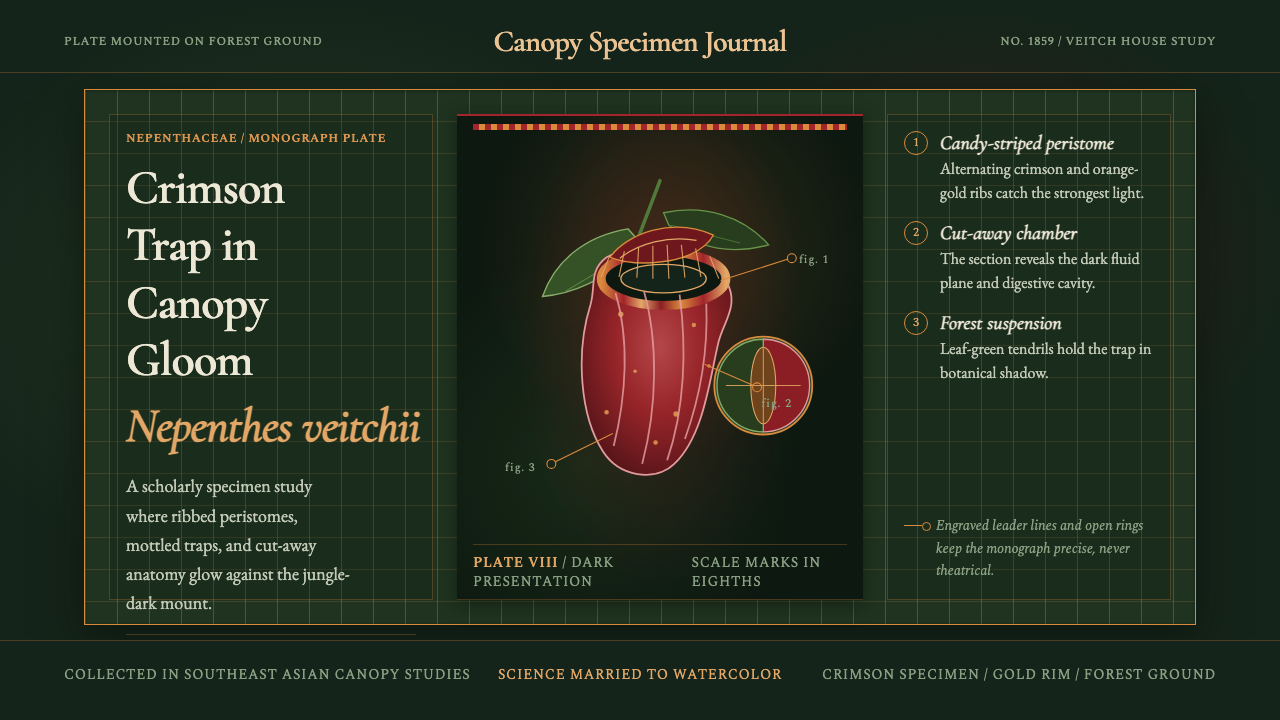 Carnivorous Pitcher PlantBotanical danger glows. Crimson traps and gold rims float on jungle-dark gree…
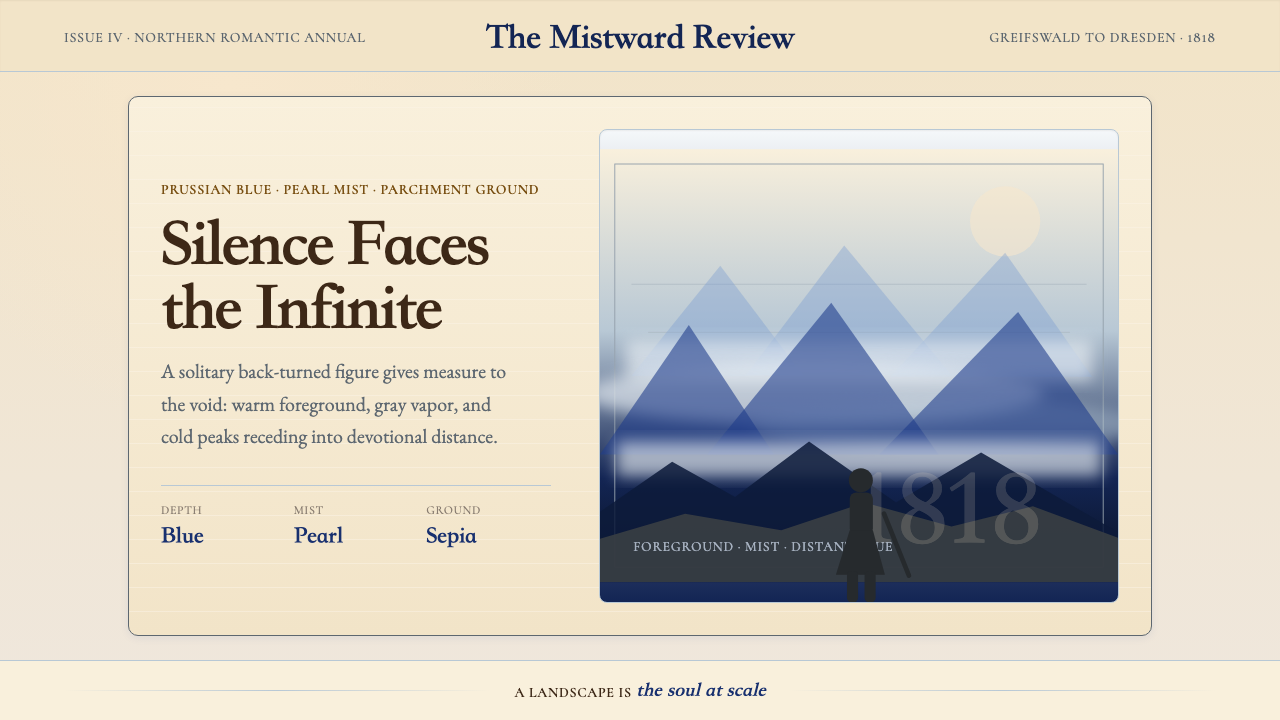 Caspar David FriedrichSilence becomes vast. Prussian blue depth, pearl mist, and parchment framing…
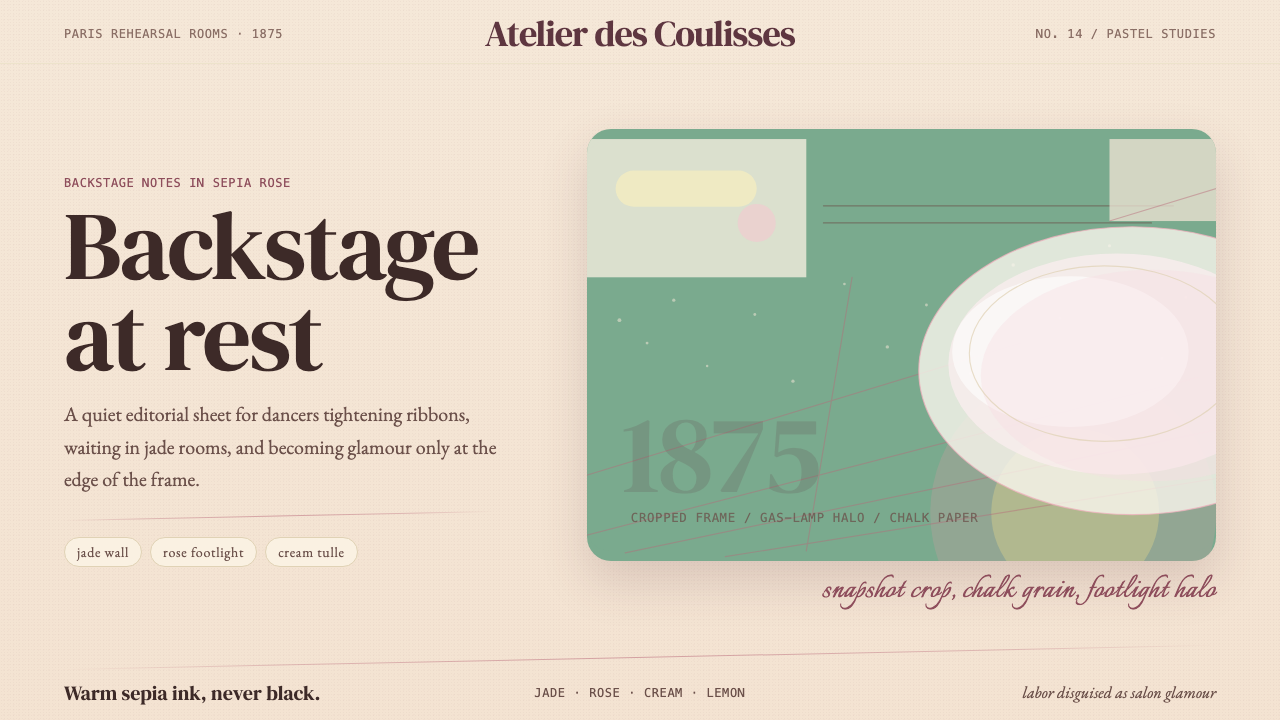 Degas Ballet PastelsBackstage glamour is labor. Jade walls, rose footlights, cropped serifs on cr…
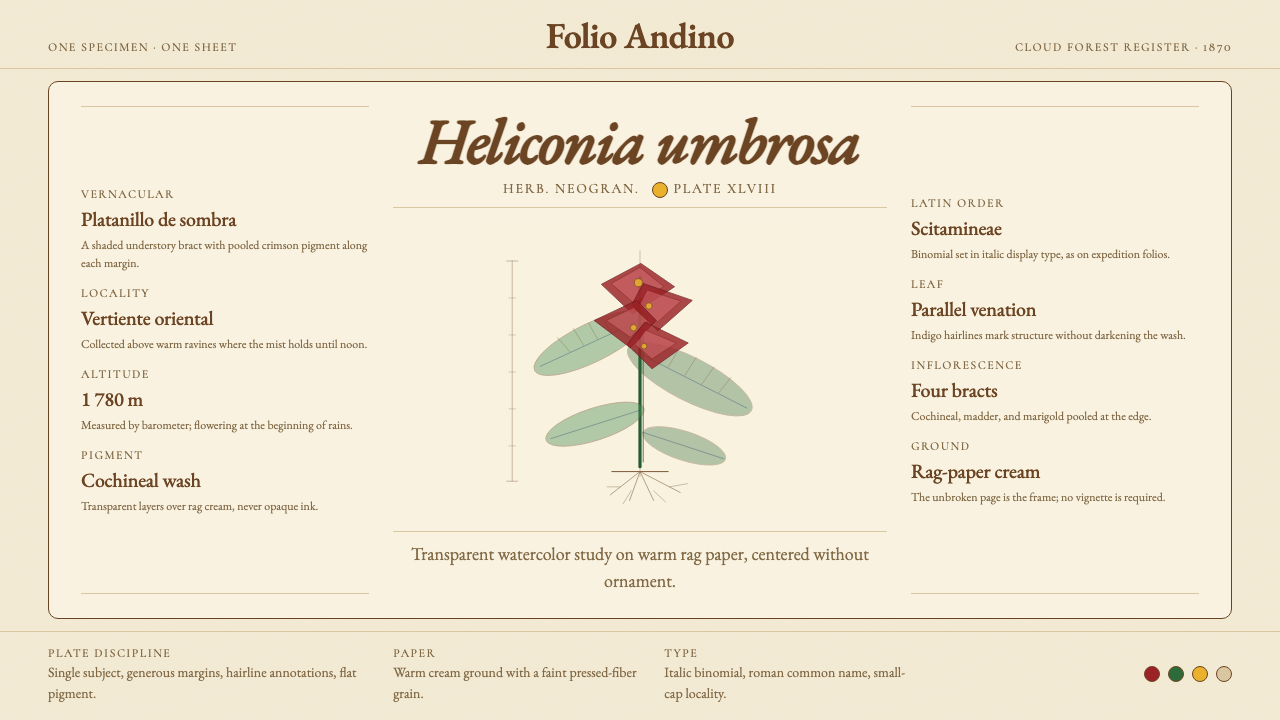 Colombian Botanical (Triana)Observation becomes ornament. Crimson watercolor specimen breathes on cream r…
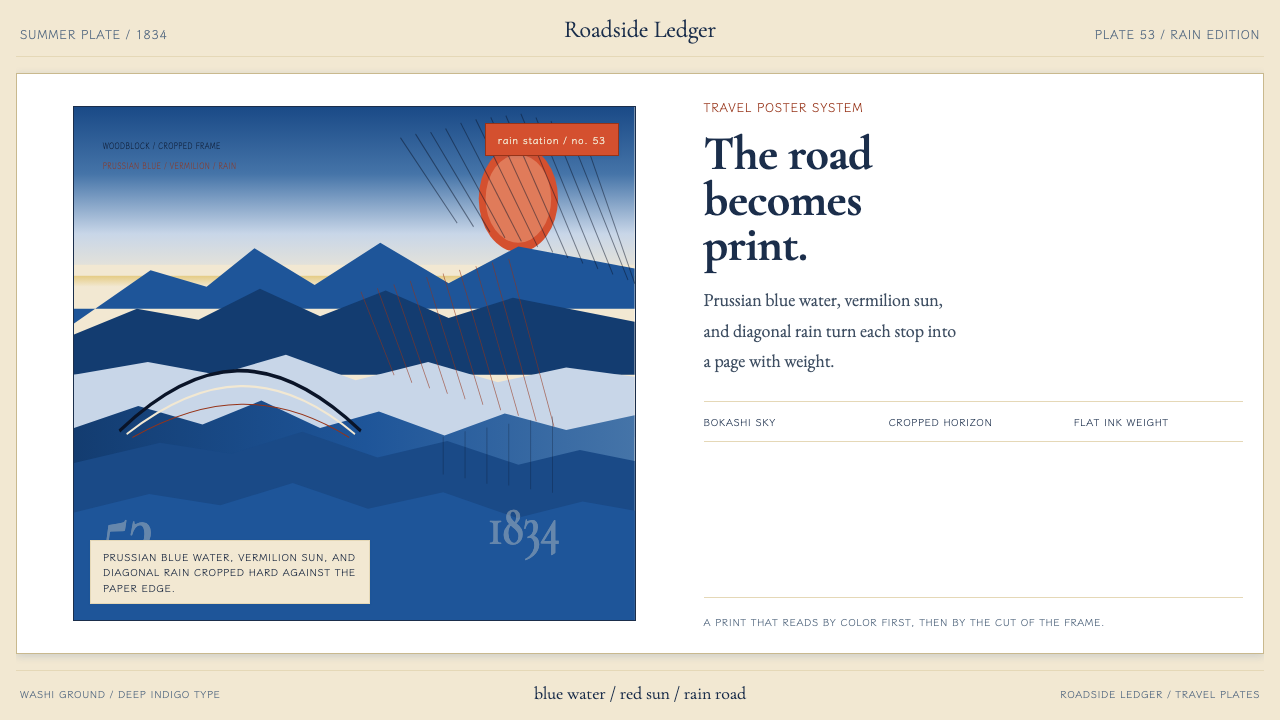 Hiroshige — Tokaido RoadA road print in motion. Prussian blue blocks, vermilion cartouches, diagonal…
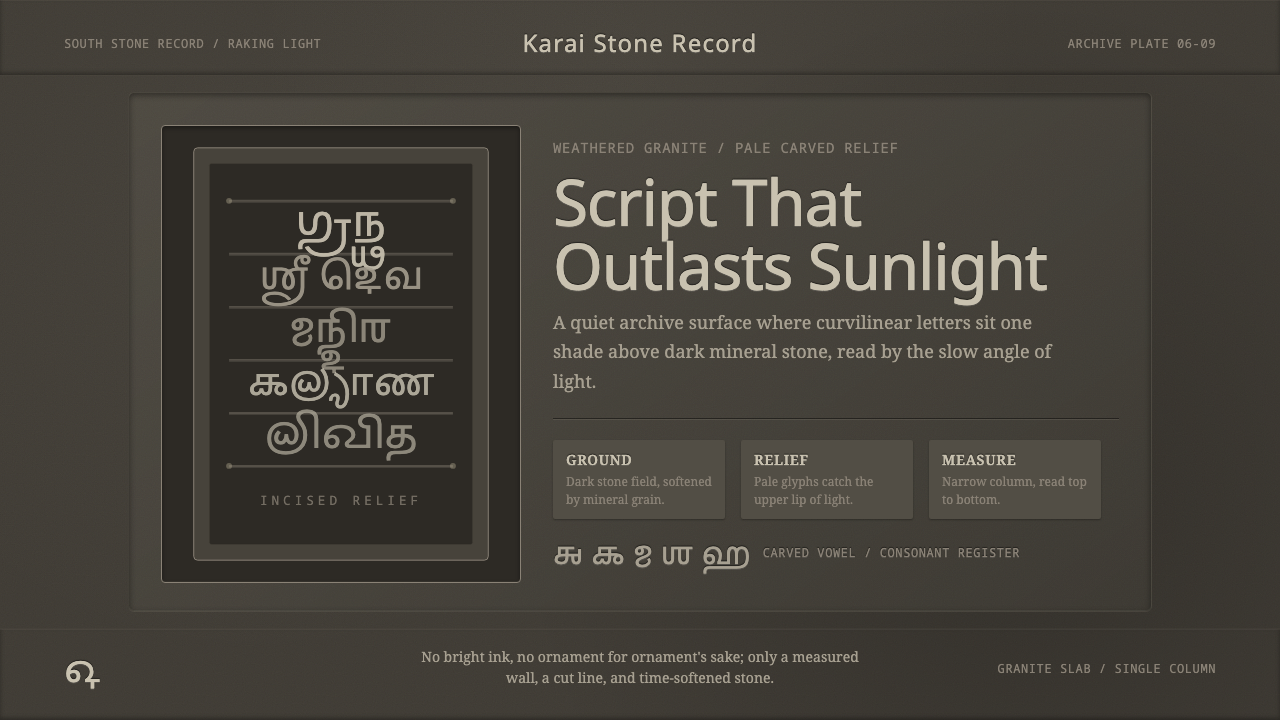 Tamil Grantha InscriptionSacred stone, quietly lit. Pale Grantha glyphs float on dark granite in a nar…