What is William Morris Arts & Crafts?
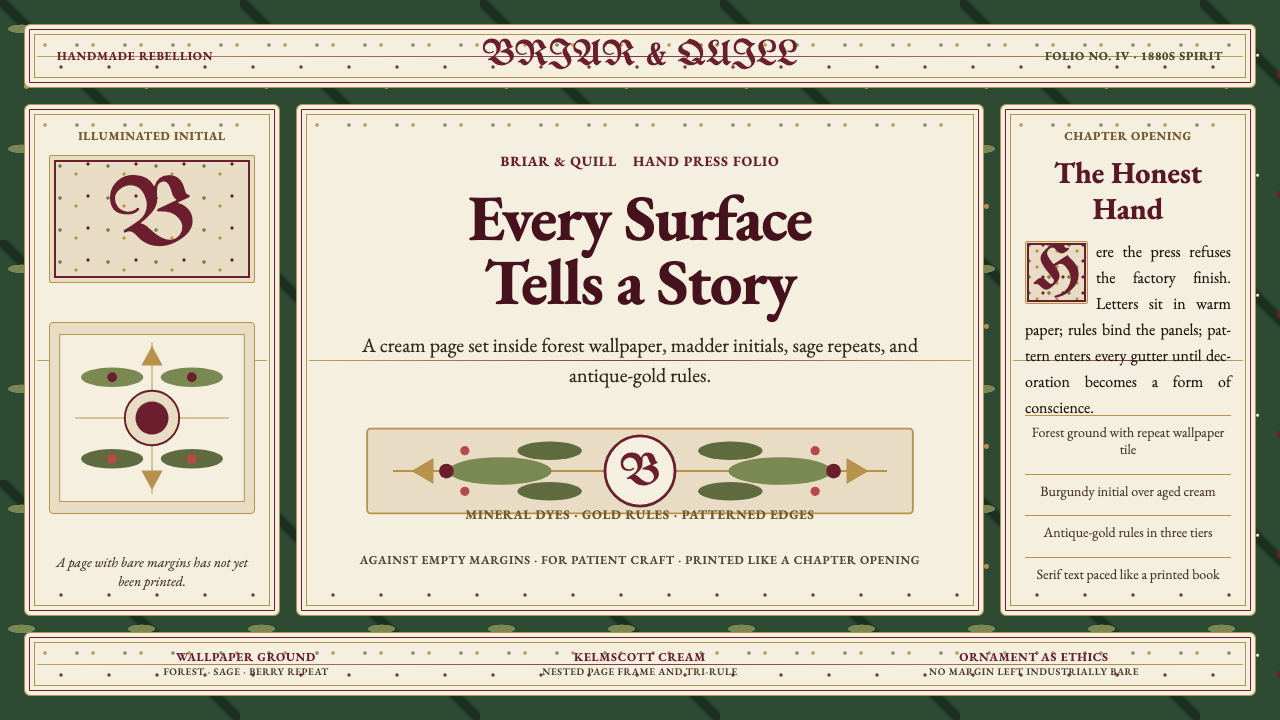
William Morris turned medieval craft into a moral argument — every surface patterned, every object handmade, every margin filled with acanthus and strawberry-thief as a rebuke to the Victorian factory.
William Morris Arts & Crafts in brief
The Arts and Crafts movement, as expressed through the work of William Morris and his circle, is Britain's most elaborate dissent from industrialism. Where the factory produced cheap, repetitive, and — in Morris's view — spiritually degraded goods, the movement produced dense floral wallpapers, hand-knotted carpets, stained-glass windows, tapestries, and hand-printed books that treated every object as an opportunity for the craftsperson to leave a human mark. The aesthetic is immediately recognizable: deep forest greens and rich burgundy grounds, cream or parchment fields for text, scrolling acanthus leaves and intertwined flowering vines filling every margin, and antique-gold rules binding each compositional panel.
The system draws heavily on medieval sources — Gothic illuminated manuscripts, Persian carpet patterns, Flemish millefleurs tapestries — filtered through Morris's passionate belief that ornament and use were not in conflict but were the same thing. A well-made textile was not decorated in addition to being functional; its pattern was evidence of the care and skill that made it functional in the deepest sense. This conviction extended to typography: the books produced by the Kelmscott Press, founded by Morris in 1891, set dense Caslon-style roman type inside elaborate woodcut borders, with chapter openings marked by large black-letter initial caps drawn by Morris himself.
Unlike the machine aesthetic that would follow it, the Arts and Crafts visual language treats empty space as a failure of attention rather than a virtue. Every edge carries pattern; every border invites a new layer of vine or blossom. The palette is warm and naturalistic — the greens of English meadows, the reds of madder dye, the golds of autumn foliage — deployed with the saturated confidence of medieval stained glass rather than the restraint of later modernist color theory. The effect is sumptuous, enveloping, and unambiguously handmade.

Where does William Morris Arts & Crafts come from?
William Morris was born in Walthamstow, Essex, in 1834, the son of a prosperous bill broker. His childhood was spent partly at Woodford Hall, a Georgian mansion whose grounds backed onto Epping Forest — and the experience of that ancient, tangled woodland would shape his ornamental imagination for the rest of his life. He arrived at Oxford in 1853 intending to take holy orders, but the university proved a crucible of different ambitions. There he met Edward Burne-Jones and fell under the influence of John Ruskin's writings, which argued that the quality of a society's art was a direct index of the moral condition of its labor. A workman forced to produce identical machine parts could not, by Ruskin's argument, be a fully human being. Morris absorbed this as a personal conviction.
The immediate catalyst for Morris & Co was the furnishing of Morris's own home. When he married Jane Burden in 1859 and needed to outfit Red House — the radical building Philip Webb designed for him in Bexleyheath — he discovered that nothing in the commercial market met his standard. So he made it himself, recruiting Burne-Jones, Rossetti, Webb, and others to produce painted furniture, embroidered hangings, and stained glass. The firm Morris, Marshall, Faulkner & Co was formally established in 1861, reorganized as Morris & Co in 1875. The commercial success of its wallpapers — 'Trellis' designed in 1862, 'Daisy' in 1864, 'Acanthus' in 1875 — gave the firm a base from which to develop more ambitious work. 'Strawberry Thief' in 1883 and 'Willow Bough' in 1887 became emblematic of the movement's mature visual language.
The movement did not exist in isolation. Morris's circle overlapped substantially with the Pre-Raphaelite Brotherhood — Rossetti was a founding partner, and Burne-Jones remained a central collaborator for decades — and drew inspiration from the same rejection of academic convention and the same romance with medieval visual culture. But where the Pre-Raphaelites were primarily painters working within the fine-art tradition, Morris was insistent that the applied arts were equally serious and that the hierarchy separating them was itself a symptom of the industrial degradation he opposed. The Gothic Revival architect William Butterfield and, later, the theorist A. W. N. Pugin had already established the moral case for medieval architectural ornament; Morris extended this argument from buildings to everything that furnished them.
The founding of the Kelmscott Press in 1891, three years before Morris's death, represented the purest distillation of his principles. Morris designed two typefaces — the Golden Type, based on Venetian humanist models, and the Troy Type, based on German Gothic — and oversaw the hand-printing of fifty-three books on handmade paper with hand-mixed inks. The culminating work, the 1896 Kelmscott Chaucer — illustrated by Burne-Jones and decorated throughout with Morris's woodcut borders — is widely regarded as the most beautiful book produced in the nineteenth century. Morris died in October 1896, the month of its completion. His daughter May Morris continued the embroidery work of the firm and became an important figure in the dissemination of the movement's textile traditions.
What defines the William Morris Arts & Crafts look?
Color Palette
The palette is rooted in natural dyes and medieval stained glass: deep forest greens, rich indigos, madder reds, saffron yellows, and warm creams. Morris was a committed user of vegetable dyes — he studied the craft at his Merton Abbey workshops from the early 1880s — and this commitment to natural colorants gives the palette its characteristic warmth and slight mutedness compared to aniline-dyed industrial competitors. Grounds are typically dark and saturated; text fields are reserved in cream or ivory, creating a high-contrast luminous window effect reminiscent of a manuscript page.
Surface Pattern
Morris's patterns follow a rigorous underlying geometry — typically a diagonal or ogee grid — concealed beneath a naturalistic overlay of leaves, stems, and blossoms so dense that the structural armature is invisible on casual inspection. This disciplined informality is what distinguishes Morris's work from simple floral decoration: the repeat is always precise, the balance always maintained, even as the surface appears to grow and meander freely. The design vocabulary draws on acanthus, vine, honeysuckle, willow, pomegranate, and the native English flora Morris encountered on his Oxfordshire walks.
Typography
The Kelmscott Press established a typographic ideal that treats the page as a unified visual object rather than a container for text. Body type is a dense, humanist roman — warm, slightly thickened strokes, bracketed serifs — set tightly to fill the measure with textural richness. Opening capitals are large black-letter woodcut initials, often elaborated with surrounding vine ornament. Borders are multi-layered woodcut frames that mirror the wallpaper patterns, creating a visual continuity between the interior of the book and the room in which it is read. Running heads and folios are set in a contrasting but compatible style, reinforcing the hierarchy without breaking the decorative field.
Ornamental Density
Where modernism would come to treat empty space as a positive value, Morris treated it as absence — as wasted opportunity. Every margin, every border, every spandrel between pattern repeats is an invitation to add another leaf, another blossom, another bird. This horror vacui is not carelessness; it is a deeply considered position about the relationship between maker, material, and viewer. The density creates an immersive quality: a Morris-patterned room or book page does not merely communicate — it envelops. The appropriate question when applying this style is not 'is this too busy?' but 'has every element earned its place through craft?'
Gold Rules and Panel Structure
Antique gold — not the bright yellow-gold of heraldry, but the muted, warm gold of gilded manuscript borders — serves as the primary structural divider across both textile and print work. Rules and lines in this warm metallic tone separate body text from ornamental border, frame chapter headings, and bind the composition into discrete panels. This paneled approach reflects the influence of medieval manuscript layout, where the text block, the commentary margin, and the illuminated border each occupied distinct but visually related zones. In contemporary applications the gold rule signals historicism and editorial authority simultaneously.
Handcraft Texture
The Arts and Crafts aesthetic deliberately preserves evidence of the hand — the slight variation in a woodblock impression, the textural irregularity of handmade paper, the weave visible through a translucent textile layer. In digital applications of this style, this translates to a preference for textures that suggest fiber, paper grain, or worn surface over the clinical smoothness of flat digital design. Illustration tends toward engraving or woodcut character rather than digital vector cleanliness. The goal is not to simulate imperfection but to acknowledge that materials have their own histories and surfaces.
Medieval and Natural Symbolism
The motif vocabulary is neither random nor purely decorative. Acanthus — the most recurring form in Morris's wallpapers — connects to classical and Gothic architectural carving, asserting continuity with pre-industrial craft traditions. The strawberry thief (a bird stealing fruit from a garden) carries pastoral and moral overtones. Pomegranates and vines reference both medieval religious iconography and Persian carpet traditions that Morris studied directly at the South Kensington Museum. Each motif arrives with layers of cultural meaning that the viewer may or may not consciously register but that give the work a seriousness beyond surface pattern.

Who shaped William Morris Arts & Crafts?
Morris (1834–1896) was simultaneously a designer, poet, novelist, translator, political activist, and printer — perhaps the most comprehensively engaged cultural figure of Victorian England. His wallpaper and textile designs produced at Merton Abbey from 1881 define the movement's visual identity. His later writing, particularly the utopian novel 'News from Nowhere' (1890), articulated the political vision underlying the aesthetic: a society where labor was creative, goods were beautiful, and industrial alienation had been abolished. The Kelmscott Press, which he operated for the last five years of his life, produced work that directly inspired the private press movement of the twentieth century.
Burne-Jones (1833–1898) was Morris's closest collaborator from their Oxford years until Morris's death, and the movement's principal figurative artist. His stained-glass designs for Morris & Co — produced for churches across Britain and North America — set the standard for late-Victorian ecclesiastical glass. His tapestry designs, including the 'Adoration of the Magi' series woven at Merton Abbey, demonstrate how Pre-Raphaelite figuration could be integrated into a fully decorative textile program without losing either narrative clarity or ornamental richness. The 87 illustrations he produced for the Kelmscott Chaucer represent the fullest synthesis of his painting sensibility with Morris's book-design system.
Webb (1831–1915) was the architectural intelligence of the movement. His design of Red House in Bexleyheath (1859–1860) for Morris — a building that drew on English vernacular tradition and Gothic Revival principles while rejecting the period-style eclecticism dominant in Victorian architecture — gave the movement its founding domestic manifesto. As a partner in Morris & Co he designed furniture, metalwork, and animal motifs that grounded the firm's decorative program in structural thinking. His later houses, including Standen in West Sussex (now a National Trust property), demonstrate how the movement's aesthetic could be extended from interiors to entire domestic environments.
May Morris (1862–1938), William's younger daughter, became director of the embroidery workshop at Morris & Co in 1885, at the age of twenty-three, and ran it until the firm's closure in 1940. Her own embroidery designs extended her father's vocabulary with greater delicacy and a stronger emphasis on subtle color gradation. She was also a tireless advocate for the movement's ideals: she edited the twenty-four-volume collected works of her father, toured the United States twice to lecture on embroidery and the decorative arts, and was a founding member of the Women's Guild of Arts. Her work ensured that the Arts and Crafts textile tradition survived well into the twentieth century.
Rossetti (1828–1882) was a founding partner of the original Morris, Marshall, Faulkner & Co and the dominant personality of the Pre-Raphaelite Brotherhood. His contribution to the firm was primarily figurative: stained-glass designs, painted furniture panels, and the mythological iconography that gave the firm's early work its literary and medieval character. His personal influence on Morris — and his complicated romantic entanglement with Jane Morris — shaped the psychological and cultural context in which the movement developed. Though his direct involvement with Morris & Co diminished after the 1870s, the sensibility he introduced remained embedded in the movement's figural vocabulary.
How do you use William Morris Arts & Crafts today?
The Arts and Crafts aesthetic is among the most commitment-intensive historical styles to apply well, because it operates through density and accumulation rather than simplicity and constraint. Getting the surface pattern right, the palette warm, and the typographic hierarchy legible within heavy ornamental framing requires accepting that this style does not scale down gracefully: a single Morris-derived border element, deployed in isolation on an otherwise spare layout, reads as decorative nostalgia rather than a coherent system. The style works when it is applied comprehensively or not at all.
For presentation slides, the style is most effective when used for storytelling decks, editorial publications, or heritage brand presentations where the warmth and seriousness of the visual language reinforce the content. A cover slide benefits from treating the full bleed as a pattern field — forest green or deep indigo ground with a repeating vine or floral motif — with the title set in a large, warm serif on a cream panel at center, framed by a gold rule border. Content slides should reserve a narrow inner margin as a decorative zone, with body text set in a legible humanist roman against a near-white or parchment field. Data visualizations work best when rendered as simple, warm-toned infographics — bar charts in muted greens and golds, without gridlines or axis markers, placed within framing rules that echo the surrounding ornamental structure.
For web interfaces, the style is well suited to editorial sites, literary publishing platforms, independent bookshops, museum digital collections, and craft or heritage brand storefronts. The approach is to define a clear text-centered layout — a single wide column for body text, flanked by decorated margins — with pattern used at page edges and section breaks rather than behind functional content. Navigation should be typographically based, with a warm serif wordmark and link text in a contrasting but compatible weight. For pricing or product pages, the gold rule serves as a natural panel divider, and tier differentiation can be achieved through ground color variation — cream for standard, deep green for premium — rather than through badge or pill components. Avoid modern UI conventions like rounded cards, drop shadows, or icon-forward navigation: they conflict with the period logic.
For editorial and marketing applications, the style excels in contexts where the brand narrative involves craft, provenance, authenticity, or cultural depth. A magazine spread using Arts and Crafts conventions places the headline in a large woodcut-style display setting, reserves a wide outer margin for a decorative border or running illustration, and uses pull quotes in a contrasting style that references Kelmscott marginal annotation. Marketing pages for heritage or artisan products benefit from alternating between full-pattern grounds and clean text panels, creating a rhythm between decorative richness and reading ease. The style also works well for event invitations, book covers, packaging, and long-form digital editorial where the reader is expected to engage slowly rather than scan.
The most common mistake when applying this style is importing individual motifs into an otherwise contemporary or minimal layout without committing to the system's underlying logic. A single acanthus border on a sans-serif slide, or a Morris-pattern header image on a flat UI, creates a collision rather than a synthesis. The second common mistake is using the pattern vocabulary at reduced size or low resolution: Morris's designs depend on the clarity of their repeat structure and the legibility of individual leaves and tendrils at the scale they were intended to be seen. A third mistake is substituting a bright, fully saturated palette for the warm, slightly muted naturalistic tones that define the historical work — the result reads as retro novelty rather than craft authority.

William Morris Arts & Crafts — FAQ
Is Arts and Crafts the same as Art Nouveau?
They are closely related and often confused, but they are distinct movements with different centers of gravity. Arts and Crafts originated in Britain in the 1860s and was grounded in a moral argument about labor, craft, and the evils of industrial production. Its ornament is drawn primarily from medieval English and Gothic sources, and it values the visible evidence of the maker's hand. Art Nouveau emerged on the continent in the 1890s — in Belgium, France, Germany, and Austria — and adopted the Arts and Crafts commitment to the decorative arts while abandoning the medievalism and the political critique. Art Nouveau ornament is more stylized, more sinuous, and more influenced by Japanese woodblock prints than by English Gothic. The two movements share a love of natural forms and a rejection of historical eclecticism, but Arts and Crafts is fundamentally backward-looking and moral, while Art Nouveau is forward-looking and aesthetic.
Can this style work for digital products, or is it too rooted in print?
The style can work digitally, but it requires translation rather than direct transplantation. Morris's wallpaper patterns were designed for rooms with specific ambient light conditions, natural material surfaces, and a viewing distance of several feet; on a screen, at high resolution and with backlit luminosity, the same patterns will read differently — denser, more intense, potentially overwhelming. Successful digital applications of Arts and Crafts tend to use pattern selectively rather than comprehensively: as background texture on hero sections, as border ornament on editorial cards, as decorative flourish on feature typography. The warm color palette translates well to screens. The typographic conventions — rich humanist roman type, large ornamental initials — are achievable with contemporary web typography. The key adaptation is accepting that digital interfaces require more negative space than a Kelmscott page, and designing the pattern to appear in controlled doses rather than edge to edge.
What is the right amount of pattern density for a contemporary application?
There is no universal calibration, but a useful heuristic is to ask where the user's eye needs to rest and work from there. Pattern should fill the zones that frame functional content — borders, backgrounds, section dividers — but should not compete with text for attention. A practical approach: treat the central text column or content area as a plain or near-plain field, and reserve pattern for the outer thirds of the layout. On a slide deck, this means patterned borders and solid text panels. On a web page, it means a patterned hero and footer with clean content sections between. The density of the pattern itself can remain high — Morris's actual patterns at their full density — as long as its placement is architecturally considered. The problem is never the pattern being too dense; it is the pattern appearing where the eye needs clarity.
How do I distinguish an authentic Arts and Crafts application from one that just uses floral decoration?
The distinguishing marks are structural rather than surface. An authentic Arts and Crafts application has an underlying grid logic — the pattern follows a mathematically precise repeat, even if that repeat is concealed beneath organic-looking surface detail. The palette is governed by the naturalistic logic of vegetable dyes: greens that suggest leaf and moss rather than lime or mint, reds that suggest madder and rust rather than cherry or tomato. Typography is historically grounded: serif type with a humanist character, not a geometric or transitional one. And the composition is paneled — text and image occupy framed zones, not flowing together in a continuous contemporary layout. Floral decoration that lacks these structural commitments, no matter how elaborate, will read as general vintage nostalgia rather than as Arts and Crafts.
Is the style always light-background, or does a dark version exist?
Dark grounds are entirely historically authentic — Morris's own wallpapers frequently used deep forest green, indigo, or burgundy as the primary ground, with the floral motifs rendered in lighter values above them. The cream-panel-on-dark-ground composition is in many ways the more characteristic Arts and Crafts layout, closer to the stained-glass analogy that Morris invoked. A dark-ground version requires ensuring that the pattern motifs have sufficient contrast and that any text panels are reversed cleanly — cream or ivory type on the dark ground, or dark type within a clearly defined cream panel. The mistake to avoid is applying the dark ground to functional UI elements like input fields or data tables, where legibility demands that users be able to read at small sizes under various conditions. Pattern grounds work best in structural or decorative zones; functional zones should remain on light fields regardless of the overall palette.
Related design styles
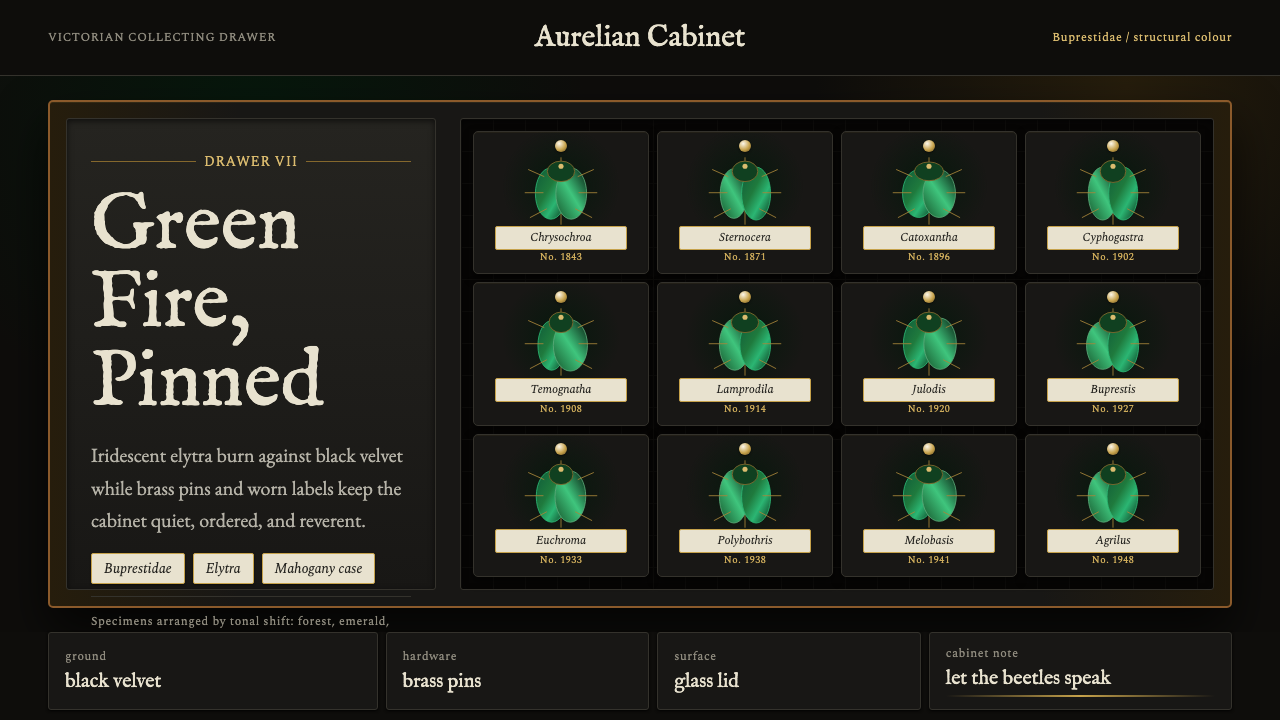 Beetle Specimen CabinetGreen burns in darkness. Emerald elytra grids glow under brass keylines and b…
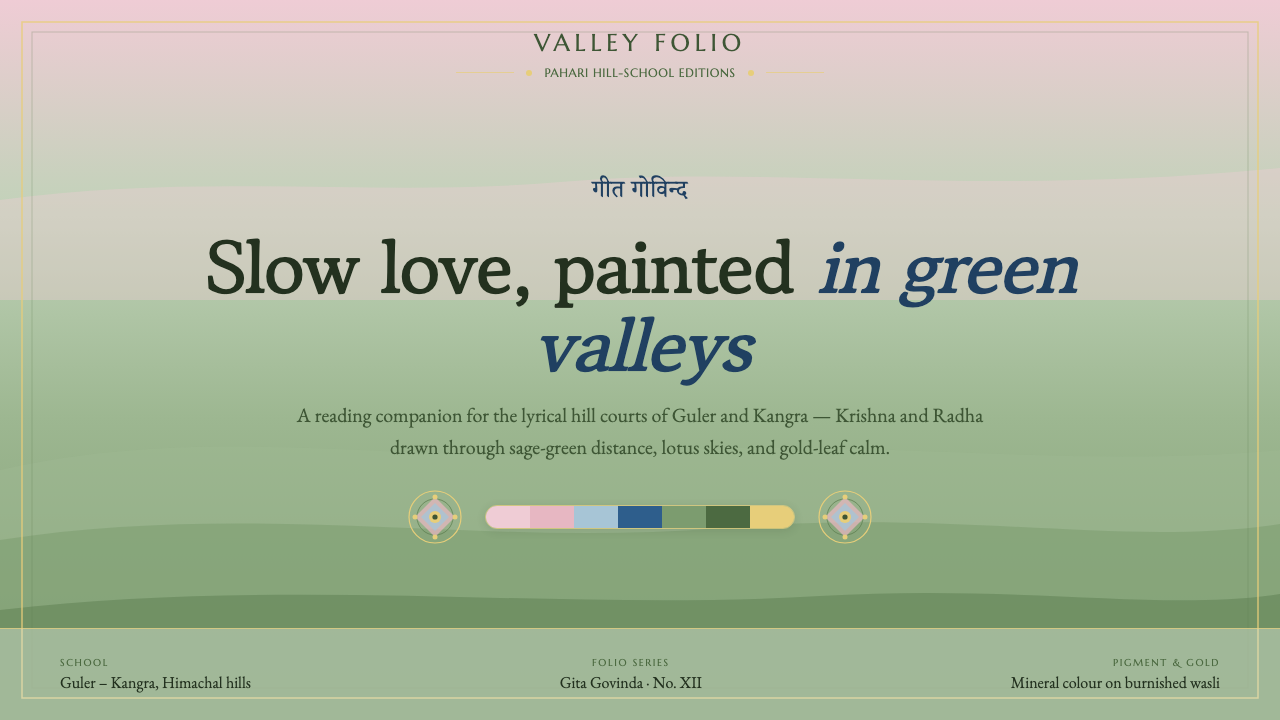 Pahari Kangra PaintingDevotional lyricism, painted slow. Sage-green hill grounds lighten to lotus-p…
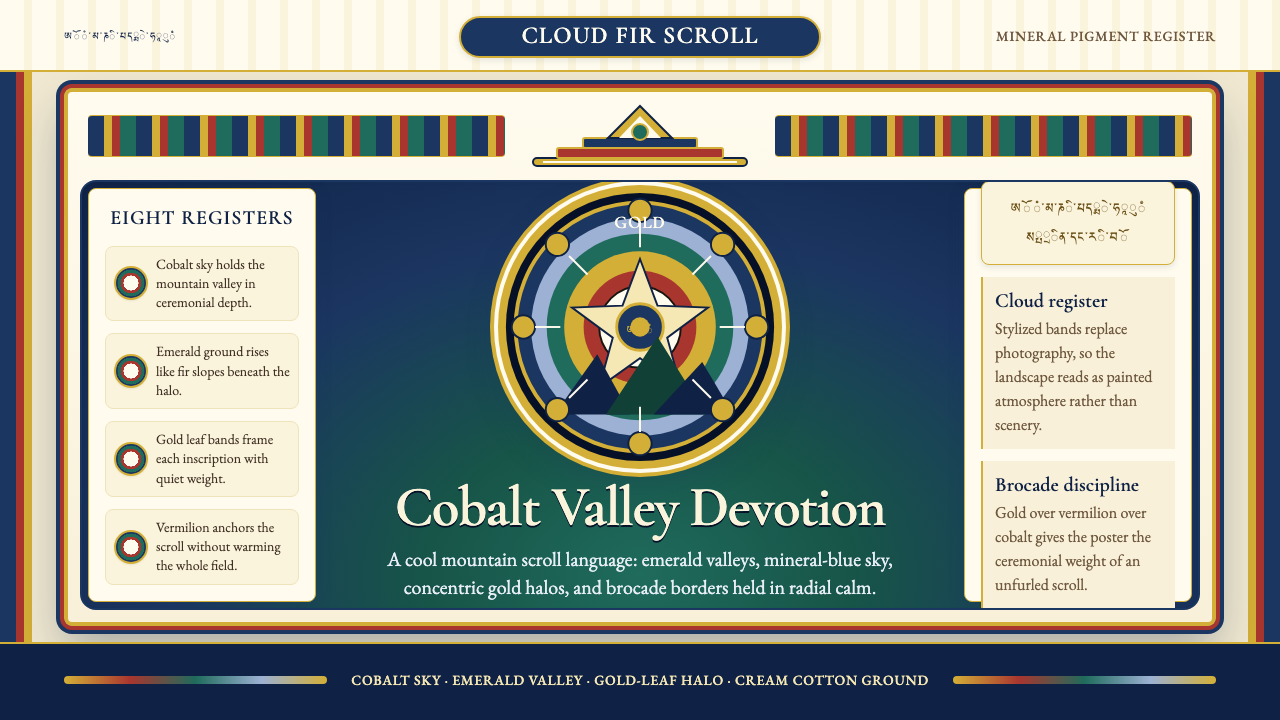 Bhutanese Thangka (Druk Style)Sacred cool-mountain clarity. Cobalt fields, emerald ground, and gold halos f…
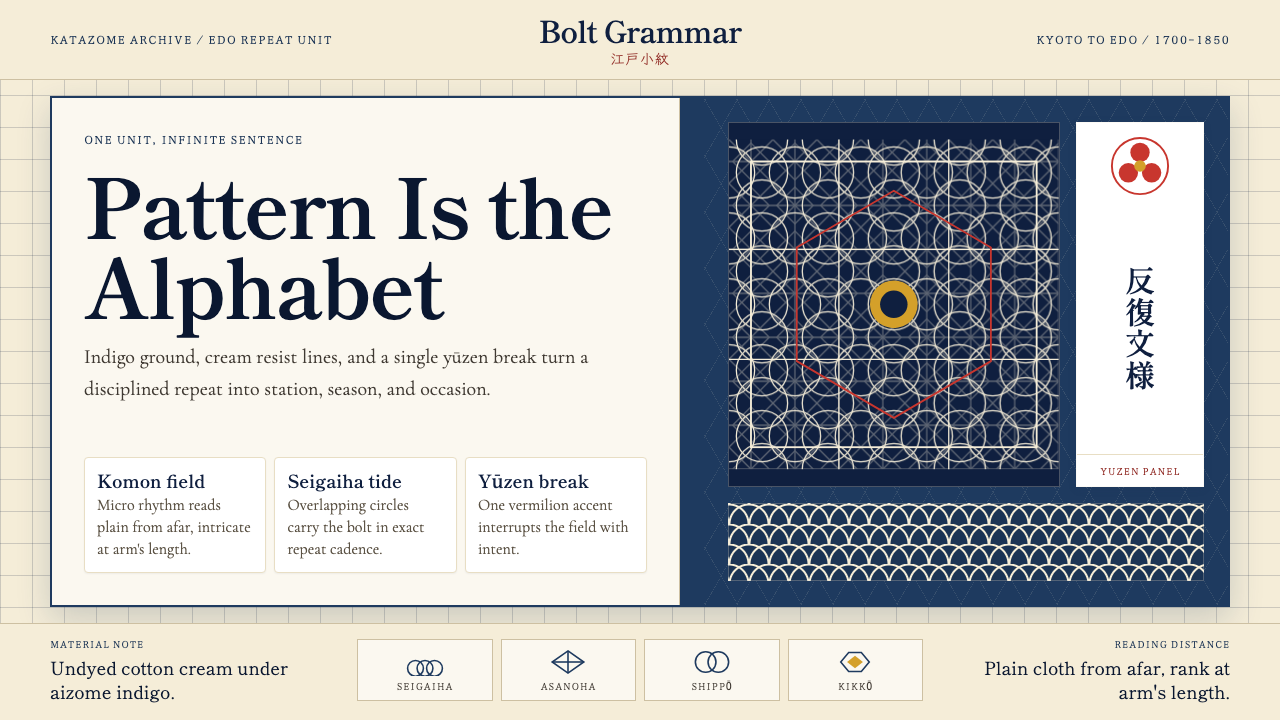 Edo Kimono TextilePattern becomes language. Indigo repeats, cream resist lines, one vermilion p…
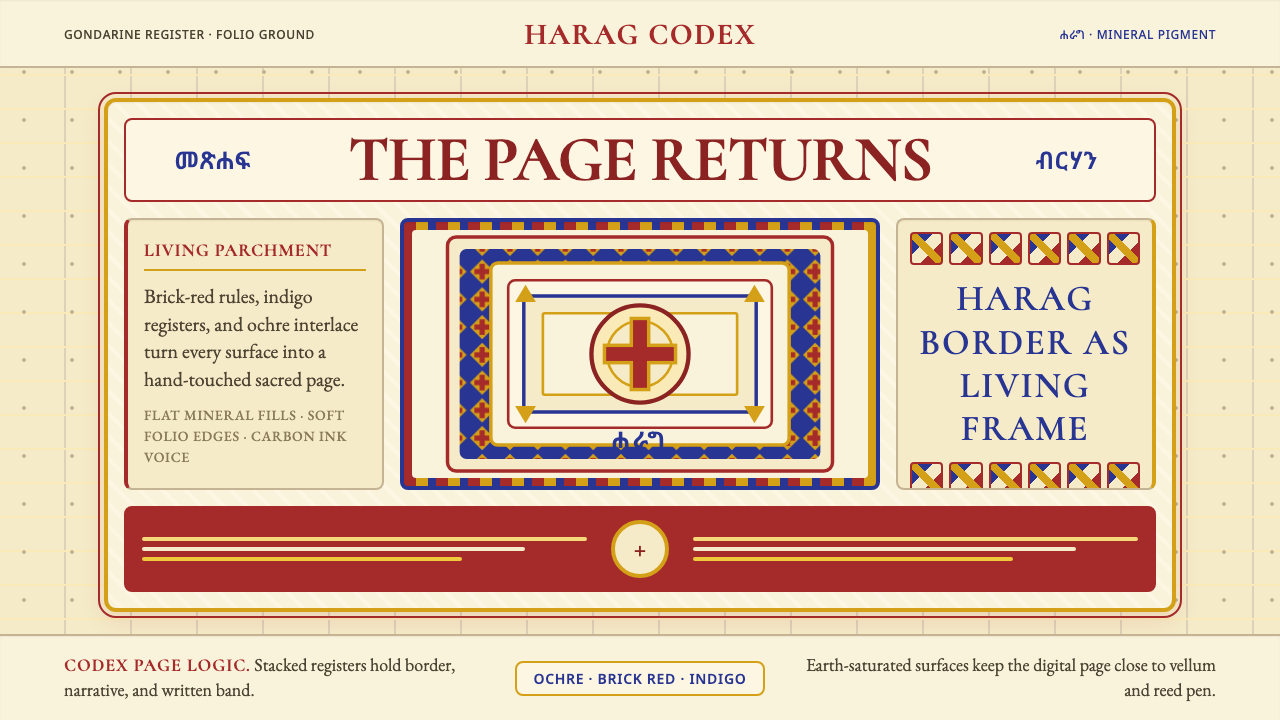 Ethiopian Orthodox ManuscriptSacred page, alive. Brick red, indigo, and ochre harag borders frame a starin…
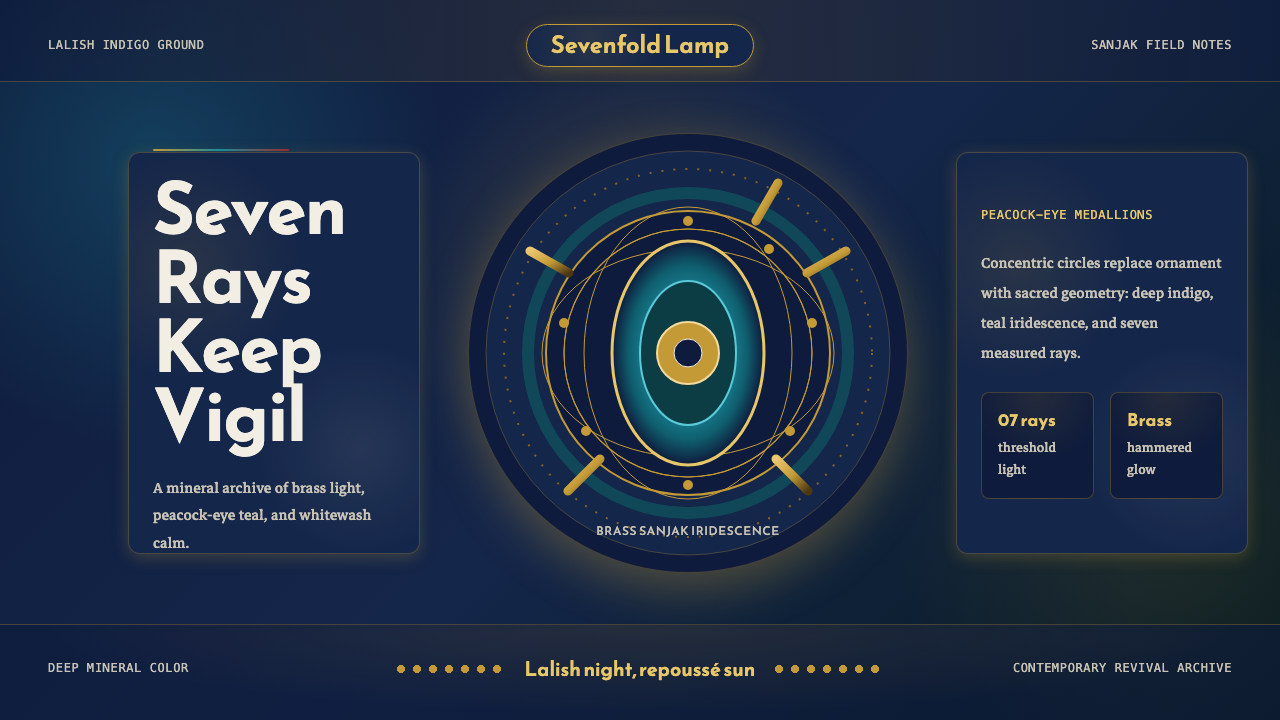 Kurdish Yazidi Peacock & SunSacred geometry glows. Lalish indigo holds brass rays and teal peacock-eye me…