What is Bhutanese Thangka (Druk Style)?
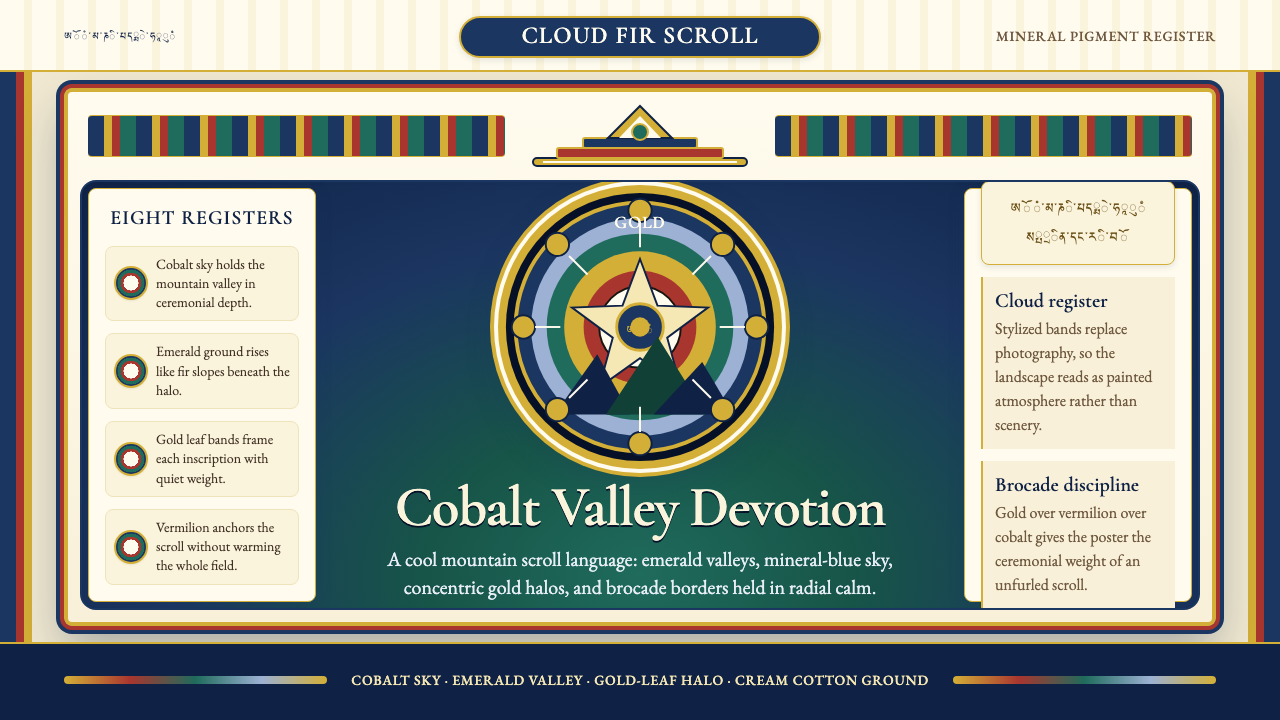
Bhutanese Thangka fuses sacred Buddhist geometry with the cool mountain palette of the Thunder Dragon's kingdom — cobalt skies, emerald valleys, and burnished gold halos on cloth that unfurls once a year before tens of thousands.
Bhutanese Thangka (Druk Style) in brief
Bhutanese Thangka — called Thongdrol in Dzongkha, meaning 'liberation through sight' — is the scroll-painting tradition of the Druk-Kagyu school of Vajrayana Buddhism, practiced in Bhutan (Druk Yul, the Land of the Thunder Dragon). These are not decorative objects. They are consecrated instruments of devotion: a worshipper who looks upon a Thongdrol at the moment of its ritual unfurling is believed to receive immediate merit. The largest examples, hung from fortress-monastery walls during annual Tshechu festivals at Punakha, Paro, and Thimphu, measure ten meters or more in height and require teams of monks and laypeople to unroll.
The visual language of Druk-style Thangka is immediately distinguishable from its Tibetan cousins by its temperature and atmosphere. Where the central Tibetan tradition tends toward warm saffron, ochre, and cinnabar grounds, the Bhutanese discipline is cooler and more mountain-aware. Deep cobalt dominates the sky fields; the landscape passages use emerald and jade greens that echo the fir-clad valleys of the eastern Himalayas. Vermilion robes and deep crimson anchor the figurative core, while gold leaf — applied to halos, lotus thrones, crown ornaments, and ritual implements — creates the luminous focal intensity that orients the viewer's gaze. The overall impression is of jewelry set in mountain air.
Compositionally, every Thangka follows a canonical architecture established by centuries of transmitted iconographic rules. The central deity — almost always the principal figure of the commissioning lineage — sits enthroned on a lotus, surrounded by a prescribed retinue of attendant bodhisattvas, protector deities, and offering figures arranged in precise hierarchical registers. Brocade borders frame the painted field, imitating the silk mountings of the physical scroll. Stylized cloud-rainbow aureoles, called rainbow light-halos, bracket the main figure and secondary panels. These compositional rules are not constraints to be loosened; they are the grammar without which the image cannot function as a sacred object.

Where does Bhutanese Thangka (Druk Style) come from?
The roots of Bhutanese Thangka reach back to the eighth century, when Padmasambhava — Guru Rinpoche, the 'Lotus-Born' — carried Vajrayana Buddhism from northwestern India and the Swat Valley into the high Himalayas. Padmasambhava is credited with converting Bhutan's mountain deities into dharma protectors and with establishing the first sacred sites at Tiger's Nest (Taktshang) and beyond. The visual culture he seeded drew from the Pala dynasty painting tradition of Bengal and Bihar, which had developed a sophisticated iconographic canon for rendering the Vajrayana pantheon. This Pala inheritance — elongated figures, jewel-studded crowns, precise hand gestures (mudras), and the use of lapis blue and gold as sacred pigments — underlies all subsequent Himalayan Buddhist painting.
The Newari craftsmen of the Kathmandu Valley became critical intermediaries. From roughly the twelfth through the seventeenth centuries, Newari artists traveled to Tibet, Bhutan, and Sikkim as specialist painters and metal-casters, carrying refined technical knowledge of mineral pigment preparation, gold-leaf application, and the proportional canon (thigse) used to measure the Buddha's body. Their influence gave Himalayan Thangka its characteristic precision of line and the luminous mineral quality of its color fields. Bhutanese painting absorbed this Newari influence through direct apprenticeship and through the movement of sacred objects along the trade and pilgrimage routes connecting the valleys.
The decisive political and aesthetic codification came in the seventeenth century. Zhabdrung Ngawang Namgyal, a lama who fled the Tsangpa rulers of central Tibet and arrived in Bhutan in 1616, unified the warring valleys under a single state and established the dual system of secular and religious governance that still defines Bhutanese identity. As part of his nation-building project, Zhabdrung commissioned a Bhutanese national art tradition that would be visually distinct from the Tibetan styles of his rivals. Fortress-monasteries (dzongs) were built and decorated with murals and Thangkas that emphasized the Druk-Kagyu lineage's particular iconographic vocabulary: the Eight Manifestations of Padmasambhava, the Cosmic Mandala, and above all the giant Thongdrol scrolls whose very scale proclaimed political and spiritual sovereignty.
In the modern period, Bhutan has made the preservation and transmission of traditional arts — including Thangka painting — a matter of official cultural policy. The National Institute for Zorig Chusum (the Thirteen Traditional Arts and Crafts), established in Thimphu in 1971 under royal patronage, trains students in the full canon: iconometry, mineral pigment preparation, gold-leaf techniques, and the transmission of compositional grids from master to apprentice. Master painters such as Asha Kama and Lopen Lhamo have been recognized as living cultural treasures. This institutional continuity means that Bhutanese Thangka is not an archaeological style but a living tradition whose practitioners can trace their lineage of instruction back through centuries of documented transmission.
What defines the Bhutanese Thangka (Druk Style) look?
Color Temperature
The defining characteristic that separates Bhutanese Thangka from its Tibetan counterpart is a consistent coolness of palette. Sky fields are rendered in deep, saturated cobalt rather than the warmer turquoise or ultramarine found in central Tibetan work. Landscape passages favor emerald and jade greens over ochre or warm earth. Even the reds used for robes and ritual implements lean toward cool crimson rather than warm vermilion. This cool mountain atmosphere is not incidental — it reflects the specific geography of Bhutan's eastern Himalayan valleys, perpetually misted, cloud-filtered, and dominated by dark fir forests.
Gold as Sacred Light
Gold leaf and gold powder serve a theological function as much as an aesthetic one. In Vajrayana iconography, gold represents the unobstructed radiance of awakened mind — a quality that cannot be simulated with yellow pigment. The Bhutanese tradition applies gold with exceptional density and finish: halos are burnished to a mirror quality, crown ornaments and lotus petals are outlined in fine gold line, and entire sky registers may be laid with gold ground rather than cobalt. Against the cool blue and green fields, these gold passages ignite with a luminous intensity that is the visual correlate of the doctrine of liberation through sight.
Hierarchical Register Composition
A Druk-style Thangka is not a freely composed painting but a precisely engineered diagram of sacred hierarchy. The central figure occupies the dominant visual field at the geometric center or upper center of the composition; its size relative to attendant figures directly encodes spiritual rank. Secondary deities, bodhisattvas, and offering figures are arranged in strict horizontal and vertical registers that read like a cosmological map. Nothing overlaps the main deity's halo without symbolic justification; nothing appears in the composition without belonging to a prescribed retinue. This hierarchical grid is measured using the traditional thigse proportional canon.
Mineral Pigments and Textile Brocade
Traditional Bhutanese Thangka is executed in mineral and earth pigments ground to precise grades of fineness and bound in an animal-glue medium. The characteristic cobalt comes from azurite; the emerald greens from malachite; the reds from cinnabar and red ochre; the whites from kaolin. These mineral pigments have a matte, stone-like opacity that is entirely unlike the translucency of oil paint, contributing to the flat, heraldic quality of the color fields. The painted panel is then mounted in a brocade silk frame — typically alternating bands of deep red, gold, and blue — that physically echoes the palette of the painted image and is itself considered a sacred object.
Rainbow-Cloud Aureoles
The stylized cloud-and-rainbow halos that encircle the central deity and bracket secondary panels are among the most recognizable motifs of Bhutanese iconography. These aureoles layer concentric bands of color — typically cycling through the spectrum from warm inner to cool outer — and terminate in flame-like or cloud-scroll flourishes at the edges. They serve multiple functions simultaneously: they isolate the deity from the background, they represent the radiance of spiritual attainment, and they echo the actual cloud formations and rainbow phenomena common in Bhutan's monsoon mountain landscape. The Bhutanese aureole is more atmospheric and layered than its Tibetan equivalent, emphasizing the weathered sky rather than pure flame.
Codified Mudra and Iconometric Precision
Every gesture of every figure in a Thangka is drawn from a finite vocabulary of mudras codified in the Vajrayana ritual texts. The touching of fingertips to earth (earth-witness mudra), the cupped hands in lap (meditation mudra), the gesture of turning the wheel of dharma — each carries specific doctrinal content that a trained viewer reads as readily as text. These gestures are not approximated but measured: the thigse proportional system specifies the exact ratio of hand to arm to torso, the angle at which fingers extend, and the spatial relationship between the hand and the deity's heart center. Deviating from these measurements is not an artistic choice but a doctrinal error.
Scale as Devotional Statement
The giant Thongdrol scrolls — some measuring ten meters or more in height — are unique to the Bhutanese tradition and represent one of the most direct uses of sheer physical scale as a devotional and political instrument in any art tradition. The doctrine of liberation through sight depends on the scroll being seen; the larger the scroll, the greater the community of viewers who can receive merit simultaneously. At the same time, the scale of the Thongdrol visually asserts the authority of the lineage that commissioned and houses it. Even at reduced scale in print or screen applications, the Thangka idiom retains this quality of environmental immersion — the image does not invite the viewer to stand back and judge; it surrounds and includes.

Who shaped Bhutanese Thangka (Druk Style)?
Padmasambhava — the Lotus-Born, or Guru Rinpoche — is the founding figure of the entire Bhutanese sacred art tradition. An eighth-century Indian tantric master from the Swat Valley, he is credited with introducing Vajrayana Buddhism to Tibet and Bhutan, converting indigenous mountain spirits into dharma protectors, and establishing the first monastic communities at sites including Tiger's Nest. Every Bhutanese Thangka tradition traces its iconographic license back to him; his Eight Manifestations — eight distinct forms with specific colors, mudras, and attributes — constitute the most frequently depicted subject in the Druk-style canon, and his enthroned form is the compositional template against which all other Thangka figures are measured.
Zhabdrung Ngawang Namgyal (1594–1651) is the political founder of Bhutan as a unified state and the architect of its distinctive national art tradition. A high-ranking lama of the Druk-Kagyu school who fled Tibet after a dispute over the reincarnation of the Drukpa Kagyu throne, he arrived in Bhutan in 1616 and systematically unified its warring valleys through military campaigns, diplomatic alliances, and the construction of dzongs — fortress-monasteries whose massive walls served as both military redoubts and ceremonial stages for the Thongdrol festivals. His consolidation created the institutional demand for a distinctly Bhutanese sacred art vocabulary, distinguishing it from the Gelug-influenced Tibetan styles of his political rivals.
Asha Kama is among the most celebrated Bhutanese master painters of the modern era, recognized by the royal government as a preeminent living exponent of the traditional Zorig Chusum arts. Working within the strict iconometric canon of the Druk tradition, Asha Kama is known for the exceptional quality of his mineral pigment preparation and the sustained precision of his gold-leaf work, particularly the burnished halo forms that are the most technically demanding element of Bhutanese Thangka. His practice bridges the institutional training of the National Institute for Zorig Chusum and the older system of direct master-apprentice transmission, and his students carry the lineage forward.
Lopen Lhamo is a rare example of a female master in the predominantly male tradition of Bhutanese sacred painting, and her recognition represents an expansion of the institutional canon. Her work adheres fully to the Druk-Kagyu iconographic specifications while demonstrating particular sensitivity in the rendering of consort figures, offering goddesses, and the landscape passages — the emerald mountain valleys and cloud-scroll aureoles — that define the distinctly Bhutanese atmosphere of the tradition. Her teaching practice at the National Institute has been instrumental in ensuring that the full technical vocabulary of mineral-pigment Thangka painting is transmitted to a new generation.
No single Newari master is historically documented by name in the Bhutanese transmission, but the Newari craft community of the Kathmandu Valley collectively shaped the technical and aesthetic foundations of Bhutanese Thangka over several centuries of direct artistic exchange. Newari painters and bronze-casters traveled throughout the Himalayan kingdoms as specialist consultants, bringing with them the Pala-derived traditions of iconometric proportion, mineral pigment chemistry, and the specific gold-burnishing techniques that characterize the Bhutanese work. Their influence is legible in the characteristic precision of line, the mineral luminosity of the color fields, and the particular quality of the brocade-mounting tradition — all of which owe more to Newari workshop practice than to the Tibetan transmission.
How do you use Bhutanese Thangka (Druk Style) today?
Bhutanese Thangka is among the most compositionally rich historical styles available to contemporary designers, and applying it well requires understanding what it is actually doing: using hierarchical scale to communicate importance, using cool mineral color to create atmosphere, using gold as sacred focal intensity, and using symmetrical-but-animated figure arrangements to create visual maps with built-in reading order. Treating it as mere pattern borrowing — lifting the cobalt and gold without engaging the compositional logic — produces results that are decorative but incoherent.
For presentation slides, the Thangka idiom translates most powerfully on cover and section-divider pages. A cover works best with a centered compositional anchor — a single strong visual element placed at the geometric center — surrounded by layered atmospheric fields that move from a deep cobalt outer zone to a lighter inner zone, with any title text placed in a position that would correspond to a lower register attendant figure. Content slides should adopt the register principle: clear horizontal bands separating data, text, and supporting visual elements, each band given its own visual weight. Data slides benefit from treating charts as mandala-like elements — radial or concentric structures — rather than conventional bar charts, particularly for showing proportional relationships or multi-layered categorical data.
For web interfaces and dashboards, the Thangka palette — deep cobalt backgrounds, emerald accent zones, gold highlight — creates a high-contrast environment that handles data-dense displays without visual noise. The hierarchical register logic maps naturally onto component stacking: primary KPIs in the central, gold-highlighted zone; secondary metrics in flanking emerald panels; contextual data in the deep cobalt outer fields. Avoid the temptation to use every color simultaneously at full intensity; the Thangka effect depends on color temperature contrast — warm gold against cool blue — rather than saturation competition. Pricing pages benefit from the tier-differentiation logic: a center tier displayed with gold ornamental emphasis, flanking tiers in progressively cooler tones.
For editorial and marketing work, the style's brocade-border logic suggests a strong use of framing. An article layout might use a rich-colored outer margin — either deep cobalt or emerald — to frame a near-white content field, with section headings placed as if they were register labels in a sacred hierarchy. Marketing pages work well with the Thangka principle of focal density: rather than distributing visual interest across the full page, concentrate the most ornamented, most richly colored treatment at the one element you want the viewer to register first — the call-to-action, the hero statement, the product feature — and let everything else recede into atmospheric cool.
A common mistake when applying this style is confusing opulence with density. Authentic Thangka achieves its richness through precision and discipline, not through accumulating decorative elements. Every gold line serves a compositional function; every figure has a defined position in the hierarchy. When designers import the surface vocabulary — the gold, the cobalt, the layered ornament — without the underlying compositional logic, the result is merely busy rather than sacred. The rule to internalize is: maximum restraint in the number of elements, maximum intensity in the treatment of each element. One well-placed gold accent in a cool blue field is more powerful than a composition entirely gilded.

Bhutanese Thangka (Druk Style) — FAQ
What is the difference between Bhutanese Thangka and Tibetan Thangka?
The two traditions share the same Vajrayana Buddhist iconographic foundation and the same basic compositional rules, but they diverge significantly in color temperature, atmospheric quality, and political iconographic emphasis. Tibetan Thangka — particularly the dominant Gelug school tradition — tends toward warmer palettes built around saffron, ochre, and warm ultramarine, with a greater emphasis on the elaborate cloud-and-flame backgrounds of the central deity. Bhutanese Druk-style Thangka is systematically cooler: cobalt rather than turquoise, emerald rather than ochre, and with the rainbow-cloud aureoles given greater atmospheric layering. Iconographically, the Bhutanese tradition emphasizes the Druk-Kagyu lineage figures — particularly the Eight Manifestations of Padmasambhava — rather than the Gelug protector-deity hierarchies that dominate in Lhasa-tradition Tibetan painting.
Is it appropriate for secular or commercial design projects to use Thangka visual language?
This requires careful judgment. The compositional logic of Thangka — hierarchical registers, cool atmospheric color fields, gold focal intensity, brocade framing — can be applied abstractly in secular work without appropriating specifically sacred imagery. The line to respect is between drawing on the visual grammar and reproducing the sacred content: using cool layered atmospheric fields with gold accents is compositional influence; reproducing the specific iconographic forms of Padmasambhava or the Eight Manifestations in commercial work is a different matter and may reasonably offend practitioners. The safest approach is to work at the level of atmosphere, palette, and compositional architecture — rather than figurative reproduction — and to be transparent about the source tradition in any public context.
How does the Thangka approach to gold differ from other traditions that use gold?
Gold in European medieval illuminated manuscripts served primarily as a ground — a flat field of luminosity replacing sky or background space. Gold in Byzantine icon painting functions similarly: a gold ground collapses pictorial depth and replaces it with divine timelessness. Gold in Bhutanese Thangka, by contrast, is primarily a finishing treatment applied to specific sacred elements within a colored compositional field. The cobalt or emerald background is painted first; gold is then applied to halos, crown ornaments, lotus petals, jewelry, and ritual implements as the final layer. This means the gold reads as an attribute of the figure — something emanating from it — rather than as the environment in which the figure exists. The burnishing process, which brings the gold to a mirror quality, adds a physical luminosity that cannot be achieved by any flat yellow pigment and that functions literally as a light source within the composition.
Can the Thangka compositional system work for non-religious, data-heavy interfaces?
More effectively than it might seem. The hierarchical register logic — strict horizontal zones, each with a defined visual weight and reading priority — is fundamentally a spatial information architecture, not a doctrinal one. Dashboard design faces exactly the problem that Thangka composition solves: how to display many kinds of information simultaneously without visual chaos, while guiding the eye to the most important element first. The Thangka solution is to assign each class of information a zone, give the most critical zone the most intensive visual treatment (the equivalent of the central deity's gold halo), and allow the peripheral zones to recede atmospherically. Applied to a data dashboard, this means: primary KPIs in the center with highest contrast treatment, secondary breakdowns in flanking zones, contextual metadata in the coolest, least saturated outer fields.
What is the most common mistake when using the Thangka palette in digital design?
The most common mistake is inverting the temperature logic: using warm tones — oranges, warm golds, saffrons — as the dominant background field and reserving cool tones as accents. Authentic Druk-style Thangka is built on a cool foundation with warm accents. The cobalt and emerald are the atmosphere; the gold is the point of maximum intensity. When this relationship is reversed, the composition loses the quality of luminous emergence — the sense that the gold is radiating outward from a cool surround — and becomes instead a uniformly warm, less differentiated field. The second most common mistake is using both gold and warm orange simultaneously as accent colors, which produces the color temperature of a different tradition entirely and loses the mountain atmosphere that defines the Bhutanese idiom.
Related design styles
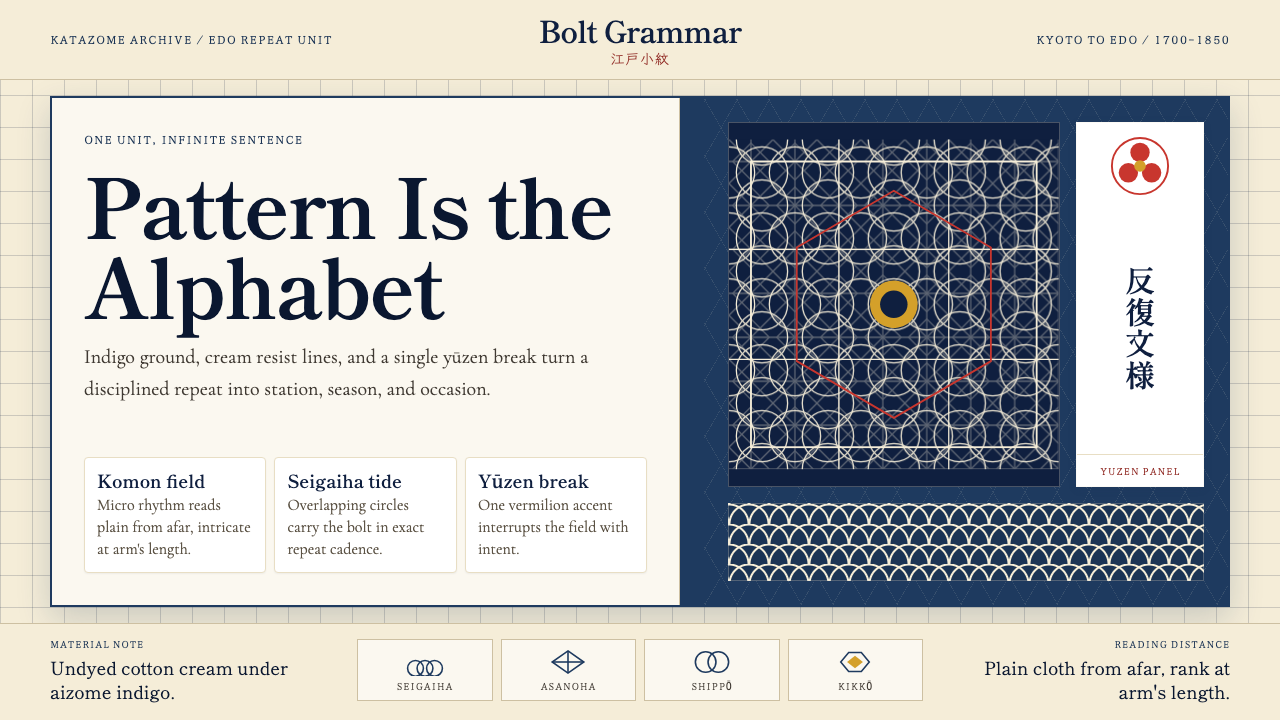 Edo Kimono TextilePattern becomes language. Indigo repeats, cream resist lines, one vermilion p…
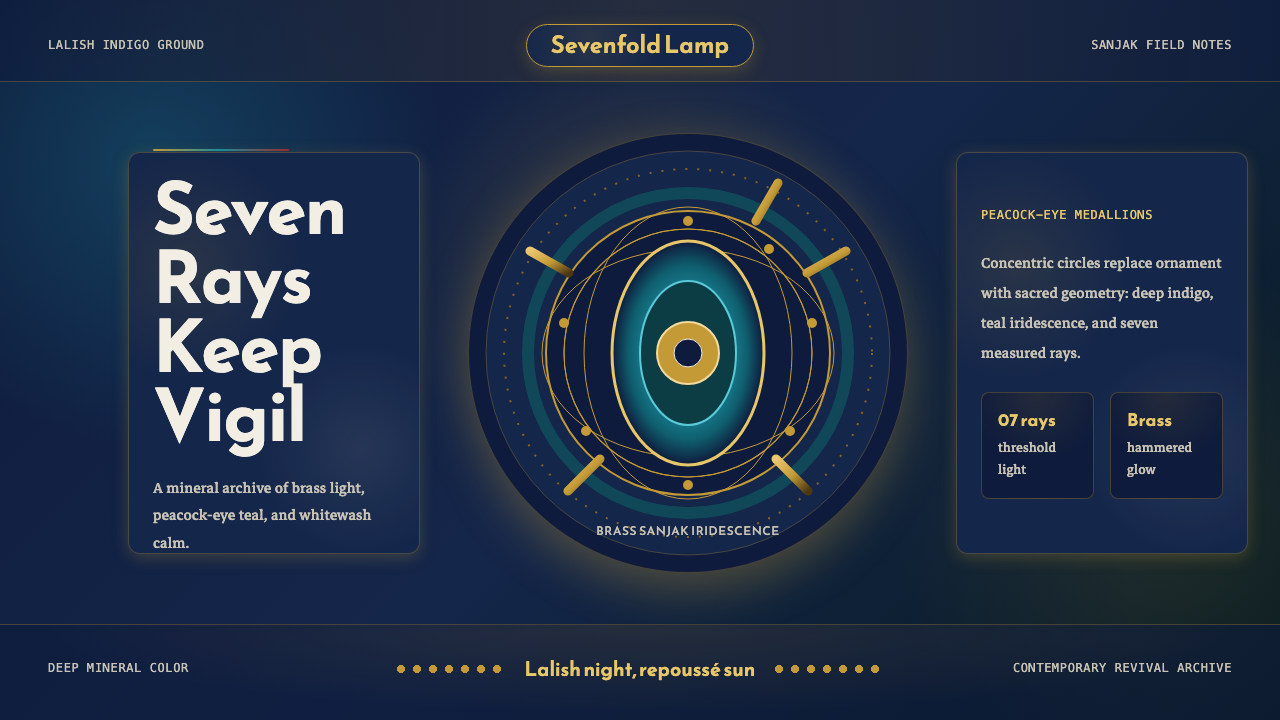 Kurdish Yazidi Peacock & SunSacred geometry glows. Lalish indigo holds brass rays and teal peacock-eye me…
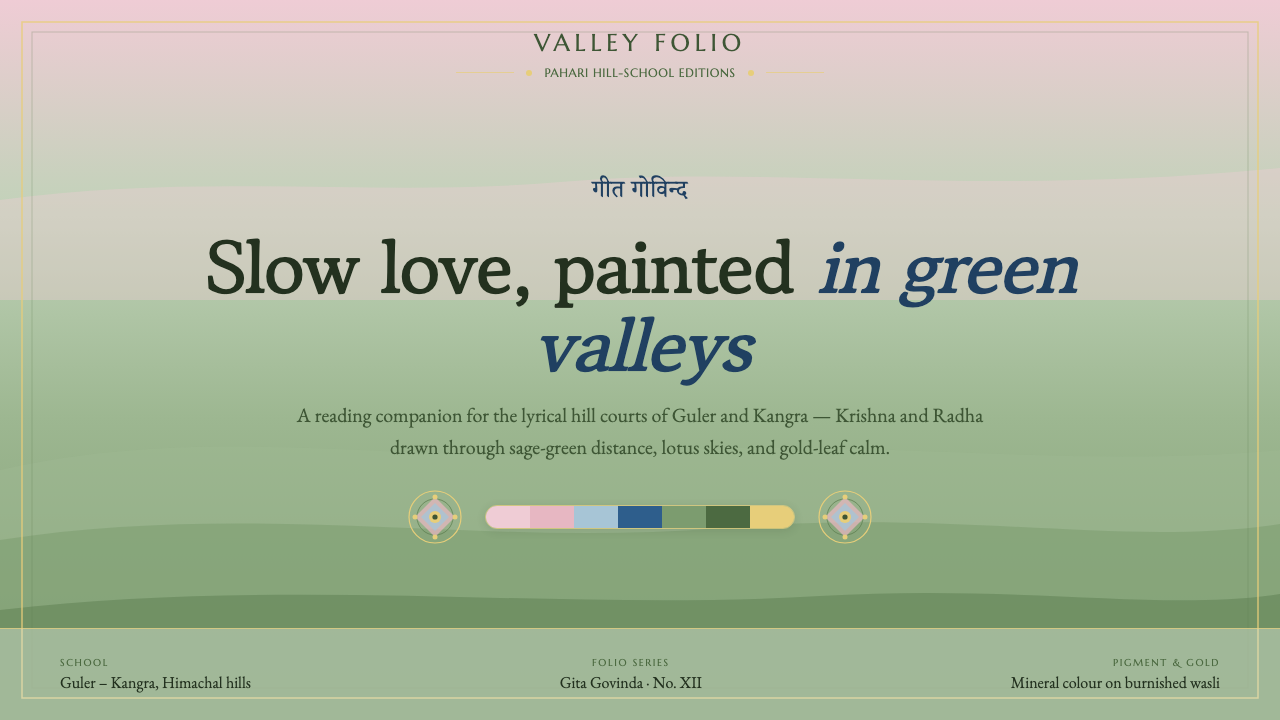 Pahari Kangra PaintingDevotional lyricism, painted slow. Sage-green hill grounds lighten to lotus-p…
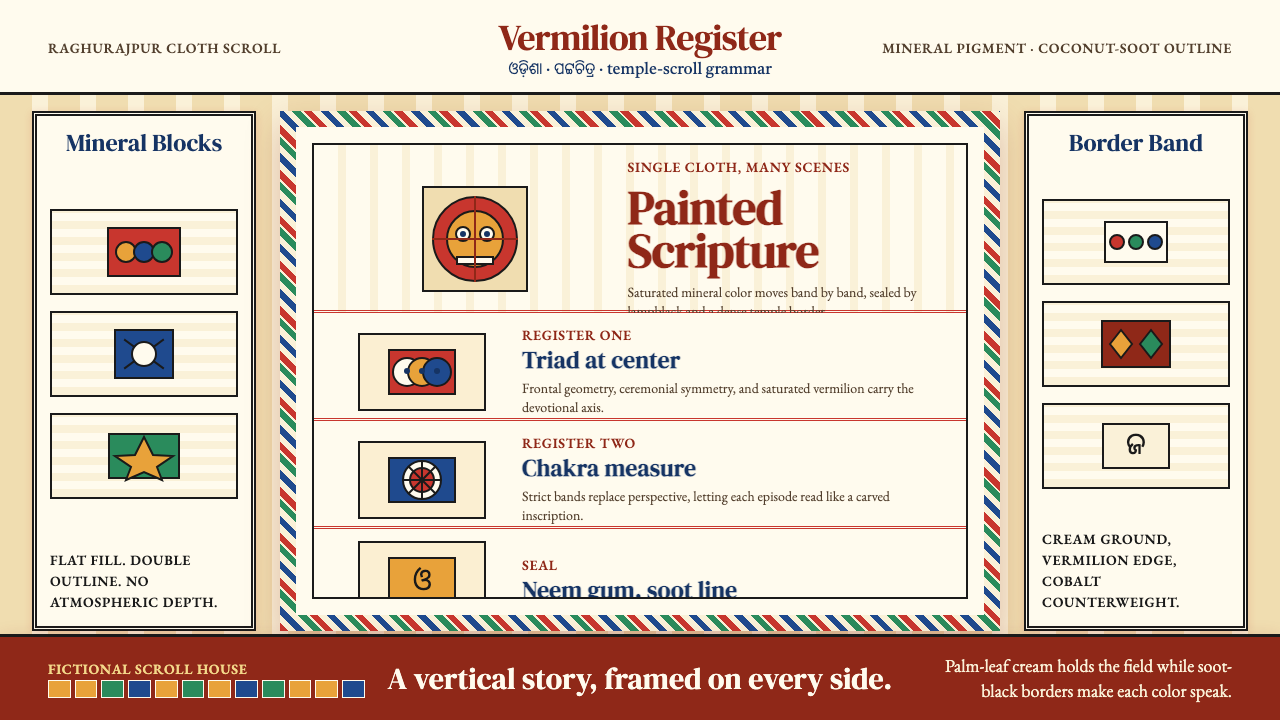 Pattachitra (Odisha Temple Scroll)Devotion as dense color. Vermilion bands and soot-black outlines stack like a…
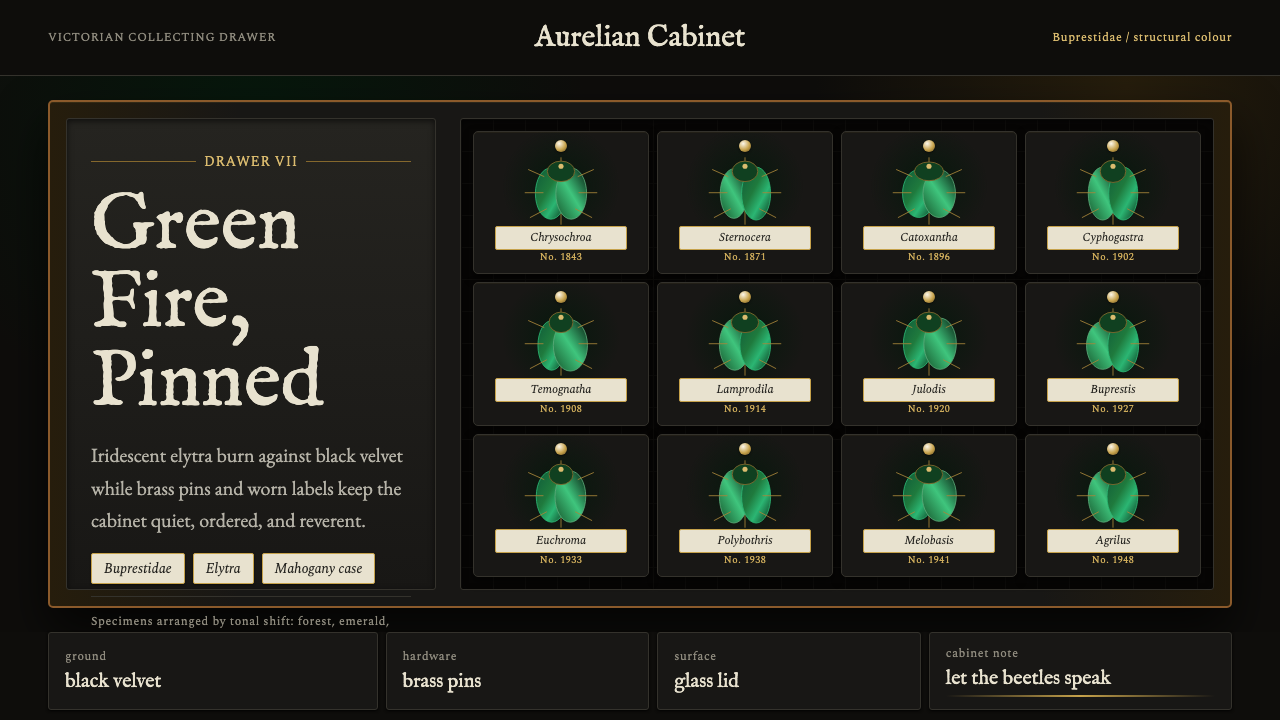 Beetle Specimen CabinetGreen burns in darkness. Emerald elytra grids glow under brass keylines and b…
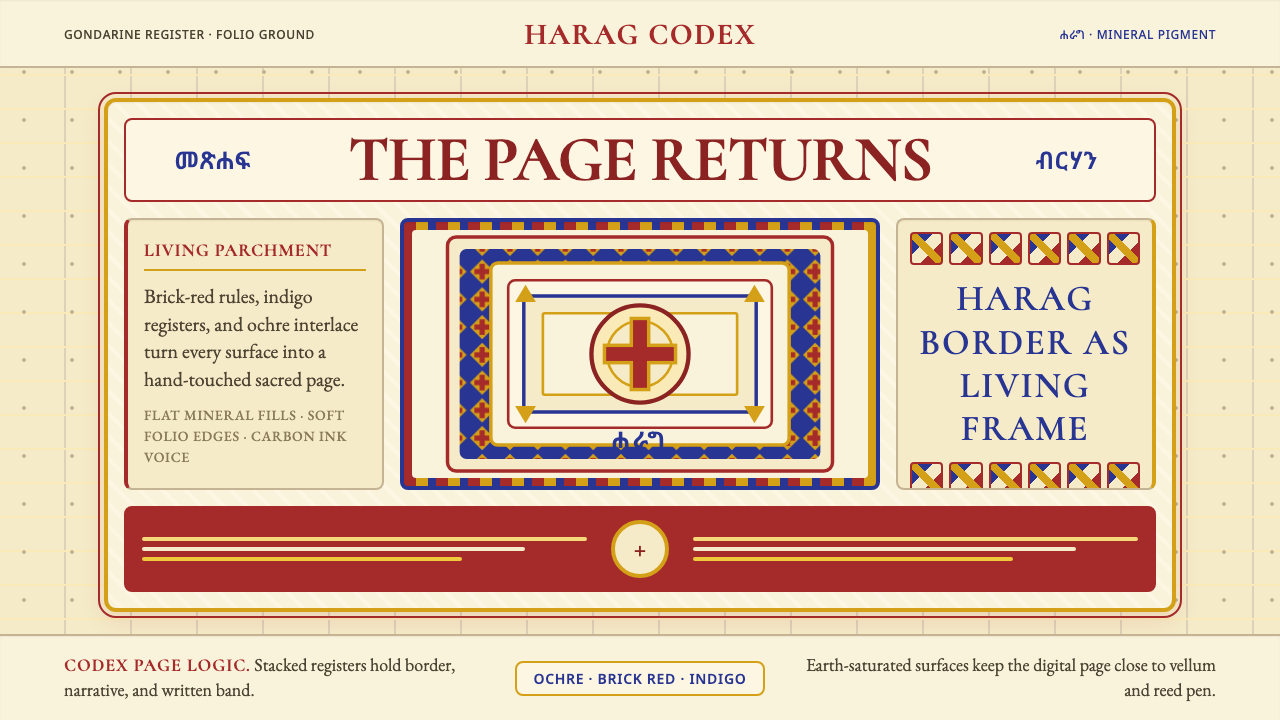 Ethiopian Orthodox ManuscriptSacred page, alive. Brick red, indigo, and ochre harag borders frame a starin…