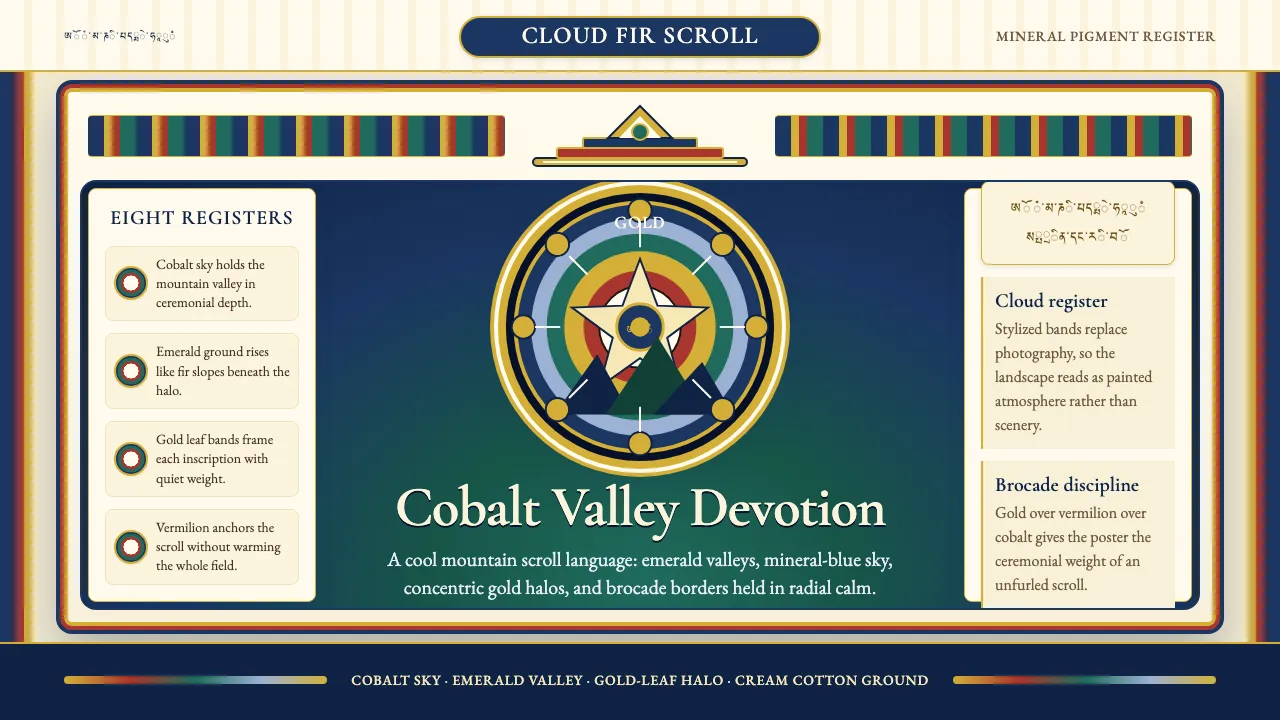
About Bhutanese Thangka (Druk Style)
Bhutanese Thangka is the Himalayan Buddhist scroll-painting tradition of the Druk-Kagyu lineage — descended from Tibetan and Newari roots but distinctly cooler, with deep cobalt skies, emerald mountain valleys, and stylized cloud-rainbow halos that reflect Bhutan's cloud-and-fir geography. The giant Thongdrol scrolls — ten by fifteen meters — unfurl once a year at Tshechu festivals before tens of thousands.
At its heart is Padmasambhava enthroned on a lotus, ringed by Eight Manifestations and consorts, framed by brocade borders and stupa-spire architecture. Gold-leaf halos burn against cobalt valleys; vermilion robes anchor the composition. Where Tibetan thangka leans warm, the Bhutanese discipline leans cool, mountain-aware, and atmospheric.
- Origin
- Bhutan (Druk Yul / Land of the Thunder Dragon), Eastern Himalaya
- Era
- 8th century onward; codified post-1616 (Zhabdrung unification); royal art school 1971–present
- Key figures
- Padmasambhava (Guru Rinpoche) · Zhabdrung Ngawang Namgyal · Asha Kama · Lopen Lhamo
- Movements
- Vajrayana Buddhist art · Druk-Kagyu codification · Tibetan-Bhutanese-Newari Himalayan painting cross-influence
Bhutanese Thangka (Druk Style) design spec
Colors
Typography
The other 11 sections — buttons, cards, spacing, motion, techniques and more — open once you unlock. Download the DESIGN.md or send it to your AI in one click. Unlock once, yours forever.
Sign up nowStyles similar to Bhutanese Thangka (Druk Style)
Also inspired by crafts & folk art, with a close feel.
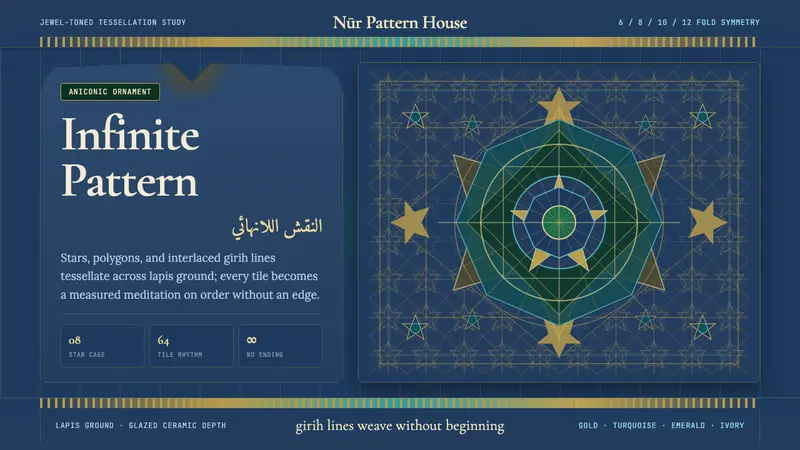 Islamic Geometric ArtInfinite order, fully tiled. Lapis ground with gold girih lines and turquoise star cells.
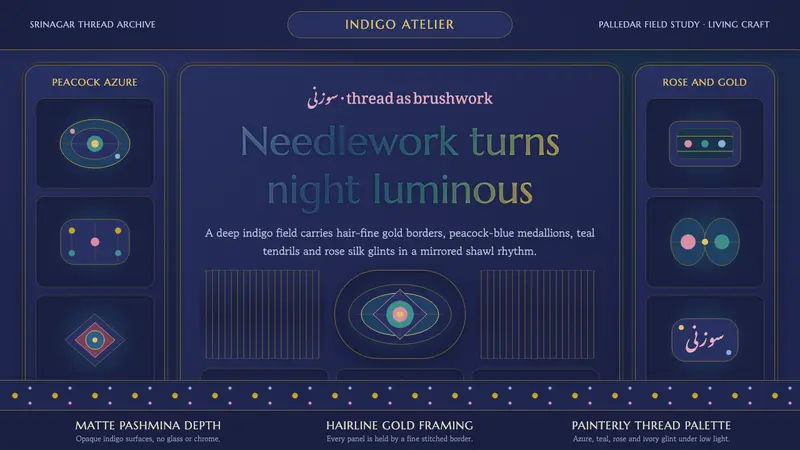 Kashmiri Sozni Shawl EmbroideryNight made luminous. Indigo ground, gold hairlines and silk medallions stitch the frame.
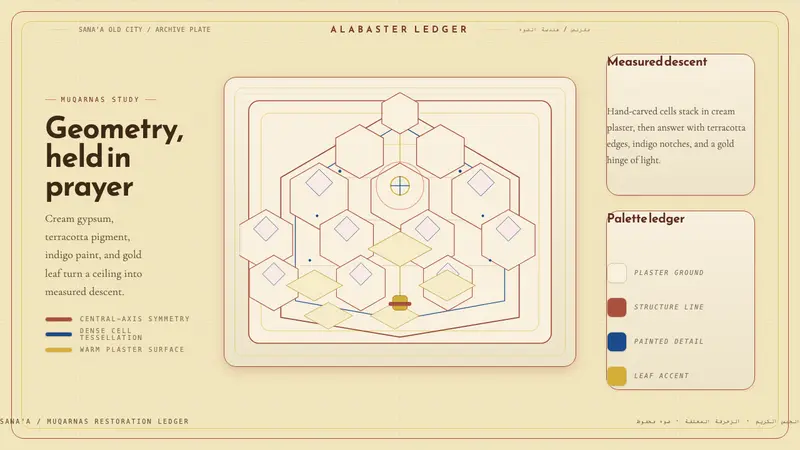 Yemeni Mukarras VaultSolemn geometry, warmed by plaster. Cream gypsum, terracotta, and indigo build the vault.
 Wodaabe Gerewol Charm FestivalRitual intensity, ornamented. Indigo ground, ochre pigment, cowrie dots, brass linework.