What is Pattachitra (Odisha Temple Scroll)?
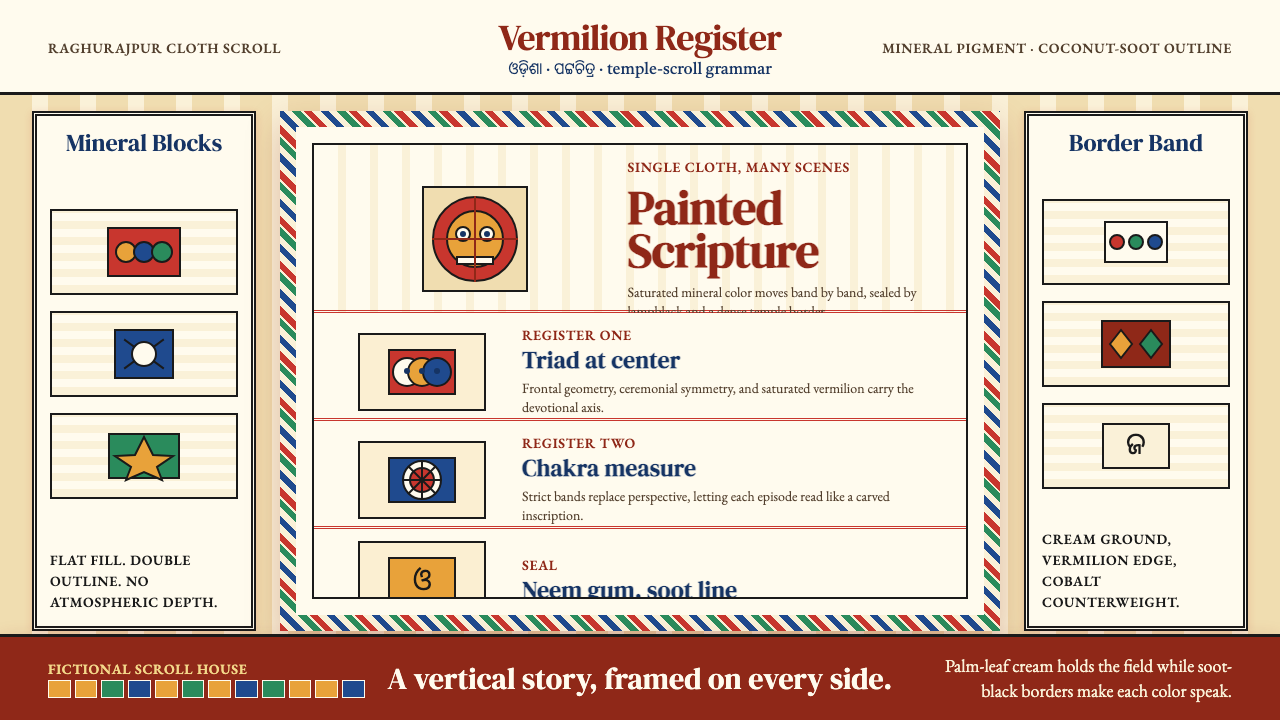
Pattachitra is a thousand-year-old Odishan temple-scroll tradition where every sacred story is told in dense mineral color, thick soot-black outlines, and an unbroken ring of flowering borders.
Pattachitra (Odisha Temple Scroll) in brief
Pattachitra — the name combines the Sanskrit words for cloth (patta) and picture (chitra) — is the sacred scroll-painting tradition of Odisha, India's eastern coastal state. Produced by hereditary chitrakar artist families in the village of Raghurajpur and the pilgrimage city of Puri, these paintings were created as portable devotional objects for worshippers who could not carry stone temple icons home. Each finished work presents a complete mythological narrative: the Jagannath triad of deities, the ten avatars of Vishnu, the childhood exploits of Krishna, or episodes from the Ramayana, rendered in flat registers stacked from top to bottom like the floors of a temple tower.
What makes the visual system immediately recognizable is the combination of two elements working in concert: the thick coconut-soot outline and the flat saturated mineral fill. Every figure — whether god, demon, devotee, elephant, or lotus — is first drawn with a bold black contour that asserts its presence against the pale ground, then filled with one of a small vocabulary of pure natural pigments: conch-white, turmeric yellow, vermilion red, indigo blue, lamp-black, or powdered stone green. No blending occurs between zones; no shadow falls across a figure's face. The result is a visual world of absolute color boundaries, where every form declares exactly what it is.
The border is inseparable from the work. A Pattachitra without its dense floral frame — concentric bands of stylized lotus buds, creepers, and petals — is structurally incomplete. The border does not decorate the edge; it seals the sacred interior against the profane outside, completing an enclosure that mirrors the carved stone borders surrounding a temple doorway. This interplay between contained narrative and enveloping ornament is the defining formal tension of the tradition.

Where does Pattachitra (Odisha Temple Scroll) come from?
The chitrakar tradition reaches back at least to the twelfth century, when the great Jagannath Temple at Puri was established under the Eastern Ganga dynasty — a lineage of rulers whose patronage of Vaishnava devotional culture shaped the religious landscape of the entire region. The painters were granted land adjacent to the temple precinct in exchange for supplying ritual paintings and decorated flags for festival processions. Their craft was therefore not folk art in the informal sense but a liturgically codified practice, regulated by temple authorities, with fixed iconographic rules for how deities could be depicted, what colors they required, and what postures they could occupy.
The golden period of the tradition ran from roughly 1200 to 1500 under successive Eastern Ganga and Suryavamsi royal courts, whose elaborate Ratha Yatra festival — in which colossal chariots carrying the Jagannath deities were pulled through the streets of Puri by tens of thousands of devotees — created enormous demand for painted ritual objects. Pattachitra panels lined chariot walls, decorated processional pavilions, and served as stand-in images for pilgrims to take home. The tradition survived later shifts in political patronage precisely because its function was embedded in a living festival cycle that continued regardless of which dynasty controlled the region.
The medium itself reflects centuries of accumulated technical knowledge. The cotton cloth support is prepared by applying a paste of tamarind seed and powdered chalk, then polishing repeatedly with a smooth stone until the surface achieves a fine off-white texture that accepts pigment without bleed. Pigments are ground from natural sources — the deep red from pure vermilion, the white from conch shell, the yellow from orpiment or turmeric, the black from coconut-shell soot — and bound with the resin of the neem tree. A final coat of lacquer, applied by holding the finished work over a flame, seals the surface and gives the colors their characteristic warm depth. No synthetic pigment enters an orthodox Pattachitra.
The twentieth century brought both threat and renewal. As temple patronage declined and mass-produced printed images displaced handmade devotional objects, many chitrakar families shifted to painting secular tourist souvenirs, adapting the visual vocabulary to greeting cards, calendar illustrations, and export-market wall hangings. The craft attracted the attention of government craft-preservation programs in the 1970s and 1980s, and Raghurajpur was eventually declared a Heritage Crafts Village by the Odisha government. This formal recognition brought training programs, direct patronage, and international exhibition opportunities — while also generating debate among practitioners about which innovations were acceptable expansions of the tradition and which represented dilutions. Today, master painters such as those from the Mahapatra and Maharana lineages continue to produce orthodox ritual works alongside contemporary adaptations, maintaining a tradition that is simultaneously ancient and alive.
What defines the Pattachitra (Odisha Temple Scroll) look?
Color Palette
The Pattachitra palette is small, saturated, and entirely mineral in origin. Vermilion red dominates structural zones and the bodies of major deities; turmeric yellow fills ornamental details and secondary figures; indigo blue reads as a cool counterweight; lamp-black provides the dominant outline and deep shadow zones; conch-white defines halos, garments, and ground areas. The palette carries devotional rather than naturalistic meaning — flesh is not skin-tone, sky is not atmospheric blue. Color identifies cosmic identity.
Outline Dominance
The thick soot-black contour line is the structural skeleton of every Pattachitra image. Applied with a brush made from squirrel hair or plant fiber, it defines each form before color is added and reasserts figure boundaries after filling. The line never thinens for distance, never softens for mood, and never disappears into the ground. Its consistent weight across the composition creates a visual equality between foreground and background figures — a deliberate theological statement that no element of the sacred scene is less important than another.
Register-Band Composition
Narrative unfolds in horizontal registers stacked vertically, like the floors of a temple tower read from the ground up. Each band contains one episode or one grouping of deities, separated from the next by a decorative stripe. There is no perspective recession, no spatial depth, no overlapping of figures that implies foreground and background in a naturalistic sense. The eye travels downward through time rather than inward through space. This compositional logic is directly borrowed from temple wall-carving practice, where narrative friezes wrap the exterior of the sanctum in exactly the same horizontal sequence.
Floral Border System
Every Pattachitra is enclosed within concentric bands of stylized floral ornament — typically alternating rows of lotus buds, scrolling creepers, and geometric petal formations. The border is not optional trim; it is a required structural element whose absence would render the painting ritually incomplete. The visual density of the border matches the density of the narrative interior, ensuring that no part of the surface is left empty. This horror vacui — the avoidance of empty space — is a consistent aesthetic principle across Odishan temple art in all media.
Frontality and Strict Pose Rules
Human and divine figures in Pattachitra appear in only two orientations: full frontal or absolute profile. The three-quarter view — standard in Western representational art since the Renaissance — does not exist in this tradition. Eyes are shown in full frontal even when the head is in profile, an approach that predates and parallels the conventions of ancient Egyptian art. This strict posing is not a technical limitation but an iconographic choice: frontality signals divine presence and direct engagement with the viewer, while profile positions figures within the narrative action.
Fixed Iconographic Vocabulary
The subjects, attributes, and symbolic objects of Pattachitra are codified in texts called Silpa Shastras and transmitted orally within chitrakar families. Jagannath, Balabhadra, and Subhadra — the three principal deities of Puri — appear in stylized oval forms unique to this tradition. The conch, discus, lotus, and mace identify Vishnu; specific flower garlands, postures, and vahana (vehicle animals) identify each avatar. A trained viewer reads these symbols as a visual language, extracting narrative meaning from combinations of attributes rather than from depicted action.
Natural Material Ethics
The insistence on natural mineral and organic pigments is both an aesthetic position and a spiritual one. Synthetic pigments, however visually similar, are not considered appropriate for ritual paintings intended as offerings. The sourcing, preparation, and application of pigments are themselves ritualized activities — stones ground, shells calcined, soot collected from sacred lamps. The cloth must be handwoven and treated by the painter's own hands. This material chain connects the finished painting to the living world of plants, shells, stones, and fire in a way that a factory-produced equivalent cannot replicate.

Who shaped Pattachitra (Odisha Temple Scroll)?
One of the most respected chitrakar masters of the twentieth century, Jagannath Mahapatra of Raghurajpur is credited with preserving orthodox Pattachitra iconographic standards during the period of greatest commercial pressure in the mid-twentieth century. He resisted simplifications demanded by the tourist souvenir market and continued to produce works in the full traditional sequence of preparation, including the cloth sizing and the layered lacquer finish. His example became a reference point when the Odisha government began formulating Heritage Crafts Village policies.
Bhaskar Mahapatra represents the generation of chitrakar artists who expanded the tradition into contemporary exhibition contexts while maintaining fidelity to the iconographic rules. His work has been exhibited internationally, introducing Pattachitra's visual system to audiences unfamiliar with the Jagannath cult iconography it encodes. He is also known for documenting the oral technical knowledge of the Raghurajpur community — particularly the pigment preparation sequences — in forms that could be transmitted outside the family lineage.
The Maharana lineage is one of the oldest continuously active chitrakar families in Raghurajpur, documented in temple records as suppliers of ritual paintings to the Jagannath Temple for many generations. The family's archive of older works — some dating to the nineteenth century — has served as the primary reference for iconographic authenticity in revival and certification programs. Several younger Maharana family members have become internationally recognized for works that apply the traditional formal vocabulary to non-mythological subjects, a controversial but influential expansion.
Not a single author but a corpus of Sanskrit canonical texts on sacred art-making, the Silpa Shastras define the proportional systems, color assignments, and iconographic attributes that govern how deities may be depicted across all Indian sacred arts including Pattachitra. For chitrakar painters, the Shastras function as a living rulebook transmitted through teacher-student apprenticeship. Their authority explains why Pattachitra iconography has remained recognizably stable across eight centuries despite the absence of any central institution enforcing it: the rules live in practitioners, not in academies.
The governmental body whose mid-twentieth-century intervention transformed Pattachitra from a declining cottage industry into a recognized national heritage. Working with master painters to document iconographic standards, establishing training programs for younger practitioners, and facilitating direct sales to collectors and institutions, the Council played a dual role: preservation apparatus and market intermediary. Its involvement is also credited with helping Raghurajpur receive its Heritage Crafts Village designation, which brought infrastructure investment and international visibility.
How do you use Pattachitra (Odisha Temple Scroll) today?
Pattachitra is among the richest of the Indian regional traditions for contemporary design application, because its visual logic is systematic rather than arbitrary: each element — outline weight, color assignment, register structure, border enclosure — plays a defined role. Applying it well requires understanding that role, not simply borrowing the surface palette. The style rewards contexts where narrative density and ceremonial richness are communicative assets rather than liabilities.
For presentation slides, Pattachitra's band-register structure translates directly into slide architecture. A cover page works best with a single iconic figure — centrally placed, fully enclosed by a border-band adapted into the slide margin, set against a warm off-white or parchment ground. The figure should be bold and outlined in dark, with flat areas of the dominant warm-red or ochre filling the majority of the composition. Content slides should use the register principle: divide the slide into two or three horizontal zones, each serving a distinct informational function (headline, body, data or callout), separated by a narrow decorative stripe rather than a line rule. Data visualization should embrace flat saturated fills — bars, segments, and nodes colored in the traditional mineral palette — with dark outlines giving each data element the same visual presence as a painted figure.
For web interfaces and dashboards, the style is well suited to contexts that benefit from ceremonial weightiness: luxury e-commerce, cultural institution websites, artisanal brand identities, or any interface where trust and heritage value are the primary signals. Apply a warm off-white as the dominant background, use the deep warm-red as the primary action color, and reserve indigo or dark tones for navigation and structural typography. Borders earn their place in this system: a card component with a visible border and a dense patterned top stripe communicates in the Pattachitra register, grounding digital elements in an aesthetic of material enclosure. Pricing pages can use tier differentiation with border-band variations — a denser ornamental band on the featured tier communicates premium status without resorting to bold color blocks alone.
For editorial and marketing work, Pattachitra's poster-like compression — many elements densely packed within an enclosing frame — translates effectively to social cards, event posters, and full-bleed section headers. A marketing hero panel that places product photography against a warm ground and frames it with a stylized floral border draws on the tradition's compositional language without replicating its sacred iconography. Editorial layouts can adapt the register structure to create strong section breaks: a full-width ornamental band between article sections signals a narrative transition while adding visual richness. The style works particularly well for cultural, travel, artisan, and wellness brands whose values align with handcraft, heritage, and careful making.
The most common mistake when applying Pattachitra is treating it as a surface texture rather than a structural system — scattering isolated lotus motifs across a layout as decoration while keeping the underlying grid and typographic logic unchanged. This produces pastiche: the ornamental vocabulary without the compositional logic that makes it coherent. A second mistake is abandoning flat color in favor of gradients and soft shadows; the mineral-pigment quality of the style depends entirely on the hard boundary between filled zones. A third is failing to observe scale proportions: Pattachitra's borders and outlines are meant to be substantial — they should read as structural, not as fine detail. Reduce them to hairlines and the style loses its presence entirely.

Pattachitra (Odisha Temple Scroll) — FAQ
Is Pattachitra only for religious or cultural contexts, or can it work in secular design?
The tradition originated as sacred temple art, but its visual system — flat saturated color, bold outline, register-band composition, dense border — is entirely separable from its iconographic content. Contemporary designers apply the formal vocabulary to secular subjects regularly: product packaging, brand identities, illustrated editorial spreads, and cultural institution identities. What must be handled thoughtfully is the use of specific sacred iconography: the Jagannath triad form, the Dashavatara sequence, and the specific deity attributes are religious symbols with active devotional significance. Borrowing the visual structure without reproducing sacred emblems is both respectful and practically sound.
How does Pattachitra compare visually to other Indian regional painting traditions?
The clearest distinguishing features are the outline weight and the border system. Madhubani painting from Bihar uses finer lines, more white space, and cross-hatched fill patterns rather than flat mineral fills. Warli painting from Maharashtra uses a white-on-red or white-on-brown palette with geometric human figures of extreme simplicity. Kalamkari from Andhra Pradesh shares the narrative register structure and the vegetable-dye palette but achieves finer detail through a pen-drawn line rather than a brush-laid contour. Pattachitra is the densest and most architecturally structured of these traditions — every centimeter of the surface is intentionally occupied, and the border-to-interior ratio is the highest.
What is the right way to handle the border in a Pattachitra-influenced digital design?
The border is not decoration — in the original tradition it is structural, sealing the composition and completing the sacred enclosure. In digital adaptation, this principle suggests that the border should be applied at compositional boundaries: around a full card component, along the header band of a section, framing a full-page hero image. It should be visible enough to read as intentional structure, not fine enough to read as a hairline rule. The ornamental density of the border can be scaled to context — a simplified two-stripe version works for small cards, while the full concentric multi-band version suits hero panels and cover images. Color should follow the mineral palette: the border is typically darker and denser than the interior, not lighter.
Can Pattachitra work with photography, or does it conflict with photographic imagery?
The original tradition contains no photography — all imagery is hand-painted and flat. In contemporary application, photography and the Pattachitra visual system can coexist when the photography is treated as a flat element rather than a naturalistic window. High-contrast cropped images on a warm ground, product photography silhouetted against parchment, or photography used inside a register band as one element of a larger composition — these all work. What conflicts is photographic imagery that depends on atmospheric depth, soft lighting, or moody gradients: the naturalism of fine photographic light directly contradicts the flat mineral quality of the Pattachitra palette. If photography must be used, err toward bold, graphic, frontal shots with simple backgrounds.
Is there a risk of cultural appropriation when using Pattachitra in commercial design?
The question is legitimate and practitioners in Raghurajpur have raised it directly. Several principles help navigate it responsibly. First, distinguish between formal vocabulary and sacred iconography: using the register-band structure, the flat mineral palette, and the border system in an abstract or secular context is aesthetic borrowing; reproducing the Jagannath triad forms or specific deity attributes in a commercial context is a more sensitive matter. Second, attribution matters: acknowledging the Odishan chitrakar tradition by name in any published design context is basic intellectual honesty and signals awareness. Third, consider sourcing: when a project's budget allows, commissioning work from actual chitrakar artists — rather than generating approximate digital simulations — supports the living tradition and its practitioners directly.
Related design styles
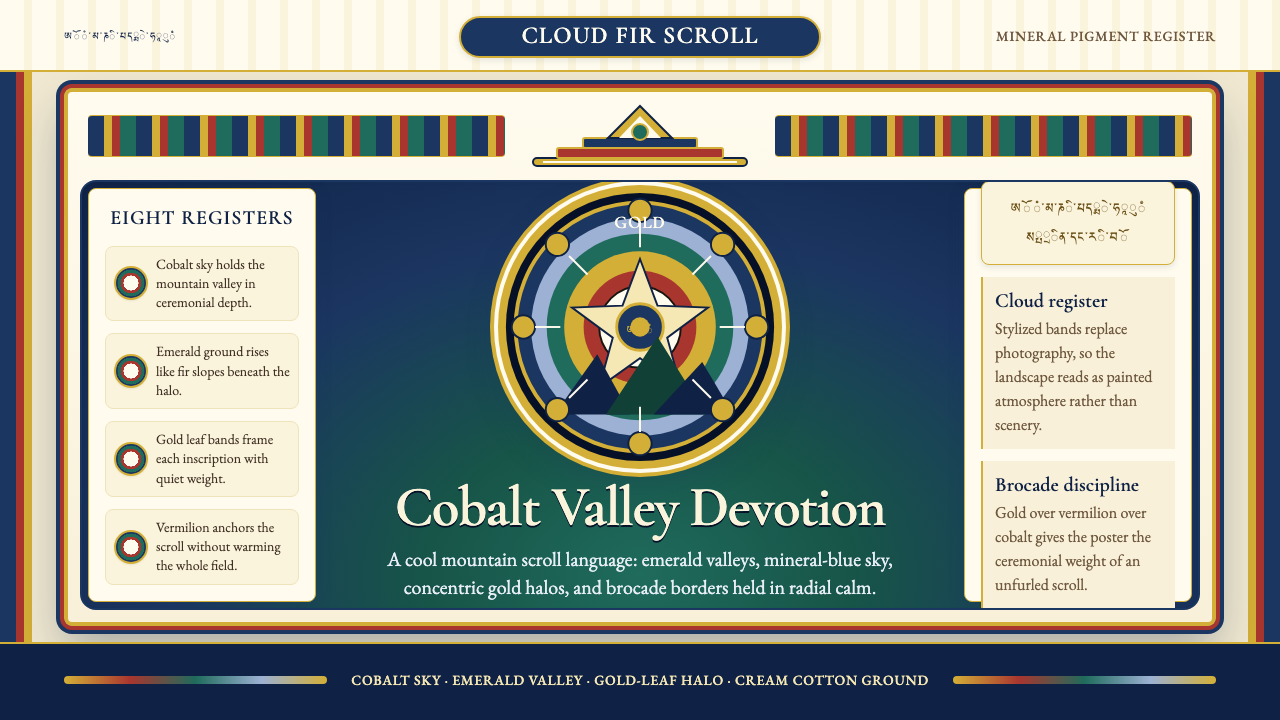 Bhutanese Thangka (Druk Style)Sacred cool-mountain clarity. Cobalt fields, emerald ground, and gold halos f…
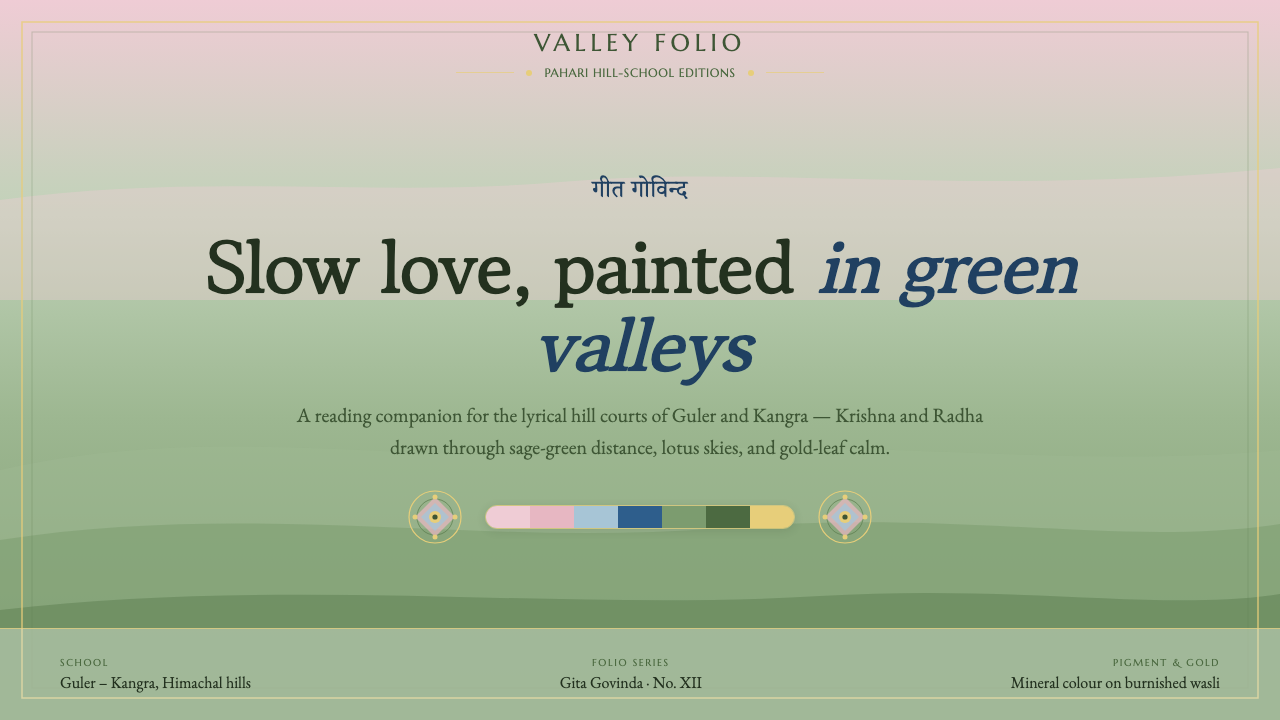 Pahari Kangra PaintingDevotional lyricism, painted slow. Sage-green hill grounds lighten to lotus-p…
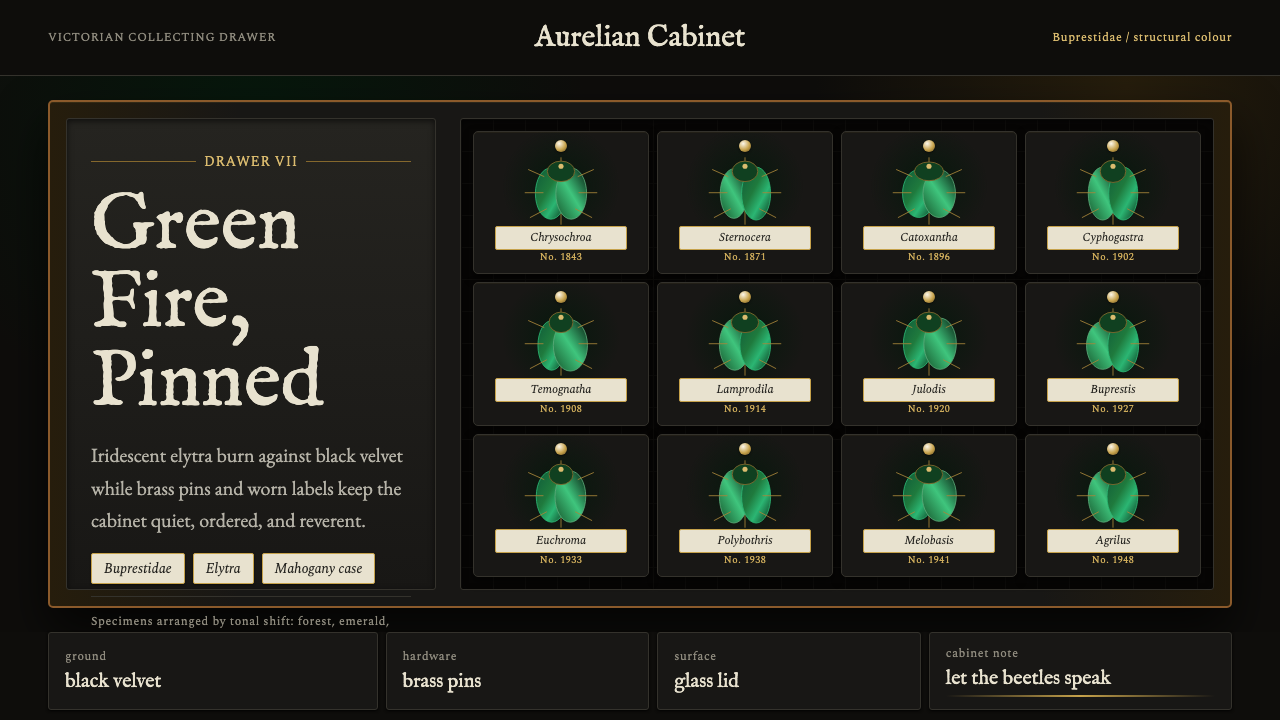 Beetle Specimen CabinetGreen burns in darkness. Emerald elytra grids glow under brass keylines and b…
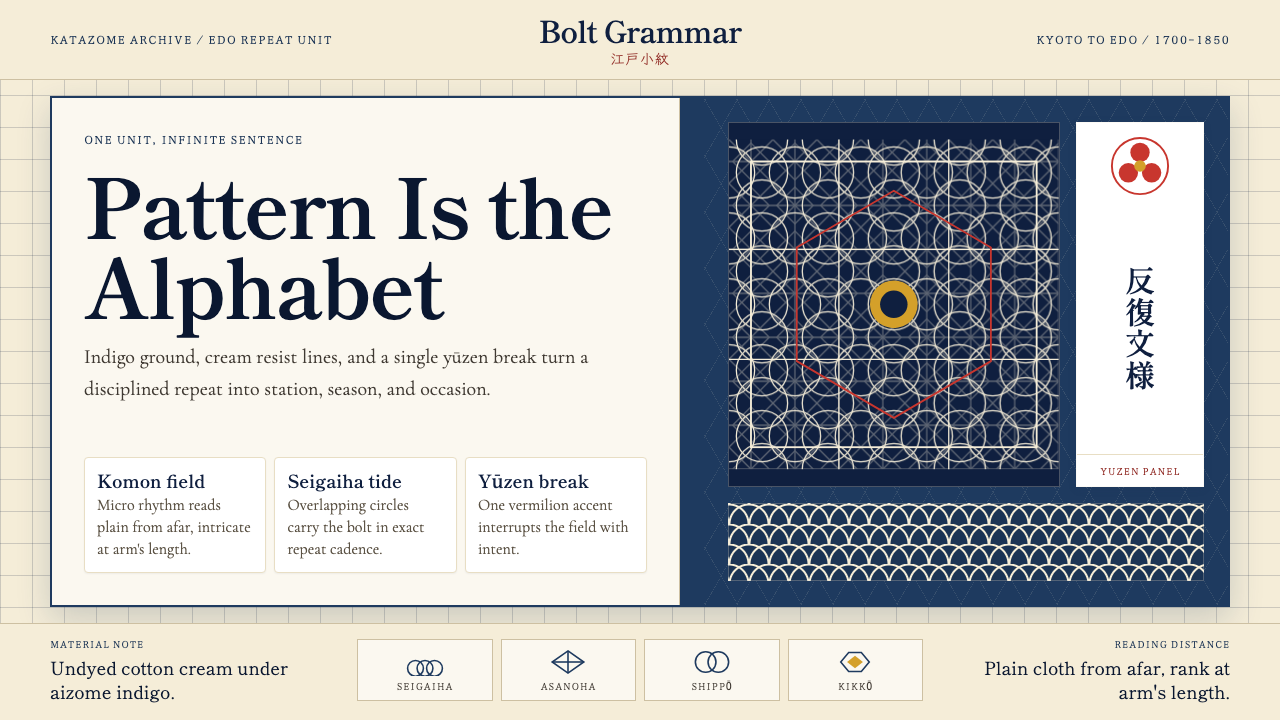 Edo Kimono TextilePattern becomes language. Indigo repeats, cream resist lines, one vermilion p…
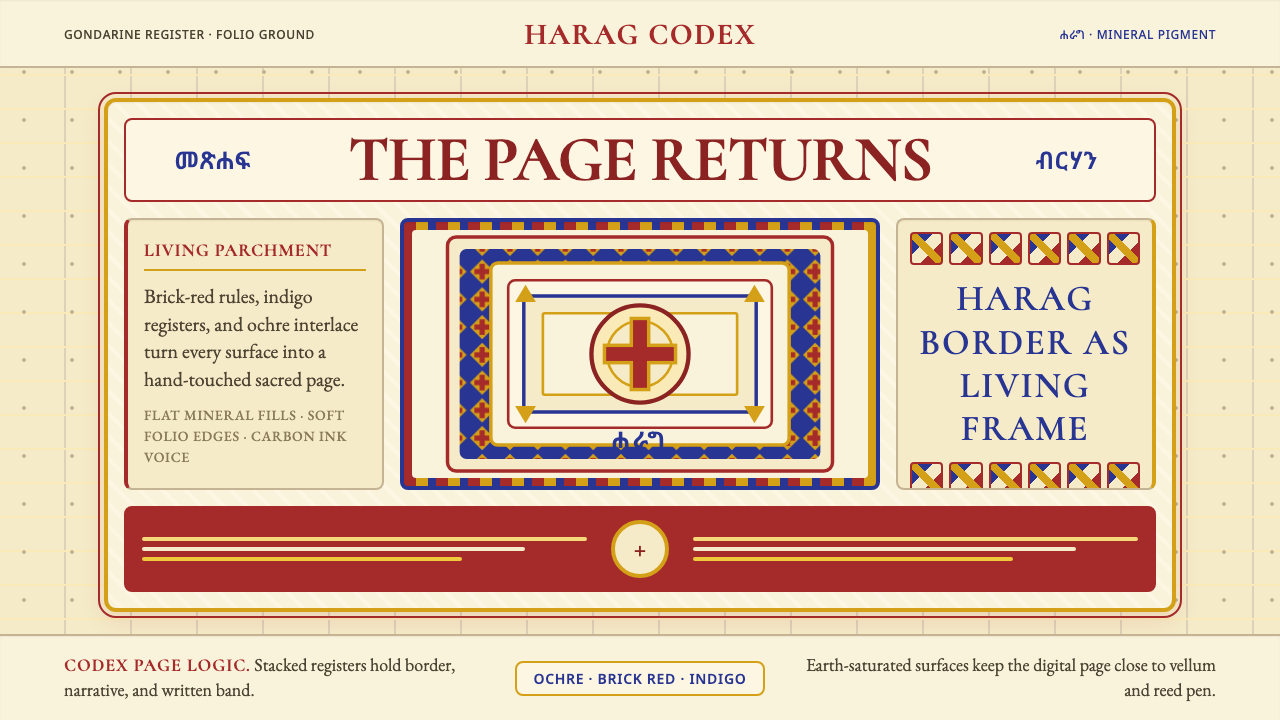 Ethiopian Orthodox ManuscriptSacred page, alive. Brick red, indigo, and ochre harag borders frame a starin…
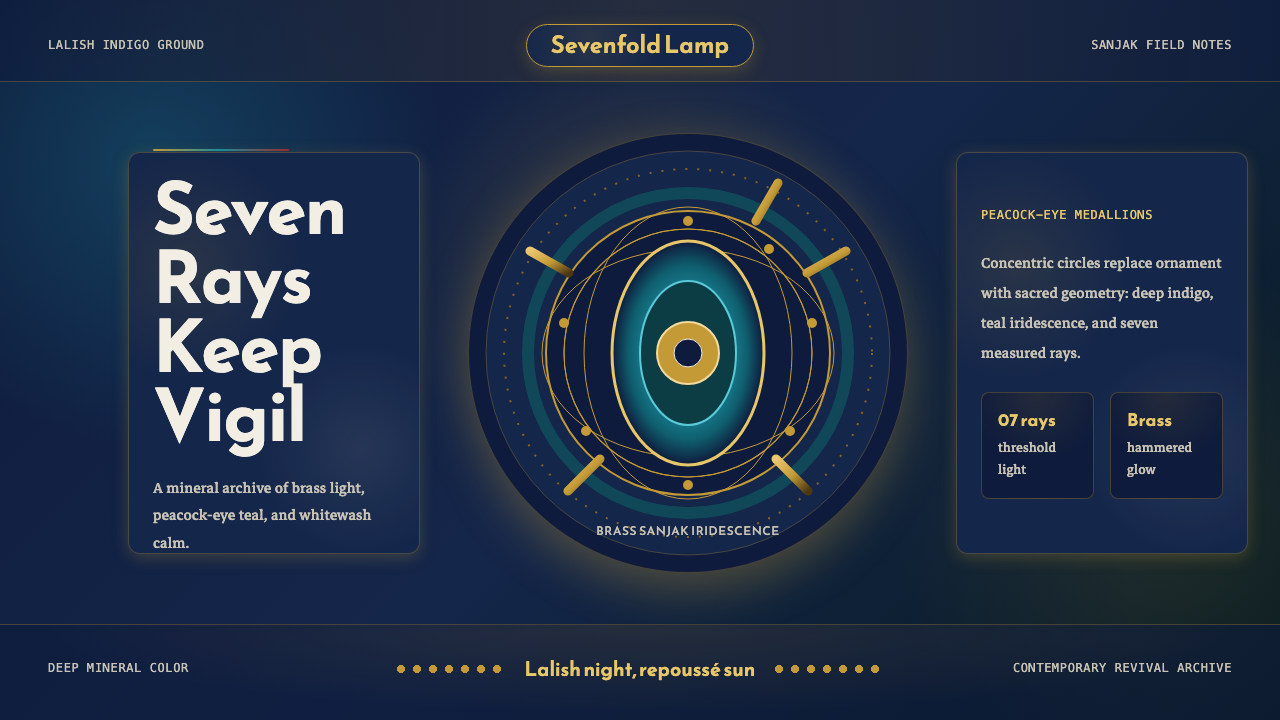 Kurdish Yazidi Peacock & SunSacred geometry glows. Lalish indigo holds brass rays and teal peacock-eye me…