What is Edo Kimono Textile?
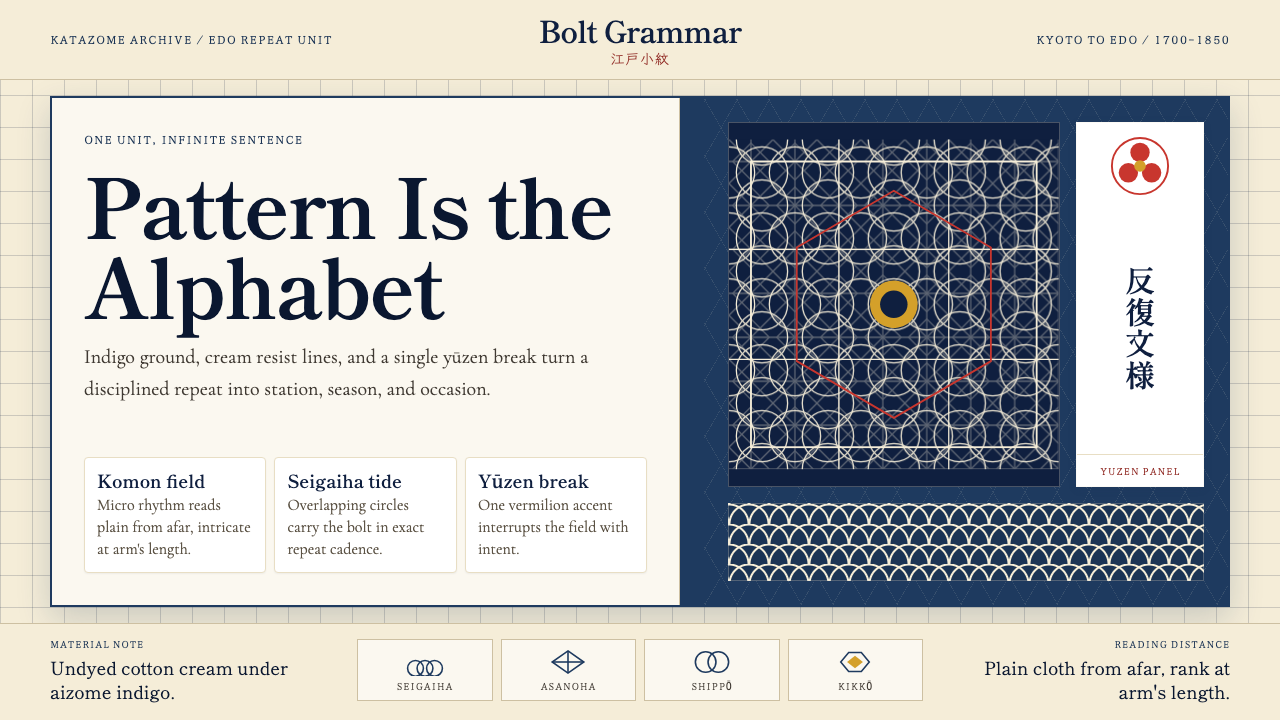
For two and a half centuries, Edo craftsmen turned cloth into a social language — a single repeating motif able to announce season, rank, and occasion at a glance.
Edo Kimono Textile in brief
Edo Kimono Textile is Japan's most disciplined system of repeating-pattern design, developed across the Edo period from 1603 to 1868 and reaching its commercial peak between roughly 1700 and 1850. It encompasses komon stipple dyeing, edomon micro-pattern stencilling, yūzen resist-paste brushwork, and katazome stencil-resist technique — four distinct crafts that share a single formal ambition: to transform a length of silk or cotton into a visual vocabulary that every social class could read without instruction.
The aesthetic core is what Japanese dyers called the 'single unit tiled to infinity.' A pattern cell — perhaps an interlocking tortoiseshell, a hemp-leaf hexagonal lattice, a wave-crest seigaiha, or a seven-treasure shippo circle — is engineered at a precise scale, then repeated with mathematical regularity across the full width and length of the cloth. The ground is typically an indigo field or a chalk-white resist field; within this ground, motif and counter-motif lock together like a woven argument. A single accent panel — a yūzen-painted band of autumn grasses or blossoming plum — breaks the repeat at a calculated position, turning the whole garment into a studied contrast between rule and exception.
As a design system, Edo Kimono Textile is not primarily about naturalistic depiction. Cranes, pine, and chrysanthemum appear everywhere, but they are almost always distilled to their geometric essence — a crane becomes a dynamic diagonal; a pine needle becomes a radiating cluster of lines; a chrysanthemum becomes a concentric ring of petals resolved to near-perfect radial symmetry. The tradition teaches that beauty lies not in resemblance but in structural clarity, rhythmic recurrence, and the disciplined restraint of a palette that speaks loudly by speaking sparingly.

Where does Edo Kimono Textile come from?
The Edo period began in 1603 when Tokugawa Ieyasu unified Japan under a military government based in Edo — the city that would later be renamed Tokyo. The Tokugawa shogunate enforced a rigid four-tier social hierarchy: samurai, farmers, artisans, and merchants. Sumptuary laws, issued and periodically renewed throughout the period, prohibited commoners from wearing silk garments decorated with gold thread or elaborate figurative embroidery. These restrictions had an unintended aesthetic consequence: urban merchants and artisans, barred from ostentatious display, channeled competitive energy into subtlety. The most desirable textiles became those whose sophistication was legible only to the initiated — pattern so fine it appeared solid from a distance, dye work so precise it looked printed.
The technical traditions that fed this aesthetic came from Kyoto, the imperial capital and center of elite weaving since the Heian period. Kyoto's Nishijin district had produced luxury figured silks for the court and aristocracy for centuries. But in the seventeenth century a new technique emerged from a Kyoto fan-painter named Miyazaki Yūzensai, whose application of rice-paste resist to silk and subsequent multi-step dyeing process — named yūzen in his honor — made complex polychrome pictorial designs achievable on a previously impossible scale. Yūzen enabled the painted flora, birds, and landscapes that became the signature of Kyoto's export kimono market, and its techniques were refined and regionalized over the following century into distinct schools in Kyoto, Kanazawa (Kaga yūzen), and later Edo itself.
In Edo, the dominant aesthetic ran in a different direction. The city's chōnin townsman culture — prosperous, sardonic, and proud of its independence from Kyoto court refinement — preferred a kind of restrained wit. The ideal was iki: a sophisticated understatement, a cool elegance that disdained obvious luxury. This sensibility produced komon, 'small pattern': an all-over stippled stencil design in which a single motif, sometimes no larger than a grain of rice, was repeated across the entire cloth in a monochromatic indigo-on-white or white-on-indigo scheme. Komon required extraordinary technical precision from the Ise katagami stencil-cutters, the Iwai family and their contemporaries, who developed paper stencils of such intricacy that hundreds of repeats could be applied with no visible seam.
By the mid-Edo period, the grammar of these pattern systems had become a shared cultural code. Certain motifs were season-locked: pine and crane for winter and longevity, cherry blossom for spring's brief perfection, autumn maple for transience. Others signified class aspiration or guild affiliation. The Rinpa school, founded by painters Hon'ami Kōetsu and Tawaraya Sōtatsu in the early seventeenth century and later codified by Ogata Kōrin, translated this pattern grammar into bold, decorative compositions for lacquerware, screens, and textiles that fused classical literary reference with vivid graphic clarity. Kōrin's compositions — fan shapes, water irises, autumn maples rendered in flat gold and color — crossed freely between textile design and the fine arts, establishing a visual language that survives in Japanese design to the present day.
What defines the Edo Kimono Textile look?
Color Philosophy
The Edo palette operates on disciplined restraint: a dominant indigo ground, a white or cream resist field, and one carefully placed accent drawn from vermilion, ochre, or gold. The system is almost never polychromatic at full saturation across the whole cloth; instead, a narrow range of tones in the ground color is punctuated by a single warm counter-note. This economy makes the accent extraordinarily powerful — a small vermilion panel or a thread of gold reads as a decisive statement precisely because it is surrounded by measured sobriety.
Repeating Pattern Grammar
The defining structural feature is the mathematically tiled repeat unit. Traditional motifs — hemp-leaf麻の葉 lattice, tortoiseshell龟甲, seigaiha wave-crest, shippo seven-treasure circles, ichimatsu checkerboard — are each built on geometric grids that interlock without visible seam across any length of cloth. The repeat unit is sized so that it reads clearly both at arm's length and in the aggregate as a tonal field. This dual legibility — pattern up close, texture from afar — is the system's central aesthetic achievement.
Resist and Stencil Technique
The visual character of Edo textile patterns is inseparable from the physical processes that created them. Katazome stencil resist produces motifs with a distinctive clean edge and a subtle handmade imprecision that no mechanical process exactly replicates. Yūzen resist-paste work creates gradients of extraordinary delicacy — color bleeding at the edge of a resist line in a way that appears natural and intended. The apparent precision of komon micro-patterns belies the extraordinary human skill required to cut the stencils and apply them without slippage.
Motif as Social Code
In Edo textile culture, every motif carried meaning that the contemporary viewer could decode. Crane and pine signaled longevity and fidelity; cherry blossom named spring and impermanence; paulownia marked imperial rank; ichimatsu checkerboard became associated with a celebrated kabuki actor and was subsequently adopted as a fashion statement by Edo townspeople. Selecting a pattern was not merely an aesthetic decision but a statement about season, occasion, aspiration, and social position — a vocabulary as legible as written language to anyone who had grown up inside the culture.
The Accent Break
A kimono composed entirely of one repeating pattern would be admirable but static. The tradition developed a compositional counterpoint: the bold accent panel, placed at the hem, collar, or sleeve, that interrupts the field with a contrasting technique or motif. Typically rendered in yūzen brushwork against a resist-dyed ground, this accent panel concentrates the garment's narrative — a burst of seasonal flowers, a water scene, a classical poetic reference. The contrast between the disciplined repeat and the expressive accent is the garment's primary visual argument, and it is this tension that contemporary design applications most productively borrow.
Scale Modulation
Edo pattern masters understood that the same motif at different scales produces entirely different effects. A hemp-leaf lattice at large scale reads as bold geometry; the same lattice reduced to near-invisible becomes an all-over texture that enriches the ground without competing with it. This deliberate modulation of scale — choosing the repeat size to govern whether the viewer sees pattern or field — is one of the tradition's most transferable formal insights. In contemporary layout and interface design, the principle maps directly onto the question of when to use pattern as foreground versus when to use it as background texture.
Geometric Naturalism
Edo textile design occupies a precise middle ground between pure abstraction and representational naturalism. A seigaiha wave is unmistakably oceanic yet composed of arcs and quarter-circles. A chrysanthemum head is recognizable as a flower yet resolved into concentric rings of equal petals — a near-mandala. This fusion of geometric order with natural reference produces motifs that carry associative meaning (season, region, mythology) while remaining formally disciplined enough to tile seamlessly and to reproduce faithfully at any scale. It is an aesthetic position that neither pure geometric abstraction nor literal naturalism can achieve.

Who shaped Edo Kimono Textile?
A Kyoto fan-painter active in the late seventeenth century, Miyazaki Yūzensai is credited with developing or significantly refining the yūzen dyeing method — a process using rice-paste resist that enabled complex, polychromatic pictorial designs on silk. Before yūzen, elaborate multi-color figuration on silk required weaving or embroidery; Yūzensai's technique opened a new register of expression for flat-dyed cloth. The style named after him became the prestige technique of Kyoto's kimono market and remains one of Japan's most recognized textile arts.
Ogata Kōrin (1658–1716) was the painter and designer who consolidated the Rinpa school's visual language into a form that could migrate freely between fine art, lacquerware, ceramics, and textile design. His compositions — irises, plum blossoms, and autumn maples rendered in bold flat areas of gold, silver, and pure color — established the principle that decorative art and fine art occupied a single continuum. Kōrin's work demonstrated that the repeating-pattern grammar of Japanese textile could support compositions of high artistic seriousness, and his influence on subsequent generations of kimono designers was profound.
The Iwai family, based in the Ise region of central Japan, were among the foremost practitioners of katagami — the art of cutting paper stencils for textile dyeing. Ise katagami stencils were produced from sheets of persimmon-tannin-treated mulberry paper, sometimes laminated in multiple layers for durability, and cut with blades of extraordinary precision. The Iwai family's stencils enabled the komon micro-patterns that defined Edo townsman aesthetics: motifs so small and regular that the resulting cloth appeared monochrome at a distance, revealing its pattern only to the eye held close. Their craft tradition represents the technical foundation without which the komon aesthetic could not have existed.
Hon'ami Kōetsu (1558–1637) was a calligrapher, potter, lacquerware designer, and cultural figure who, together with the painter Tawaraya Sōtatsu, founded the Rinpa artistic tradition. Kōetsu's synthesis of classical Japanese literary culture with bold, decorative visual form established a model for how refined aesthetic thinking could operate across multiple material domains simultaneously. His community at Takagamine, outside Kyoto, became a crucible for the cross-disciplinary aesthetic that would eventually reach textiles through Ogata Kōrin and persist as one of Japan's most recognizable design lineages.
Tawaraya Sōtatsu (active early seventeenth century) was the painter whose collaboration with Hon'ami Kōetsu initiated the Rinpa school. His paintings on gold-leaf screens — crashing waves, deer in autumn fields, wind gods and thunder gods — translated the decorative potential of Japanese textile pattern into monumental pictorial form. Sōtatsu's technique of tarashikomi, flooding wet color into wet color to produce soft blooming edges, became a signature Rinpa effect that appeared on textiles as well as paintings. His work established that the boundary between pattern design and fine-art painting was, in Japanese aesthetics, essentially permeable.
How do you use Edo Kimono Textile today?
Edo Kimono Textile is among the most structurally sophisticated pattern systems available to contemporary designers, and applying it well requires understanding what makes it work: the discipline of a restrained palette anchored by deep indigo or near-black, the visual intelligence of a geometrically precise repeat unit, and the compositional boldness of a single accent break that gives the entire field a narrative direction. The system rewards those who engage with its logic rather than sampling its surface.
For presentation slides, the style offers genuine versatility across both cover and content pages. A cover built on this aesthetic uses a dense, seamless micro-pattern as the dominant background field — small enough to read as a rich texture rather than a competing graphic — with the title sitting in a clean, generously sized typeface against a solid indigo or cream ground panel that anchors one side of the composition. Content slides adopt the principle of the accent break: a primary field of restrained pattern or flat color is interrupted by a single bold element — a large data figure, a chapter heading, an illustrative motif — placed with deliberate asymmetry. Data visualization works well when bars and segments are colored according to the indigo-and-accent logic: a dominant cool ground tone, a single warm accent marking the key data point.
For web interfaces, the style translates most naturally into dashboards, pricing tiers, and editorial surfaces where layered information hierarchy is essential. The approach is to use the ground pattern at low opacity as a background texture on card surfaces or section dividers — present but not dominating — while reserving the saturated indigo and accent warmth for interactive states, category labels, and calls to action. Navigation and structural chrome should feel quiet and grid-anchored; the pattern energy lives in the content layer, not in chrome. Pricing-tier differentiation maps well onto the palette's accent logic: the majority tier takes the indigo ground, the featured tier takes the warm accent.
For editorial and marketing work, the tradition's poster-like quality — high contrast between a patterned field and a plain ground, strong geometric containment of type — makes it effective for feature covers, campaign headers, and brand identity applications that want to signal cultural depth alongside visual authority. A marketing page built in this register alternates between heavy indigo sections with cream type and cream sections with indigo type, using the accent color exclusively for primary calls to action. The micro-pattern appears as a textile-like section background at reduced opacity, never at full saturation where it would compete with text legibility. Social cards work well with a single dominant repeat-pattern field cropped tight, a white panel cut across it at an angle, and the headline set in strong, simple type.
A common mistake when applying this style is treating the palette's warmth as permission to introduce multiple accent colors simultaneously. Authentic Edo textile aesthetics gain their power from chromatic economy: the moment you introduce a second warm accent — say, both a vermilion and a gold — the system loses its internal hierarchy and starts to read as merely decorative rather than structurally intentional. Similarly, enlarging the repeat unit to make the pattern more obvious undermines the dual-legibility principle: the motif should reward close inspection but dissolve into texture at reading distance. Finally, pairing this system with highly naturalistic photography or illustration creates a category mismatch — the tradition's strength is geometric restraint, and imagery that imports too much visual noise from the physical world works against it.

Edo Kimono Textile — FAQ
How is Edo Kimono Textile different from other Japanese pattern traditions?
The key distinction is the combination of mathematical pattern discipline with a highly restricted palette and a defined accent-break compositional logic. Other Japanese textile traditions — Okinawan bingata, Kyoto Nishijin weaving, aizome solid-indigo dyeing — each have their own aesthetic laws, but none so directly encodes the social grammar of the Edo period's townsman culture. Bingata is polychromatic and South Asian in temperament; Nishijin weaving is technically complex but typically figurative and aristocratic in reference; aizome is monochromatic but without the sophisticated repeat-unit engineering. Edo textile is specifically the system built for a prosperous urban middle class that had to be subtle about it.
Can this style work in digital interfaces that need to feel light and modern?
Yes, with deliberate adaptation. The key is to use the micro-pattern at very low opacity on a near-white ground, so that the textile reference reads as surface richness rather than visual weight. The dominant ground color in this adaptation should be cream or pale warm white rather than full indigo — reserving the deep indigo for accent bars, icons, or selected-state indicators. The accent color (vermilion, gold, or a warm rust) appears sparingly, as it would in a formal komon kimono. This low-density version of the system retains the cultural specificity and the repeat-pattern intelligence while shedding the heaviness that a fully saturated indigo field would impose on a screen context.
Is this style appropriate for Western audiences or does it read as overly specific to Japanese culture?
The style carries clear Japanese cultural reference, and that specificity is one of its strengths — it is not a generic 'Asian-influenced' pastiche but a coherent system with a documented history and a defined visual logic. For Western audiences, the question is whether the product or communication benefits from that specificity. Brands in fashion, hospitality, food, wellness, and cultural institutions frequently find that the system's cultural clarity is an asset rather than a barrier, because it signals genuine engagement with a tradition rather than superficial borrowing. Where the cultural reference feels misaligned with the product's core identity, the safer application is to use the structural principles — repeat-unit discipline, accent-break composition, restrained palette — while keeping the specific traditional motifs secondary.
How should the pattern repeat be scaled when used in digital or print layouts?
Scale is one of the most consequential decisions when applying Edo textile patterns to contemporary layouts. At small scale — where the individual repeat unit is barely distinguishable at normal viewing distance — the pattern functions as a rich background texture that adds depth without competing with foreground content. At medium scale — where the repeat unit is clearly visible but still tight — it operates as an active graphic element that gives the layout rhythm and visual interest. At large scale — where only one or two repeat units fit within a design element — the pattern risks reading as clumsy or decorative in the wrong sense. In most digital contexts, erring toward smaller repeat units preserves the dual-legibility logic that made the original textile tradition so elegant: texture from afar, pattern up close.
What is the difference between komon, yūzen, and katazome, and does it matter which one a designer references?
The three techniques produce visually distinct results that carry different aesthetic implications. Komon is characterized by all-over micro-pattern in a monochromatic or near-monochromatic scheme — it is the most disciplined and restrained of the three, and referencing it suggests an aesthetic of subtle complexity and understated elegance. Yūzen is characterized by polychromatic brushwork with soft resist-dyed edges, often depicting naturalistic or semi-naturalistic subject matter — it is more expressive and painterly, and referencing it opens the palette toward more varied, illustrative applications. Katazome is a stencil-resist technique that produces clean-edged, repeating pattern in a limited palette — it sits between komon and yūzen in terms of visual complexity and color range. For most contemporary design applications, komon and katazome are the most structurally useful references because their mathematical regularity and chromatic restraint translate most directly into repeatable layout and interface patterns.
Related design styles
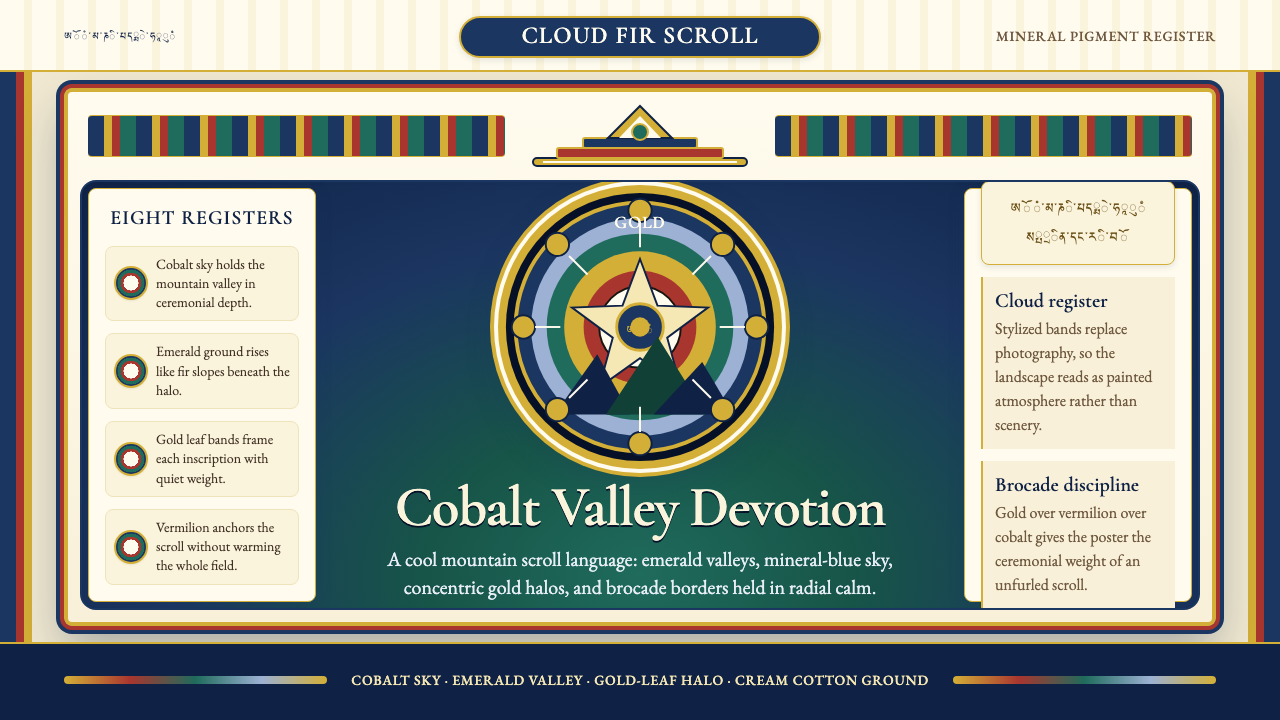 Bhutanese Thangka (Druk Style)Sacred cool-mountain clarity. Cobalt fields, emerald ground, and gold halos f…
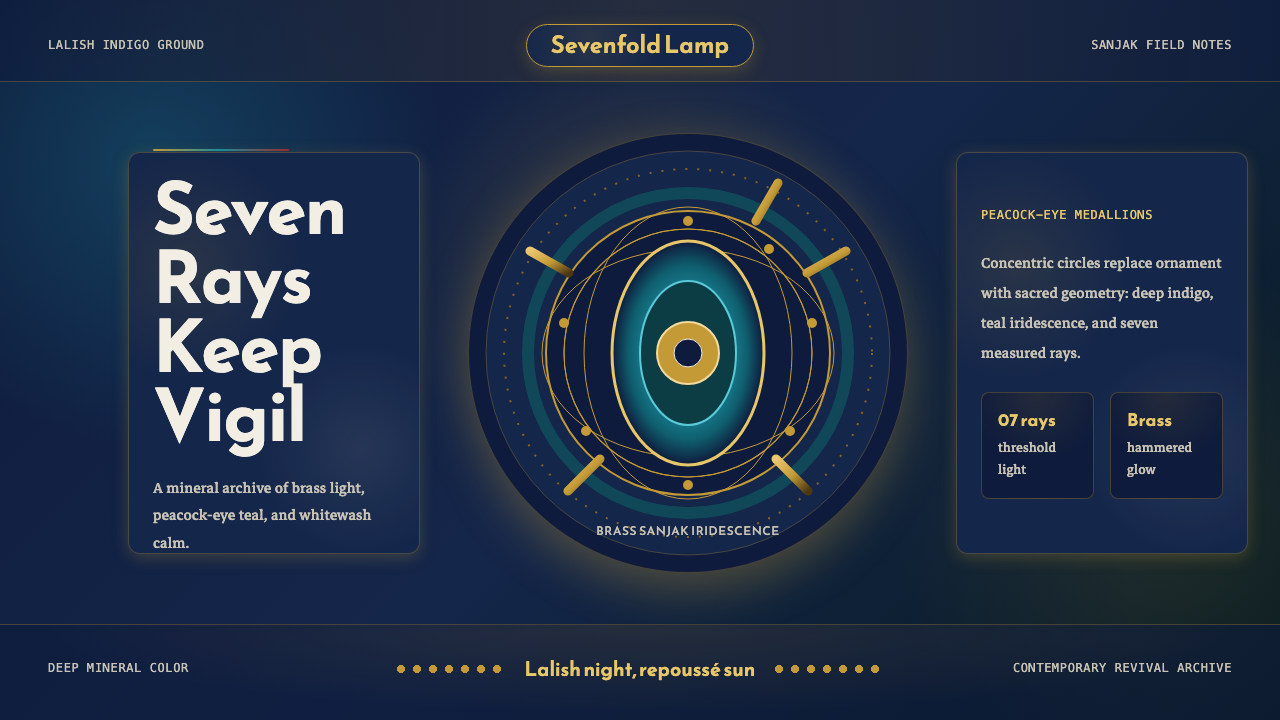 Kurdish Yazidi Peacock & SunSacred geometry glows. Lalish indigo holds brass rays and teal peacock-eye me…
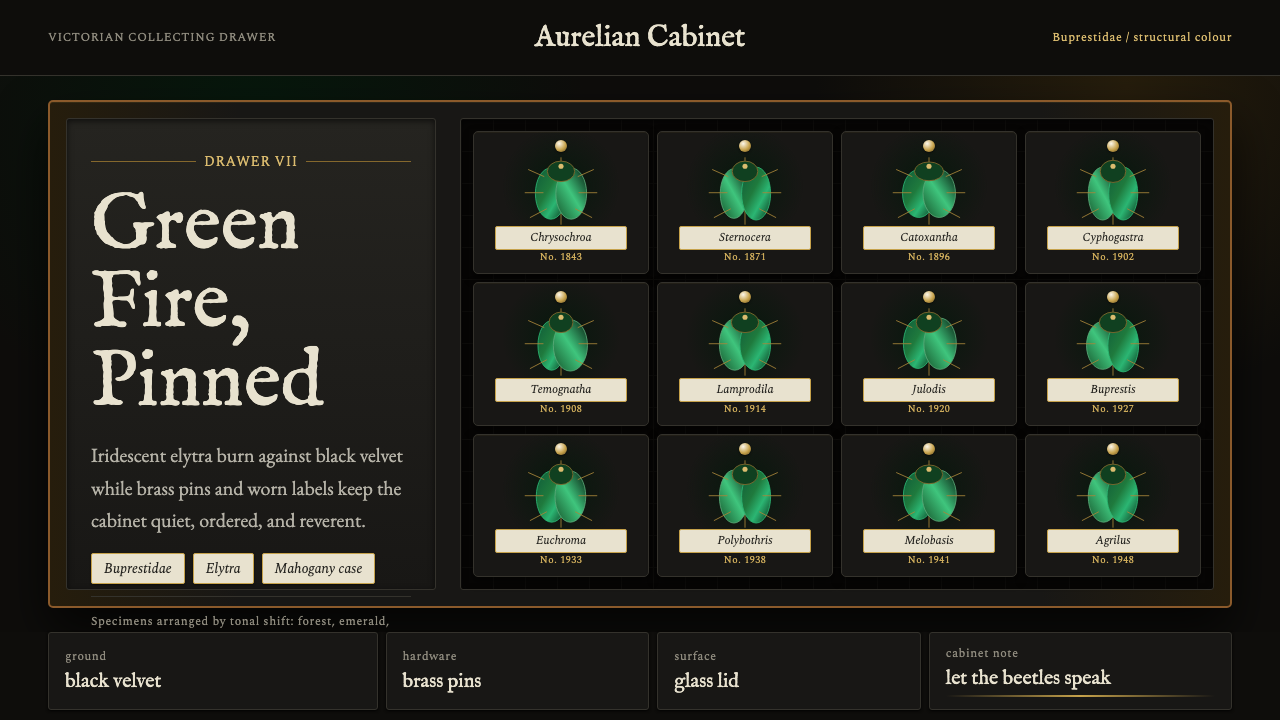 Beetle Specimen CabinetGreen burns in darkness. Emerald elytra grids glow under brass keylines and b…
 Ethiopian Orthodox ManuscriptSacred page, alive. Brick red, indigo, and ochre harag borders frame a starin…
 Pahari Kangra PaintingDevotional lyricism, painted slow. Sage-green hill grounds lighten to lotus-p…
 Pattachitra (Odisha Temple Scroll)Devotion as dense color. Vermilion bands and soot-black outlines stack like a…