What is Ethiopian Orthodox Manuscript?
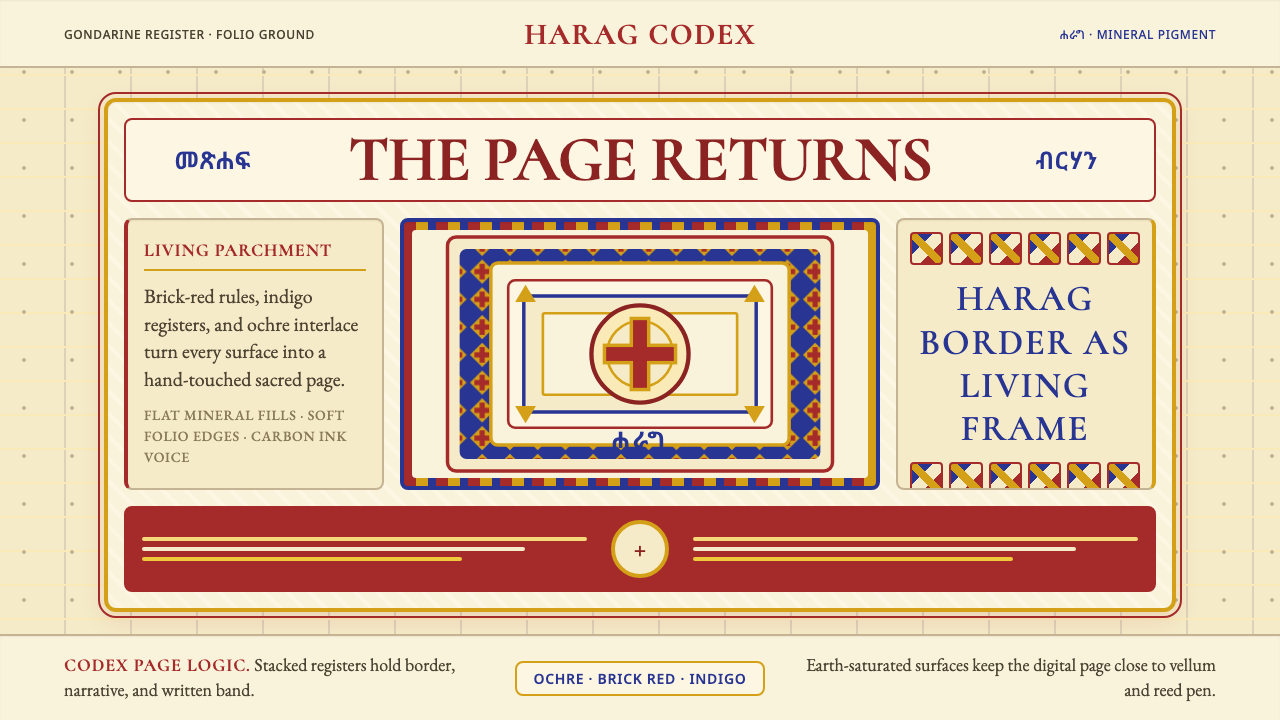
Sacred parchment reimagined — brick-red halos, indigo archangels, and interlaced harag borders transform every surface into a living icon.
Ethiopian Orthodox Manuscript in brief
Ethiopian Orthodox Manuscript illumination is a centuries-old tradition of sacred book-making in which parchment codices were covered in mineral pigments, geometric interlace borders, and monumental figurative icons. The style is instantly identifiable: every saint and archangel gazes forward with enormous almond-shaped eyes, frontal and unflinching, transforming the book page into something that looks back. Halos glow brick-red against warm ochre grounds, robes fall in flat indigo and crimson planes, and tessellating vine-and-knot borders — called harag — frame each composition with the rhythmic intensity of woven textile.
The design system translates these sacred conventions into a contemporary visual vocabulary. The palette remains earth-saturated: warm parchment grounds, mineral reds, deep indigos, and radiant ochre-golds replace the cool neutrals of modern interfaces. Pattern plays a structural role — harag interlace does not simply decorate margins but organizes, frames, and consecrates each region of the layout. Figural elements, when they appear, are rendered frontally and with confident outline rather than atmospheric shading. The result is a visual language that feels simultaneously ancient and graphic, hand-touched and bold.
Unlike styles rooted in restraint and reduction, Ethiopian Orthodox Manuscript embraces density and symbolic layering. Every choice — color, border, gaze, gesture — carries theological meaning. Applied to design, this tradition teaches that richness and legibility are not in opposition: when pattern is structured and palette is controlled, a dense visual field can still read with clarity and command.

Where does Ethiopian Orthodox Manuscript come from?
Christian manuscript illumination in Ethiopia can be traced to the Aksumite Empire, which adopted Christianity as its state religion in the fourth century under King Ezana — making Ethiopia one of the earliest Christian kingdoms in history. Monks at ancient centres such as Aksum and Lalibela copied and illustrated the Gospels, the Psalms, and liturgical texts, establishing visual conventions for depicting Christ, the Virgin Mary, and the archangels that would persist for more than a thousand years. Early Ethiopian iconography drew on both Coptic Egyptian and Byzantine sources, filtered through a distinctly African sacred imagination.
The style reached its apex during the Gondarine period, named for the imperial capital Gondar, which Emperor Fasilides founded in 1636. Under the patronage of emperors including Iyasu I (reigned 1682–1706) and Empress Mentewab (who wielded enormous cultural influence through the mid-eighteenth century), the monasteries of Lake Tana and the royal churches of Gondar became centres of manuscript production of extraordinary refinement. Monk-scribes and illuminators — mostly anonymous — developed the characteristic conventions of this school: the dramatically enlarged almond eye, the brick-red halo, the indigo and crimson robe rendered in flat mineral planes, and the densely patterned harag border drawn from older Aksumite geometric traditions.
The harag — from the Ge'ez word for vine or tendril — is perhaps the most immediately recognizable feature of Ethiopian manuscript decoration. These interlaced borders, woven from repeating cruciform and knotwork units, appear at the heads and feet of text columns, around full-page miniatures, and as dividers within the page. Their origins lie in the knotwork traditions of early Christian manuscript art shared across the Nile Valley and the Red Sea world, but Ethiopian illuminators developed the harag into a uniquely elaborate and rhythmically complex form. The borders are never purely decorative: they sanctify the space they enclose, marking the transition between the everyday and the sacred.
Ethiopian manuscripts were produced on vellum — typically calfskin or goatskin — prepared by stretching and scraping. The pigments used were almost entirely mineral and plant-based: red ochre and vermilion for the halos and garments, indigo derived from the plant Indigofera tinctoria for the deep blue robes, yellow ochre for grounds and gilded accents, carbon black for outlines and script. The binding itself was a sacred object: thick wooden boards wrapped in blind-tooled leather, fastened with leather cords, and carried in embroidered cloth bags. Many of these codices survive in the monasteries of Lake Tana and in the Ethiopian National Library, still used in liturgical practice today.
What defines the Ethiopian Orthodox Manuscript look?
Palette
The color vocabulary is warm, mineral, and earth-saturated. Brick red anchors halos and structural accents, carrying sacred energy; indigo and deep crimson fill the flat planes of robes and architectural elements; warm ochre and raw-parchment tones form the ground from which figures emerge. Black is used for decisive outlines and Ge'ez script. The overall effect is richly chromatic but never chaotic — each hue occupies a defined role derived from centuries of theological convention rather than aesthetic whim.
The Frontal Gaze
Every significant figure — Christ, the Virgin, archangels, saints — is rendered facing directly forward, with dramatically enlarged almond eyes that meet the viewer without deviation. This is not a stylistic convention alone but a theological statement: the icon is a window through which the sacred and the human exchange presence. The gaze commands rather than invites; it transforms a book page into a sacred encounter. In design terms, this frontality creates anchoring focal points of absolute stillness amid any surrounding pattern.
Harag Border
The harag is a repeating interlace pattern of vine tendrils, cruciform knots, and geometric loops that frames every significant region of the manuscript page. It is drawn with extraordinary precision — each unit interlocking with the next in a continuous rhythm — and colored in contrasting mineral tones so that the weave reads clearly against its ground. The harag simultaneously organizes space, marks hierarchy, and transforms the margin from dead zone to active sacred boundary. In contemporary application it functions as a structural framing device of great visual weight.
Flat Mineral Planes
Figures and garments are rendered in flat, unmodulated planes of pure mineral color — no gradients, no cast shadows, no attempt to simulate the fall of light across fabric. A robe is a shape of indigo; a halo is a disk of brick red; a face is a plane of warm ochre outlined in black. This flatness is not a technical limitation but a theological commitment: the sacred figure exists outside ordinary space and time, and therefore outside ordinary illumination. It produces a bold, graphic quality that reads at distance with the force of a printed emblem.
Dense Symbolic Pattern
Ethiopian manuscript pages are never empty. Background fields behind figures may be filled with repeat geometric patterns — crosshatch, stepped diamonds, or stylized flora — drawn from Aksumite decorative traditions. These fills do not merely occupy space; they signal the sanctified nature of the depicted realm. Density is a value, not a failure of restraint. The skilled illuminator controls density through pattern scale and color contrast rather than by leaving areas bare, achieving visual richness that remains ordered and legible.
Outline Dominance
Strong, confident black outlines define every form — faces, robes, architectural frames, harag units. The line is not a supplement to color but co-equal with it: the outline establishes the shape, and color fills within. This approach gives the style its graphic legibility at any scale and its ability to absorb dense surrounding pattern without losing figure-ground distinction. It also means that individual elements can be isolated and used independently without losing their identity — a quality that transfers well to digital icon systems and typographic ornaments.
Warm Parchment Ground
The ground of every composition is the warm, slightly irregular tone of prepared animal skin — not the cool white of modern paper or the absolute white of a digital canvas. This warmth is foundational: it unifies the mineral pigments laid over it, softens the visual field, and gives the work its sense of age and tactility. In digital translation, the ground should suggest organic material — warm off-white or deep parchment — rather than defaulting to pure white, which strips the palette of its characteristic depth and cohesion.

Who shaped Ethiopian Orthodox Manuscript?
Mentewab (c. 1706–1773) was the most powerful patron of the arts in Gondarine Ethiopia. As queen consort to Emperor Bakaffa and regent during her son Iyasu II's reign, she commissioned churches, monasteries, and illuminated manuscripts on an extraordinary scale. The church of Narga Selassie on an island in Lake Tana, built under her patronage and decorated with manuscript-influenced wall paintings, is among the finest surviving examples of Gondarine sacred art. Her support gave illuminators the resources and stability to develop the Gondarine school's most refined formal conventions.
Iyasu I (reigned 1682–1706), known as 'the Great,' presided over the height of the Gondarine cultural renaissance. His reign saw intense activity at the Lake Tana monasteries, where scriptoria produced illuminated Gospels, Books of the Hours, and hagiographies in the fully developed Gondarine style. Iyasu himself commissioned the decoration of Debre Berhan Selassie church in Gondar — its ceiling covered in painted angel faces — which became a touchstone of the tradition. His patronage established the visual norms that subsequent generations of monk-scribes would inherit and refine.
The Gondarine school was produced almost entirely by anonymous religious artists — monk-scribes who were simultaneously theologians, calligraphers, and painters. Working within strict iconographic conventions inherited from older Coptic and Byzantine sources, they nonetheless developed a collectively distinctive hand: the dramatically enlarged eye, the particular geometry of the harag border, the characteristic brick-red halo. Their anonymity was deliberate — the point was not the artist but the sacred text and image. Their collective achievement across two centuries constitutes one of the most distinctive bodies of sacred art produced anywhere in the pre-modern world.
Emperor Zara Yaqob (reigned 1434–1468) is not primarily remembered as an art patron but as the ruler who standardized Ethiopian Orthodox liturgical practice, settling doctrinal disputes and enforcing uniform observance across the kingdom. His reforms had direct consequences for manuscript production: by establishing canonical texts, feast cycles, and iconographic programs for the veneration of Mary and the saints, he gave illuminators a settled visual theology to work from. The iconographic conventions that reached their apex in the Gondarine period were partly the outcome of the doctrinal clarity his reign imposed.
How do you use Ethiopian Orthodox Manuscript today?
Ethiopian Orthodox Manuscript is one of the few historical design traditions that explicitly rewards density and symbolic layering — making it well-suited to contexts where richness, warmth, and cultural depth are desired values. Applying it correctly requires understanding its underlying logic: every element earns its place through structural or symbolic function. The harag border does not merely decorate; it demarcates sacred space. The frontal figure does not merely illustrate; it commands presence. Reproducing the visual surface without this intentionality produces pastiche.
For presentation slides, the tradition works powerfully on cover pages and section dividers. A cover benefits from a central frontal motif — an icon-like image or a bold geometric emblem — surrounded by harag-derived interlace framing on warm parchment ground. Section title slides can use a full-width harag band across the top or bottom as a structural marker, with the title set in large, confident type against a warm ground. Content slides require restraint: the harag should appear as a contained border element, not a full-page fill, and body text must have sufficient breathing room against the warm background. Data slides work best when charts are treated as flat geometric objects framed within the visual system — use the brick-red and indigo palette to encode data series, with the ochre ground providing neutral space.
For web interfaces and dashboards, the style is most effective in contexts that call for warmth, cultural resonance, and premium positioning — cultural institutions, heritage brands, editorial platforms, and artisanal or hand-crafted product lines. Navigation and header regions take well to harag-patterned borders; cards and panels sit naturally on warm parchment-toned backgrounds with strong outlined frames. Interactive states can use the brick-red as an active accent. Pricing pages work with tier distinction encoded in palette — indigo for premium tiers, ochre for standard — with harag framing separating each column. The style does not suit contexts requiring clinical neutrality or hyper-minimalism.
For editorial and marketing work, the tradition supports deep visual hierarchy and strong section identity. A long-form article layout can use harag-derived drop caps and section dividers, a warm parchment background for the text field, and bold outlined pull-quotes in brick-red or indigo. Marketing pages benefit from alternating full-width bands: warm ochre ground with dark figural or typographic elements, then deep indigo ground with parchment-toned type. Every call-to-action should feel like an illuminated initial — given a bordered frame and a warm accent — rather than a flat button. Photography, when used, should be treated as icon-like: tightly cropped, given a strong outlined border, and placed frontally rather than in casual documentary angles.
A common mistake when applying Ethiopian Orthodox Manuscript is treating it as surface decoration — adding a harag border to an otherwise conventional layout and considering the job done. The tradition requires that the pattern serve a genuine structural role: framing, separating, or consecrating specific regions. A second frequent error is lightening the palette toward pastels in an attempt to modernize. The power of this style comes from its mineral saturation and warm depth; diluting the palette to soft dusty tones breaks the internal coherence that makes the system work. Use the full weight of brick-red, deep indigo, and warm ochre, and let the parchment ground do the work of softening and unifying.

Ethiopian Orthodox Manuscript — FAQ
How does Ethiopian Orthodox Manuscript differ from other African art traditions?
Ethiopian Orthodox Manuscript is a Christian liturgical art tradition rooted in the specific theology and book culture of the Ethiopian Orthodox Tewahedo Church — one of the oldest Christian churches in the world. It shares with other African sacred traditions a taste for symbolic pattern and mineral-saturated color, but its direct lineage runs through Coptic Egypt and Byzantine iconography rather than through the West African, sub-Saharan, or indigenous traditions more commonly associated with the term 'African art.' The frontal gaze, the halo, the codex format, and the hagiographic subject matter all place it squarely within the Eastern Christian sacred art family.
Can this style work in dark-background layouts?
The canonical ground of Ethiopian manuscript illumination is warm parchment — not black or dark. A dark inversion is possible but requires significant care. On a dark background, the brick-red loses its halo-warmth and can read as aggressive; the indigo can disappear against near-black grounds. A dark variant works best when it treats deep indigo or near-black as the ground, uses warm ochre and parchment-tone as the primary light elements, and reserves brick-red as a concentrated accent for borders and focal points only. The harag pattern can be rendered in a slightly lighter tone of the ground color — giving it presence without competing with foreground content.
Is this style appropriate for secular or commercial contexts?
Yes, with appropriate sensitivity. The visual language of Ethiopian Orthodox Manuscript can be applied to secular design work — the aesthetic system is rich enough to stand on its own formal merits independent of its religious origins. Cultural institutions, museums, heritage tourism, artisanal brands, and editorial projects regularly draw on sacred art traditions without theological intent. The key is to engage with the tradition with knowledge and respect rather than reducing it to exotic surface decoration. Avoid using specific devotional iconography (individual saints, crosses, sacred texts) in ways that are trivializing or purely ornamental. The harag border, the palette, and the compositional conventions are broadly available; the specific sacred imagery carries more responsibility.
How do I apply the harag pattern without it overwhelming the layout?
Scale and containment are the two key controls. A harag pattern read at large scale — covering a wide margin or a full background — will dominate; the same pattern rendered at small scale in a contained border strip becomes a structural accent without competing with content. In practice, limit harag to defined zones: page or slide edges, section headers, card frames, or decorative dividers. Keep the interior content zone — the area where text and primary visual elements live — free of pattern, using only the warm ground color. The contrast between patterned border and open interior is what gives the style its characteristic tension between richness and legibility.
What makes Ethiopian Orthodox Manuscript different from Byzantine or Coptic icon art?
All three traditions share the frontal gaze, the theological use of gold or warm color for sacred ground, and the flat rendering of form without naturalistic shadow — they are related branches of Eastern Christian sacred art. The differences lie in specifics. Byzantine icons tend toward more refined elongated proportions and a cooler, more golden palette with greater use of gold leaf. Coptic art is bolder and more graphic, with heavier outlines and a stronger contrast between figure and ground, but lacks the elaborate interlace border tradition. Ethiopian manuscript art is distinguished above all by the harag border — an indigenous pattern tradition with no close parallel in Byzantine or Coptic work — and by a warmer, earthier palette rooted in locally available mineral pigments rather than imported Byzantine gold and lapis.
Related design styles
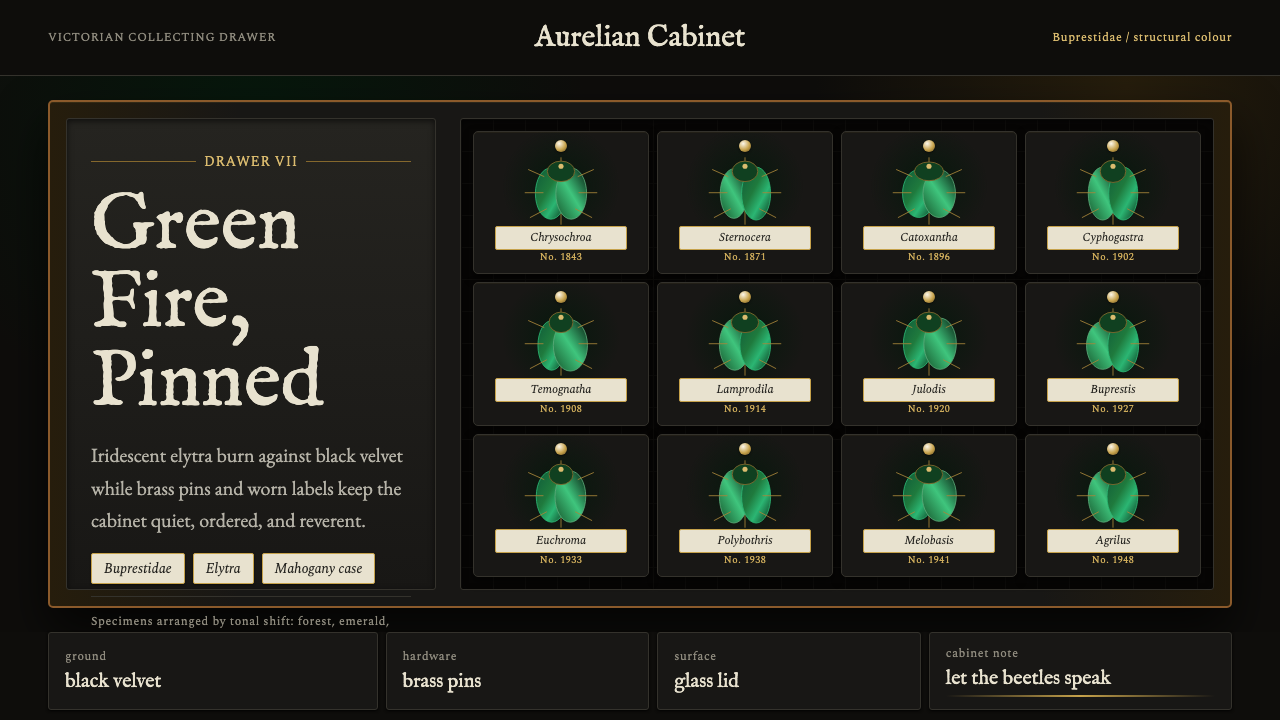 Beetle Specimen CabinetGreen burns in darkness. Emerald elytra grids glow under brass keylines and b…
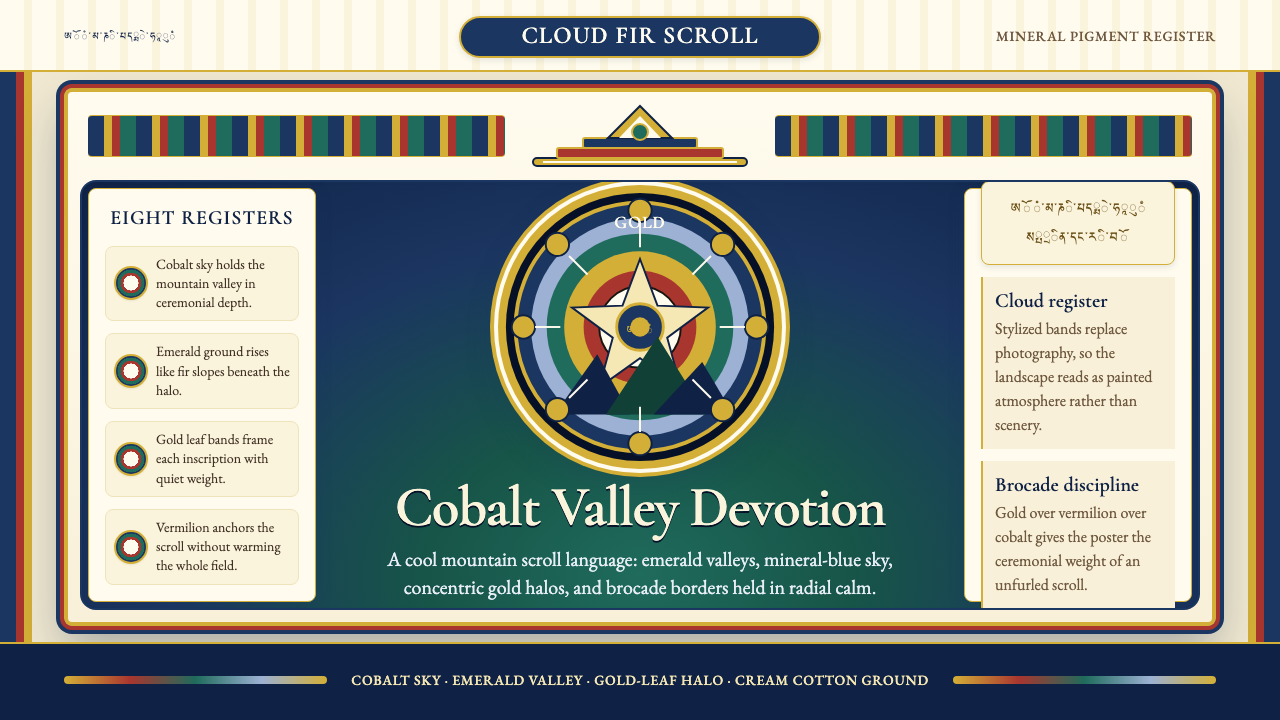 Bhutanese Thangka (Druk Style)Sacred cool-mountain clarity. Cobalt fields, emerald ground, and gold halos f…
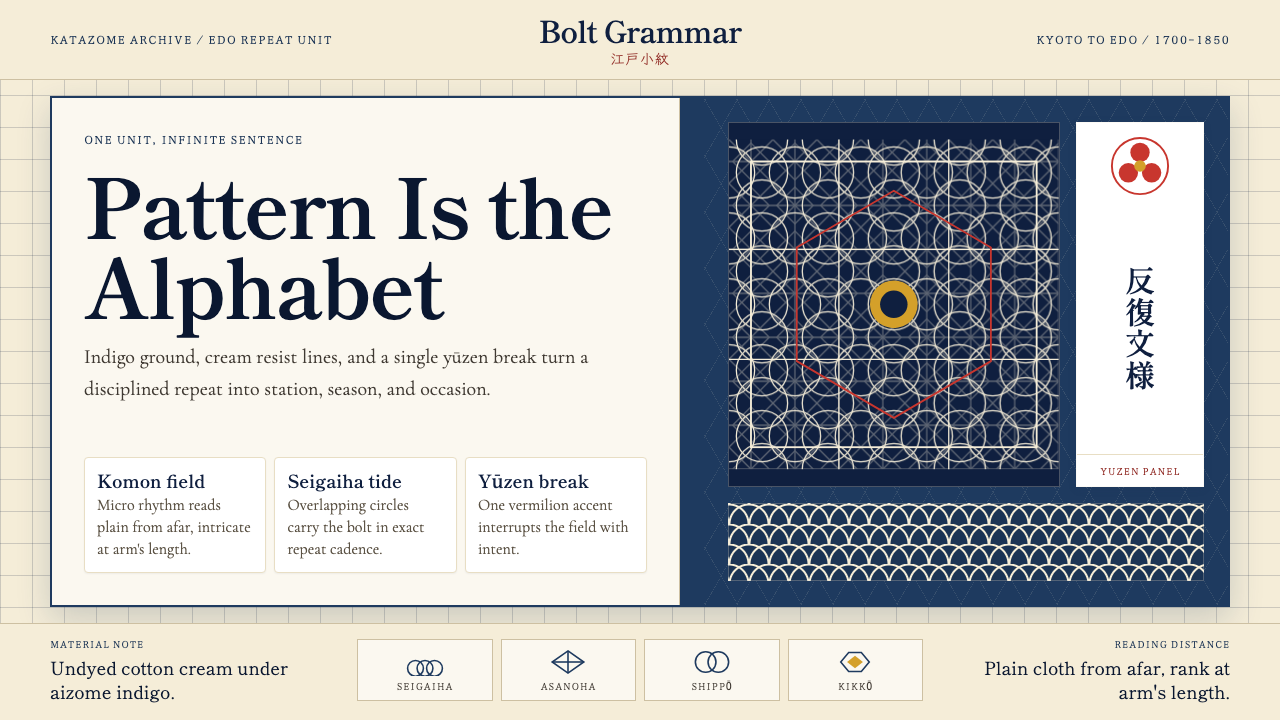 Edo Kimono TextilePattern becomes language. Indigo repeats, cream resist lines, one vermilion p…
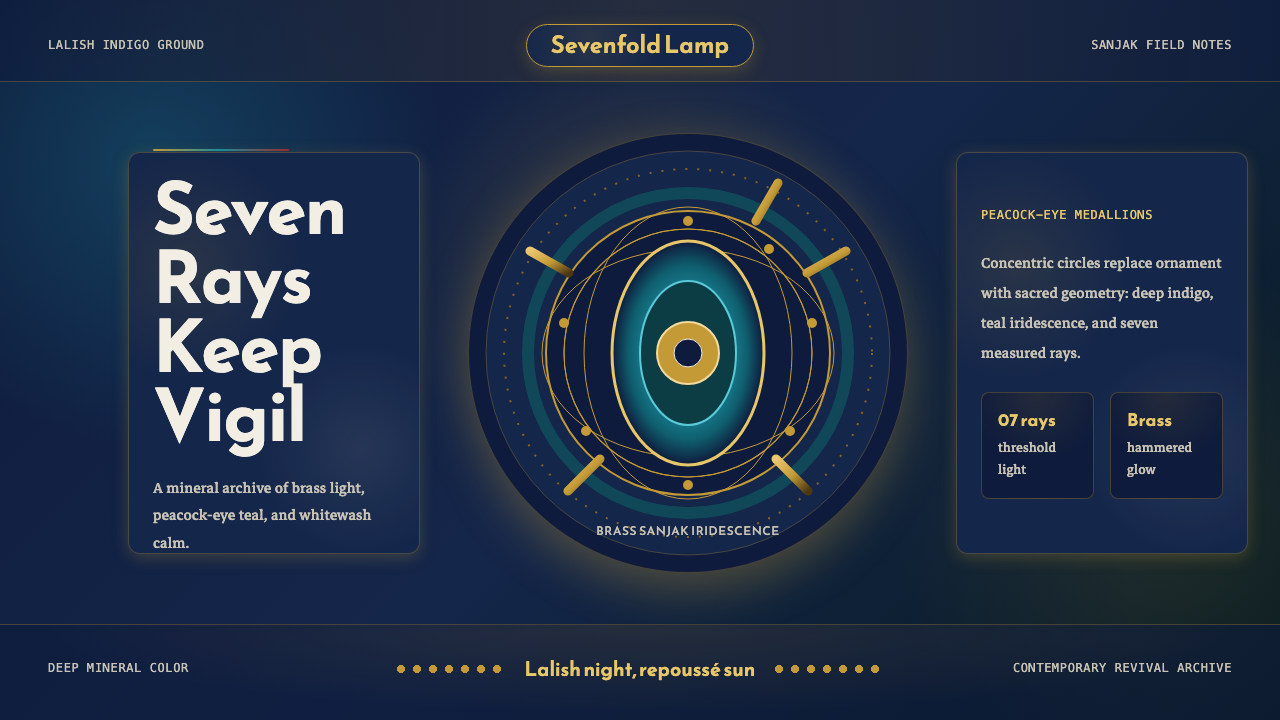 Kurdish Yazidi Peacock & SunSacred geometry glows. Lalish indigo holds brass rays and teal peacock-eye me…
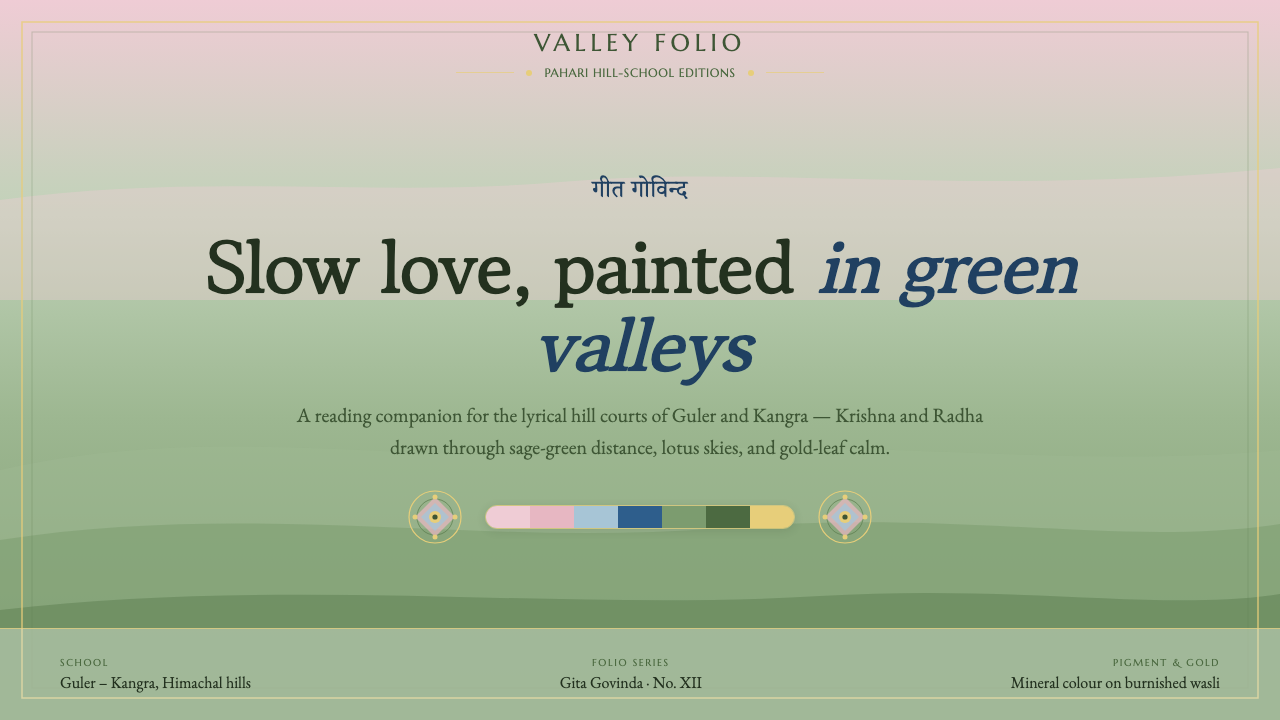 Pahari Kangra PaintingDevotional lyricism, painted slow. Sage-green hill grounds lighten to lotus-p…
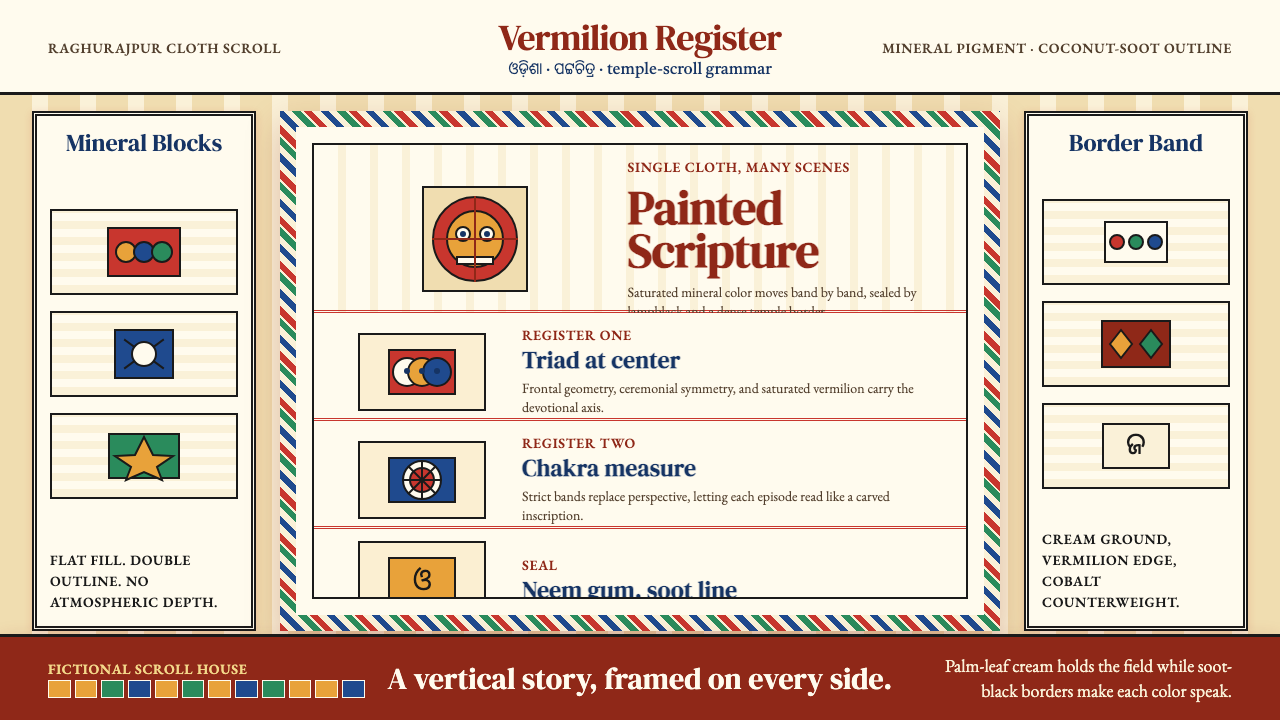 Pattachitra (Odisha Temple Scroll)Devotion as dense color. Vermilion bands and soot-black outlines stack like a…