What is Kurdish Yazidi Peacock & Sun?
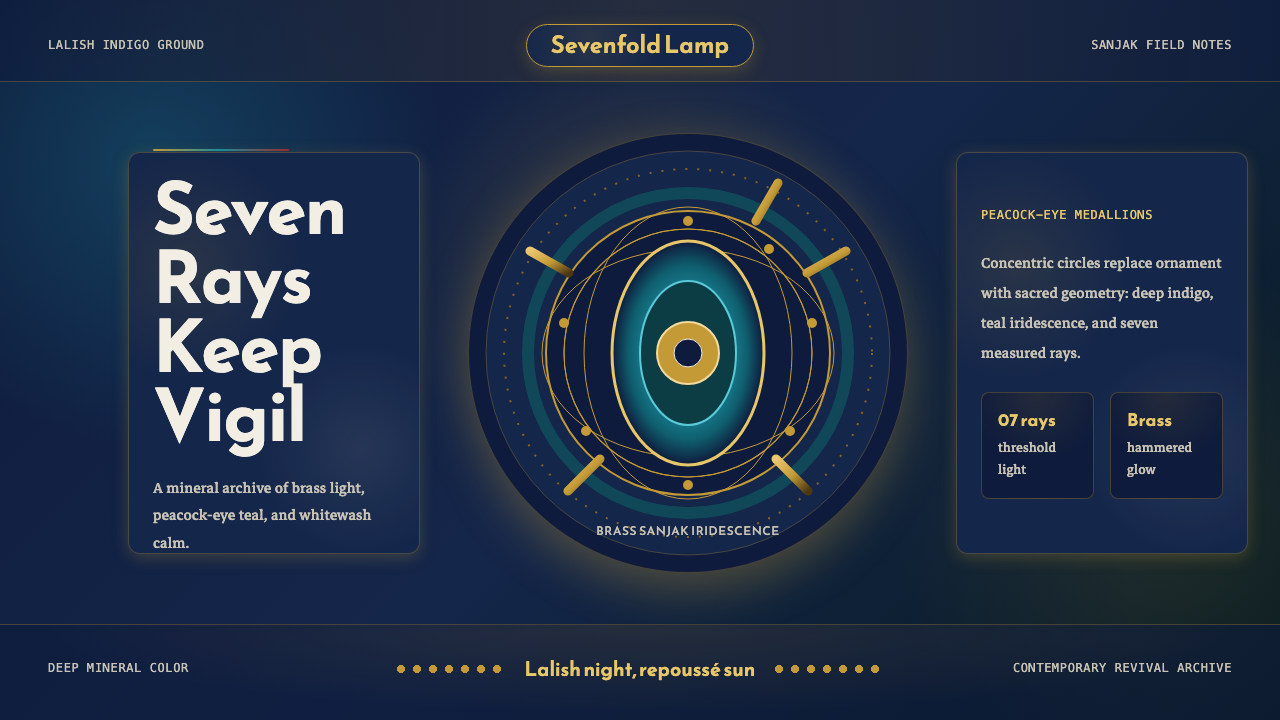
Kurdish Yazidi Peacock & Sun is a sacred design vocabulary rooted in Lalish valley — deep indigo grounds, hammered-brass sun-rays, and the iridescent peacock-eye medallion of Tawûsî Melek, the angel of divine light.
Kurdish Yazidi Peacock & Sun in brief
Kurdish Yazidi Peacock & Sun is a sacred visual tradition born in the mountain valleys of Iraqi Kurdistan, distilled from centuries of Yazidi religious iconography and dramatically revitalized by diaspora designers after the genocide of 2014. At its core are three interlocking motifs: the deep indigo ground that evokes the night sky over Lalish; the radiant burst of seven golden sun-rays emanating from the sacred sanjak standard; and the peacock-eye medallion, emblem of Tawûsî Melek — the Peacock Angel — who holds supreme rank among the seven archangels of Yazidi theology.
The style is simultaneously devotional and ornamental. Unlike purely geometric systems that prioritize structure above all, the Yazidi tradition weaves symbolic density into every layer — each color, each repetition of the peacock-eye, each cluster of sun-rays carries theological weight. The visual rhythm is one of sacred abundance: forms cluster and overlap, building an almost textile-like density, yet the overall composition retains a luminous clarity because the deep indigo ground throws the warm metallic tones forward with exceptional force.
In its contemporary revival form, the style bridges ancient craft and modern communication. Designers working in this tradition draw equally on the repousse metalwork of historical sanjak standards, the embroidered agal headdress borders of Yazidi women, and the bold color contrasts of diaspora memorial posters. The result is a visual language that can function as ceremonial identity, political statement, and cultural affirmation — often all three simultaneously.
Where does Kurdish Yazidi Peacock & Sun come from?
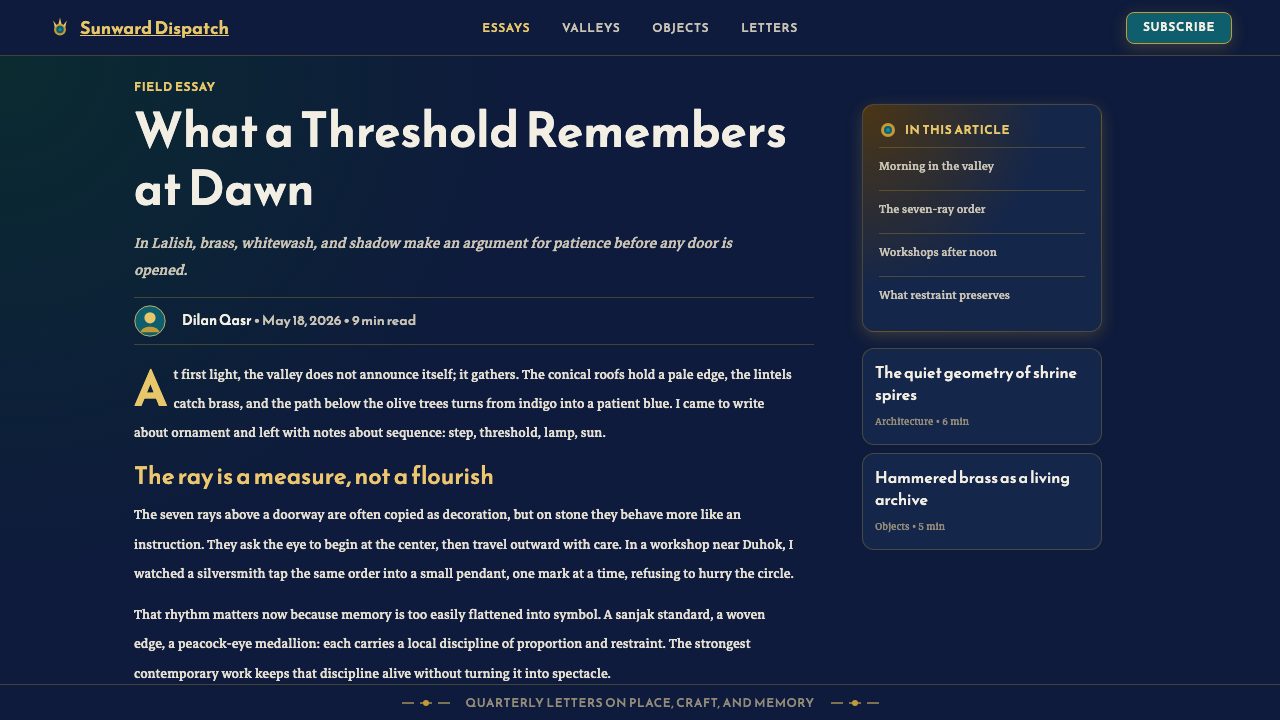
The roots of Yazidi visual culture extend far deeper than the 12th century, though the reform associated with Sheikh Adi ibn Musafir — the Sufi mystic who settled in the Lalish valley around 1110 CE and whose tomb became the religion's holiest shrine — consolidated and formalized many of the symbolic elements that define the tradition today. The peacock as divine emblem was already ancient when Sheikh Adi arrived; the seven-rayed sun appears in pre-Islamic Mesopotamian solar iconography that Yazidi communities absorbed and reinterpreted across millennia of cultural contact with Assyrian, Zoroastrian, and early Islamic currents.
The sanjak — a bronze or brass standard cast in the form of a peacock — is among the most sacred objects in Yazidi religious practice. Seven sanjaks exist, one for each of the great archangelic lineages, and each is periodically carried in procession through Yazidi villages by a hereditary caste of custodians called the kawwals. The visual logic of the sanjak — hammered metal, radiating form, warm gold-brass tones emerging from a dark background — becomes the organizing principle of the entire design tradition. The peacock is not depicted naturalistically; it is abstracted into radiant geometry, its tail an explosion of concentric eye-rings, its body a blaze of embossed curves.
Lalish valley itself, set in the mountains northeast of Mosul, provided the chromatic grammar of the tradition. The stone of the conical shrine spires weathers to an almost luminous white-cream against the dense dark-green of mountain forest and the deep blue of the highland sky. The interior of the shrines is lit by olive-oil lamps whose warm amber glow falls across carved stone reliefs and the silk cloths — predominantly deep indigo, gold, and teal — that drape the sacred objects. Anyone who has visited Lalish or studied its documentation understands immediately why deep indigo and warm metallic gold became the canonical palette: they are what the sacred space actually looks like.
The catastrophic genocide perpetrated by the Islamic State in August 2014, in which more than five thousand Yazidis were killed and thousands of women enslaved, also catalyzed a profound diaspora artistic response. Designers and artists in Duhok, in Hannover, in Lincoln, Nebraska — wherever Yazidi refugee communities formed — began producing memorial posters, embroidered textiles, and jewelry that deliberately foregrounded traditional iconography as acts of cultural survival. Levi Meir Clancy, a photographer and digital archivist working in Erbil, documented Yazidi material culture extensively, creating visual records that diaspora designers and memorial artists could reference. This post-2014 revival is not nostalgia; it is a contemporary design practice in which the peacock-eye and the seven-rayed sun carry explicit political meaning alongside their theological one.
What defines the Kurdish Yazidi Peacock & Sun look?
The Indigo Ground
Deep indigo is the chromatic foundation of the entire system. It is not a cool neutral — it is a saturated, active dark that reads simultaneously as night sky, as deep water, and as the mineral lapis found throughout the region's ancient craft traditions. Against indigo, warm metallic tones — the burnished gold of sun-rays, the aged brass of sacred implements — appear with a luminosity that no lighter background could produce. The ground is rarely interrupted by secondary colors; it serves as the unified field from which sacred forms emerge.
Seven-Rayed Solar Burst
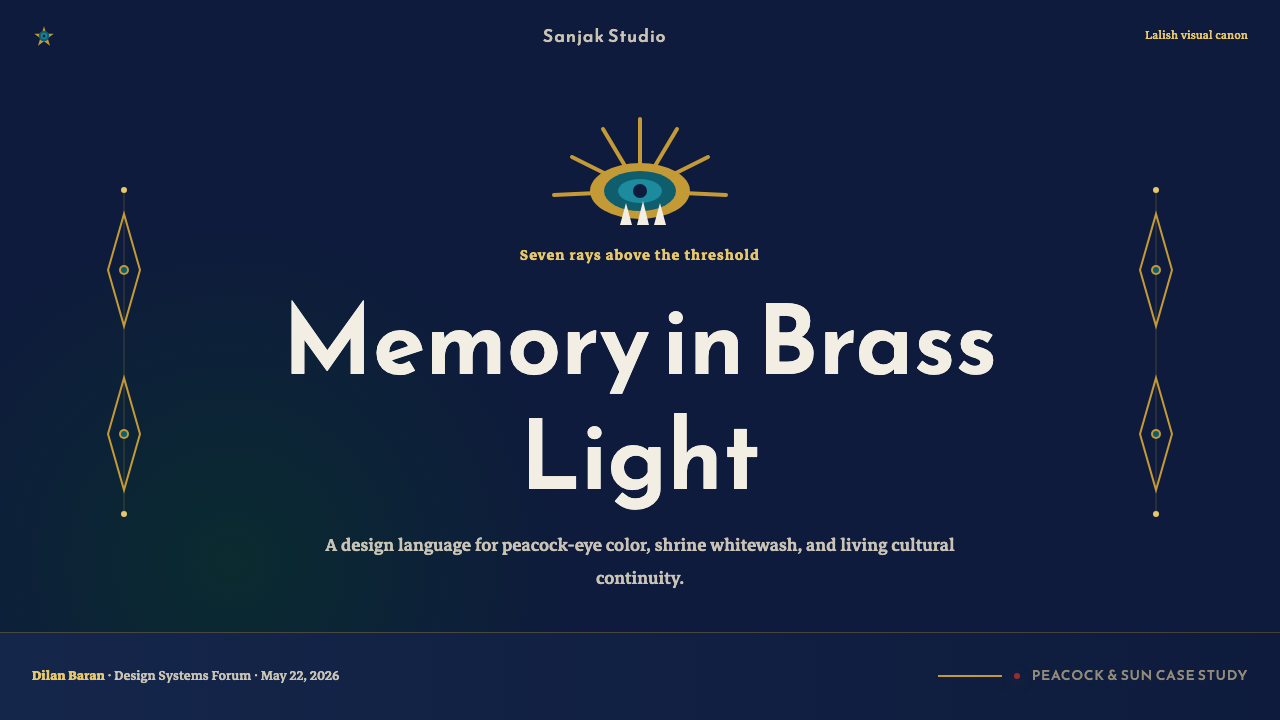
The solar motif in Yazidi iconography is not a generic sun — it is a specifically seven-rayed radiance, corresponding to the seven sacred archangels of Yazidi theology. The rays are bold, even, and typically rendered in warm brass or gold tones, radiating from a central disc with geometric precision. This is not a decorative flourish but a theological statement encoded in form. In contemporary design applications the seven-ray structure is maintained with care; altering the number of rays would change the symbolic meaning entirely.
Peacock-Eye Medallion
The peacock eye — a concentric ring pattern that abstracts the iridescent ocellus of the peacock tail feather — is perhaps the most recognizable single element in the Yazidi visual vocabulary. It appears on sanjak standards, embroidered textiles, carved stone, and jewelry. The pattern is typically built from layers of concentric circles or ellipses in alternating warm and cool tones, with the outermost ring often picking up the brass or gold of the solar motif. Unlike European peacock-eye ornament, the Yazidi version carries active theological weight: Tawûsî Melek's eye is the eye of divine witness, not merely a decorative motif.
Textile Density and Pattern Layering
Yazidi visual culture is rooted in embroidery and metalwork — crafts in which pattern must fill available surface with purposeful abundance. This inheritance makes the design tradition comfortable with density that would feel overcrowded in a Western minimalist framework. Multiple pattern registers can coexist: a border of interlocking geometric chevrons, a central field of peacock medallions, a framing device of repeated solar motifs. The layering is hierarchical — sacred symbols occupy the compositional center; supporting patterns recede toward edges — but never sparse. This density is a feature of reverence, not an accident of overcrowding.
Warm Metallic Palette Against Deep Ground
Beyond indigo and gold, the Yazidi chromatic range includes teal and peacock green — the iridescent tones of the living bird — and ivory or warm cream for sacred textile borders. Copper and aged bronze provide a lower-key metallic register that grounds the bright gold without neutralizing it. The palette avoids cool grays, pure whites, and flat blacks; even the darkest tones lean warm. This warmth is not accidental — it mirrors the light conditions of oil-lamp-lit shrine interiors, where everything the eye receives is inflected with amber and gold.
Bilaterally Symmetric Composition
In contrast to the Bauhaus tradition of compositional asymmetry, Yazidi sacred imagery is predominantly bilaterally symmetric. The sanjak peacock spreads its wings and tail in perfect mirror balance; embroidered borders repeat their patterns with strict regularity; the solar disc at the center of a composition radiates its rays in equal intervals. This symmetry expresses divine order and cosmic balance — it is a theological claim made visible. Even in diaspora revival work that incorporates contemporary graphic conventions, designers tend to maintain this compositional symmetry in primary elements, reserving asymmetry for subsidiary framing and text.
Material Reference: Repoussé and Embroidery
The Yazidi design vocabulary carries the memory of its craft origins in every form. Curves carry the slightly uneven, handmade quality of hammered metal; borders carry the rhythmic regularity of counted-thread embroidery. This material memory distinguishes the tradition from superficially similar decorative systems — Islamic geometric ornament, for instance, tends toward mathematical perfection and absolute regularity, while Yazidi metalwork and embroidery contain a perceptible human warmth in the slight variations of hand-crafted repetition. In digital applications, preserving some of this textural memory — through pattern variation, soft edge treatments, or illustrated rather than vector-perfect curves — keeps the work grounded in its origins.

Who shaped Kurdish Yazidi Peacock & Sun?
A Sufi mystic of probable Syrian Christian origin who settled in the Lalish valley around 1110 CE, Sheikh Adi is considered the central reformer of the Yazidi faith. He synthesized elements of pre-Islamic Mesopotamian religion, Sufi mysticism, and early Christian practice into a coherent theological and ritual system. The visual iconography associated with his shrine — the conical spires of Lalish, the sanjak standards, the oil-lamp-lit interiors — became the primary visual reference for Yazidi sacred art. His tomb in Lalish remains the most sacred pilgrimage site in Yazidi religion, and the visual vocabulary developed around Lalish over nine centuries of active worship is the foundation of this design tradition.
As the spiritual head of the Yazidi community — a role that combines religious authority with custodianship of ritual practice — the Baba Sheikh oversees the maintenance and use of the sacred sanjak standards, the management of shrine iconography at Lalish, and the ritual calendar that structures Yazidi visual and material culture. Baba Sheikh Khurto Hajji Ismail, who held this position during the period around the 2014 genocide and its immediate aftermath, was an important figure in efforts to preserve and re-establish Yazidi cultural continuity in the face of deliberate cultural destruction. The ritual and material culture he helped maintain is the direct source of the visual vocabulary this design tradition draws upon.
A Yazidi survivor of the 2014 Islamic State genocide and 2018 Nobel Peace Prize laureate, Nadia Murad has become the most internationally recognized face of Yazidi cultural survival. Her testimony before the United Nations, her memoir, and her ongoing advocacy work have brought Yazidi iconography — including the peacock symbol and Lalish imagery — to global visibility. The visual language produced to accompany her advocacy work and to represent her community has drawn heavily on the Yazidi design tradition, and her prominence has amplified awareness of that tradition among international audiences. The post-2014 design revival in which traditional Yazidi motifs are used as acts of cultural resistance is inseparable from the broader context of advocacy she helped create.
An American photographer and digital archivist based in Erbil, Iraqi Kurdistan, Levi Meir Clancy has produced extensive photographic documentation of Yazidi religious sites, material culture, sanjak standards, and ceremonial objects. His archive, which includes detailed photographic records of Lalish shrine iconography, embroidered textiles, and repoussé metalwork, has provided diaspora designers and memorial artists with high-quality visual reference material that would otherwise be inaccessible outside Iraqi Kurdistan. Clancy's documentation work represents the intersection of archival practice and cultural preservation that has supported the contemporary revival of Yazidi design vocabulary in diaspora communities worldwide.
The contemporary visual revival of Yazidi iconography is not attributable to a single designer but to a diffuse creative response by community members across Duhok, Hannover, and other diaspora hubs. Working primarily in digital media — poster design, social media graphics, embroidery pattern revival, and silver jewelry — these designers brought traditional Yazidi motifs into contemporary visual formats following the 2014 genocide. Their work performs the double function of cultural documentation and political resistance, maintaining the visibility of a tradition that its perpetrators sought to erase. The aesthetic decisions embedded in this body of work — deep indigo grounds, seven-rayed suns, peacock-eye medallions, warm metallic palettes — define the contemporary version of the tradition that this design system draws upon.
How do you use Kurdish Yazidi Peacock & Sun today?
Applying the Yazidi Peacock & Sun vocabulary in contemporary work requires understanding that every core element carries symbolic specificity — the peacock eye is not merely a decorative circle-in-circle motif, the seven-rayed sun is not interchangeable with a generic starburst. Designers working with this tradition should treat it with the same seriousness they would bring to other living religious iconographies: the visual language is most powerful and most respectful when the symbolism is acknowledged rather than purely aestheticized. That said, diaspora artists and designers within the community have themselves established a precedent for using these motifs in secular contexts — memorial posters, cultural festivals, educational materials — so their use in design work is not inherently off-limits, but it benefits from informed intent.
For presentation slides, the tradition offers exceptional richness for cover pages and section dividers. A dark indigo background with a centered or asymmetrically placed seven-rayed solar burst in warm gold creates an immediate and dignified visual presence. Peacock-eye medallions work well as large-scale compositional anchors when placed at corners or as full-bleed background textures reduced to low opacity. Type should be set in cream or warm white against the dark ground, sized boldly for headings. Content slides can maintain the deep ground throughout for immersive visual consistency, or shift to a lighter variant for legibility-intensive data slides — in either case retaining the warm metallic accent tones for chart highlights and interactive callouts.
For web interfaces, this design language suits products with ceremonial, cultural, or memorial purposes — museum platforms, cultural organizations, community archives, and high-end editorial properties where richness and depth carry positive connotations. Dashboard or analytics contexts are less natural fits unless the product explicitly serves a cultural or arts institution. The approach for web: use the deep indigo as the primary background for hero and navigation areas, letting warm gold and teal perform all hierarchy and interactive duties. Card components should carry the warmth through subtle embossed or repoussé-referencing shadow treatments. Navigation can incorporate peacock-eye motifs as decorative indicators without overwhelming the information architecture.
For editorial and marketing work, the palette's inherent poster-like quality — deep saturated ground, brilliant metallic accent, high visual drama — translates naturally into strong cover designs, event posters, and campaign graphics. The bilateral symmetry of the tradition's compositional logic supports centered headline layouts with strong visual authority. For long-form editorial, use the deep indigo sparingly — as section-opening full-width blocks or pull-quote backgrounds — and build the body-text environment in cream or off-white with warm metallic accent rules to maintain tonal continuity. Marketing pages for cultural products can lean into the tradition's density by layering subtle peacock-eye patterns as background textures at very low opacity behind content.
A common error when working with this visual tradition is stripping it down to a color palette and losing the symbolic specificity. Deep indigo plus gold is also evocative of many other traditions — Byzantine, Mughal, Ottoman — and without the specific geometric vocabulary of the peacock eye and seven-rayed sun, the connection to Yazidi visual culture becomes vague and potentially appropriative without acknowledgment. The other frequent mistake is over-saturating the metallic tones to the point that the deep ground is overwhelmed. In authentic Yazidi material culture, the gold gleams against the dark; it does not shout. Restraint in the metallic register — allowing it to be warm and luminous rather than harsh and harsh-bright — preserves the sacred quality that makes the tradition visually compelling.
Kurdish Yazidi Peacock & Sun — FAQ
Is using Yazidi iconography in design work culturally appropriate?
This is a genuinely complex question, and the answer depends heavily on context, intent, and relationship to the community. The tradition itself is one of a living minority religion that has faced severe persecution, and its visual symbols carry active theological meaning for community members. That said, diaspora Yazidi designers and artists have themselves brought these motifs into secular and commercial contexts — festival posters, cultural brands, memorial campaigns — establishing a precedent for use outside purely devotional settings. The strongest guidance is: use the symbols with acknowledged meaning rather than as purely decorative motifs; credit the tradition clearly in any context where attribution is possible; avoid commercial applications that commodify sacred symbols without community connection; and recognize that the contemporary design vocabulary documented here was in significant part forged by Yazidi community members themselves as a form of cultural survival.
What is the theological significance of the peacock in Yazidi belief?
In Yazidi theology, Tawûsî Melek — the Peacock Angel — occupies the highest rank among the seven archangels who govern the world on behalf of the supreme God. The peacock is not a representation of vanity or pride (as in some European symbolic traditions) but of divine magnificence, wisdom, and the iridescent complexity of creation. The peacock eye — the ocellus pattern — is understood as the eye of divine witness: omnipresent, all-seeing, and radiating outward into the world. The association between the peacock and the sun (both radiate outward from a center, both shift color as light changes) makes the joint motif of peacock-eye and seven-rayed sun a compressed cosmological statement: divine light witnessing all of creation.
How does this design tradition differ from Islamic geometric ornament?
The superficial similarity — geometric patterns, rich dark backgrounds, gold accents — can mislead. The structural logic and symbolic content are quite different. Islamic geometric ornament characteristically pursues mathematical infinity: tessellating patterns that could theoretically continue forever, implying divine boundlessness through mathematical form. Yazidi iconography is symbolic rather than abstract: its forms represent specific theological entities — the peacock angel, the sun as divine light, the seven archangels — rather than mathematical principles. Yazidi composition is also typically centered and bilateral rather than all-over; the sacred symbol sits at the compositional center, surrounded by framing ornament, rather than across an undifferentiated field. Additionally, Islamic ornament traditionally avoids figural representation of living beings, while the Yazidi peacock is a stylized but recognizable bird.
Can this style work for digital interfaces, or is it mainly suited to print?
The tradition is historically rooted in physical craft — metalwork, embroidery, stone carving — and the design language carries that material heritage most powerfully in contexts with high visual resolution and rich color reproduction: high-quality print, large-format displays, and premium web environments. It can work well for digital interfaces, but requires careful calibration. Deep indigo screens read well on modern displays, but the warm metallic tones need careful handling to avoid becoming muddy or overly bright at screen resolution. The pattern density that gives the tradition its richness can become overwhelming at small sizes, so detailed medallion patterns should be used at large scales or substantially simplified for icon and small-component sizes. The overall effect at digital scales is closer to a statement piece than a workhorse system — best deployed in hero areas, landing pages, and ceremonial moments rather than as the primary system for dense information displays.
Why does the revival of this tradition after 2014 matter for design?
The post-2014 revival is significant in design terms because it demonstrates how a threatened visual tradition can be actively maintained and extended through design practice, rather than only preserved in archives. The diaspora designers who forged contemporary Yazidi visual identity were doing something design practitioners rarely articulate explicitly: using the tools of graphic design — color, composition, typographic hierarchy, pattern — as instruments of cultural survival. The design decisions they made — anchoring the tradition in deep indigo and warm gold, maintaining the seven-ray structure and peacock-eye specificity, resisting the dilution into generic orientalist ornament — were acts of cultural fidelity as much as aesthetic choices. For any designer engaging with living cultural traditions, this history offers a model for how to carry a visual language forward: maintain the symbolic core while adapting the form language to contemporary media and contexts.
Related design styles
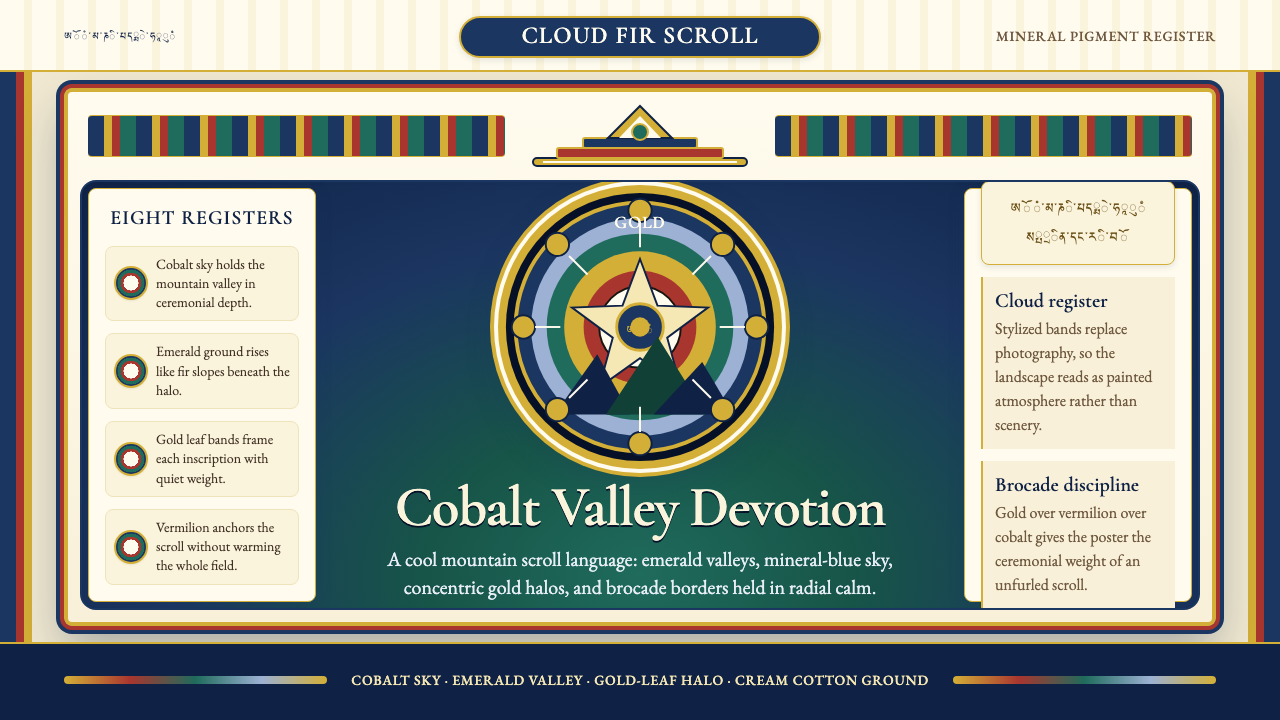 Bhutanese Thangka (Druk Style)Sacred cool-mountain clarity. Cobalt fields, emerald ground, and gold halos f…
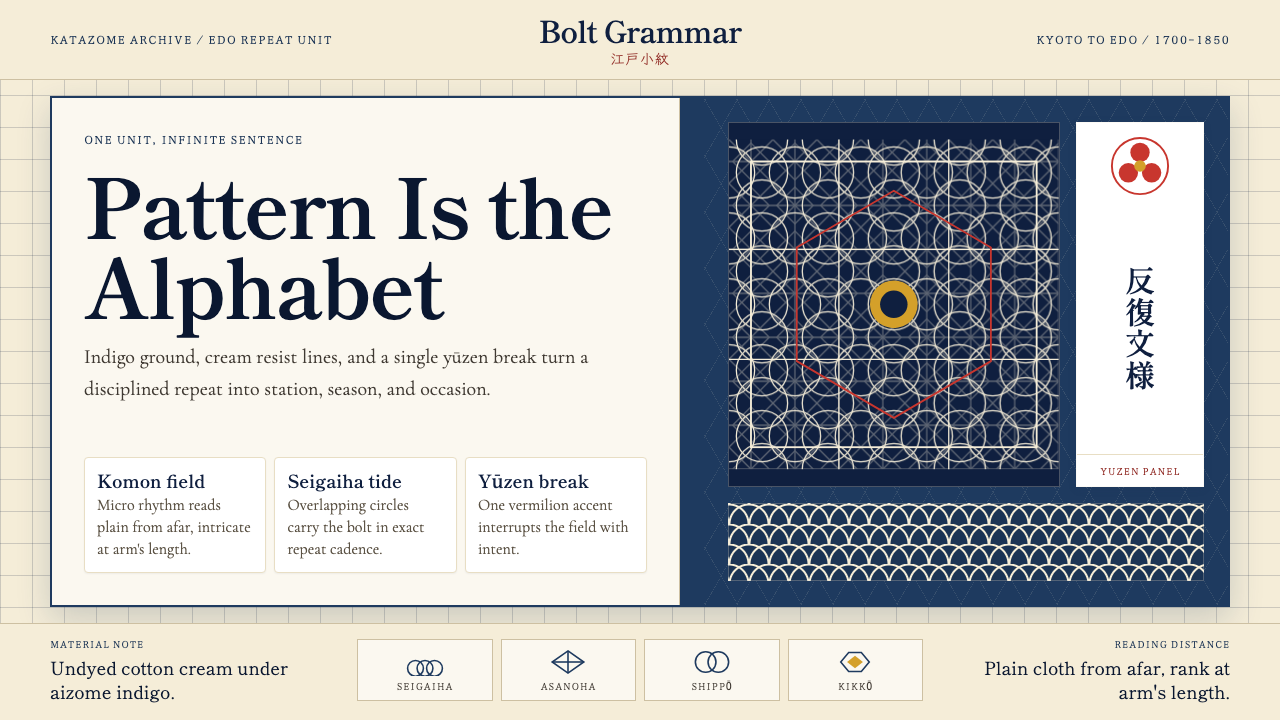 Edo Kimono TextilePattern becomes language. Indigo repeats, cream resist lines, one vermilion p…
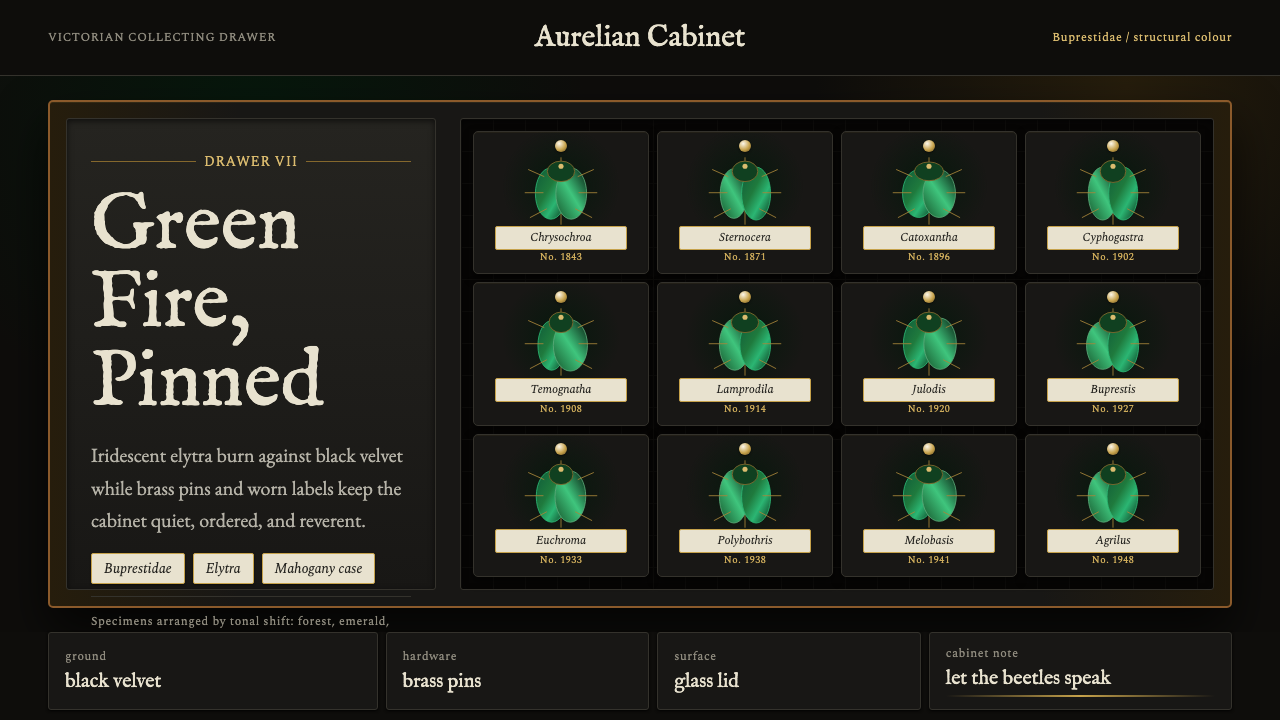 Beetle Specimen CabinetGreen burns in darkness. Emerald elytra grids glow under brass keylines and b…
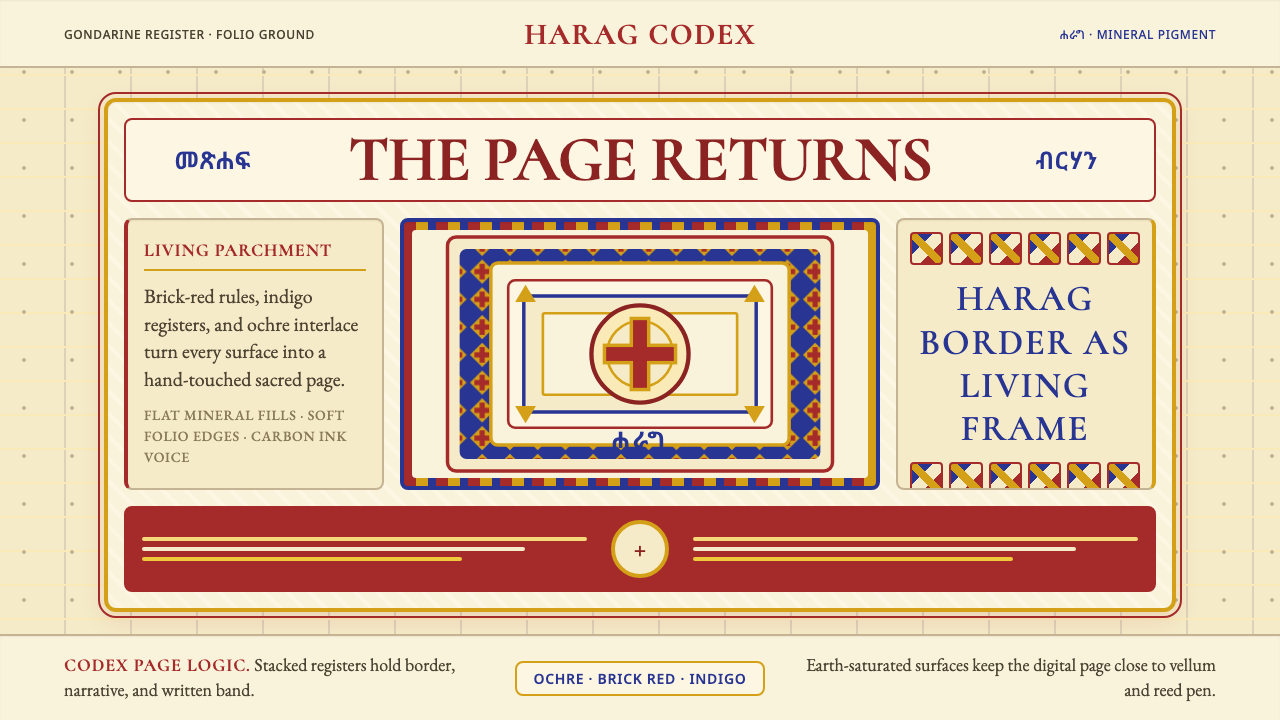 Ethiopian Orthodox ManuscriptSacred page, alive. Brick red, indigo, and ochre harag borders frame a starin…
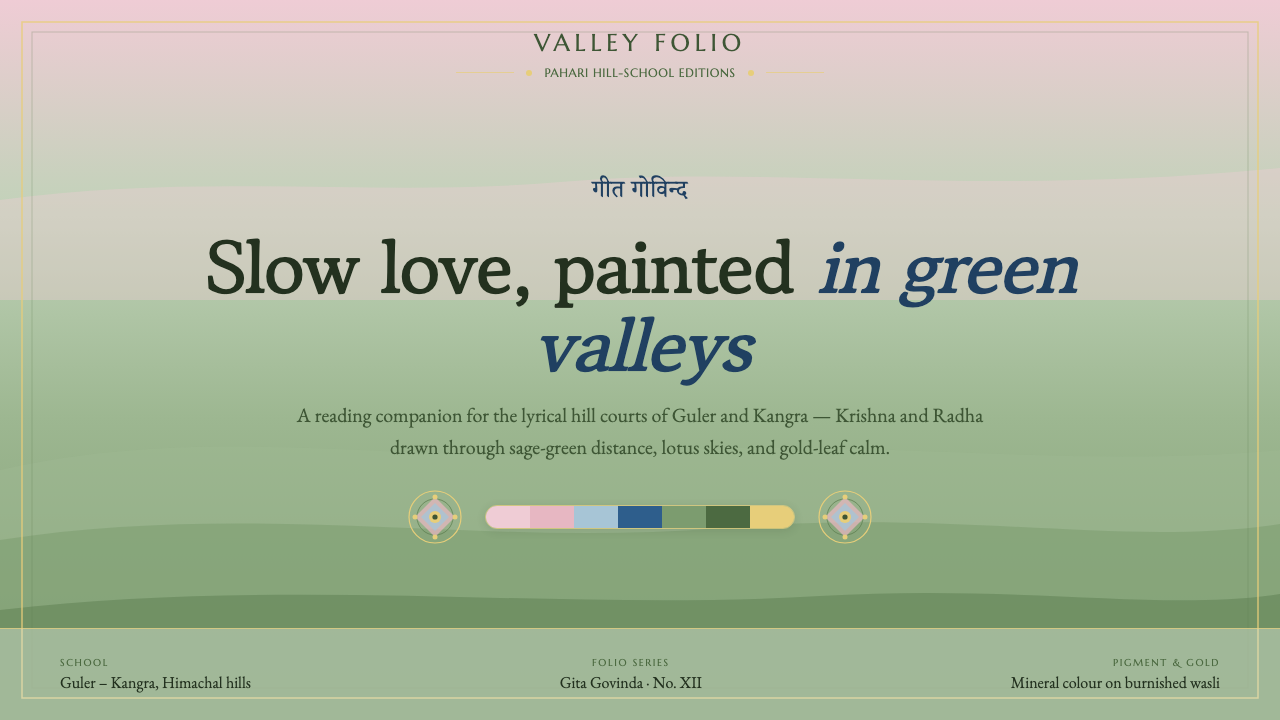 Pahari Kangra PaintingDevotional lyricism, painted slow. Sage-green hill grounds lighten to lotus-p…
 Pattachitra (Odisha Temple Scroll)Devotion as dense color. Vermilion bands and soot-black outlines stack like a…