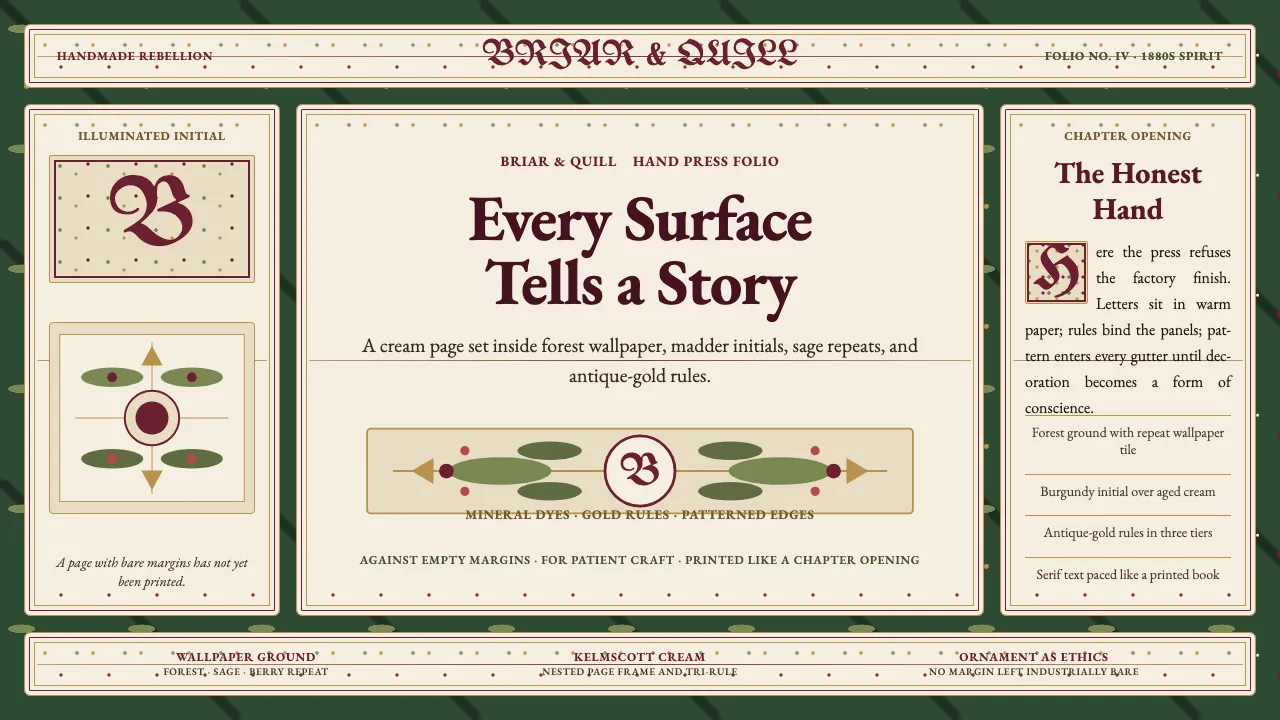
About William Morris Arts & Crafts
William Morris's Arts & Crafts movement was Britain's 1880s handmade rebellion against industrial mass-production — wallpapers, tapestries, stained glass, and printed books rendered in dense medieval-revival floral pattern. Morris co-founded Morris & Co in 1861 and the Kelmscott Press in 1891, culminating in the 1896 Kelmscott Chaucer, widely held as the most beautiful book of the nineteenth century.
The system reads as a printed Kelmscott page: cream paper set inside forest-green wallpaper grounds, Caslon body text, acanthus and strawberry-thief borders on every surface, and antique-gold rules binding each panel. Every edge carries pattern; empty space is treated as an industrial failure.
- Origin
- Western Europe (Walthamstow / Kelmscott / London, England)
- Era
- 1861 Morris & Co founded → 1880s pattern peak (Strawberry Thief 1883, Willow Bough 1887) → 1891 Kelmscott Press → 1896 Kelmscott Chaucer
- Key figures
- William Morris · Edward Burne-Jones · Philip Webb · May Morris · Dante Gabriel Rossetti
- Movements
- Arts & Crafts movement · Pre-Raphaelite Brotherhood · Gothic Revival
William Morris Arts & Crafts design spec
Colors
Typography
The other 11 sections — buttons, cards, spacing, motion, techniques and more — open once you unlock. Download the DESIGN.md or send it to your AI in one click. Unlock once, yours forever.
Sign up nowStyles similar to William Morris Arts & Crafts
Also inspired by art & artists, with a close feel.
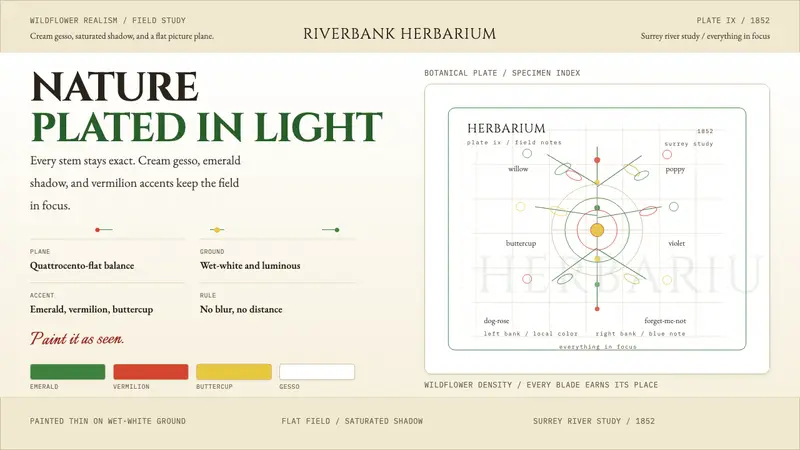 Millais — Ophelia / Wildflower Pre-RaphBotany, rendered with conviction. Cream gesso, emerald, and vermilion stay in sharp focus.
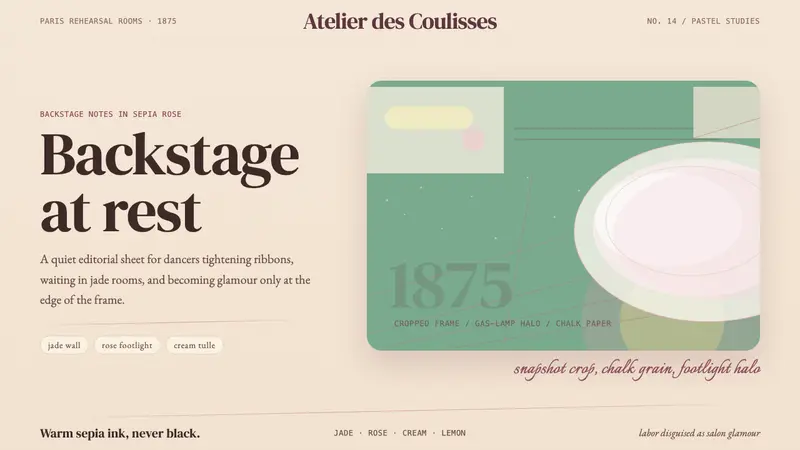 Degas Ballet PastelsBackstage glamour is labor. Jade walls, rose footlights, cropped serifs on cream paper.
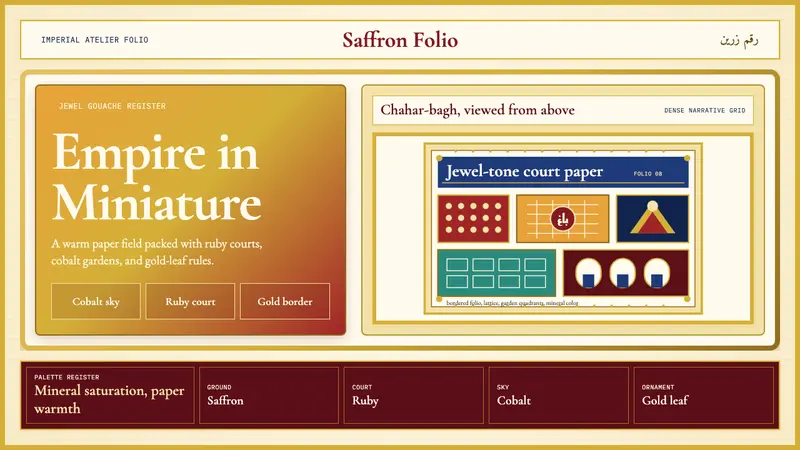 Mughal Miniature (Akbar era)Opulence refuses emptiness. Saffron paper, ruby panels, cobalt lattice, gold borders.
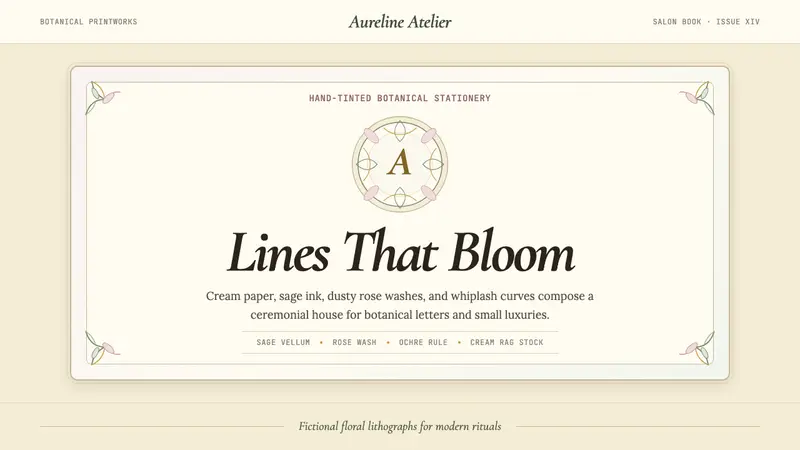 Art Nouveau (Mucha)Mucha's whiplash arabesques. Botanical halos, muted lithograph palette, no machine-cut edges.