What is Hiroshige — Tokaido Road?
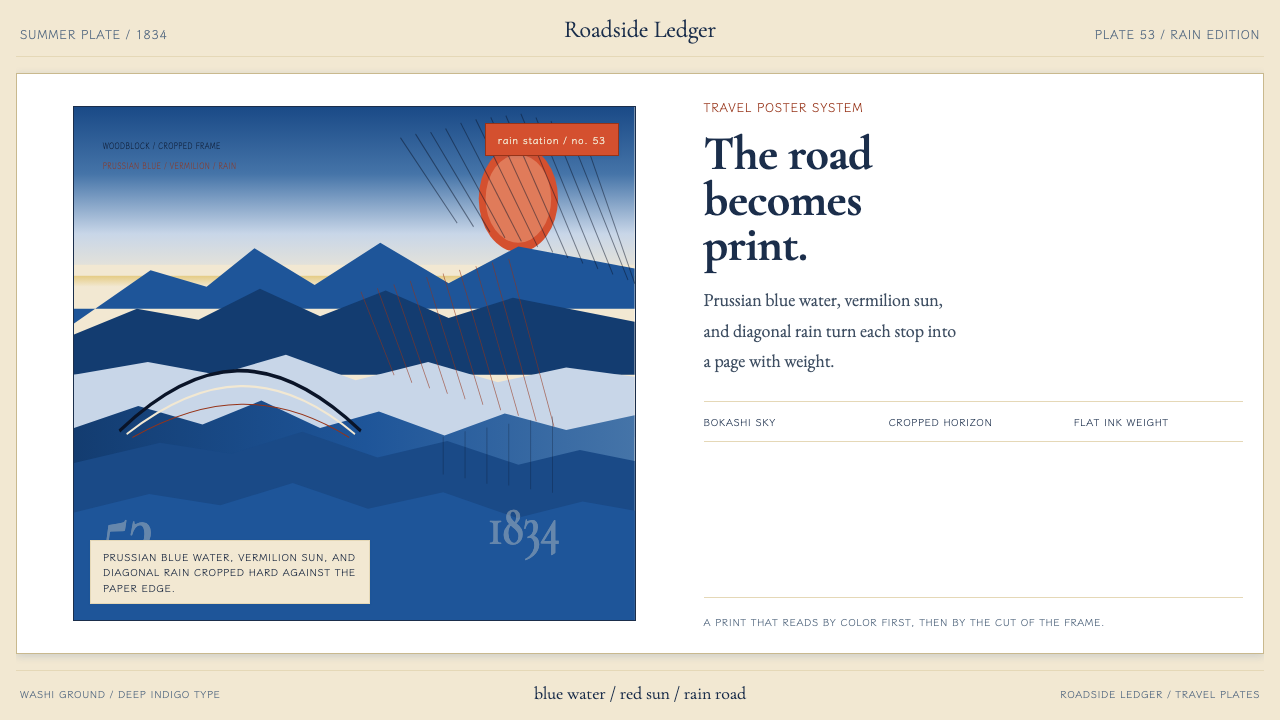
Hiroshige's Tōkaidō prints turned a five-hundred-kilometer road into fifty-five lessons in color, cut, and the beauty of weather.
Hiroshige — Tokaido Road in brief
Utagawa Hiroshige's *Fifty-Three Stations of the Tōkaidō* is a woodblock print series produced between 1833 and 1834 that documents each post-station along the great road connecting Edo to Kyoto. The series comprises fifty-five plates — fifty-three stations plus the two terminus cities — and is remarkable not for topographic accuracy but for its emotional, meteorological, and compositional intelligence. Each print is a self-contained composition: a cropped, almost cinematic view of a station in a particular season, weather condition, and time of day.
The visual language Hiroshige developed for this series became the template for modern landscape printing worldwide. Its defining qualities are saturated, flat color fields applied in smooth graduated washes called bokashi; strong diagonal compositional forces — rain rendered as parallel ruled strokes, roads receding at sharp angles — that create motion within a static frame; and a color palette anchored by deep Prussian blue, warm vermilion, and the natural cream of unprinted washi paper. These qualities were not merely beautiful: they were the product of the woodblock printing process itself, exploiting the physical properties of rice paper, water-soluble pigments, and hand-carved keyblock lines.
The Tōkaidō series arrived at a moment of mass travel literacy in late Edo Japan. The Tōkaidō road was the most traveled in the country, used by merchants, pilgrims, and official processions alike, and meisho-e — pictures of famous places — were a popular tourist genre. Hiroshige's series became both a cultural phenomenon and a commercial success, spawning dozens of imitations and subsequent series by the artist himself. When Japanese prints reached Europe in the 1860s and 1870s, the Tōkaidō compositions directly influenced Monet, Van Gogh, and Whistler, igniting the Japonisme movement.

Where does Hiroshige — Tokaido Road come from?
The Tōkaidō road had existed as an official highway since the Nara period, but it reached its cultural peak during the Edo era (1603–1868), when the Tokugawa shogunate required all daimyo to make regular journeys between their domains and the capital at Edo — the system of sankin-kōtai, or alternate attendance. The road's fifty-three official stations were spaced roughly one day's walk apart, each with inns, teahouses, and the dense human activity of a functioning waypoint. This traffic created both an audience for pictures of the road and the commercial ecosystem to distribute them.
Hiroshige first traveled the Tōkaidō in 1832 as part of an official shogunal procession delivering tribute horses to Kyoto. He was in his mid-thirties and already an established ukiyo-e artist — trained in the lineage of Toyohiro and working primarily in the warrior-print tradition — but the journey transformed his artistic direction. He made sketches along the route, capturing conditions of light, weather, and local character that no earlier meisho-e series had attempted with such documentary intent. The resulting plates, published by the Edo bookseller Hōeidō Takenouchi Magohachi beginning in late 1833, were an immediate sensation.
Hiroshige did not invent the Tōkaidō as a subject: his contemporary Katsushika Hokusai had already published landscape print series including *Thirty-six Views of Mount Fuji* (from 1831), and Keisai Eisen had collaborated with Hiroshige himself on a *Sixty-nine Stations of the Kisokaidō* series. What Hiroshige brought to the Tōkaidō was a specific sensitivity to atmospheric conditions — mist, snow, rain, the flat gray light of an overcast dawn — rendered through technical innovations in the bokashi gradation process. His rain scenes in particular, notably the Shōno and Kambara plates, created a visual vocabulary for precipitation that remains influential.
The Prussian blue that defines the series' palette entered Japan through Dutch trade in the early nineteenth century, and its adoption by ukiyo-e printers was rapid and transformative. Unlike the traditional ai-blue derived from indigo, Prussian blue offered depth, saturation, and resistance to fading under natural light. Hiroshige used it not as a direct substitute but as a structural element: the blue grounds of sky and water against which warm earth tones and vermilion accents read with exceptional clarity. The Hōeidō Tōkaidō is widely considered the finest printing of the series; later reprintings, including those by other publishers after the initial plates wore down, show perceptibly lower bokashi quality and less precise registration.
What defines the Hiroshige — Tokaido Road look?
Flat Color with Graduated Wash
The defining technical mark of the Tōkaidō palette is bokashi — a graduated wash applied by dampening the woodblock and wiping pigment unevenly across its surface before printing, so that color fades smoothly from dense to absent. In Hiroshige's skies, the Prussian blue deepens toward the top of the plate and dissolves to bare paper near the horizon. In water passages, the same technique creates the sense of reflective depth without depicting waves literally. The rest of each composition uses flat, unmodulated color fields for landforms, figures, and vegetation — no blending, no highlights — giving the work the compressed visual weight of ink on paper rather than paint on canvas.
Prussian Blue as Structural Anchor
Prussian blue is the load-bearing element of the Tōkaidō system. It appears in skies, water bodies, distant mountains, and shadow passages, occupying the largest total area of most plates. Against this deep, slightly cool blue, warm tones — the vermilion of a torii gate, the ochre of a straw raincoat, the buff of a dirt road — read with exceptional clarity and vibration. This warm-cool opposition is not accidental: it mirrors the complementary color relationships that make traditional woodblock prints legible at a distance in dim indoor lighting, where the series would typically have been displayed or sold.
Diagonal Composition and Framing Cut
Hiroshige consistently uses diagonal lines — roads, rivers, rain, tree lines, coastlines — to drive the eye through the picture plane from one corner toward another. This creates a sense of transit that is appropriate to the subject: every scene is a place you are moving through, not a static monument. The frame itself actively cuts landscape features: a mountainside disappears behind the right edge, a procession of figures exits the lower left corner, a pine branch enters from the top-right. This aggressive cropping, which anticipates modern photography, gives each print a sense of arrested motion — as though the viewer arrived at exactly this spot at exactly this moment.
Weather and Atmosphere as Subject
Unlike earlier meisho-e that depicted famous places under ideal, generic lighting, Hiroshige made weather conditions the actual content of each plate. Rain is drawn as dense parallel diagonal strokes — a woodblock innovation that became so strongly associated with the series that it entered the visual vocabulary of every subsequent Japanese print. Snow turns rooftops and hillsides into unmodulated white forms. Fog dissolves mountain outlines into bare paper. The time of day is specific: a station scene at dusk shows a sky at the moment of color change; a morning departure captures the flat gray-lavender light before full sunrise. These meteorological observations make each plate a record of experience rather than a description of place.
Red-Orange Cartouche as Typographic Anchor
Each plate carries a title cartouche — typically placed in the upper left or upper right corner — printed in warm red-orange against a lighter field, with the station name in strong black brushwork within it. This cartouche functions as the page's typographic keystone: it is the highest-contrast element in many plates, drawing the eye first, and it introduces warm red into compositions that might otherwise be dominated by cool blue. The cartouche's rounded, almost shield-like form echoes the physical road markers of the Tōkaidō. In contemporary applications derived from this tradition, this anchoring of text in a distinct warm-ground label in a corner of the composition is one of the most immediately recognizable stylistic signatures.
Layered Spatial Depth Without Perspective
Hiroshige synthesizes two spatial systems that are technically incompatible. From the Western tradition — which entered Japan via Dutch imports and Dutch-style copper engravings — he borrows the logic of a vanishing-point perspective for roads and buildings, particularly in the post-station courtyard scenes. From the ukiyo-e tradition, he retains overlapping flat color planes to indicate depth: a near hill in medium blue, a far mountain in a lighter, cooler blue, the sky above in the deepest Prussian. Objects are sized by narrative importance as much as by spatial position. The result is a pictorial space that reads as simultaneously flat and deep — compressed like a theater backdrop but spatially legible at multiple levels.
Human Figure as Scale and Story
Unlike the panoramic grandeur of Hokusai's Fuji views — where human figures are often absent or microscopic — Hiroshige's Tōkaidō plates consistently include travelers, porters, merchants, and villagers at a scale that makes them co-protagonists with the landscape. A porter adjusting a load, a pilgrim caught in rain, a group of travelers resting under a pine — these figures are never merely staffage. They establish the human rhythm of the journey: the weight of walking, the relief of shelter, the sociality of roadside inns. Rendered in a few confident strokes, they carry the emotional texture of the series without ever becoming its focal subject.

Who shaped Hiroshige — Tokaido Road?
Hiroshige entered the Utagawa school of woodblock printing as a teenager and worked initially in the warrior-print genre. His Tōkaidō journey of 1832 reoriented him toward landscape, and the resulting series transformed him from a well-regarded craftsman into the defining figure of late ukiyo-e. He went on to produce hundreds of landscape series — a second Tōkaidō, *One Hundred Famous Views of Edo*, *Sixty-nine Stations of the Kisokaidō* — consistently deepening his experiments with atmospheric light, rain, and snow. He died in 1858 during an Edo cholera epidemic, still at work.
The Edo bookseller and publisher who commissioned and first released the Hōeidō Tōkaidō series beginning in 1833. Takenouchi's publishing house had a reputation for high production quality, and the initial Hōeidō printings are distinguished by their careful bokashi gradations and precise color registration — qualities that deteriorated in later reprint runs as the woodblocks wore. The commercial success of the Hōeidō series created the market conditions for the explosion of landscape print series that followed throughout the 1840s and 1850s, and Takenouchi's instinct to pair Hiroshige's sketches with superior printing craftsmanship was decisive in establishing the series' canonical status.
Hokusai is the figure against whom Hiroshige's achievement is most usefully measured. Where Hokusai's landscape prints — particularly *Thirty-six Views of Mount Fuji* — are architecturally bold, structurally dramatic, and dominated by the monumental presence of a single geographic subject, Hiroshige's are experiential, atmospheric, and human-scaled. Both artists adopted Prussian blue as a structural element and both worked within the meisho-e tradition of famous-place prints, but they represent opposite temperaments: Hokusai the visionary geometer, Hiroshige the empathetic traveler. European Japonisme drew on both, but Hiroshige's diagonal rain and graduated skies left the more direct trace in Monet and Van Gogh.
Eisen was a contemporary of Hiroshige's who collaborated with him on the *Sixty-nine Stations of the Kisokaidō* series, an alternative mountain road connecting Edo to Kyoto via the interior. Eisen began the series and Hiroshige completed it, producing a joint work that reveals both artists' contrasting sensibilities side by side. Eisen's contribution to the Tōkaidō design tradition is less visible but real: his figure work, particularly his bijin-ga (pictures of beautiful women) adapted to travel scenes, influenced the integration of human narrative into landscape prints in ways that Hiroshige extended and deepened.
Monet is the most direct Western conduit through whom Hiroshige's compositional strategies entered European painting. He collected Japanese prints — his home at Giverny displayed over two hundred — and the influence on his late work is specific and traceable: Hiroshige's diagonal rain strokes appear in Monet's own rain studies; the layered atmospheric washes of Tōkaidō skies are legible behind Monet's dissolving water-lily surfaces; the practice of painting the same subject under different weather conditions across a series is Hiroshige's working method directly translated. Monet did not simply admire the prints — he internalized their compositional logic and used it to solve problems in Western plein-air painting.
How do you use Hiroshige — Tokaido Road today?
The Tōkaidō design system translates into contemporary work through its structural principles rather than its historical iconography. The goal is not to produce something that looks like a woodblock print — it is to apply the system's rules about spatial layering, color opposition, typographic anchoring, and atmospheric gradation to screens, slides, and editorial layouts. Used correctly, the result feels grounded and visually deliberate without resembling a museum reproduction.
For presentation slides, the system works exceptionally well for both cover compositions and content pages. A cover benefits from the layered spatial approach: a background field of deep blue graduated toward the lower portion, a mid-ground element in a warm neutral — landform, horizon, architectural silhouette — and a title block set in strong, clean type within a warm red-orange cartouche anchored to one corner. The compositional diagonal should guide the eye from the cartouche toward the central image. Content slides work best with strict horizontal banding: information layers mapped to color layers, with Prussian blue reserved for headers or key data, warm ochre for supporting content, and the cream of the slide background doing structural work as a third neutral. Data visualizations take on the character of landscape elements — bar charts become ridgelines, area fills become color-field strata.
For web interfaces, the system is well-suited to editorial platforms, cultural institution sites, travel applications, and any dashboard where a sense of depth and considered atmosphere is preferred over the flat utility of standard design systems. The approach uses a strict two-to-three-color palette derived from the Tōkaidō anchor colors, with the blue-green of deep water as a primary field, warm cream or light buff as a secondary background, and a single vermilion-adjacent accent reserved for interactive elements and calls to action. Navigation labels and headings should use the cartouche principle: text in a distinct, warm-ground container that reads at a glance against a cooler background. Gradients, when used, should evoke the bokashi technique — smooth, directional, moving from dense to absent rather than between two saturated hues.
For editorial and marketing work, the series' poster logic translates directly. A feature spread uses the full-bleed blue field as its opening visual field, with warm-toned imagery or typography occupying the lower third — replicating the ground-to-sky spatial division of the prints. Marketing materials work well with the rain-stroke device adapted as a directional texture: parallel lines at a consistent diagonal that give motion to otherwise static fields. Pull quotes and callouts should carry their own cartouche container, in warm red or ochre, that signals importance the way the station-name labels signal location in the original series. The principle of weather-as-content translates to seasonal or contextual variation: a product launch for winter might lean into cold blue and near-white; a summer campaign into the warm amber and haze of an afternoon station scene.
A common mistake when working with this system is treating the Prussian blue as a background default and adding warm accents on top — this produces a competent but inert result. The actual power of the Tōkaidō palette comes from the tension between its fields: the blue must be deep enough to carry structural weight, and the warm accents must be warm enough to vibrate against it. A second common error is eliminating the cream or near-white of unprinted paper from the palette entirely, filling all areas with solid color. The ground tone — whether expressed as a slide background, a card surface, or a hero section — carries as much visual information as the saturated fields. Its presence creates the breathing room that prevents the composition from reading as heavy or overworked.
A third failure mode is applying the diagonal compositional logic mechanically — rotating elements by a fixed angle without considering the directionality of the full composition. In Hiroshige's prints, the diagonal is always purposeful: it carries the eye toward a destination, implies movement along a route, or introduces the sensation of weather falling through a scene. In layout work, the equivalent means that diagonal elements — rain-stroke textures, slanted dividers, angled type — should move in a consistent direction that reinforces the reading path, not compete with it.

Hiroshige — Tokaido Road — FAQ
Is this style suitable for dark-background applications?
The Tōkaidō palette is historically a light-ground system — the cream of unprinted washi paper is structurally essential, not optional. A dark inversion is possible but requires care. On a near-black ground, Prussian blue loses its structural dominance because it no longer contrasts against a light field — it merges with the darkness. The warm accents then take on more visual weight than the original compositions intend. A successful dark variant typically replaces the Prussian blue field with a deep indigo-adjacent tone, uses a light warm cream as the primary text and highlight color, and reserves the red-orange cartouche element for its original purpose. Avoid dark versions where you need the full three-color tension of the original; they work best as two-color compositions.
How does this style differ from other ukiyo-e visual traditions?
Ukiyo-e encompasses a wide range of subjects and visual strategies. The Tōkaidō tradition is specifically landscape-oriented (meisho-e), making it distinct from the figure-focused bijin-ga (beautiful women pictures), the dynamic kabuki-actor prints of Sharaku and Kuniyoshi, or the erotica of shunga. Even within landscape, Hiroshige's approach differs from Hokusai's: where Hokusai's compositions are architecturally constructed and his color use bold and confrontational, Hiroshige's are experiential and atmospheric. The Tōkaidō system's particular design signature — bokashi sky gradations, diagonal rain, layered spatial depth, the corner cartouche — is specific to this series and its derivatives, not a property of all Japanese woodblock printing.
Can Hiroshige's rain-stroke device be used purely as a decorative texture?
It can be used that way, but doing so usually weakens rather than strengthens the composition. In Hiroshige's plates, the rain strokes are not texture — they are weather. They create a specific sensation of being inside a storm: the diagonal direction implies falling, the density implies force, and their relationship to the scale of figures in the scene establishes the rain as a physical presence larger than any human element. When the same stroke pattern is applied as a background fill or a decorative surface treatment without this spatial and scalar logic, it becomes wallpaper. The rain device works in contemporary applications when it carries directional force across the composition — moving the eye, implying motion — not when it fills a space because it looks Japanese.
What types of products and brands does this style suit best?
The Tōkaidō system is strongest where a sense of journey, contemplation, and considered atmosphere adds direct value to the user experience. It suits travel platforms, cultural institutions, publishing brands, slow-content editorial products, premium hospitality, and any brand that wants to signal deliberateness and visual intelligence rather than velocity and novelty. It works well in educational contexts — particularly where complex information benefits from the clarity of layered spatial organization. It is less well-suited to fintech products where speed and precision are the dominant values, e-commerce contexts requiring dense product grids, or consumer apps whose primary users are children or teenagers for whom the historical resonance is not legible.
Why is the cream or buff ground color so important — can I replace it with pure white?
Pure white is technically compatible but changes the character of the system in ways that matter. In Hiroshige's plates, the unprinted washi has a warm, slightly textured tone that sits between the cool Prussian blue and the warm vermilion, mediating the temperature opposition rather than sharpening it. Pure white has no temperature — it is a neutral that sharpens all contrasts equally, making the blue read cooler and the vermilion read more aggressive. The result is a palette that feels more modern and graphic but less atmospheric. If you choose white for functional reasons — accessibility contrast, screen legibility — compensate by warming the blue slightly (toward teal) and softening the red slightly (toward coral) to preserve the color temperature balance that the original cream ground provided.
Related design styles
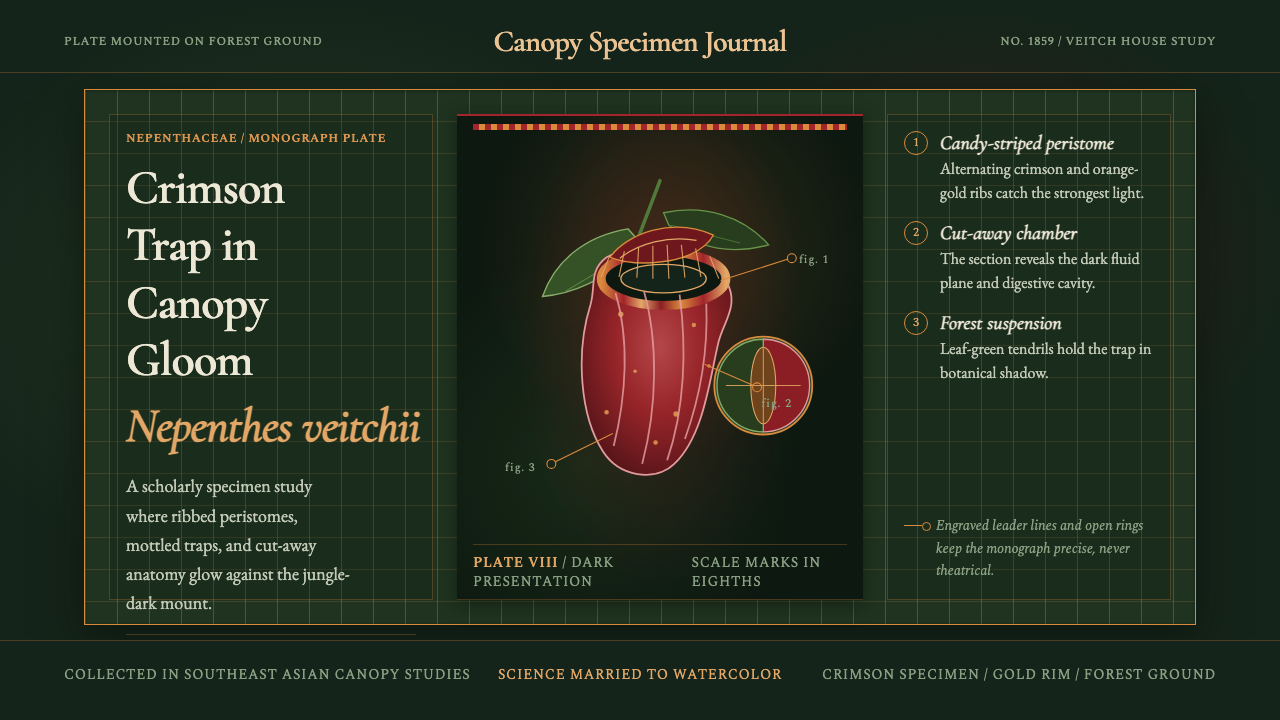 Carnivorous Pitcher PlantBotanical danger glows. Crimson traps and gold rims float on jungle-dark gree…
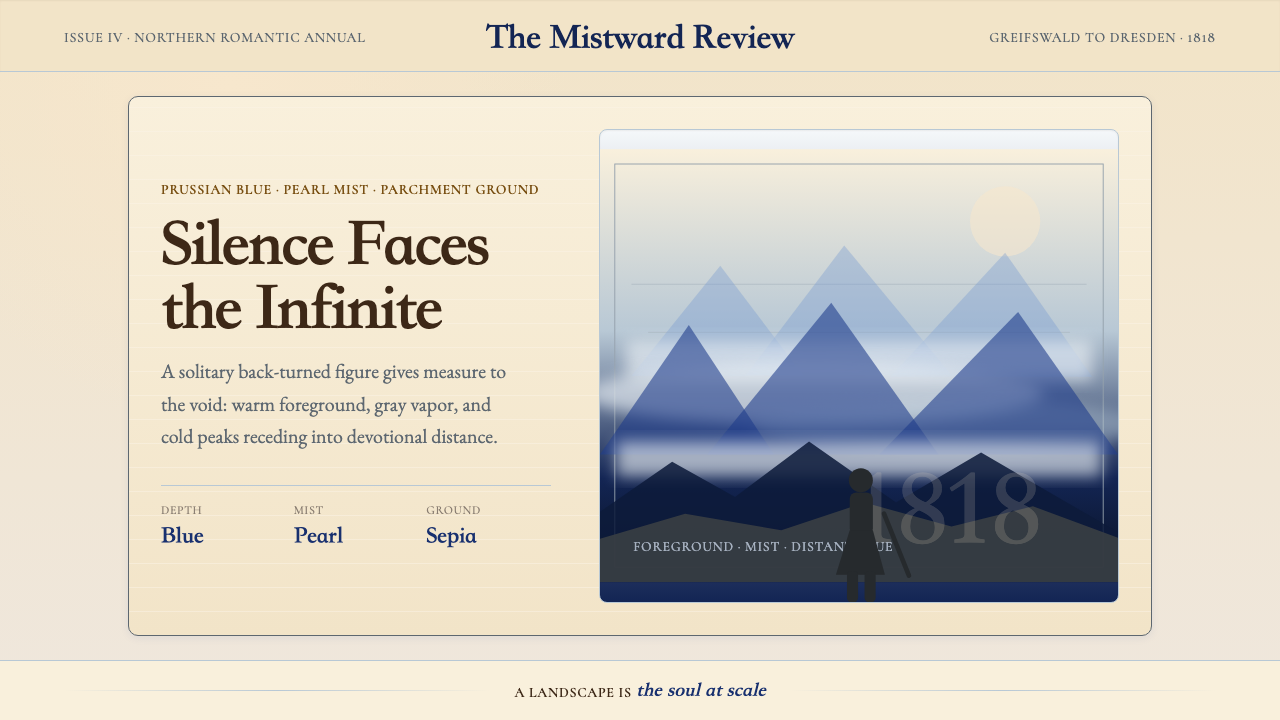 Caspar David FriedrichSilence becomes vast. Prussian blue depth, pearl mist, and parchment framing…
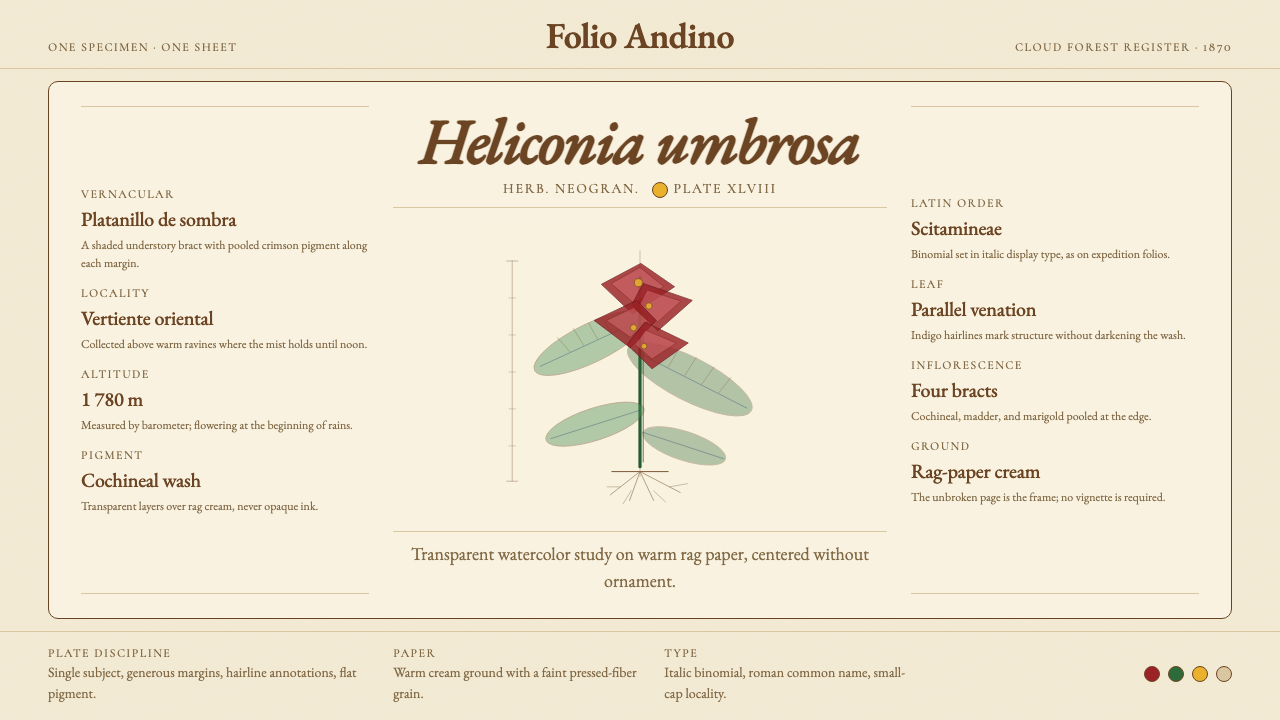 Colombian Botanical (Triana)Observation becomes ornament. Crimson watercolor specimen breathes on cream r…
 Degas Ballet PastelsBackstage glamour is labor. Jade walls, rose footlights, cropped serifs on cr…
 Millais — Ophelia / Wildflower Pre-RaphBotany, rendered with conviction. Cream gesso, emerald, and vermilion stay in…
 Tamil Grantha InscriptionSacred stone, quietly lit. Pale Grantha glyphs float on dark granite in a nar…