What is Colombian Botanical (Triana)?
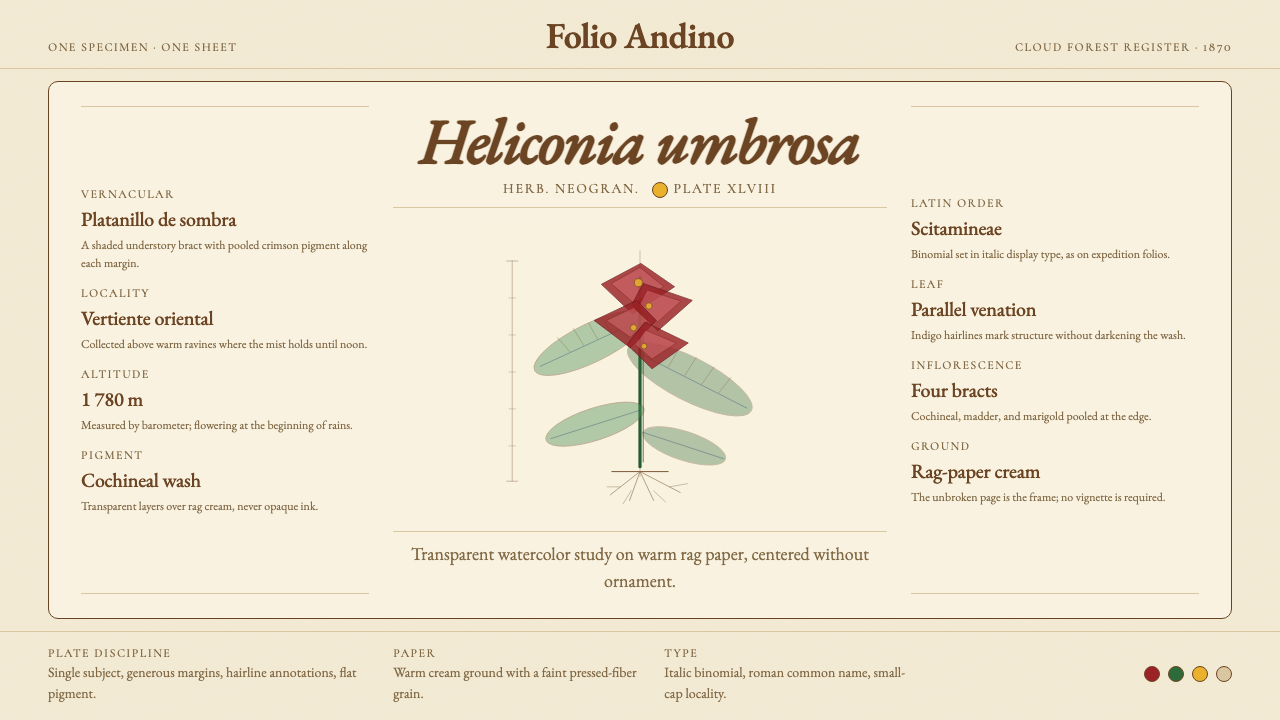
Seven thousand folio sheets of Andean orchids and palms, rendered in translucent watercolor on cream rag paper, gave the world its most rigorous and beautiful tradition of scientific illustration.
Colombian Botanical (Triana) in brief
Colombian Botanical illustration — named for the Triana tradition after botanist José Jerónimo Triana, who brought the expedition's legacy to European scientific circles — is a visual discipline built on a single conviction: the specimen itself is sufficient. On a field of untouched cream paper, a single oversized flower, palm frond, or heliconia spike occupies the sheet with calm authority. Roots are laid out in anatomical sequence. Venation of every leaf is traced with the patience of a mapmaker. Every stamen, sepal, and seed capsule is accounted for. The page is not decorated — it is observed.
The aesthetic is one of the few traditions in Western visual history where scientific precision and artistic beauty are not in tension but are identical goals. The translucent layering of watercolor pigment creates luminosity without opacity; shadows are built up through transparent washes that retain the paper's warmth rather than covering it. The result is specimens that appear lit from within — not painted, but revealed. Color ranges from the deep crimson of Andean bromeliads to the pale ochre of dried palm fiber, always grounded in naturalistic observation rather than decorative choice.
In contemporary design, this tradition translates into an aesthetic that values generous white space, a single dominant botanical subject at large scale, restrained earth-toned palettes derived from specimen pigmentation, and a total absence of geometric abstraction or typographic display. It is the opposite of maximalism and the opposite of sterile minimalism — it is observation elevated to the status of ornament.

Where does Colombian Botanical (Triana) come from?
In 1783, the Spanish Crown authorized the Real Expedición Botánica del Nuevo Reino de Granada — the Royal Botanical Expedition of the New Kingdom of Granada — under the direction of José Celestino Mutis, a physician and naturalist from Cádiz who had lived in New Granada since 1761. The expedition was part of the broader Enlightenment project of cataloguing the natural world, modeled on similar surveys in Peru and Chile but far more ambitious in scope. Mutis established his base at Mariquita, a town in the hot valley east of the Magdalena River, and later moved operations to Santa Fe de Bogotá. Over thirty-three years, the expedition documented the botanical wealth of the Andean cloud forests, the humid lowlands, and the páramo highland plains.
What distinguished the expedition visually was Mutis's decision to train local painters rather than rely solely on European illustrators shipped from Spain. He recruited indigenous and mestizo artists from the region, establishing a workshop that at its height employed more than thirty painters. The chief among them was Salvador Rizo, a mulato painter from Mompox who became the expedition's lead illustrator and whose compositions defined the format that the entire workshop followed: the specimen centered on the sheet, oriented for maximum legibility of its diagnostic features, rendered at a scale larger than life when the flower was small, and at natural scale when large. Francisco Javier Matís, another workshop painter, became celebrated in Europe after Alexander von Humboldt — who visited Mutis in Bogotá in 1801 — called him the finest botanical painter in the world.
The expedition produced nearly seven thousand folio sheets between 1783 and 1816, but they were never formally published during Mutis's lifetime. He died in 1808 with the archive incomplete. The sheets remained in Bogotá and later in Madrid, where they were transferred after independence, constituting one of the largest unpublished botanical archives in history. It was José Jerónimo Triana, a Colombian botanist who had emigrated to Paris in the 1850s, who brought the tradition into European scientific publication. Working from the expedition's materials and his own fieldwork, Triana published systematic studies of Colombian flora through the 1860s and 1880s, establishing in the European scientific community the name and reputation of the Colombian botanical school. His name became synonymous with the tradition in the way that Mutis's operational role had not: Triana was the public face of Colombian botanical science in Europe.
The Enlightenment roots of the expedition mean that the visual system is inseparable from its scientific ambitions. The illustration conventions — the blank ground, the single specimen, the anatomical completeness, the multi-language labeling — were not aesthetic preferences but epistemological ones. A botanical illustration was a scientific argument: it claimed to show the species in its complete, typical form, stripped of the contingencies of any individual plant at any particular moment. This commitment to the specimen as argument, rather than as decoration or narrative, gives the tradition its characteristic combination of visual quietness and cognitive intensity. The page feels still because everything unnecessary has been removed; it feels rich because nothing necessary has been omitted.
What defines the Colombian Botanical (Triana) look?
Palette
The color range is entirely naturalistic, derived from the pigments of Andean flora: deep crimson and vermilion from bromeliads and heliconias, ochre and raw sienna from seed pods and dried stems, soft moss green and blue-green from fern fronds and palm leaves, pale cream from the paper ground that is allowed to breathe through every wash. There are no invented colors, no decorative accents unrelated to the specimen. Saturation is high in the bloom itself and diminishes toward the stem and root, mirroring how living color behaves in nature.
Ground and Space
The cream rag paper ground is not a neutral backdrop but an active element. It provides the warmth that unifies all specimen colors, the breathing space that makes a single plant feel monumental, and the luminosity that watercolor cannot create from pigment alone. Margins are generous; the specimen never crowds the sheet's edge. The surrounding emptiness is not void but potential — it is where the eye rests after moving through the botanical detail.
Watercolor Technique
The hallmark technique is transparent layering: pigment is applied in successive thin washes that build depth without losing translucency. Shadow areas are achieved by adding cool, slightly greyed washes over warm underpainting, creating the impression of form without the opacity of opaque media. Highlights are preserved as bare paper rather than added with white pigment. The result is a luminous quality that no print reproduction fully captures — the sense that the specimen is generating its own light.
Anatomical Completeness
Each illustration accounts for the whole organism: flower in full bloom and in cross-section, leaf from both surfaces when the undersides differ, root system exposed and mapped, seed or fruit included at the same or enlarged scale. There are no decorative omissions and no compositional shortcuts. A diagnostic feature that is botanically significant will be isolated and enlarged in a corner vignette. The page reads as an argument — here is everything you need to know about this species — rather than as a portrait of a single beautiful plant.
Scale and Hierarchy
The primary specimen is always rendered at a scale that fills the sheet with authority. Small flowers — an Andean orchid with a bloom no wider than a thumbnail — are shown several times larger than life so that structural detail is legible. Large inflorescences, such as a heliconia, may be compressed to fit but never cropped. Supporting elements — detail vignettes, labels, scale indicators — are subordinate in size and placed at the sheet's margins. This hierarchy of scale communicates importance directly, without color or typographic device.
Labeling and Text
Labels in the original expedition sheets appear in three languages: Spanish vernacular names, Latin binomials following Linnaean nomenclature, and indigenous Muisca, Quechua, or local regional names. This multilingual annotation is not ornamental — it reflects the epistemological ambition of the expedition to account for the plant across multiple knowledge systems simultaneously. In contemporary applications of the style, text is sparse, set in a typeface with an antiquarian or manuscript quality, and positioned close to the specimen rather than in separate title areas.
Ornament from Observation
The paradox at the heart of this tradition is that the complete absence of decorative intent produces some of the most decorative objects in Western art history. Because nothing is added for visual effect, everything present is load-bearing — and the cumulative weight of observed detail creates a density of visual interest that purely ornamental traditions rarely achieve. A single sheet from the Mutis archive has more to look at than most designed posters, because every mark is justified by what the plant actually is rather than by what the artist thought would be beautiful.

Who shaped Colombian Botanical (Triana)?
Mutis was the physician, mathematician, and naturalist who conceived and directed the expedition from its founding in 1783 until his death in 1808. Born in Cádiz in 1732, he arrived in New Granada as personal physician to the Viceroy and devoted the rest of his life to the botanical wealth of the Andes. He corresponded with Linnaeus, trained the workshop of painters, and established the visual protocols — the large-format sheets, the blank grounds, the anatomical completeness — that defined the tradition. He never published the expedition's results, leaving a legacy that was monumental in scope and invisible in reach until European botanists began to work through the archives decades later.
Rizo was the mulato painter from Mompox who served as the expedition's lead illustrator and workshop director under Mutis. His compositional decisions — how to orient a specimen for maximum diagnostic legibility, how to scale a small flower to fill a folio sheet without distortion, how to represent root systems as both scientific record and coherent image — became the standard that the entire workshop emulated. The quality and consistency of the Mutis archive owes more to Rizo's technical and organizational leadership than to any other single individual. He represents the indigenous and mestizo contribution to a tradition usually named for its European scientific director.
Triana was the Colombian botanist who became the tradition's European ambassador. Arriving in Paris in the 1850s, he worked at the Natural History Museum and published systematic studies of Colombian flora through the 1860s and 1880s that brought the expedition's scientific legacy to the attention of European researchers. His monograph on the Guttiferae family and his publications on Cinchona — the source of quinine, essential to colonial medicine — established him as a figure of international standing. The naming of the tradition after him reflects the fact that European scientific institutions encountered Colombian botany primarily through his publications rather than through Mutis's unpublished archive.
Matís was the expedition painter whom Alexander von Humboldt, after visiting Bogotá in 1801, called the finest botanical painter in the world — high praise from a man who had seen the best European scientific illustration of his era. Matís continued to paint botanical subjects into the early nineteenth century, bridging the expedition's colonial-era production and the independent Colombian republic's nascent scientific institutions. His technical mastery of the translucent watercolor method — particularly the rendering of orchid petals and the texture of mossy bark — represents the tradition at its most accomplished.
Although Humboldt was not a member of the expedition, his 1801 visit to Mutis in Bogotá — and his subsequent writings about the expedition's scientific achievement — were decisive in shaping European awareness of the Colombian botanical tradition. Humboldt's own illustrated publications on South American natural history, particularly his Plantes équinoxiales, drew on aesthetic principles similar to those the Mutis workshop had developed, and his enthusiastic accounts of the workshop's quality reached scientific audiences across Europe. His advocacy turned an unpublished colonial archive into a recognized chapter in the history of scientific illustration.
How do you use Colombian Botanical (Triana) today?
Colombian Botanical is one of the most specific historical styles available to contemporary designers — specific in the sense that its visual logic is inseparable from its subject matter. Applied correctly, it creates an immediate sense of intellectual authority and natural richness that very few other aesthetic traditions can replicate. Applied carelessly — as a wallpaper pattern or a generic green-and-cream color scheme — it loses everything that makes it distinctive. The key is to work from the same principles the expedition painters worked from: generous space, a single subject at commanding scale, color that follows the specimen rather than the designer's preference.
For presentation slides, the style works best when each slide is treated as a single folio sheet. A cover slide places one large botanical illustration — or a close detail of one — against a cream or warm white ground, with the title set in a sparse, slightly antiquarian typeface positioned as a label rather than a headline. Content slides use the same ground color, with text set in a narrow column and generous margins left open. Data slides transform charts into specimen-like objects: a bar chart becomes a row of botanical specimens at varying heights, colored in the ochre-to-crimson range of the palette. The style works less well for dense data tables and should not be forced into grid-heavy layouts.
For web interfaces, Colombian Botanical is best suited to contexts where a single focal image carries most of the visual weight: a product page for a luxury botanical brand, a science communication site, an academic archive, or a wellness platform where natural provenance is a core brand value. The approach: a cream or warm off-white background, a single large botanical image or illustration at hero scale, body text set in a readable but slightly formal typeface, and interactive elements — buttons, links, hover states — indicated through subtle shifts in the warm earth palette rather than through primary-color saturation. Dashboard and pricing page applications are possible but require careful restraint; the style resists dense information hierarchy.
For editorial and marketing work, the style delivers maximum impact in contexts that can afford visual slowness — annual reports, luxury brand lookbooks, cultural institution publications, and long-form digital editorial. A two-page spread with a full botanical illustration on the left and a narrow column of text on the right, set against the cream ground, reads as both authoritative and beautiful. Marketing materials work well when they adopt the expedition's labeling convention: product names or claims set as if they were Latin binomials, annotations positioned close to the subject rather than in separate typographic zones. The style's historical specificity makes it immediately legible as a reference to natural science — it should be used when that association adds value rather than merely as a decorative shortcut.
The most common mistake when applying this style is treating it as a botanical-pattern aesthetic rather than a botanical-illustration aesthetic. Repeating floral motifs, dense all-over surface patterns, and decorative vine borders are the opposite of what the tradition does: the expedition paintings place one specimen, carefully, in a generous field of empty paper. A second common error is over-saturating the palette — using vivid emerald greens and bright magentas that feel contemporary but have nothing to do with the restrained, naturalistic pigments of watercolor on aged paper. A third mistake is mixing the style with geometric or abstract compositional devices; the tradition is figurative and observational, not designed in the abstract sense, and it loses its character when forced into grid systems or combined with flat geometric shapes.

Colombian Botanical (Triana) — FAQ
Is this style suitable for technology or software products?
Occasionally, but with significant caveats. The style reads immediately as organic, historical, and natural-science oriented — associations that work against technology products positioning themselves as fast, innovative, or cutting-edge. Where it can work is in technology contexts that want to signal care, depth, and craftsmanship: a botanical-data API, a biodiversity research platform, a scientific instrument brand, or a sustainability-focused enterprise product. In these cases the historical resonance is an asset. In consumer-facing software, especially anything requiring quick comprehension or dense information, the style's visual slowness and ornamental richness tend to compete with usability.
How does Colombian Botanical differ from other botanical or nature-inspired aesthetics?
Most botanical aesthetics in contemporary design derive from Victorian decorative traditions — William Morris, Arts and Crafts, Art Nouveau — where the plant form is abstracted, stylized, and repeated as pattern. Colombian Botanical is the opposite: it is scientific, not decorative; it presents the whole organism rather than a stylized fragment; it insists on blank space rather than all-over fill; and its palette is constrained by naturalistic pigment rather than expanded for decorative richness. The closest contemporary cousins are Japanese botanical woodblock illustration and the Dutch Golden Age flower painting tradition — both of which share the commitment to the single specimen at center stage, though with different compositional and pigment conventions.
Can the style work in dark-mode or dark-background applications?
With considerable difficulty. The tradition's luminosity depends fundamentally on the warm cream paper ground — it is the substrate that gives the watercolor its glow. Inverting to a dark background requires either using actual illuminated specimen photography (which can work beautifully in the right context, evoking a lightbox or a microscope slide) or making a significant aesthetic departure from the tradition. A dark inversion works best when framed as a nighttime or archival context: a deep blue-black ground suggesting a storage drawer or a vellum folder in low light, with specimen illustrations rendered as if lit by a single lamp. This is a valid creative extension, but it is not the tradition itself.
What typefaces pair well with this style?
The original expedition sheets used handwritten labels that combined technical precision with the slight irregularity of hand production. In contemporary applications, typefaces with a slightly antiquarian or manuscript quality work best — letterforms that feel considered and unhurried, with a suggestion of historical context, rather than faces that read as purely contemporary. Serifs in the classical or transitional tradition pair naturally; so do careful humanist faces that retain a pen-drawn quality. Display type should be used sparingly, as the style's visual authority comes from the specimen, not from typographic showmanship. Type that draws attention to itself through novelty or complexity competes with the botanical subject and should be avoided.
How should imagery be sourced or created for this style?
The best source is the tradition itself: the Mutis archive and related expedition materials are held by the Real Jardín Botánico de Madrid and the Biblioteca Nacional de Colombia, and high-resolution scans of public-domain sheets are increasingly available through institutional digitization projects. These originals, used directly, carry an authenticity that no contemporary reproduction can match. When original materials are not accessible, commissioning watercolor botanical illustration in the scientific tradition is the correct approach — not vector botanical graphics, not photography of living plants (which has a different visual logic), and not AI-generated imagery (which tends to blur the precise anatomical detail on which the style depends). When photography must be used, it should be treated as a specimen on a light ground: isolated, cleanly lit, at a scale that respects the subject's structural complexity.
Related design styles
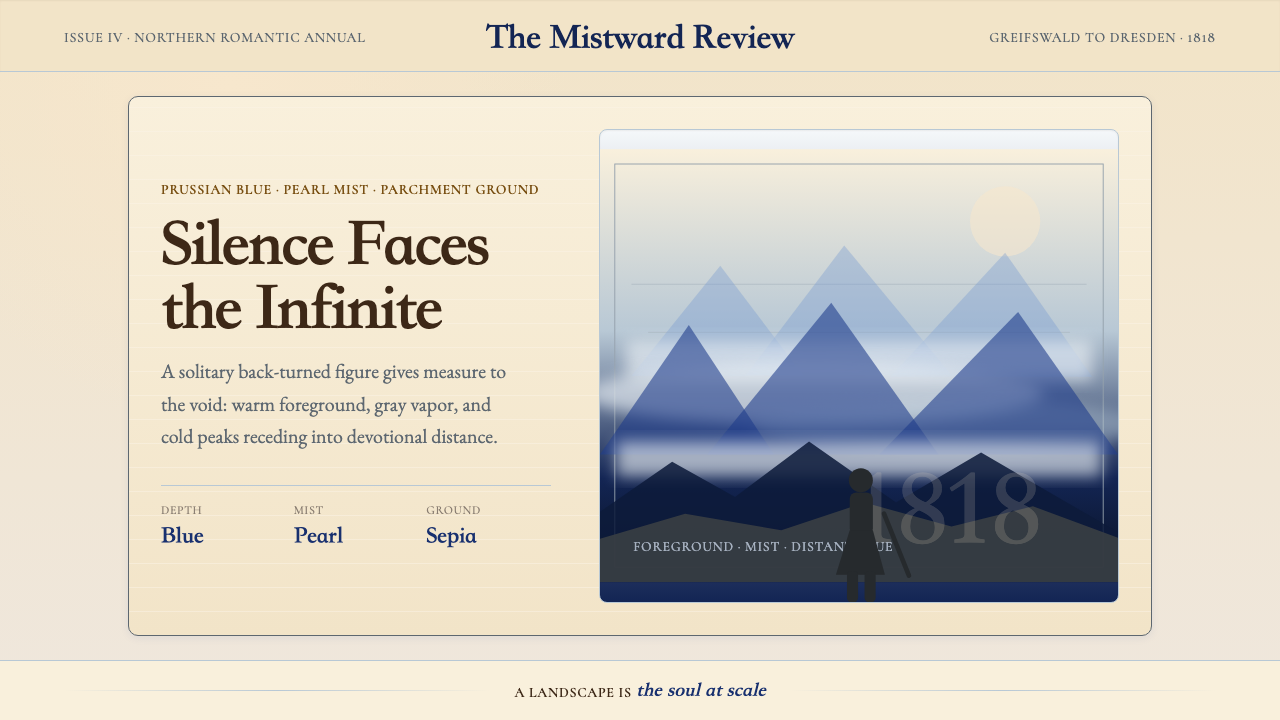 Caspar David FriedrichSilence becomes vast. Prussian blue depth, pearl mist, and parchment framing…
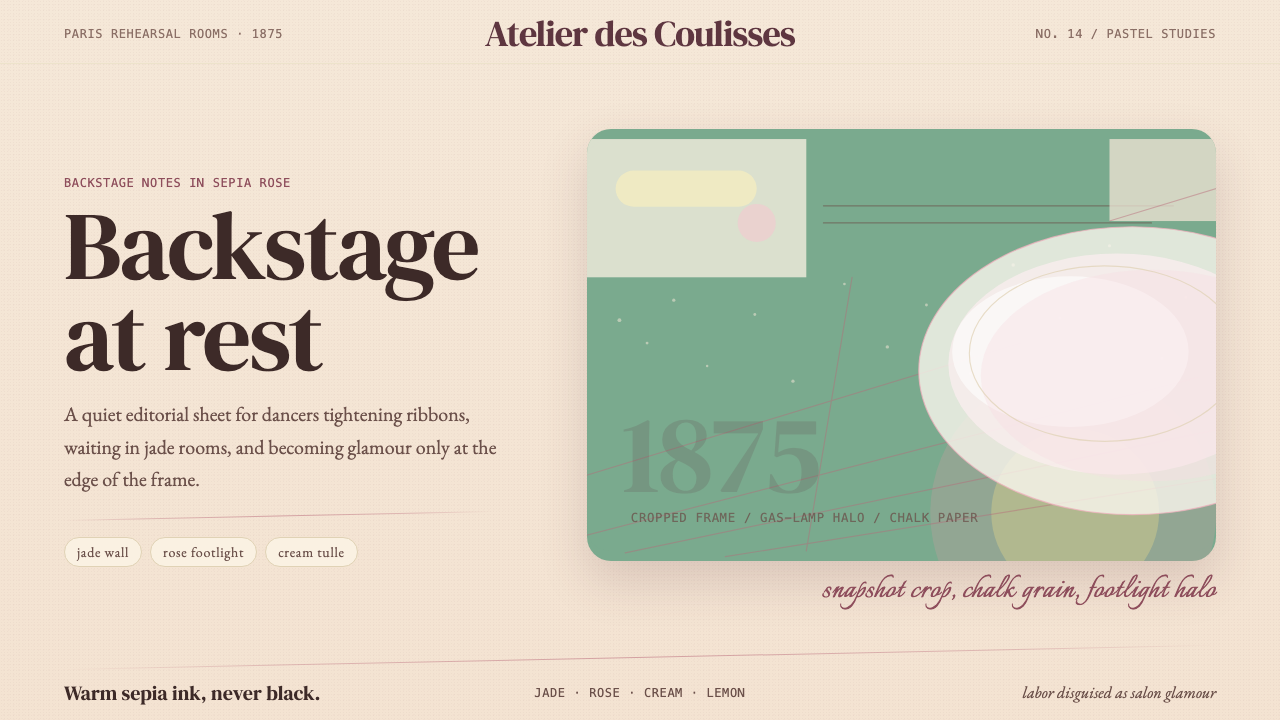 Degas Ballet PastelsBackstage glamour is labor. Jade walls, rose footlights, cropped serifs on cr…
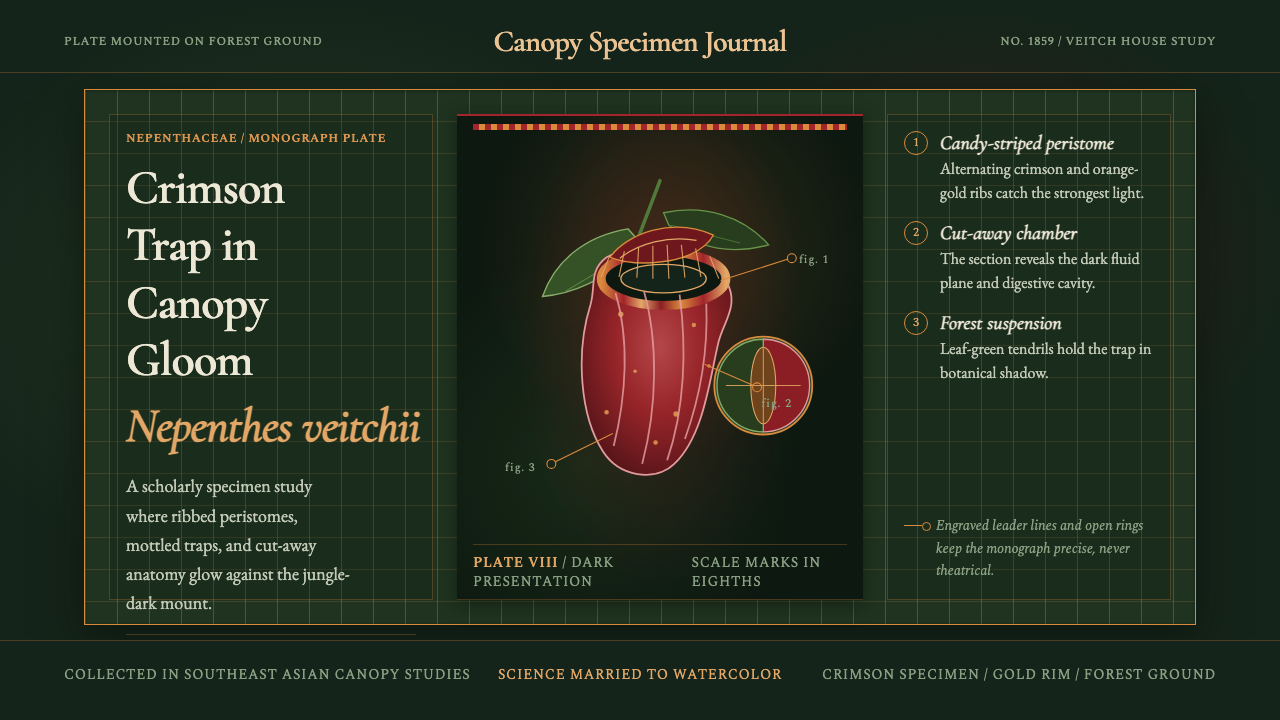 Carnivorous Pitcher PlantBotanical danger glows. Crimson traps and gold rims float on jungle-dark gree…
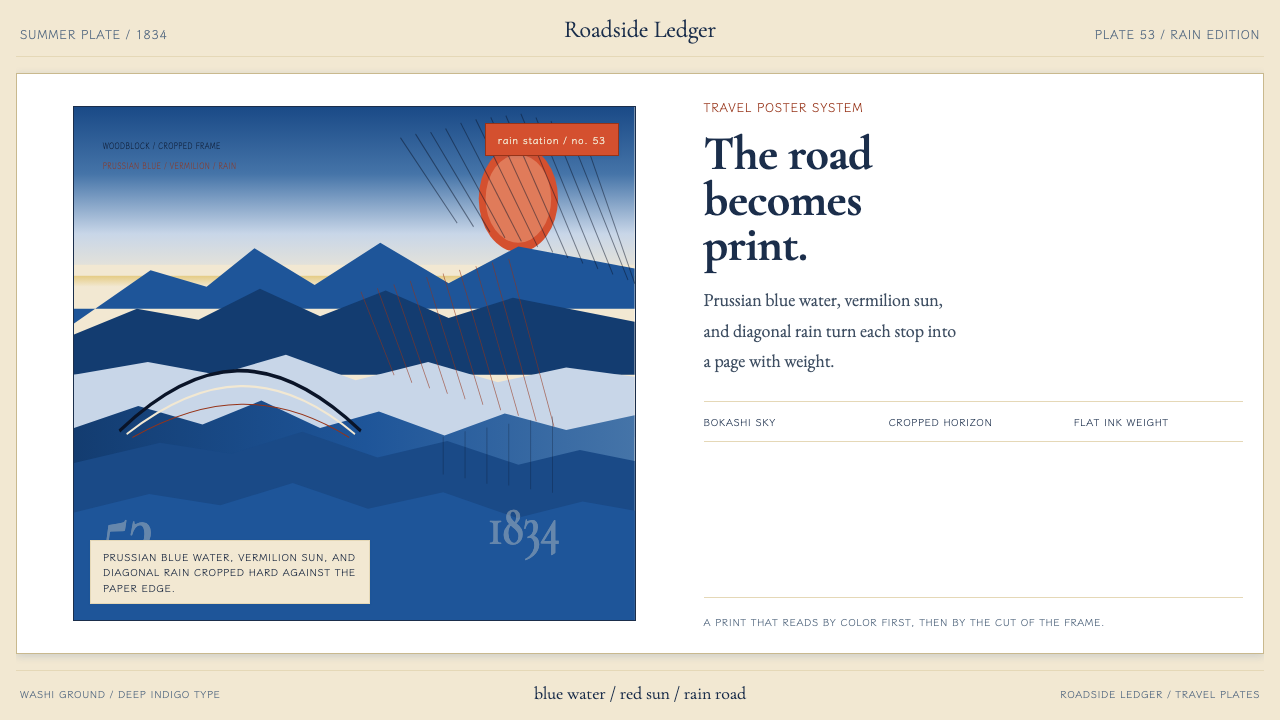 Hiroshige — Tokaido RoadA road print in motion. Prussian blue blocks, vermilion cartouches, diagonal…
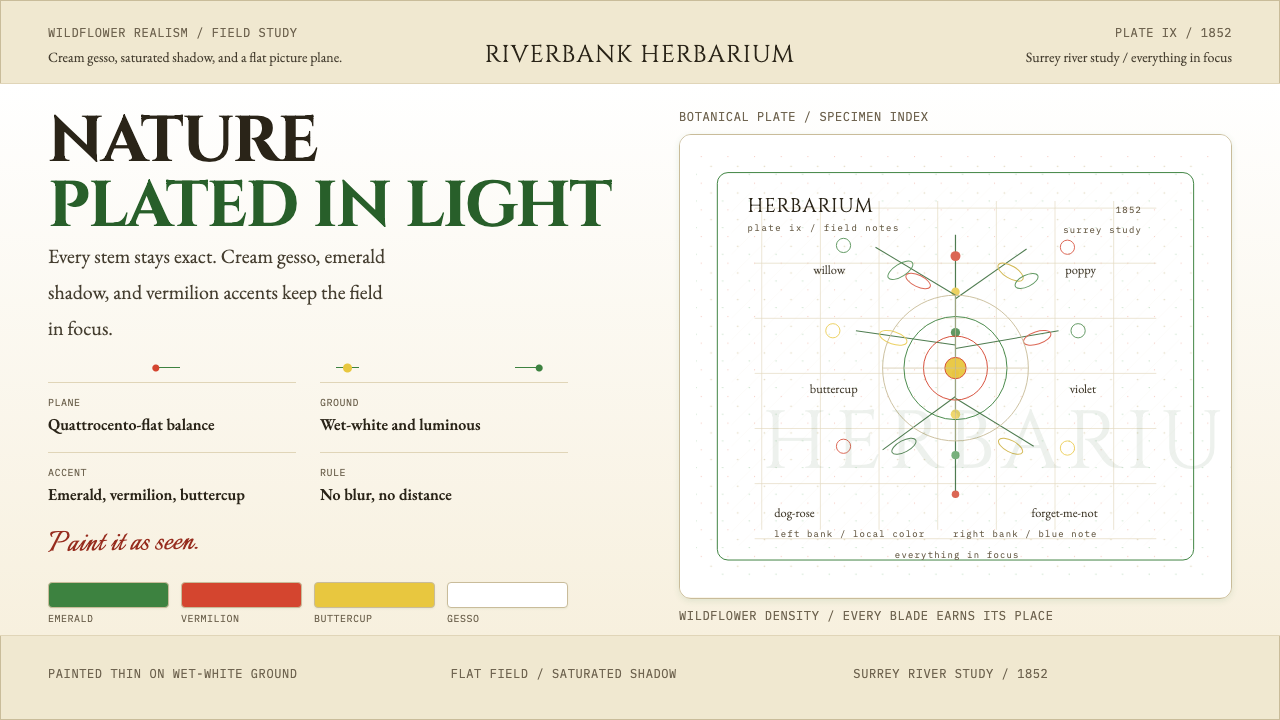 Millais — Ophelia / Wildflower Pre-RaphBotany, rendered with conviction. Cream gesso, emerald, and vermilion stay in…
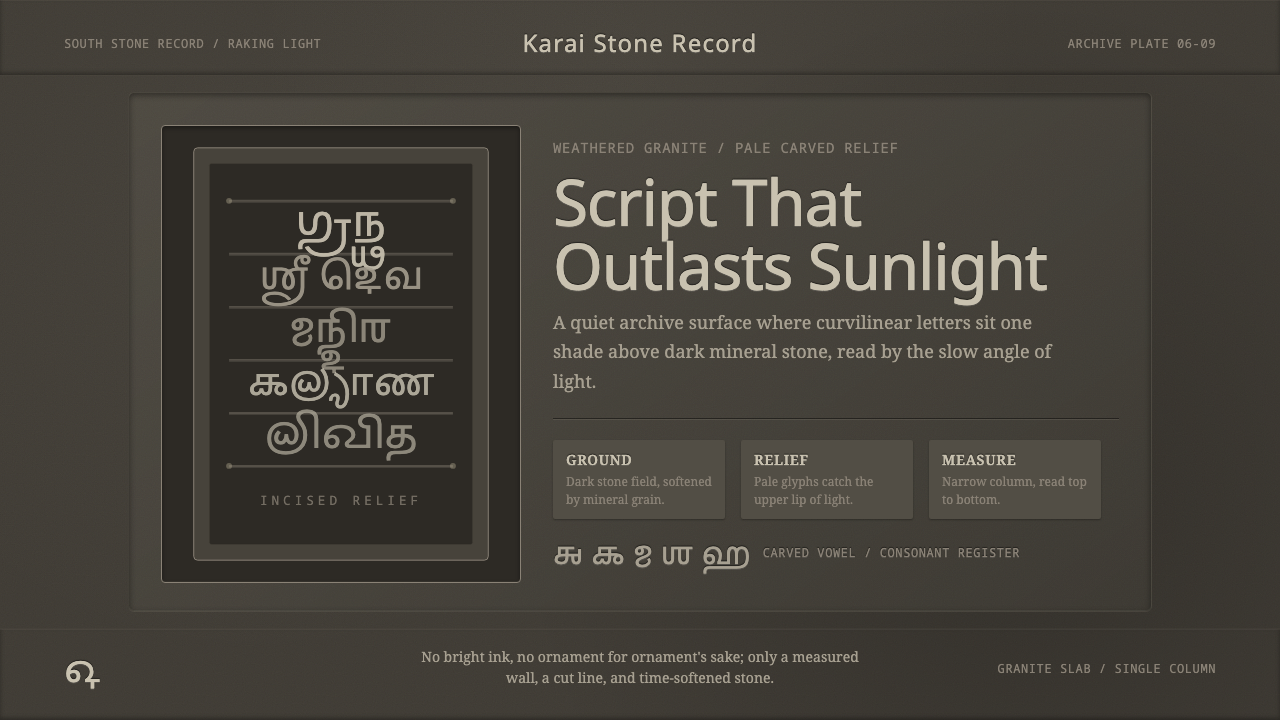 Tamil Grantha InscriptionSacred stone, quietly lit. Pale Grantha glyphs float on dark granite in a nar…