What is Aztec Codex?
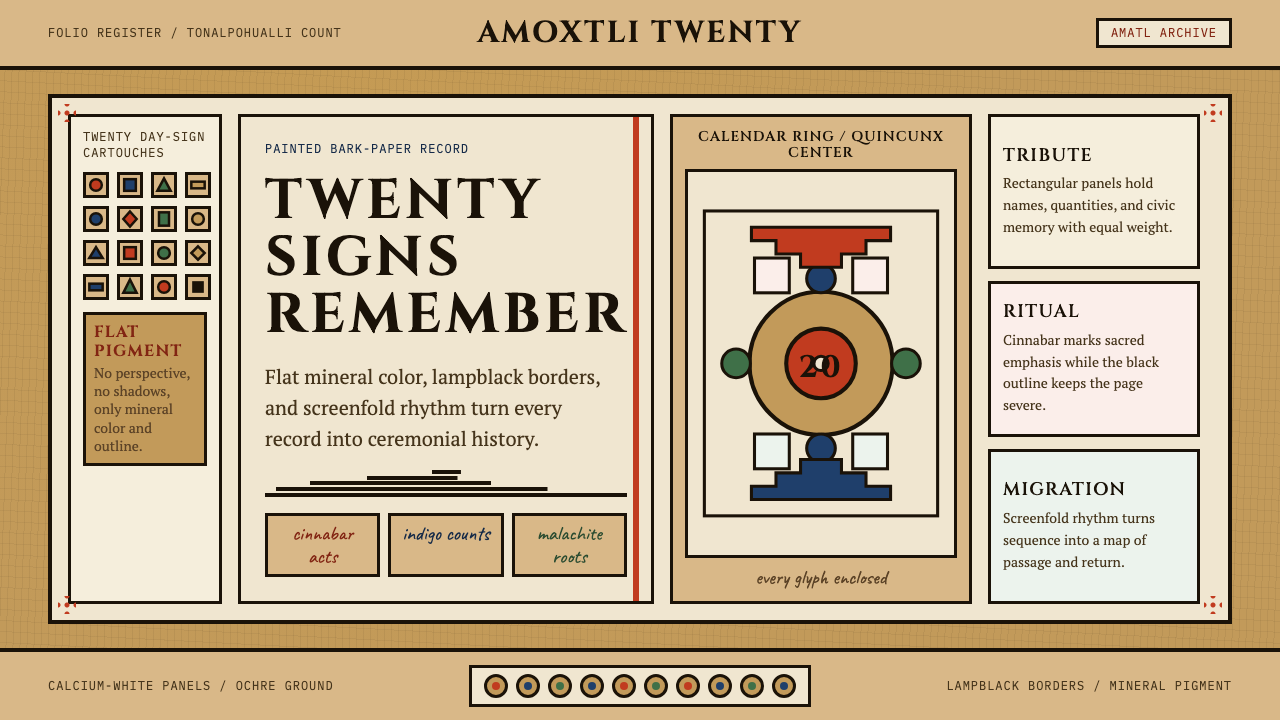
Painted on folded bark paper by anonymous tlacuilo scribes, Aztec codices compressed an entire civilization — its gods, calendars, and conquests — into flat mineral color and thick black outline.
Aztec Codex in brief
Aztec Codex is a design system derived from the painted bark-paper screenfolds (amatl) produced by the Mexica civilization between roughly 1300 and 1577. These manuscripts — among them the Codex Mendoza, the Codex Borgia, and the Florentine Codex — recorded tribute obligations, ritual calendars, and cosmological narratives in a visual language that is simultaneously symbolic, sequential, and architecturally ordered. The design system extracts that visual language into a contemporary toolkit: amatl ochre as the dominant ground, cinnabar red and indigo blue as structural accents, malachite green for categorical differentiation, lampblack for outline and type, and limestone white for panel breaks and negative space.
The system is distinguished by three formal commitments: flatness, frontality, and cartouching. Every figure sits flush against its ground with no cast shadow or atmospheric perspective. Figures are depicted frontally or in strict profile — never at intermediate angles — reflecting the codex convention that orientation carries meaning rather than illusion. And every significant element is enclosed in a thick-stroked rectangular or stepped cartouche, the visual equivalent of a sentence boundary in prose. Day-sign glyphs, tribute tallies, and deity portraits each occupy their own bounded field, creating a grid of cells that reads simultaneously as image and as data.
What makes Aztec Codex distinctive among historical revival styles is its refusal of fiesta kitsch. The palette is mineral and muted, not festive and saturated. The geometry is rigorous and calendrical, not decorative. The system is designed for narrative, archival, and culturally grounded interfaces — contexts where visual weight and historical authority matter, not contexts where surface warmth or commercial friendliness is the goal.

Where does Aztec Codex come from?
The visual culture that Aztec Codex draws upon developed over centuries in Central Mexico within the overlapping traditions of the Mexica (Aztec) empire and its neighbors in the Valley of Mexico. The tlacuilo — a specialized scribe-painter whose training began in childhood at institutions called calmecac — was responsible for producing these manuscripts. Tlacuilos were not simply copyists; they were specialists who held knowledge of the tonalpohualli (the 260-day ritual calendar), the xiuhpohualli (the 365-day solar calendar), and the pictographic conventions that allowed both to be rendered legibly on bark paper or deerskin. The surviving pre-conquest codices, including the Codex Borgia and the Codex Laud, were produced in this tradition and represent the most intact examples of the pre-colonial visual system.
The Spanish conquest of Tenochtitlan in 1521 disrupted but did not immediately destroy the codex tradition. Colonial administrators quickly recognized that the pictographic manuscripts were indispensable records of tribute, land tenure, and local governance. The Codex Mendoza, commissioned around 1541 by Antonio de Mendoza, the first Viceroy of New Spain, was explicitly produced to convey to the Spanish Crown the structure of Aztec tribute and conquest history. Its pages were painted by tlacuilo scribes using the traditional pictographic system, with Spanish-language glosses added alongside. This hybrid document — pre-Columbian in its visual grammar, colonial in its administrative purpose — is among the finest exemplars of the style.
The Franciscan friar Bernardino de Sahagún undertook the most systematic colonial documentation of Mexica culture between roughly 1545 and 1590. His General History of the Things of New Spain, commonly known as the Florentine Codex, compiled in twelve volumes with both Nahuatl text and Spanish summaries, was illustrated by trained Nahua artists working in a style that blended the indigenous pictographic tradition with European naturalistic conventions. The illustrations in the Florentine Codex are a critical record of the transition period and show how the original visual system began to absorb Renaissance line-weight variation and perspectival hints while retaining its essentially flat and cartouched character.
The modern design legacy of Aztec codices emerged through two channels. The first was archaeological and art-historical scholarship: from the late nineteenth century onward, major codices held in European libraries — the Codex Borgia in the Vatican, the Codex Vindobonensis in Vienna, the Codex Mendoza in Oxford — were photographically reproduced and made available to scholars and designers worldwide. The second was the Mexican Muralist movement of the early twentieth century, in which Diego Rivera, José Clemente Orozco, and David Alfaro Siqueiros drew heavily on pre-Columbian visual conventions to construct a national visual identity. Contemporary use of the Aztec Codex aesthetic in design descends from both traditions: rigorous historical scholarship about what the original manuscripts actually looked like, and a longer cultural tradition of treating these images as living visual resources rather than archaeological artifacts.
What defines the Aztec Codex look?
Palette
The palette is mineral and historically grounded: amatl ochre (the warm, slightly darkened tan of processed bark paper) serves as the dominant ground. Against this ground, cinnabar red signals ritual importance and structural emphasis, indigo blue marks celestial and watery domains, malachite green distinguishes vegetation and fertility figures, and lampblack provides all outlines and typographic elements. Limestone white appears as a highlight and panel separator. The overall character is earthy, saturated but not bright — colors that appear to have been ground from stone rather than mixed from synthetic pigment.
Outline and Cartouche
Every figure and significant element is bounded by a thick, consistent black stroke. There is no line-weight variation for depth or atmosphere — the outline weight is structural, not expressive. Cartouches take two primary forms: the rectangular border (used for tribute counts, day-sign registers, and text panels) and the stepped or interlocking border (echoing the talud-tablero architectural profile of Mesoamerican temple platforms). These borders are not decorative additions; they are the primary organizational mechanism, equivalent to the cell structure of a spreadsheet or the frame of a comic panel.
Day-Sign Glyphs
The tonalpohualli calendar is divided into twenty named day-signs — Crocodile, Wind, House, Lizard, Serpent, Death, Deer, Rabbit, Water, Dog, Monkey, Grass, Reed, Ocelot, Eagle, Vulture, Movement, Flint, Rain, Flower — each with a fixed pictographic form. These glyphs appear in registers along the borders of composition, marking calendrical sequence. In contemporary use, day-sign glyphs function as repeating border motifs, section dividers, or icon-like categorical markers. Their strict formal constraints — each fits within a roughly square cell — make them highly adaptable as a modular visual system.
Frontality and Profile Convention
Human and divine figures in the codices are rendered either fully frontal or in strict profile — these are the only two orientations the system recognizes. There is no three-quarter view, no foreshortening, no atmospheric perspective. Frontality denotes authority or sacred status; profile denotes action or narrative sequence. This convention is not a limitation of skill — tlacuilo painters who worked after the conquest demonstrated fluency with European spatial conventions when required — but a deliberate semantic choice in which orientation carries meaning. Applying this principle in contemporary design means treating the angle of every figure as a communicative decision rather than a stylistic preference.
Grid and Sequence
The internal organization of a codex page is not compositional in the Western easel-painting sense — it is sequential and cellular. Reading order follows a boustrophedon or serpentine path through a grid of cartouched cells, with footprints, lines, and directional glyphs indicating the reading path explicitly. This grid-and-sequence logic translates directly into contemporary interface design: the codex page structure is essentially a data table or dashboard panel array, where each cell is self-contained but positioned within a larger navigational sequence. The aesthetic of the structure is not imposed but intrinsic.
Typography and Glyph Integration
In the original codices, there was no alphabetic text — meaning was encoded entirely in pictographic and ideographic glyphs. The contemporary Aztec Codex system integrates Roman capitals with serif letterforms that carry a weight and axis reminiscent of colonial-era stonecutting — the Trajan tradition — to bridge the pre-Columbian visual grammar with legible Latin text. This combination is deliberate: the serif capital evokes the colonial-Latin inscriptions that appeared alongside codex imagery in the decades after the conquest, creating a historically layered visual voice. Body text and captions benefit from the same axial consistency, keeping the typographic register austere and monumental rather than warm and approachable.
Symbolic Color Assignment
In the codices, color functions as a taxonomic code rather than a decorative choice. Tlaloc, the rain deity, is consistently rendered in indigo blue and malachite green; Xipe Totec wears cinnabar red; Quetzalcoatl appears in turquoise and white. This system of fixed color-identity pairings was not arbitrary — it encoded cosmological and calendrical associations that a literate viewer would recognize immediately. Applying Aztec Codex in contemporary design means honoring this principle: assign colors to categories or states consistently and systematically, and resist the impulse to introduce additional hues for visual variety. The constraint is the meaning.

Who shaped Aztec Codex?
The tlacuilo (plural tlacuiloque) were specialist scribe-painters trained from childhood in the calmecac, the Mexica institution for priestly and administrative education. They held proprietary knowledge of both calendrical systems, the pictographic conventions for representing deities, tribute items, place names, and human figures, and the material techniques for preparing amatl bark paper, grinding mineral pigments, and laying color in flat, opaque layers. Because the Spanish colonial authorities suppressed knowledge of who made specific codices, and because the pre-Columbian tradition did not involve individual attribution in the Western sense, the tlacuiloque remain collectively anonymous — yet they are the direct authors of the entire visual vocabulary that Aztec Codex draws upon.
Antonio de Mendoza, the first Viceroy of New Spain (serving 1535–1550), commissioned the document now known as the Codex Mendoza around 1541. His intention was to produce a comprehensive account of Aztec tribute, conquest history, and daily life for presentation to the Spanish Crown. The resulting codex is a hybrid object: its images were painted by tlacuilo scribes using the traditional pictographic system in full, while Spanish-language glosses were added to translate the content for European readers. The Codex Mendoza is among the best-preserved and most extensively studied of all surviving codices, and its pages — particularly the tribute lists with their systematic grid of commodity icons — are among the most direct antecedents for the contemporary Aztec Codex design system.
Sahagún (c. 1499–1590) was a Franciscan friar who arrived in New Spain in 1529 and devoted most of his subsequent life to documenting Mexica language and culture. His monumental work, the General History of the Things of New Spain (Florentine Codex), compiled over several decades, is one of the most comprehensive ethnographic records of any pre-modern culture. Crucially for the design legacy, the Florentine Codex was illustrated by Nahua artists working under Sahagún's direction, producing images that sit at the intersection of the indigenous pictographic tradition and European naturalistic conventions introduced by colonial contact. These illustrations — showing how the codex visual system adapted under external pressure while retaining its essential character — are a key reference for understanding both the range and the limits of the style.
Rivera (1886–1957) is the figure most responsible for bringing the visual conventions of Aztec codices into twentieth-century design consciousness. His large-scale murals at the National Palace in Mexico City, painted between 1929 and 1935, reconstruct pre-Columbian scenes using a synthesis of codex iconography, European fresco technique, and Socialist Realist spatial organization. Rivera did not copy the codices — he reinterpreted them, demonstrating that the flat, frontal, cartouched visual grammar of the Mexica could bear the weight of monumental historical narrative in a modern context. His influence on subsequent Mexican graphic design, typography, and visual culture established the path through which contemporary designers encounter and absorb the codex aesthetic.
Zelia Nuttall (1857–1933) was an American archaeologist whose 1902 facsimile publication of the pre-Columbian screenfold now known as the Codex Nuttall made an exceptionally high-quality version of a Mixtec codex widely available to scholars and artists for the first time. Her work at the intersection of archaeological field research and publication — she also worked on the Codex Magliabechiano — helped establish the scholarly apparatus through which codex imagery became accessible as a visual resource outside specialist libraries. The availability of high-quality facsimiles is a prerequisite for faithful design revival, and Nuttall's contributions to that availability in the early twentieth century were foundational.
How do you use Aztec Codex today?
Aztec Codex is among the most structurally coherent of historical design styles available to contemporary practitioners, because its organizing logic — the cartouched grid, the fixed color taxonomy, the sequential register — maps directly onto common interface and presentation structures. Applying it correctly requires engaging with that structure rather than simply borrowing the surface palette and adding stepped borders to otherwise conventional layouts.
For presentation slides, the style excels at both cover compositions and data-heavy content pages. A cover slide benefits from a full-bleed amatl ochre ground with a large cartouched title panel centered or slightly offset, flanked by a border register of day-sign glyphs. Content slides should be treated as codex pages: organize information into a grid of bordered cells rather than using bullet lists or floating text blocks. A four-cell or six-cell grid with one dominant panel and several subordinate panels — each with its own thick-bordered frame — creates a visual structure that is immediately recognizable as codex-derived. Data slides gain particular power in this system: charts and diagrams rendered as flat geometric shapes in the codex palette, enclosed in cartouche frames, read as tribute tallies updated for contemporary data.
For web interfaces, Aztec Codex suits dashboards, analytics platforms, and archival or museum-adjacent products exceptionally well. The core approach for a dashboard: set the page ground to the warm ochre or a desaturated near-white that echoes amatl paper, use thick-bordered card components in place of soft-shadow panels, color-code data categories using the fixed palette of cinnabar, indigo, and malachite, and use serif capitals for section labels and navigation. Pricing pages benefit from the system's ability to encode hierarchy through containment: tier cards with thick stepped borders, each tier differentiated by a single accent color from the codex palette, communicate relative value through the visual weight of their framing rather than through gradient fills or glassmorphism.
For editorial and marketing applications, the style supports strong visual authority. An editorial layout in the Aztec Codex mode uses a narrow body text column with generous margins, section breaks marked by a full-width border register (a horizontal band of repeating day-sign or geometric motifs rather than a simple rule), and pull quotes contained within cartouche frames. Marketing pages work well with the system's poster-like boldness: alternating content blocks on ochre and lampblack grounds, figure illustrations rendered in flat profile silhouette, and calls to action enclosed in cinnabar-accented cartouches. The style is particularly effective for cultural institutions, educational platforms, publishing brands, and any product whose audience expects historical weight and visual seriousness.
A common mistake when applying Aztec Codex is mistaking the decorative surface for the structural logic — adding stepped borders and earth-tone colors to conventional layouts without adopting the grid-and-cartouche organizing system beneath them. The result reads as costume rather than architecture. A second mistake is importing festive associations from folk-art or Day of the Dead visual culture, which shares some surface elements — skull motifs, saturated color, organic curves — but belongs to an entirely different aesthetic tradition. Aztec Codex should read as archival and monumental, not celebratory or festive. A third mistake is ignoring the symbolic specificity of the color assignments: using the codex palette as a general earth-tone scheme, with colors applied decoratively rather than taxonomically, loses the system's most powerful distinguishing feature.

Aztec Codex — FAQ
Is Aztec Codex appropriate for brands with no connection to Mesoamerican culture?
The question of cultural appropriateness is real and deserves a direct answer. The Aztec Codex aesthetic is a living cultural heritage with deep significance to Nahua and broader Mexican communities, not simply a historical style that has passed into neutral public domain. Using it thoughtfully means engaging with its actual visual logic — the grid, the taxonomy, the flatness — rather than extracting surface elements as exotic decoration. Brands that do this with research, credit, and genuine structural engagement occupy a different position than brands that borrow skull imagery and earth tones without awareness. The strongest argument for legitimate use by non-Mexican brands is when the product's values — archival seriousness, calendrical or data structure, long historical time-depth — genuinely align with what the codex system was built to do.
How does Aztec Codex differ from other Mesoamerican or indigenous visual styles?
Mesoamerica encompassed many distinct visual traditions, and conflating them is a significant error. The Aztec Codex system draws specifically from the Central Mexican Mexica / Aztec pictographic tradition — the tonalpohualli day-signs, the amatl bark-paper ground, the tribute-list grid format, the flat mineral palette. This is distinct from the Maya visual tradition (which favored curvilinear forms, profile figures with elaborate headdresses, and a different glyph system), the Mixtec tradition (which shares the screenfold format but has different iconographic conventions and a different palette emphasis), the Zapotec tradition, and the many regional variants within the broader Mesoamerican world. Within the Aztec codex tradition itself, there is also meaningful variation between pre-conquest codices and the colonial-period hybrid codices produced after 1521 — the latter show European influence in line weight, spatial depth, and compositional organization.
Can the style work in a light or white-ground version, or is the ochre ground mandatory?
The amatl ochre ground is not mandatory, but it is the element that most immediately places a design within the Aztec Codex visual tradition. A version using a near-white or cream ground is workable — it shifts the register from archival warmth toward something more neutral and contemporary — but it risks losing the distinctive material character that separates the style from generic earth-tone or Southwestern design aesthetics. If using a lighter ground, the critical compensation is to strengthen the cartouche borders (keeping them thick and fully black) and to increase the color specificity of the categorical palette. The system does not work well on a pure cool white or a dark background: the mineral palette was developed for warm grounds, and the colors lose their character and hierarchy when placed against strongly contrasting cool or dark fields.
What is the difference between the pre-conquest and colonial-era codex styles, and does it matter for design?
The pre-conquest codices (Codex Borgia, Codex Laud, Codex Fejéráry-Mayer) are the purest expression of the Mexica visual system: completely flat, no atmospheric perspective, no line-weight variation for depth, figures rendered in strict frontal or profile orientation, color used purely taxonomically. The colonial-era hybrid codices (Codex Mendoza, Florentine Codex, produced roughly 1521–1577) show increasing European influence: line weights begin to vary for shadow suggestion, some figures acquire three-quarter views, perspective depth hints appear in architectural depictions. For design purposes, the pre-conquest mode produces a more severe, more rigorous, and more historically grounded result. The colonial hybrid mode is slightly more legible to audiences unfamiliar with the indigenous visual grammar, because it begins to incorporate familiar naturalistic conventions. Choosing between them is a question of how much severity versus accessibility the design context can support.
How should day-sign glyphs be used without misrepresenting their calendrical meaning?
The twenty tonalpohualli day-signs each have specific names and cosmological associations — Cipactli (Crocodile) is the first day of the cycle, associated with primordial earth; Miquiztli (Death) is the sixth, associated with the underworld; Ollin (Movement) is the seventeenth, associated with earthquakes and the current cosmic era. Using them decoratively as generic geometric ornament ignores this specificity and risks inadvertent misrepresentation. The responsible approaches are: use them as a sequential register (preserving their cyclical order) rather than selecting individual glyphs for their visual appeal alone; or, if selecting specific glyphs, research and acknowledge their meaning and choose based on genuine alignment with the content. The visual logic of the tonalpohualli as a repeating twenty-element cycle maps naturally onto categorical systems with similarly bounded, cyclical, or modular structures.
Related design styles
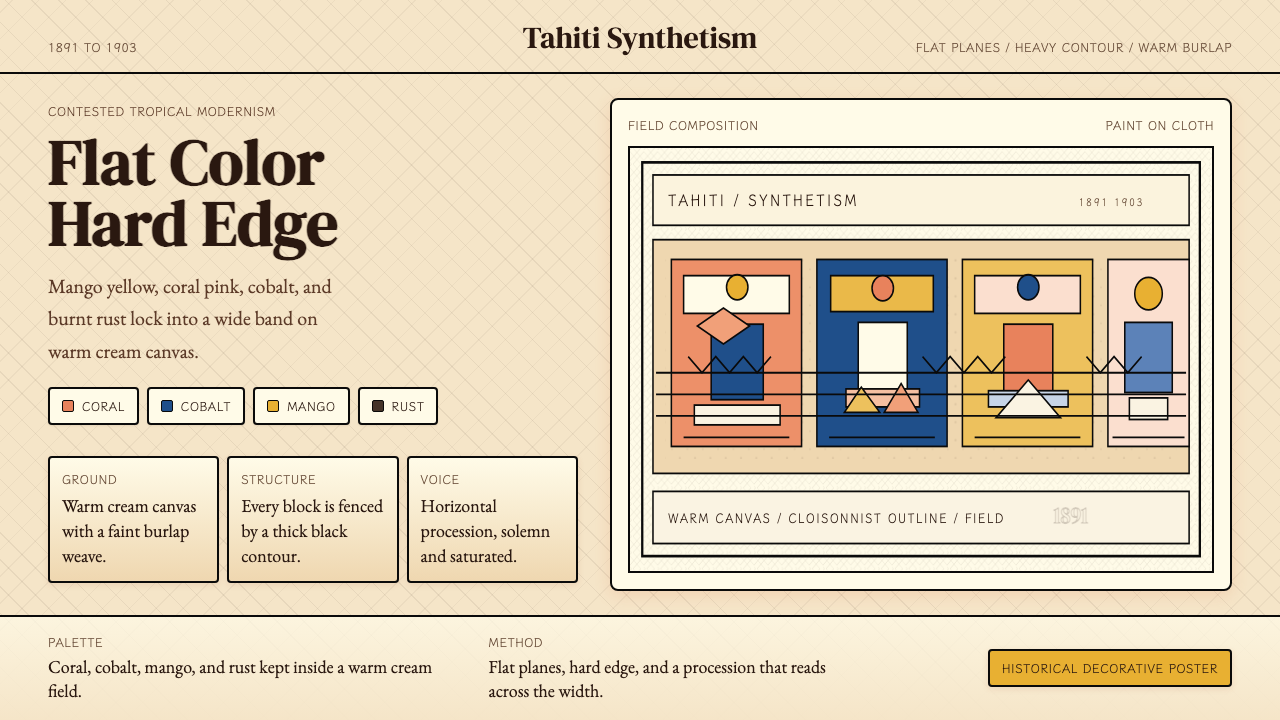 Gauguin — Tahiti SynthetismFlat color, hard edge. Cream canvas, coral, cobalt, and rust lock into a frie…
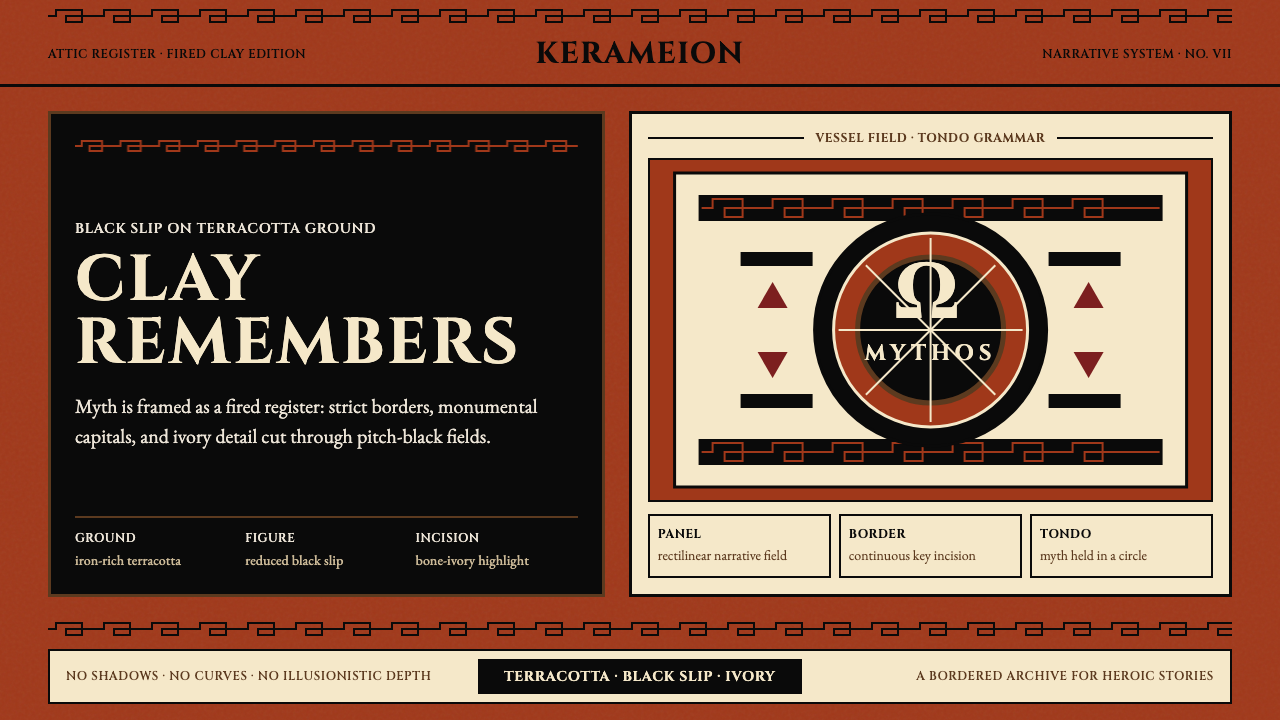 Greek Antiquity (Attic Vase)Myth becomes architecture. Terracotta, black slip, and Greek-key borders fram…
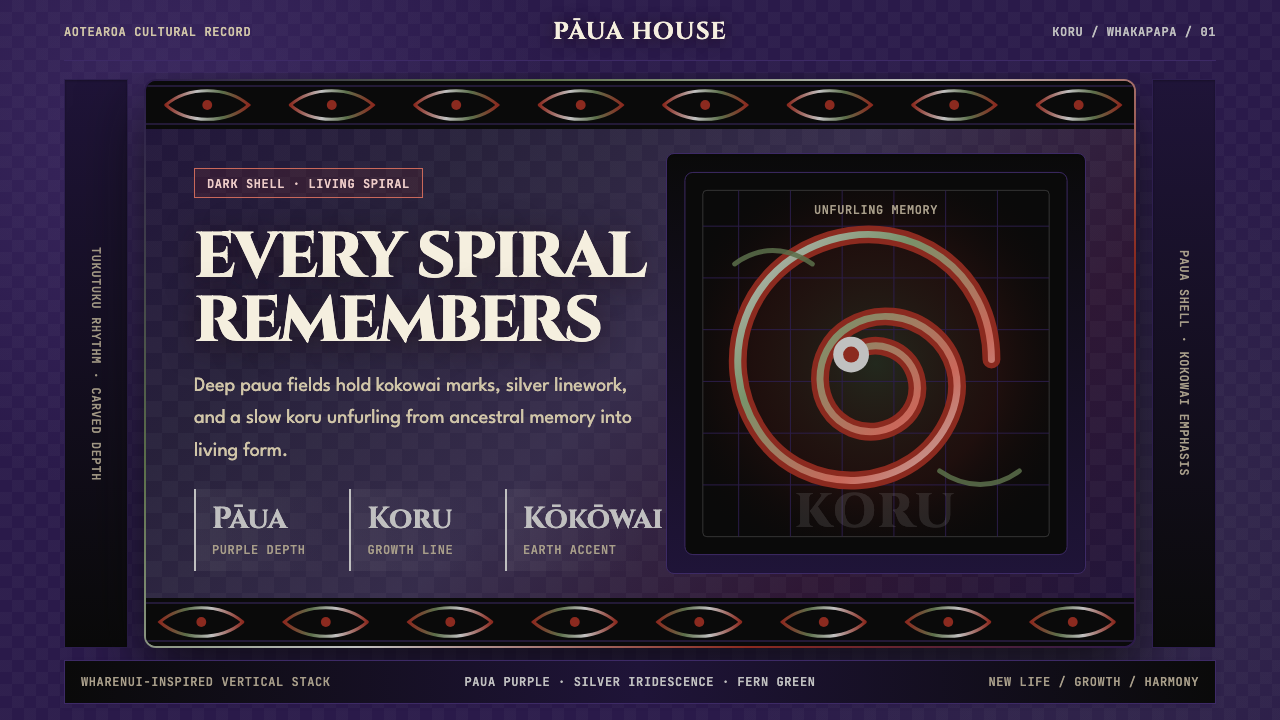 Māori Koru (Aotearoa)Ancestry glows in the dark. Paua purple, kokowai red, and silver koru frame t…
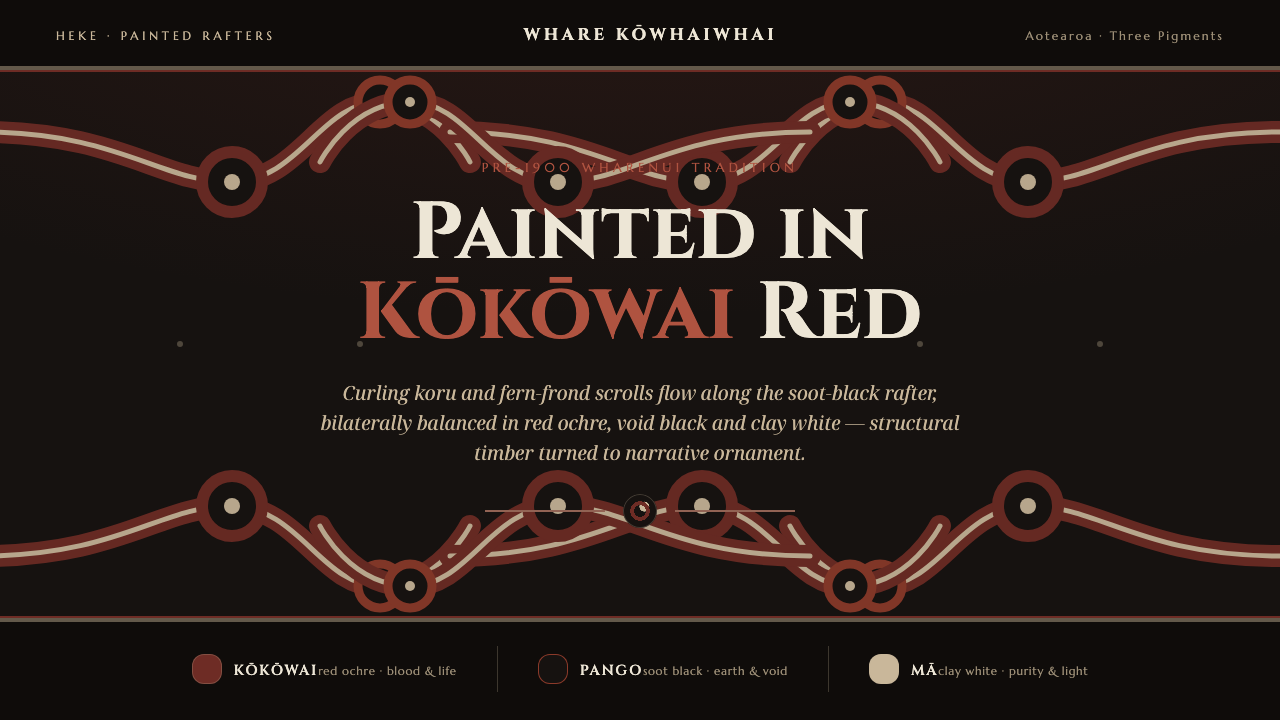 Māori Kōwhaiwhai RafterPainted timber, not pixels. Kōkōwai-red koru scrolls in mirrored balance on b…
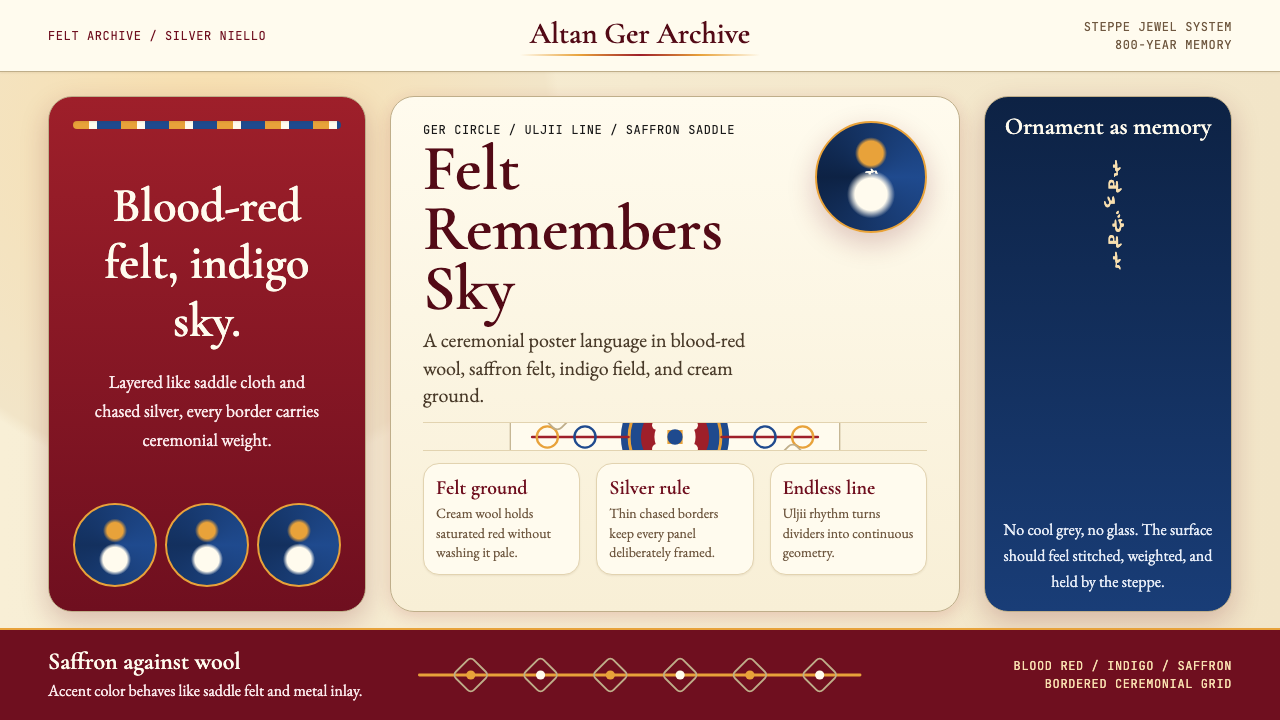 Mongolian Nomadic SteppeSteppe memory in jewel tones. Blood-red felt, saffron, indigo, and bordered u…
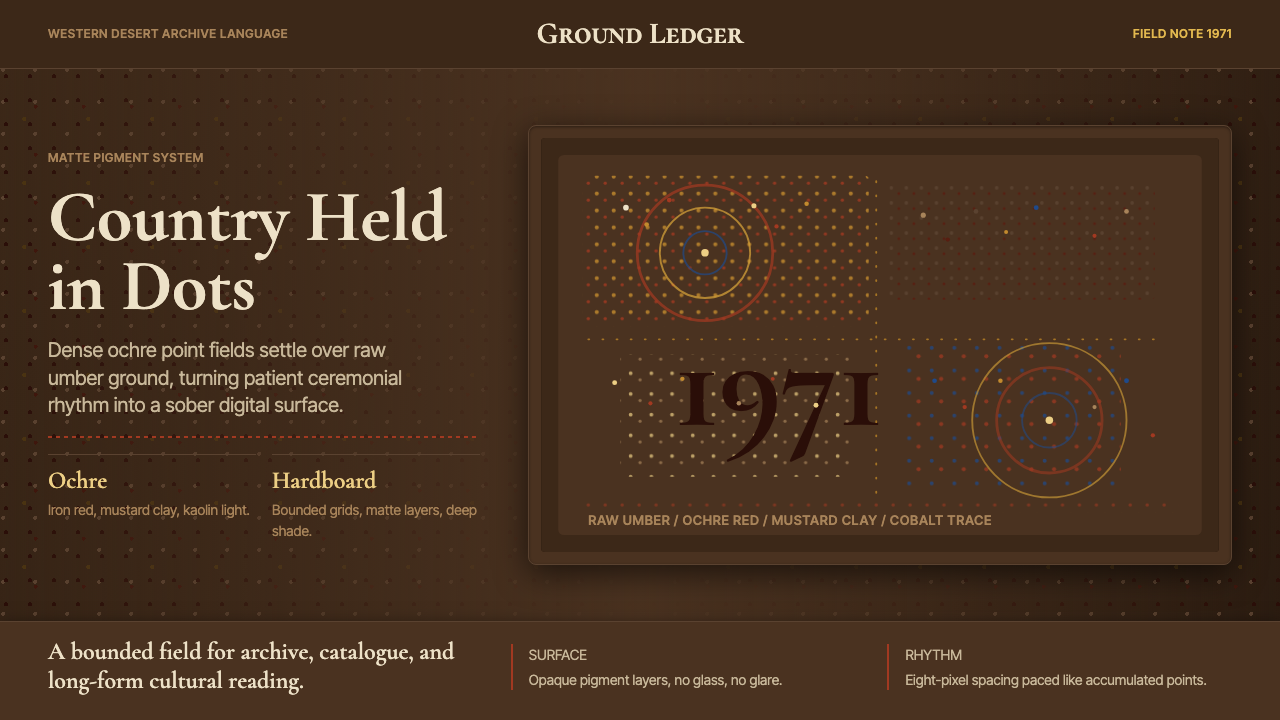 Aboriginal Dot Painting (Papunya 1971)Ochre memory, held steady. Raw umber ground, Cormorant type, disciplined dot-…