What is Aboriginal Dot Painting (Papunya 1971)?
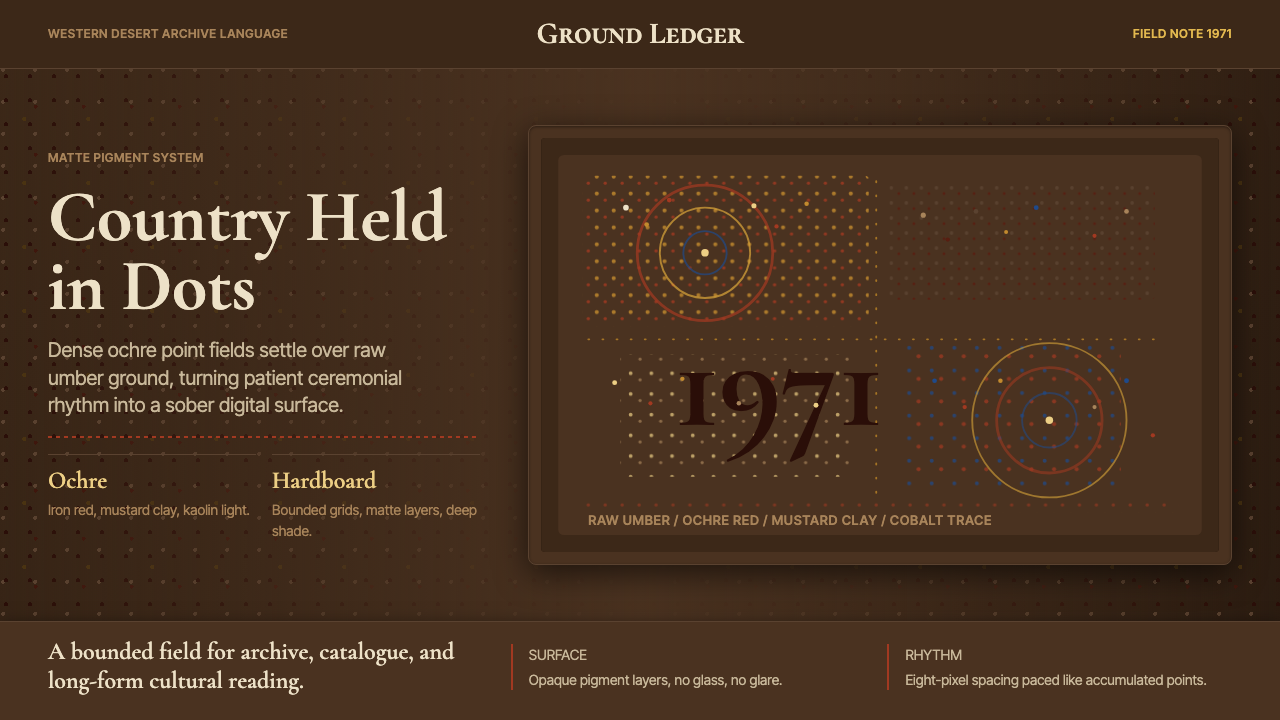
In a remote settlement in the Northern Territory in 1971, senior Aboriginal men transferred sacred sand-painting knowledge onto hardboard with acrylic paint — and accidentally founded one of the most consequential art movements of the twentieth century.
Aboriginal Dot Painting (Papunya 1971) in brief
Aboriginal Dot Painting in the Papunya tradition is a visual language rooted in the Dreaming — the complex cosmological framework through which Aboriginal Australians understand the creation of the land, its spiritual geography, and the laws governing human conduct. The distinctive dense dot-fields that define the style are not decorative texture; they were initially a protective veil drawn over sacred iconography that could not be shown to uninitiated viewers, encoding the landscape itself as a constellation of marks.
The resulting aesthetic is one of remarkable visual density and rhythm. Ochre, raw sienna, burnt umber, and desert white are the dominant earth tones, punctuated by the deep charcoal of the hardboard ground or, in later works, deep acrylic blacks. Dots accumulate into fields of vibrating color, circles nest inside larger circles to indicate waterholes and ceremonial sites, and meandering lines trace the paths of ancestral beings across Country. The compositions are typically read from above — a bird's-eye topographic perspective that maps spiritual territory rather than literal space.
What makes this style enduringly powerful as a design language is its unique combination of strict geometric discipline with what reads as organic vitality. The palette is deeply earthy yet visually electric. The repetitive dot-work creates optical vibration that contemporary screen interfaces can exploit without diminishing its cultural gravity — provided the application is handled with awareness and restraint.
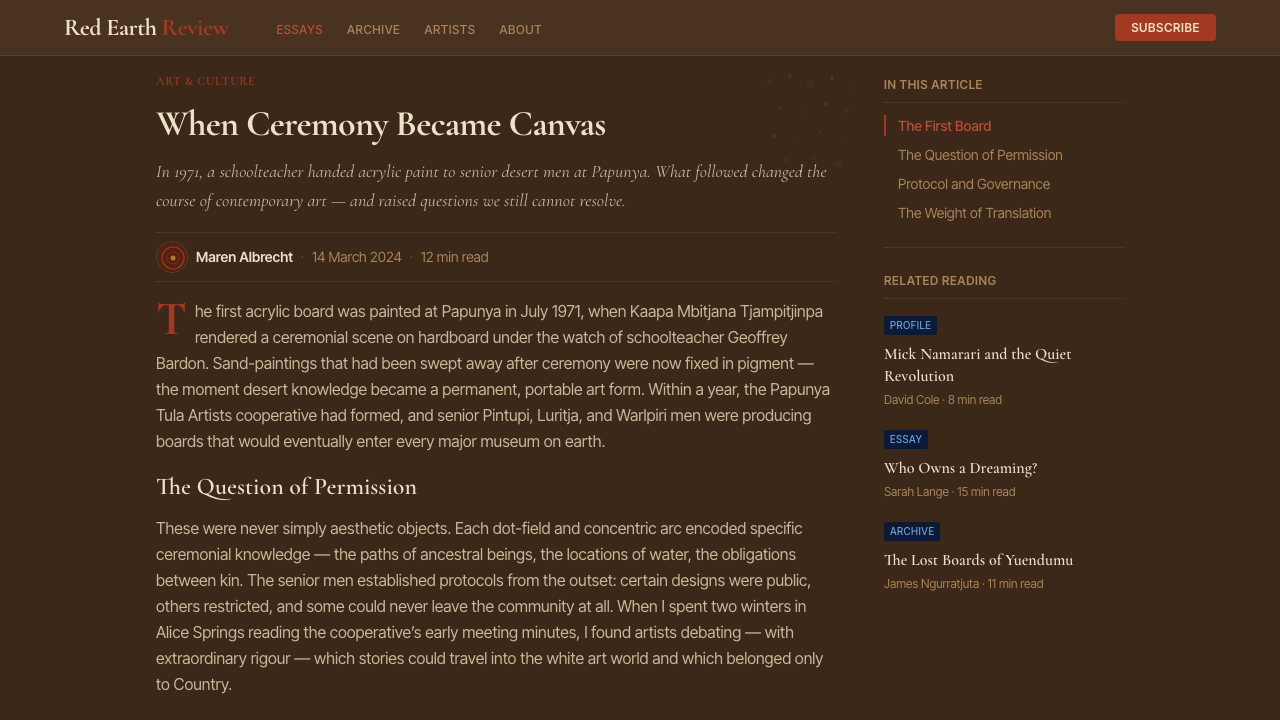
See the Aboriginal Dot Painting (Papunya 1971) design system
Where does Aboriginal Dot Painting (Papunya 1971) come from?
The story of Papunya Tula begins in 1971 at Papunya, a government settlement about 240 kilometres north-west of Alice Springs established in the late 1950s to consolidate disparate Aboriginal communities — Pintupi, Luritja, Warlpiri, Aranda, and Anmatyerre peoples — onto a single administered location. The displacement was profound. Men and women who had lived according to the laws and ceremonial cycles of specific Country found themselves crowded into corrugated-iron housing on land not their own.
In 1971, Geoffrey Bardon, a young schoolteacher from Sydney, arrived at Papunya and began encouraging the men to paint the ceremonial designs they recalled from their homelands onto the school walls. What followed was unexpected. Senior law men — including Kaapa Tjampitjinpa, Johnny Warangkula Tjupurrula, and Mick Namarari Tjapaltjarri — began producing works of extraordinary visual sophistication on sheets of hardboard and later canvas. The mural painted on the school wall in July 1971, depicting the Honey Ant Dreaming, is considered the founding moment of the Western Desert art movement.
Papunya Tula Artists was formally incorporated as an artists' cooperative in 1972, becoming the first Indigenous-owned art cooperative in Australia. The cooperative gave artists control over the sale of their work and established a model that Indigenous art centres across Australia would later adopt. Early Papunya boards were distinguished by explicit sacred iconography — concentric circle complexes, U-shapes representing seated figures, tracks and body-part symbols — that reflected the full ceremonial knowledge the painters carried. However, concerns from senior custodians about revealing sacred designs to non-initiated people led artists to develop the dot-overlay technique: dots were applied in dense fields over sacred elements, both obscuring specific knowledge and creating the distinctive visual texture the style became known for worldwide.
Clifford Possum Tjapaltjarri emerged in the mid-1970s as the movement's most ambitious cartographer of Dreaming narratives. His large-scale canvases mapped multiple overlapping Dreaming tracks across a single surface, creating compositions of remarkable spatial complexity — different story-lines coexisting in a single aerial view of Country. By the 1980s, works by Papunya Tula artists were entering major international collections. The 1988 Australian Bicentenary sparked renewed international attention, and throughout the 1990s and 2000s, the paintings became both cultural icons and significant commercial objects. Today the tradition continues across Western Desert communities, with artists navigating the ongoing tension between the ceremonial obligations of country knowledge and the demands of a global art market.
What defines the Aboriginal Dot Painting (Papunya 1971) look?
Earth-Tone Palette
The foundational color register draws from the pigments available in the Western Desert landscape: ochres ranging from pale yellow to deep burnt orange, raw umber darks, red-brown siennas, and chalky desert whites. These earth tones are rarely used at full brightness; they are layered and modulated, giving the surface a warmth that reads as aged and material even in digital applications. The darkest grounds — near-black or deep charcoal — serve as recessive fields against which the warmer dots advance, creating a depth that is atmospheric rather than spatial.
Dot-Field Rhythm
The defining visual element is the accumulation of individual dots into continuous fields that vibrate with optical energy. Dots are not applied randomly; they follow contour lines, radiate outward from central motifs, or fill negative space in dense, meditative rows. The spacing between dots is as deliberate as the dots themselves — tighter clusters read as solid mass, more open fields breathe and recede. This creates a kind of halftone logic that predates digital screens by decades: the image is constructed from discrete marks whose spacing controls perceived density and color value.
Concentric Circle Geometry
Circular forms — particularly concentric rings nested inside one another — are the most immediately recognizable formal element of the Western Desert tradition. In the original ceremonial context, concentric circles mark sites of significance: waterholes, campsites, sacred locations on the Dreaming map. As a compositional device, they function as focal anchors around which dot-fields organize themselves, creating visual hierarchies that the eye reads as landscape features. Multiple circle-complexes distributed across a composition produce the effect of a topographic map viewed from altitude.
Aerial Topographic Perspective
Papunya compositions are organized from a bird's-eye viewpoint — not the European pictorial convention of horizon and vanishing point, but a flat, overhead mapping of territory. This perspective means that all compositional elements exist in the same plane: there is no foreground, middle ground, or background in the conventional sense. Tracks, circles, and sinuous lines coexist as marks on a surface that is simultaneously physical ground and spiritual map. In interface applications, this produces layouts that feel simultaneously abstract and geographical — capable of organizing large amounts of information without conventional spatial hierarchy.
Controlled Chromatic Contrast
While the palette is grounded in earth tones, Papunya works achieve striking visual impact through the careful juxtaposition of warm and cool within a narrow tonal range. A rust-orange dot-field against a deep charcoal ground creates intense contrast without departing from the earth-tone register. Later artists introduced more saturated intervals — turquoise or deep mineral blue — as accent colors that register against the warm darks. The result is a palette that feels simultaneously ancient and contemporary: restrained enough to seem timeless, varied enough to sustain visual interest across large-scale applications.
Line as Story-Path
Sinuous, meandering lines traverse Papunya compositions, connecting circle-sites and tracking the routes of ancestral beings across Country. These are not decorative curves; they carry narrative function, tracing the journeys that Dreaming stories describe. In visual terms, they introduce a calligraphic element into the otherwise dot-dominant surface: a flowing counterpoint to the static accumulation of marks. In design applications, such lines can serve as movement paths, connection indicators, or thematic threads that stitch otherwise discrete elements into a legible whole.
Material Density
Original Papunya works were built up in multiple layers: ground color, motif layer, and then the dot-overlay applied with controlled pressure to achieve varying heights of impasto. The result is physically tactile — the surface has topography. In digital and print applications, this material quality must be evoked rather than replicated: through the use of slight tonal variation within dot-fields, through layering that suggests depth without introducing gradients, and through restraining the temptation to make elements look 'flat' in the contemporary minimalist sense. The style reads best when it feels like it has been made, not generated.

See the Aboriginal Dot Painting (Papunya 1971) design system
Who shaped Aboriginal Dot Painting (Papunya 1971)?
An art teacher from Sydney who arrived at Papunya in 1971, Bardon occupies a complicated but foundational position in the movement's history. He encouraged senior Aboriginal men to paint their ceremonial designs and provided them with materials — initially house paints and hardboard. His instinct that the paintings warranted serious artistic attention, and his persistence in bringing early works to the attention of buyers and institutions, gave the movement its initial commercial footing. Bardon documented the early period extensively; his records remain among the most important historical accounts of Papunya's founding years.
Tjapaltjarri emerged by the mid-1970s as the artist most responsible for expanding the formal ambitions of the Papunya movement. His large multi-narrative canvases overlaid multiple Dreaming stories from different countries, producing compositions of exceptional spatial and narrative complexity. His 1977 work mapping the Warlugulong Dreaming narrative is considered a landmark in the development of the Western Desert style. His ability to hold competing ceremonial obligations in a single visual field while maintaining compositional legibility made him the movement's most technically demanding practitioner, and his works command some of the highest prices achieved by any Australian artist.
One of the original Honey Ant Mural painters of 1971, Tjupurrula was among the first Pintupi men to take up acrylic on hardboard. His compositions are distinguished by their use of interlocking dot-fields in warm ochre and red-brown tones against dark grounds, with an unusually intimate quality that contrasts with the epic scale pursued by some contemporaries. His work Water Dreaming at Kalipinypa, painted in 1972, became one of the most celebrated of the early Papunya period and played a significant role in establishing the international reputation of the movement.
Namarari Tjapaltjarri's work is among the most formally austere within the Papunya tradition. His mature compositions often reduce the Dreaming map to near-abstract fields of dots arranged in geometric patterns — concentric circles, parallel lines, and radial forms — with the narrative content encoded so deeply within the formal structure that the works read as pure abstraction to uninitiated viewers. This quality made his paintings among the most legible to Western gallery audiences, who approached them through the lens of mid-century abstraction, while the ceremonial depth remained intact for those who shared the cultural knowledge.
Though not a Papunya Tula artist — she was an Anmatyerre woman from Utopia Station who began painting in 1988 — Kngwarreye is essential to any account of the Western Desert tradition's reach and development. Her late work abandoned dot-fields for sweeping gestural marks that retained the earthen palette and the topographic sensibility while producing something completely unprecedented in Australian art. She produced an extraordinary volume of work in just eight years before her death in 1996, and her paintings have been exhibited at the Venice Biennale and the National Museum of Modern Art in Tokyo — demonstrating the breadth to which the visual language developed at Papunya has expanded.
How do you use Aboriginal Dot Painting (Papunya 1971) today?
The Papunya visual language translates into digital and print contexts most effectively when the application preserves the two qualities that give the style its power: the meditative repetition of marks, and the grounded, earthy color register. Applying this style superficially — scattering a few dots over a neutral background — produces something that reads as cultural tokenism rather than as a coherent design system. The approach requires committing to density.
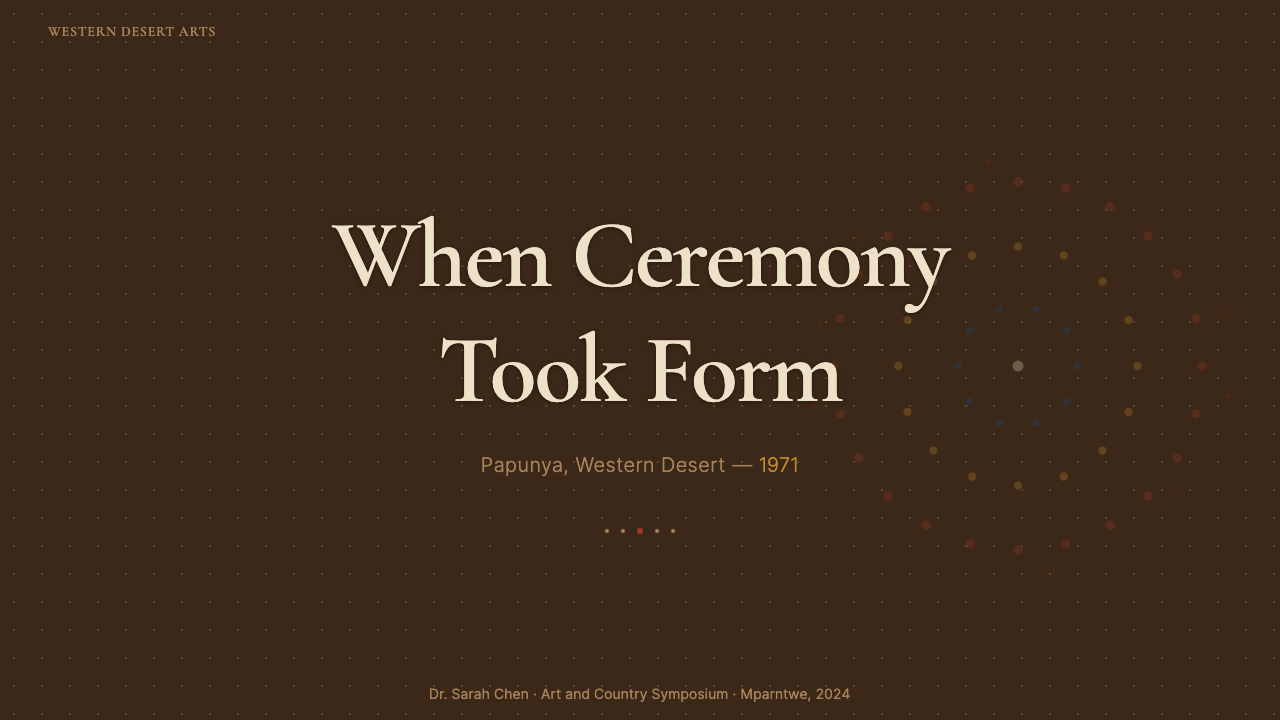
For presentation slides, the style works best on cover and transition pages where full-bleed treatment is possible. A cover image built on a near-black or deep charcoal ground, with dense ochre and rust dot-fields radiating from a central concentric circle motif, creates immediate visual authority. Text should sit in high-contrast cream or white, set at a scale that does not compete with the dot texture. Content slides should extract from the palette rather than reproduce the full dot-treatment: earth-tone backgrounds with clean typographic hierarchies, using the warm-to-cool contrast of the palette for category differentiation. Data visualizations benefit from using the concentric circle motif as a focal anchor for donut charts or radial displays.
For web interfaces, the style is best suited to landing pages, hero sections, and cultural or heritage contexts where the richness of the visual texture is a feature rather than a distraction. Applied to a full-width hero, a dot-pattern generated from the Papunya palette — ochre, sienna, and near-black — creates a background of unusual warmth and authority. Navigation and interactive elements should stay typographically clean against these textured grounds, with the earth-tone palette carried through into button states and accent colors. Dashboards and data-dense layouts should use the palette and the topographic perspective but minimize the dot-texture in favor of clear information hierarchy.
For editorial and marketing work, the style supports richly textured feature imagery and section dividers. Magazine layouts can use a full-spread dot-ground as a background for portrait photography — the warmth of the earth tones flatters skin tones across a wide range of subjects, and the texture adds depth without competing with the photographic subject. Marketing materials for cultural institutions, tourism, arts organizations, and indigenous-owned businesses can use the visual language with particular coherence when the connection to the tradition is genuine. Environmental graphics and wayfinding systems can use the concentric circle motifs as location markers, adapting the topographic logic of the original painting tradition to navigational purposes.
The most common mistake when applying this visual language is conflating it with generic decorative dot patterns. The Papunya tradition is specific: the dots are dense and rhythmic, organized around concentric circles and meandering lines, and the palette is anchored in earth tones rather than bright primaries. A random scatter of dots in primary colors is not this style — it is a misreading of it. Equally problematic is using the aesthetic without acknowledgment in contexts where it could be mistaken for an endorsement by or collaboration with Aboriginal artists or communities. The visual language carries cultural weight that should be handled with transparency about the source of inspiration.
See the Aboriginal Dot Painting (Papunya 1971) design system
Aboriginal Dot Painting (Papunya 1971) — FAQ
What is the cultural significance of the dot overlay technique?
The dot overlay was not an aesthetic decision in origin — it was a solution to a cultural problem. When the Papunya painters began exhibiting and selling their work to non-Aboriginal audiences, senior custodians of ceremonial law became concerned that sacred iconography was being shared too broadly. The response was to apply dense dot-fields over the sacred elements, obscuring specific knowledge while preserving the overall composition. This means the visual texture that defines the style internationally — the shimmering, meditative dot-fields — was invented as a form of cultural protection. Understanding this origin matters when applying the aesthetic: the dots are not decorative fill; they are a layer of deliberate concealment.
How does this style differ from other Australian Aboriginal art traditions?
Australia's Aboriginal art traditions are extraordinarily diverse — the dot-and-circle style associated with Papunya and the Western Desert is specific to that cultural region and was, in its current acrylic form, essentially invented in 1971. Other regional traditions include the cross-hatching (rarrk) designs of Arnhem Land in the Northern Territory, the bark paintings of the Yolŋu people with their intricate figurative and geometric forms, and the X-ray style paintings of Kakadu. The Kimberley region has its own traditions of Wandjina spirit figures. The mistake of treating all Aboriginal Australian art as a single tradition — visually unified by dots — erases the cultural specificity of each distinct tradition. The Papunya style is one among many, and its global visibility is partly a historical accident of the movement's early commercialization.
Is using this visual style culturally appropriate?
This is a question without a single clean answer, and intellectual honesty requires acknowledging that directly. The Papunya style has entered the global visual vocabulary through legitimate commercial channels — it has been exhibited in major museums, reproduced in licensed prints, and built into design systems with the involvement of Aboriginal art organizations. At the same time, the tradition carries ceremonial significance that purely aesthetic application does not honor. The clearest guidance is this: using the general visual language (earth-tone dot-fields, concentric circle geometry, topographic perspective) as design inspiration is distinct from reproducing specific sacred iconography, which should not be used outside its ceremonial context. Acknowledging the source, working with or through Aboriginal art organizations where possible, and avoiding contexts that could imply cultural endorsement that does not exist are the minimum standards of responsible application.
What makes a dot-pattern authentically read as Papunya rather than generic?
Several factors distinguish authentic Papunya-derived work from generic dot decoration. First, the palette: earth tones grounded in ochres, siennas, and umbers against near-black or deep charcoal grounds — not bright primaries on white. Second, the organizational logic: dots are not scattered randomly but accumulate along contour lines, radiate from central circle motifs, or fill regions defined by sinuous path-lines. Third, density: the dot-fields should be genuinely dense, creating optical vibration rather than a sparse, decorative sprinkle. Fourth, the compositional structure: the overall composition should read as a topographic map of connected sites rather than a pattern repeating across a surface. Achieving this combination requires studying actual Papunya Tula works rather than working from stylized derivatives.
How does the style work at small scale — icons, thumbnails, or UI components?
The Papunya style faces genuine challenges at small scale, because its defining qualities — dense dot-fields and concentric circle complexity — require sufficient visual space to resolve properly. At icon size, individual dots collapse into textured noise rather than controlled rhythm. The most effective small-scale adaptation is to abstract the vocabulary rather than miniaturize the full composition: a concentric circle rendered cleanly in the earth-tone palette functions as a recognizable reference to the tradition without requiring dots to be legible. At thumbnail scale, a region of the full dot-pattern can be used as a crop — the partial composition reads as texture and atmospheric depth rather than as a complete image. Attempting to reproduce the full compositional logic at small scale usually results in visual clutter; restraint and abstraction are better strategies than miniaturization.
Related design styles
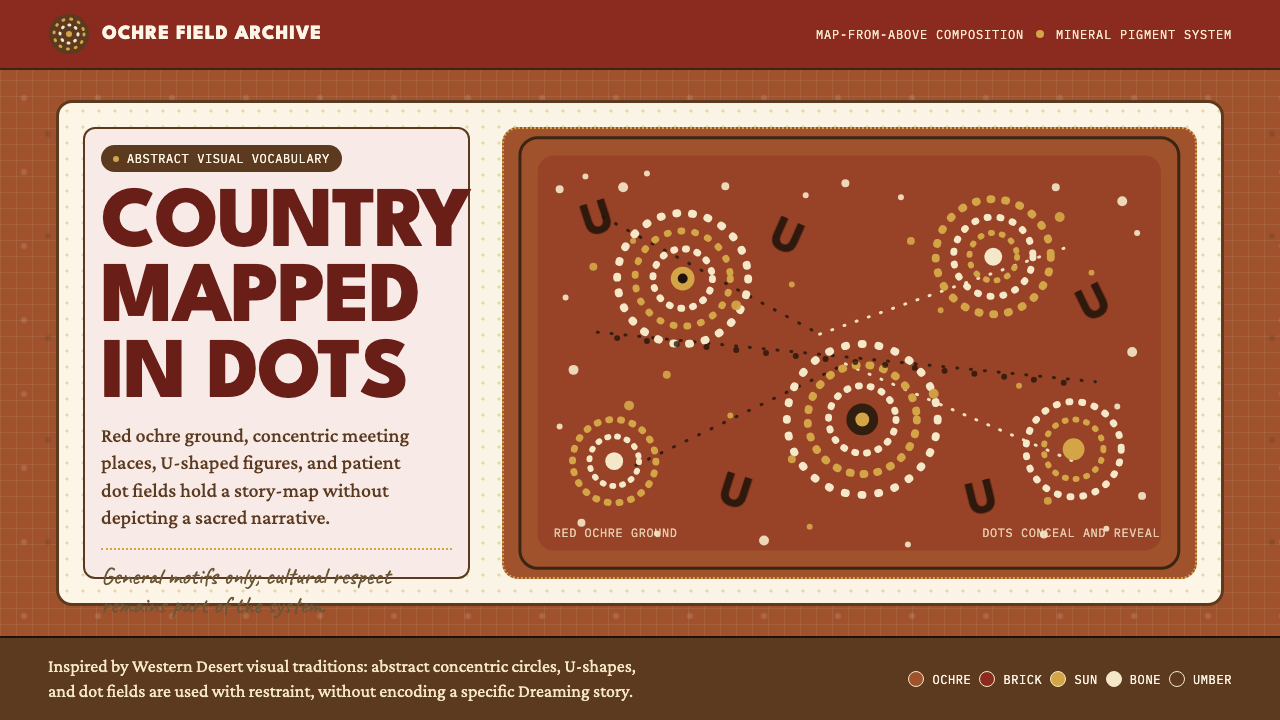 Aboriginal Dot PaintingAncient story-map energy. Red ochre, bone dots, concentric circles, and U-mar…
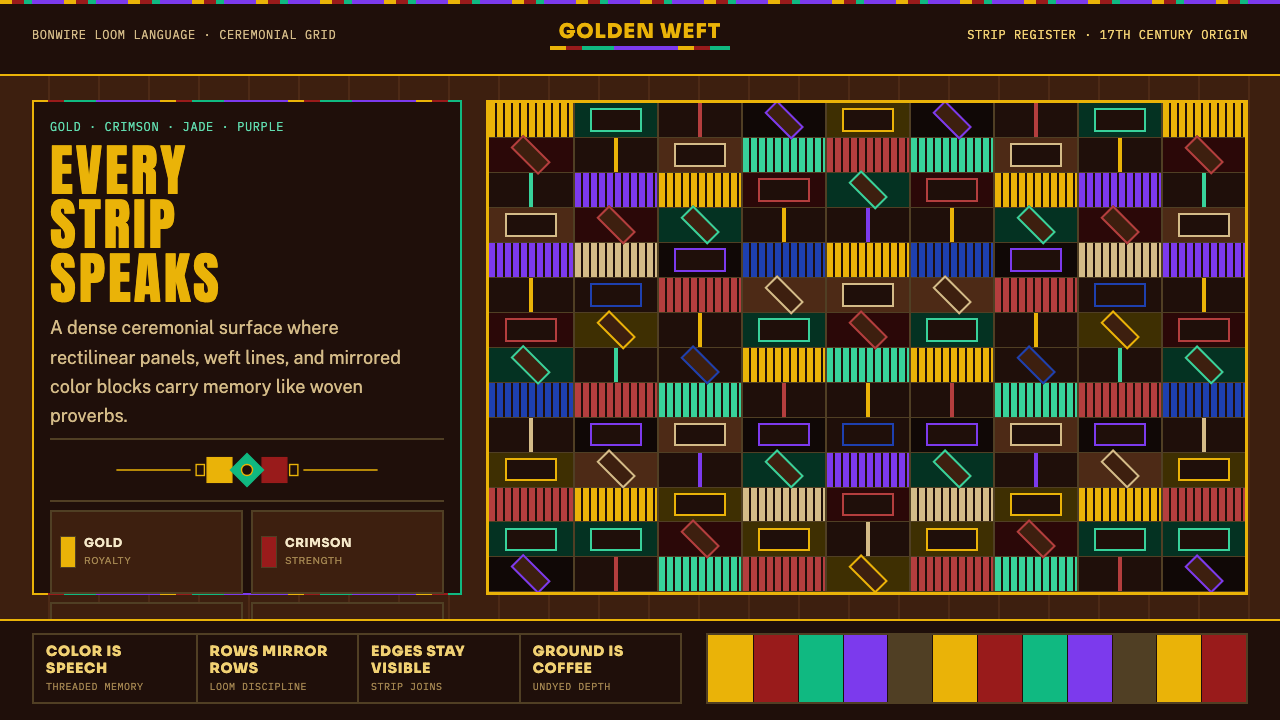 West African Kente ClothWoven authority. Gold, crimson, jade, and purple strips lock into a dense cof…
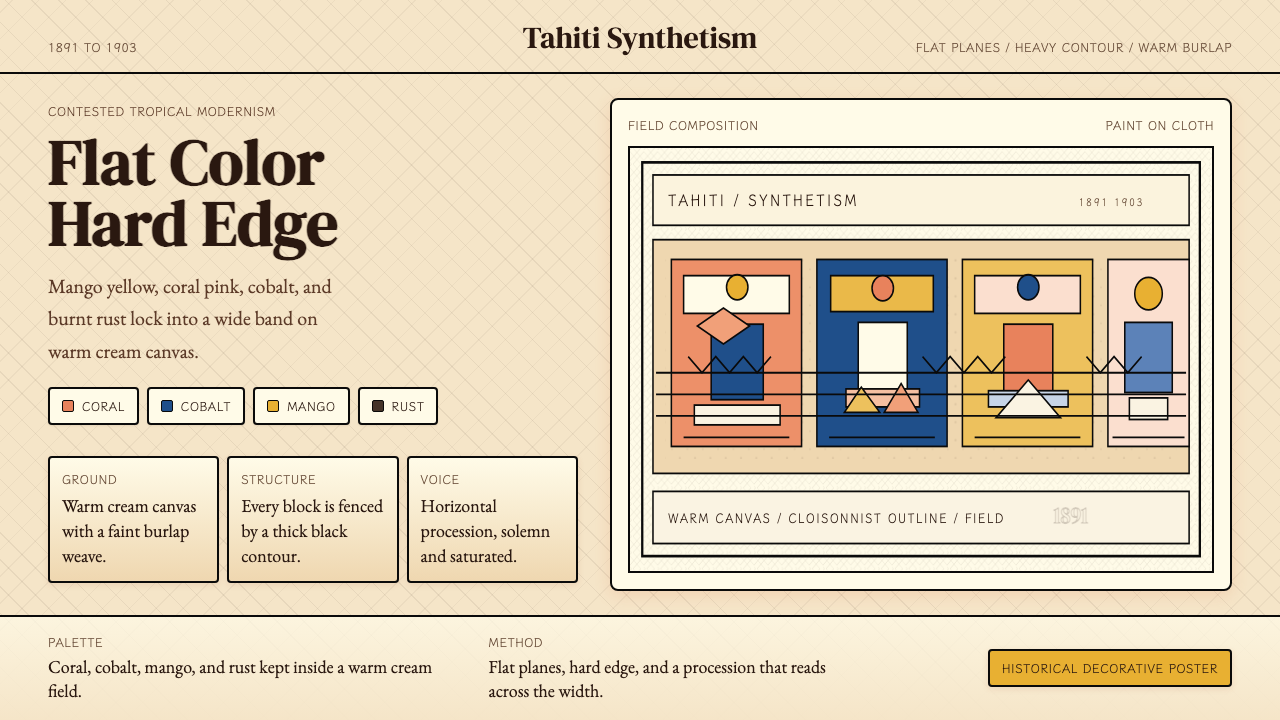 Gauguin — Tahiti SynthetismFlat color, hard edge. Cream canvas, coral, cobalt, and rust lock into a frie…
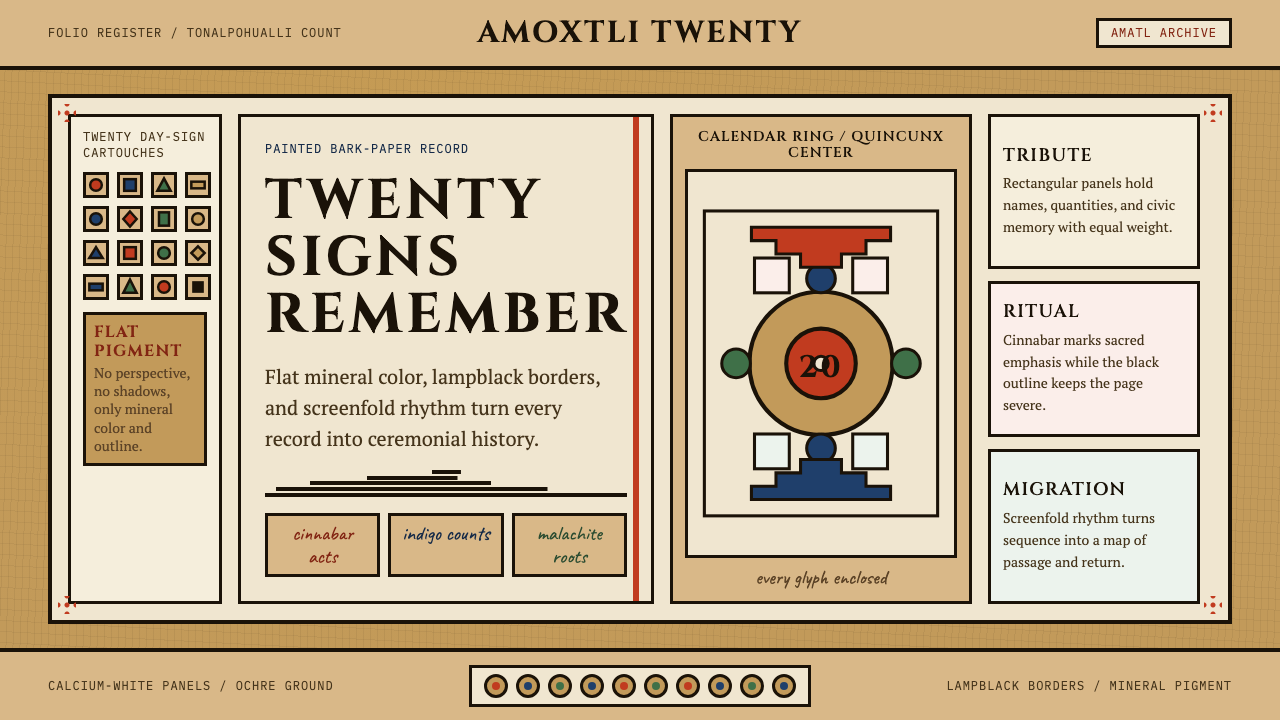 Aztec CodexSacred records stay severe. Ochre amatl ground, Cinzel capitals, black cartou…
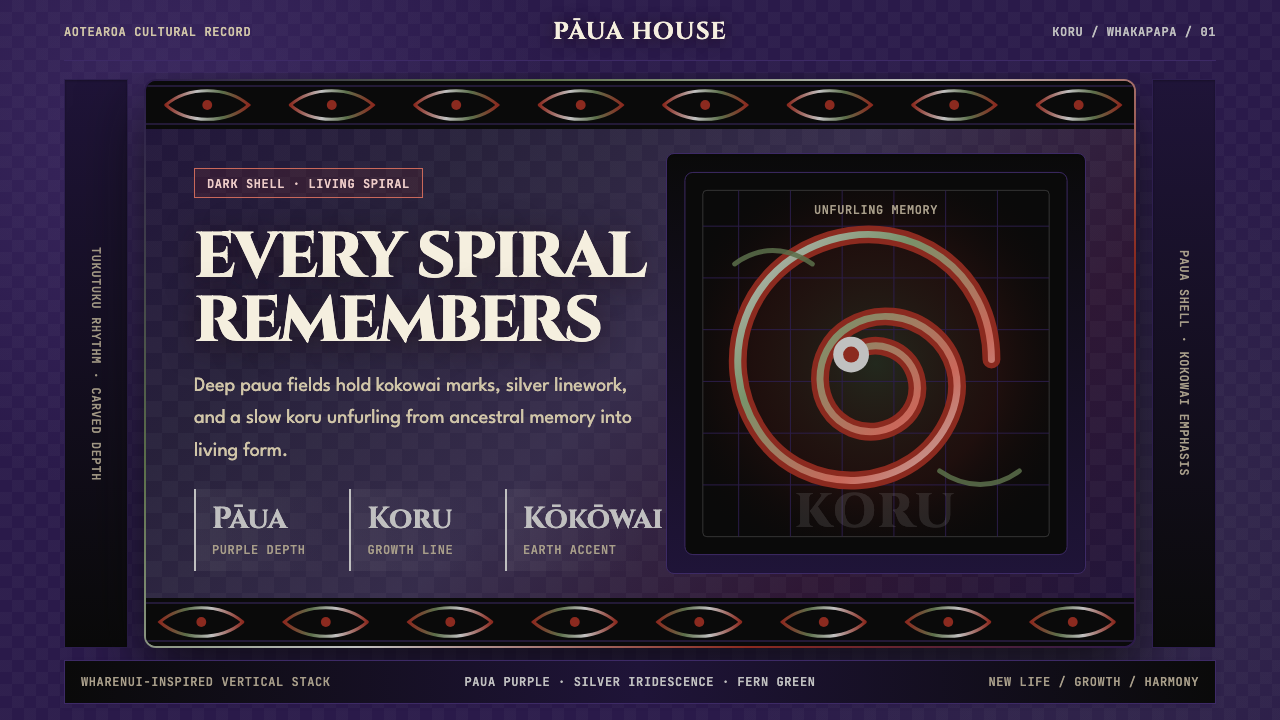 Māori Koru (Aotearoa)Ancestry glows in the dark. Paua purple, kokowai red, and silver koru frame t…
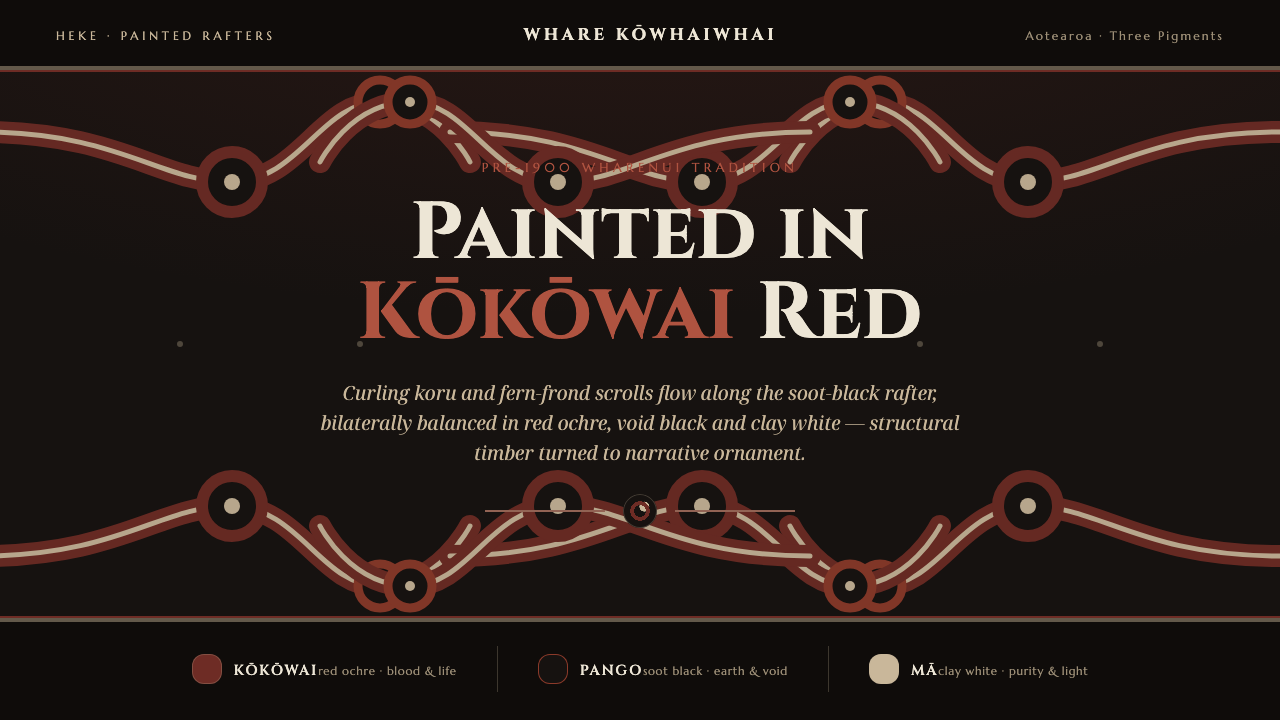 Māori Kōwhaiwhai RafterPainted timber, not pixels. Kōkōwai-red koru scrolls in mirrored balance on b…