What is Aboriginal Dot Painting?
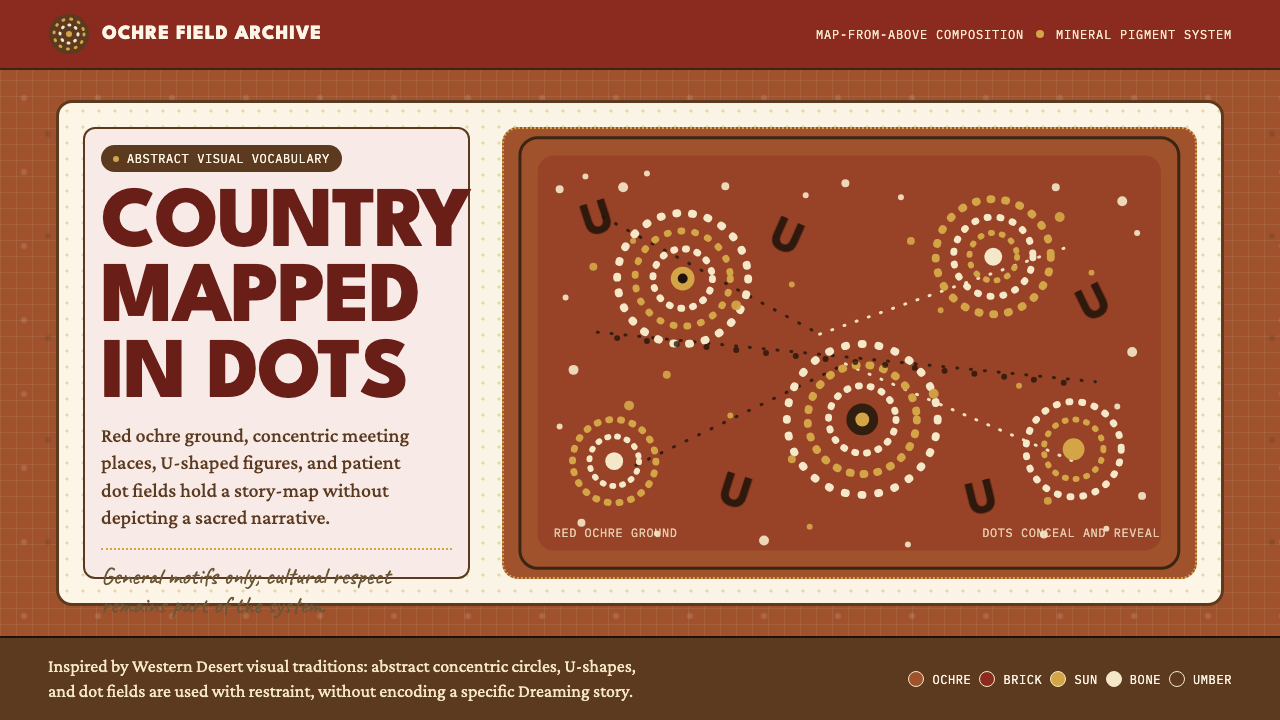
Forty thousand years of story compressed into fields of dancing dots — Aboriginal dot painting is the world's oldest continuous visual tradition reborn as a map of the sacred.
Aboriginal Dot Painting in brief
Aboriginal dot painting is a contemporary canvas art movement rooted in the ceremonial and body-painting traditions of the Western Desert peoples of Australia. Its most recognizable feature — dense, rhythmically applied fields of acrylic dots covering every centimeter of the picture plane — is not decorative texture but a deliberate encoding system. Concentric circles denote waterholes or campsites; U-shaped marks represent seated human figures; meandering lines trace ancestral travel routes; radiating dot fields express country seen from above. Every composition is simultaneously an abstract painting and a map of the Dreaming.
The Dreaming — known in the Anangu language as Tjukurpa — is the foundational law and cosmology of Aboriginal peoples: the time before time when ancestral beings shaped the land, created its features, and established the moral and social codes that govern living communities. Dot paintings do not merely illustrate these stories; they are considered active embodiments of them, made through the same ritual intention that animates ceremony. The material world of the painting and the spiritual world of Tjukurpa are understood as continuous rather than separate.
Visually, the style is distinguished by its mineral-earth palette — deep red ochres, warm umbers, chalky bone whites, and muted brick reds drawn from the pigments of the Central Australian desert — and by the all-over quality of its composition. There is no empty background. Every surface is activated. The dot itself, applied in even, deliberate strokes, carries both visual and spiritual weight. Color relationships are warm and earthbound; contrast emerges from the interaction of closely valued tones rather than from sharp light-and-dark opposition.

Where does Aboriginal Dot Painting come from?
The contemporary canvas tradition has a precise and well-documented origin: July 1971, in the remote settlement of Papunya, two hundred and fifty kilometers northwest of Alice Springs in the Northern Territory of Australia. A young Sydney schoolteacher named Geoffrey Bardon had been posted there to teach the children of Luritja and Pintupi people. Watching his students draw traditional symbols in the sand, and observing the older men's reluctance to demonstrate their knowledge in school, Bardon recognized that an extraordinarily rich visual tradition was at risk of going undocumented. He encouraged the elders to paint — first on the school wall, then on boards and canvases — using house paints that he supplied. The resulting mural, completed by a group including Kaapa Tjampitjinpa, depicted Honey Ant Dreaming and became the catalyst for the entire movement.
What Bardon had witnessed was not the invention of a new art form but the translation of an ancient one into a new medium. Western Desert peoples had encoded Dreaming narratives in sand drawing, body painting, ground designs, and carved wooden objects for tens of thousands of years. The same symbols — circles, arcs, lines, dots — had appeared in rock art across the region for at least forty thousand years. What changed in 1971 was the support: canvas and acrylic paint allowed works to survive, travel, and be exchanged outside the community. The dot, in particular, which had been used to obscure sacred designs from uninitiated eyes when works entered the public sphere, became the defining visual device of the movement.
The artists who gathered around Bardon's initiative formed the Papunya Tula Artists cooperative in 1972, the first Indigenous-owned and -run art organization in Australia. Its founding members — including Clifford Possum Tjapaltjarri, Johnny Warangkula Tjupurrula, Tim Leura Tjapaltjarri, and Mick Namarari Tjapaltjarri — had no prior experience selling art, negotiating with gallery owners, or navigating the art market. Within a decade, their work was selling in major Australian galleries; within two, it had entered international museum collections. The movement they seeded spread from Papunya to communities across the Western Desert: Yuendumu, Kintore, Balgo, and eventually to the Utopia homelands in the east, where Emily Kngwarreye emerged in the late 1980s as one of the most internationally celebrated Aboriginal artists of the twentieth century.
The history of the movement is not without ethical complexity. Early dealers and collectors profited enormously from work acquired for very little; questions of copyright, community authorship, and the commercialization of sacred knowledge remain ongoing. The dot itself became so commercially identified with Aboriginal art that artists from communities with no traditional dot-painting heritage began producing it for the tourist market — a phenomenon Aboriginal communities and art organizations have consistently distinguished from authentic community-based practice. These tensions are part of the tradition's living history, not peripheral to it, and any serious engagement with the style must hold them in view.
What defines the Aboriginal Dot Painting look?
The Dot Field
The defining structural element of the style is the all-over dot field: small, consistently sized marks applied in dense, rhythmic repetition across the entire picture plane. Unlike stippling, which modulates light and shadow, the Aboriginal dot is tonally consistent within a given color zone and changes only when the underlying symbol or territory changes. The visual effect is vibrant and almost optical — the surface appears to pulse when colors of similar warmth are placed in adjacent fields.
Ancestral Symbols
Beneath and within the dot field, a fixed vocabulary of ancestral symbols organizes the composition. Concentric circles of varying sizes mark sites — waterholes, campsites, ceremonial grounds. U-shapes clustered around a circle represent people seated at a place. Parallel lines indicate paths, rivers, or digging sticks. Arcs and semi-circles represent shade structures or shields. These symbols are not decorative; they have fixed referential meaning within their cultural context, and compositions are structured by the relationships between sites rather than by conventional pictorial perspective.
Aerial Perspective
Aboriginal dot compositions are organized from a bird's-eye or map-like perspective — the viewer looks down on country rather than across it. This is not a Western mapping convention; it reflects the way Dreaming narratives describe territory: as a network of connected sites rather than as a landscape seen from a fixed horizon. The aerial perspective allows a single work to encompass vast geographic and temporal scales, collapsing hundreds of kilometers and thousands of years into a unified field.
Mineral Earth Palette
The authentic color range of Western Desert painting is derived from the mineral pigments of the landscape itself: the deep warm reds and burnt oranges of iron-rich ochre, the dark earthy browns of umber and manganese, the chalky near-white of ground clay, and the muted dusty yellows of sandstone. On canvas, these mineral tones are approximated with warm-toned acrylics that retain the matte, earthy quality of their pigment originals. The palette is warm throughout; cool grays and blues are largely absent from traditional work, appearing mainly in later urban and gallery-oriented practice.
All-Over Composition
There is no hierarchy between figure and ground in the traditional Aboriginal dot painting sense: the entire surface is equally activated. Background is not an empty field waiting to receive imagery — it is itself composed of meaningful marks. This creates a visual density quite different from Western compositional conventions, where negative space is used to direct attention and create rest for the eye. In dot painting, attention is distributed evenly across the field; meaning accumulates through pattern rather than through focal isolation.
Ceremonial Intentionality
The act of mark-making in the Aboriginal tradition carries ritual weight regardless of the medium. Paintings are made with awareness of the ancestral authority behind each symbol, and the knowledge of which stories may be publicly shown and which must remain restricted is carefully maintained by senior custodians. This does not make the style inaccessible to design application, but it means that any use of the visual language should be approached with acknowledgment of its origin and with respect for the distinction between cultural homage and appropriation.
Rhythm and Repetition
The visual power of dot painting comes significantly from controlled repetition: the same small mark, made thousands of times with consistent pressure and spacing, builds into an almost meditative surface. Adjacent color zones vibrate against each other, creating optical movement that no single dot could generate alone. This structural use of repetition — rhythm as content rather than decoration — distinguishes authentic dot-painting-derived design from work that merely scatters dots as surface texture.

Who shaped Aboriginal Dot Painting?
Bardon was an art teacher from Sydney posted to Papunya in 1971. His central contribution was not artistic but catalytic: he recognized the visual intelligence of the community's elders, supplied materials, and — crucially — encouraged artists to work on portable surfaces rather than ephemeral ones. His sustained advocacy helped establish Papunya Tula Artists as a cooperative, and his documentation of the early years, including photographs and written accounts, became the primary historical record of the movement's founding. He is remembered not as a creator of the tradition but as the person who created the conditions for it to enter the world.
One of the founding members of Papunya Tula Artists and widely considered among the greatest Aboriginal painters of the twentieth century, Clifford Possum was a Anmatyerre man whose large-scale narrative compositions mapped multiple Dreaming stories simultaneously across single canvases. His masterwork, Warlugulong, painted in 1976, covers more than two meters and encodes an intricate web of overlapping ancestral narratives. The work entered the National Gallery of Australia's collection and has been described as one of the most significant Australian paintings of the century. Clifford Possum's technical innovation — layering stories in strata of dots at different scales — defined the visual ambition of the Papunya Tula school.
Emily Kame Kngwarreye began painting on canvas at Utopia station in the Eastern Desert only in 1988, at an estimated age of around eighty. In the eight years before her death in 1996, she produced more than three thousand works — a prolific output matched by its formal range. Where earlier Papunya work is organized by legible symbol systems, Emily's paintings move toward a more gestural abstraction: thick skeins of color flowing across the canvas in sinuous lines, fields of layered marks building into atmospheric fields that Western critics compared to Abstract Expressionism. She represented Australia at the 1997 Venice Biennale, the only time a single artist has held that honor, and her retrospective at the National Gallery of Victoria drew record attendance.
A Pintupi elder and founding member of Papunya Tula, Mick Namarari was known for the intense focus and meditative quality of his compositions — often centering on a single Dreaming site rendered through concentric fields of dots that radiate outward from a central motif. His late works, made in the 1990s, reduced this approach to its most essential form: a single circular composition of dots in a tightly controlled palette, almost monochromatic, that anticipated the formal concerns of Western minimalist painting while remaining entirely grounded in Pintupi ceremonial knowledge. His work is held in major Australian and international collections.
Kaapa was among the very first artists to paint at Papunya in 1971, and his work on the original Honey Ant Dreaming mural was foundational. A Anmatyerre and Arrernte man, he went on to win the prestigious Caltex Art Award in 1972 — the first Aboriginal artist to win a major national art competition in Australia — a moment that brought significant public attention to the Papunya movement at a critical early stage. His compositions often feature bold, large-scale geometric arrangements of Dreaming symbols set against richly dotted grounds, and his early career success helped legitimize the commercial viability of desert painting at a moment when the market was still skeptical.
How do you use Aboriginal Dot Painting today?
Aboriginal dot painting translates into contemporary design work most powerfully when its structural logic — all-over pattern, symbolic mark-making, and a warm mineral palette — is treated as an organizing system rather than as surface decoration. The most common failure is to scatter dots loosely across a layout as a texture or background flourish. Authentic dot-painting-derived design commits to the full-field approach: dots are not accent marks but the primary compositional material, and every zone of the layout should feel purposefully activated rather than randomly filled.
For presentation slides, the style works exceptionally well for covers and section dividers. A cover treated in this language uses a warm earth tone as the full-bleed ground and builds the foreground from concentric circular motifs or radiating dot fields that frame the title. The title itself should be set in clean, unadorned type that does not compete visually with the dot pattern — the pattern carries the cultural weight, the type carries the information. Content slides should use a restrained version of the palette: a single warm ground color, dot-pattern accents limited to borders or small decorative zones, and generous clear space for text. Data visualizations can adopt circular and radial structures that echo the concentric-ring motif, using warm ochres and umbers to differentiate segments without imposing the full dot texture on chart elements.
For web interfaces, the style is best suited to hero sections, loading screens, cultural landing pages, and decorative editorial contexts where visual richness is appropriate. Dashboard and data-dense interfaces do not suit the all-over pattern well — the visual complexity of the dot field competes with the informational complexity of the content. Where the style is applied to UI, the most effective approach is contrast: a patterned zone adjacent to a clean, minimal information zone, so that the dot field frames and draws attention to the content area without overwhelming it. Pricing pages can use the style for tier-differentiation headers, with each tier identified by a distinct color from the earth palette, the dot density adjusted to signal hierarchy.
For editorial and marketing work, the style supports immersive, culturally resonant visual storytelling. Full-bleed dot-pattern images work as section backgrounds in long-form editorial layouts, with reversed type sitting directly on the pattern — provided the pattern's tonal value is consistent enough to maintain legibility. In marketing contexts, the palette's warmth and organic quality work well for brands in the cultural, travel, wellness, and artisanal sectors. Posters and social cards in this style benefit from the same approach as historical Aboriginal works: a dominant central motif — a circle, a set of concentric rings — surrounded by a field of smaller marks in an adjacent but distinct color, creating the layered depth that the tradition's compositional logic naturally produces.
The most significant mistake when applying this style is treating it as generically decorative ethnic pattern — using any collection of dots in warm colors and calling it Aboriginal-inspired. This both misrepresents the tradition and produces weak design, because the visual power of actual dot painting comes from the specific structural relationships between symbol, field, and color that the tradition's logic defines. A second common error is combining the dot-painting palette with cool-toned typographic treatments or blue-dominant interface elements; the mineral warmth of the palette is not merely atmospheric but structural, and introducing competing color temperatures undermines the system's coherence. Finally, whenever this style is used commercially, attribution and acknowledgment of the tradition's origin should be considered standard practice — not as legal obligation but as creative honesty.

Aboriginal Dot Painting — FAQ
Is it appropriate to use Aboriginal dot painting as a design inspiration?
This is a genuinely contested question, and a thoughtful answer holds more nuance than a simple yes or no. The visual language of Western Desert painting has entered the global design consciousness and is widely used; many Aboriginal artists and organizations support broader awareness of the tradition. The relevant distinctions are: using the visual logic of the style (its compositional principles, color relationships, structural approach to the dot field) is different from reproducing specific sacred symbols whose meaning and custodianship belong to particular communities. Crediting the tradition explicitly, working with Aboriginal artists or consultants when possible, and avoiding the reductive flattening of the culture to a surface texture are the practical markers of respectful use.
How do I distinguish authentic Aboriginal art from work made for the tourist market?
Authentic work is made by artists from communities with a genuine custodial relationship to the Dreaming stories depicted, sold through Indigenous-owned or community-certified art centers, and accompanied by provenance documentation identifying the artist, their country, and the story the work encodes. The Australian government's Indigenous Art Code provides a framework for ethical trade. Work sold as Aboriginal at tourist markets without provenance — or made by non-Aboriginal artists imitating the style — is both ethically problematic and legally actionable under Australian law. For design reference purposes, institutional collections (National Gallery of Australia, South Australian Museum) and the catalogues of established community art centers are the most reliable sources.
Can this style work in dark-background or nighttime contexts?
The traditional palette of Western Desert painting is strongly associated with the warm, sunlit earth tones of the Central Australian landscape. Dark inversions are possible in design contexts — replacing warm ochre grounds with deep charcoal or near-black, and shifting the dot colors to more luminous warm tones — but they should be approached with care. The risk is that the visual warmth and earthbound quality that makes the style distinctive evaporates when the ground darkens, leaving only a generic dot pattern. A successful dark version typically retains at least one strong ochre or warm amber element that anchors the composition to the tradition's color world, even on a predominantly dark ground.
How is this style different from other dot-based design approaches like pointillism or halftone?
The differences are fundamental rather than superficial. Pointillism (the Post-Impressionist technique of Seurat and Signac) uses dots of optically mixed color to simulate light and atmospheric tone — each dot is a unit of light, and the composition is governed by naturalistic representation. Halftone uses a grid of dots varying in size or density to reproduce photographic tonal ranges in print — it is a mechanical reproduction technology, not a compositional system. Aboriginal dot painting uses the dot as a unit of spatial activation and symbolic covering: it is not simulating light, not reproducing photography, and not organized by a mechanical grid. The marks are applied by hand, the color zones are defined by ancestral geography, and the overall surface is structured by the relationships between sites and stories rather than by optical or photographic logic.
What are the most common mistakes when designing in this style?
Three errors recur most frequently. First: using dots as loose scatter texture rather than as a disciplined all-over field — the dot must be applied with intention and density, not scattered decoratively. Second: mixing the style's warm earth palette with cool interface colors, particularly cool grays and desaturated blues, which fight the system's tonal warmth and read as a category confusion rather than a design choice. Third: borrowing the visual surface of the style without engaging its compositional logic — producing work that has the color and the dot but not the organizing principles of concentric structures, all-over activation, and aerial perspective that give authentic dot painting its visual power. The style rewards systematic commitment; it does not reward casual quotation.
Related design styles
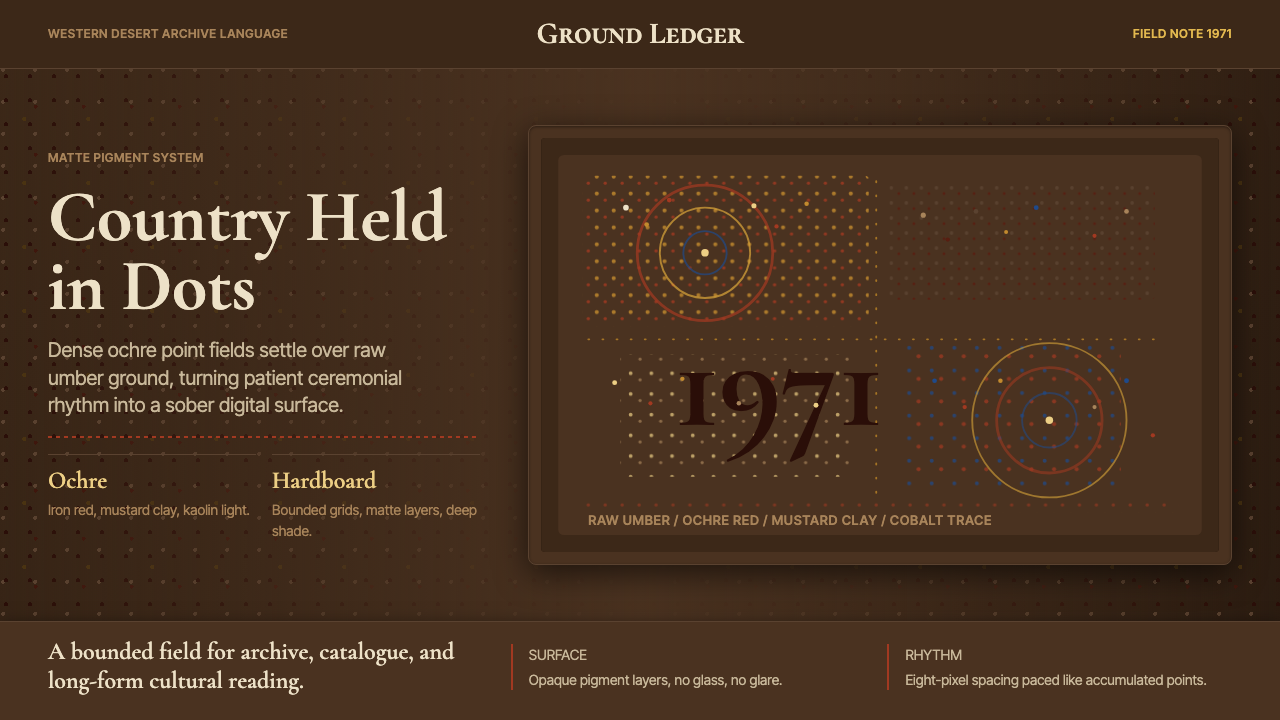 Aboriginal Dot Painting (Papunya 1971)Ochre memory, held steady. Raw umber ground, Cormorant type, disciplined dot-…
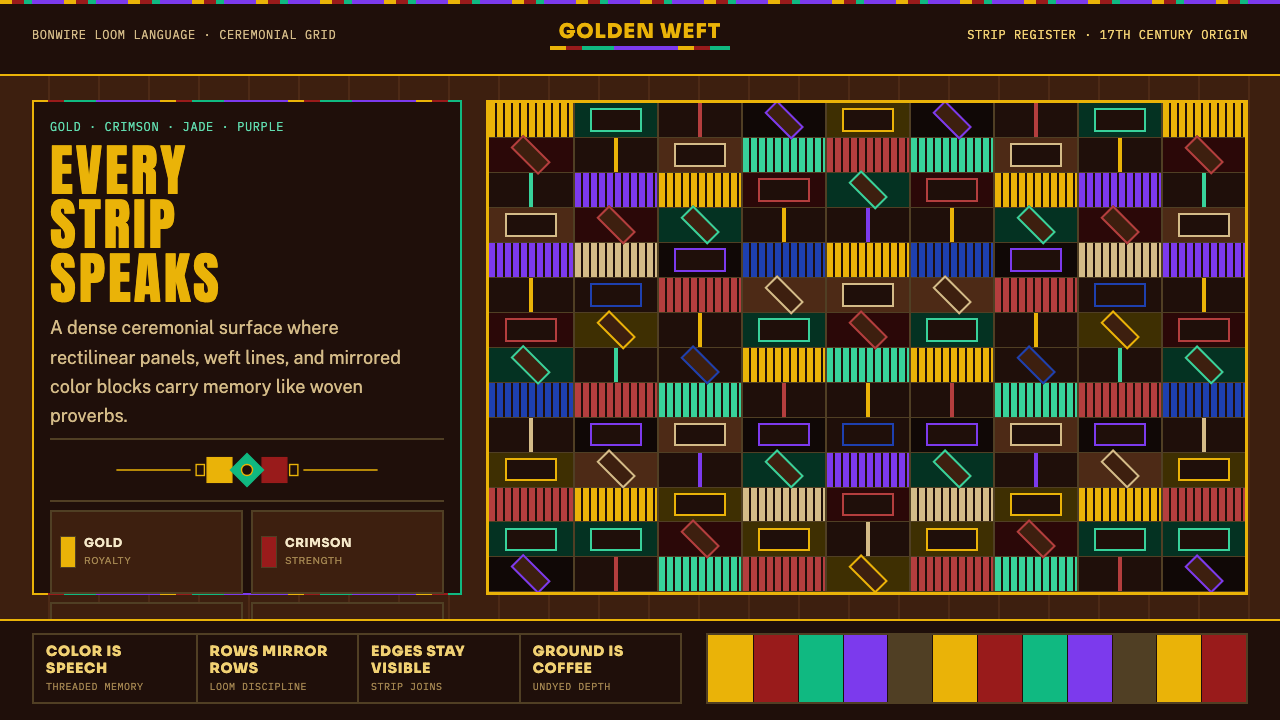 West African Kente ClothWoven authority. Gold, crimson, jade, and purple strips lock into a dense cof…
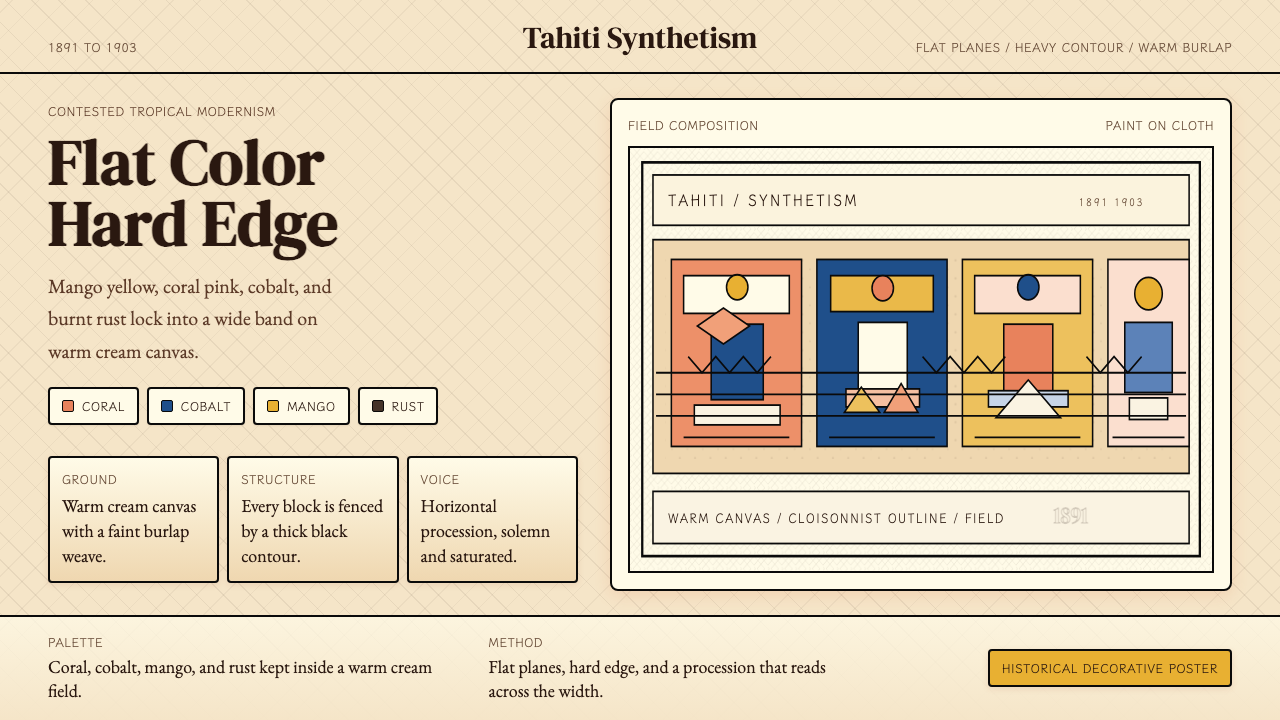 Gauguin — Tahiti SynthetismFlat color, hard edge. Cream canvas, coral, cobalt, and rust lock into a frie…
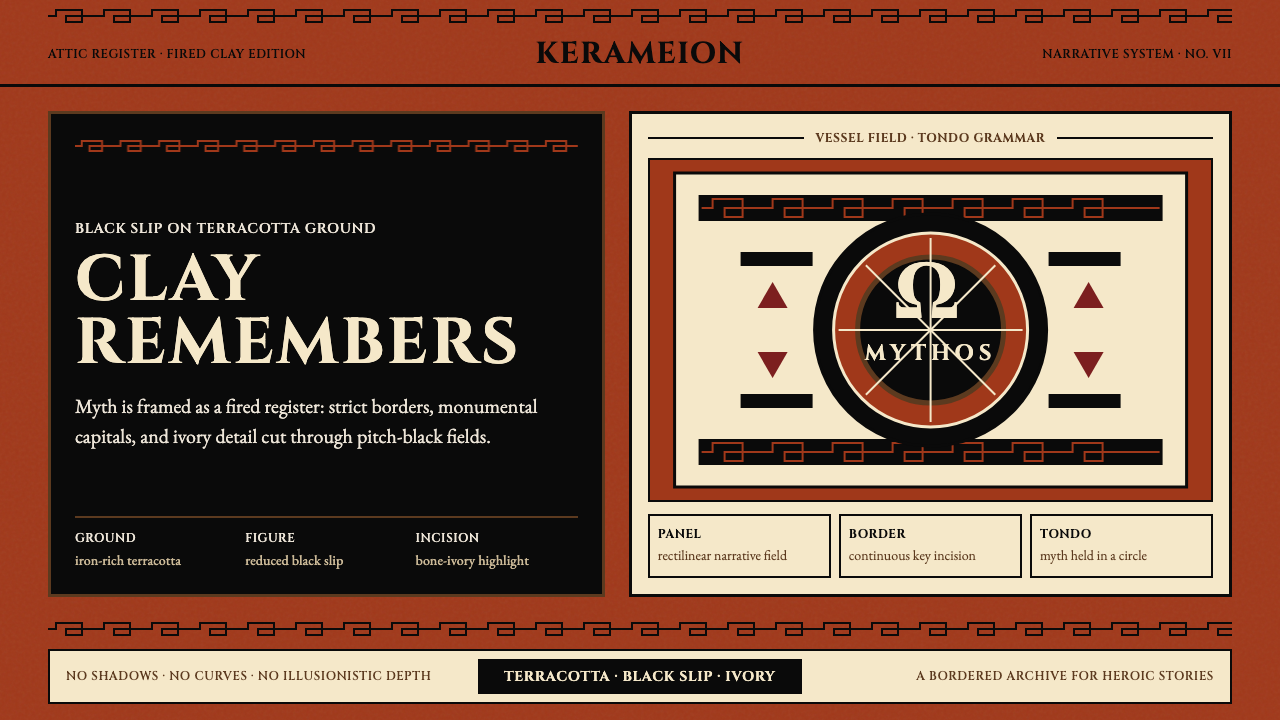 Greek Antiquity (Attic Vase)Myth becomes architecture. Terracotta, black slip, and Greek-key borders fram…
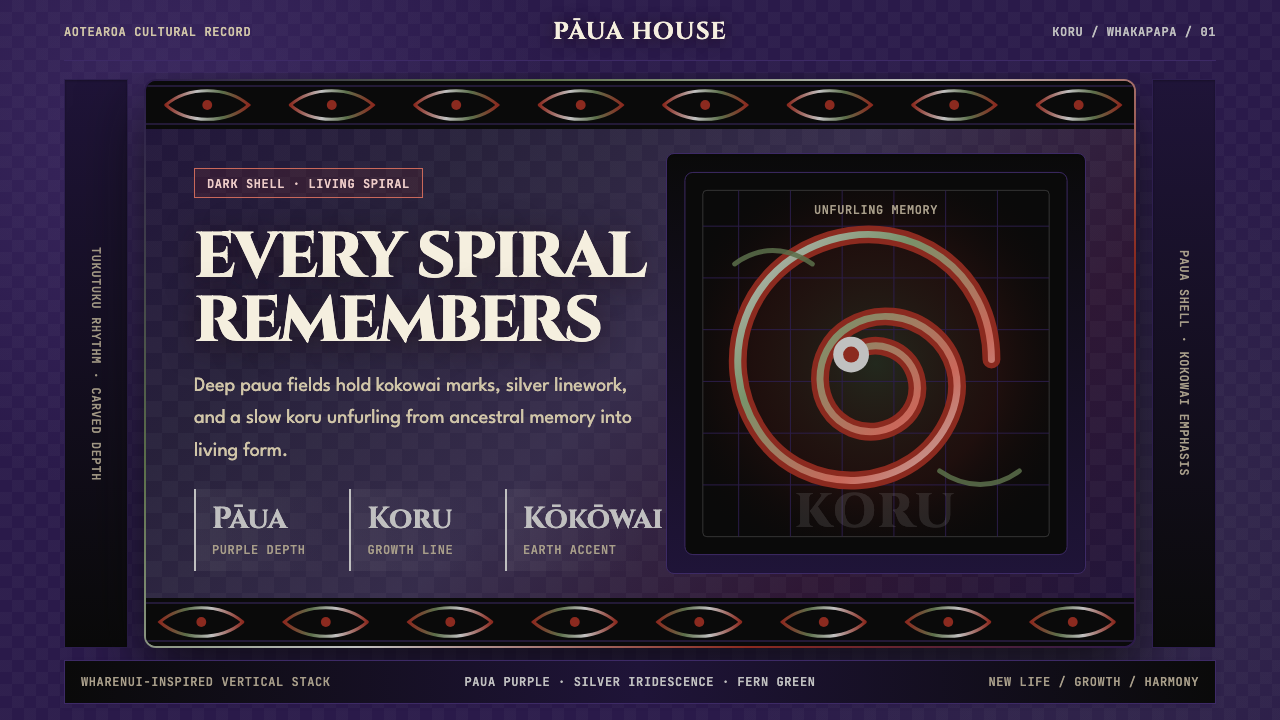 Māori Koru (Aotearoa)Ancestry glows in the dark. Paua purple, kokowai red, and silver koru frame t…
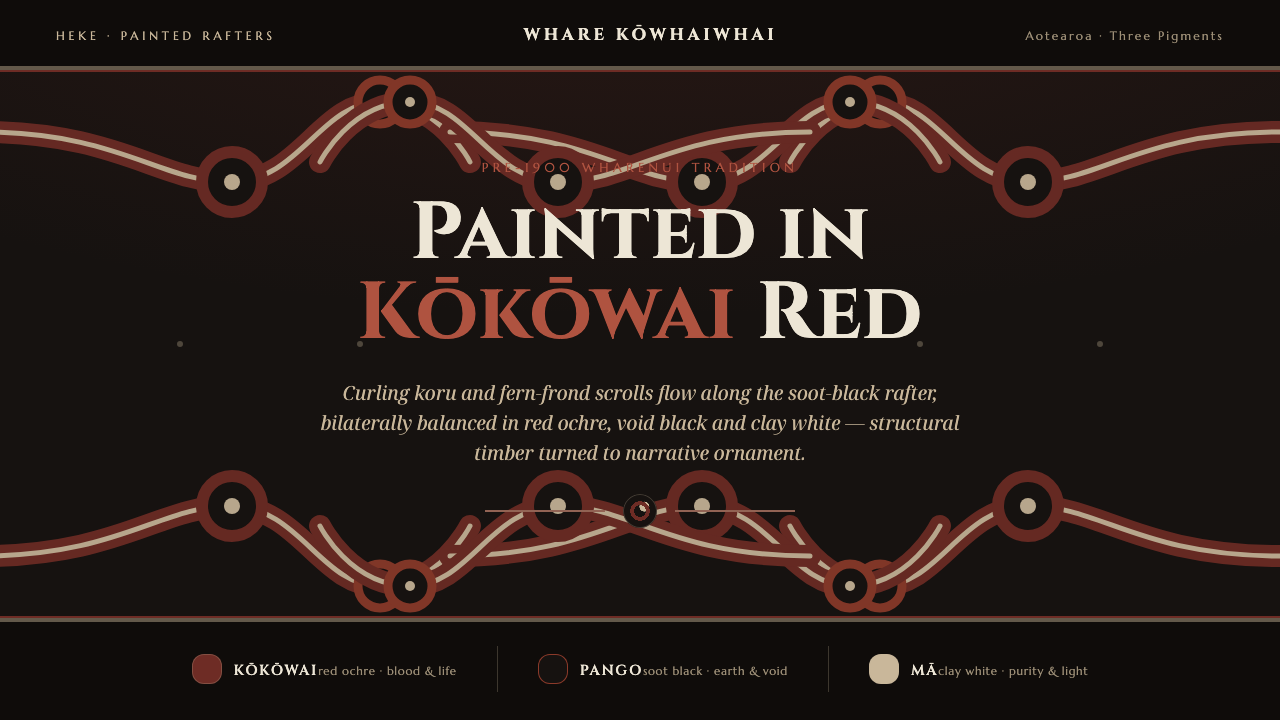 Māori Kōwhaiwhai RafterPainted timber, not pixels. Kōkōwai-red koru scrolls in mirrored balance on b…