What is Māori Koru (Aotearoa)?
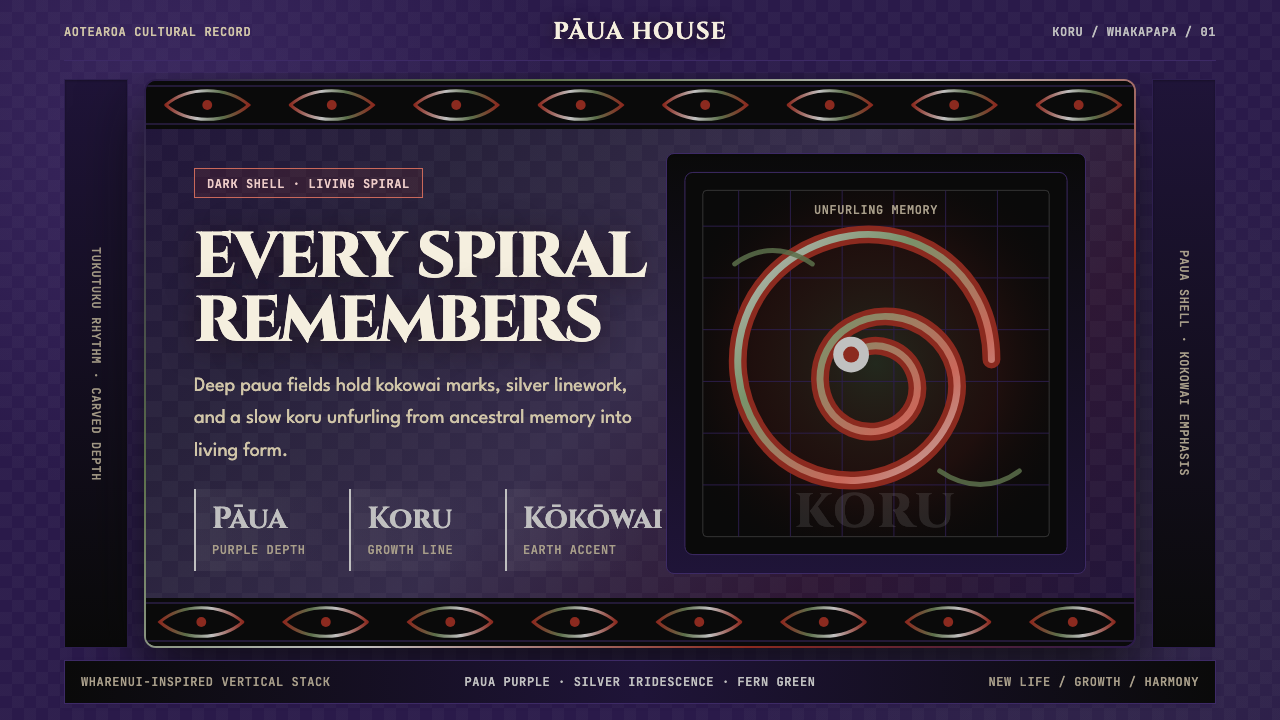
From the unfurling silver fern frond to the carved meeting house, Māori visual culture spirals outward from ancestral memory into living, breathing design.
Māori Koru (Aotearoa) in brief
Māori Koru (Aotearoa) is a design system rooted in the indigenous visual traditions of the Māori people of Aotearoa, New Zealand. Its central motif is the koru — the tightly coiled spiral of the silver fern frond as it unfurls into new growth. Around this symbol, an entire aesthetic universe assembles: carved rafter paintings called kowhaiwhai, interlaced lattice panels called tukutuku, and the intricate surface carving of wharenui (meeting houses). Together these traditions form one of the most coherent and philosophically grounded visual systems in the Pacific.
The palette is immersive and distinctly of the land and sea. Deep paua-shell hues — the iridescent blue-purple of abalone — ground compositions in oceanic darkness. Against this, kokowai, the sacred red ochre pigment ground from iron-rich earth, provides warmth and vitality. Silver and white, the colours of the silver fern and of moonlight on water, arc and spiral across the dark ground. Black line work, dense and deliberate, defines the koru outline and the interlocking scroll forms that give the system its unmistakable identity.
What distinguishes Koru design from mere decorative borrowing is its philosophical coherence. Every spiral form carries whakapapa — genealogy, lineage, the continuous thread connecting living people to ancestors. Growth moves outward from a coiled centre, mirroring the patterns of biological life. Symmetry and asymmetry coexist: kowhaiwhai panels repeat and mirror their scroll forms to create a sense of rhythmic momentum, while carved surfaces may stack forms in deliberate hierarchical sequence. The result is a visual language that is simultaneously ancient and immediately contemporary.

Where does Māori Koru (Aotearoa) come from?
Māori visual art traditions predate European contact by centuries. The ancestors of the Māori people, Polynesian voyagers who navigated by stars and ocean currents, arrived in Aotearoa from eastern Polynesia beginning around the thirteenth century CE. They brought with them the shared Polynesian vocabulary of curvilinear form and surface ornament, and over the following centuries developed it into something entirely distinct: a visual system shaped by the specific materials, landscapes, and spiritual frameworks of the new land.
The koru spiral as a central motif appears throughout early Māori carving, particularly in the interlocking scroll forms known as pitau, which animate the surfaces of whakairo (wood carving) found in wharenui, waka (canoes), and pātaka (storehouses). Kowhaiwhai rafter painting, applied in bold curvilinear repeating patterns to the rafters of meeting houses, developed its own formal vocabulary of scroll, notch, and interlace that could be read as genealogical record, spiritual protection, or ceremonial boundary — sometimes all three simultaneously. Tukutuku latticework, woven from kiekie rushes and muka (prepared flax fibre), added geometric counterpoint, its angular forms in dialogue with the curvilinear energy of the carved and painted surfaces.
European colonisation from the late eighteenth century onwards brought severe disruptions to Māori cultural practice. The land confiscations and cultural suppression of the nineteenth and early twentieth centuries threatened the continuity of carving, weaving, and painting traditions. The survival of these arts owes much to institutions like Te Aute College, where Māori leaders in the 1890s initiated a programme of cultural revival, and to master carvers and weavers who maintained their craft through periods of intense pressure. By the mid-twentieth century, organisations such as the Māori Arts and Crafts Institute at Whakarewarewa worked actively to document, teach, and practise traditional forms.
The modern Māori cultural renaissance from the 1970s onward transformed the tradition again, this time on its own terms. Artists such as Cliff Whiting, Robyn Kahukiwa, Shane Cotton, and Lisa Reihana brought traditional visual vocabulary into contemporary galleries, prints, film, and digital media. They were not simply reproducing old forms but translating them: examining what koru, kowhaiwhai, and whakairo could mean in new contexts, for new audiences, while remaining grounded in whakapapa. This contemporary practice is now globally recognised and has influenced branding, architecture, and graphic design well beyond Aotearoa.
What defines the Māori Koru (Aotearoa) look?
The Koru Spiral
The koru is the visual and philosophical core of the system. Derived from the silver fern frond as it coils before opening, the form is neither a simple circle nor an open curl but a specific shape: a tightly wound spiral that terminates in a bulbous, seed-like head. This terminal swell distinguishes the koru from other spiral traditions and encodes its meaning — potential, new life held in tension before release. In layouts, koru forms function as focal anchors, as connective tissue linking panels, or as directional signals guiding the eye from dense centre to open perimeter.
Dark Oceanic Ground
The canonical ground of Koru design is deep and immersive rather than light and neutral. Paua-shell hues — the shifting blue-purple iridescence of abalone — establish a base that feels simultaneously dark and alive. This is not the flat black of many dark-mode interfaces but a colour with depth, suggesting the ocean floor, the night sky over the Pacific, or the interior of a carved meeting house lit by firelight. Against this ground, lighter forms — silver spirals, white line work, cream glyphs — appear to emerge rather than sit on the surface.
Kokowai Accent
Kokowai, the red ochre pigment used in traditional Māori painting and ceremony, functions as the system's primary warm accent. It is a red with evident earthen origin — denser and more mineral than a pure scarlet, warmer than a pure crimson — and it carries ceremonial weight. In digital applications, a kokowai-inspired accent reads as a signal of sacred importance, used sparingly on the most critical interactive elements, calls to action, or structural highlights. Its power depends entirely on restraint: surrounded by dark ground and silver line work, even a small kokowai form commands immediate attention.
Silver Iridescence
Silver and near-white carry a specific cultural resonance in Māori visual culture: they evoke the silver fern, the shimmer of moonlight on water, and the pale highlights of paua shell. In the design system, silver is used for primary line work — the koru outlines, the scrolling borders of kowhaiwhai panels, the structural wireframe of a composition. Unlike flat white, a silver with slight warmth or iridescent quality adds a sense of material presence without disrupting the dark-ground composition. It also provides accessible contrast for text placed within the system.
Interlocking Scroll Rhythm
Kowhaiwhai painting organises its forms through repetition and mirroring: a single scroll unit is reflected and rotated, creating bands of interlocking pattern that move across a surface with rhythmic momentum. This is not random decoration but a formal system with its own internal logic — each element relates to its neighbours through rotation, reflection, or scaling. Applying this principle to digital design means treating repeated motifs as a generative system rather than a stamped pattern: the spacing, scale variation, and directional energy of the repeating unit all carry meaning.
Layered Depth and Darkness
Unlike many design systems that build depth through drop shadows or elevation tokens, Koru design achieves depth through tonal layering within a dark range. Surfaces do not cast shadows so much as they recede — a slightly lighter ground suggests a raised panel, a slightly darker border suggests depth, a luminous koru form floats above the ground through tonal contrast alone. This approach creates a sense of carved space, as though the interface were a wharenui interior whose carved surfaces emerge from and recede into the wood.
Whakapapa as Structure
In Māori thought, whakapapa — genealogy, the layering of origins — is not merely ancestry but a structural principle: everything that exists can be understood by tracing its connections back through time. This translates into design as a preference for hierarchical, layered compositions that make relationships explicit. Larger forms contain or generate smaller forms; the spiral unfurls in a legible sequence; panel borders announce transitions between domains. Structure is narrative. The system resists flat, non-hierarchical arrangements in favour of compositions that can be read as having a beginning, a lineage, and a direction.

Who shaped Māori Koru (Aotearoa)?
Cliff Whiting (1936–2014) was a central figure in the mid-to-late twentieth century renaissance of Māori visual art. A master carver and painter, he was instrumental in bringing kowhaiwhai and traditional carving vocabularies into large-scale public commissions, including the celebrated Te Hono ki Hawaiki installation at the National Library of New Zealand. Whiting argued consistently that Māori visual forms were not merely decorative but carried epistemological weight — ways of knowing encoded in spirals and interlace. His influence shaped how a generation of artists and designers understood the relationship between form and meaning in Māori practice.
Robyn Kahukiwa (born 1940) is a painter and illustrator whose work has been foundational in bringing Māori women's perspectives and spiritual forms into contemporary fine art and popular culture. Her distinctive visual language combines traditional koru and figurative forms with bold, flat colour and a confrontational directness that reads powerfully in both gallery and printed contexts. Her picture books and paintings have introduced Māori visual vocabulary to audiences far beyond Aotearoa, making her one of the most significant translators of the tradition into accessible contemporary form.
Shane Cotton (born 1964, Ngāti Rangi, Ngāpuhi) works at the intersection of Māori visual tradition and contemporary painting practice. His canvases bring together koru spirals, kowhaiwhai forms, and moko (facial tattoo) patterns with a painterly sensibility that acknowledges both their cultural specificity and their capacity to generate meaning for audiences without prior knowledge of Māori tradition. Cotton's work demonstrates that the Koru design vocabulary can operate at high aesthetic sophistication without losing its cultural grounding — a model for how the style might be applied in contemporary contexts.
Lisa Reihana (born 1964, Ngāpuhi, Ngāti Hine) is a multi-disciplinary artist and filmmaker whose works bring Māori visual language into immersive digital and video contexts. Her panoramic video work Emissaries — which represented Aotearoa at the 2017 Venice Biennale — demonstrated the capacity of Pacific visual traditions to occupy and transform contemporary large-scale installation. Reihana's practice is relevant to contemporary designers not just as cultural reference but as a demonstration of how depth, movement, and ancestral form can be translated into immersive digital environments without diminishing their power.
Though primarily remembered as a religious leader and military commander of the nineteenth century, Te Kooti (c. 1832–1893) was also the founder of the Ringatū faith, whose meeting houses prompted a distinctive flowering of carved and painted interior design. The wharenui built for Ringatū communities brought the full vocabulary of koru carving, kowhaiwhai painting, and tukutuku weaving into a unified interior environment at a moment when Māori cultural practice was under severe colonial pressure. These buildings survive as some of the most complete and historically documented examples of the total Māori interior design tradition.
How do you use Māori Koru (Aotearoa) today?
Māori Koru is one of the most immediately recognisable of the Pacific design traditions, and precisely because of that recognisability it demands careful, informed application. The system's visual power comes from its coherence: the dark ground, the silver koru, the kokowai accent, and the scroll-rhythm of kowhaiwhai all depend on each other. Picking individual elements — a koru here, an earthy red there — without engaging the underlying compositional logic produces decoration rather than design. Begin by committing to the dark-ground palette and the spiral as the primary organisational motif before introducing any secondary elements.
For presentation decks, Koru works with exceptional force on cover slides. A full-bleed dark ground with a large koru spiral in silver anchoring one corner, a kokowai accent line marking the title zone, and high-contrast white or cream type creates a cover with genuine presence. Content slides should maintain the dark palette and use silver line work as section dividers — a single bold horizontal scroll border separates sections more effectively than a conventional rule. Data slides benefit from the system's tonal layering: charts and diagrams drawn in silver line work on dark grounds, with kokowai highlighting critical values, feel embedded in the visual system rather than imported from a default charting library.
For web interfaces, Koru translates well to dashboards, cultural and arts organisation sites, and premium product platforms where depth and singularity are valued. A full-dark layout with paua-toned grounds and silver type gives dashboards a distinctive visual authority. Navigation should be typographic, with koru-derived icons used sparingly for wayfinding. Pricing pages work with the system's natural hierarchy: a kokowai border or background signals the recommended tier, while the remaining tiers recede against the dark ground. Interactive states — hover, active, focus — can be marked by a shift toward the silver-iridescent end of the palette.
For editorial and marketing contexts, the system's bold tonal contrast supports strong information hierarchy. A long-form article layout using a dark ground with cream body text and silver heading accents reads as both immersive and authoritative. Section breaks marked by a kowhaiwhai-derived scroll band replace conventional typographic dividers. Marketing pages suit the system's poster-like intensity: full-width feature blocks alternate between dark-ground and slightly lighter mid-tone panels, with kokowai used exclusively for primary calls to action, ensuring the accent colour never loses its ceremonial weight through overuse.
A common and serious mistake in applying Koru design is treating it as generic Pacific or Polynesian decoration. The koru, kowhaiwhai, and tukutuku forms are specifically and culturally Māori; using them without understanding their origins, their meaning, or their community context is cultural appropriation rather than design reference. The most effective and respectful applications of this vocabulary work with Māori artists or cultural advisers, treat the forms as a living tradition rather than a historical artifact, and are transparent about the sources of their visual decisions. Organisations working with Māori communities or audiences in Aotearoa should also consider whether indigenous design leadership rather than aesthetic borrowing is the appropriate framing for their project.

Māori Koru (Aotearoa) — FAQ
Is it appropriate for non-Māori designers to use this visual system?
This is the most important question to ask before applying the style, and the answer is nuanced. The Koru design vocabulary is a living cultural tradition, not a historical artifact in the public domain. Using it respectfully means understanding its origins, engaging with Māori cultural perspectives, and ideally working in partnership with Māori designers or cultural advisers. It is quite different from applying a historical movement like Bauhaus — whose creators made their work explicitly universalist — to a new project. If your work is for a Māori community, a New Zealand organisation with Treaty obligations, or an explicitly bicultural context, the more important question is whether Māori design leadership is appropriate rather than aesthetic borrowing. If you are working in a global context using Koru as a reference point, do so with full acknowledgement of sources and without claiming cultural ownership.
How is Koru different from other Pacific or Polynesian design traditions?
While Māori visual culture shares broad Polynesian roots — the preference for curvilinear form, the centrality of ancestor worship, the use of surface ornament to encode genealogy — it developed in ways that are distinctly Aotearoa-specific. The koru spiral is particular to the silver fern of New Zealand and is not found in the same form in Samoan, Tongan, or Hawaiian design traditions. Kowhaiwhai rafter painting and tukutuku latticework are forms that emerged from the specific building traditions of the wharenui. The dark paua-shell palette reflects the marine environment of the New Zealand coast. Treating Koru as interchangeable with other Pacific traditions is an error of the same kind as treating Bauhaus as interchangeable with Art Deco because both are European and twentieth-century.
Can the Koru system work in light-background contexts, or is dark ground essential?
The deep, immersive ground is central to the system's visual and cultural logic — the darkness evokes the interior of a carved meeting house, the depth of ocean, and the nocturnal quality of paua shell. A light-ground inversion is technically possible but culturally and aesthetically at odds with the system's character. On a cream or white ground, the kokowai red tends to dominate aggressively, the silver line work loses its luminous quality, and the sense of forms emerging from depth — which is the system's primary spatial achievement — disappears entirely. If a light-background application is required by context, consider using the forms and the kokowai palette while acknowledging that you are working with a significant adaptation rather than a true Koru application. A more faithful approach might be a dark panel or card component within an otherwise light layout.
How does the system handle typography, given that traditional Māori art is non-typographic?
Traditional Māori visual culture encodes language in form — in the spiral, the lattice, the scroll — rather than in alphabetic text. Contemporary applications of the system therefore face an interesting challenge: introducing Latin or te reo Māori text into a visual environment whose logic is curvilinear and pictographic. The most successful approaches treat type as another structural element rather than a layer above the design: generous size contrasts between headings and body text mirror the scale relationships found in koru forms; typographic spacing is open, reflecting the breathing quality of spiral composition rather than tight European text setting. Type drawn in silver or cream against the dark ground appears to belong to the same material world as the silver koru. Avoid typefaces with heavy decorative serifs, which compete with the organic complexity of the scroll forms.
What is the difference between using Koru as a design system and cultural appropriation?
The line between respectful design reference and cultural appropriation is drawn primarily by context, consent, and credit. Appropriation typically involves taking forms without acknowledgement, using them in ways that misrepresent their meaning, profiting from cultural capital without returning value to the culture of origin, or displacing indigenous practitioners from opportunities that the style creates. Respectful reference involves transparently acknowledging Māori origins, engaging with the actual cultural meaning of the forms rather than their surface appearance, supporting Māori artists and designers in contexts where the style is commercially applied, and seeking input from Māori cultural advisers where the stakes are high. The scale of the project also matters: a student poster exploring Pacific design traditions sits in a very different ethical context from a multinational brand campaign using koru spirals as a marketing device.
Related design styles
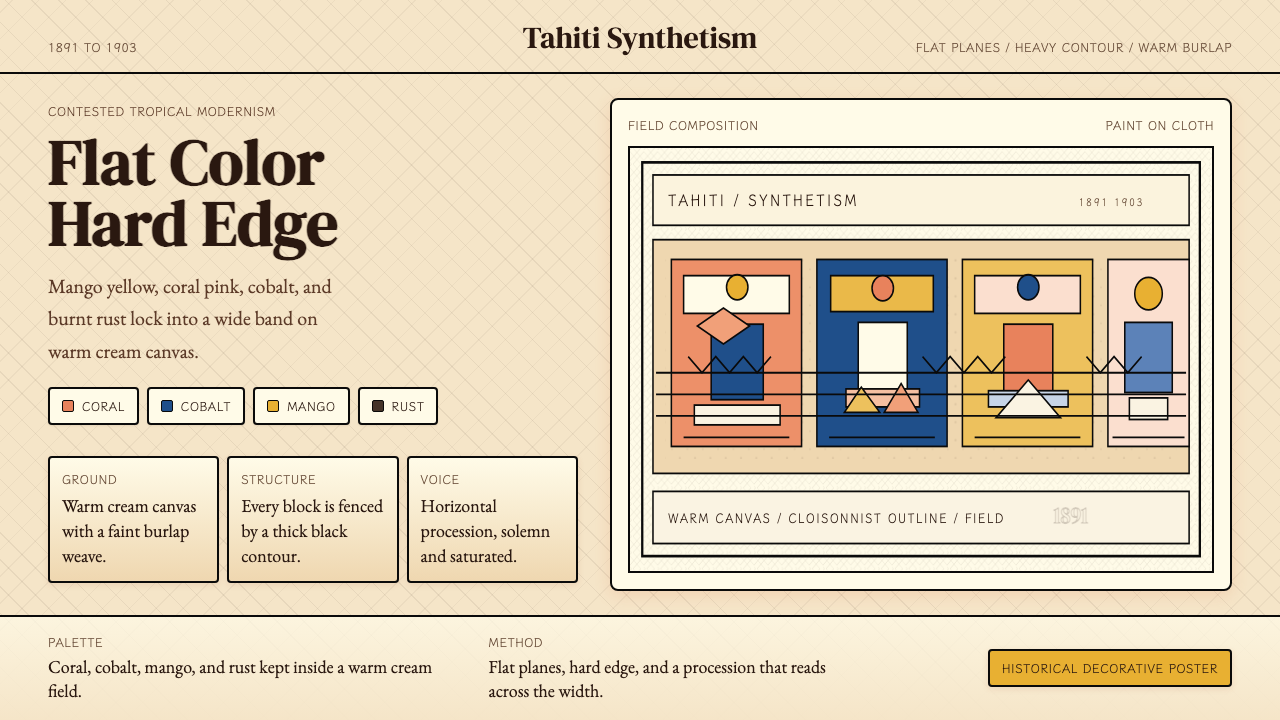 Gauguin — Tahiti SynthetismFlat color, hard edge. Cream canvas, coral, cobalt, and rust lock into a frie…
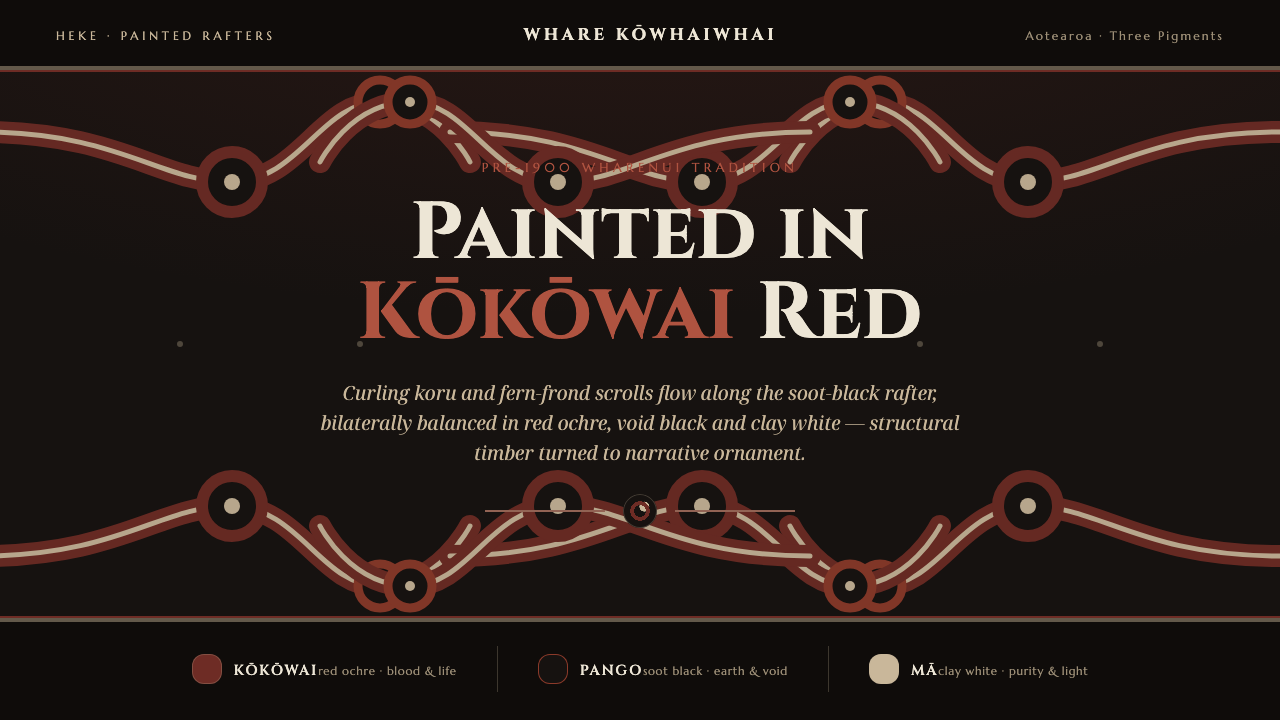 Māori Kōwhaiwhai RafterPainted timber, not pixels. Kōkōwai-red koru scrolls in mirrored balance on b…
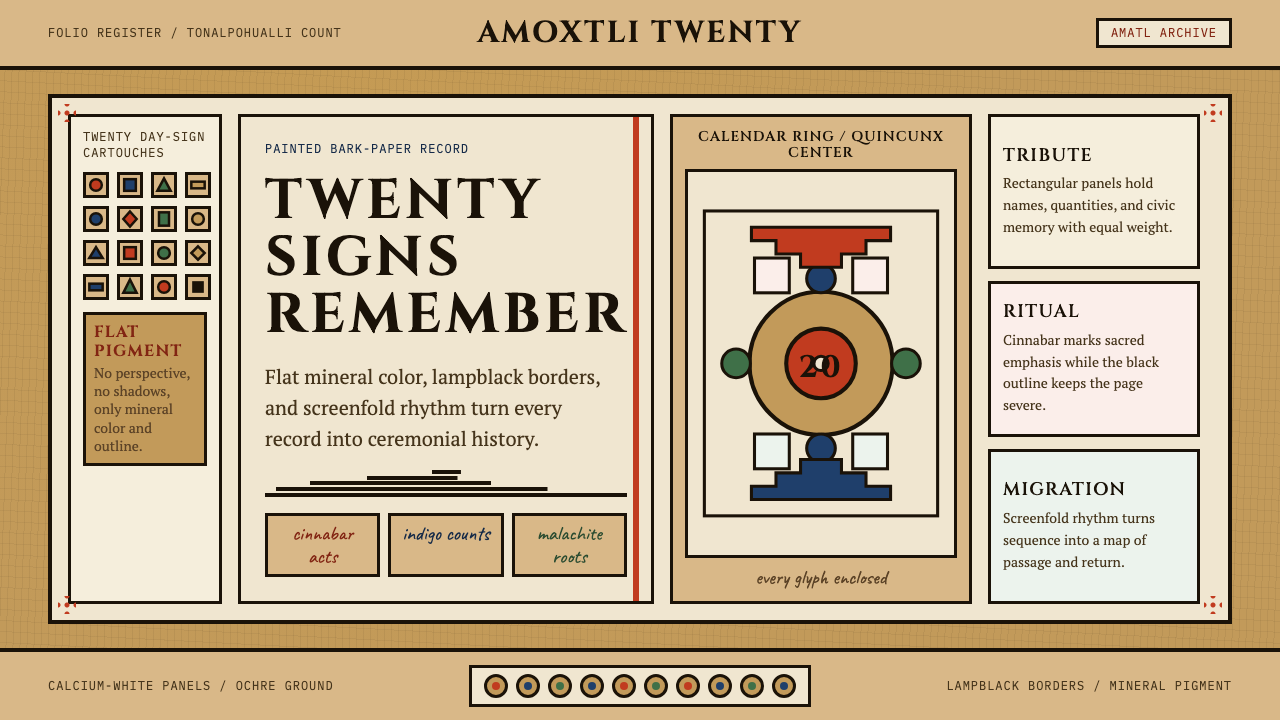 Aztec CodexSacred records stay severe. Ochre amatl ground, Cinzel capitals, black cartou…
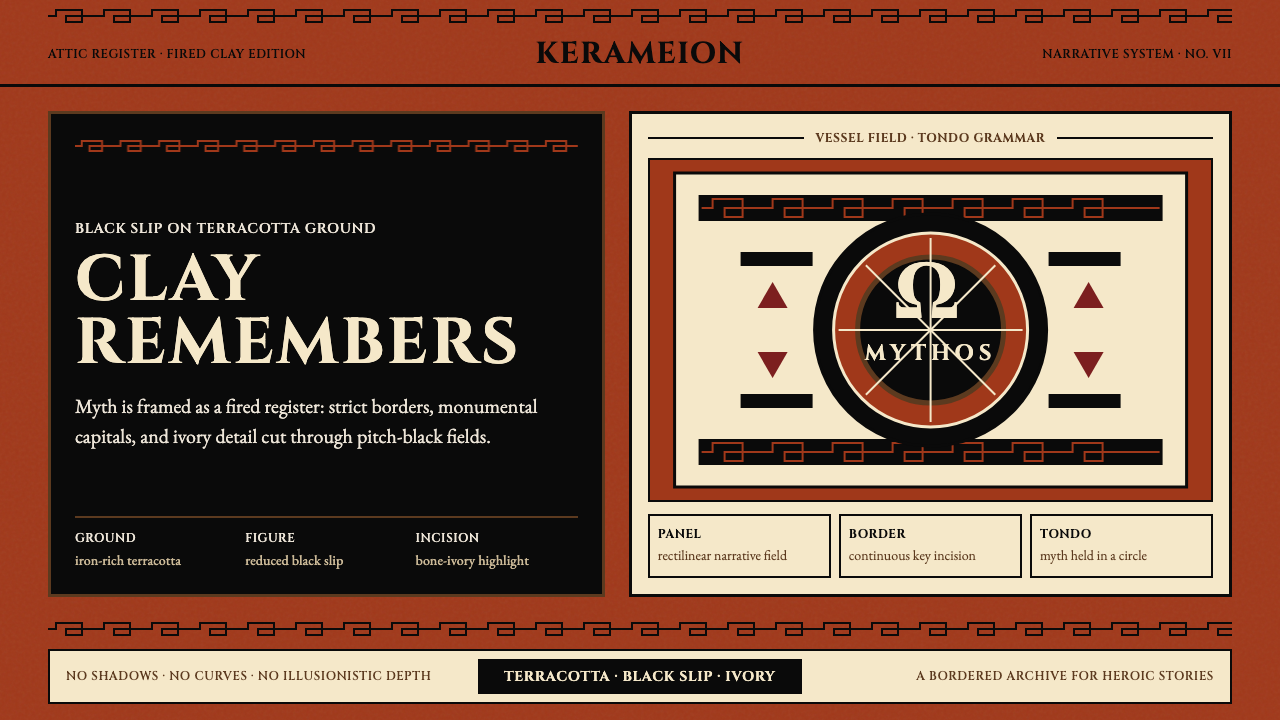 Greek Antiquity (Attic Vase)Myth becomes architecture. Terracotta, black slip, and Greek-key borders fram…
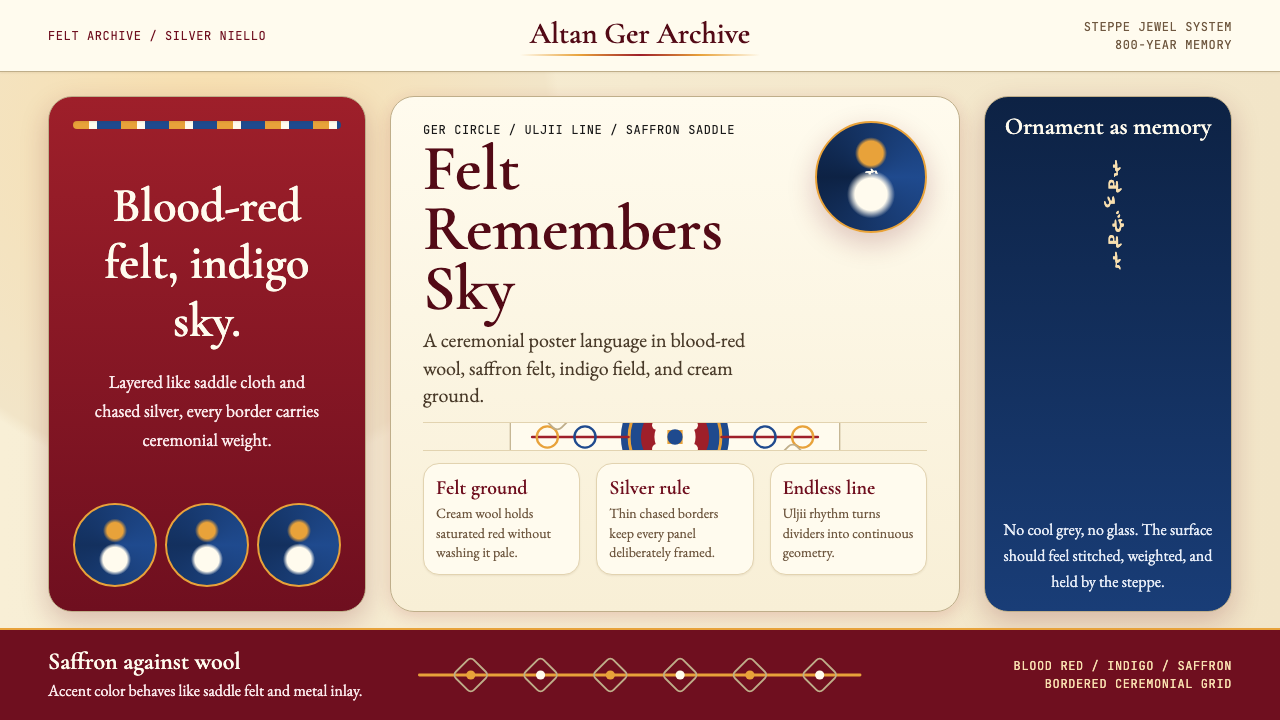 Mongolian Nomadic SteppeSteppe memory in jewel tones. Blood-red felt, saffron, indigo, and bordered u…
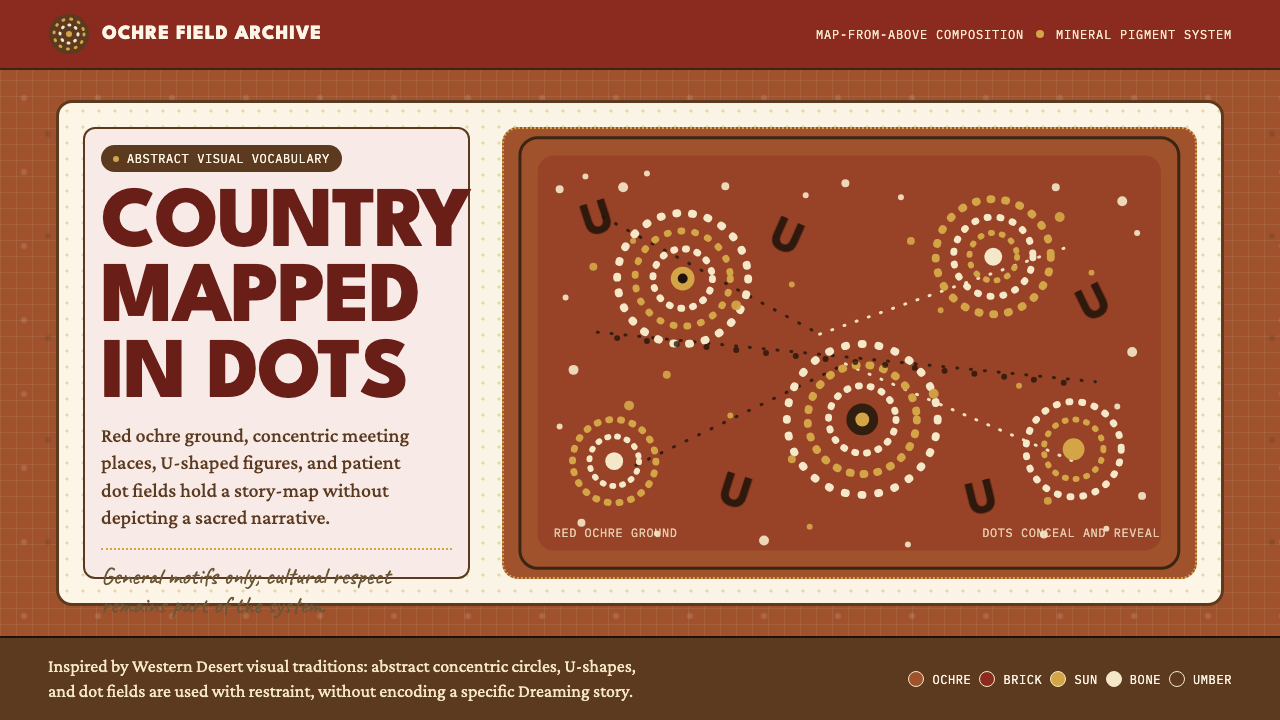 Aboriginal Dot PaintingAncient story-map energy. Red ochre, bone dots, concentric circles, and U-mar…