What is Mongolian Nomadic Steppe?
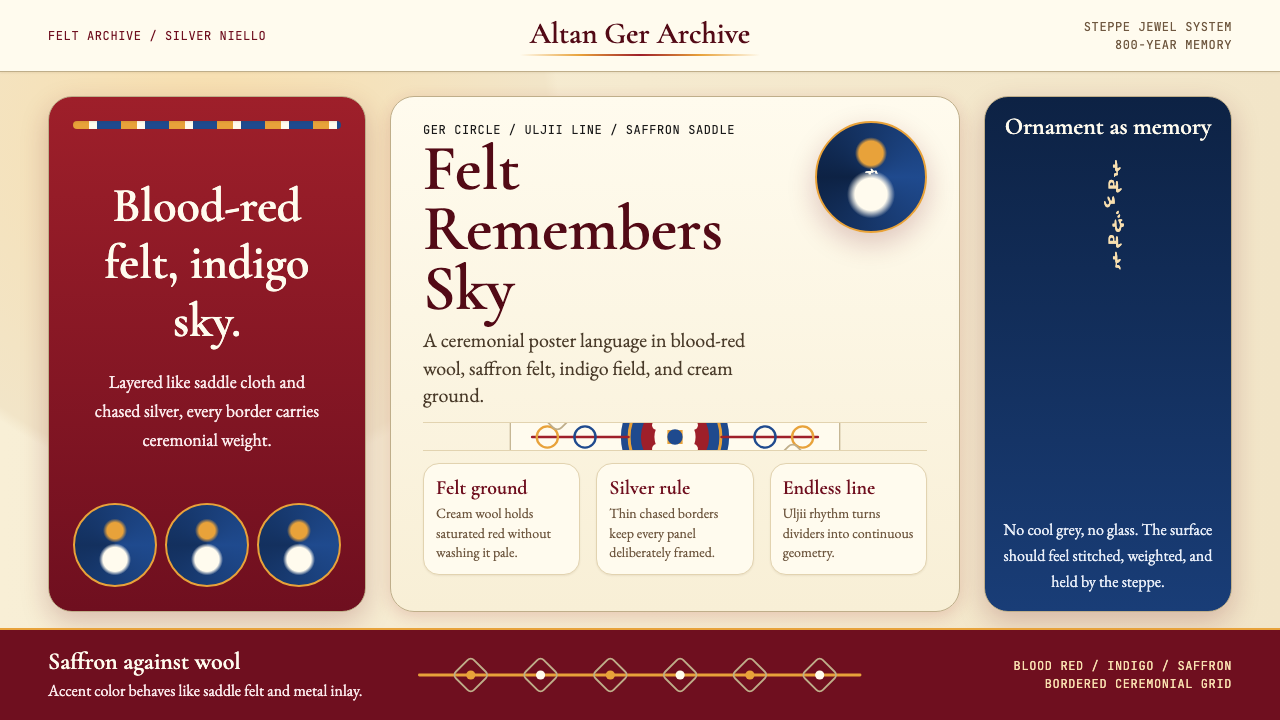
Eight centuries of Genghisid pastoralism — encoded in blood-red felt, saffron saddle cloth, and the curling uljii endless-knot — arrive as a visual system saturated enough to stop a steppe wind.
Mongolian Nomadic Steppe in brief
Mongolian Nomadic Steppe is the visual culture distilled from eight centuries of Genghisid pastoralism: the interior of a ger tent where blood-red felt walls meet silver-niello hardware, the tooled leather of a saddle bordered by interlocking geometry, the vast indigo sky over an amber grassland horizon. As a design system, it translates those material realities into a codified palette of jewel-saturated steppe tones and a grammar of ornamental geometry that has never permitted itself to become merely pretty.
The system works through four interlocking elements. Color is drawn from physical objects rather than abstract theory — the deep crimson of compressed felt, the saffron of dyed wool and brass fittings, the near-navy of Central Asian sky, the silver of chased metalwork, and the warm cream of undyed wool ground. Pattern is geometric and codified: the uljii endless-knot, the Soyombo emblem developed by the Buddhist scholar-artist Zanabazar in the seventeenth century, the circular rhythms of the ger plan, and stylized silhouettes of horse, gazelle, and golden eagle drawn from the steppe's living world. Every motif carries cultural and often cosmological weight; ornamentation here is never arbitrary.
What separates Mongolian Nomadic Steppe from decorative exoticism is its quality of material presence. The aesthetic comes from felt appliqué and chased metal, not from paint applied to cloth. Textures read as layered and dense; edges carry the weight of craft labor. Applied to screen or print, this translates into a richness that avoids flatness on one side and theatrical excess on the other — a visual register that is simultaneously ancient and commanding.

Where does Mongolian Nomadic Steppe come from?
The visual culture now recognized as Mongolian Nomadic Steppe did not emerge from a single artistic movement with a manifesto. It accumulated across centuries of necessity, trade, and cosmological belief on the Eurasian steppe. The ger — the portable circular dwelling of Mongolian pastoralists — was the primary design laboratory. Its construction, interior arrangement, and decoration were governed by principles refined over generations: the lattice wall (khana) supporting felt layers of graded warmth, the central smoke-hole (toono) as calendar and compass, the interior furnished with carved chests, painted columns, and embroidered textiles whose patterns encoded clan identity and spiritual protection.
The Genghisid period beginning in 1206 supercharged this existing aesthetic vocabulary. Chinggis Khan's conquests created the largest contiguous land empire in history, and with it came the movement of artisans, materials, and visual ideas at an unprecedented scale. Metalworkers from Central Asia, weavers from China, goldsmiths from Persia — all worked within Mongol court patronage, producing objects that synthesized steppe traditions with the luxury vocabularies of conquered civilizations. The Yuan dynasty (1271–1368), established by Kublai Khan in China, represents the apex of this pan-Asian synthesis: Mongolian structural forms and motifs received Chinese lacquerwork, Central Asian tile geometry, and Tibetan Buddhist iconography as neighboring registers rather than replacements.
The seventeenth century brought a codification that gave the aesthetic much of its recognizable contemporary structure. Zanabazar (1635–1723) — sculptor, monk, polymath, and first Jebtsundamba Khutuktu of Outer Mongolia — worked at the intersection of Mongolian steppe tradition and Tibetan Buddhist visual culture. His Soyombo script and the Soyombo emblem, which now appears on the Mongolian national flag, synthesized fire, sun, moon, and geometric elements into a single symbol of extraordinary density. The Mongolian Buddhist Halh school of thangka painting and decorative arts that developed around Zanabazar's workshops established formal standards for color, proportion, and ornamental grammar that continued influencing applied arts into the twentieth century.
The post-1990 period opened by Mongolia's democratic transition marked the most recent transformation of this visual tradition. Freed from Soviet-era constraints that had suppressed traditional ornament as feudal, Mongolian artists, designers, and state institutions undertook a systematic recovery and recontextualization of the aesthetic. The Soyombo was restored to the national flag. Traditional ger architecture, silver craft, and felt-appliqué textile traditions received renewed institutional support. Contemporary Mongolian graphic designers began reworking uljii patterns and ger-plan geometries for poster design, corporate identity, and digital interfaces — creating a living tradition that draws on eight centuries of accumulated visual intelligence rather than treating it as museum material.
What defines the Mongolian Nomadic Steppe look?
Color
The palette is anchored by five steppe-jewel tones, each traceable to a physical material in nomadic craft: blood-red felt, saffron-dyed wool or brass fittings, deep indigo sky, cold silver hardware, and warm undyed cream felt ground. These colors appear at full saturation — never washed out, never pastel. Black is used structurally for outlines and borders rather than as a background field. The system has no room for muted intermediary tones; the contrast between the saturated hues and the cream or white ground carries all the visual weight that softer palettes distribute across dozens of shades.
Ornamental Geometry
The geometric vocabulary is specific and codified, not generically decorative. The uljii endless-knot — a single continuous line folding back on itself in interlocking loops — is the system's most versatile module, used as a border, a fill pattern, or an isolated focal motif. The Soyombo emblem compounds fire, sun, moon, earth, and water into a vertically stacked symbol. Ger-plan geometry — concentric circles, radiating spokes — appears as a structural organizing device. These motifs are not interchangeable with generic Celtic knots or Islamic arabesques; their specific forms carry cultural meaning and should be used with fidelity to the originals.
Material Texture
The aesthetic originates in felt appliqué and chased metalwork, not in painted illustration, and this origin is legible in the visual system's characteristic density and layering. Edges are firm rather than smooth; shapes read as cut and placed rather than drawn. Pattern layers over ground with the slight relief quality of actual textile. In screen applications, this translates to an avoidance of soft gradients and ambient glow effects — not because those are technically wrong, but because they would import a logic of light and atmosphere that is foreign to the steppe material tradition.
Animal Silhouette
The steppe's living world provides a second figurative register alongside the geometric: the horse in full gallop, the gazelle mid-leap, the golden eagle with wings spread. These appear not as naturalistic illustrations but as stylized silhouettes — curves simplified to their most expressive essence, proportions slightly elongated or flattened to emphasize movement and power. They function as accent motifs within geometric compositions, never as the primary organizing element. The treatment descends from the animal-style art of Eurasian nomadic cultures going back to the Scythian period, filtered through later Mongol and Buddhist Halh refinements.
Border and Frame Logic
The aesthetic makes heavy use of bordered compositions — an inner field of color or pattern circumscribed by one or more ornamental borders — reflecting the ger interior logic where each textile panel is bounded, layered, and distinct. Borders are not merely decorative trim; they define the territory of each visual zone and create the system's characteristic sense of intentional containment. The border motif itself is typically a reduced form of the uljii or a simple stepped fret, repeated at a scale that registers as pattern rather than individual motif. Borderless, open compositions feel foreign to the system.
Circular Rhythm
The ger's circular plan inscribes a specific compositional preference into the tradition: radial symmetry, concentric organization, and the circle as the natural container for cosmological symbolism. The toono — the circular smoke-hole at the apex of the ger — functions as a calendar, compass, and symbolic opening to the sky, and this multivalent circular motif recurs at every scale in the visual system. Compositions built on circular or radial axes feel native to the aesthetic in a way that strict rectilinear grids do not.
Silver and Metalwork Accent
Silver — the color of chased-metal hardware on saddles, belts, and ger fittings — functions as the system's cool accent and precision element. Where other steppe aesthetics lean toward gold as the prestige metal, Mongolian craft tradition elevates worked silver: niello-inlaid, engraved, or filigree. In visual design, this translates to a cool-gray or metallic accent that reads as craft authority rather than luxury excess. Applied sparingly — on borders, on type set against deep-colored grounds, on key iconographic elements — it lifts the composition without competing with the primary jewel tones.

Who shaped Mongolian Nomadic Steppe?
Genghis Khan (c. 1162–1227) unified the Mongolian tribes in 1206 and launched the conquests that created the Mongol Empire — the largest contiguous land empire in history. His political unification had direct aesthetic consequences: it created a unified Mongol court patronage system that drew artisans from across Eurasia, funding the production of saddles, textiles, metalwork, and ger furnishings that synthesized steppe craft traditions with Chinese, Central Asian, and Persian luxury vocabularies. The Genghisid period established the prestige context in which Mongolian visual culture was first systematically elaborated and exported across the known world.
Kublai Khan (1215–1294) founded the Yuan dynasty in China in 1271, creating the political framework for the most ambitious visual synthesis of the Genghisid era. Under his rule, Mongolian steppe aesthetics — the ger's circular geometry, the felt and leather material culture, the bold jewel-tone palette — were placed in dialogue with the court arts of China, Central Asia, and Tibet. The Yuan period produced textiles, lacquerwork, and decorative objects in which Mongolian structural logic and Chinese surface refinement are genuinely integrated, rather than juxtaposed. This synthesis remains visible in the pan-Asian character of Mongolian decorative motifs today.
Zanabazar (1635–1723) was the first Jebtsundamba Khutuktu of Outer Mongolia, a Buddhist incarnation recognized simultaneously as a political and spiritual leader. He was also the most accomplished visual artist in Mongolian history — sculptor, calligrapher, and designer. His Soyombo script and the Soyombo emblem, composed in 1686, synthesized fire, sun, moon, earth, and water elements into a vertically stacked symbol of such formal precision that it has been adopted as the centerpiece of the Mongolian national flag. The thangka painting school and decorative arts workshops he founded established formal canons for color, proportion, and ornamental grammar that shaped Mongolian applied arts for three centuries.
Nyam-Osoryn Tsultem (1923–2001) was Mongolia's most significant art historian and a practicing painter who worked at the intersection of traditional Mongolian aesthetic scholarship and twentieth-century cultural documentation. His books on Mongolian art — covering sculpture, decorative arts, and painting from the Genghisid period through the Zanabazar school — provided the first systematic academic framing of the visual culture that design practitioners now draw on. Writing during the Soviet period, Tsultem navigated between official cultural policy and genuine scholarly recovery of the tradition, producing reference works that remain foundational for anyone working with Mongolian visual heritage.
Since Mongolia's democratic transition in 1990, a generation of Mongolian graphic designers — working in Ulaanbaatar and in diaspora — has led the systematic translation of traditional steppe aesthetics into contemporary visual communication. Working with uljii patterns, Soyombo geometry, and ger-plan radial structures, these practitioners have produced national identity programs, cultural event posters, and digital interfaces that demonstrate the aesthetic's full range when handled by designers who understand its internal logic. Their work establishes the contemporary standard against which applications of the style outside Mongolia should be measured.
How do you use Mongolian Nomadic Steppe today?
Mongolian Nomadic Steppe is a visually commanding style that rewards deliberate application. Its jewel-tone palette, ornamental geometry, and border-containment logic make it well-suited to contexts where cultural authority, ceremonial weight, or distinctive identity are the design objective. The first decision before applying it is whether the content warrants its register: the style reads as significant, rooted, and serious — assets when those qualities align with the message, liabilities when they do not.
For presentation slides, the style excels on cover and chapter-opener pages. A cover built on this system might place the title in a bold, high-contrast treatment against a deep crimson or indigo field, framed by a uljii-derived border in cream or silver. The composition should suggest containment and ceremony, not open-plan minimalism. Content slides work best when they adopt the bordered-field approach: a clearly defined content zone, a consistent grid that recalls the ger's structured interior, and color used categorically to distinguish sections or data types rather than decoratively. Data visualizations should be treated as geometric objects within the system — bars and segments taking on the palette's jewel tones with firm edges and no soft gradient fills.
For web interfaces, the system is particularly effective on dashboards, cultural institution sites, heritage brand homepages, and premium product landing pages where gravitas and distinctiveness are valued. Define a grid that accommodates the border logic — leaving room at the perimeter of key containers for an ornamental border frame. Use the cream or warm white as the primary ground, reserve the deep jewel tones for navigation, section headers, and interactive states. Card components should carry a firm border rather than a soft shadow; the border itself can incorporate a simplified uljii or stepped-fret motif at small scale. Pricing or tier pages benefit from the system's categorical clarity: each tier assigned one jewel tone, with the Soyombo or a circular motif as the tier icon.
For editorial and marketing work, Mongolian Nomadic Steppe suits campaign materials, cultural event identities, luxury brand communications, and any context where a strong sense of place and heritage is the selling proposition. A poster in this system would use the full palette boldly — one dominant jewel tone as ground, the cream for type, a silver or contrasting-jewel-tone border — with an animal silhouette or uljii pattern as the secondary visual layer. Marketing pages should maintain the bordered-composition logic even in digital scroll contexts: each section reads as a self-contained framed panel, an echo of the ger's interior panels. Type hierarchies use scale and weight to establish order; ornamental borders and dividers replace the ruled lines or white space that perform the same function in minimal systems.
A common mistake when applying this style is overloading the composition with too many motifs simultaneously — uljii borders, Soyombo icons, animal silhouettes, and full jewel-tone palette all competing for attention. Authentic steppe craft is rich but not chaotic; each object uses a limited selection of the tradition's elements, not all of them at once. A second error is treating the color palette as interchangeable with any saturated jewel-tone set: the specific relationship between blood-red, saffron, indigo, silver, and cream is the system — substituting teal or purple for indigo, or burnt orange for saffron, dissolves the visual authority that comes from the palette's material origins. Use the specific tones, keep the composition internally structured, and let one motif dominate while the others serve.

Mongolian Nomadic Steppe — FAQ
How is Mongolian Nomadic Steppe different from other Central Asian or Islamic geometric traditions?
The overlap is real — Mongolian decorative arts absorbed Central Asian geometric vocabulary through the Yuan-era synthesis — but the differences are specific. Islamic geometric traditions tend toward infinite repetitive tessellation that erases the individual motif in favor of an overall field; Mongolian geometry preserves the discrete, named motif (uljii, Soyombo) as a legible unit. The Mongolian palette is dominated by saturated jewel-tones with clear material origins, while Central Asian Islamic palettes often extend to turquoise, terracotta, and gold. Animal silhouettes — horses, eagles, gazelles — have no significant place in Islamic decorative tradition but are central to the Mongolian system. The most reliable differentiator is the uljii endless-knot: it is not a Buddhist eternal knot nor a Celtic equivalent, but a specifically Mongolian single-continuous-line form with no close analogue elsewhere.
Can this style work effectively in a dark-background application?
Yes, with specific adjustments. The historical palette is light-ground — cream or undyed felt — but an inversion to a deep indigo, near-black, or very dark crimson ground is not inauthentic: ger interiors at night, with firelight, shift the tonal balance exactly this way. On a dark ground, the saffron and cream tones become the light-carrying elements; silver metalwork accents read with particular clarity. The main risk on dark grounds is that all five palette tones become simultaneously active and compete rather than organize. The discipline on a dark-background application is to select one jewel tone as the primary luminous accent and treat the others as structural or typographic elements only — the same management logic that applies to the light-ground version, but with the tonal roles partially reversed.
How should ornamental motifs be sourced and adapted for digital use?
The most important practice is to work from documented originals — uljii patterns from museum textile records, the Soyombo from official Mongolian government sources — rather than from third-party approximations that may have drifted from the authentic forms. The uljii's defining characteristic is that it is drawn from a single continuous line; reproductions that break this into separate segments lose the motif's essential quality. When adapting for digital use, the correct approach is vector-faithful simplification: preserve the line continuity and proportional relationships of the original, reduce complexity only where the scale demands it. Scaling a uljii pattern down to a very small border detail is legitimate; reinterpreting its structure to make it easier to draw is not.
Is this style appropriate for non-Mongolian brands and contexts?
The style is appropriate when the connection to Mongolian culture is genuine — products made in Mongolia, cultural institutions working with Mongolian heritage, tourism or geographic contexts, or collaborations with Mongolian artists and designers — and it requires care in other contexts. The aesthetic's motifs are not abstract patterns; they carry specific cultural and cosmological meaning within the tradition. Applying the uljii or Soyombo purely decoratively, without acknowledging their origins, risks the kind of surface appropriation that reduces a living tradition to wallpaper. The productive model is engagement rather than extraction: citing sources, working with Mongolian designers, understanding what the motifs mean before deploying them. A brand that does this thoughtfully gains not just a distinctive visual register but a credible story.
Where does Mongolian Nomadic Steppe sit in relation to contemporary Mongolian national identity design?
The relationship is direct and ongoing. The Soyombo emblem on the national flag represents the most visible instance of this tradition operating as state visual identity. Since 1990, Mongolian national identity design — for government institutions, cultural organizations, and state events — has drawn explicitly and self-consciously on the steppe aesthetic vocabulary: uljii patterns as structural devices, the ger's circular geometry as organizational logic, the jewel-tone palette as the national color register. Contemporary Mongolian designers working in this space are not revivalists applying a historical style; they are participants in a living design tradition that has been continuously elaborated for eight centuries and is currently in one of its most active periods of reinterpretation. Engaging with the aesthetic means engaging with that ongoing conversation.
Related design styles
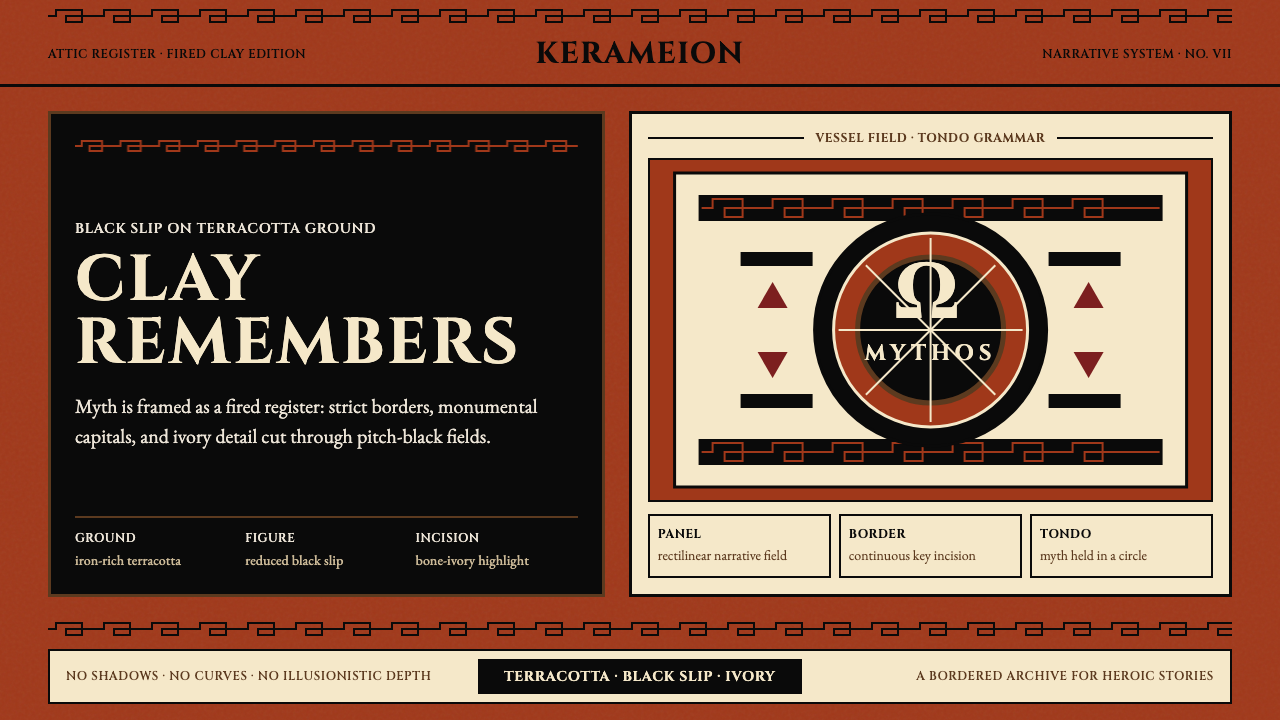 Greek Antiquity (Attic Vase)Myth becomes architecture. Terracotta, black slip, and Greek-key borders fram…
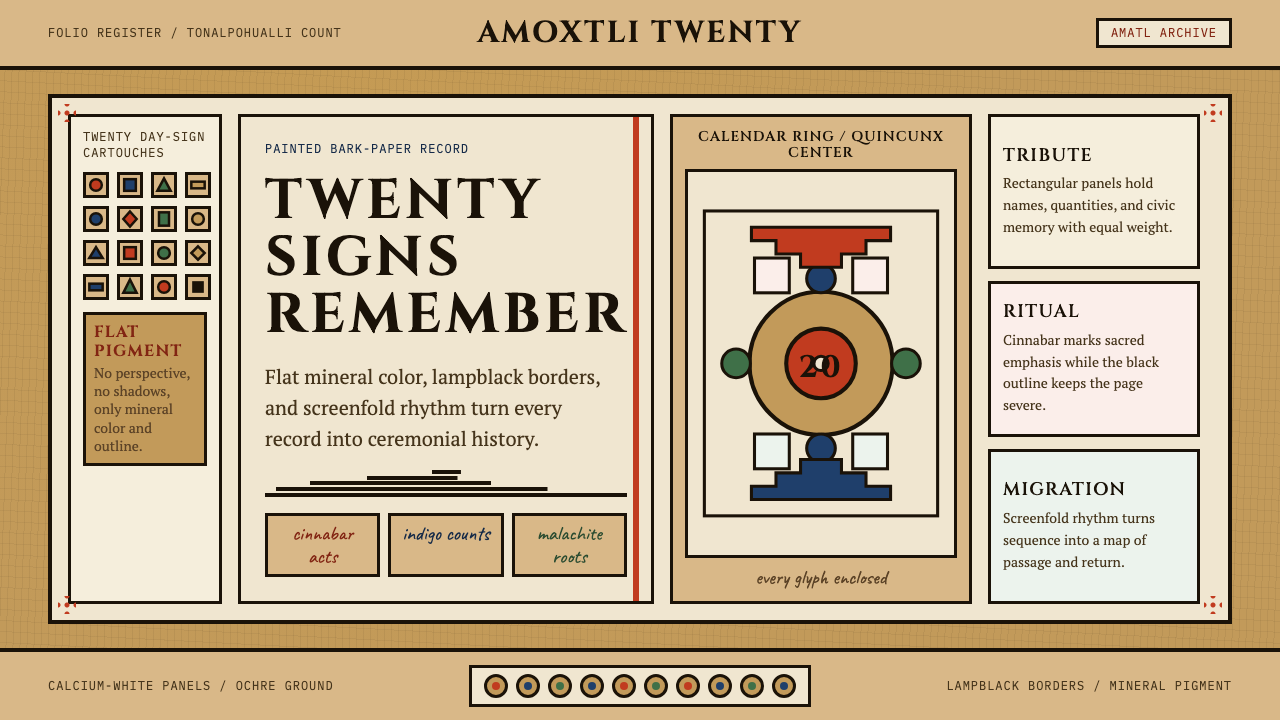 Aztec CodexSacred records stay severe. Ochre amatl ground, Cinzel capitals, black cartou…
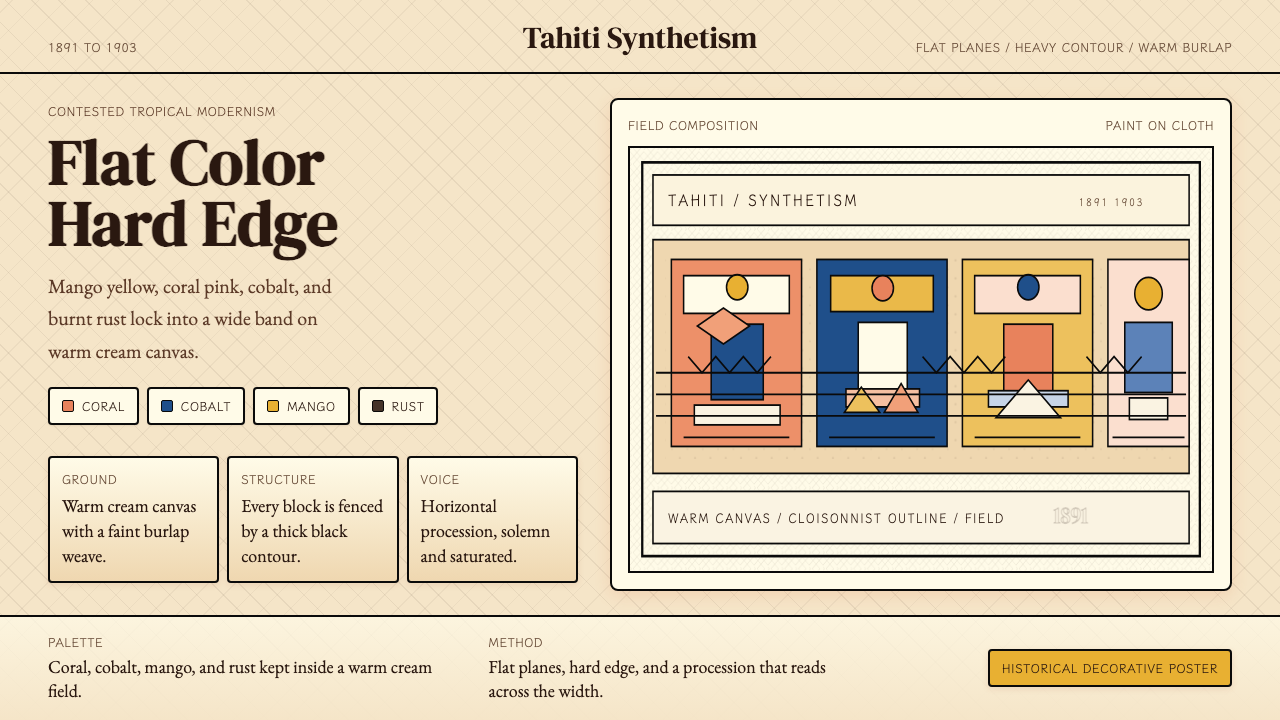 Gauguin — Tahiti SynthetismFlat color, hard edge. Cream canvas, coral, cobalt, and rust lock into a frie…
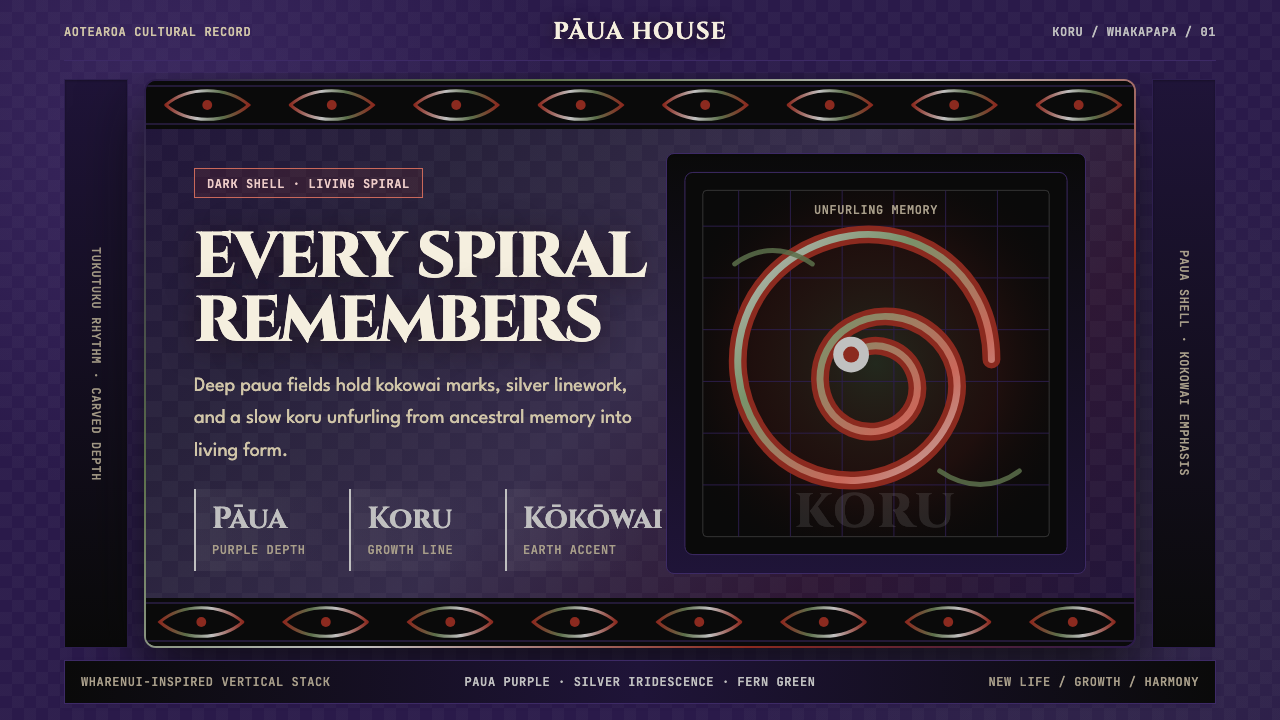 Māori Koru (Aotearoa)Ancestry glows in the dark. Paua purple, kokowai red, and silver koru frame t…
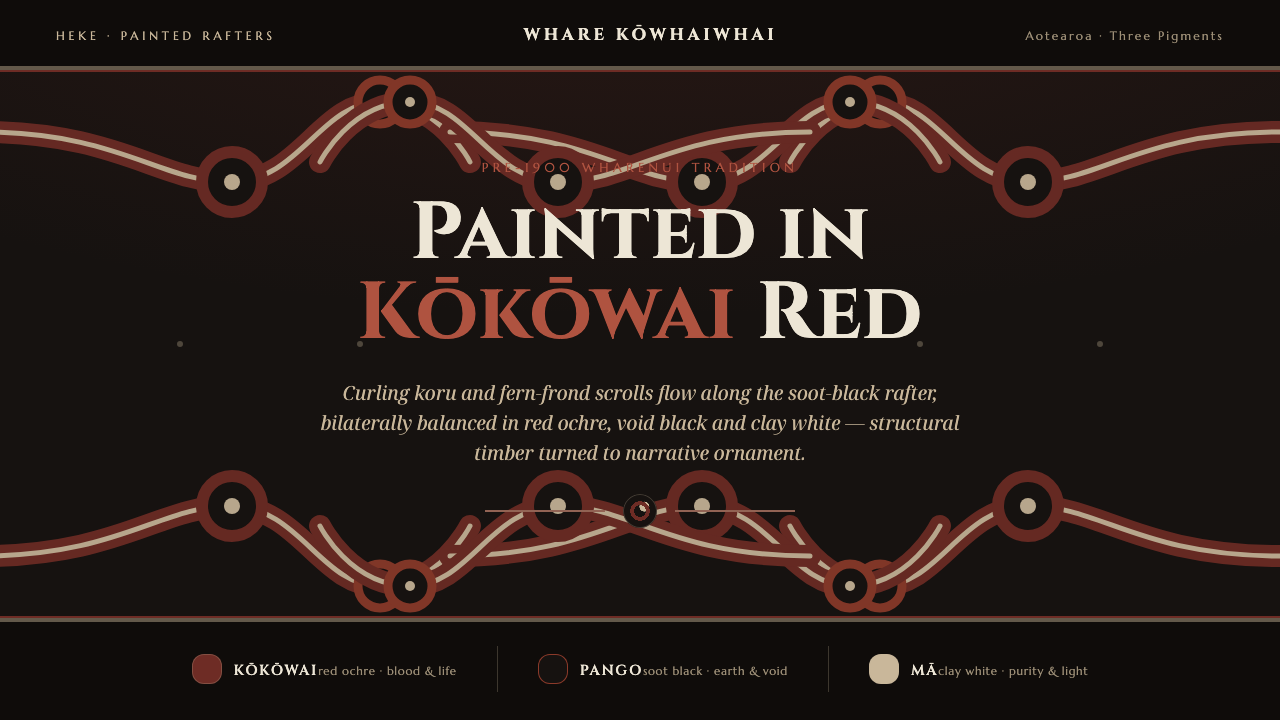 Māori Kōwhaiwhai RafterPainted timber, not pixels. Kōkōwai-red koru scrolls in mirrored balance on b…
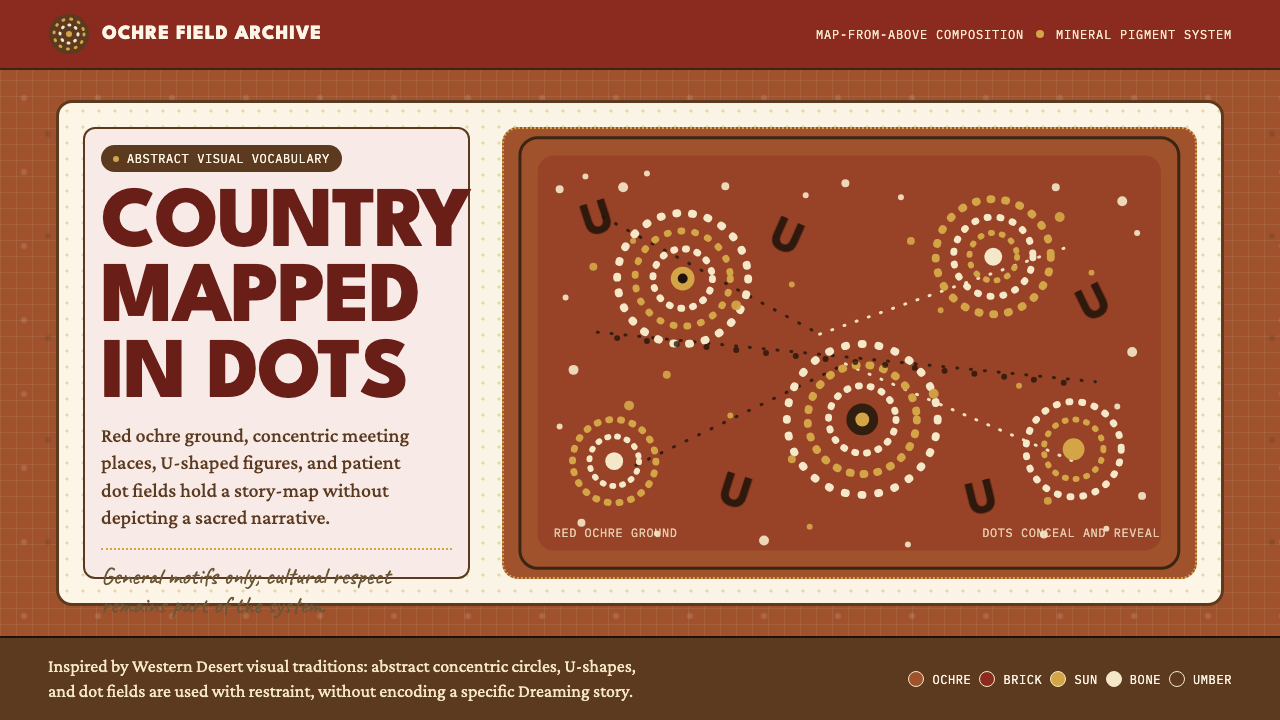 Aboriginal Dot PaintingAncient story-map energy. Red ochre, bone dots, concentric circles, and U-mar…