What is Gauguin — Tahiti Synthetism?
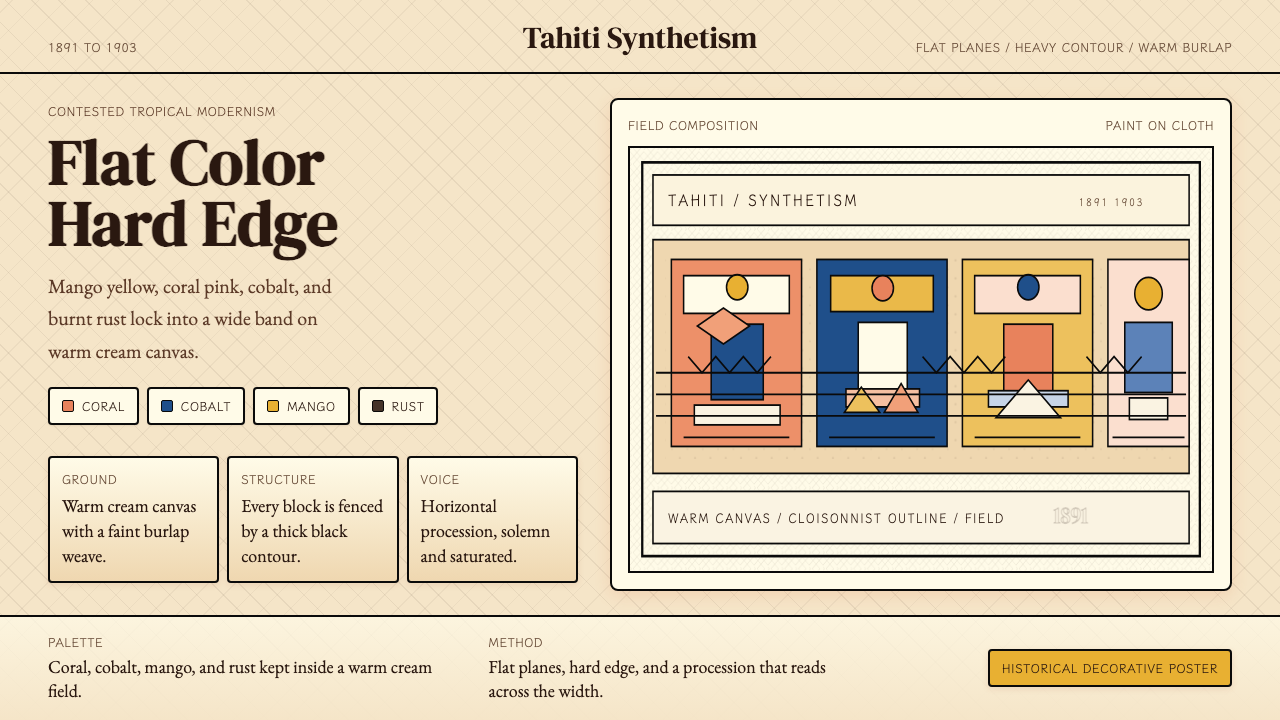
Gauguin's Tahitian canvases shattered Western perspective with flat planes of mango-yellow, coral-pink, and cobalt ringed by heavy Cloisonnist outlines — a color blast that became both a cornerstone of modernism and one of its most contested inheritances.
Gauguin — Tahiti Synthetism in brief
Gauguin — Tahiti Synthetism is a Post-Impressionist visual language developed by Paul Gauguin during his 1891–1903 stays in French Polynesia. It is defined by flat, unmodulated color planes bounded by heavy, deliberate outlines — a technique Gauguin had begun developing in Brittany in 1888 under the name Synthetism and then carried into his Polynesian work, intensifying both the palette and the conceptual stakes.
The visual system dispenses entirely with naturalistic skin tones, atmospheric perspective, and chiaroscuro modeling. Figures press flat against richly ornamented backdrops as if arranged in a Quattrocento frieze, while Tahitian-language inscriptions float in upper corners. Colors are not mixed toward realism but chosen for emotional and symbolic weight: coral-pink for flesh and warmth, cobalt for sky and water, mango-yellow for light and abundance, burnt-rust for earth and shadow. The rough texture of burlap canvas is not hidden but allowed to read through the paint, adding a material honesty to the otherwise anti-naturalist surface.
It is essential to approach this aesthetic with both admiration and critical awareness. The visual innovations are genuinely foundational to twentieth-century modernism — influencing Fauvism, Expressionism, and primitivist strands of abstraction. But they emerged from a colonial context: Gauguin's appropriation of Tahitian imagery, his mythologizing of indigenous life, and the power asymmetries embedded in his presence on the islands are inseparable from the work. Applying this style in contemporary design demands a measured, respectful approach — one that honors the visual intelligence without reducing it to a cheap tropical fantasy.

Where does Gauguin — Tahiti Synthetism come from?
The roots of Gauguin's Tahitian style reach back to Brittany in the late 1880s. Working at the artists' colony of Pont-Aven, Gauguin and the painter Émile Bernard developed Synthetism — a method of painting that synthesized the outward form of things, the painter's inner feelings, and a pure aesthetic surface into a single statement. Their 1888 collaboration produced works like The Vision After the Sermon, in which flat red fields, heavy black contours, and simplified figures abandon any pretense of representational depth. Vincent van Gogh, with whom Gauguin lived briefly in Arles, reinforced the commitment to bold unnatural color, though their temperaments ultimately made the partnership explosive and short-lived.
Gauguin first arrived in Tahiti in June 1891, driven by a combination of genuine disillusionment with European civilization and a romanticized fantasy of escaping it. He had read Pierre Loti's novel Rarahu (known in French as Le Mariage de Loti) and imagined Polynesia as a prelapsarian paradise outside history. What he found was a French colonial territory already deeply transformed by missionary activity and administration. Nevertheless, his painting practice flourished. The Tahitian light, the unfamiliar plant life, and his immersion — however partial and problematic — in Māori visual culture accelerated and deepened the Synthetist approach he had developed in Brittany. The heavy outline became heavier; the color planes became bolder and more confrontational.
The theoretical framework for Gauguin's mature style was articulated in part by the critic Albert Aurier, who published an influential essay in the Mercure de France in 1891 identifying Gauguin as the exemplary Symbolist painter. Aurier described the Symbolist ideal as an art that was ideist (representing ideas rather than appearances), synthetist (simplifying form to its essential character), subjective (filtered through the artist's temperament), and decorative in the Polynesian and Japanese sense — meaning that the picture surface was to be organized as a flat decorative object rather than as a window onto three-dimensional space. Gauguin absorbed these formulations and pushed them further, combining Cloisonnism's hard outlines with a palette informed by Japanese ukiyo-e prints and the flat color fields of Javanese temple friezes he had encountered at the 1889 Paris World's Fair.
Gauguin's second stay in Polynesia, from 1895 until his death in the Marquesas Islands in 1903, produced some of his most ambitious canvases — including the monumental Where Do We Come From? What Are We? Where Are We Going? (1897–98), which he painted as what he considered a philosophical testament. By this stage, the style had fully matured: figures of monumental scale arranged across a horizontal frieze, the palette anchored by deep indigo and warm ochre, Tahitian text integrated directly into the picture field as both inscription and visual element. When Post-Impressionism was formally introduced to British and American audiences through Roger Fry's 1910 Post-Impressionist exhibition in London, Gauguin's Polynesian work was central to the revelation — and the controversy.
What defines the Gauguin — Tahiti Synthetism look?
Flat Color Planes
Color is applied as flat, unmodulated fields with no internal tonal variation or blending. A coral-pink arm does not transition through rose and peach toward highlight — it remains uniformly coral from outline to outline. This flatness derives from Gauguin's study of Japanese woodblock prints, stained-glass Cloisonnism, and Polynesian tapa cloth, all of which treat color as a bounded zone rather than a modeled volume. The effect removes atmospheric distance and places every element on a single decorative plane.
Cloisonnist Outline
Heavy, dark contour lines enclose each color plane much as the lead channels of stained glass contain individual panes of color. These outlines are not naturalistic edge-detection — they are deliberate graphic decisions, often heavier than the depicted form would suggest and sometimes slightly detached from it. The Cloisonnist technique was borrowed from Émile Bernard, who had adapted it from medieval enamelwork and Japanese woodblock borders. In Gauguin's mature Polynesian work, the outlines become increasingly expressive, with variable weight that contributes to the emotional character of a figure.
Symbolic, Non-Naturalistic Palette
The palette is organized around emotional and cultural meaning rather than optical accuracy. Mango-yellow signals light, spiritual abundance, and heat; coral-pink and salmon stand in for flesh across a range of figures regardless of their actual skin tone; cobalt and deep indigo represent water, sky, and the spiritual realm; burnt-rust and ochre anchor the earth and the human. Secondary colors appear where pictorial structure demands them, not where nature would place them. Gauguin himself described his use of color as musical — harmonies rather than descriptions.
Frieze-Like Horizontal Composition
Figures are arranged laterally across the picture plane in shallow, stage-like space, recalling Egyptian friezes, Javanese temple reliefs, and Polynesian tapa cloth patterns. There is minimal recession into depth: backgrounds are rendered as patterned tapestries rather than as spatial environments. This compositional logic means that figures at different 'distances' are often the same size and rendered at the same tonal value — depth is implied by overlap and placement rather than by scale diminishment or atmospheric fading.
Tahitian Text as Visual Element
Gauguin frequently inscribed Tahitian words or phrases directly into the picture plane — most famously in Ia Orana Maria (1891) and the monumental triptych question of 1897–98. These inscriptions are not captions or labels; they are compositional elements, placed in upper corners or along horizontal registers where they function both as linguistic content and as abstract mark-making that echoes the flat graphic logic of the rest of the surface. This integration of lettering into pictorial space anticipates later modernist practice in collage and poster design.
Canvas Texture as Material Presence
Gauguin frequently worked on coarse burlap or sackcloth rather than fine-weave canvas, and he applied paint thinly enough to allow the rough, irregular texture to read through. This was partly a practical decision — quality materials were expensive and hard to obtain in Polynesia — but it became an aesthetic one: the visible grain of the support adds a material rawness that counterpoints the otherwise bold, graphic color fields. In design applications, this quality can be evoked through subtle surface texture, though it must remain subordinate to the overall flat graphic logic.
Decorative Pattern as Background Field
Rather than receding into undefined atmospheric space, backgrounds in Gauguin's Polynesian work are often filled with dense, flat pattern — flowers, foliage, fabric motifs, or abstract geometric repetition. These pattern fields are rendered at the same visual intensity as the foreground figures, refusing the conventional Western hierarchy that subordinates background to figure. The result is an all-over surface richness that aligns the paintings with textile and decorative art traditions rather than with easel painting conventions.

Who shaped Gauguin — Tahiti Synthetism?
Gauguin (1848–1903) began his career as a successful Paris stockbroker who painted on weekends, then abandoned his family and career to pursue painting full-time after encountering Impressionism in the late 1870s. His Brittany years (1886–1891) produced Synthetism in collaboration with Émile Bernard. His two Polynesian periods — 1891–1893 in Tahiti, then 1895–1903 in Tahiti and the Marquesas — generated the body of work for which he is now known. His final years on Hiva Oa in the Marquesas, where he died in May 1903, produced some of his most monumental compositions. His legacy is inseparable from ongoing critical debate about the ethics of his presence in Polynesia and his representation of Tahitian women and culture.
Bernard (1868–1941) was the younger Pont-Aven painter whose experiments with flat color and heavy outline in 1887–1888 directly preceded — and were later disputed as the origin of — the Cloisonnist technique that became central to Synthetism. His collaboration with Gauguin was creatively productive but personally contentious; Bernard believed Gauguin had appropriated his innovations without sufficient credit. Bernard's subsequent turn toward more academic religious painting limited his long-term influence, but his early work remains foundational to understanding how Synthetism emerged.
Van Gogh (1853–1890) and Gauguin shared two turbulent months in Arles in 1888, during which both artists pushed toward bold unnatural color and simplified form. While their temperaments clashed catastrophically — the episode ending in van Gogh's self-mutilation — the artistic exchange reinforced Gauguin's commitment to expressive color divorced from optical reality. Van Gogh's influence on the emotional intensity of the palette, and Gauguin's reciprocal challenge to van Gogh to abandon Impressionist brushwork, shaped both bodies of work.
Aurier (1865–1892) was the Symbolist critic whose 1891 essay in the Mercure de France, 'Le Symbolisme en peinture: Paul Gauguin,' provided the first and most influential theoretical framework for Gauguin's mature style. Aurier defined the Symbolist work as ideist, synthetist, subjective, and decorative — terms that Gauguin absorbed and that subsequent art historians have used to position Synthetism within the broader landscape of Post-Impressionism and Symbolism. Aurier's early death from typhoid at twenty-seven cut short what had been an extraordinarily precocious critical career.
Fry (1866–1934) was the British critic and curator who coined the term 'Post-Impressionism' for his landmark 1910 exhibition Manet and the Post-Impressionists at the Grafton Gallery in London. By placing Gauguin's Polynesian paintings at the center of this exhibition alongside Cézanne and van Gogh, Fry introduced the visual logic of Tahitian Synthetism to British and subsequently American audiences, triggering both the Bloomsbury Group's engagement with the style and a wave of critical controversy that has not fully subsided. Fry's formalist analysis — focusing on the pictorial logic of flat color and line rather than subject matter — shaped how the twentieth century received and theorized Gauguin's work.
How do you use Gauguin — Tahiti Synthetism today?
Gauguin Tahiti Synthetism is one of the richest and most challenging historical styles to bring into contemporary design work. Its power comes from the interplay of flat, bounded color fields with heavy structural outlines — a system that is simultaneously graphic and sensory, bold and decorative. Applying it well requires understanding its internal logic: color is symbolic rather than descriptive, outline is structural rather than mimetic, and pattern is a foreground element rather than a retreating background. Applying it poorly means borrowing only the tropical color associations while abandoning the formal discipline that gives those colors their force.
For presentation slides, the style suits both cover and content applications, but they function differently. A cover should commit to one dominant color field — mango-yellow or deep cobalt — as the ground, with a strongly outlined figure or motif and a title set in a bold, weighty typeface with generous scale contrast. Content slides should resist the temptation to introduce the full palette at once; a restrained two-color system — one warm, one cool — with heavy ruled lines as structural dividers will read far more clearly than a profusion of competing coral, yellow, and indigo. Data slides can treat charts as Cloisonnist objects: bars and segments outlined rather than naked, colored according to a clear symbolic logic rather than for visual variety.
For web interfaces — dashboards, pricing pages, editorial landing pages — the style delivers strong hierarchy and immediate visual presence. The approach: establish a warm cream or off-white ground as the baseline, use deep cobalt or indigo for primary navigation and headings, reserve coral or mango for calls to action and key data highlights. Card components can echo the Cloisonnist principle by using a visible border rather than a shadow; inputs and form elements should have defined, unambiguous edges. Avoid soft drop shadows, gradient overlays, and ambient glows — every depth cue should be flat and architectural. Full-bleed image sections work best when photographs are treated as flat color fields: high contrast, desaturated toward the palette, or overlaid with a dominant Gauguin hue.
For editorial and marketing work, the style supports theatrical visual impact. A Gauguin-inflected poster or feature spread works by establishing a single dominant color plane as background — filling edge to edge — and composing a simplified figure or motif against it in flat complementary tones. Typography should be large, authoritative, and contrasted boldly against the ground; decorative borders, when used, should be geometric and pattern-based rather than floral or calligraphic. Marketing materials benefit from the style's frieze-like horizontal logic: a wide-format banner or social card organized as a lateral arrangement of simplified forms reads instantly and memorably. The decorative pattern vocabulary — repeated botanical or geometric motifs in the background field — can be used sparingly to add surface richness without undermining the flat graphic structure.
A critical mistake when applying this style is collapsing its visual intelligence into generic tropical cliché — lime greens, turquoise blues, and hibiscus imagery that evoke leisure brands rather than the formal seriousness of Gauguin's work. The palette should be anchored in the specific hues of the paintings: mango-yellow, coral-pink, cobalt and deep indigo, burnt-rust and warm ochre. A second common failure is using the style without acknowledging its ethical complexity: given Gauguin's colonial context, this aesthetic should not be applied to content that romanticizes indigenous culture, travel escapism, or exoticized representations of any people. The visual power of the style is real; so is the responsibility it carries. Use it for its formal intelligence — the flat color logic, the frieze composition, the integration of lettering into graphic space — not as a shorthand for the exotic.

Gauguin — Tahiti Synthetism — FAQ
Is Gauguin Synthetism the same as Cloisonnism?
They overlap but are not identical. Cloisonnism is a specific technique — flat color areas separated by heavy dark outlines, named after the cloisonné enamelwork it resembles — developed by Émile Bernard and Louis Anquetin around 1887. Synthetism is a broader aesthetic philosophy that includes Cloisonnism's technique but adds a theoretical layer: the idea that painting should synthesize outward appearance, inner feeling, and aesthetic form into a single unified surface. Gauguin's Polynesian work uses Cloisonnist technique within a Synthetist philosophy, but Synthetism also encompasses the symbolic use of color, the rejection of naturalistic space, and the integration of pattern and lettering that go beyond technique alone.
How should this style be applied given its colonial context?
With deliberate care and clear purpose. The visual formal language — flat color planes, heavy outlines, frieze composition, pattern backgrounds, integrated lettering — can be applied independently of the problematic subject matter. What this means practically: use the style for its compositional and chromatic logic, not as a vehicle for representing or invoking Pacific Islander people, culture, or mythology. Avoid imagery that exoticizes or flattens actual cultural traditions. The style's power in contemporary design contexts comes from its formal intelligence, not from any appropriation of its subjects. A pricing page or dashboard that uses cobalt, coral, and heavy outlines draws on Gauguin's compositional innovations without engaging with the colonial dynamics of the source material.
Does the style work well in dark-background layouts?
The historical palette was warm-ground — Gauguin worked predominantly on burlap with warm ochre or cream underlayers, and most of his canonical compositions read as warm-toned fields. A dark inversion is possible but requires rethinking the palette. On a very dark or near-black ground, the mango-yellow and coral must be applied sparingly or they will overpower the composition; deep cobalt and indigo read much more naturally as dark-mode primaries. A workable dark variant might use deep indigo as the ground, with coral and mango appearing only as accent and highlight — the frieze structure and outline logic can be preserved, but the chromatic balance shifts significantly. Test the composition carefully: flat color that reads with authority on a warm ground can feel strident or garish inverted.
What distinguishes an authentic application from a tropical-theme pastiche?
The most reliable test is whether the formal logic of the style is doing meaningful work, or whether only surface associations are being borrowed. An authentic application uses flat color planes as a structural system — each color field has a compositional purpose, bounded by deliberate outlines, arranged in a lateral frieze-like order. A pastiche borrows the warm tropical color associations — lime, turquoise, coral, hibiscus — without the underlying formal discipline: colors blend or gradient into each other, outlines are absent or decorative rather than structural, depth is simulated rather than flattened. In practical terms: if you can remove all the 'tropical' imagery and the design still holds together as a coherent visual system, you are working with the style. If removing the imagery collapses the design, you were using the imagery as a crutch.
How does this style relate to later modernist movements it influenced?
Gauguin Synthetism was a direct catalyst for several early-twentieth-century movements. The Fauves — Matisse, Derain, Vlaminck — took the non-naturalistic color logic and pushed it further into pure chromatic expression, abandoning the heavy outline while retaining and amplifying the flat color plane. German Expressionists, particularly the Brücke group, absorbed both the emotional intensity and the flattened pictorial space. The Arts and Crafts movement and early Art Nouveau were contemporaneous rather than derivative, but shared the commitment to pattern as foreground element and the rejection of academic illusionism. Later, Paul Klee and other Bauhaus artists drew on Synthetism's integration of color symbolism with flat form. In contemporary design terms, this means Gauguin Synthetism sits upstream of several established visual languages — it has a more raw, original, and ethically complex character than its descendants, and should be engaged with accordingly.
Related design styles
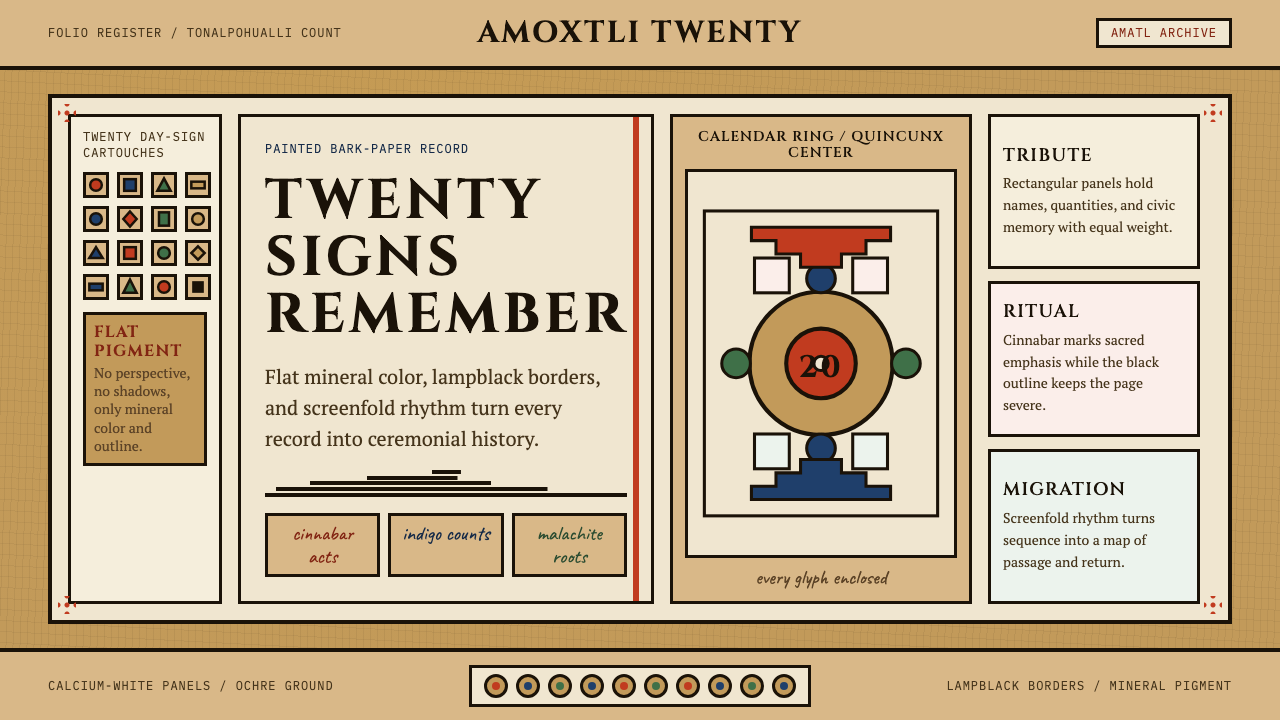 Aztec CodexSacred records stay severe. Ochre amatl ground, Cinzel capitals, black cartou…
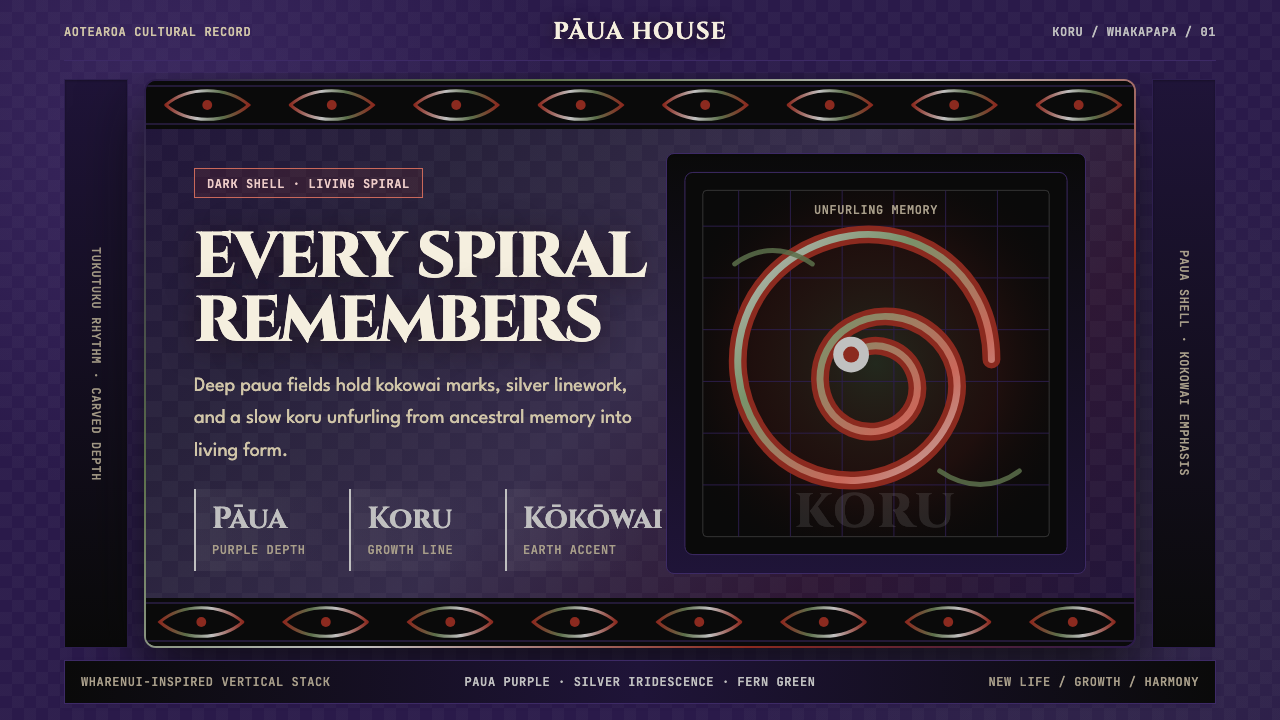 Māori Koru (Aotearoa)Ancestry glows in the dark. Paua purple, kokowai red, and silver koru frame t…
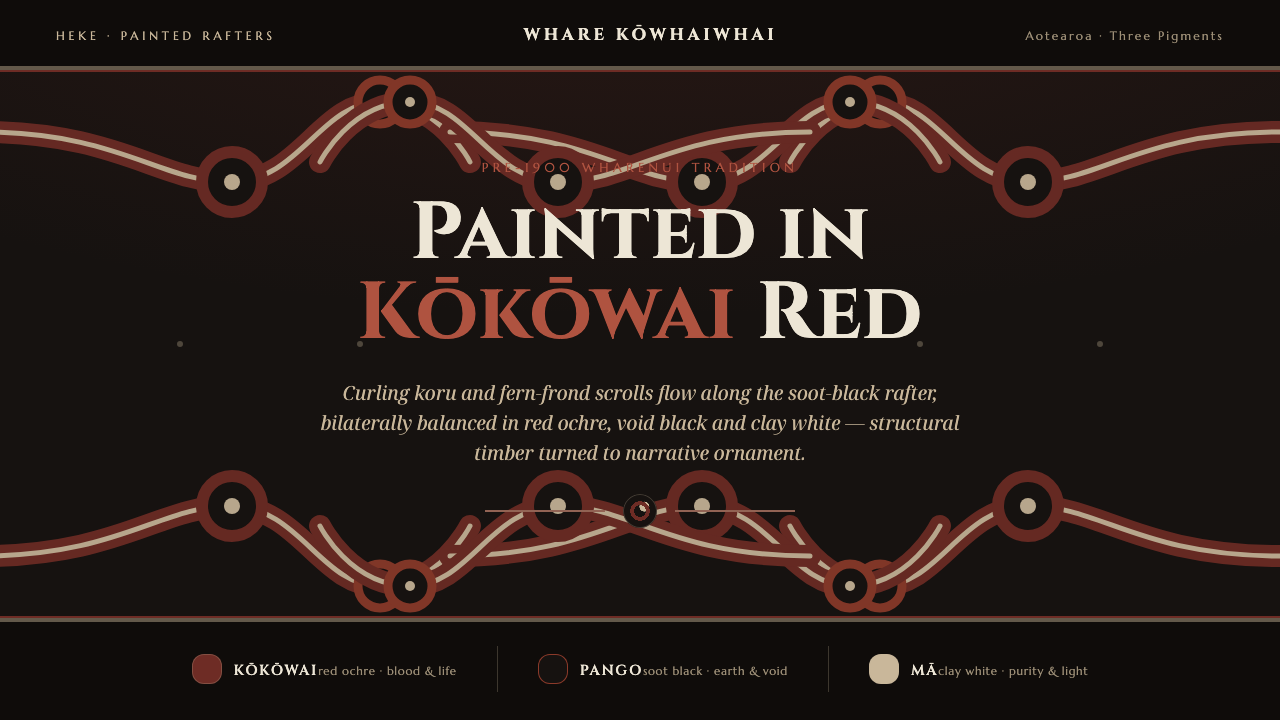 Māori Kōwhaiwhai RafterPainted timber, not pixels. Kōkōwai-red koru scrolls in mirrored balance on b…
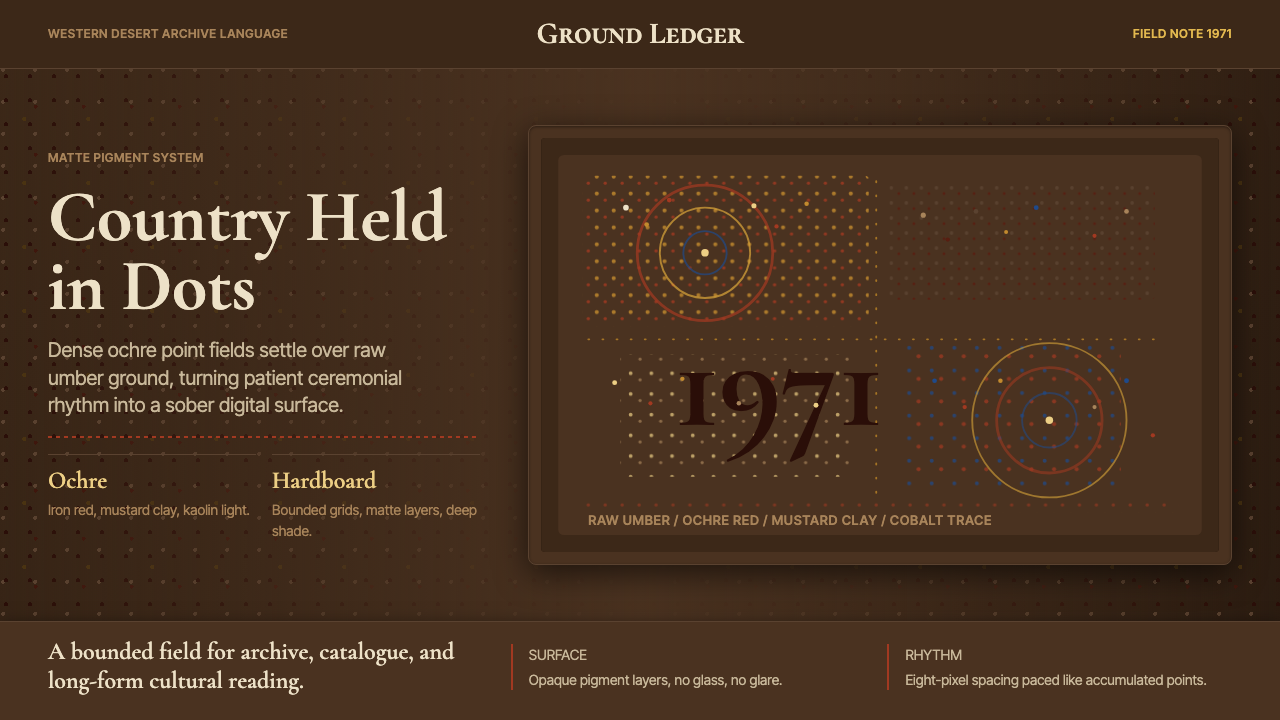 Aboriginal Dot Painting (Papunya 1971)Ochre memory, held steady. Raw umber ground, Cormorant type, disciplined dot-…
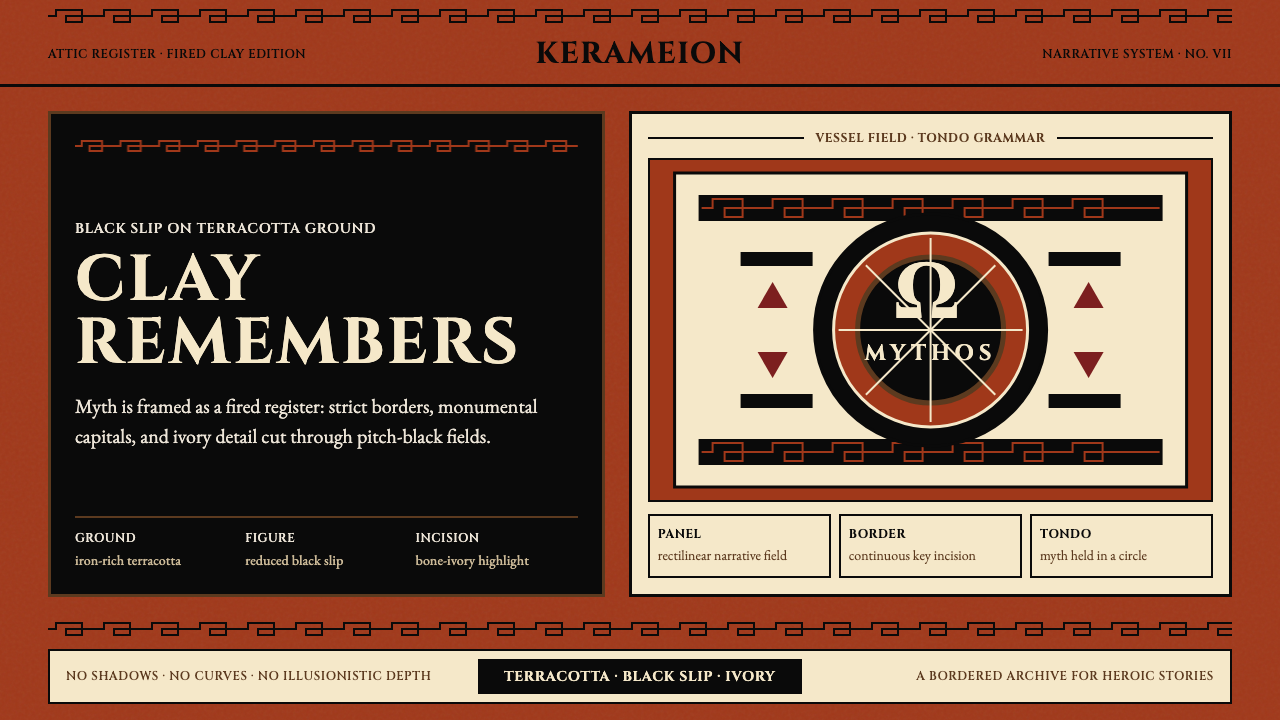 Greek Antiquity (Attic Vase)Myth becomes architecture. Terracotta, black slip, and Greek-key borders fram…
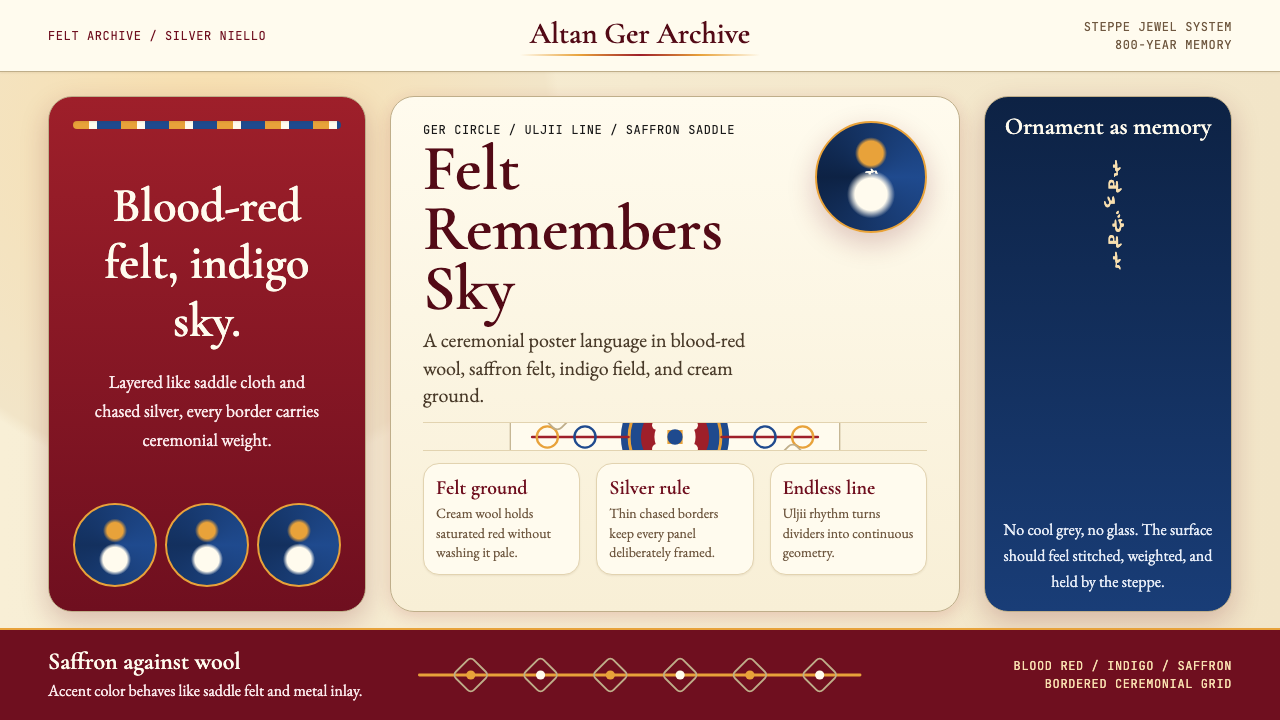 Mongolian Nomadic SteppeSteppe memory in jewel tones. Blood-red felt, saffron, indigo, and bordered u…