What is Greek Antiquity (Attic Vase)?
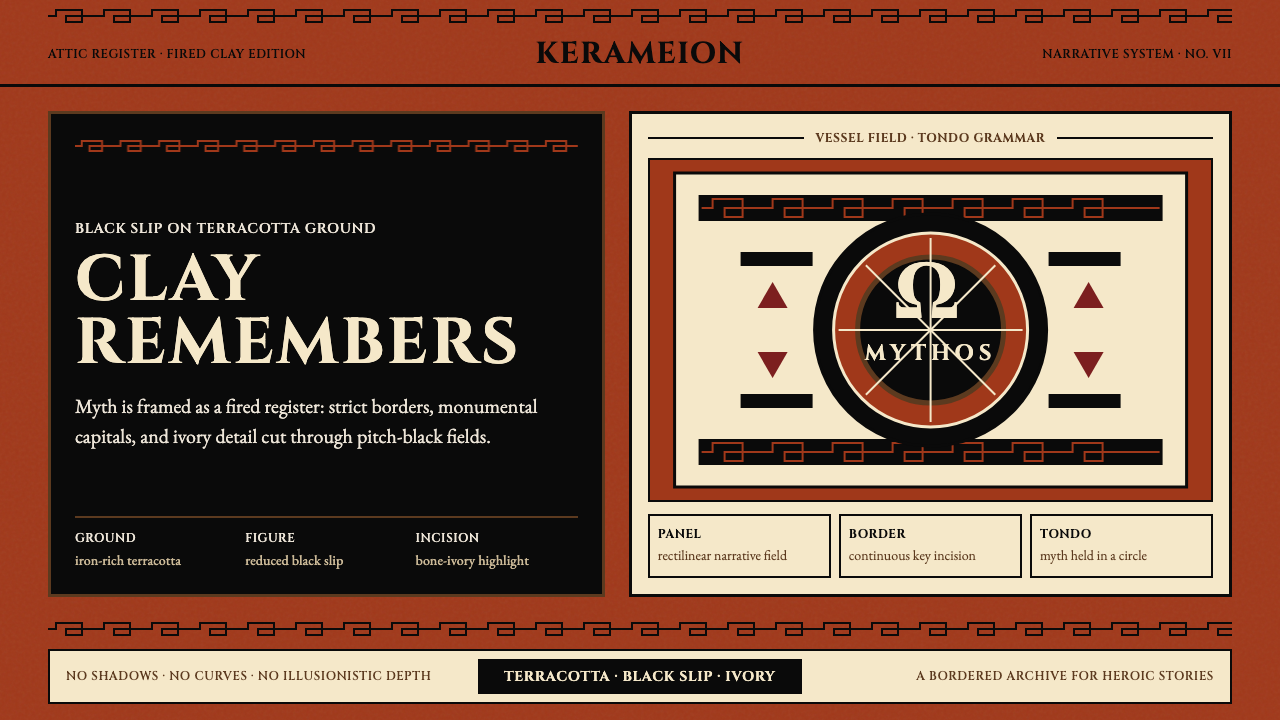
Two and a half millennia before digital design, Attic vase painters solved the same problems — narrative, hierarchy, and border — in fired clay, black slip, and iron-red ground.
Greek Antiquity (Attic Vase) in brief
Greek Antiquity (Attic Vase) is a design system derived from the painted ceramic tradition of ancient Athens, specifically the black-figure and red-figure vase painting techniques that flourished between roughly the 7th and 4th centuries BCE. Its visual grammar rests on three elements that no subsequent Western design tradition has entirely abandoned: a warm terracotta ground, high-contrast silhouette figures rendered in a dense black slip, and rectilinear meander borders — the Greek key — that frame every narrative scene with architectural precision.
The system is fundamentally a narrative design language. Every Attic vase was a surface organized to tell a story — a myth, a ritual, a moment from the Trojan cycle — with figures, objects, and ground in strict compositional relationship. This narrative logic translates directly into contemporary layout practice: a clear foreground-midground distinction, figures that read at a distance, and ornamental registers that separate rather than merely decorate. The aesthetic is simultaneously ancient and legible to a viewer shaped by twenty-first-century visual culture.
Digitally, the style translates the kiln's output into interface and print vocabulary: terracotta-warm page grounds that recall fired clay, sharp black panels and silhouette elements, ivory or bone-white for highlights and secondary text, and the meander as a structural border motif. The result is a visual language with traceable historical authority — every design choice references an object that survived two and a half millennia — and with a formal clarity that functions as well on a slide deck as it does on an amphora.

Where does Greek Antiquity (Attic Vase) come from?
The Attic vase painting tradition grew from the Geometric style of the 9th and 8th centuries BCE, in which potters working in Athens covered their vessels with dense bands of repeated angular pattern — meanders, zigzags, checkerboard registers — with human and animal figures reduced to schematic silhouettes embedded in the decoration. The Dipylon amphoras, funerary vessels of monumental scale found near the Dipylon gate of Athens, are the defining objects of this early phase: every surface is organized into horizontal registers, pattern alternating with figure, with a strict hierarchy that the eye reads from base to neck.
The black-figure technique, developed in Corinth and perfected in Athens from the late 7th century BCE, introduced a new figural ambition. Painters applied a refined black slip — an iron-rich clay solution that fired to a dense, lustrous black — over the natural terracotta ground, then used incised lines to indicate internal detail: musculature, drapery folds, facial features. The terracotta, left unpainted in areas of highlight, reads as a warm iron-red against the black. Added white and purple-red pigments supplied further differentiation — white for women's skin, purple-red for accessories and inscription labels. Exekias, working in Athens around 540–520 BCE, brought the technique to its expressive peak in vessels such as the amphora showing Achilles and Ajax playing dice, where the composition's stillness and psychological tension anticipate conventions of Western narrative art by two millennia.
The red-figure technique, invented in Athens around 530 BCE — traditionally attributed to the Andokides Painter — reversed the tonal logic: figures were now left in the natural terracotta color while the background was painted entirely in black slip. This inversion gave painters access to brushwork for internal detail rather than incision, enabling far more fluid and anatomically ambitious figure drawing. The Late Archaic and Early Classical periods, roughly 510–450 BCE, produced the style's greatest draughtsmen. Euphronios, whose krater depicting the death of Sarpedon is among the most analyzed objects in Western art history, and the Berlin Painter, known for isolating single figures against unbroken black grounds, between them established the canonical vocabulary of red-figure composition. The style reached such technical refinement that its products were traded and imitated across the entire Mediterranean world.
The Classical period of the 5th century BCE brought further formal development — increasingly complex multi-figure compositions, foreshortening, spatial layering — before the tradition gradually gave way to the polychrome Hellenistic styles of the 4th and 3rd centuries BCE. What persists is the design logic rather than any single moment: the disciplined palette of three tones, the architectural meander border as framing device, the insistence that every element on the vessel surface serve the organizing narrative. This logic survived into Roman decorative arts, resurfaced in Renaissance antiquarianism, and reentered Western design vocabulary definitively in the Neoclassical revival of the 18th century, which produced the Wedgwood jasperware, the Adam interior style, and the typographic conventions still visible in institutional serif letterforms today.
What defines the Greek Antiquity (Attic Vase) look?
Palette
The color system is tightly constrained: a warm iron-red terracotta ground — the natural color of the Attic clay — functions as the primary field. Against it, a dense, lustrous black derived from refined slip carries figures, borders, and background fills. A bone or ivory white, applied as a separate pigment, marks highlights and — in black-figure — women's skin and select decorative accents. A reserved purple-red appears in accessories and inscription details. No other hues enter the system. This extreme restraint means every color carries categorical weight: ground is ground, figure is figure, highlight is highlight, and accent is accent.
Figure-Ground Logic
The entire pictorial system operates on a strict two-value figure-ground relationship. In black-figure, dark silhouettes occupy the warm ground; in red-figure, the warm figures emerge from a dark ground. Either way, the relationship is absolute — there is no gradation, no atmospheric softening, no ambient light. Figures read as cut shapes against a uniform field. This produces an extremely high signal-to-noise ratio: the eye locates the narrative immediately, without searching. Contemporary digital applications of this logic — light elements on dark grounds, or dark elements on warm grounds — inherit the same legibility advantage.
Meander Border
The meander — a continuous angular spiral running in a single direction without break — is the structural frame of every Attic composition. It appears at the lip, shoulder, and foot of vessels as a demarcating register, separating the narrative panels from one another and from the plain body below. As a design element, it is simultaneously decorative and architectural: it signals edge, creates hierarchy between zones, and provides a visual resting point between narrative episodes. In contemporary use, the meander functions as a border component for panels, cards, and dividers — wherever a boundary needs to carry historical authority without resorting to a plain line.
Silhouette and Incised Line
Attic figures are defined first by outer contour — the silhouette — and then refined by internal incised lines in black-figure, or by fluid brushwork in red-figure. There is no rendering in the modern sense: no volume built up through tone, no cast shadow, no texture simulation. A figure's three-dimensionality is implied entirely through contour and the placement of limbs. This convention translates into digital work as a commitment to outline-first, fill-second illustration logic: icons, pictograms, and figure elements built from clean contours and flat fills, with detail added through line rather than shading.
Register and Zone Organization
Attic vessels organize their surface into distinct horizontal registers or zones — a frieze of figures here, a meander band there, a zone of lotus-palmette ornament between shoulder and body. Each register operates at its own scale and serves a distinct compositional function. This zoning principle is directly analogous to the layout regions of a contemporary page: a masthead zone, a hero narrative zone, a supporting content band, a footer register. The logic of articulated zones rather than undifferentiated fields creates visual rhythm and prevents the eye from treating all information as equally weighted.
Inscriptions and Lettering
Attic vase painters regularly inscribed text directly into the painted field — naming figures, identifying the kalos (beauty) of a youth, signing the work with the potter's or painter's name. These inscriptions are painted in the same black slip as the figures, using the uppercase letter forms of archaic Greek script that are the direct ancestors of the Roman capitals still in use today. In contemporary applications, this convention suggests an inscriptional approach to typography: spaced capitals for labels, titles, and border text; letterforms treated as marks of authority rather than as neutral information carriers.
Narrative Freeze
Unlike later Western art traditions that sought to capture a moment of maximum action, Attic painters frequently chose a pregnant pause — the instant before or after the climactic event. Achilles and Ajax sit absorbed in their game; the god approaches but has not yet touched the mortal. This preference for suspended action over frozen violence gives the figures a composed, almost diagrammatic stillness. In design terms, this translates as a compositional preference for clarity over drama: well-separated elements, figures arranged to be read individually, no visual collision. It is the opposite of the kinetic, overlapping composition strategies of more turbulent styles.

Who shaped Greek Antiquity (Attic Vase)?
The most celebrated black-figure painter, active in Athens around 540–520 BCE, Exekias worked both as potter and painter — one of the few artists who mastered both crafts. His amphora depicting Achilles and Ajax at a board game is among the most analyzed compositions in ancient art: two warriors locked in stillness, their spears in the background, while the war happens somewhere off the vessel entirely. Exekias also painted the kylix showing Dionysus sailing in a boat whose mast has grown into a vine heavy with grapes — a miniaturist achievement of visual storytelling that has influenced illustrated narrative ever since. His technical control of incised line detail brought the black-figure technique to its highest point of refinement.
Active in Athens around 520–490 BCE, Euphronios is the defining figure of the early red-figure style and the first Attic painter whose command of anatomy compares with later sculptural achievement. His calyx-krater depicting the death of Sarpedon — the Trojan hero carried from the battlefield by Sleep and Death while Hermes watches — is one of the most discussed objects in Western art history, both for its compositional complexity and for the legal and ethical controversies surrounding its acquisition by the Metropolitan Museum. Euphronios signed several of his works as both painter and potter, treating both crafts as equally worthy of attribution. His draftsmanship introduced a muscular, volumetric figure style that set the terms for the classical period that followed.
Named after a bell-krater in the Berlin Antikensammlung rather than by his actual identity — which remains unknown — the Berlin Painter was active in Athens around 500–460 BCE and is the defining artist of a compositional convention that became central to red-figure: isolating a single large figure against an unbroken black ground, with no secondary figures, no ground line, and no decorative fill. The effect is monumental and intensely focused. His name vase in Berlin shows the god Hermes carrying the infant Dionysus: the figure is enormous relative to the vessel, the black ground absolute. This single-figure-on-black convention anticipates the poster aesthetic by two and a half millennia and is among the most directly transferable Attic visual strategies to contemporary screen design.
Credited by modern scholarship with the invention of the red-figure technique around 530 BCE, the Andokides Painter — named after the potter Andokides whose workshop he worked in — produced a remarkable series of bilingual vases: vessels on which the same scene is rendered in both black-figure and red-figure on opposite sides, allowing the tonal logic of both traditions to be compared directly. These bilingual vases make visible exactly what the technical innovation changed: the shift from incised interior detail to painted brushwork, and from dark figure on light ground to light figure on dark ground. As a historical demonstration of how a design system can be inverted while retaining its compositional grammar, they have no equivalent in the ancient world.
Active in Athens around 505–470 BCE, the Kleophrades Painter — also known by the actual name Epiktetos II in some scholarship — was among the first red-figure artists to tackle ambitious multi-figure mythological narratives at monumental scale, particularly scenes from the Trojan War and the sack of Troy. His handling of crowd compositions, overlapping figures, and emotional states gave Greek vase painting its most complex spatial ambitions before the Classical style fully arrived. His name stamnos showing a Dionysiac scene, and the Vivenzio hydria with its panoramic Trojan sack, demonstrate how an Attic painter managed large casts of figures within the curved, zoned surface of a ceramic form — a compositional challenge closely analogous to designing a multi-panel narrative page.
How do you use Greek Antiquity (Attic Vase) today?
Applying the Attic Vase system correctly requires committing to its tonal logic before touching any other design decision. The palette is not decorative; it is structural. Warm terracotta ground functions as the neutral field — equivalent to the cream or white of a minimal contemporary layout — and the dense black carries the primary visual weight. Every element must be categorizable as ground, figure, or border, and the border exists to demarcate zones rather than to embroider them. If a design element cannot be assigned to one of these three roles, it probably does not belong in the system.
For presentation slides, the style excels on both cover and section-divider pages. A cover built in this system places a large silhouette figure or meander-framed title block against a terracotta ground, with all text set in spaced uppercase letterforms that recall Greek inscriptional practice. Black panels can anchor one edge of the layout as a bold ground-reversal zone, allowing white or ivory title text to float against the dark field — a direct application of the red-figure reversal. Content slides should treat data as figure: bar charts and timelines become silhouette elements against the warm ground, with black meander rules separating sections and replacing generic horizontal dividers. The style imposes visual discipline on data-heavy slides because it demands that every element have a legible figure-ground relationship.
For web interfaces, the Attic Vase palette is best suited to editorial, cultural, and institutional contexts where historical authority and a sense of craftsmanship are desired values. Dashboard layouts benefit from the register logic: organize the interface into clearly demarcated horizontal bands — a masthead with spaced uppercase navigation, a hero band for the primary metric or featured content, a supporting register for secondary data, and a footer zone anchored by a meander rule. Avoid soft shadows and rounded corners; the style belongs to sharp edges, flat fills, and hard borders. Pricing pages and feature comparison tables take well to the palette when tier differentiation is handled through the black-versus-terracotta contrast rather than through hue variation.
For editorial and marketing materials, the system supports strong visual hierarchy and a distinctive archival voice. A magazine-style article layout benefits from a terracotta-ground pull-quote register set in spaced uppercase — the inscriptional convention applied to editorial callouts. Full-width section headers can use the black-ground reversal, with ivory or bone-white display type echoing the white-pigment highlights of the original vessels. Marketing posters built in this style have natural authority: the meander border contains the composition the way it once contained myth, and the high-contrast figure-ground logic ensures legibility at distance. Packaging, book covers, and cultural event materials are natural applications where the style's archival gravity becomes a selling point rather than a constraint.
A common mistake when applying this style is treating the terracotta as merely a warm neutral and drifting toward orange or brown variants that lose the specific iron-red quality of fired Attic clay. The ground should read as earth and kiln, not as autumn or hospitality. A second frequent error is overloading the meander: in the historical sources, the border is always narrower in proportion than beginners expect, and using it as a wide decorative element rather than a precise framing rule destroys the architectural clarity it exists to provide. Finally, resist the temptation to introduce additional colors — a muted gold or a sage green — to soften the palette. The three-tone system is the system. Introducing a fourth tone does not extend it; it collapses the categorical logic on which all the style's legibility depends.

Greek Antiquity (Attic Vase) — FAQ
What is the difference between black-figure and red-figure, and does it matter for digital application?
In black-figure, the figures are painted in black slip over the natural terracotta ground; in red-figure, the background is painted black and the figures remain in the terracotta color of the clay. The two techniques produce tonally opposite results from the same three-value palette — one dark-on-light, one light-on-dark. For digital application, this distinction maps directly to light-mode and dark-mode variants: a black-figure approach places dark elements on a warm terracotta ground, while a red-figure approach places warm terracotta elements on a dark ground. Both are historically grounded, both use the same palette, and understanding the distinction lets you move between variants without breaking the system's logic.
Can the Greek-key meander be used sparingly, or is it mandatory for the style to read correctly?
The meander is the style's most immediately recognizable marker, but it is not mandatory for every application. A layout using only the terracotta-black palette and inscriptional uppercase type will still read as Attic-influenced, particularly if the figure-ground logic is disciplined. The meander becomes essential when the design needs to explicitly signal historical authority — on a border, a header separator, or a footer rule — and when the composition benefits from a zone-demarcating device that carries more visual weight than a plain line. Use it where borders actually need to exist rather than as a wallpaper texture; in the historical sources, it appears at transitions between compositional zones, not as an overall surface pattern.
Is this style appropriate for brands that want to appear modern and forward-looking?
It depends on what kind of authority the brand wants to project. Attic Vase is not a style that signals novelty or technical innovation; it signals durability, cultural depth, and a kind of timelessness that comes from demonstrated survival across millennia. Brands in luxury goods, cultural institutions, heritage food and wine, publishing, architecture and interiors, and legal or financial services that want to position themselves as principled and enduring — rather than cutting-edge — can use this style to great effect. For brands whose proposition is disruption, speed, or technological novelty, the style works against the message. The question to ask is not whether the style is old but whether the brand's authority is enhanced or undermined by historical association.
How do you handle photography within this design system?
Photography is the element most at risk of breaking the system's tonal logic, because naturalistic color photography introduces a full chromatic range that sits completely outside the three-value palette. The safest approach is to treat all photography as figure rather than as window: crop aggressively to silhouette the subject, convert to high-contrast duotone using the palette's warm ground tone and black, or use photography only within strictly bounded black panels where it reads as a contained zone rather than a competing chromatic field. Avoid placing full-color photography as a background or hero image — the contact between naturalistic color and the terracotta-black system will always favor the photograph, dissolving the palette's authority. When in doubt, illustrate rather than photograph; the style's figure-drawing convention accommodates clean vector silhouettes and outline illustrations far more naturally than it accommodates camera images.
What contemporary design styles share the most with Attic Vase, and how are they different?
The closest stylistic relatives are Art Deco and Neoclassical Revival, both of which drew directly on Greek and Roman antiquity for their ornamental vocabulary. Art Deco shares the meander, the spaced uppercase lettering, and the high-contrast palette, but adds geometric luxury materials, gold accents, and a streamlined modernity that Attic Vase explicitly lacks. Neoclassical Revival is closer in archaeological fidelity but tends toward the pale blue and white of Wedgwood jasperware rather than the terracotta-black of Attic ceramics. Swiss International Style shares the discipline of restricted palette and typographic hierarchy but operates from an industrial logic completely opposed to the artisanal and mythological register of the ancient style. The Attic Vase system is unique in that its restraint comes not from modernist principle but from the physical constraints of the kiln and the clay — which gives it a material authenticity that contemporary styles borrowing its visual surface cannot fully replicate.
Related design styles
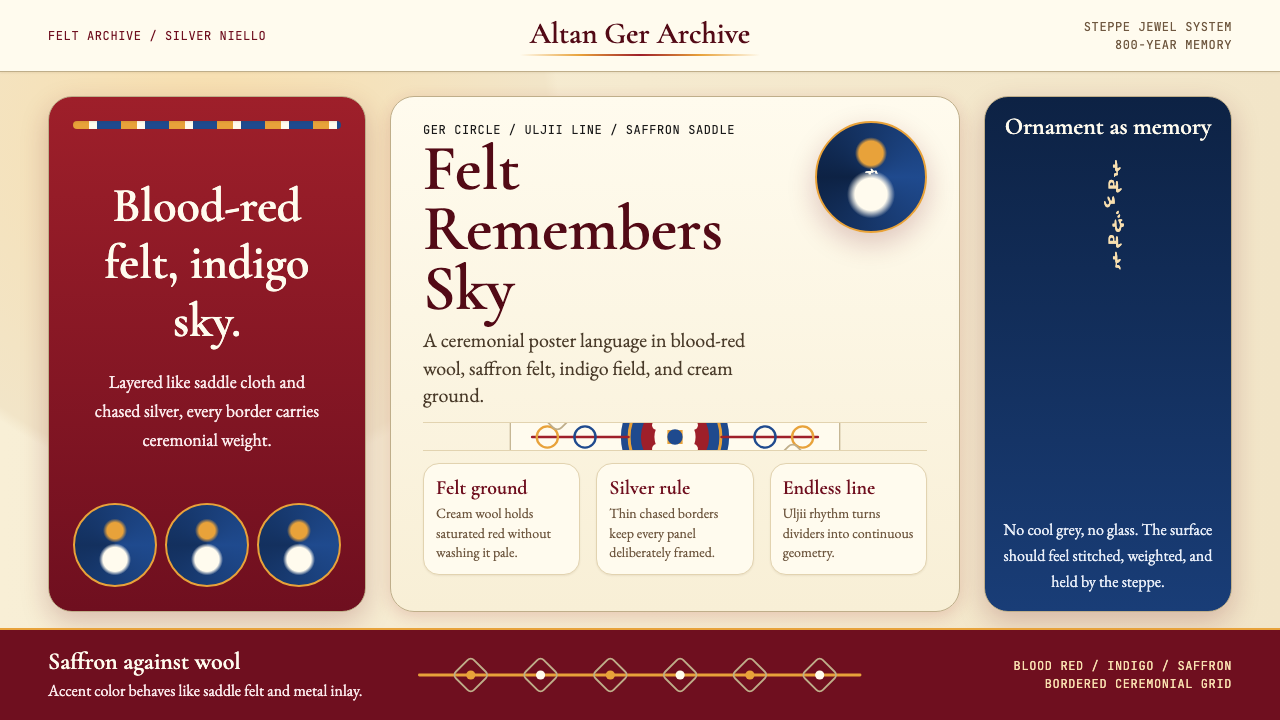 Mongolian Nomadic SteppeSteppe memory in jewel tones. Blood-red felt, saffron, indigo, and bordered u…
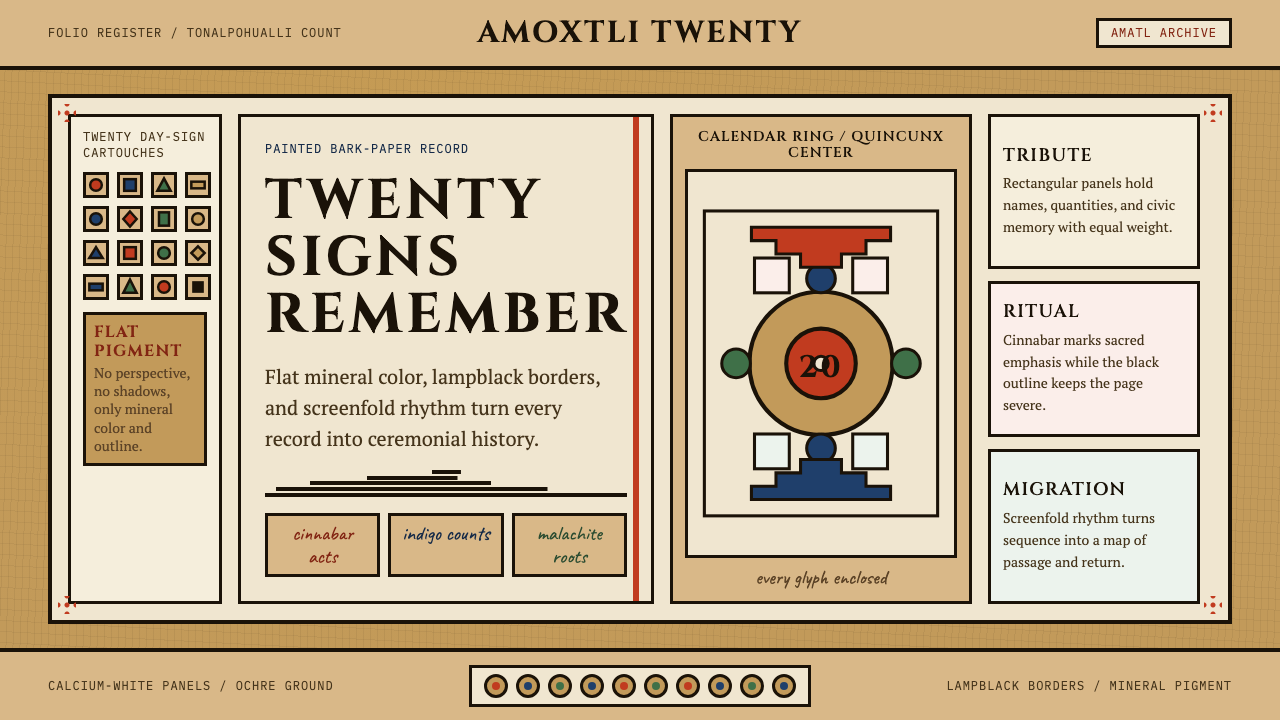 Aztec CodexSacred records stay severe. Ochre amatl ground, Cinzel capitals, black cartou…
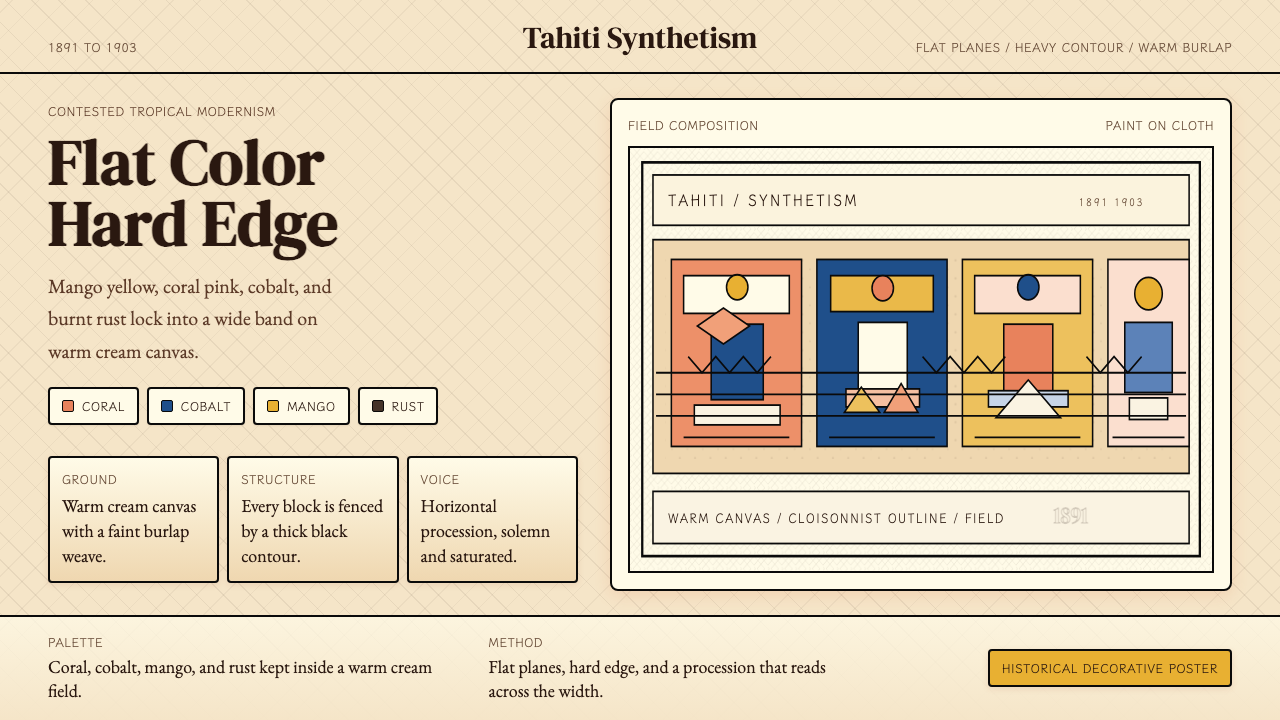 Gauguin — Tahiti SynthetismFlat color, hard edge. Cream canvas, coral, cobalt, and rust lock into a frie…
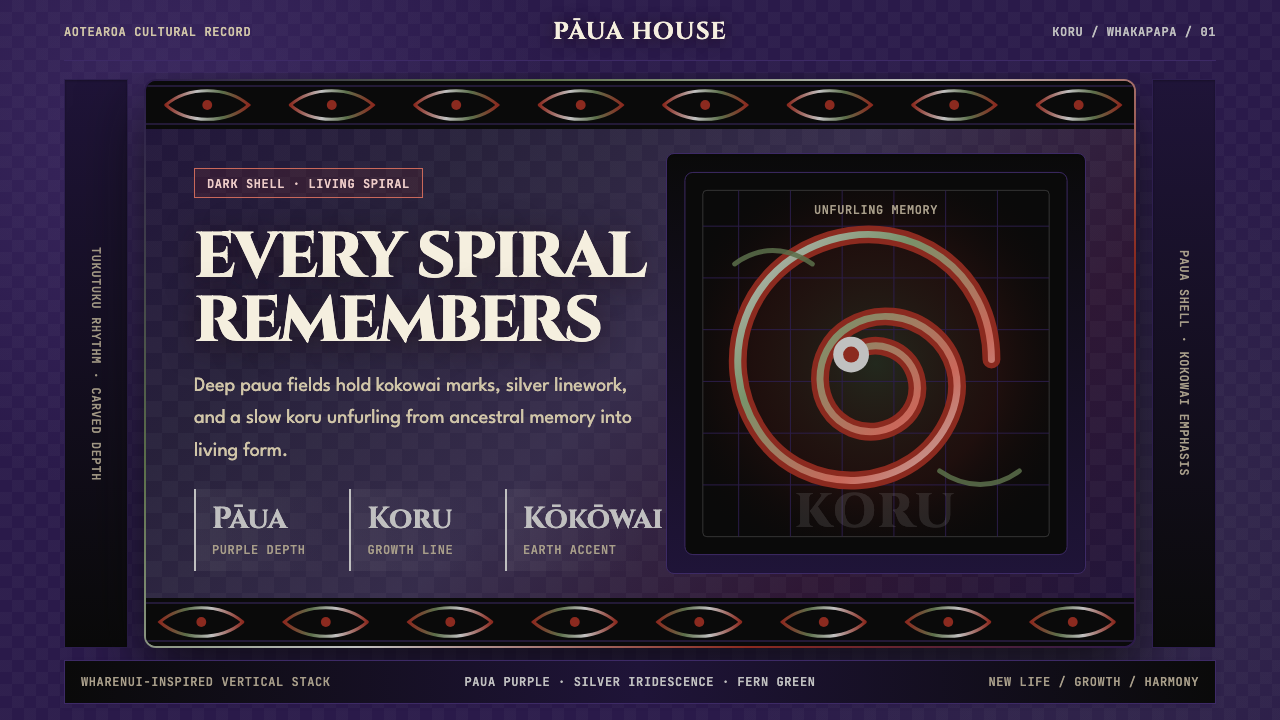 Māori Koru (Aotearoa)Ancestry glows in the dark. Paua purple, kokowai red, and silver koru frame t…
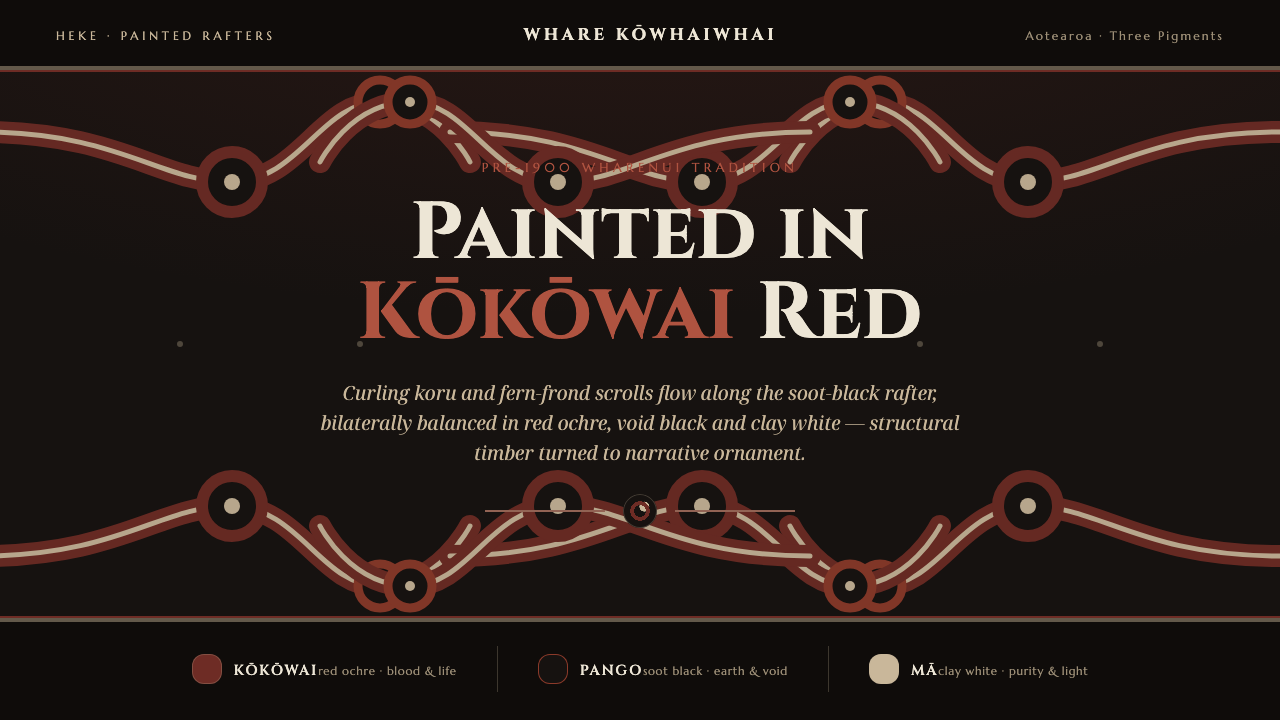 Māori Kōwhaiwhai RafterPainted timber, not pixels. Kōkōwai-red koru scrolls in mirrored balance on b…
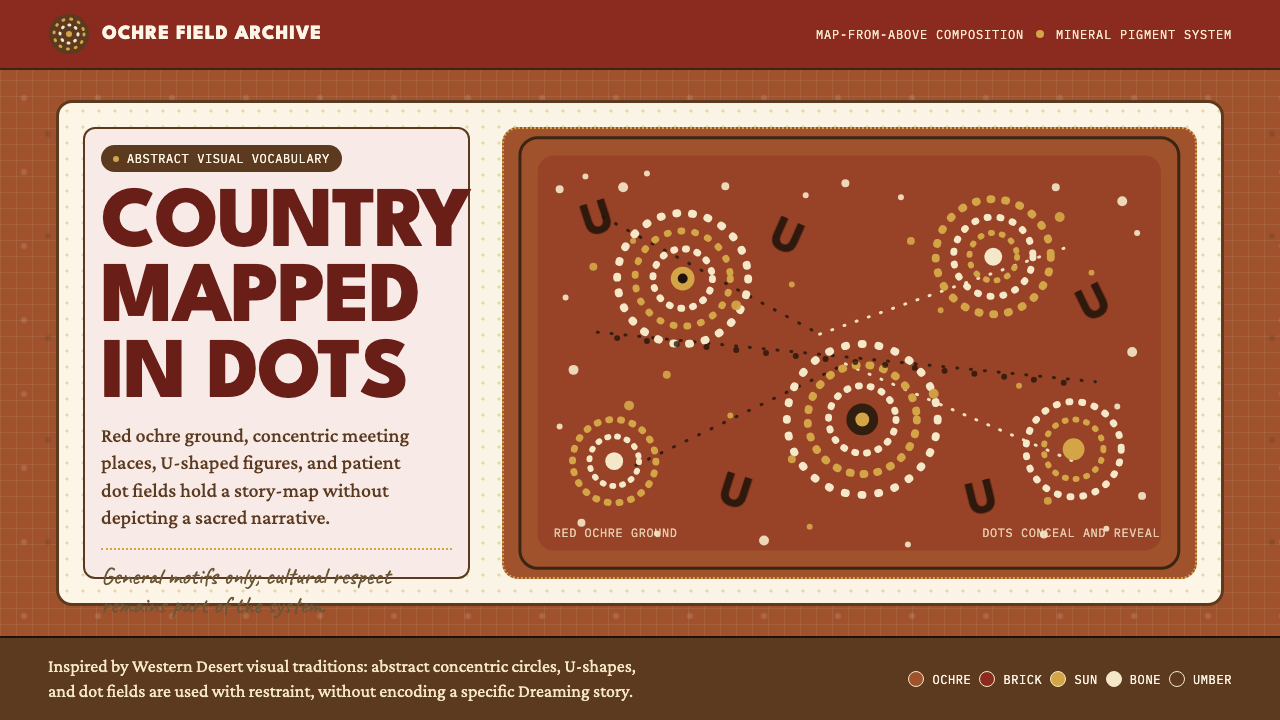 Aboriginal Dot PaintingAncient story-map energy. Red ochre, bone dots, concentric circles, and U-mar…