What is West African Kente Cloth?
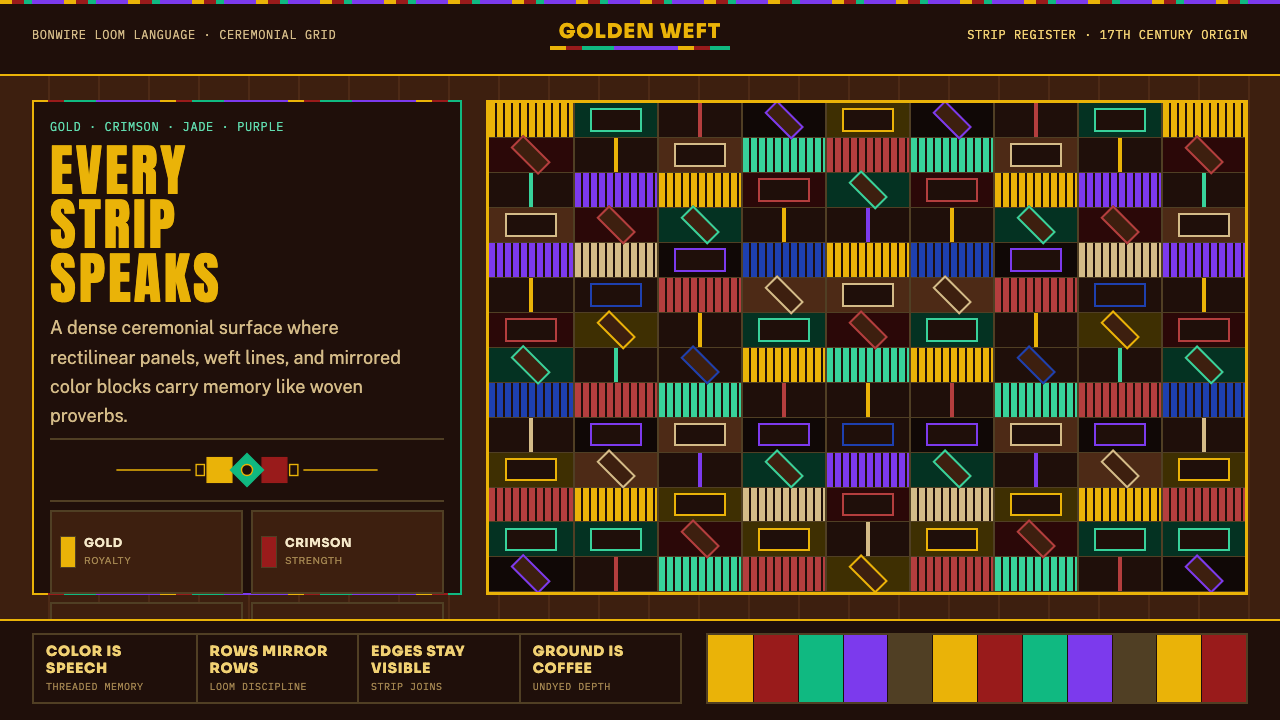
Every strip of kente cloth is a sentence — woven in gold, crimson, jade, and purple on coffee-brown grounds, each color a proverb, each pattern a name carried across centuries of Asante royal ceremony.
West African Kente Cloth in brief
Kente cloth is the most symbolically dense woven textile tradition in West Africa. Originating among the Asante people of present-day Ghana, it is constructed by weaving narrow strips of fabric — each only a few finger-widths across — on a specialized horizontal loom, then sewing those strips edge to edge to form a larger cloth. The resulting surface is a dense grid of interlocking color blocks, weft accent lines, and geometric micro-patterns whose combinations encode proverbs, social status, historical events, and personal identity.
The palette is dominated by gold, the color of royalty and wealth; crimson, associated with political strength and sacrifice; jade green, signifying growth and renewal; and deep purple, representing spiritual potency and high feminine achievement. These saturated hues are assembled against a ground of deep coffee-brown or black, creating a visual rhythm of heat and depth that reads from a distance as bold and ceremonial, and up close as intricately layered. The interplay between vertical strip seams and horizontal weft patterns gives kente its distinctive woven-grid structure — a geometry that is simultaneously rigid and vibrant.
Unlike decorative textiles that treat pattern as surface ornament, kente's visual system is fundamentally semantic. A specific arrangement of colors and patterns constitutes a named cloth with a known meaning, the way a coat of arms carries heraldic information. This makes kente one of the rare textile traditions in the world that functions as written language as well as visual art — and it is this semiotic density that makes the style so productive when translated into digital design systems.

Where does West African Kente Cloth come from?
The Asante oral tradition places the origin of kente weaving in the late seventeenth century, in the village of Bonwire near Kumasi, the capital of the Asante kingdom in what is now Ghana. The founding myth describes two brothers, Kurugu and Ameyaw, who observed a spider weaving its web and were so captivated by the geometric precision of the pattern that they taught themselves to replicate it on a loom using raffia fibers. They brought their cloth to Asantehene Osei Tutu, the powerful king who had recently consolidated the Asante confederacy, and the cloth was immediately adopted as a royal textile. Osei Tutu's court institutionalized kente as an emblem of Asante sovereignty — a material expression of the same cultural energy that produced the Golden Stool, the sacred symbol of the Asante nation.
Alongside the Asante tradition, the Ewe people of present-day Togo and the Volta region of Ghana developed their own parallel kente tradition, characterized by more pictorial figurative elements and a somewhat different color symbolism. Ewe kente tends to incorporate representational motifs — birds, tools, human figures — woven into the strip patterns, while Asante kente more strictly adheres to abstract geometric arrangements. The two traditions cross-pollinated over centuries of trade and intermarriage, and today most kente sold internationally draws on conventions from both lineages. The distinction matters to specialists and to communities for whom the cloth carries specific cultural ownership.
The Adinkra symbol system, developed by the Gyaman people of the Brong-Ahafo region and adopted by the Asante, forms a closely related visual tradition. Adinkra symbols — compact geometric glyphs, each encoding a proverb or philosophical concept — appear stamped on cloth as a parallel communicative textile. Several Adinkra symbols share their geometric vocabulary with kente patterns, and in contemporary design applications the two systems are often referenced together: kente provides the woven-grid color structure, while Adinkra contributes the concentrated ornamental glyph. Understanding the relationship between the two systems prevents shallow application of either.
The twentieth century transformed kente from a closely controlled royal textile into a global symbol of African and African diasporic identity. The transition began in the 1950s and 1960s when newly independent African nations, including Ghana under Kwame Nkrumah, adopted kente as a symbol of Pan-African pride. Diaspora communities in the United States, the Caribbean, and Europe began wearing kente — particularly kente-trimmed graduation robes and ceremonial stoles — as an act of cultural affirmation. By the 1990s kente had become one of the most recognized visual markers of African heritage internationally. Ghanaian fashion designers such as Christie Brown and collectives such as Studio 189 have in recent decades brought kente into dialogue with contemporary fashion and global design audiences, insisting on craft integrity and fair attribution while expanding the vocabulary of the tradition into new contexts.
What defines the West African Kente Cloth look?
Strip-Grid Structure
The defining structural feature of kente is its woven-strip construction: narrow panels sewn side by side create visible vertical seams that run the full length of the cloth. These seams are not hidden — they are structural lines that divide the surface into columns, much like a grid system in print layout. Within each strip, horizontal weft patterns create row divisions. The result is an inherent two-axis grid of columns and rows whose intersections can carry different color and pattern information. In digital translation, this produces a visual system built on strong vertical panels intersected by horizontal accent lines, giving surfaces a woven rather than painted quality.
Royal Color Symbolism
Kente color is never decorative in a casual sense — each hue carries fixed cultural meaning that has accumulated over centuries. Gold signals royalty, wealth, and high status; it is the dominant tone and the one most closely associated with the Asante kingdom's identity. Crimson and red convey political power, sacrifice, and blood lineage. Jade and forest green represent growth, renewal, and the living world. Purple and violet denote spiritual protection and high feminine achievement. Black, used as a ground or accent, signals maturity, aging, and connection to the ancestral realm. In digital application, this symbolic logic suggests using color purposefully rather than decoratively — gold for premium or primary states, crimson for emphasis and critical information, green for growth-related data.
Mirror-Symmetric Geometry
Kente patterns are constructed through systematic repetition and mirroring. A pattern unit within one strip is typically repeated across the adjacent strip in a mirror or rotated arrangement, creating large-scale symmetrical compositions from small-scale repeated units. This differs from random or ad hoc ornament: the geometric logic is rule-based and predictable, which is precisely what gives kente its sense of authority and visual weight. Translated into digital layouts, this principle favors modular, symmetrically organized panels — a horizontal band that mirrors itself across a center axis, or a data dashboard whose left and right halves echo each other structurally while carrying different content.
Weft Accent Lines
Within each narrow strip, the weft threads running horizontally create thin accent lines that punctuate the larger color blocks. These fine horizontal lines — often in contrasting gold, white, or black — function as visual breathing points that prevent the dense color grid from becoming oppressive. They are analogous to the hairline rules in fine typography: structural but delicate, defining rhythm without competing with the dominant shapes. In screen design, translating this element as thin horizontal dividers or subtle line separators within panels preserves the characteristic kente visual texture while maintaining readability.
Ceremonial Scale and Weight
A full kente cloth worn by an Asante king may span several meters — a physical embodiment of authority through sheer material presence. This quality of overwhelming visual weight, achieved through the relentless accumulation of colored strips, translates in digital design as an emphasis on visual density and boldness over restraint. Kente-inspired interfaces do not whisper; they declare. Large color blocks occupy dominant portions of the screen, type is set at generous sizes with confident weight, and the overall impression is rich and ceremonial rather than spare and functional. This boldness must be calibrated carefully for screen contexts: what works on cloth worn before thousands works differently on a laptop display.
Adinkra Symbol Integration
Kente cloth is often worn alongside or combined with Adinkra-stamped garments, and contemporary kente-inspired design frequently incorporates Adinkra symbols as ornamental glyphs. Adinkra symbols are compact, ideographic geometric forms — spirals, crosses, interlocking curves — each encoding a specific proverb or philosophical concept. In digital application they function similarly to iconography: a small, information-dense graphic unit that communicates precisely. Used as section markers, watermarks, or structural corner ornaments in kente-style layouts, they add cultural specificity without overwhelming the color-grid system. The key constraint: each symbol carries a specific meaning that should be used with that meaning in mind, not chosen for shape alone.
Named Pattern Vocabulary
Unlike most decorative textiles where patterns are chosen for visual appeal, kente patterns are chosen for meaning. Each named cloth — and there are hundreds, with names such as Sika Futuro (gold dust), Oyokoman (a pattern reserved for royalty), or Asasia (for kings and queens) — carries specific social and ceremonial associations that determine who may wear it and on what occasion. This principle of semantic specificity, translated into design, suggests that visual choices in a kente-inspired system should be intentional and readable: a specific color combination for a specific content category, a specific panel arrangement for a specific page type. Randomness of pattern is culturally foreign to kente.

Who shaped West African Kente Cloth?
Osei Tutu was the founder and first king of the Asante confederacy, ruling from approximately 1701 to 1717. His court institutionalized kente as a royal textile, transforming what had been a craft tradition into a regulated emblem of Asante sovereignty. By associating kente with the Golden Stool — the sacred object believed to hold the soul of the Asante nation — Osei Tutu elevated the cloth from artifact to political symbol. His legacy is why kente's gold-dominant palette carries connotations of royal authority rather than mere decoration, a semiotic weight that persists in contemporary applications of the style.
The village of Bonwire, located near Kumasi in the Ashanti Region of Ghana, has been the acknowledged center of kente weaving for over three hundred years. Bonwire weavers hold hereditary knowledge of named patterns, color sequencing rules, and loom techniques that are passed from master to apprentice across generations. The Ghanaian government has formally recognized Bonwire as the home of authentic kente production, and the village remains a living workshop where both traditional ceremonial cloths and contemporary interpretations are produced. The collective knowledge of the Bonwire weaving community represents the primary custodianship of the technical and semiotic tradition.
Christie Brown is a Ghanaian fashion brand founded in 2008 by designer Aisha Ayensu, widely credited with bringing kente and other Ghanaian textile traditions into dialogue with international luxury fashion. Rather than reproducing kente as an ethnic accessory, Ayensu's designs integrate kente structures — the strip geometry, the color rhythm, the weft texture — into contemporary silhouettes and garment construction, demonstrating that the textile's formal properties are sophisticated enough to anchor high-fashion work without cultural reduction. Christie Brown's international runway presence has been instrumental in framing kente as a living design tradition rather than a heritage artifact.
Studio 189 is a Ghana- and New York-based fashion and lifestyle company co-founded by actress Rosario Dawson and entrepreneur Abrima Erwiah. The studio works directly with Ghanaian artisans, including kente weavers, to produce contemporary fashion and home goods that center African craft traditions while operating within global commercial markets. Studio 189's model — artisan-direct, transparency-focused, community-reinvestment-oriented — has been influential in demonstrating that African textile traditions can be brought into contemporary design contexts without the extraction patterns that historically accompanied their global spread. Their work provides a contemporary ethical framework for how institutions and designers should engage with kente.
As Ghana's first president following independence in 1957, Kwame Nkrumah actively promoted kente cloth as a symbol of Pan-African unity and cultural pride. He wore kente at international diplomatic events, including at the United Nations, transforming the garment from a Ghanaian royal textile into an internationally recognizable emblem of African self-determination. Nkrumah's embrace of kente in the 1960s directly catalyzed the cloth's adoption by African diaspora communities in the United States and elsewhere, where it became associated with the civil rights movement and, later, with Afrocentric cultural identity. His political recontextualization of the cloth is why kente today carries meanings that extend far beyond its Asante origins.
How do you use West African Kente Cloth today?
Kente cloth's visual system translates into digital design most naturally through its two defining structural principles: vertical strip division and saturated, symbolically loaded color. Applying this style correctly means understanding that both of these elements carry meaning — the grid is not arbitrary scaffolding and the color is not chosen for mood. Before beginning any kente-inspired design, it helps to decide which color will carry primary weight (typically gold for prestige, crimson for urgency), which will serve as accent, and which will serve as structural ground. This decision made in advance prevents the common failure mode of all-at-once saturated color that collapses the hierarchy.
For presentation slides, the kente system works powerfully on both cover and full-bleed section dividers. A cover page benefits from a deep coffee-brown or near-black ground with vertical strip panels in gold and crimson occupying the left or right third of the frame, while the title sits in large, high-contrast type against this field. The contrast between the dense, pattern-rich strip zone and the open text field creates immediate visual tension that commands attention. Content slides should restrain the palette to one or two accent colors on a near-neutral ground: a gold left-border rule signals a quote or callout, a crimson top-band marks a critical finding. Data slides gain from the kente color logic — assigning gold to the leading metric, crimson to the comparison metric, and jade to growth or positive deviation makes charts legible and thematically consistent without explanation.
For web interfaces and dashboards, the strip-grid structure maps onto column-based layouts with notable clarity. A left navigation panel in deep coffee-brown with gold typographic labels, a main content area structured by horizontal weft-line dividers, and a right data panel with crimson accent indicators reproduces the essential kente surface grammar in interface form. Pricing pages work well with kente's tiered color logic: a standard tier in neutral tones, a premium tier in gold-dominant treatment, and an enterprise tier optionally marked with deep purple. The key is reserving the saturated hues for the highest-value or most critical elements — overusing gold at every level destroys the hierarchy that kente color is specifically designed to encode.
For editorial and marketing work, kente's boldness supports high-impact feature layouts. A full-width hero section with alternating vertical color strips — a narrow gold strip, a wide dark ground with headline text, a narrow crimson strip — creates immediate cultural visual energy without requiring any photographic imagery. Long-form article layouts can use a narrow Adinkra-derived glyph as a section marker in the margin, a thin gold horizontal rule as a paragraph break, and a coffee-brown sidebar for pull quotes. Marketing emails and social content benefit from the poster-like decisiveness of the style: one large color field, one weight of type, one clear call to action in a contrasting band — no gradient, no soft shadow, no decorative filigree that diffuses the visual authority the style is built to project.
The most common mistake when applying kente-inspired design is treating the palette as ethnically decorative rather than structurally symbolic — using all the colors simultaneously at full saturation, adding Adinkra symbols as generic exotic ornament without regard for their meanings, or applying the strip pattern as surface texture on top of an otherwise unrelated layout. Authentic kente-derived work commits to the grid at every scale: the macro layout divides into strips, each strip contains a clear color or pattern function, and no element exists outside that structural logic. A second common error is visual timidity — applying one muted gold accent on a white background and calling it kente-inspired. The tradition is ceremonially bold, and digital translations that shy away from that visual authority produce something closer to an allusion than a genuine application of the system.

West African Kente Cloth — FAQ
Is it culturally appropriate to use kente aesthetics in commercial design work?
This question is legitimate and deserves a direct answer. The appropriateness depends heavily on how the style is used and attributed. Using kente's visual logic — the strip grid, the color symbolism, the geometric regularity — as the structural foundation of a design system, while being transparent about its origins and not claiming cultural authorship, is broadly considered respectful engagement. What becomes problematic is using Adinkra symbols as generic graphic decoration without knowledge of their meanings, passing kente-derived work off as an original design language, or extracting the aesthetic while the communities who created and maintain it receive no credit or economic benefit. The safest approach is to attribute the tradition explicitly, avoid using sacred or royal-specific patterns in trivial commercial contexts, and consider whether any collaboration with Ghanaian designers or artisans is appropriate to the project's scale.
How is kente cloth different from other African textile traditions like mudcloth or Ankara print?
The differences are fundamental, not merely aesthetic. Kente is a woven textile — its pattern is created structurally through the interlacing of colored warp and weft threads, meaning the design is inseparable from the fabric's construction. Mudcloth (bogolanfini) from Mali is a resist-dyed cotton textile in which patterns are applied through a chemical process using fermented mud, producing a characteristically matte, earth-toned surface with graphic geometric motifs. Ankara (also called African wax print or Dutch wax) is a machine-printed cotton fabric whose bold, colorful patterns were introduced by European manufacturers in the nineteenth century and adopted across West Africa; despite its widespread association with African fashion, its industrial origins are distinctly different from hand-woven traditions like kente. Each textile carries its own regional, ethnic, and historical identity, and conflating them is the design equivalent of treating all European architectural styles as interchangeable.
Can kente-inspired design work in a light or white-ground layout, or does it require a dark background?
Kente's historical palette is dark-ground — the deep coffee-brown or black ground is what makes the gold, crimson, and jade sing at full intensity. However, light-ground applications are viable with adjustment. On a light or cream background, the saturated accent colors need to be used more sparingly to avoid visual cacophony: one strong gold element as the primary anchor, one crimson element for emphasis, and neutral or near-neutral fields for everything else. The strip-grid structure still works on light backgrounds — a narrow gold vertical rule on white reads clearly as a structural divider — but the sense of ceremonial weight diminishes proportionally. Light-ground kente works best for editorial contexts where readability must dominate, or for interfaces where the kente heritage is a tonal gesture rather than the full visual commitment.
How do I avoid the kente-inspired layout looking chaotic given how many colors and patterns are involved?
The discipline that prevents chaos in authentic kente cloth is the same discipline required in digital translation: strict structural hierarchy and selective deployment of pattern. In a real kente cloth, the weaver does not fill every available space with maximum color variation — areas of solid color blocks anchor the eye, and the more complex pattern zones are bounded by those solid fields. Applied to digital design: define two or three color zones and keep them structurally separate (one dominant ground color, one primary accent zone, one secondary accent zone), use the complex strip-pattern logic only in designated structural elements like headers or sidebar panels, and let the main content area breathe with a simpler color treatment. The visual richness of kente comes from controlled density in specific zones, not from scattering pattern everywhere. Any element that does not clearly belong to the strip-grid logic should be simplified or removed.
What is the difference between Asante kente and Ewe kente, and does it matter for design?
Asante kente, originating in Bonwire near Kumasi, is characterized by strictly abstract geometric patterns within each strip — no figurative or pictorial elements. The color combinations and pattern sequences are governed by a precise naming system in which each cloth configuration corresponds to a named meaning. Ewe kente, from the Volta region and Togo, incorporates pictorial representational elements: birds, human figures, tools, and narrative scenes may appear woven into the strips alongside geometric patterns. Ewe kente also tends toward a wider range of colors and a somewhat less rigid structural grammar. For design purposes, the distinction matters in terms of what you can legitimately reference: Asante kente's abstract geometry is highly adaptable to systematic digital design without pictorial complications; Ewe kente's figurative elements suggest different, more illustrative design directions. Mixing conventions from both without awareness of their distinct origins can produce technically incoherent visual results.
Related design styles
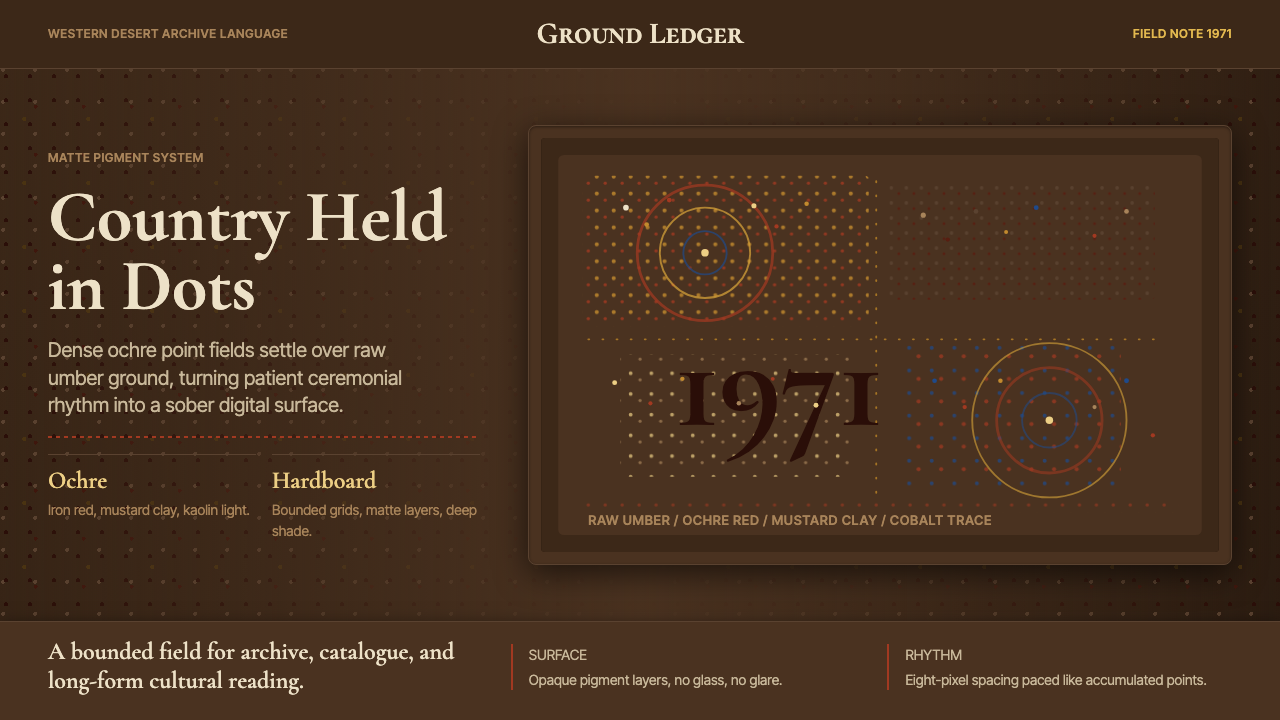 Aboriginal Dot Painting (Papunya 1971)Ochre memory, held steady. Raw umber ground, Cormorant type, disciplined dot-…
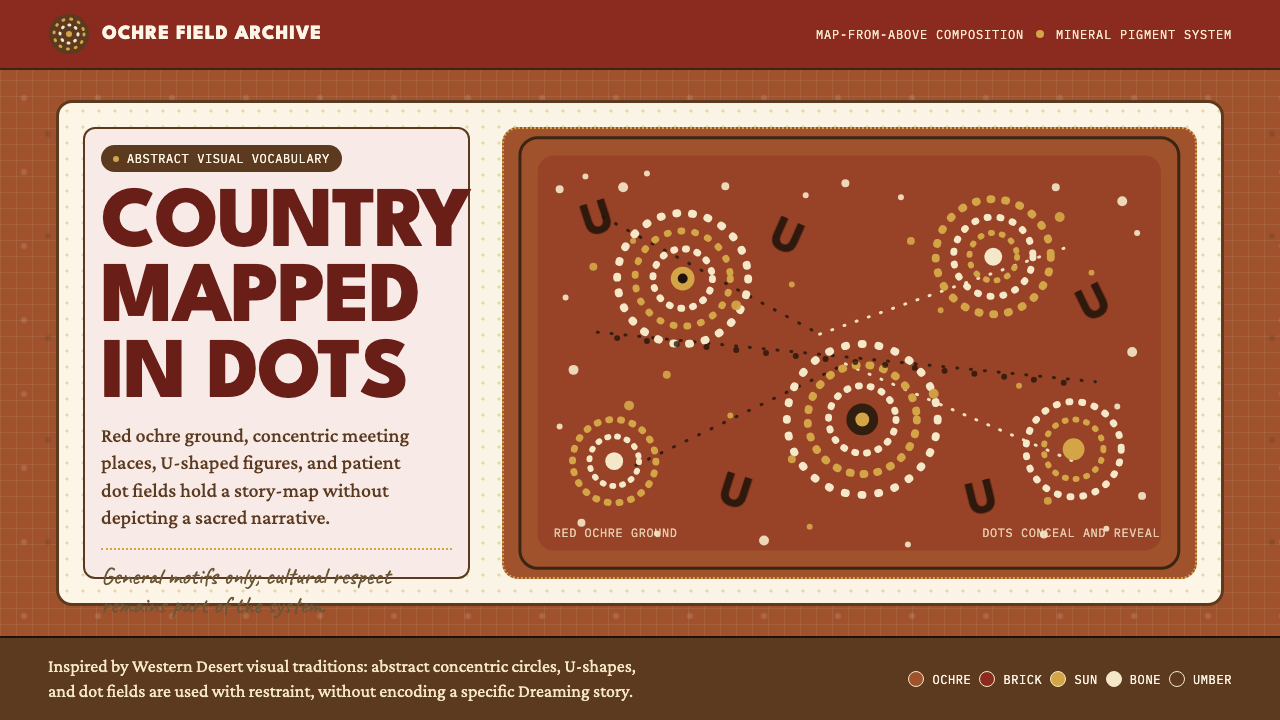 Aboriginal Dot PaintingAncient story-map energy. Red ochre, bone dots, concentric circles, and U-mar…
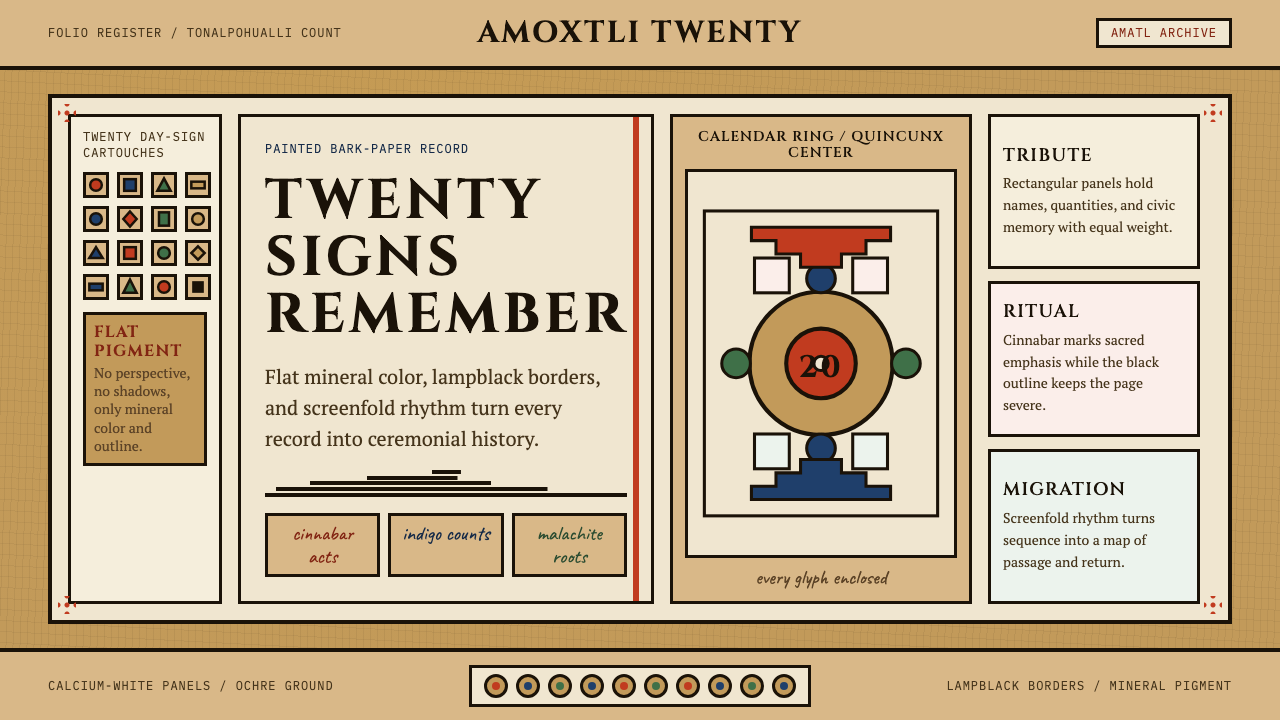 Aztec CodexSacred records stay severe. Ochre amatl ground, Cinzel capitals, black cartou…
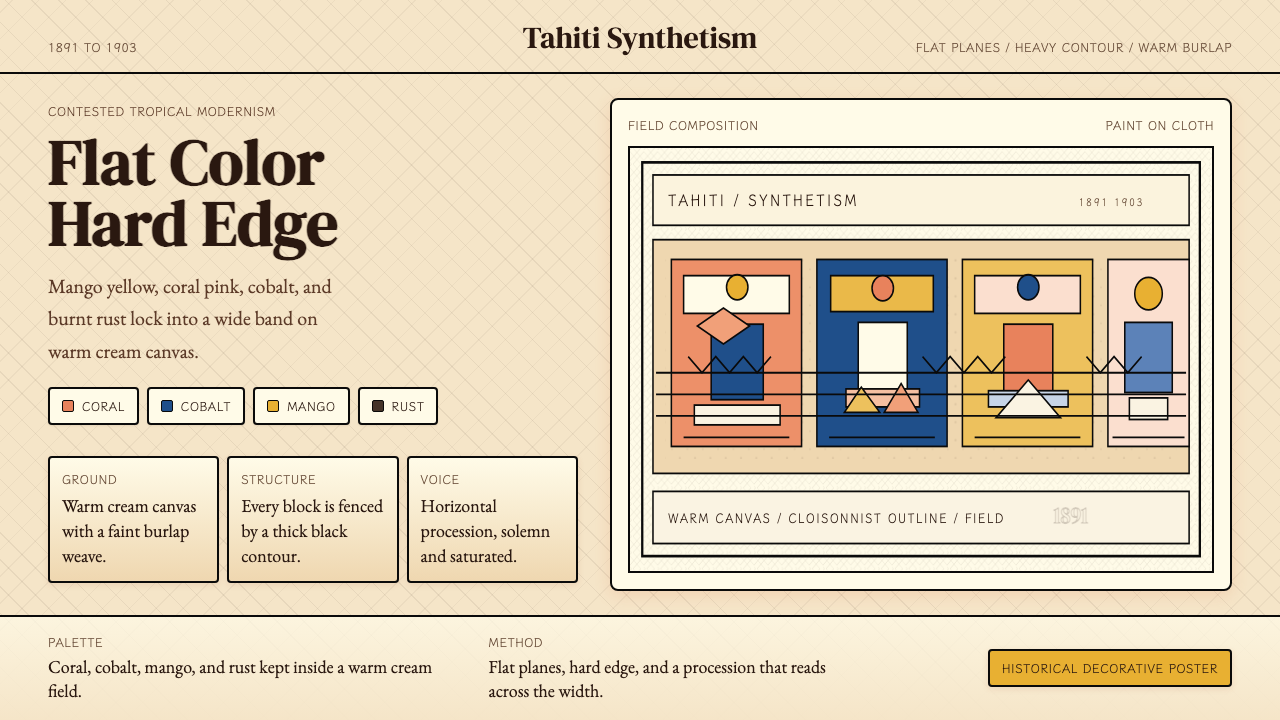 Gauguin — Tahiti SynthetismFlat color, hard edge. Cream canvas, coral, cobalt, and rust lock into a frie…
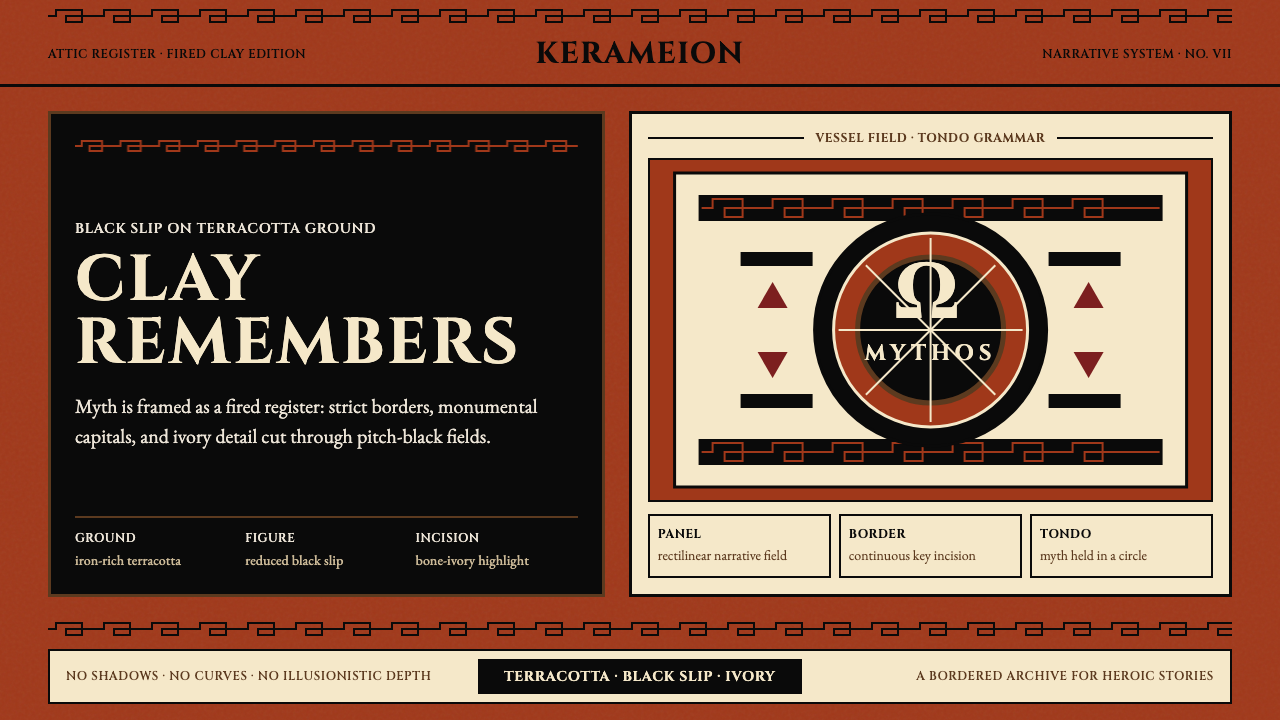 Greek Antiquity (Attic Vase)Myth becomes architecture. Terracotta, black slip, and Greek-key borders fram…
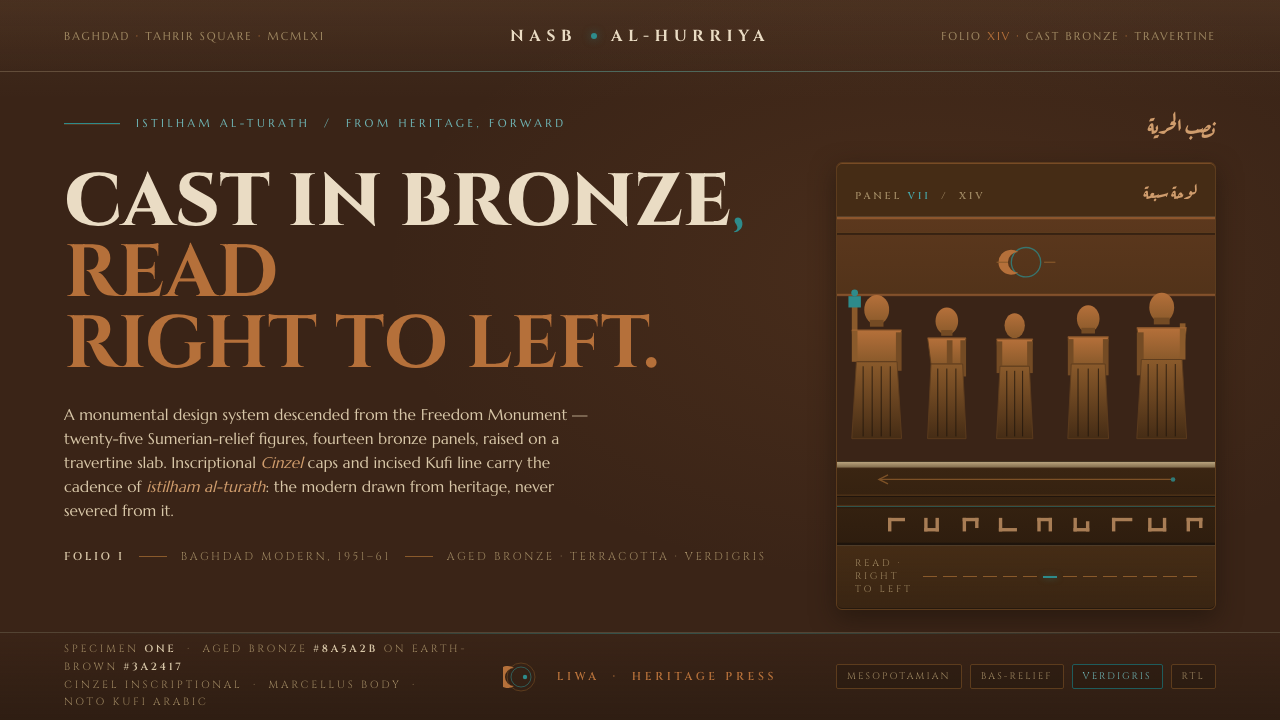 Jewad Selim Baghdad ModernCast in bronze, read right to left. Aged-bronze grounds, incised Kufi line, v…