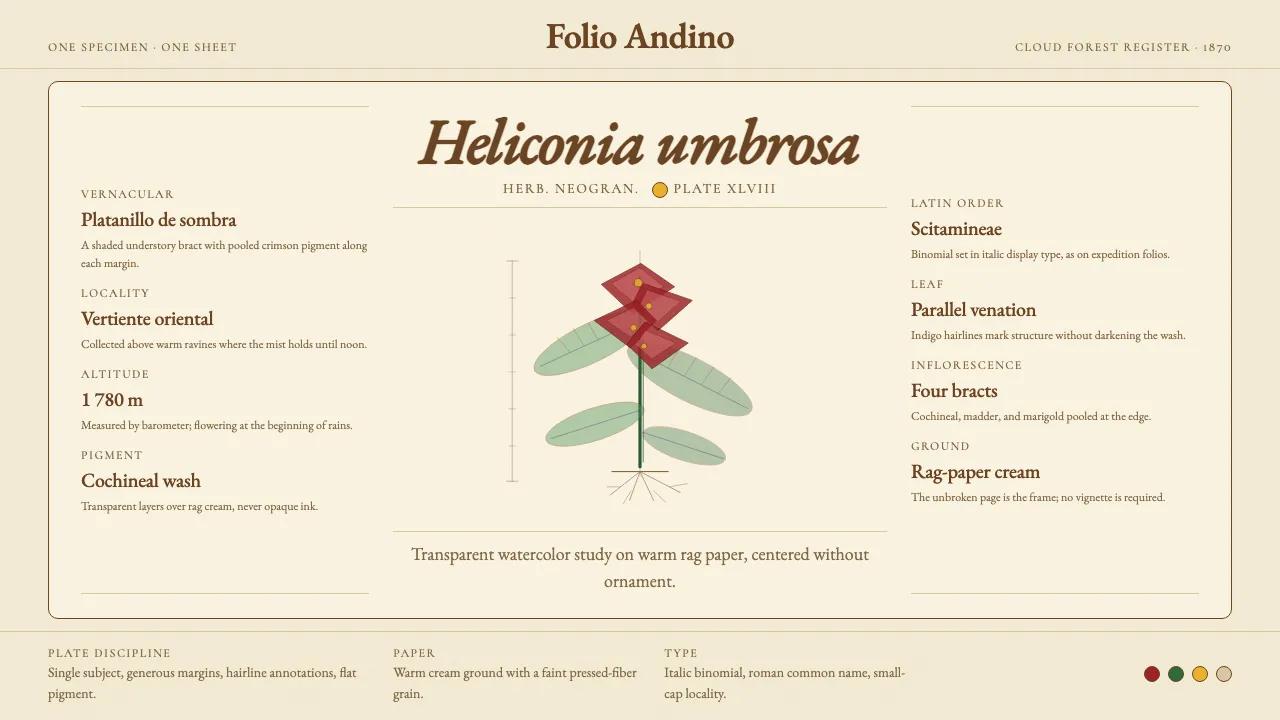
About Colombian Botanical (Triana)
Colombian botanical illustration is the finest scientific watercolor tradition in the Americas. Between 1783 and 1816, José Celestino Mutis's Real Expedición Botánica in Mariquita trained a workshop of indigenous and mestizo painters who produced nearly seven thousand folio sheets of Andean orchids, palms, frailejones, Cinchona, and Heliconia — each rendered in translucent pigment on cream rag paper.
The aesthetic is exhaustive observation on a blank page: a single oversized hero flower, precise venation of every leaf, root system drawn with anatomical care, labeled in Spanish, Latin, and indigenous tongues. It says nothing that the specimen does not say itself.
- Origin
- New Granada / Colombia — Mariquita, Santa Fe de Bogotá, Andean cloud forests
- Era
- 1783–1816 (Mutis Expedition); 1845–1890 (Triana Paris publications); ongoing through Universidad Nacional de Colombia
- Key figures
- José Celestino Mutis · Salvador Rizo · José Jerónimo Triana · Francisco Javier Matís
- Movements
- Spanish Enlightenment scientific expeditions · Linnaean botanical illustration · Colombian Andean natural history
Colombian Botanical (Triana) design spec
Colors
Typography
The other 11 sections — buttons, cards, spacing, motion, techniques and more — open once you unlock. Download the DESIGN.md or send it to your AI in one click. Unlock once, yours forever.
Sign up nowStyles similar to Colombian Botanical (Triana)
Also inspired by art & artists, with a close feel.
 Degas Ballet PastelsBackstage glamour is labor. Jade walls, rose footlights, cropped serifs on cream paper.
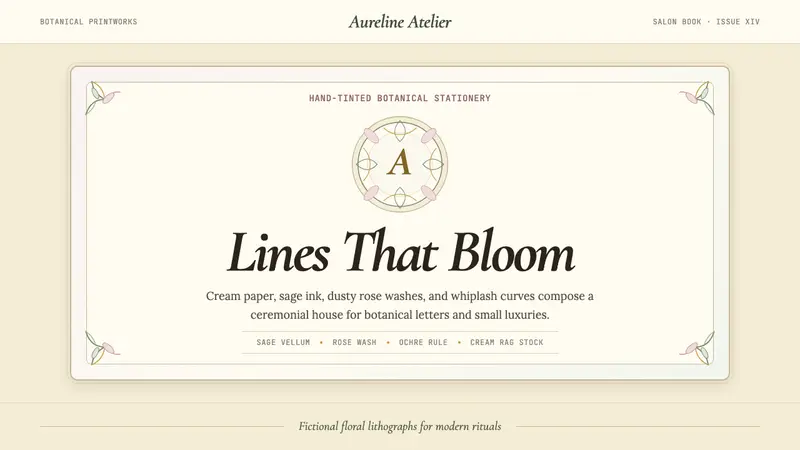 Art Nouveau (Mucha)Mucha's whiplash arabesques. Botanical halos, muted lithograph palette, no machine-cut edges.
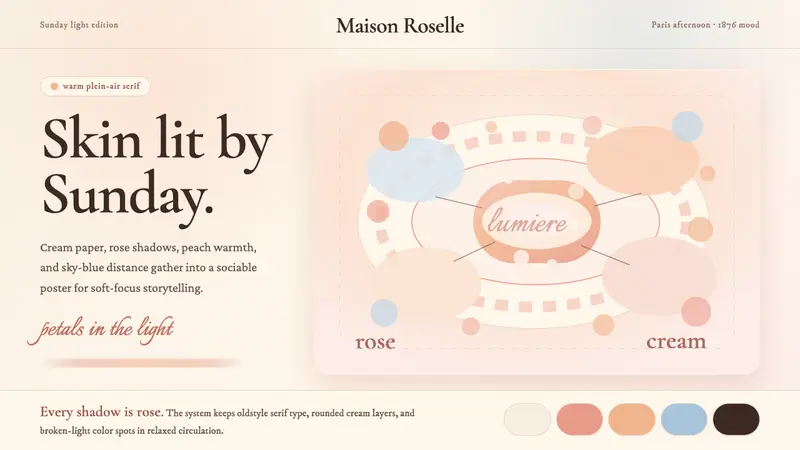 Renoir ImpressionismWarmth refuses haste. Rose shadows and Cormorant curves drift across cream.
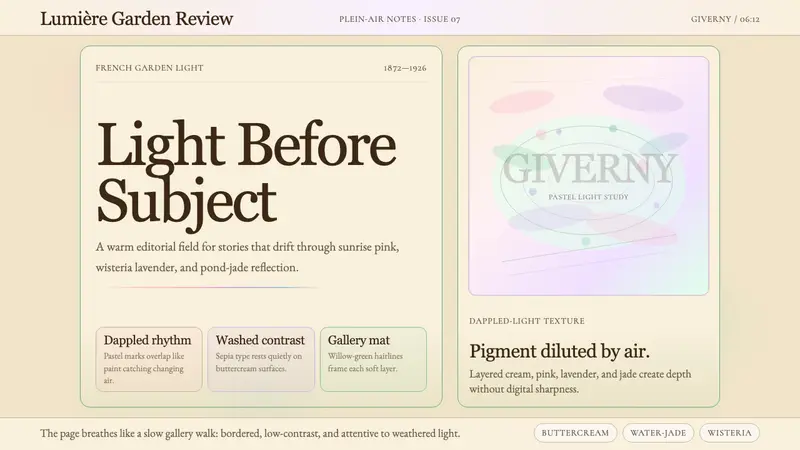 Claude Monet ImpressionistLight becomes the subject. Buttercream, pastel dapples, and Cormorant serif soften the frame.