What is Caspar David Friedrich?
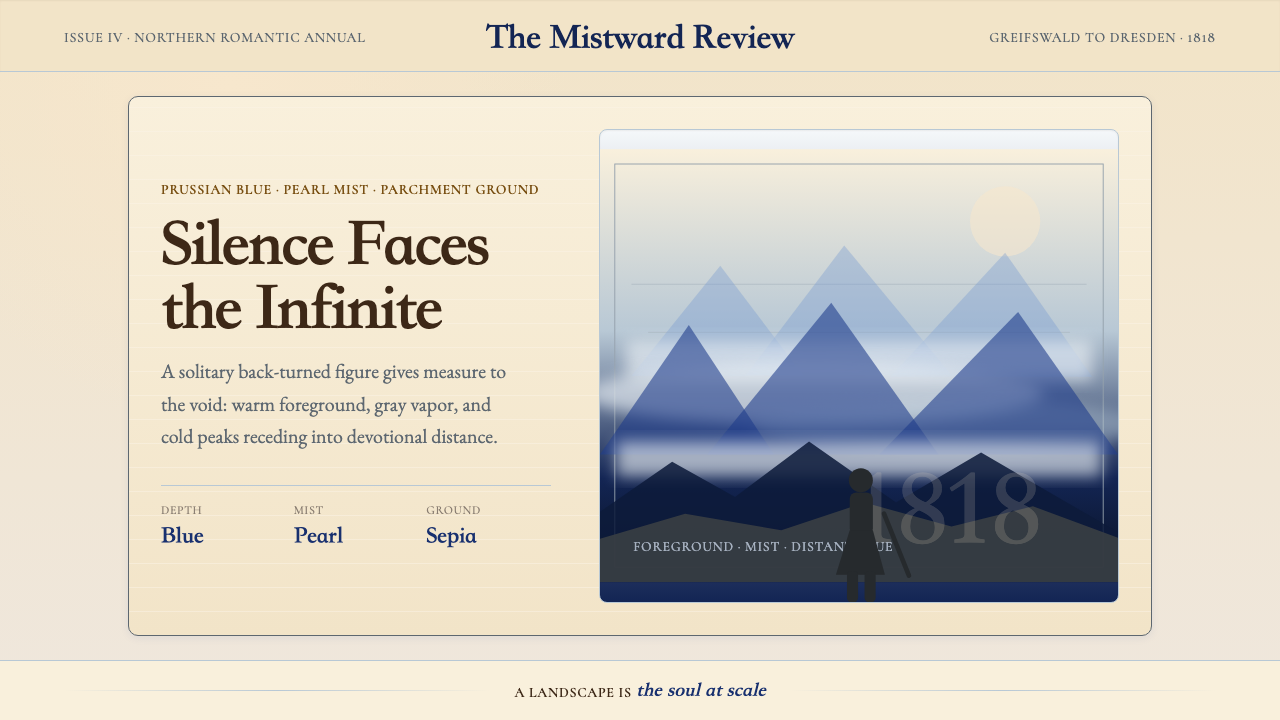
Friedrich's paintings taught the world that emptiness is not absence — it is the loudest thing in the room.
Caspar David Friedrich in brief
Caspar David Friedrich's visual language is built on a single, radical act: the figure turned away from the viewer. Where other traditions placed the human at the center of nature as its master or its measure, Friedrich positioned the lone wanderer as a supplicant — back to us, face to the void, dwarfed by mist, mountains, and the infinite sky. The landscape is not backdrop; it is protagonist. The human presence exists only to establish scale, and that scale is always humbling.
The palette that carries this emotional weight is deliberately narrow. Deep Prussian blue anchors the atmospheric voids and distant water. Pearl gray and silver-white mist diffuse the middle distances, dissolving firm edges into suggestion. Warm parchment and amber tones hold the foreground — gnarled oak roots, snow-dusted ruins, a lone pine silhouetted against dusk — before the eye is pulled irresistibly into the cold recession beyond. This warm-to-cold color journey encodes a journey of the soul: from the familiar and earthbound toward the transcendent and unknowable.
Friedrich's compositional approach is architectural in its precision. Foreground framing elements — a stone arch, a frame of fir branches, a cliff edge — enclose and direct the gaze into a luminous, receding depth. Hairline horizontal bands of subtly differentiated tone separate sea from sky, valley from ridge, fog layer from fog layer. The effect is not illustration but meditation: each painting is a structured invitation to dwell in vastness.

Where does Caspar David Friedrich come from?
Caspar David Friedrich was born in 1774 in Greifswald, a Baltic port town then belonging to Swedish Pomerania. His early life was shadowed by a sequence of personal losses — his mother died when he was seven, and as a young man he witnessed his brother Christoph fall through ice and drown, possibly while attempting to save Caspar himself. These experiences of sudden absence and the cold indifference of nature appear to have marked his imagination permanently. He studied at the Copenhagen Academy of Fine Arts from 1794 to 1798, absorbing the Northern European tradition of topographic landscape painting, then moved to Dresden, where he would spend the rest of his life.
Dresden in the early nineteenth century was a crucible of German Romantic thought. The philosopher Friedrich Schelling had argued that nature was the visible form of the infinite spirit, and that the artist's task was to find the Absolute within the finite world. The poet Novalis wrote of a 'blue flower' — Blaue Blume — as the symbol of Romantic longing for an unattainable ideal. Friedrich absorbed these ideas and translated them directly into paint. His breakthrough came in 1808 with 'The Cross in the Mountains' (Tetschener Altar), a painting that placed a crucifix at an alpine summit and framed it like an altarpiece — proposing, controversially, that landscape itself could function as a sacred image.
The years 1810 to 1825 — Friedrich's peak period, centered on Dresden — produced his most celebrated works. 'Wanderer above the Sea of Fog' (circa 1818) distilled the Romantic ideal of the solitary contemplative hero into a single unforgettable composition. 'Chalk Cliffs on Rügen' (1818) and 'The Wanderer above the Sea of Fog' used the island of Rügen — a place Friedrich visited repeatedly and associated with the purity of the Baltic coast and his own childhood — as a theater for spiritual encounter. 'The Sea of Ice' (1823–1824) transformed polar shipwreck into a meditation on nature's crushing indifference. Friedrich often collaborated with the painter and naturalist Carl Gustav Carus, who admired Friedrich and later wrote the 'Nine Letters on Landscape Painting,' helping to theorize the spiritual landscape tradition Friedrich had pioneered.
Friedrich's reputation collapsed dramatically after 1825. Tastes shifted toward the realism and narrative history painting championed by the Düsseldorf School, and Friedrich — increasingly isolated, weakened by a stroke in 1835 — died in poverty in Dresden in 1840. His rediscovery came largely through the twentieth century: the Norwegian art historian Andreas Aubert and later the Symbolists recognized in Friedrich's work a precursor to their own spiritual preoccupations. By the mid-twentieth century, he was firmly established as one of the defining masters of German painting, and by the late twentieth century his imagery — the Rückenfigur (figure seen from behind), the misty gorge, the lone tree against twilight — had entered the global visual vocabulary as the defining image of Romantic solitude.
What defines the Caspar David Friedrich look?
Receding Depth
Friedrich's compositions are organized around a consistent three-zone recession: a warm, detail-rich foreground of rocks, roots, or architectural ruins; a dissolving middle distance of mist and indistinct forms; and a luminous, cold, nearly featureless far distance. This spatial grammar communicates the Romantic idea that the material world gives way to the spiritual one as the eye travels inward. Applied to design surfaces, it translates as a layered visual hierarchy where foreground elements are grounded and warm, and background fields grow progressively cooler, lighter, and more diffuse.
Contemplative Palette
The core palette runs from deep Prussian blue and slate gray in the atmospheric depths, through silver-white and pearl mist in the middle registers, to warm parchment, amber, and muted ochre in the foreground. This is not an illustrative palette — it is a psychological one. Deep blue evokes the infinite and the nocturnal; parchment suggests the human and the historical; silver-white mist marks the threshold between the knowable and the unknown. The palette contains no saturated, high-energy accent colors. Every tone is modulated toward quietude.
The Rückenfigur
The most recognizable formal device in Friedrich's work is the figure seen entirely from behind — back to the viewer, face to the landscape. This figure functions as a surrogate: the viewer inhabits the figure's perspective rather than observing it as a separate subject. The psychological effect is one of shared solitude, of being drawn into the contemplative experience rather than witnessing it from outside. In design terms, this is the principle of the immersive view — a compositional choice that subordinates the near to the far and positions negative space, not the foreground element, as the true subject.
Atmospheric Dissolution
Friedrich rendered fog, mist, and atmospheric haze not as obstacles to visibility but as active, meaning-laden presences. Forms in the middle and far distance lose their sharp edges and merge with the ambient atmosphere, creating a quality of visual suspension — objects that seem to float rather than rest. This dissolution is controlled and gradual, not random: near edges remain articulated, distant ones fade. The technique produces a measurable sense of depth without the need for strong perspectival geometry, relying instead on tonal graduation from warm-dark to cool-light.
Framing Architecture
Friedrich consistently used strong foreground frames — Gothic arches, the silhouette of a ruined nave, overarching tree branches, cliff edges — to enclose and direct the gaze toward the luminous far distance. These frames are never neutral; they carry their own symbolic weight. A Gothic arch implies the sacred; a dead tree implies mortality; a cliff edge implies the limit of the known. The frame and the view it reveals are in dialogue, each qualifying the meaning of the other. This principle — that the container shapes the meaning of the contained — is directly applicable to screen layouts, where headers, panels, and borders are never merely structural.
Silence as Tone
Friedrich's canvases are almost entirely devoid of narrative event. No action is depicted; no story is being told. The single figure stands, or sits, or looks. The landscape simply exists — vast, quiet, indifferent. This deliberate emptiness is not a failure of content but a content in itself: the experience of being alone before something immensely larger than oneself. In typographic and compositional terms, this translates to a willingness to leave large expanses of a surface unoccupied, treating generous negative space not as waste but as the primary communicative material.
Symmetry of Weight, Not Form
Friedrich's most celebrated compositions are not strictly symmetrical, yet they feel profoundly balanced. 'Wanderer above the Sea of Fog' places the figure slightly left of center; the mist and mountain peaks are disposed asymmetrically around him. Balance is achieved through visual weight — the density of tonal contrast in one region answering the diffuse openness of another. This is compositional tension held in equilibrium rather than the static rest of mirror symmetry. It is a balance that feels earned rather than given, dynamic rather than inert.

Who shaped Caspar David Friedrich?
Friedrich (1774–1840) remains the central figure of the German Romantic landscape tradition and the originator of the visual grammar this style is drawn from. Working almost entirely in Dresden, he transformed the topographic landscape tradition he absorbed in Copenhagen into a vehicle for spiritual and philosophical meditation. His output spans oil paintings, sepia drawings, and prints, all unified by the same compositional and emotional logic. Despite a dramatic fall from critical favor in his final decade, he has since been established as one of the most influential painters in European art history, his imagery recycled by filmmakers, photographers, and designers from the late nineteenth century to the present.
Carus (1789–1869) was a physician, naturalist, and painter who became Friedrich's close friend and intellectual companion in Dresden. His 'Nine Letters on Landscape Painting,' published between 1815 and 1824, provided the theoretical framework for the spiritual landscape tradition Friedrich practiced — arguing that landscape painting at its highest aspiration was 'earth-life painting' (Erdlebenbildkunst), a form of visual philosophy. Carus documented Friedrich's working methods and preserved accounts of his thought that help illuminate the intentionality behind the visual decisions.
Runge (1777–1810) was Friedrich's contemporary and the other great originator of German Romantic painting. Where Friedrich oriented his work toward landscape and the horizon, Runge pursued a symbolic, allegorical mode centered on the human figure and the cycle of day and night. His major project, 'The Times of Day,' proposed a total integration of painting, music, and poetry into a single contemplative artwork. Runge died at thirty-three, leaving his ambitions largely unrealized, but his theoretical writings on color — developed independently from Goethe — influenced the broader Romantic color sensibility that informs this design tradition.
Johann Wolfgang von Goethe (1749–1832) was not a visual artist but exerted enormous influence on the Romantic movement through his 'Theory of Colors' (Farbenlehre, 1810) and his role as the pre-eminent cultural authority of German Romanticism. Goethe saw color as a phenomenological experience rather than a purely physical fact, arguing that colors carry inherent emotional and moral qualities — blue produces a restless, yearning state; yellow is cheerful and active; red is serious and dignified. While Goethe criticized some of Friedrich's work as too private and obscure, his broader framework for understanding color as expressive rather than merely descriptive is foundational to the emotional logic of Friedrich's palette.
Dahl (1788–1857) was a Norwegian landscape painter who settled in Dresden and became Friedrich's closest friend and householder — the two men literally shared a building for many years. While Dahl's own naturalistic style diverged from Friedrich's spiritualized approach, his presence in Dresden's artistic community kept Friedrich connected to the broader European landscape tradition and the Northern Romantic networks centered on Scandinavia and the Baltic coast. Dahl was also responsible for preserving many of Friedrich's works and advocating for his legacy after Friedrich's death and eclipse.
How do you use Caspar David Friedrich today?
Friedrich's visual grammar is not simply a color palette to borrow — it is a spatial and emotional system built on the logic of recession, contemplation, and the subordination of the near to the far. Applying it correctly to contemporary digital surfaces requires understanding what the system is actually doing: creating a felt sense of depth through tonal temperature, reserving warm and detailed elements for the foreground plane, and treating the background as the true subject — the vast, open, quietly luminous field that gives foreground elements their meaning.
For presentation slides, this style works with particular force on cover and transition pages. A cover should commit to the three-zone recession: a strongly colored or textured foreground element at the bottom of the frame, a soft middle band of mist-tone — silver-gray, pearl, or cool white — that blurs into nothing, and a pale, luminous sky-field at the top with the title set in fine, period-echoing serif type. Content slides should carry the spatial logic more quietly: parchment-warm panels floating on a cool, receding background field, section headers in slate, data presented with the restraint of a scientific illustration. Avoid energetic compositional movement — Friedrich's slides should feel still.
For web interfaces and dashboards, this style is best suited to products that wish to project depth, authority, and meditative calm rather than speed or playfulness. A pricing page or comparison dashboard using this visual language might use deep slate-blue as the primary surface, layered with pearl-gray card panels that read as floating in shallow depth. Interactive states should use the warmest tones in the palette — muted amber or parchment — as hover and selection indicators, reserving the coldest blues for inactive or background states. Navigation should be spare and typographic, with thin hairline rules used instead of heavy separators.
For editorial and marketing work, Friedrich's compositional logic supports layouts of unusual gravitas. A long-form article design might open with a full-width image field that occupies the top two-thirds of the viewport, with body text anchored at a narrow measure at the foot of the frame — reprising the figure-standing-at-the-horizon compositional logic in typographic terms. Marketing pages benefit from alternating between a cool, deep-receding background section and a warm-foreground section with rich parchment tone, creating the warm-to-cold rhythmic alternation that drives Friedrich's spatial narrative. Pull quotes should float in the mist zone — set in a lighter tone against the mid-range background, occupying the middle distance.
A common mistake when applying this style is treating it as a dark, moody aesthetic and increasing contrast and saturation to produce drama. Friedrich's actual palette is not high-contrast — it is atmospherically diffuse, relying on subtle tonal gradation rather than strong value jumps. Saturating the Prussian blue toward electric or navy, or forcing the foreground and background into high-contrast opposition, destroys the mist and recession that are the style's defining qualities. The goal is quietude, not intensity. Another frequent misstep is using this style for content that demands urgency or action — calls to action, checkout flows, error states — where the contemplative slowness becomes a liability rather than a strength.

Caspar David Friedrich — FAQ
How is this style different from other Romantic landscape traditions?
The British Romantic landscape tradition — Turner and Constable above all — is equally atmospheric but oriented toward the drama of weather, light, and sublime terror. Turner's skies explode with chromatic energy; Constable's fields are damp and mortal. Friedrich's German Romantic counterpart is quieter, more formal, and more explicitly spiritual. Where Turner paints the storm, Friedrich paints the stillness after the storm. Where Constable grounds the viewer in agricultural England, Friedrich turns the viewer away from the familiar world entirely. Compositionally, Friedrich is also more architectural and symmetrical in his underlying geometry, relying on a stable horizon line and frontal framing that other Romantic traditions often deliberately destabilize.
Can this style work for light-mode and dark-mode interfaces equally?
Friedrich's canonical palette is light-ground — parchment and pearl mist over Prussian blue depths, with sky-fields tending toward pale luminosity rather than darkness. A light-mode implementation is most historically faithful and tends to produce the mist and recession the style depends on. A dark-mode inversion is possible — using deep slate as the ground, floating pearl and warm parchment panels as elevated surfaces — but requires more care. The risk in dark mode is that the warm foreground tones become too prominent and the cool background loses its sense of infinite recession. In dark mode, restraint with warm tones is essential: they should appear as gentle illumination, not as aggressive contrast.
Is this style appropriate for data-heavy products like analytics dashboards?
It can be, with deliberate adaptation. Friedrich's style is naturally suited to contexts where depth, authority, and a sense of looking into something vast are desirable — which maps well to certain analytical tools where the user is surveying large datasets and needs to feel oriented in a complex information landscape. The risks are the style's slowness and quietude: a dashboard that demands rapid scanning and instant comparison may suffer if the color system is too muted and the spatial hierarchy too atmospheric. The practical approach is to use the Friedrich spatial logic for macro layout and navigation — cool, receding backgrounds; warm, floating foreground panels — while using sharper tonal contrast within individual charts and data elements to ensure local readability.
What typefaces best suit this visual tradition?
Friedrich's work predates modernist typography entirely — his era was one of German blackletter scripts and the transition toward the early humanist serifs that would characterize nineteenth-century book design. The typographic tradition most congruent with this style is the early nineteenth-century roman and italic: letterforms with moderate contrast between thick and thin strokes, slightly bracketed serifs, and a quality of quiet elegance rather than either extreme of geometric precision or baroque decoration. Avoid ultra-modern geometric sans-serifs — they import the wrong century. Avoid heavily decorative Victorian display types — they are too ornamental. A well-set classical serif at a considered scale and weight is the appropriate choice, paired with very restrained use of italic for mood and emphasis.
Which kinds of brands or products should avoid this style?
Friedrich's visual language communicates solitude, contemplation, spiritual gravity, and a longing for the infinite — qualities that are genuinely desirable for certain products and actively counterproductive for others. Brands oriented toward community, warmth, celebration, or fast-paced interaction should avoid it: social platforms, marketplace products, food and beverage brands, children's applications, and consumer entertainment products all benefit from visual languages that foreground human connection and sensory pleasure rather than solitary introspection. High-conversion e-commerce contexts will also struggle — the quiet pace of Friedrich's atmosphere works against the urgency that drives purchase decisions. The style is best reserved for products where the user experience benefits from contemplative depth: premium editorial platforms, research tools, heritage luxury goods, cultural institutions, and any product where the user's fundamental mode is reflective rather than reactive.
Related design styles
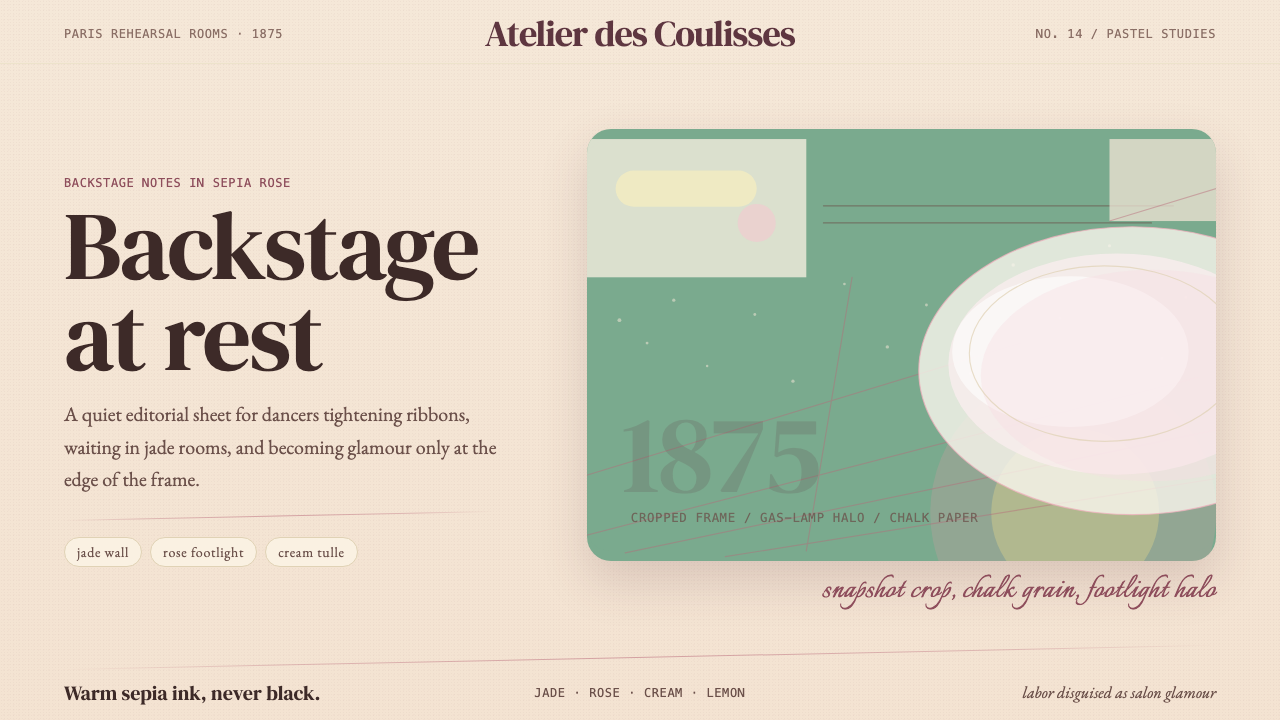 Degas Ballet PastelsBackstage glamour is labor. Jade walls, rose footlights, cropped serifs on cr…
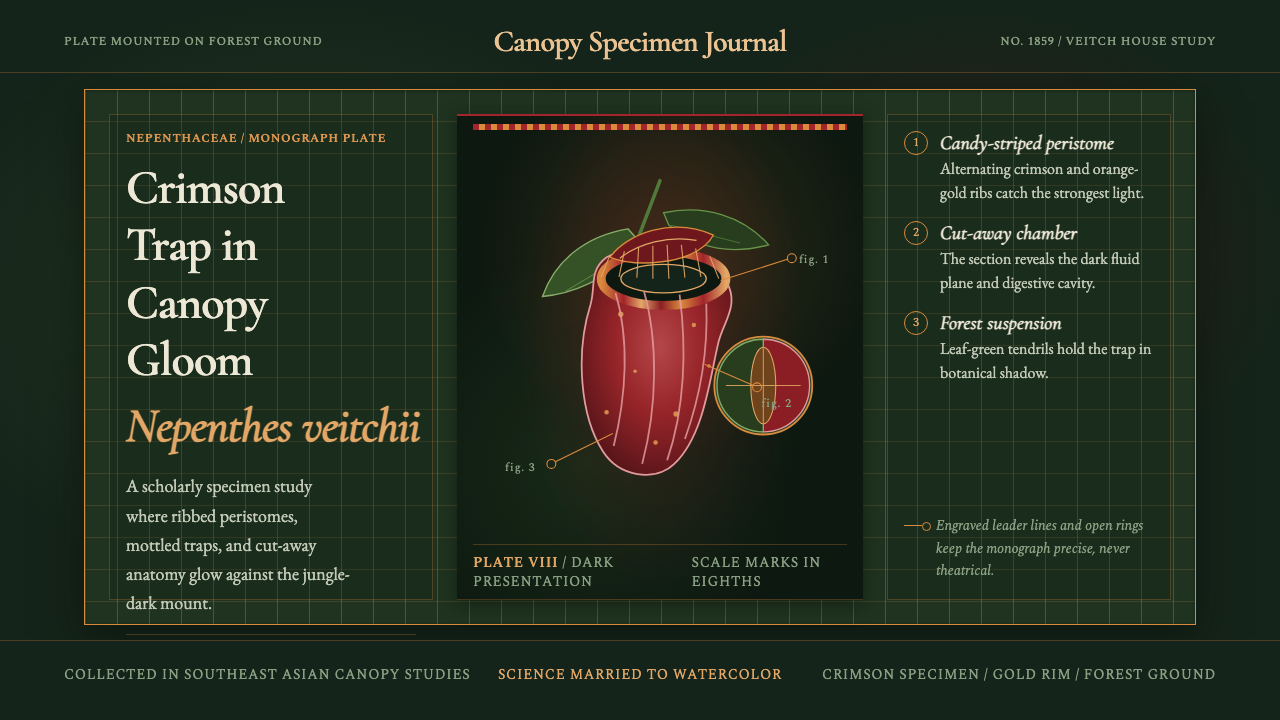 Carnivorous Pitcher PlantBotanical danger glows. Crimson traps and gold rims float on jungle-dark gree…
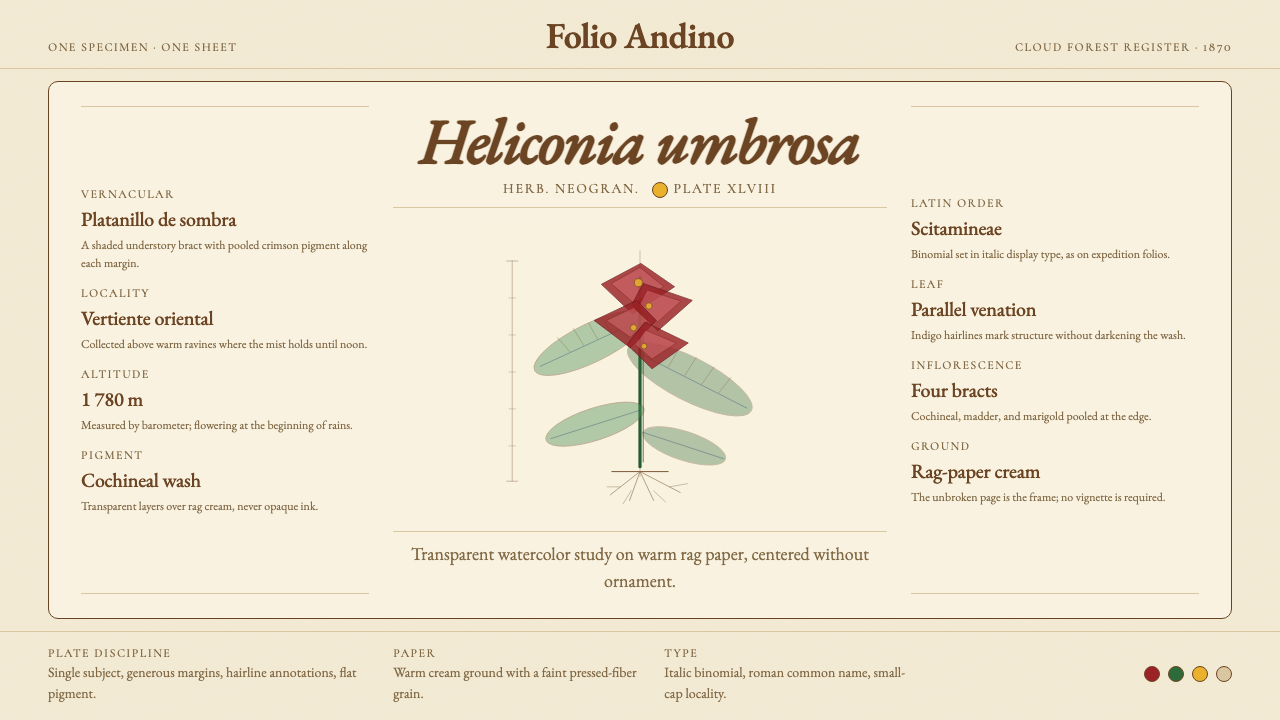 Colombian Botanical (Triana)Observation becomes ornament. Crimson watercolor specimen breathes on cream r…
 Millais — Ophelia / Wildflower Pre-RaphBotany, rendered with conviction. Cream gesso, emerald, and vermilion stay in…
 Hiroshige — Tokaido RoadA road print in motion. Prussian blue blocks, vermilion cartouches, diagonal…
 Tamil Grantha InscriptionSacred stone, quietly lit. Pale Grantha glyphs float on dark granite in a nar…