What is Delacroix French Romanticism?
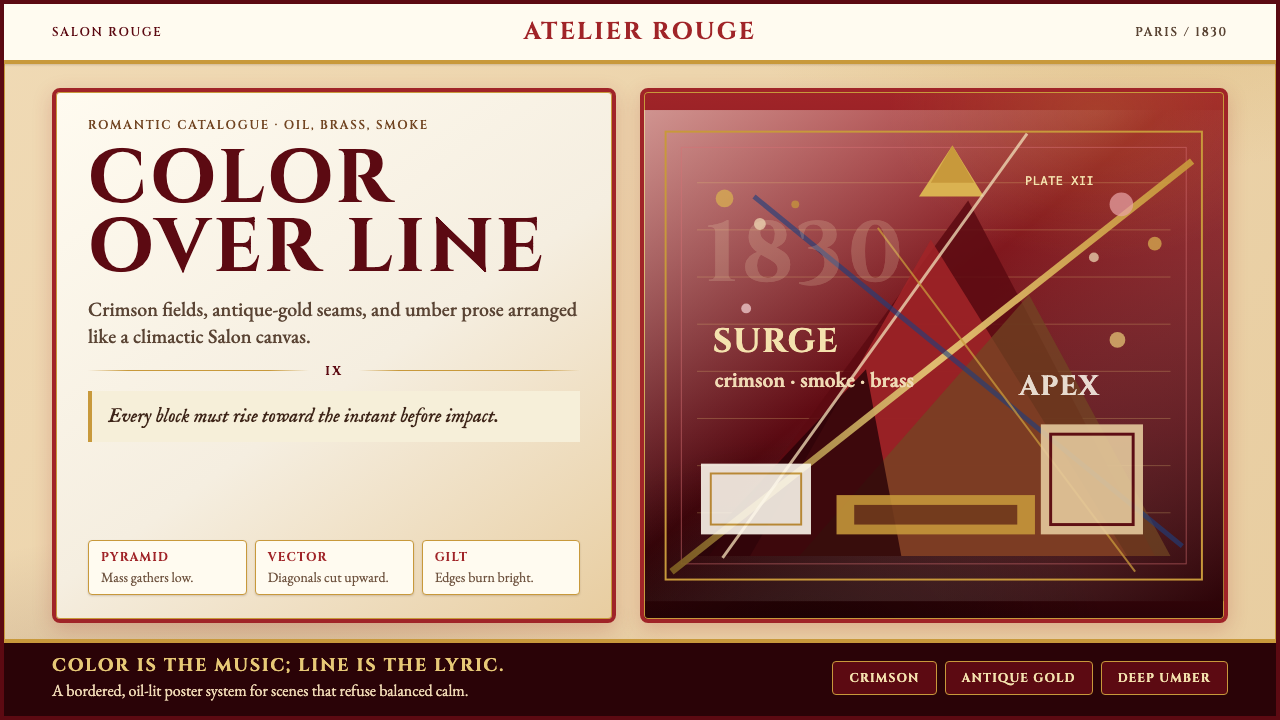
Delacroix turned the painted canvas into an opera — crimson banners, smoke-filled skies, and diagonal pyramids of surging bodies locked at the climactic instant of triumph or massacre.
Delacroix French Romanticism in brief
Delacroix French Romanticism is the visual language codified by Eugène Delacroix (1798–1863) across his career at the Paris Salon, a language that placed color above line, emotional intensity above rational order, and the climactic instant above narrative sequence. Where his rival Jean-Auguste-Dominique Ingres upheld the cool contours of Neoclassicism, Delacroix made the brushstroke itself expressive — visible, energetic, at times turbulent — and organized his compositions around diagonal pyramids that drag the eye toward a single moment of maximum action.
The palette is not decorative but dramatic: deep bordeaux and warm crimson anchor the darks, burnished golds and brass-tinged ochres catch the light, cool blue-greys fill the smoky middle distances, and creamy parchment tones ground the highlights. Nothing sits at polite, averaged equilibrium. Color relationships are chosen for maximum contrast and emotional resonance — the way the saturated crimson of a flag reads against smoke, or the way dull bronze glints against a figure draped in violet shadow.
Equally defining is the style's relationship to ornament: not rejection (as in Bauhaus) but excess — gilded borders, intricate costumes, layered draperies, the sumptuous textile patterns of North Africa that Delacroix brought back from his 1832 Morocco journey. Applied to contemporary design, this becomes a system of rich material surfaces and editorial boldness: heavy gold filigree framing, parchment and vellum grounds, strong diagonal compositions, and type that carries the weight of a proclamation rather than the neutrality of information.

Where does Delacroix French Romanticism come from?
French Romanticism emerged in the 1820s as an explicit revolt against the Neoclassical doctrine enforced by the Académie des Beaux-Arts in Paris, which held that line was the supreme element of painting, that ancient Greco-Roman subjects were the only proper content for ambitious art, and that the painter's personal emotion was irrelevant to the work's quality. The Romantics disputed every one of these propositions. Influenced by the English painters John Constable and J. M. W. Turner — whose works Delacroix saw at the Paris Salon of 1824 — and animated by the political turbulence of post-Napoleonic France, they argued that color, not line, was painting's primary expressive instrument, and that contemporary history, literature, and the exotic East were as worthy of monumental treatment as any classical myth.
Delacroix's career was the movement's central drama. His first major Salon success, The Barque of Dante (1822), already showed the palette and compositional energy that would define him: turbulent dark water, writhing figures, a cold sky that makes the warm flesh tones strike like fire. His Massacre at Chios (1824) — depicting the Ottoman killing of Greek civilians — caused a scandal precisely because it brought contemporary atrocity into the grand-history format that Neoclassicism had reserved for elevated ancient subjects. When he reworked parts of the Massacre after seeing Constable's Hay Wain, critics were outraged; the new passages were looser, more broken, more openly brushed. He did not care.
The pivotal work is Liberty Leading the People (1830), painted in the aftermath of the July Revolution that ousted Charles X. It is not a document of historical realism — the allegorical figure of Liberty is bare-breasted and monumental, a classical goddess in a street scene — but a compression of political emotion into a single diagonal surge. Crimson, blue, and the dull white-grey of smoke organize the color; the pyramidal composition drives upward to Liberty's raised tricolor. The painting entered the Louvre, then was hidden for periods by governments that found it too inflammatory. It remains the defining image of a movement that understood spectacle as argument.
Delacroix's 1832 journey to Morocco and Algeria, accompanying a French diplomatic mission, transformed his palette and his archive of visual subjects permanently. He filled notebooks with drawings of markets, interiors, horses, and costume — the richly saturated textiles, the complex layering of pattern and shadow, the quality of North African light that was simultaneously harsh and warm. These sketches fed his work for the next three decades. The Orientalist strain in his output — Women of Algiers (1834), The Jewish Wedding in Morocco (1839) — brought an entirely new range of pigment relationships into French painting: acid yellows against deep ultramarine, warm saffron against cool marble-white, intricate geometric embroidery against pliant human flesh. This encounter with the visual complexity of another culture is what separates his chromatic ambition from merely theatrical excess.
What defines the Delacroix French Romanticism look?
Dramatic Color Palette
The palette is built around the extremes of heat and shadow rather than harmonious middle tones. Deep bordeaux and warm crimson — the red of banners and blood — function as dominant anchors in the dark range. Burnished gold and brass-tinged ochre catch directional light and create the visual equivalent of a trumpet fanfare. Cool blue-grey fills the atmospheric middle distances — smoke, sky, shadow. Creamy parchment and warm ivory carry the highlights. The relationship is never placid: colors are chosen for their capacity to collide productively, to create the kind of sustained visual tension that Delacroix called 'the music of the painting'.
Diagonal and Pyramidal Composition
Where Neoclassical composition sought horizontal stability and frontal balance, Delacroix drives his compositions along steep diagonals that surge from corner to climax. Figures are stacked into pyramidal masses — bodies at the base, a dominant figure or symbol at the apex — and the whole structure tilts at an angle that creates forward momentum. This diagonal energy is the compositional signature of the style: nothing rests, everything ascends or collapses. Figures at the edges are often cropped by the frame, as if the action exceeds the canvas.
Visible, Expressive Brushwork
Unlike the smooth, almost photographic surfaces prized by the Académie, Delacroix left his marks visible. Brushstrokes are directional, energetic, and varied in width — short broken strokes describe turbulent water or churning crowd; long fluid strokes model drapery and flag. In the lighter passages, strokes of different hues are placed side by side rather than blended, creating optical color mixtures that shimmer. Charles Baudelaire, his most perceptive early critic, noted that Delacroix's works were best appreciated from a distance, where individual strokes fused into the total tonal drama rather than remaining discrete marks.
Rich Ornamental Layering
Rather than stripping away ornament, the style embraces it as a carrier of emotional and cultural meaning. Gilded borders frame; intricate textile patterns — the geometric embroideries and striped silks of North Africa — assert material richness against the violence of the subject. Armor, bridles, tassels, headdresses, and the sumptuous drapery of classical costume all coexist within a single composition. The layering is never arbitrary: each decorative element creates a surface tension against which the primary action reads more starkly. Applied to design, this becomes a principle of deliberate material richness: parchment grounds, filigree rules, heavy editorial borders.
Atmospheric Light and Shadow
Delacroix did not use light to reveal form with clinical precision, as did Neoclassicism. He used it to create atmosphere — the hazy, smoke-diffused quality of a battlefield or the warm, oblique shaft of a North African interior. Shadows are rich in reflected color: the shadow side of warm flesh might carry cool violet, the shadow of a gold garment might hold deep olive. This treatment, which influenced the Impressionists directly, means that dark passages are never simply dark — they are chromatically alive. In design application, this translates to depth through layered tonal surfaces rather than uniform flat fields.
Climactic Figural Drama
The human body in Delacroix is never at rest. Figures strain, fall, reach upward, clutch weapons, or lie spent across the foreground. Musculature is shown at maximum exertion; drapery catches the wind of movement; faces express terror, ecstasy, or the blank abstraction of violent death. The style draws on Rubens and Michelangelo but amplifies the temperature of action — every figure is at the peak of effort or the depths of collapse, never midway. For contemporary design, this principle of 'climactic moment' becomes an argument for full-commitment editorial choices: the most striking image, the most urgent typographic weight, the most saturated color used at the single point of maximum emphasis.
Historical and Exotic Subject Matter
Delacroix ranged across literary sources — Dante, Shakespeare, Byron, Walter Scott — and across historical periods from ancient Greece and Rome to contemporary Paris. His 1832 Morocco journey opened a sustained engagement with Islamic architecture, Berber costume, and the visual culture of the Maghreb. This breadth of reference is not decorative tourism but an argument: the Romantic movement held that all human experience, across time and geography, was legitimate artistic material. For design applications, this translates as a style that supports rich, documentary-style content: travel editorial, historical narrative, cultural exhibition branding, luxury goods that want to suggest a world larger than their category.

Who shaped Delacroix French Romanticism?
The central figure of the movement, Delacroix (1798–1863) exhibited at every Paris Salon from 1822 onward, accumulating a body of work of extraordinary range — from Shakespearean subjects and Byronic Eastern tales to contemporary history and intimate Moroccan interior scenes. He was elected to the Institut de France only after seven unsuccessful attempts, a measure of how thoroughly the academic establishment resisted his methods. His late mural commissions — the ceiling of the Galerie d'Apollon at the Louvre, the Chapel of the Holy Angels at Saint-Sulpice — demonstrate that his energetic chromatic method was as capable of monumental architectural integration as of easel drama. His journals, published posthumously, remain the most sustained written account of Romantic painting theory in French.
Géricault (1791–1824) was the elder by seven years and the movement's first explosive voice. His Raft of the Medusa (1819) — an enormous canvas depicting the survivors of a government shipwreck scandal — brought the Romantic temperament directly into grand-format history painting a decade before Delacroix's Liberty. The work's pyramidal composition of tangled bodies straining toward a distant ship, its grey-green deathly palette shot through with warm flesh tones, and its insistence on contemporary catastrophe as monumental subject are all elements Delacroix absorbed and intensified. Géricault died at thirty-two from a riding accident, and Delacroix — who had posed for the Raft and knew him well — inherited the movement's leadership.
Baudelaire (1821–1867) was not a painter but the critic who gave Delacroix's work its most penetrating theoretical framework. His Salon reviews of 1845 and 1846 articulated why Delacroix was 'the last great painter of the old world and the first of the new' — a figure whose obsessive relationship with color, whose ability to communicate states of feeling rather than merely depicting events, and whose visible brushwork anticipated the full break from academic tradition that Impressionism would complete. His essay 'The Painter of Modern Life' (1863) extended this argument into a general theory of Romantic art as the art of capturing the transient, the fleeting, and the contingent — against the academy's insistence on the timeless and the ideal.
Ingres (1780–1867) is best understood in relation to Delacroix because the two men defined French painting by opposing each other for four decades. Where Delacroix made color primary and rendered it with broken, visible strokes, Ingres believed that drawing — precise, sculptural, contour-defining line — was the only true foundation of painting. Where Delacroix sought the moment of emotional maximum, Ingres constructed images of idealized, almost breathless calm. The debate between them — called the querelle du coloris in its eighteenth-century form, revived in the nineteenth — was not merely aesthetic but philosophical: a dispute about whether sensation or intellect, impulse or system, was the higher faculty in art. Contemporary designers who understand this opposition understand Romanticism better than those who approach it as a style catalog.
Fromentin (1820–1876) was both a painter in the Romantic Orientalist tradition and the author of Les Maîtres d'autrefois (1876), one of the most lucid accounts of the Flemish and Dutch painting traditions that Delacroix himself drew on. As a painter, Fromentin traveled extensively in Algeria and brought back canvases depicting Arab horsemen, desert light, and the architectural textures of the Maghreb with a chromatic sensitivity that extended Delacroix's North African discoveries into a sustained documentary practice. His work demonstrates how the Romantic relationship with the exotic could become rigorous ethnographic observation rather than projective fantasy — a distinction that matters for designers who want to use this style's rich visual vocabulary without reducing it to theatrical surface.
How do you use Delacroix French Romanticism today?
Delacroix French Romanticism is among the most visually commanding historical styles available to contemporary designers, precisely because its organizing principle — the compressing of maximum emotion into a single, decisive compositional instant — translates directly into high-impact presentation and editorial work. Applying it well requires understanding that the style's power comes from tension and selectivity, not from indiscriminate richness. The parchment ground, the crimson accent, the gold filigree border: each element earns its place by making every other element read more clearly against it.
For presentation slides, the style transforms both cover and content treatment. A cover in this mode uses a steeply diagonal compositional axis — the title block set low-left while a principal image or abstract form surges toward the upper-right — against a warm parchment or aged-vellum ground. Gold rule lines at the top and bottom edge complete the framing without overcrowding. Section dividers work best as near-full-bleed crimson or deep bordeaux fields with the section title in cream type: the color shift is announcement enough. Data slides should resist the temptation to introduce too many accent colors; choose one — crimson for emphasis, gold for callouts — and use deep charcoal rather than pure black for body text, to stay within the palette's warmth register.
For web interfaces, the style is best suited to contexts where editorial authority and cultural depth are the primary brand signals: luxury goods landing pages, cultural institution sites, travel and hospitality platforms, high-end editorial publications. Dashboard and pricing applications are feasible but require discipline: the palette's warmth must be balanced against the neutral legibility demands of dense data. In practice, this means using the parchment-and-bordeaux palette for navigation, hero sections, and feature callouts, while reverting to near-white grounds and charcoal type for data-dense table and card regions. Hover and interactive states can carry a gold or crimson accent without overwhelming the information structure.
For editorial and marketing work, the style is at its most natural. A marketing page built on this system uses alternating full-width sections: warm parchment ground with deep-charcoal headline and bordeaux subhead, then a near-black ground with gold headline — the oscillation creates the visual rhythm of a broadsheet without requiring photographic content. Pull-quote treatments work especially well: oversized opening guillemets in gold, a single tight line of large warm-cream type, a thin gold rule beneath. Event posters and conference identity materials respond well to the diagonal compositional logic — title text angled slightly, supporting information arranged along the same axis, a crimson or gold bar running diagonally across a corner.
A common mistake when applying this style is confusing richness with excess. Delacroix's paintings are sumptuous but not chaotic — every composition has a clear spine, a dominant value structure, and a single point of maximum intensity. Designers often import the decorative vocabulary (gold borders, parchment grounds, ornate frames) without maintaining this underlying compositional discipline, producing work that reads as costume rather than character. The rule: before adding any ornamental element, identify the single strongest visual statement in the layout and ensure that every decorative addition serves to direct attention toward it, not away from it. If an element competes with the climactic center, it belongs elsewhere or not at all.

Delacroix French Romanticism — FAQ
How is French Romanticism different from Baroque, which also uses dramatic color and diagonal composition?
The confusion is understandable — Delacroix himself was deeply influenced by Rubens and admired Rembrandt. The key distinctions are subject matter, emotional register, and the role of the brushstroke. Baroque drama, especially in Rubens, is triumphalist and sensuous — it celebrates earthly power, religious glory, and the opulence of flesh. Romantic drama is shot through with melancholy, political urgency, and the consciousness of loss: Liberty Leading the People mourns and celebrates simultaneously. The brushstroke is also different in kind: Baroque surfaces, however energetic, are typically blended and polished; Romantic surfaces are explicitly worked, even rough. Applied to design, Baroque suggests ceremony and institutional authority, while Romanticism suggests urgency, emotional authenticity, and the individual human cost of historical events.
Can the Delacroix style work for digital product interfaces, or is it purely editorial?
It works for digital interfaces in specific contexts, but requires careful translation. The style's emotional intensity and ornamental richness are best suited to contexts where slowness and savoring are part of the user experience — a luxury e-commerce site, a cultural institution's collection browser, a travel booking platform targeting the premium end of the market. It is poorly suited to utility-first interfaces: high-frequency trading dashboards, enterprise analytics tools, or any application where the user needs to extract information at speed with minimal friction. When adapting the style to digital UI, the practical approach is to preserve the palette and compositional principles — warm grounds, crimson or gold accent, diagonal editorial framing — while simplifying the ornamental density for the constraints of component-based layout systems.
What is the role of the parchment or aged-paper ground in this style, and can it be substituted?
The warm ground is not decorative but functional. Against a cream or parchment surface, the bordeaux and crimson accents read as warm-on-warm, creating a sensuous depth rather than the stark cold contrast of the same red on pure white. The gold tones integrate naturally rather than clashing. And the overall effect positions the work in a historical and material register — the impression of paper with age, of documents and manuscripts — that is central to the style's authority. It can be substituted: a very dark ground (deep olive, near-black charcoal) produces a 'dramatic night' variant that preserves the tension. What cannot be substituted without losing the style's character entirely is pure cool white or saturated digital blue — these belong to design languages with incompatible values.
How does the Orientalist dimension of Delacroix's work bear on design applications today?
The Orientalist strain in Delacroix is both the richest source of his chromatic complexity and the most historically contested aspect of his legacy. His Morocco notebooks and the paintings they generated introduced genuinely specific visual observation — the quality of North African light, the geometry of Islamic tilework, the layering of Berber textile patterns — into European painting. At the same time, scholars since Edward Said have analyzed how this encounter was filtered through projective Western assumptions about the 'exotic East'. For design, the practical implication is this: the palette innovations that came from Delacroix's North African encounter — the acid yellow-against-ultramarine, the warm saffron-against-cool-white, the complex layered pattern work — are available as visual resources. Using them in contemporary work is a matter of applying color and pattern intelligence, not of replicating or endorsing the colonial framework through which Delacroix originally encountered these traditions.
What distinguishes an authentic application of this style from a generic 'vintage luxury' aesthetic?
The generic 'vintage luxury' aesthetic borrows surface markers — warm grounds, gold accents, serif type, aged texture — without the compositional logic that gives those elements their force. Delacroix's style has a specific structural grammar: the diagonal compositional surge, the clear value hierarchy from dark base to light apex, the single point of maximum chromatic intensity, the strategic use of ornament to frame rather than fill. A piece that uses parchment grounds and gold rules but arranges its content in centered, symmetric, horizontally stable blocks is not Romantic — it is Victorian Revival or generic period pastiche. The test is whether the layout has a climactic center that everything else serves. If the design could be rotated ninety degrees without losing meaning, it lacks the directional energy that is the style's deepest principle.
Related design styles
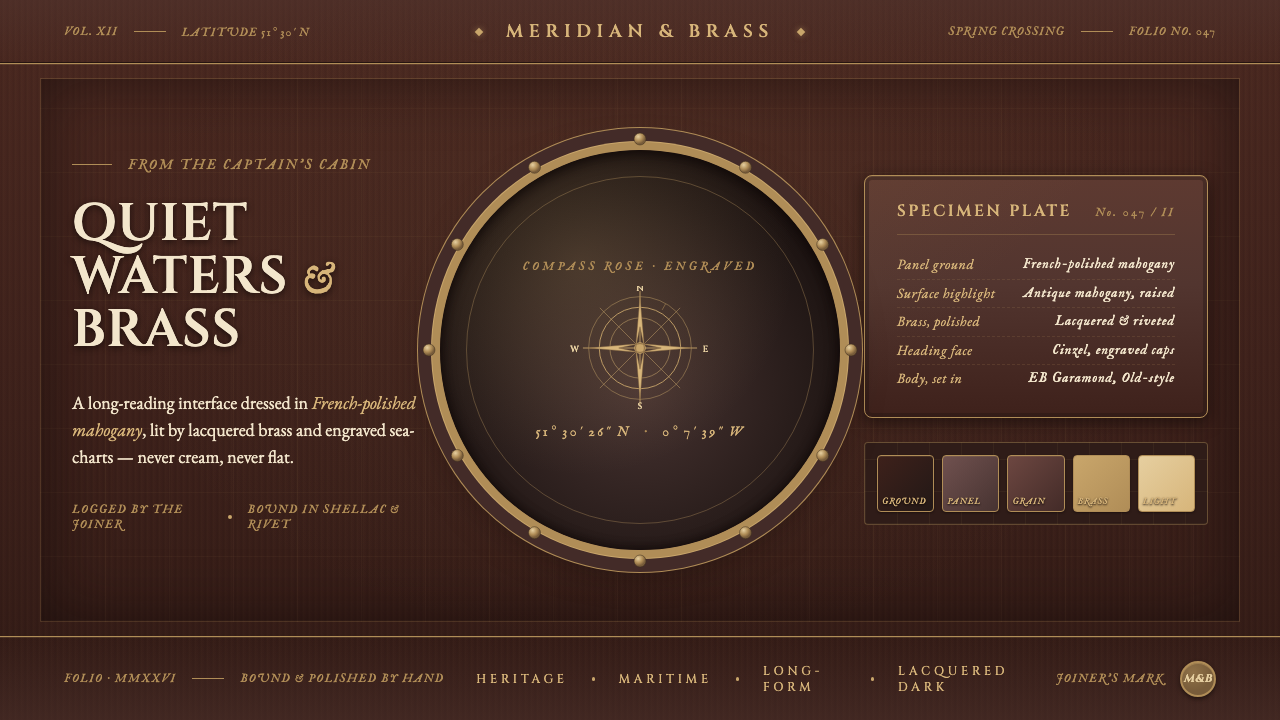 Mahogany Ship CabinPre-1900 maritime luxury. Mahogany panels, brass portholes, Cinzel caps over…
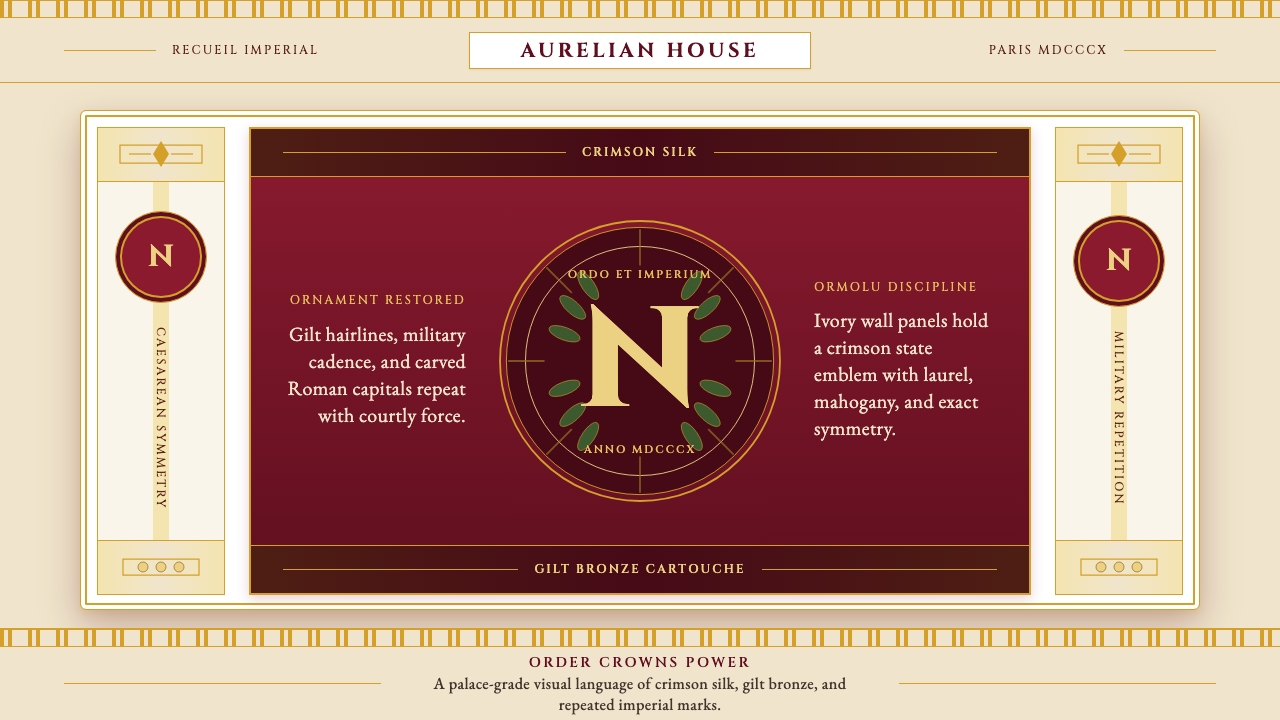 Napoleonic Empire StyleImperial order speaks. Crimson silk, gilt hairlines, and strict symmetry fram…
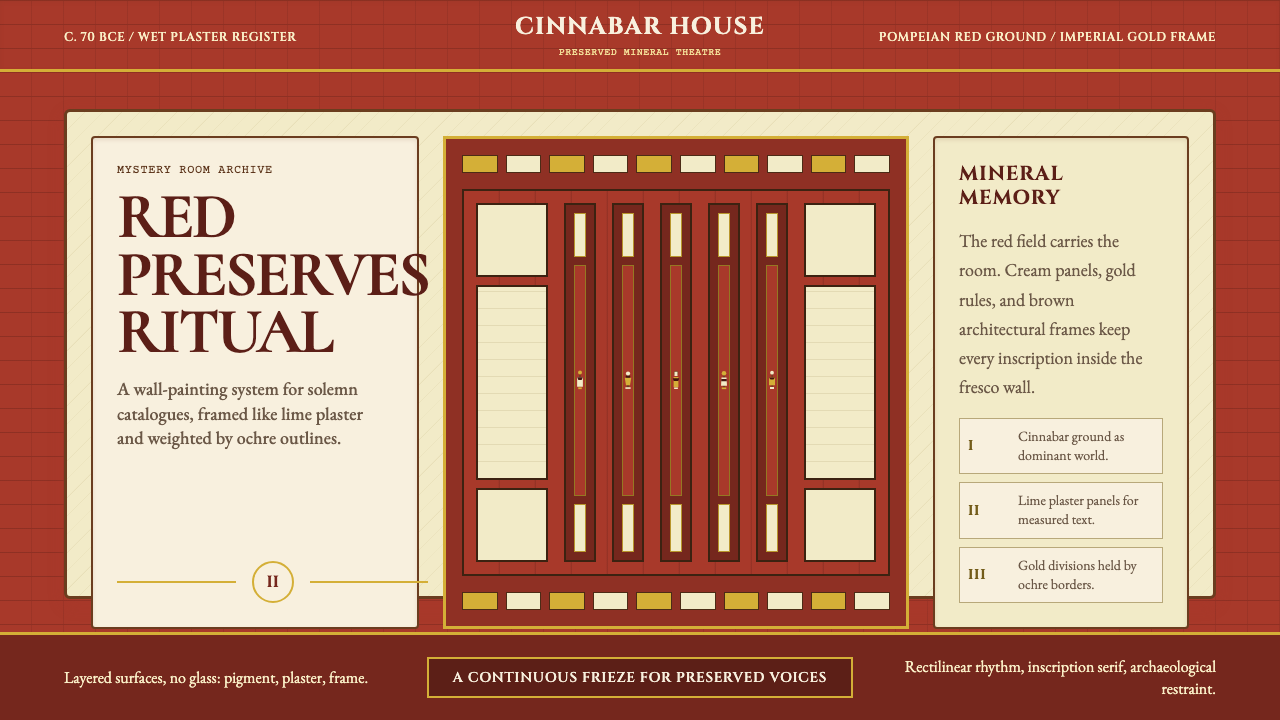 Pompeii Fresco Villa of MysteriesThe wall is the world. Pompeian red, cream plaster panels, and gold frames ho…
 Rossetti — Pre-Raphaelite StunnerRomance refuses restraint. Crimson velvet, copper serif, and gilt frame turn…
 Bhutanese Dzong (Fortress Red)Monumental red holds the page. Cobalt frames and gold bands lock the fortress…
 Bird of Paradise MonographTheatrical plate-book darkness. Flame plumes blaze from a bordered forest-bla…