What is Napoleonic Empire Style?
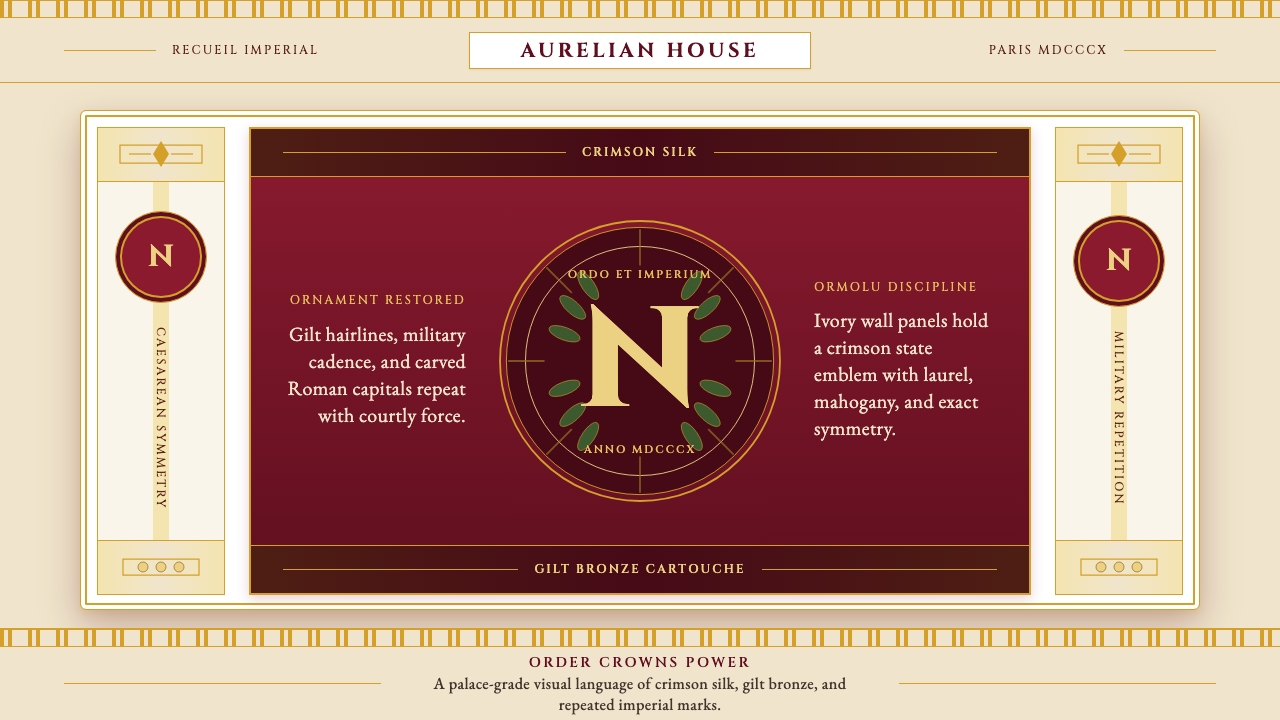
Napoleonic Empire Style is the visual language of absolute power — sphinxes, laurel wreaths, imperial bees, and mathematically precise symmetry pressed into every surface from palace walls to state dispatches.
Napoleonic Empire Style in brief
Napoleonic Empire Style is the official state aesthetic commissioned by Napoleon Bonaparte between his coronation in 1804 and his defeat at Waterloo in 1815. Codified by the architect-decorators Charles Percier and Pierre-François-Léonard Fontaine in their seminal publication of interior design plates, it fused three distinct visual inheritances — Egyptian campaign trophies, Republican Roman gravitas, and the Pompeii excavations then newly under study — into a single, coherent system of palace, state, and ceremony.
The style is distinguished above all by its absolute commitment to symbolic repetition and mathematical symmetry. Every surface is a carrier of imperial signification: chair backs bear sphinxes, wallpapers are woven with laurel-wreathed monograms, gilt-bronze hardware is cast as eagles, victory figures, or bees — Napoleon's personal emblem, adopted from the Merovingian dynasty to claim ancient Frankish legitimacy. Nothing is accidental; every ornamental choice is a political argument rendered in bronze, silk, or mahogany.
In palette, the style is bold and declarative rather than subtle. Deep crimson and imperial purple — colors with ancient associations with Rome and Byzantium — are the primary grounds, warmed by saturated gold that reads simultaneously as wealth, military valor, and divine sanction. Malachite green, rich azure, and the warm amber of polished mahogany appear as supporting notes. The overall effect is one of opulent density: surfaces are not empty but populated with meaning.

Where does Napoleonic Empire Style come from?
The direct political trigger for Empire Style was the French Revolution's destruction of the Bourbon visual order. After 1789, the monarchy's rich rococo language — all asymmetric curves, pale pastels, and intimate pastoral scenes — was politically toxic. The Directory and then the Consulate groped toward a replacement aesthetic rooted in Roman Republican virtues: severity, civic duty, and martial simplicity. Jacques-Louis David's neoclassical paintings, particularly his portraits of figures like Marat and his massive coronation scene depicting Napoleon as a new Augustus, established the visual template that decorative arts would then translate into three dimensions.
Napoleon's Egyptian campaign of 1798 to 1799 introduced a second major current. Although militarily inconclusive, the expedition produced the monumental scholarly publication Description de l'Égypte, which made Egyptian visual vocabulary — hieroglyphics, obelisks, sphinxes, lotus capitals, and the crisp geometric forms of ancient monuments — suddenly fashionable across Europe. Dominique-Vivant Denon, who accompanied the expedition and later became Napoleon's director of museums, was the critical conduit: he collected Egyptian artifacts for the Louvre, designed medals and commemorative objects, and supervised the incorporation of Egyptian motifs into the imperial decorative scheme. The sphinx became a ubiquitous form in furniture, appearing as armrest terminals, table supports, and clock cases.
A third stream came from the systematic excavation of Herculaneum (from 1738) and Pompeii (from 1748), which had made the domestic interiors and decorative arts of ancient Rome directly available to European designers for the first time. The Pompeian vocabulary — flat wall panels divided by slender pilasters, friezes of dancing figures, delicate acanthus scrollwork, and the warm earth tones of Roman fresco — filtered into Empire Style as a counterweight to the heavier Egyptianizing elements, providing lighter ornamental passages within the overall grandeur.
The institutional mechanism for translating these sources into a unified imperial brand was the collaboration between Percier and Fontaine, the two architects Napoleon appointed as his principal decorators. They redesigned the apartments at the Tuileries, Malmaison, Fontainebleau, and Compiègne, and their publication of design plates — Recueil de décorations intérieures, first issued in 1801 — functioned as a kind of imperial style guide, diffusing the aesthetic to cabinetmakers, bronze-founders, textile weavers, and porcelain manufacturers throughout France and, through Napoleon's satellite courts, across Europe from Madrid to Warsaw.
What defines the Napoleonic Empire Style look?
Palette
The Empire palette is fundamentally an assertion of power through color. Deep crimson — the color of Roman triumph — serves as the primary ground for upholstery, wall hangings, and drapery. Imperial purple anchors the most ceremonial contexts. Against these saturated grounds, burnished gold reads not as mere wealth but as divine sanction: every gilt line, mount, and fringe signals that this is the court of a new Caesar. Supporting tones include malachite green, a vivid sky blue, and the warm reddish-brown of polished mahogany, which adds organic warmth to what might otherwise be an entirely metallic effect.
Symmetry and Geometry
Unlike the playful asymmetry of rococo, Empire Style demands exact bilateral symmetry across every composition. Rooms, furniture arrangements, wall treatments, and even individual objects are organized around a central axis, with each element mirrored precisely on both sides. This symmetry is not merely aesthetic preference but ideological statement: it evokes the order of Roman architecture, the discipline of military formations, and the authority of law. Geometric precision — straight lines, regular arcs, and right-angle junctions — dominates over organic curves.
Imperial Iconography
Every surface carries a repertoire of recurring symbols chosen to construct Napoleon's legitimacy across multiple historical traditions simultaneously. The eagle — Rome's legionary standard — signals martial supremacy. The bee — Merovingian symbol reclaimed to claim Frankish ancestry — marks personal imperial ownership. The sphinx — trophy of the Egyptian campaign — projects exotic conquest and esoteric knowledge. The laurel wreath crowns every monogram, N cipher, and victory scene. The fasces, the Roman bundle of rods with an axe, communicates unified authority. These symbols appear at every scale from monumental friezes to cabinet keyhole surrounds.
Gilt Bronze and Precious Materials
The material vocabulary of Empire Style is unapologetically luxurious. Ormolu — gilt bronze made from an alloy cast in precise molds and then fire-gilded — is the defining hardware material. Pierre-Philippe Thomire's atelier produced the most celebrated pieces: clock cases surmounted by eagle groups, candelabra terminating in winged victories, and furniture mounts of extraordinary refinement. Mahogany, imported from the Caribbean and prized for its straight grain and reddish warmth, is the preferred cabinet wood. Marble — both white Carrara and richly veined colored varieties — surfaces tabletops and mantelpieces. Silk velvet and brocade, often woven at Lyon with the imperial motifs, cover seating and walls.
Monumental Scale and Repetition
Empire Style is fundamentally a monumental aesthetic that scales upward naturally. In architectural contexts, it favors tall ceilings, deep cornices, large-format wall panels, and imposing doorways framed by pilasters or columns. Decorative programs are organized through exact repetition: a single frieze motif — perhaps a palmette, a running anthemion, or an alternating bee and wreath — is repeated without variation for the full circumference of a room. This insistent repetition is not laziness but discipline, enforcing visual unity and communicating the inexhaustible resources of the imperial state.
Egyptianizing Elements
The Egyptian campaign's visual legacy within Empire Style adds an element of exotic gravity that differentiates it from straight Greco-Roman neoclassicism. Sphinx forms — with the human head and leonine body — appear as armrest supports, clock flankers, and garden sculpture. Obelisk profiles influence clock cases and architectural accessories. Lotus-blossom capitals top pilasters and columns. Hieroglyphic-inspired banding decorates friezes and textile borders. These Egyptian elements are deployed as imperial trophies — visual proof of conquest — rather than as studied archaeological reconstruction, so they are often stylized and combined freely with Roman and Greek elements.
Typography and Lettering
In printed and inscribed contexts, Empire Style gravitates toward letterforms derived from Roman imperial inscriptions: upright, serifed, and geometrically regular. The N cipher — Napoleon's personal monogram — is rendered in a bold, engraved style, often enclosed within a laurel wreath cartouche. State documents, commemorative medals, and proclamations use a typographic register that deliberately echoes ancient Roman titulus inscriptions on triumphal arches and columns. The visual authority of the letterform is enhanced by the medium: engraved metal, impressed wax seals, and embossed paper all give the text a physical weight appropriate to imperial decree.

Who shaped Napoleonic Empire Style?
Percier was the senior partner in the architectural duo that defined Empire Style. A trained architect who had spent formative years studying antique remains in Rome, he returned to France to collaborate with Fontaine on the transformation of Napoleon's palaces. Their publication Recueil de décorations intérieures (1801) was the single most important document for diffusing the style: it provided pattern-plate designs for furniture, drapery, wall treatments, and decorative objects that workshops across France and satellite courts throughout Europe could reproduce. Percier's draftsmanship was renowned for its precision and archaeological seriousness.
Fontaine was Percier's collaborator and, after Napoleon's fall, the longer-lived and politically more durable of the two. He served as premier architecte — first architect — not only to Napoleon but subsequently to Louis XVIII and Charles X during the Restoration, demonstrating that the architectural language of Empire could survive the death of the empire itself through institutional continuity. His ongoing work at the Louvre and the Tuileries extended the physical reach of Empire Style through successive French governments, making him the most enduring single force in its preservation.
David was Napoleon's court painter and the visual propagandist who established the heroic iconographic program from which the decorative arts drew. His enormous Coronation of Napoleon (1805-1807) and the equestrian portrait Napoleon Crossing the Alps set the template for how Napoleon was to be visualized: as a figure simultaneously Roman, military, and transcendent. David's command of antique dress, pose, and setting gave the imperial image its intellectual gravity. His studio trained a generation of artists who carried neoclassical figure painting into every official context, from commemorative prints to Sèvres porcelain decorations.
Thomire was the greatest bronze-founder and ormolu manufacturer of the Empire period. His Parisian atelier supplied gilt-bronze clock cases, candelabra, table centerpieces, and furniture mounts to Napoleon's court and to crowned heads across Europe. What distinguished Thomire's work was the combination of archaeological seriousness — he studied antique bronze work closely — with industrial efficiency: his workshop employed hundreds of artisans and could produce the enormous quantities of identical hardware that populating the palaces of an empire required. His pieces are now among the most valuable objects from the period.
Denon occupied a unique position as the cultural administrator who translated military conquest into visual capital. As director-general of French museums under Napoleon, he oversaw the acquisition and display of the Egyptian and Italian antiquities that the campaigns brought to Paris, shaping how they entered the French visual imagination. He had accompanied the Egyptian expedition personally and his published account and drawings made Egyptian visual vocabulary broadly accessible. His influence on Empire Style was less that of a designer than of a cultural impresario who determined which historical languages were legitimate sources for the imperial aesthetic.
How do you use Napoleonic Empire Style today?
Empire Style translates into contemporary design contexts through its core structural logic — hierarchical symmetry, declarative color, and the insistent repetition of a symbolic vocabulary — rather than through literal reproduction of Napoleonic motifs. The goal is to evoke the style's communicative intensity: the feeling that every element has been chosen deliberately and carries weight.
For presentation slides, Empire Style works most powerfully as a high-stakes, authoritative visual register. A cover slide benefits from strict bilateral symmetry: a centered title in bold, classically proportioned type, flanked by mirrored ornamental rules or geometric border elements on a deep crimson or midnight ground, with gold-toned text or accents. Section dividers should repeat a single ornamental device — a laurel-inspired rule, a simple palmette border — with complete consistency rather than varying it slide to slide. Data visualizations should be treated as formal documents: charts centered on a page, axis labels in a clean upright typeface, bars or segments in the imperial palette of deep red, gold, and malachite green.
For web interfaces, Empire Style suits contexts that need to communicate institutional authority, heritage luxury, or ceremonial gravitas — law firms, auction houses, heritage cultural institutions, state-adjacent organizations, or premium financial services. The approach requires a strong typographic hierarchy using serifed display type at generous scale for headings, a restrained body type that allows the hierarchy to dominate, and a palette that commits to one dominant ground color (deep crimson or near-black) with gold or warm cream for text. Symmetrical layouts with centered navigation, formal card components with visible borders, and minimal interactive animation all serve the style's gravity.
For editorial and marketing work, Empire Style performs well in premium print contexts and in high-production digital editorial where visual authority is more important than approachability. A feature spread benefits from a centered composition: the headline in large, serifed, centered type occupies the upper portion of a richly colored ground, with the body text set in a narrow centered measure below, flanked by generous margins. Borders — whether simple double rules or more elaborate ornamental frames — define the edges of contained content blocks and reinforce the formal register. For marketing campaigns, the style's poster-like boldness supports strong hero imagery: a centered compositional anchor (portrait, object, or symbol) on a crimson or deep blue ground, with gold headline type above or below.
A common mistake when applying Empire Style is mistaking surface decoration for the underlying logic. Scattering eagles, bees, and laurel wreaths across a design without the supporting structure — the strict symmetry, the weight hierarchy, the commitment to deep ground colors — produces pastiche rather than power. The ornamental vocabulary only works when every other element is already doing the heavy lifting: the composition must be formally resolved, the color committed, and the type hierarchy clear before the first decorative motif is added. Similarly, applying the full imperial palette — deep crimson, imperial purple, and gold simultaneously — at maximum saturation tends to overwhelm rather than impress. One dominant hue with gold as accent is more disciplined and more historically accurate than three competing saturated grounds.

Napoleonic Empire Style — FAQ
How is Empire Style different from general neoclassicism?
General neoclassicism, as practiced across Europe from roughly the 1760s through the early nineteenth century, draws on Greek and Roman antiquity in a relatively scholarly, restrained manner — seeking formal purity and moral seriousness. Napoleonic Empire Style is neoclassicism weaponized for political propaganda. It takes the same ancient vocabulary and deploys it at maximum intensity: saturated colors rather than pale grounds, total ornamental coverage rather than selective classical detail, and a specific symbolic inventory (the N cipher, the eagle, the bee, the sphinx) that transforms every object into an instrument of dynastic legitimation. Where general neoclassicism is studious, Empire Style is declarative.
Can Empire Style work for modern digital products, or is it too historically specific?
It works, but selectively. The structural principles — strict symmetry, deliberate use of deep ground colors, gold as an accent that signals premium status, and a restrained symbolic vocabulary repeated consistently — translate cleanly into digital contexts. Luxury e-commerce, high-end hospitality booking, premium financial platforms, and heritage cultural institutions have all successfully deployed Empire-adjacent visual languages online. What does not translate directly is literal Napoleonic iconography: eagles and sphinxes in a mobile app read as costume rather than communication. The solution is to apply the style's organizational logic and color discipline while replacing historical motifs with contemporary equivalents — a geometric border, a centered composition, a typographic mark — that carry the same formal authority without the costume.
Why does Empire Style rely so heavily on gold, and how should it be used without becoming garish?
In the original historical context, gilt bronze and gold thread were functionally scarce and therefore genuinely signified imperial resources. The style used gold not as decoration but as a structural medium: every gilt line, mount, and fringe demarcated the boundary between states — between upholstery and frame, between field and ornament, between one material and another. This is the discipline that prevents gold from becoming garish: it is used as a line element, a border, an edge rather than a fill. In contemporary application, the same rule applies. Use gold as a hairline rule separating elements, as an accent on type, as a thin border on cards or containers — not as a fill color for large surfaces. Deep crimson or dark grounds carry the visual weight; gold provides the articulation.
Does Empire Style suit dark-mode interfaces?
Unusually among historical styles, Empire Style is actually better suited to dark grounds than to light ones. The historical palette was predominantly dark: crimson walls, ebonized wood, deep blue silk, near-black lacquer. A digital dark mode that uses a near-black or very deep ground with gold text and accents, and reserves crimson or malachite green for status indicators or interactive elements, is closer to the historical original than any light-ground interpretation would be. The key discipline in a dark Empire interface is to keep the accent palette restrained — gold for primary actions and borders, one secondary hue for status, and white or cream only for body text — rather than allowing all imperial colors to compete simultaneously at full intensity.
Is it appropriate to use Empire Style for brands that have no connection to French history?
Yes, with one important caveat. Empire Style's power in contemporary contexts comes not from its Frenchness or its Napoleonic specificity but from its abstract communicative properties: the feeling of institutional authority, the sense that resources have been concentrated, the formal gravity of strict symmetry and weighted materials. These properties are universally legible and have been successfully deployed in design contexts far from France — Japanese luxury retail, Middle Eastern financial institutions, American legal and academic publishers. The caveat is intentionality: if the brand has no genuine claim to heritage, grandeur, or institutional authority, applying the style's vocabulary without those underlying values reads as unearned posturing. The style amplifies what is already present; it cannot manufacture what is not there.
Related design styles
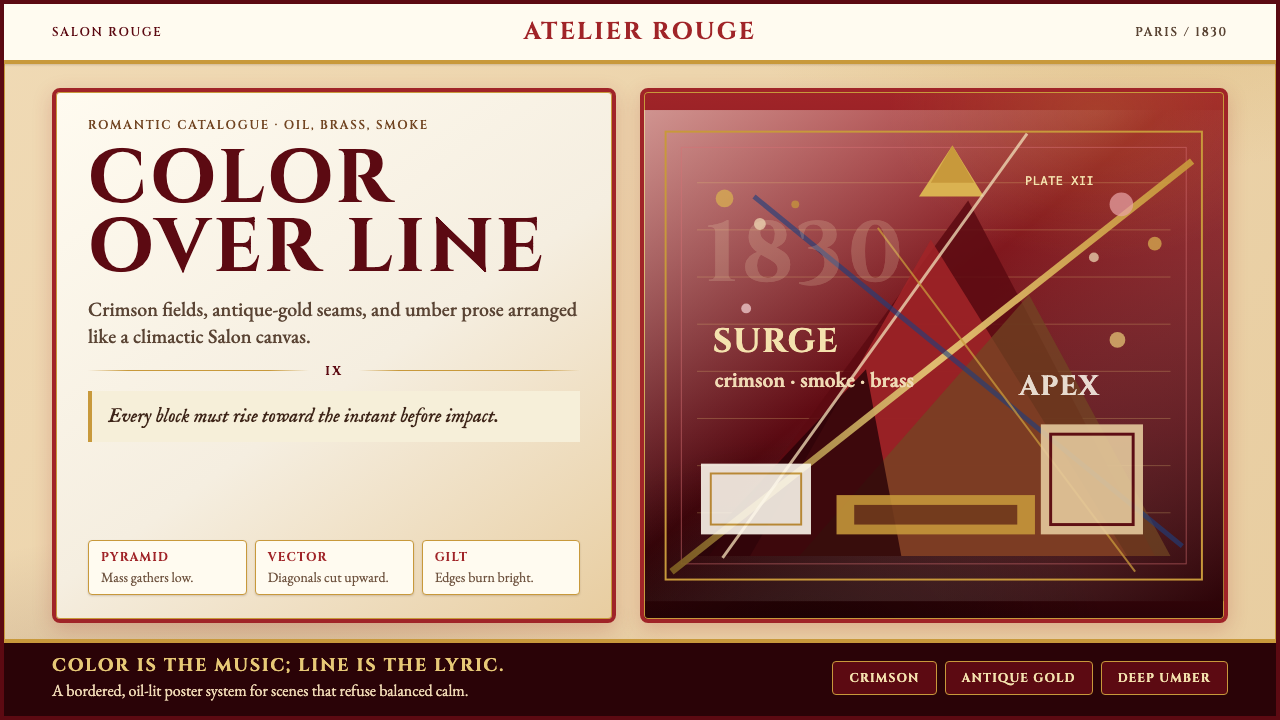 Delacroix French RomanticismOperatic color erupts. Crimson parchment, gilt borders, and diagonal pyramids…
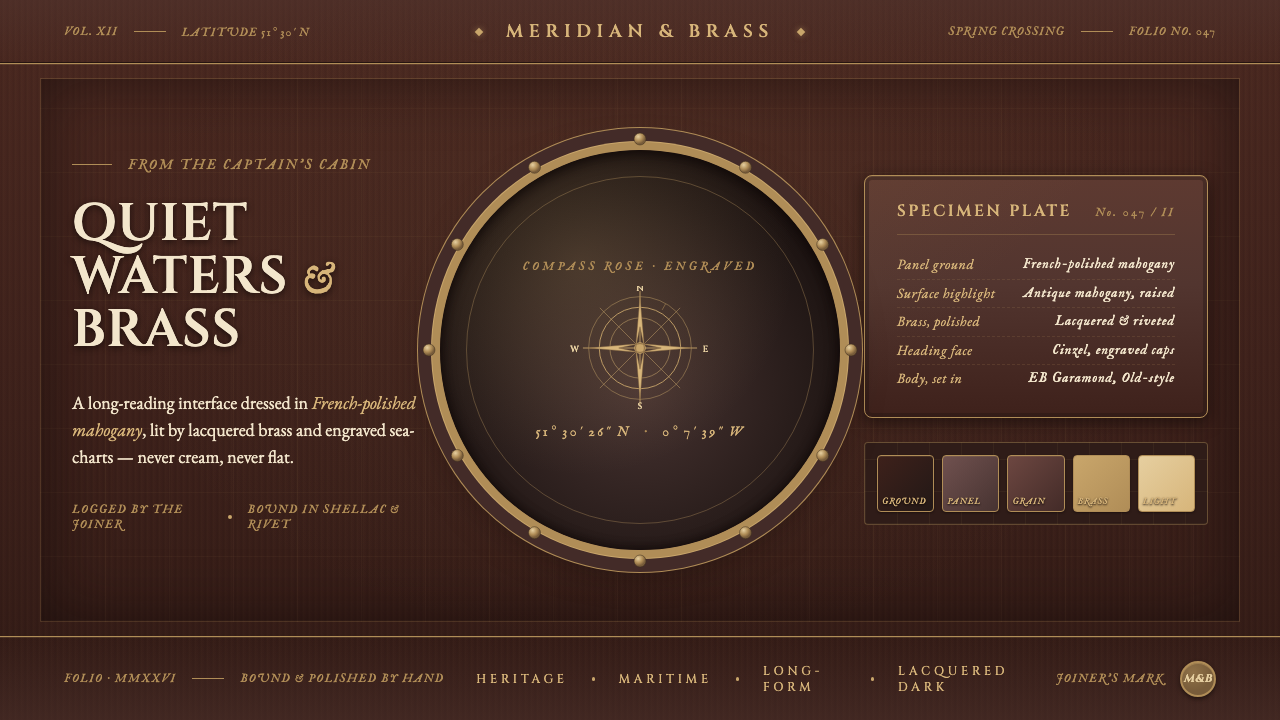 Mahogany Ship CabinPre-1900 maritime luxury. Mahogany panels, brass portholes, Cinzel caps over…
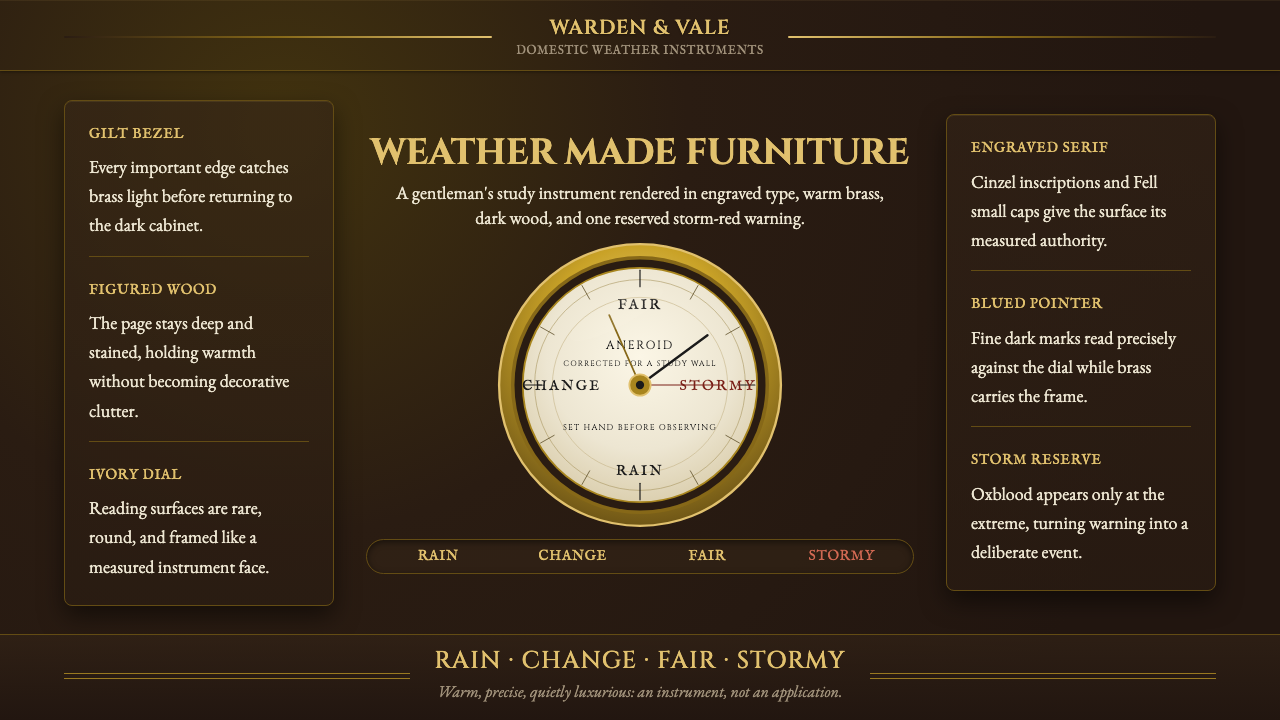 Aneroid BarometerMeasures weather as furniture. Gilt rings and Cinzel engraving glow on dark w…
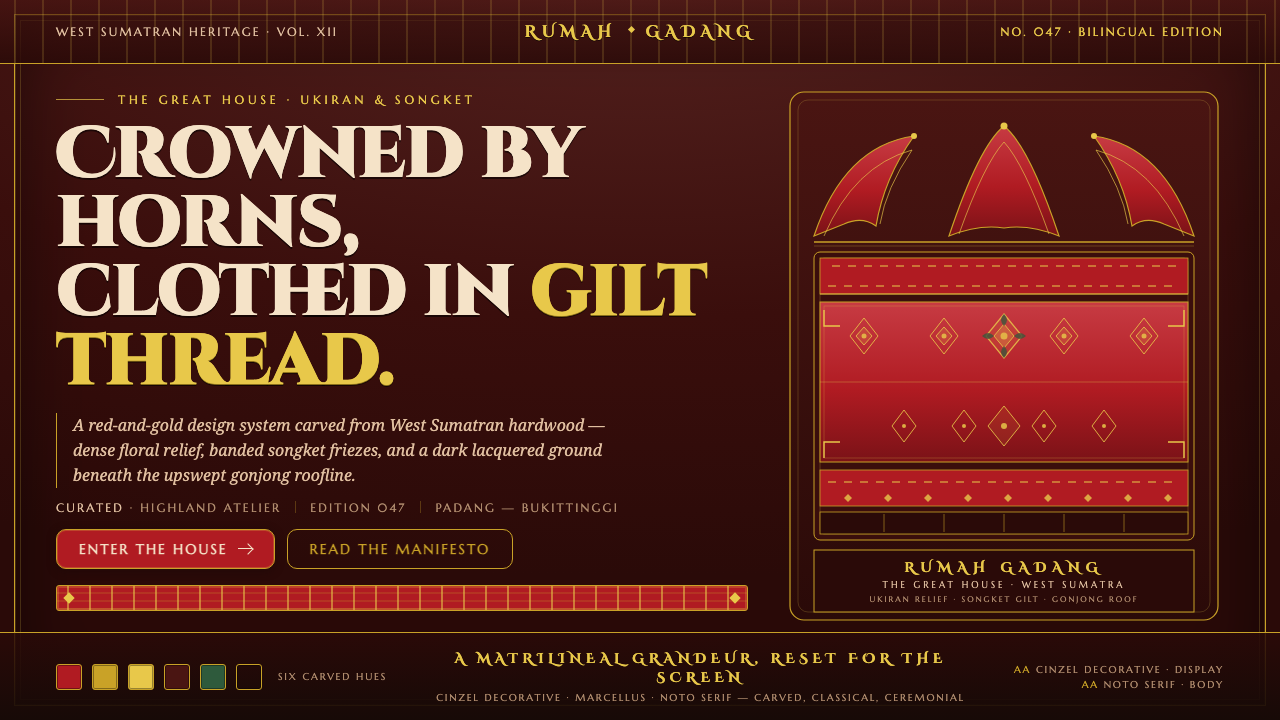 Minangkabau Rumah GadangMatrilineal grandeur, carved. Red-gilt ukiran relief on dark lacquered wood u…
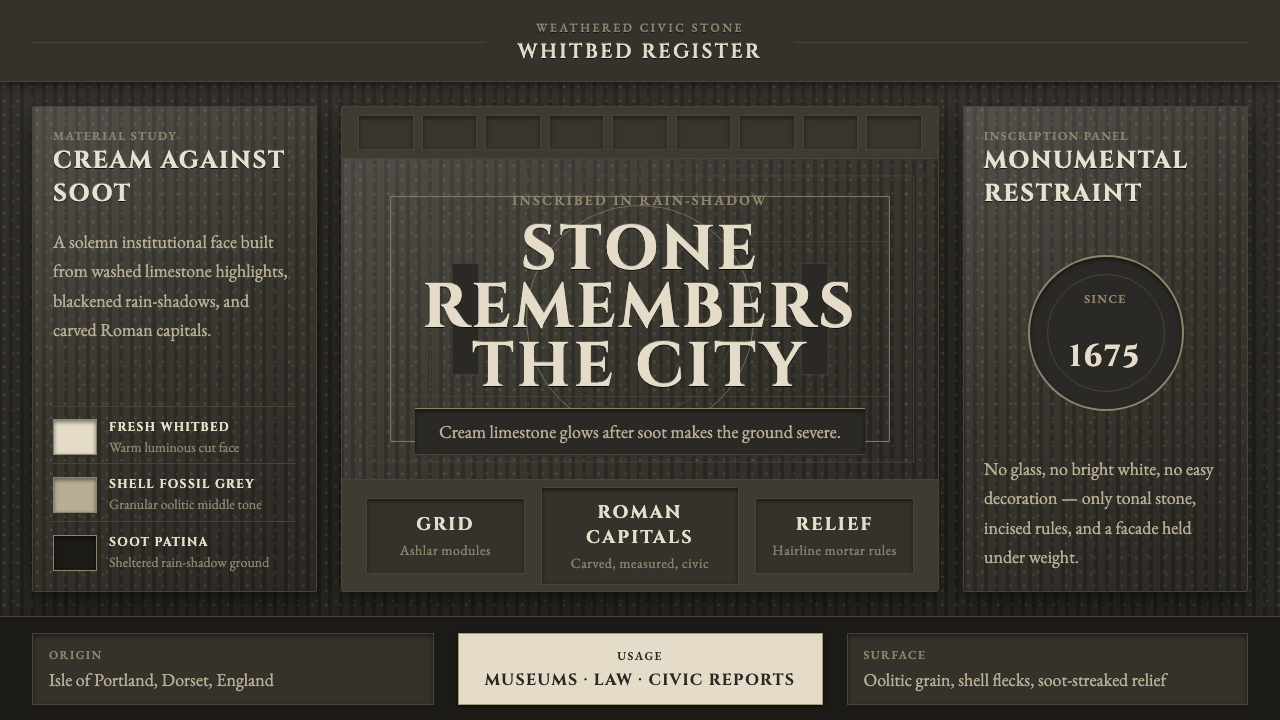 Portland Whitbed StoneCivic stone in shadow. Cream Cinzel capitals glow over soot-black ashlar grai…
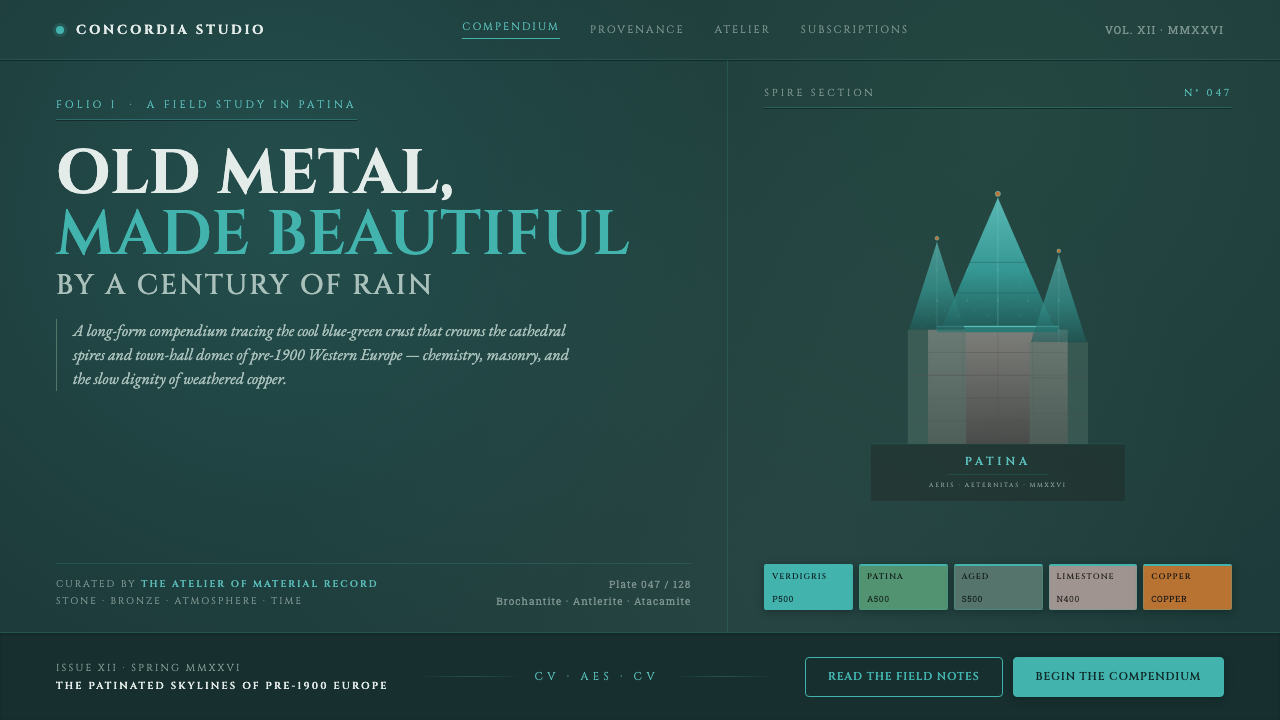 Verdigris Copper RoofOld metal made beautiful by decay. Cool cyan-green patina on dark teal, with…