What is Lindt Swiss Chocolate?
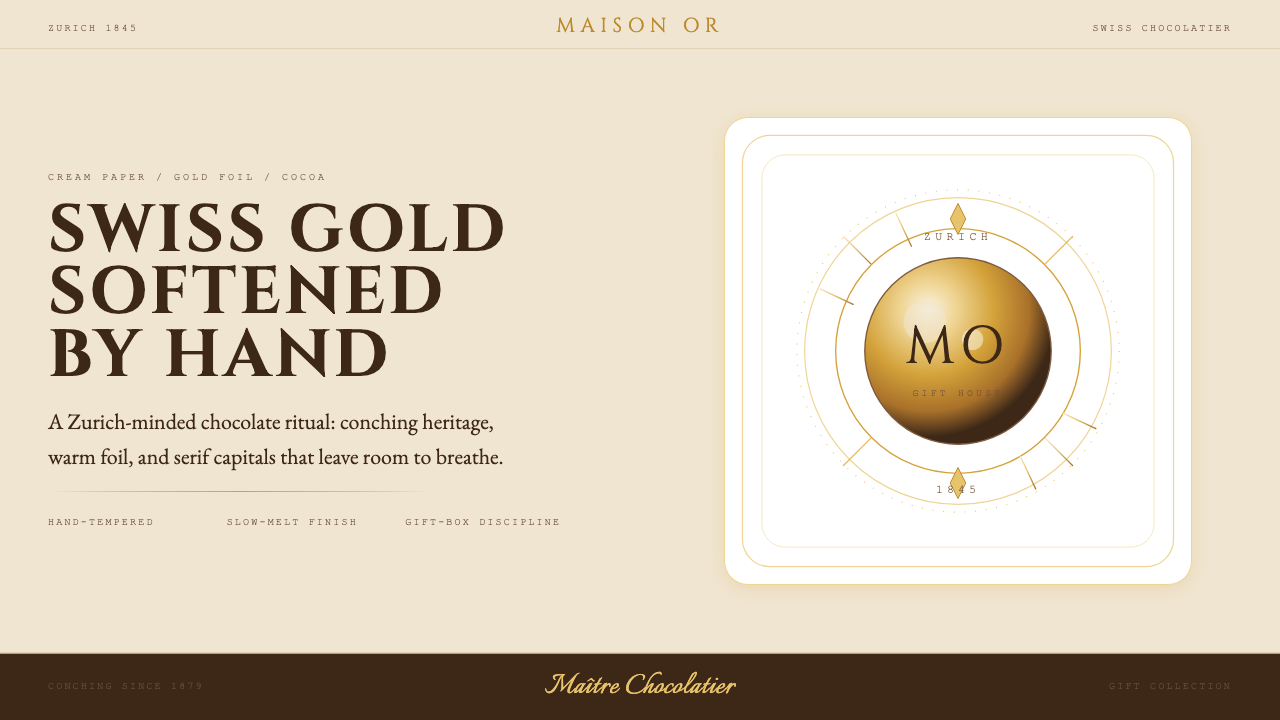
A century and a half of Swiss chocolate mastery distilled into warm gold foil, deep cocoa brown, and the unhurried confidence of cream paper — Lindt's visual identity is luxury made legible.
Lindt Swiss Chocolate in brief
The Lindt Swiss Chocolate design style is a visual system built on restraint and pedigree. Its palette anchors around three inseparable companions — a warm, burnished gold drawn from Lindor foil wrappers, a deep cocoa brown that carries the weight and richness of aged chocolate, and a cream paper ground that gives every composition room to breathe. These three tones are not merely colors; they are the material memory of a Swiss confiserie — the foil, the ganache, the parchment lining the box.
Typography in this aesthetic is classical and unhurried. Tall serif capitals set at generous letter-spacing evoke the engraved signage of an old Zurich shop front, signaling that what is being offered here is not a commodity but a craft. Hand-script flourishes appear as restrained ornamental gestures — a signature beneath a headline, a curl at the end of a product name — never overwhelming the composition but lending it the warmth of a master's handwriting on a recipe card. Thin gold filigree lines serve as section dividers, precise and delicate, the visual equivalent of the foil trim on a Lindor box.
The overall temperament of the style is what might be called 'disciplined Swiss luxury': every element earns its place on the page through purpose rather than whim. There is space without emptiness, ornament without excess, warmth without sentimentality. It is a design language that speaks in measured tones — confident enough in the quality of what it represents that it never needs to shout.

Where does Lindt Swiss Chocolate come from?
The story begins in Zurich in 1845, when David Sprüngli-Schwarz and his son Rudolf Sprüngli-Ammann opened a small confiserie on the Marktgasse, in the old city center. Switzerland at mid-century was already establishing its reputation for precision craftsmanship — in watches, in engineering, in the refined pleasures of the table. The Sprüngli confiserie positioned itself within this tradition, offering hand-made chocolates to a clientele that expected quality as a given rather than a luxury exception. The visual language of the early shop would have drawn on the signage and packaging conventions of nineteenth-century Swiss commercial elegance: engraved serif lettering, restrained gold detailing, and the unspoken authority of good materials honestly presented.
The defining technical event came in 1879, when Rodolphe Lindt, working in a small factory in Berne, accidentally discovered conching — a process of rolling and aerating chocolate over many hours that transforms a gritty, bitter mass into the smooth, melt-in-the-mouth texture that now defines premium chocolate worldwide. Lindt's conche, left running over a weekend by accident, had worked its slow alchemy on the chocolate inside. When the Sprüngli family acquired Rodolphe Lindt's factory and his conching patents in 1899, they did not merely buy a production method; they acquired the scientific foundation for a quality claim that would hold across generations. The merged company, Lindt & Sprüngli, was now in possession of both the heritage of a Zurich confiserie and the technical superiority of the conching master.
Through the twentieth century, the brand refined its visual identity in parallel with the premiumization of the global chocolate market. The Lindor truffle line, introduced in 1949, gave the brand its most iconic physical artifact — the foil-wrapped sphere whose gold (and later, color-coded) wrapping became instantly recognizable on shelves from Geneva to Tokyo. Gold became the master signal of the Lindt visual system: warm rather than metallic, burnished rather than bright, associated with craftsmanship rather than ostentation. The cream paper ground that supports Lindt's printed communications carries the same historical association — it recalls the unbleached paper of old apothecary wrappings and confiserie boxes, a material choice that reads as authenticity rather than economy.
The contemporary visual system — refined through roughly the 2020s — systematizes these historic associations into a coherent design language. Tall serif typefaces in the tradition of classical Swiss commercial lettering establish the typographic register. The gold, brown, and cream palette is held with unusual consistency across packaging, advertising, retail environments, and digital surfaces. The thin filigree rules and hand-script accents that appear as decorative gestures within this system trace directly to the engraved ornament of nineteenth-century European luxury packaging. What the contemporary system achieves is the difficult feat of keeping heritage legible without allowing it to calcify into pastiche — the Lindt aesthetic feels timeless rather than merely old.
What defines the Lindt Swiss Chocolate look?
Palette
The color system is anchored by three tones that function almost like a material specification rather than a chromatic choice. A warm, burnished gold — the visual memory of Lindor foil — holds the role that primary red holds in more assertive design systems: it signals value, draws attention, and anchors hierarchy. Deep cocoa brown provides gravitas and warmth, acting as a dark ground or heavy accent without the coldness of black. Cream paper — slightly off-white, with the warmth of aged parchment — serves as the default field, giving the composition space to breathe. Together, the three tones are self-sufficient: no additional colors are needed, and the introduction of unrelated hues would immediately dilute the system's coherence.
Serif Typography
The typographic register is classical and formal, rooted in the engraved letterforms of nineteenth-century European luxury commerce. Tall serif capitals set at wide letter-spacing — a convention drawn directly from the signage and label tradition of old Swiss confiseries — communicate that the product being offered has a history and a craft behind it. Headlines are set large and with deliberate breathing room; body text is treated with similar care for legibility rather than density. The typefaces chosen tend toward the old-style or transitional serif traditions: letterforms with bracketed serifs, moderate contrast between thick and thin strokes, and a humanist warmth that prevents the composition from feeling austere.
Hand-Script Accents
Where most luxury systems rely entirely on printed formality, the Lindt aesthetic introduces hand-script elements as controlled warmth. A cursive flourish beneath a product name, a flowing signature-style logotype, a calligraphic accent on a section header — these gestures recall the handwritten recipe cards and master chocolatier's notes of the old confiserie tradition. They are used sparingly: one such accent per composition is a rule of thumb, because the moment script competes with serif for attention, both lose authority. The hand-script element humanizes what would otherwise be a purely formal arrangement, adding the sense that a skilled person — not merely a printing press — stands behind the product.
Gold Filigree Lines
Thin ornamental lines in gold — single-stroke rules, delicate border frames, or filigree dividers — perform the structural role of separating content zones without interrupting the visual flow. In this system, the line is never a hard architectural boundary but rather a breath, a pause, a moment of precision between one thought and the next. These lines draw their lineage directly from the thin gold trim pressed into luxury chocolate box edges and the embossed borders of old European confectionery labels. Their thinness is as important as their presence: a line too heavy would impose rather than refine.
Generous Negative Space
One of the clearest markers of the Lindt aesthetic is the ratio of space to content. The system is not dense; it is unhurried. Headlines float with padding on all sides, paragraphs are set with leading that allows each line to be read without effort, and decorative elements are placed so they are experienced as accents rather than as pattern. This generosity of space is a confidence signal — it communicates that the brand does not need to crowd the composition with messages, that a single well-placed line of text is enough. In a marketplace full of visual noise, the discipline of leaving space is itself a form of luxury.
Material Warmth Over Coldness
Unlike the cool precision of, say, Swiss International Style or the sharp metallics of contemporary tech luxury, the Lindt system deliberately maintains warmth at every level. The gold is burnished rather than chrome; the cream is parchment-warm rather than clinical white; the brown is the warmth of good chocolate rather than the severity of black. Even formal elements — the serif capitals, the ruled lines — are selected and treated to retain a sense of hand-crafted quality rather than machine precision. The result is a system that reads as expensive but approachable, authoritative but not cold — the visual equivalent of a well-tempered piece of fine chocolate.
Heritage Restraint
Perhaps the most difficult quality to describe but the most important to understand: the Lindt visual system never overreaches. It does not attempt to be contemporary by borrowing current trends, and it does not attempt to signal heritage by layering on historical ornament. Instead, it holds a clear, consistent register that communicates confidence in its own continuity. The restraint is not minimalism — the gold lines and script accents make clear that decoration is not forbidden — but it is disciplined. Every element has a reason to be present, and every element knows its place in the hierarchy. This is the visual equivalent of the Maître Chocolatier Suisse tradition: mastery expressed through precision, not excess.

Who shaped Lindt Swiss Chocolate?
David Sprüngli-Schwarz founded the original confiserie in Zurich in 1845 alongside his son Rudolf, establishing the company that would eventually bear the Lindt name. His decision to open a quality chocolate shop in Zurich's old city center positioned the brand from its very first day within Switzerland's tradition of refined commercial craft — a positioning that the visual language of the brand still communicates today. The Sprüngli family's instinct for quality and their mercantile acuity in recognizing and acquiring Rodolphe Lindt's patents in 1899 were the two founding acts on which the modern brand rests.
Rodolphe Lindt is the technical genius behind the brand that carries his name. Working in Berne in 1879, Lindt discovered conching — the extended rolling and aeration process that gives fine chocolate its smooth, melt-in-the-mouth character — reportedly by leaving his conching machine running over a weekend by accident. The discovery was transformative: before conching, even the best chocolate had a gritty, rough texture; after, it became the refined confection that the word 'premium chocolate' now implies globally. When Lindt sold his factory and patents to the Sprüngli family in 1899, the combined entity acquired not just a production method but the scientific foundation for a quality claim that has sustained the brand for over a century.
Rudolf Sprüngli-Ammann co-founded the Zurich confiserie with his father David in 1845 and guided the business through its crucial early decades. His role was that of the capable commercial steward who translated his father's founding vision into a functioning and growing enterprise. It was under the watch of the Sprüngli family that the business developed the commercial instincts — the understanding of quality presentation, of the Swiss luxury market, of the relationship between material craft and visual communication — that would eventually make the Lindt & Sprüngli brand one of the most recognizable in global confectionery.
The Maître Chocolatier Suisse — the Swiss master chocolatier — is less a single figure than an institutional tradition that the Lindt brand has consistently invoked as its quality credential. The tradition holds that great chocolate is the product of sustained technical mastery: precise temperature control during tempering, the art of blending cacao origins, the patience of extended conching. Lindt's visual system implicitly references this tradition in its choice of formal serif typography, its use of hand-script accents resembling a master's signature, and its overall register of disciplined, unhurried quality. The tradition functions within the brand as a form of cultural authority — the visual equivalent of the appellation system in wine.
How do you use Lindt Swiss Chocolate today?
The Lindt Swiss Chocolate style is one of the more technically precise luxury aesthetics to apply correctly, because its effect depends not on bold primary-color contrast but on the quality of restraint — the calibration of space, the consistency of the three-tone palette, and the judicious deployment of script and filigree as accents rather than as pattern. Understanding these subtleties before applying the style is the difference between a convincing execution and a fussy, over-decorated composition that reads as luxury pastiche.
For presentation slides, the style works most effectively when it commits fully to the warm three-tone palette. A cover slide benefits from a single bold typographic statement in tall serif capitals set against a deep cocoa-brown ground, with the product or event name in cream or gold tones and a thin filigree rule as the sole decorative element. Content slides should be treated with similar restraint: wide margins, generous line spacing, section headers in serif caps at a clearly distinct size from body text. Data slides — charts, tables, timelines — should inherit the palette directly, with bars and segments rendered in the warm tones rather than in conventional charting colors. The result reads as a premium document that happens to contain data, rather than a data document with cosmetic surface treatment.
For web interfaces — particularly brand landing pages, premium e-commerce product pages, and editorial features — the style's cream ground, serif typography, and gold accent language translate directly into screen contexts. Navigation and header elements should be typographic and sparse, relying on well-set serif wordmarks and restrained gold rule accents rather than icon-heavy navigation bars. Pricing pages and feature comparison layouts benefit from the style's inherent hierarchy: a headline tier in tall serif caps, a supporting descriptive tier in smaller serif text, and a clear action element distinguished in warm gold. Dashboard and data-heavy interfaces are a less natural fit, but where the brand context demands them, maintaining the cream background and confining color only to the most critical interaction states will preserve the premium register.
For editorial and marketing work — print advertising, brand campaigns, packaging systems, event materials — the Lindt aesthetic is in its element. A brand campaign page using this system might alternate between cream-ground sections (where gold and brown type carry the content) and deep cocoa-brown sections (where cream and gold type reverse out), using the contrast between the two to create visual rhythm without introducing any additional hues. Packaging applications should maintain the three-tone discipline rigorously: the temptation to introduce product-differentiating colors must be managed through tone variation and filigree accent rather than chromatic expansion. Print advertising works especially well with wide negative space, a single large serif headline, and a small hand-script accent functioning as a visual signature.
A common mistake when applying this style is conflating luxury with ornamentation. The instinct when working with gold and script is to add more — more filigree, more flourishes, more decorative borders — until the composition tips from refined to cluttered. The Lindt aesthetic is specifically about luxury through discipline: each gold line, each script accent, each serif headline should be placed with the understanding that it is the only one of its kind in that composition. The filigree line divides once; the hand-script accent appears once; the gold tone is reserved for the most important element. Restraint is not the absence of decoration — it is the mastery of knowing when to stop.

Lindt Swiss Chocolate — FAQ
How does the Lindt style differ from other luxury chocolate brand aesthetics?
The Lindt system is distinguished by its three-tone discipline — gold, cocoa brown, and cream — and by its commitment to classical serif typography and hand-script accents as the primary vehicles of warmth. Competitors such as Godiva have historically leaned into rich jewel-tone palettes and heraldic imagery; Valrhona uses a darker, more austere professional register aimed at pastry chefs rather than consumers. Lindt occupies the middle ground: warmer and more approachable than a professional chocolate house aesthetic, more restrained and classically grounded than a confectionery brand that celebrates indulgence through visual abundance. The filigree line and the script accent are particularly distinctive — they trace directly to nineteenth-century Swiss commercial engraving traditions in a way that competitors rarely replicate convincingly.
Can this style work for non-food or non-luxury product categories?
Yes, but with important caveats. The warm three-tone palette and classical serif typography communicate heritage, craftsmanship, and premium quality — values that translate well into categories such as fine fragrances, premium skincare, financial services with a heritage positioning, boutique hospitality, and artisan goods of any kind. The style struggles in contexts that require technological credibility, youthful energy, or clinical precision — a fintech startup, a sportswear brand, or a medical device company would find the warm warmth and classical serif register working against their core positioning. The hand-script accents in particular are context-sensitive: in a fine fragrance campaign, they read as artisanal authenticity; in a software interface, they can undermine the credibility that digital tools depend on.
How should color be managed when product variants need visual differentiation?
This is one of the genuine tensions in applying the Lindt aesthetic to multi-SKU product systems. The system's strength — its three-tone discipline — is also its constraint when differentiation is needed. The recommended approach is to manage differentiation through tone and warmth within the existing palette rather than through chromatic expansion. A milk chocolate variant reads warmer, leaning into the cocoa brown; a dark chocolate variant leans cooler and deeper within the brown-to-near-black range; a white chocolate variant emphasizes the cream and gold tones. Where a category genuinely requires a distinct hue — as Lindor has done with its color-coded foil truffle range — the introduced color should be warm-toned, restrained in saturation, and used as a foil accent only, never as the dominant field color. The gold and cream structure of the overall system should remain legible above any product-level color coding.
Is the style appropriate for digital interfaces, or is it primarily a print and packaging aesthetic?
The style originated in and is strongest in tactile media — packaging, print advertising, retail environments — where the warmth of cream paper, the luster of gold foil, and the physicality of embossed filigree lines can be experienced directly. Translating it to screen requires compensating for the absence of material tactility. On digital surfaces, the cream background should be warm enough to read as parchment rather than white; gold should be muted and warm rather than metallic or high-saturation; the serif typefaces need to be chosen for screen legibility as well as classical authority. The hand-script accents work best on screen as logotype elements and headline signatures rather than as body-text decoration. The style is entirely viable for digital brand touchpoints — landing pages, e-commerce, brand social content — but demands more careful calibration on screen than in print because the absence of physical texture means the warmth must be carried entirely by color and typographic choices.
What is the single most common error when designers first attempt this style?
Over-scripting: using hand-lettered or cursive elements so liberally that the formal serif structure of the system is overwhelmed. The temptation is understandable — the hand-script accent is the most distinctive and expressive element of the visual system, and it is natural to want more of what is working. But the script derives its power entirely from contrast with the formal serif typography and the precise gold filigree. Use it twice on a composition and it becomes wallpaper; use it three times and the composition reads as a generic 'fancy food' aesthetic that has no particular association with Swiss chocolate heritage. The Lindt aesthetic is built on the interaction between the formal and the human, the precise and the warm, the classical and the personal — and that interaction requires that each element respect the other's space.
Related design styles
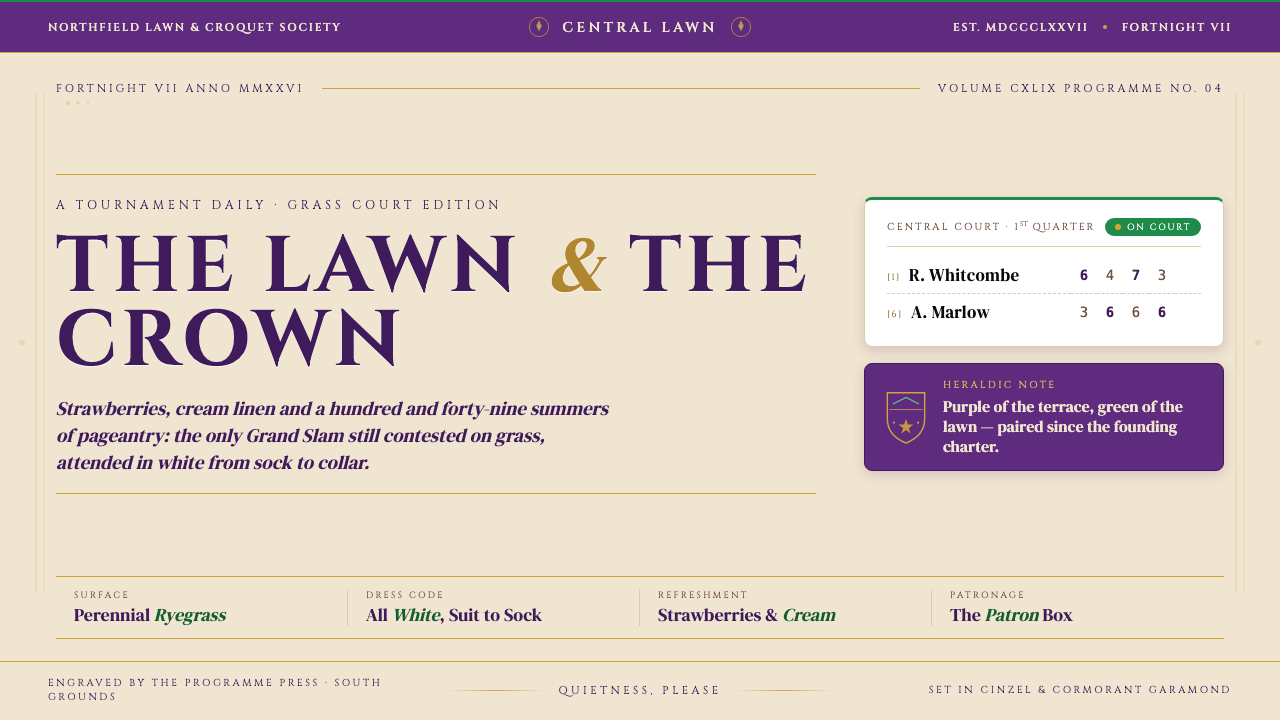 Wimbledon (Purple-Green)Centre Court in tokens. Regal purple and grass-green crest, cream linen, Cinz…
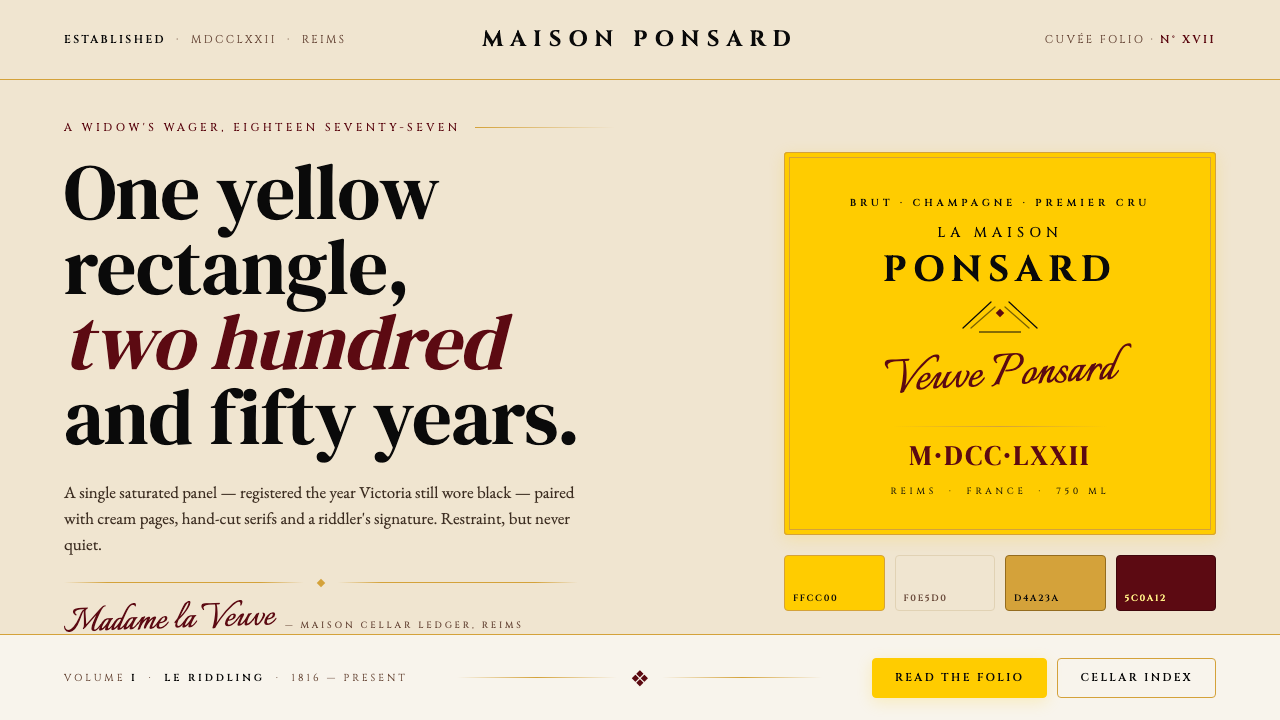 Veuve Clicquot (Yellow-Label)One audacious yellow rectangle, 250 years. Pantone yellow on cream, Cinzel se…
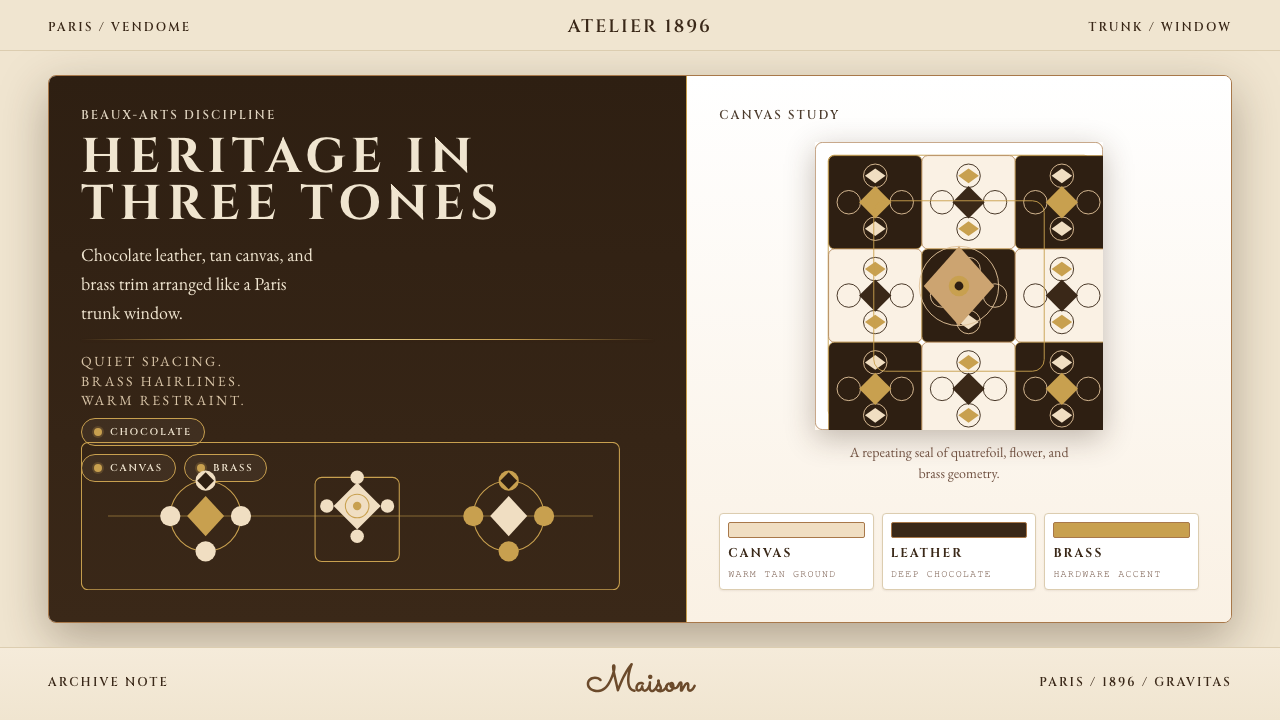 Louis Vuitton MonogramHeritage stays luminous. Chocolate, tan, and brass stage a Paris trunk window.
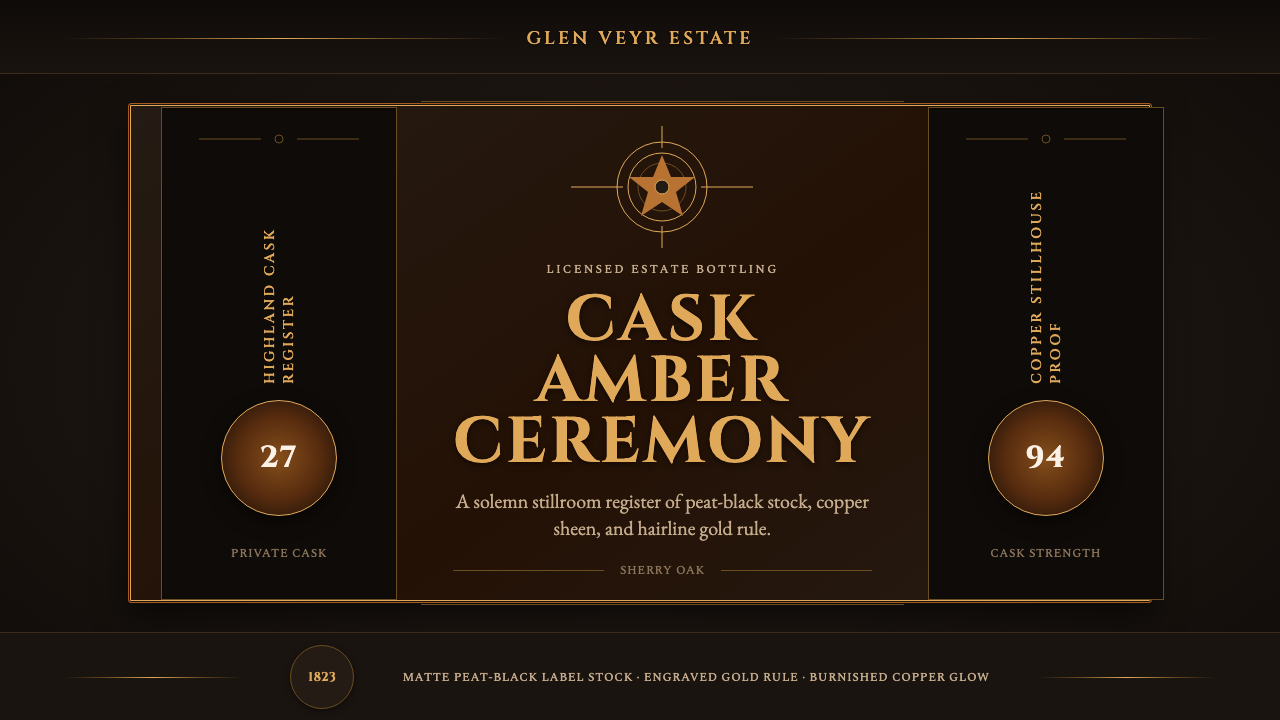 Single Malt ScotchSolemn amber gravity. Thin gold rules and Cinzel capitals glow on peat-black.
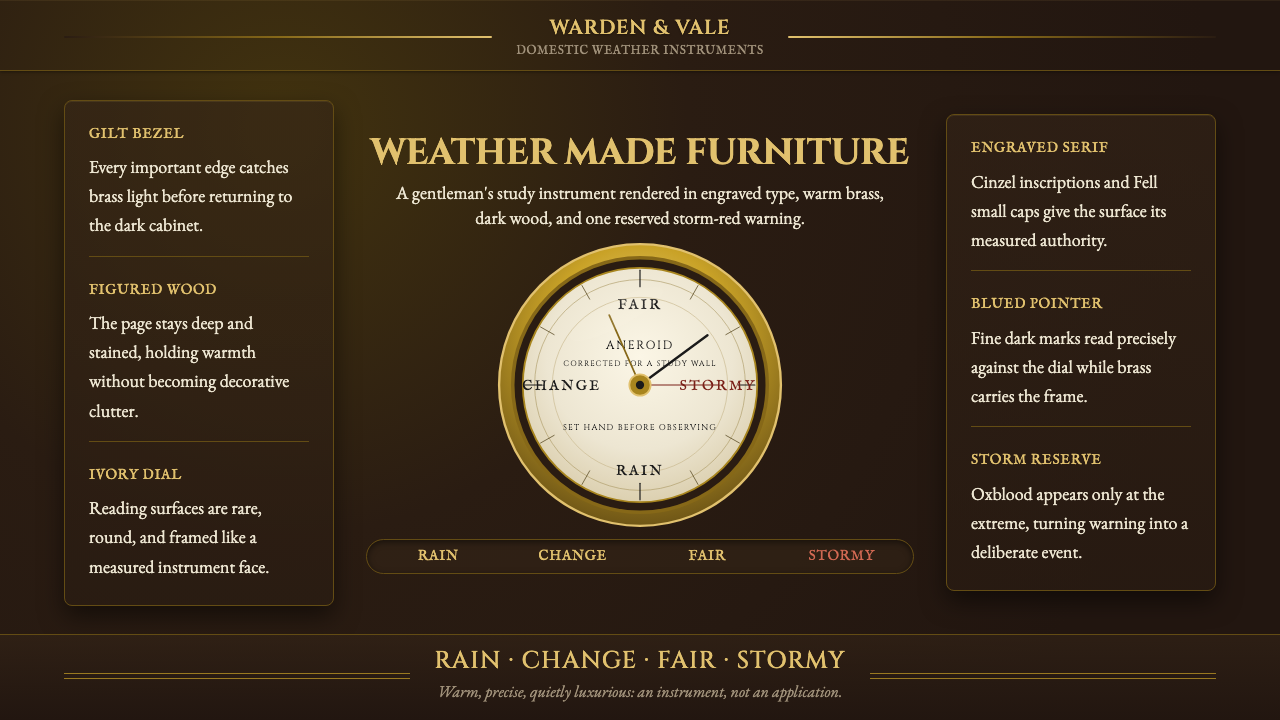 Aneroid BarometerMeasures weather as furniture. Gilt rings and Cinzel engraving glow on dark w…
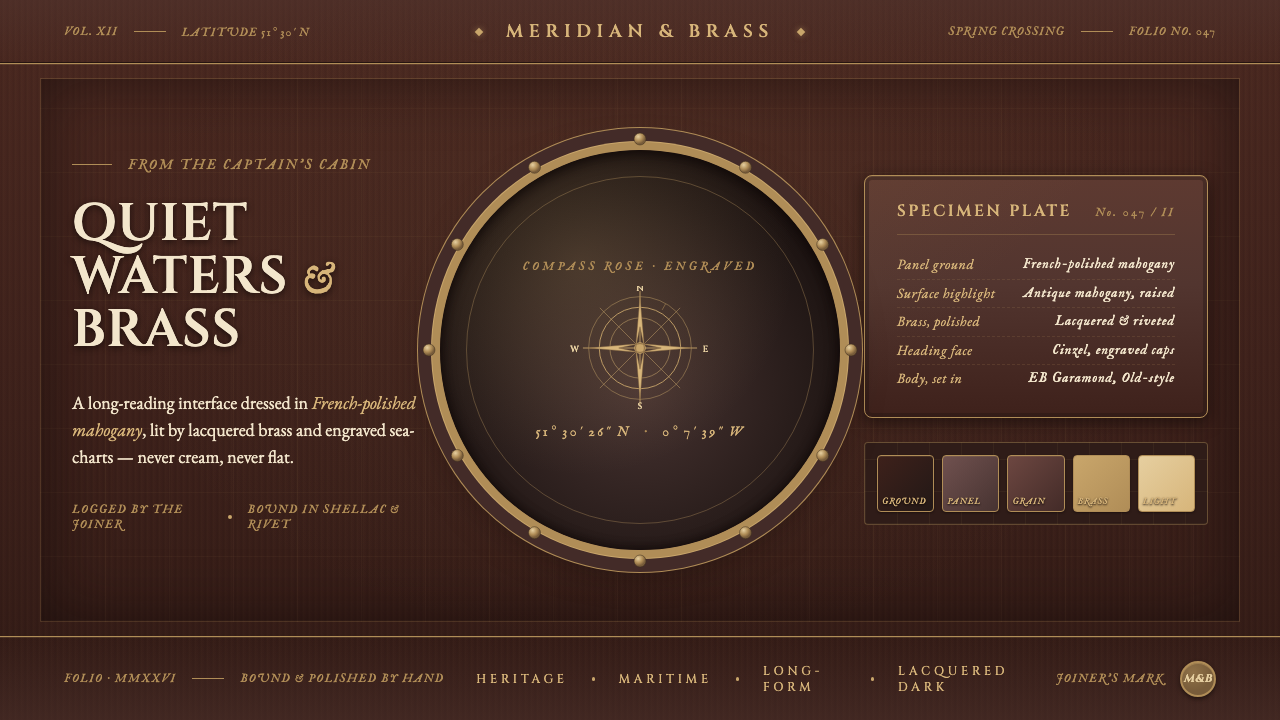 Mahogany Ship CabinPre-1900 maritime luxury. Mahogany panels, brass portholes, Cinzel caps over…