What is Wimbledon (Purple-Green)?
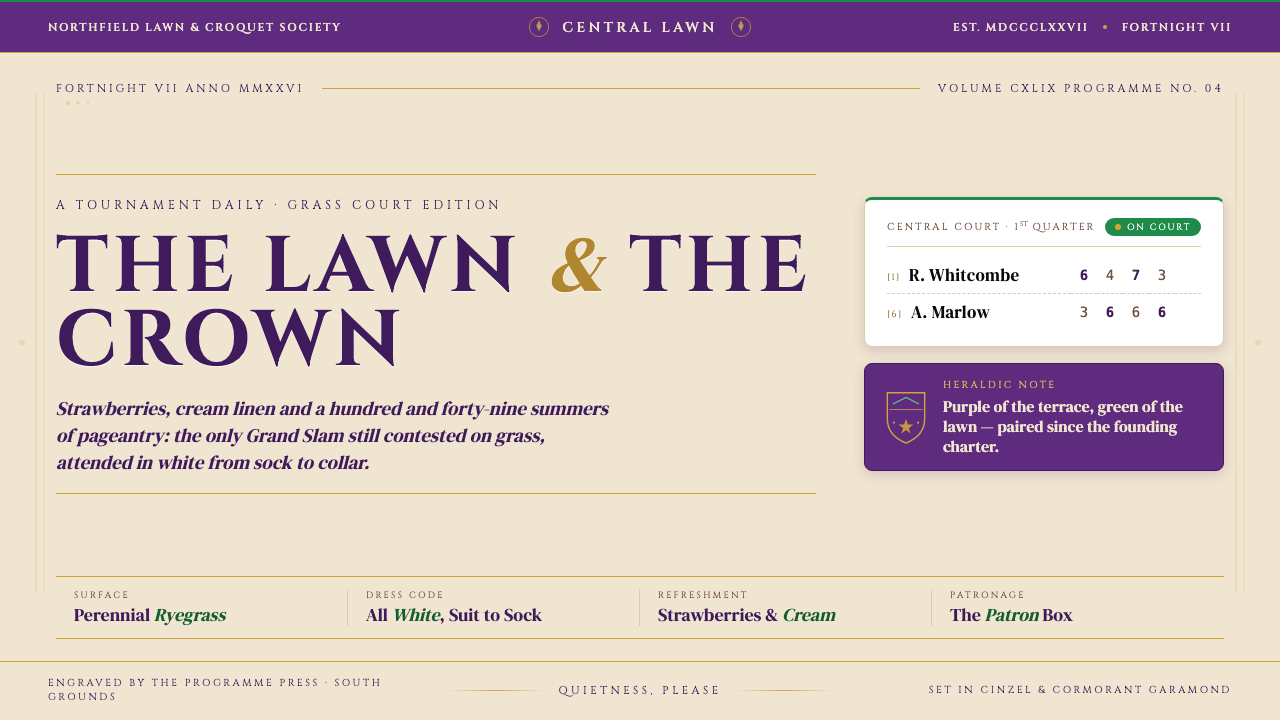
Wimbledon's visual identity is 147 years of British ceremony compressed into regal purple, grass-court green, and hushed cream — a design language that feels less like branding and more like protocol.
Wimbledon (Purple-Green) in brief
Wimbledon's design language is the visual expression of lawn tennis's oldest and most ceremonious Grand Slam. Founded in 1877 at the All England Lawn Tennis and Croquet Club (AELTC) in the London borough of Merton, the tournament has maintained a consistent aesthetic identity for nearly a century and a half — one built on saturated regal purple, the vivid green of its grass courts, warm cream linen, and restrained gold accents. The result feels less like a designed brand system and more like an inherited heraldic canon.
Where many sports brands chase modernity, Wimbledon moves in the opposite direction: continuity is the value. The all-white player dress code — strictly enforced since the Victorian era — is mirrored in the visual system's preference for clean grounds, unhurried spacing, and a palette that never shouts. Serif type carries the identity's weight; a roman letterform with inscriptional gravity handles display duties, while a refined editorial serif handles running text. Gold filigree dividers and bordered panels reinforce the sense of a tournament that considers its own history a living document.
The result is an aesthetic with a very specific emotional register: heraldic, ceremonious, hushed. It signals tradition rather than disruption, prestige rather than accessibility, and patience rather than urgency. Applied well, it confers authority on anything it touches — a scoreboard, a programme, a website header. Applied carelessly, it can tip into pastiche of English nostalgia. The discipline lies in understanding what the system is protecting, not just what it looks like.

Where does Wimbledon (Purple-Green) come from?
The All England Lawn Tennis and Croquet Club held its first Championship meeting in July 1877 — initially conceived as a fundraiser to repair a broken pony roller on the croquet lawn. Twenty-two men entered the singles draw; about two hundred spectators attended. The winner was Spencer Gore, a rackets player who had never previously competed seriously in lawn tennis. The prize was twelve guineas and a silver challenge cup. What began as a one-day club fixture would, over the following decades, evolve into the sport's most revered institution.
The tournament's visual character solidified gradually over the late nineteenth and early twentieth centuries, shaped by the aesthetics of British Victorian and Edwardian sporting pageantry. The AELTC's colors — a particular saturated purple paired with a vivid, almost heraldic green — became the club's official palette and were applied to everything from member ties and blazers to the painted woodwork of Centre Court's famous covered stands. The cream ground, drawn from the warm white of traditional lawn tennis clothing, completed the three-note palette that remains canonical today. Gold was introduced as an accent drawn from the trophies themselves: the gentlemen's singles trophy, a silver gilt challenge cup, and the ladies' singles trophy, the Venus Rosewater Dish.
The architectural and typographic sensibility of Wimbledon's visual identity owes much to the classical traditions of British institutional design. Inscriptional roman letterforms — the kind carved into stone memorials and engraved on silver plate — have always governed the tournament's display typography, lending the aesthetic a gravity that photographic or hand-drawn alternatives would not achieve. This tradition connects Wimbledon's visual language to a broader lineage of British formal design: the typefaces of the Bank of England, the headed paper of the Lord Chamberlain's Office, the signage of the Royal Household.
The twentieth century brought modernization without transformation. Television coverage from the 1950s onward required the visual identity to function at new scales and in new media, but the AELTC consistently resisted the temptation to refresh the palette in favor of trendier or more legible alternatives. Broadcasting introduced the famous purple and green on-screen graphics, queue wristbands, and the Championship's distinctive scoreboard aesthetic — all of which reinforced rather than diluted the established visual canon. By the time global sports branding became a professional discipline in the 1990s and 2000s, Wimbledon's identity was already so thoroughly naturalized that it required no reinvention. Its age was its equity.
What defines the Wimbledon (Purple-Green) look?
Color
The palette is a strict three-color system: saturated regal purple, vivid grass-court green, and warm cream, with gold reserved for accent and black for type. The purple and green function as equals — neither dominates the other, and together they create the heraldic contrast that defines the visual identity. Cream grounds soften the collision and keep the overall register from feeling confrontational. Gold appears only in deliberate moments — dividers, rules, crests — never as a fill or background. The palette's restraint is its most defining quality: secondary or tertiary colors are essentially absent.
Typography
Serif type dominates at every scale. Display-level text calls for a letterform with inscriptional weight — the kind of roman serif associated with carved stone and engraved plate, which brings centuries of institutional authority to a tournament name or section heading. Body copy uses a refined editorial serif with generous proportions and strong stroke contrast — readable at small sizes but elegant at large ones. All-caps setting is used frequently for headlines and labels, reinforcing the formal register. Letter-spacing at display sizes is traditionally open, giving each character room to breathe like an engraved character on silver.
Ornament and Detail
Unlike the strict zero-ornament philosophies of modernist traditions, Wimbledon's visual language embraces deliberate, historically-grounded ornament. Gold filigree dividers, thin ruled borders, and crested panel headers are all part of the canonical vocabulary. These ornamental elements are always restrained in quantity — one ruled line suffices where a lesser system might use three — and always rooted in heraldic or classical British typographic tradition. The ornament earns its place by reinforcing the sense of ceremony; anything purely decorative without historical grounding is still absent.
Spacing and Proportion
Layouts breathe. Generous white space — or cream space — surrounds every major element, reflecting the unhurried register of the tournament itself. Text columns are set at comfortable reading measures with ample leading; panels and cards give their contents room to settle. Margins are wide and intentional. Nothing is crowded. This spatial generosity is not inefficiency — it is the visual equivalent of the queue at Wimbledon: orderly, patient, deliberate. Compressed layouts feel immediately wrong in this system, regardless of color fidelity.
Texture and Ground
Cream rather than pure white is the characteristic ground tone, introducing a warmth that pure digital white cannot replicate. The reference point is physical — linen, laid paper, the programme in your hand at Centre Court — rather than screen-native. In digital applications, this warmth is typically achieved through an off-white background that reads as cream in context. The green of the grass courts also carries texture associations: it is a saturated, living color rather than a flat corporate green, recalling close-cropped turf at its July peak.
Hierarchy and Formality
The visual hierarchy in Wimbledon's aesthetic is unambiguous and consistently formal. Titles are always clearly superior to subtitles; player names are set distinctly from match data; tier distinctions — member, debenture holder, public — are communicated through specific color and typographic registers rather than vague gradation. This clarity of hierarchy reflects the tournament's institutional structure, in which every role, every gate, and every seat has a precise designation. Ambiguity of rank is not a design value here.
Restraint and Absence
What Wimbledon's visual system does not contain is as defining as what it does. There are no loud photographic backgrounds, no animated transitions competing for attention, no gradients filling purple panels, no display of anything beyond what the occasion requires. This discipline of absence is how the aesthetic preserves its atmosphere across applications. A scoreboard, a courtside banner, a website — each restrains itself in the same way, so the cumulative effect is a consistent sense of ceremony rather than a fragmented collection of touchpoints.

Who shaped Wimbledon (Purple-Green)?
The AELTC's successive committees have been the stewards of Wimbledon's visual identity across nearly a century and a half. Their most consequential design decision is arguably one of conservation rather than creation: maintaining the purple and green palette and the all-white dress code through successive eras of sporting fashion when commercial pressure would have justified updates. By treating the visual identity as an institutional inheritance rather than a brand asset, the committee ensured that Wimbledon's aesthetic authority deepened rather than depreciated over time.
Borg's five consecutive Wimbledon titles between 1976 and 1980 made him the tournament's defining modern icon during the era when televised sport began constructing global design languages around star athletes. His stoic, aristocratic court presence — floppy hair, headband, white Fila kit — became inseparable from the Wimbledon aesthetic in global public consciousness. The image of Borg on Centre Court is one of the clearest early examples of an athlete functioning as a living embodiment of a visual identity system.
Federer's eight Wimbledon titles (2003–2017) span precisely the period in which global sports branding became a sophisticated design discipline. His association with the tournament did more than any marketing campaign to reinforce the values embedded in Wimbledon's visual identity — elegance, precision, historical self-awareness — at a moment when those values were under pressure from more aggressive, disruption-oriented sports aesthetics. His on-court comportment served as a kind of editorial standard for what the visual identity was communicating.
Williams's seven Wimbledon titles (2002–2016) demonstrate how Wimbledon's strict aesthetic framework functions as a counterpoint to individual expression rather than a suppressor of it. The all-white dress code and the formality of the grounds become, paradoxically, the stage that makes individual excellence more legible. Williams's presence on Centre Court showed that the visual system's restraint amplifies rather than constrains the figures it frames — a lesson applicable to any design context where a strong system and strong content must coexist.
As the winner of the inaugural 1877 Championship, Gore is the figure at the origin point of the Wimbledon visual tradition — not as a designer but as proof of the aesthetic's foundational continuity. The silver challenge cup he was awarded in 1877 established the gold-and-silver accent palette that persists in the visual identity today; the cream-white dress he wore established the ground color of the canonical palette. His presence anchors Wimbledon's design language to a specific historical moment rather than a later act of branding.
How do you use Wimbledon (Purple-Green) today?
The Wimbledon aesthetic is one of the most context-specific historical design languages available to contemporary practitioners. Its authority derives from the specificity of its references — British ceremony, lawn tennis heritage, Victorian institutional formality — and applying it well means understanding which contexts legitimately share those associations and which are simply borrowing prestige without coherence. The style works where gravitas, tradition, and deliberate unhurriedness are genuine product values, not decorative claims.
For presentation slides, the Wimbledon palette works best when treated as a full system rather than a color choice. A cover slide should establish the heraldic register immediately: purple panel with cream type and a gold ruled border, or a cream ground with purple and green as structural accents anchoring a tournament-style typographic composition. Content slides should be built on generous margins and clear hierarchy — a dominant heading in an inscriptional serif, body text at a comfortable reading size, and section markers indicated by a thin gold or green rule rather than a colored block. Data slides in this system become scoreboard-like: clean rows, tight labels, numbers in an authoritative serif. The system collapses if overcrowded; every slide should feel like it has room to breathe.
For web interfaces, the style suits contexts where prestige and trust are primary values: premium membership platforms, financial services with a heritage positioning, institutional or cultural organizations. The approach requires a cream or warm off-white background as the default ground, with purple and green reserved for interactive states, navigation highlights, and primary action elements. Typography should be consistently serif across both display and body scales. Dashboards in this system work well for data that benefits from a calm, authoritative presentation — analytics platforms, portfolio trackers, event management tools. Pricing pages should use the color hierarchy deliberately: the recommended tier highlighted in the darker purple, alternative tiers in green or cream, so the visual system does the persuasive work without aggressive contrast.
For editorial and marketing applications, the style's poster-like formality is an asset. Feature pages and article headers benefit from the full palette deployed boldly: a cream ground with a large purple header panel, green used for pull-quote emphasis or byline markers, and gold for the horizontal rules that separate major sections. Marketing materials — event invitations, programme covers, announcement graphics — should commit fully to the all-caps serif headline treatment and bordered-panel structure that give the aesthetic its distinctive ceremonial register. Resist the temptation to modernize with rounded elements or playful type; every informal gesture reads as an error of register in this system.
A common mistake when applying this style is reaching for all three palette colors simultaneously at high intensity across a layout. The Wimbledon visual canon is disciplined about color relationships: purple and green appear together most powerfully when one is used as a ground and the other as a figure, never both as fills competing at the same visual weight. Similarly, the cream is not a passive neutral — it is the primary ground, and replacing it with pure white or a light grey undermines the warmth that makes the palette feel heirloom rather than corporate. The other persistent error is typographic: mixing a decorative serif with a sans-serif body defeats the system's logic entirely. Commit to one serif family at multiple weights, and let spacing and scale carry the hierarchy.

Wimbledon (Purple-Green) — FAQ
Can the Wimbledon palette work for technology products, or is it too heritage-specific?
It can work, but the context must carry the weight. The palette's association with heritage and ceremony is an asset when the technology product is positioning around trust, longevity, or institutional credibility — financial data platforms, legal technology, premium membership services, archival tools. It becomes a liability when the product values disruption, accessibility, or youthful energy, because the aesthetic signals the opposite of those things. The key test is honest: does the visual heritage of this palette align with the actual values the product is trying to communicate? If the answer requires explanation, the palette is probably wrong for the application.
How do I distinguish Wimbledon-style design from generic British heritage pastiche?
The distinction is in specificity and discipline. Generic British heritage pastiche typically uses green and cream in softer, more desaturated tones, favors script typefaces or casual serif alternatives, and layers texture and illustration liberally. Wimbledon-derived design is precise in its colors — the purple is saturated and specific, the green vivid — and strict in its typography, insisting on a roman inscriptional serif rather than anything warmer or more approachable. The gold accent is deployed sparingly as a functional divider, not as decoration. When every ornamental decision can be traced to a specific heraldic or institutional precedent, the result reads as authentic; when ornament is applied for atmosphere alone, it reads as pastiche.
Does Wimbledon's visual style work in dark mode?
A dark inversion is possible but demands significant care. The canonical palette is light-ground — cream and white with color accents — and a straight inversion to a dark purple or near-black background inverts the hierarchy in ways that can feel funereal rather than regal. A better approach for dark-mode applications is to use the deepest purple as the primary background, introduce cream as the primary text color (which reads as warm against deep purple), and use the green and gold sparingly as accent and highlight. The result preserves the palette's heraldic associations while functioning credibly in dark contexts. Avoid reducing the purple to a grey-dark background that strips the color identity entirely.
How should photography and imagery be handled within this visual system?
Photography works best when it is treated as a document of the occasion rather than an expressive element competing with the color system. Court-level photography — close-cropped, high-contrast, with the green of the grass and the white of the clothing as dominant tones — integrates naturally with the palette. Posed or studio photography should be handled carefully: highly retouched or stylized imagery tends to read as out of register. An effective approach is to apply a mild warm-toned treatment to photography that echoes the cream ground, unifying image and layout without heavy filtration. Imagery that introduces saturated colors outside the palette — particularly warm reds or blues — should be avoided, as they compete with the purple and green for visual priority.
What are the most common mistakes when trying to apply this style?
The first and most common is using the purple and green at full saturation side by side at the same scale, which creates visual competition rather than heraldic contrast. The palette works through hierarchy: one color leads, the other supports. The second mistake is substituting a warm-toned sans-serif for the required roman serif, in the belief that the color palette alone carries the identity — it does not. Typography is roughly half the aesthetic. Third is crowding: this is a system that requires generous negative space to maintain its register, and dense layouts immediately read as inconsistent with the style's values. Finally, many practitioners add softness — rounded corners, drop shadows, gradients — in an attempt to modernize the system, which instead removes the very elements that give it its authority. The style is not harsh, but it is precise. Precision should not be confused with rigidity; it should be understood as care.
Related design styles
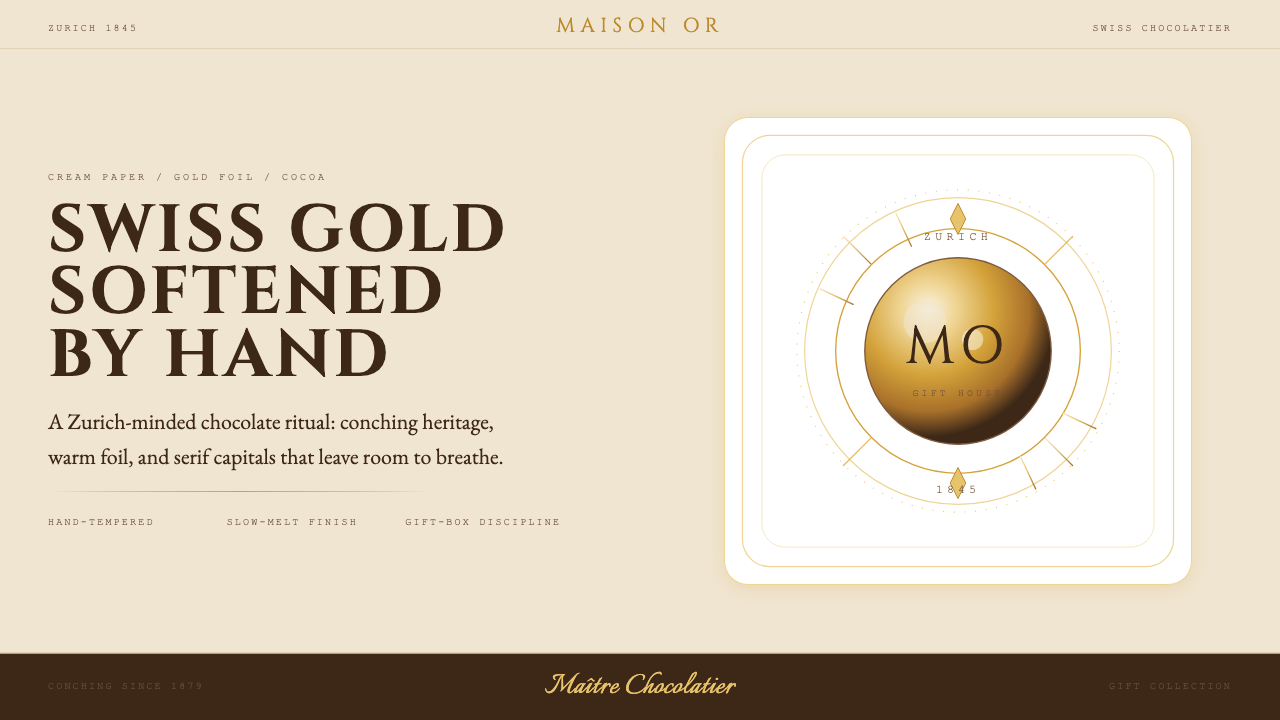 Lindt Swiss ChocolateOld-world luxury, softened. Gold foil, cocoa brown, and cream paper carry the…
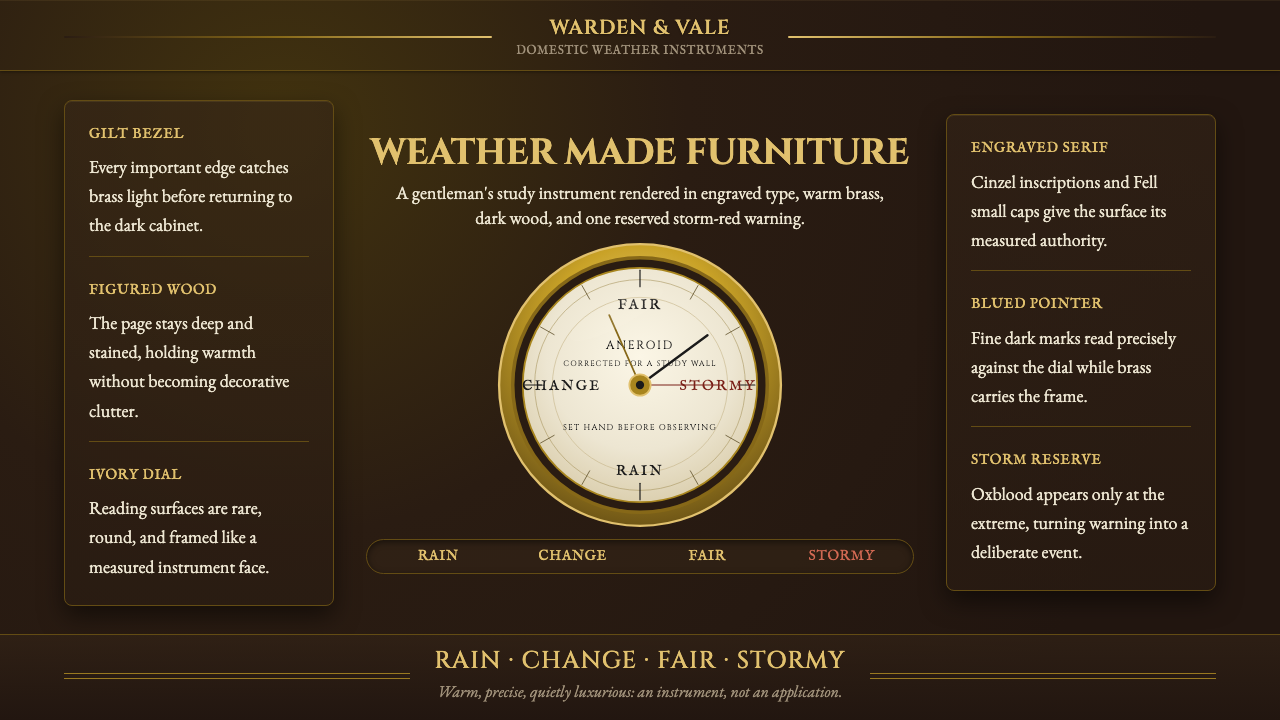 Aneroid BarometerMeasures weather as furniture. Gilt rings and Cinzel engraving glow on dark w…
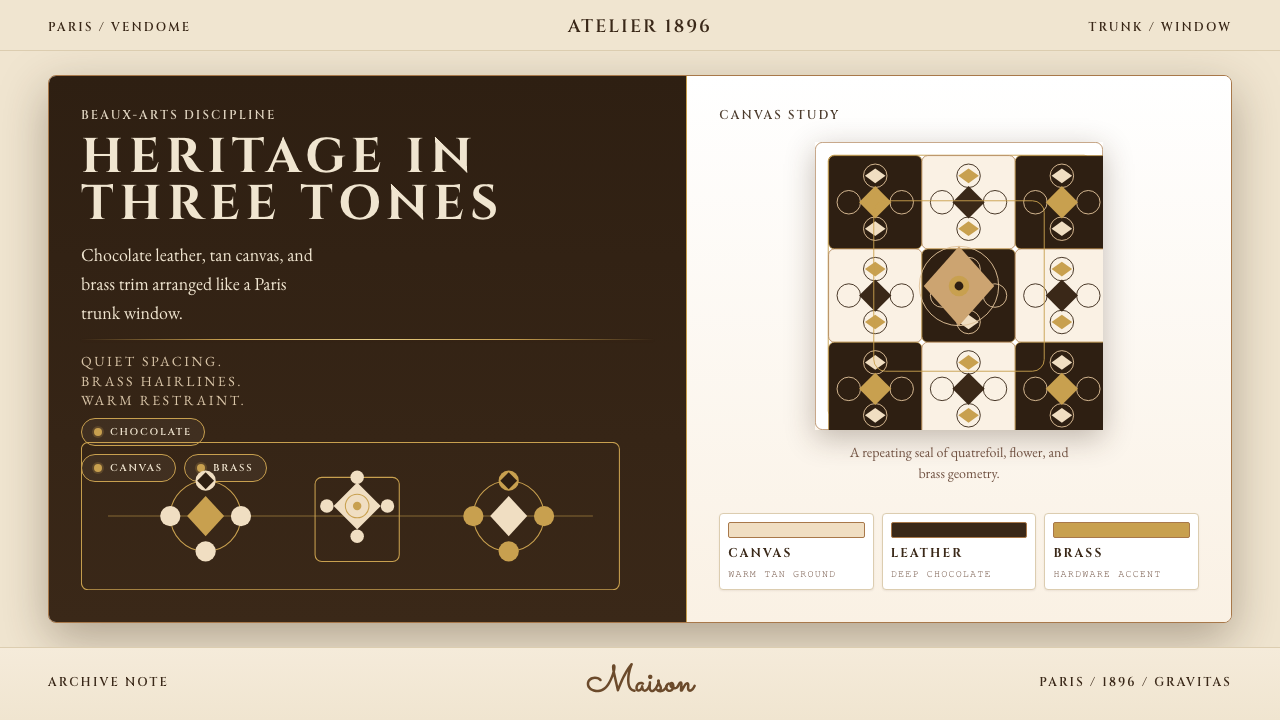 Louis Vuitton MonogramHeritage stays luminous. Chocolate, tan, and brass stage a Paris trunk window.
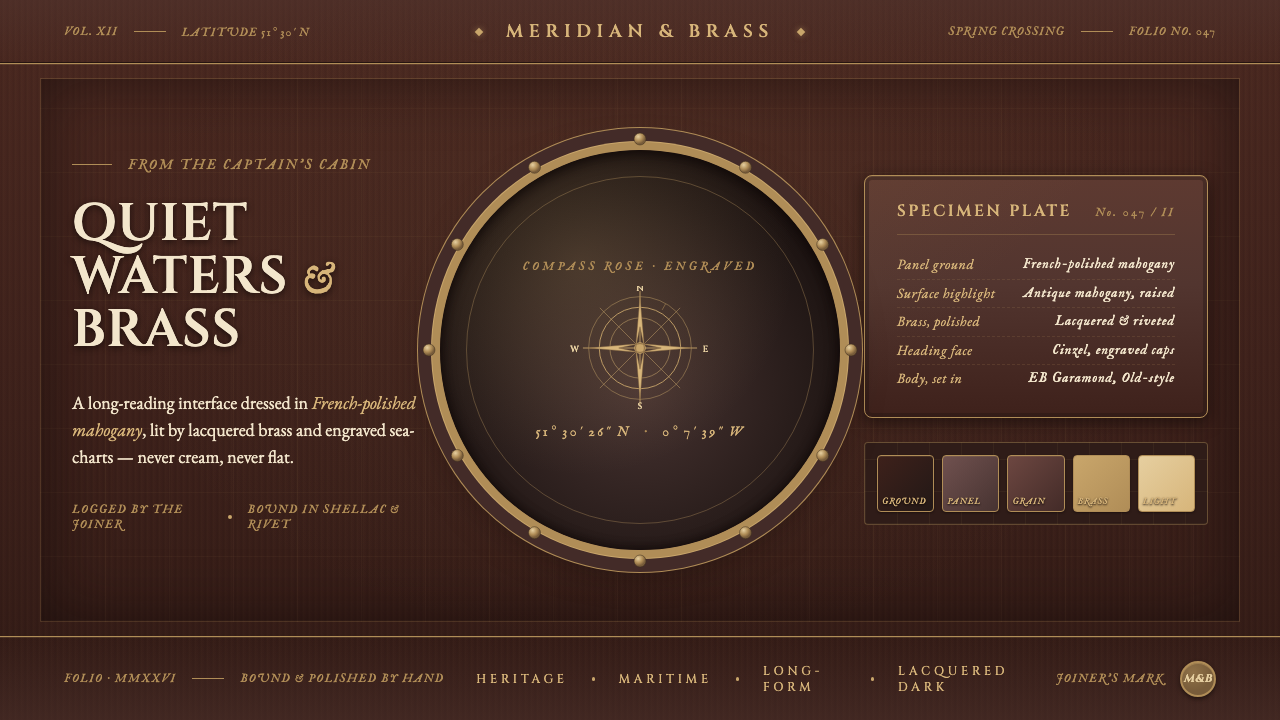 Mahogany Ship CabinPre-1900 maritime luxury. Mahogany panels, brass portholes, Cinzel caps over…
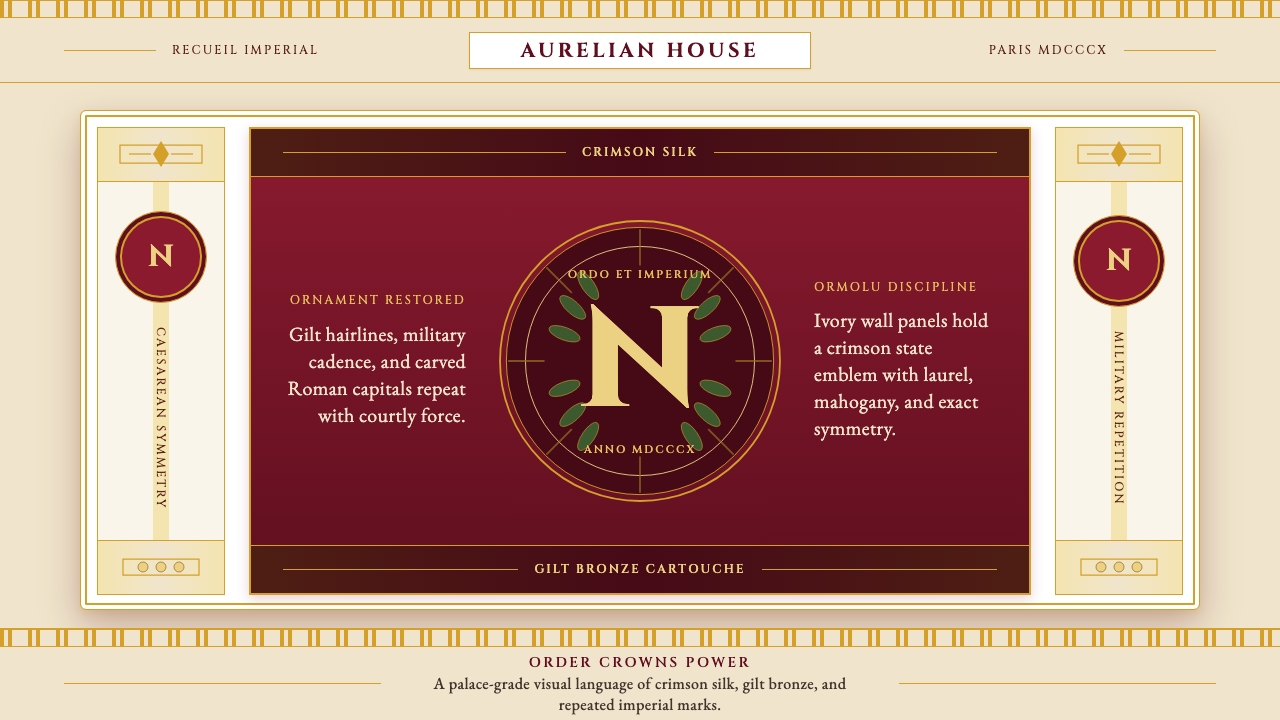 Napoleonic Empire StyleImperial order speaks. Crimson silk, gilt hairlines, and strict symmetry fram…
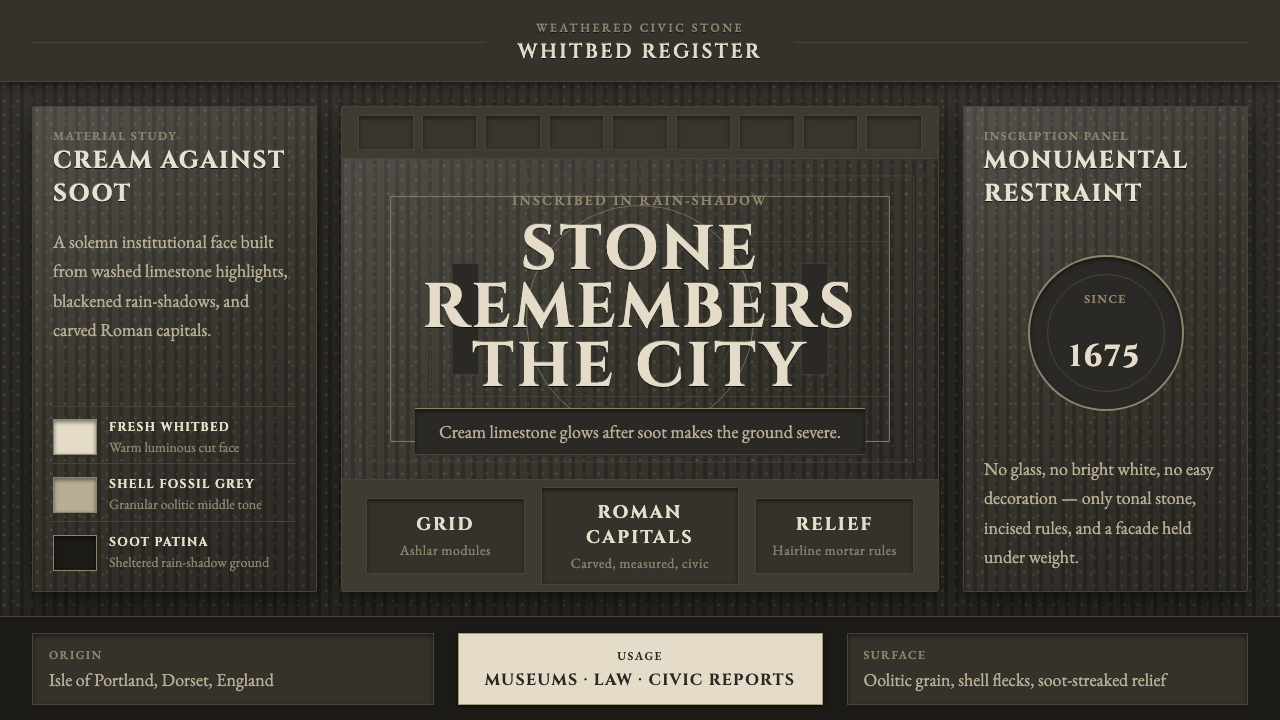 Portland Whitbed StoneCivic stone in shadow. Cream Cinzel capitals glow over soot-black ashlar grai…