What is Louis Vuitton Monogram?
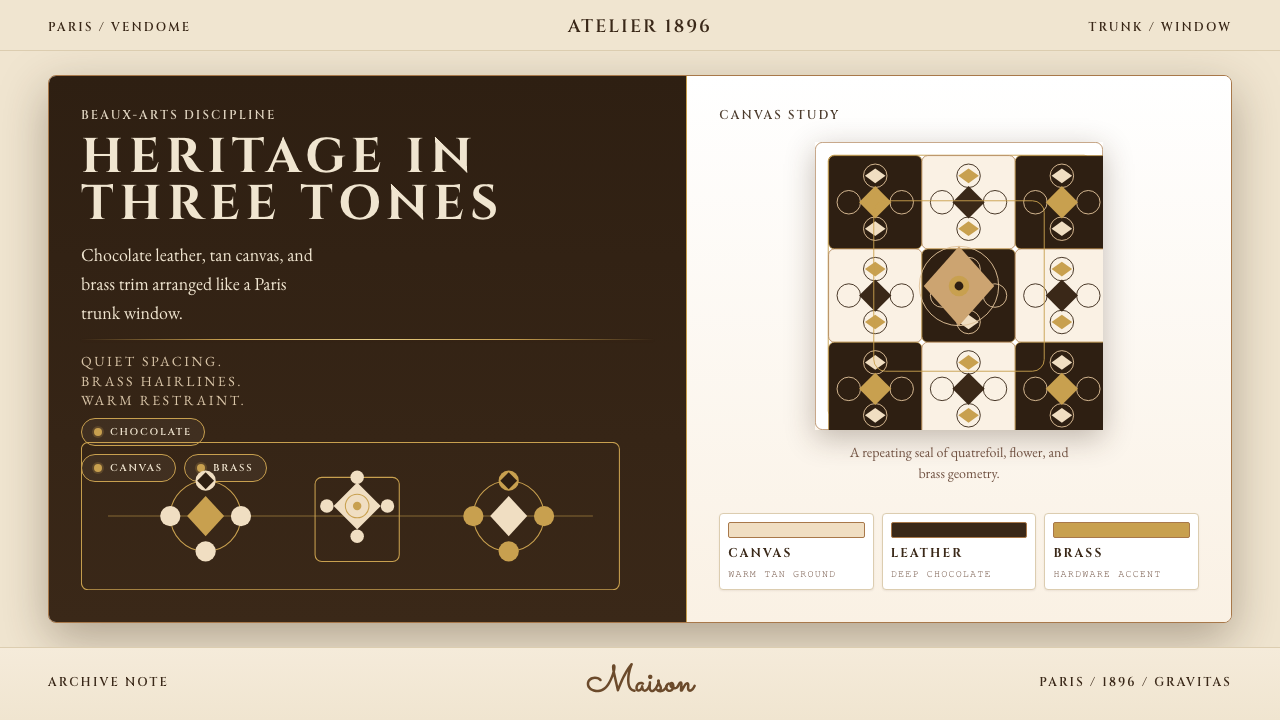
One hundred and thirty years after Georges Vuitton drew it as an anti-counterfeiting mark, the Monogram Canvas remains the most recognized — and most imitated — luxury pattern on earth.
Louis Vuitton Monogram in brief
The Louis Vuitton Monogram style is a visual system built on radical restraint: three colors, two interlocking initials, and two repeating floriated motifs tiled across a deep chocolate-brown ground. Where most luxury aesthetics rely on abundant surface material — embroidery, lacquer, gilding — Monogram achieves authority through symbolic density rather than visual complexity. Every element earns its place by referencing heritage, craftsmanship, and Parisian savoir-faire simultaneously.
The palette is the system's anchor. A warm, almost leathery chocolate brown dominates all ground surfaces, evoking the coated canvas that Vuitton's craftsmen developed to resist water, mold, and the rigors of ocean travel. Against this ground, the monogram motifs and logotype appear in a complementary warm tan — the color of natural, unfinished hide — creating a tonal relationship that is rich without being garish. Brass and burnished gold provide a third register: the hardware on trunks and bags, the shimmer of clasps and locks. The system uses no pure white, no cool gray, no bright accent color. Everything is warm, deliberate, and patinated.
Typographically, the brand name is set in a wide, open serif — a letterform rooted in French Beaux-Arts commercial signage — with generous letter-spacing that reads as self-assurance rather than informality. The interlocked LV monogram itself is not strictly a typeface but a logotype-as-pattern: the two characters are geometrically fitted together so that positive and negative space alternate in equal measure. The result is a unit that tiles seamlessly and reads as both text and ornament, depending on viewing distance.

Where does Louis Vuitton Monogram come from?
The Louis Vuitton maison was established in Paris in 1854, when Louis Vuitton — then working as a trunk-layer for the French imperial court — opened his own workshop on the Rue Neuve-des-Capucines. The business was built on a technical innovation: flat-topped, airtight trunks with a coated canvas exterior that could be stacked in the holds of steamships and railway cars. This was a direct response to the explosion of middle- and upper-class travel that followed the expansion of the European rail network. The earliest canvas pattern, introduced in 1872, was a simple red-and-brown or beige-and-brown stripe.
Louis died in 1892, and his son Georges Vuitton inherited both the business and an acute commercial problem. The original striped and checked canvas patterns had been so widely imitated — by competitors throughout Europe and Asia — that customers could no longer be confident they were buying authentic Vuitton goods. In 1896, Georges designed the Monogram Canvas as an explicit anti-counterfeiting measure. He drew on the Japanese design vocabulary then fashionable in Paris following the Meiji-era opening of Japan to Western commerce: the quatrefoil (a four-lobed rosette) and the four-petal flower are both motifs derived from Japanese mon — family crests — filtered through the Art Nouveau movement's obsession with organic, flat, non-representational ornamentation. The interlocked LV initials were added as a brand anchor. The combination, Georges calculated, would be far more difficult to replicate accurately than a simple geometric stripe.
The canvas proved him right in reverse: it became the most counterfeited design in fashion history precisely because it was so potent as a status signal. Throughout the twentieth century, as Vuitton expanded from luggage to leather goods to ready-to-wear, the Monogram Canvas appeared on an ever-wider range of products. The maison carefully managed the tension between exclusivity and ubiquity — occasionally retiring the motif from certain product categories, occasionally reintroducing it at elevated price points, and periodically collaborating with artists to recontextualize it.
Those collaborations began in earnest with Marc Jacobs, who served as artistic director from 1997 to 2013. Jacobs invited Stephen Sprouse to vandalize the canvas with graffiti lettering in 2001, then worked with Takashi Murakami to produce the Multicolore variant in 2003 — the monogram motifs silk-screened in thirty-three colors on a white or black ground. These interventions did not replace the original canvas; they proved that the Monogram could absorb ironic distance and artistic reinterpretation without losing its referential power. Nicolas Ghesquière and later Pharrell Williams, as successive creative directors, have continued this practice, each generation of leadership using the Monogram as a stable ground for contemporary dialogue.
What defines the Louis Vuitton Monogram look?
The Three-Color Ground
The entire system rests on three colors and three alone. Chocolate brown — deep, warm, and slightly red-shifted — covers all background surfaces. Warm tan, the color of natural leather left to age in dry air, carries every motif and logotype element. Polished brass or burnished gold appears on hardware, clasps, and metallic finishes. No fourth color intrudes. This radical limitation produces the visual coherence that makes the system legible at any scale, from a trunk panel to a luggage tag.
The Monogram Motif Pair
Two floral forms repeat in alternating rhythm across every tiled surface: a four-petal flower enclosed within a diamond outline, and a quatrefoil — a four-lobed rosette enclosed within a circle. Both are derived from Japanese family-crest iconography (mon), abstracted into flat, symmetrical silhouettes with no shading, no depth, and no representational detail. They are pure ornament in the Art Nouveau sense — organic in origin, geometric in execution. The two forms are sized and spaced so that neither dominates; they form a continuous field rather than a hierarchy of focal points.
The Interlocked LV Monogram
The LV logotype is an act of geometric problem-solving as much as lettering design. The capital L and capital V are fitted together so that the vertical stroke of the L and the left diagonal of the V share the same axis, and the negative space between them mirrors the positive forms. The result tiles as a repeating unit — not just a brand mark but a module in a larger pattern system. At reduced sizes it reads as a letter pair; at the scale of a trunk panel, it dissolves into the overall field alongside the two floral forms.
Beaux-Arts Logotype Typography
When the brand name appears in full — on labels, linings, and branded materials — it is set in a wide-tracking, open-bracketed serif with the proportions of late nineteenth-century French commercial lettering. The letterforms are upright, legible, and neither condensed nor expanded beyond their natural optical weight. The wide spacing between characters implies patience and permanence rather than urgency or fashionability. It is the typographic equivalent of a mahogany shop front: it does not shout, because it does not need to.
Restraint as Brand Discipline
The most distinctive formal property of the Monogram system is what it refuses to do. There are no gradients, no drop shadows, no texture overlays, no color accents beyond the three-color palette, no seasonal color variants in the classic Monogram Canvas format. The coated canvas is matte in finish, not glossy. Hardware is polished but not chrome-bright. Every temptation toward visual richness is resolved by returning to the palette and the motif set. This restraint is a form of brand confidence: the system does not need to be updated because it was designed to be permanent.
The Patina Dimension
Unlike most luxury visual systems, the Louis Vuitton Monogram is designed to age visibly and reputably. The natural leather trim that accompanies the canvas on bags and luggage begins as a pale, almost cream-toned vachetta and darkens over years of handling into a rich honey-amber. This expected transformation is built into the aesthetic: a darkened, well-worn Monogram piece is not damaged, it is seasoned. The patina dimension means the visual system has a temporal axis — it looks different in year one than in year twenty, and both states are considered authentic expressions of the design.
Tonal Harmony Over Contrast
Where many graphic design systems use high contrast — dark type on light ground, or vice versa — as their primary organizing tool, the Monogram palette operates through tonal harmony. The brown ground and tan motifs are close in value: they do not snap apart at a glance but reveal themselves upon sustained looking. Legibility is achieved through hue and warmth difference rather than luminance difference. This tonal closeness gives the pattern its characteristic depth and richness — it looks layered, like leather tooling, rather than printed — and it is the reason that digital or screen reproductions often feel flatter than physical Monogram Canvas.

Who shaped Louis Vuitton Monogram?
The founder arrived in Paris from the Jura mountains in 1835 at the age of fourteen, reportedly walking much of the journey. He apprenticed under Monsieur Maréchal, a prominent trunk-layer whose clients included the French imperial family. By 1854 he had established his own house, and by the 1867 Paris Universal Exposition his trunks were winning international recognition. Louis established the core business propositions — flat-topped stackable design, coated canvas for weather resistance, exceptional hardware precision — that defined the maison's engineering identity. The design culture he established valued technical problem-solving as the foundation of aesthetic distinction.
Georges inherited the maison in 1892 and designed the Monogram Canvas four years later, making him the author of what became the world's most recognized luxury pattern. His design decision to draw on Japanese mon iconography was not arbitrary: japonisme was at the height of its influence in Paris in the 1890s, and Georges was among several designers who understood that the visual grammar of Japanese family crests — flat, symmetrical, infinitely tileable — offered exactly the complexity-without-figuration that an anti-counterfeiting pattern required. Georges also expanded the business internationally and refined the brand's commercial identity, transforming a specialized luggage-maker into a broader luxury house.
Jacobs served as Louis Vuitton's artistic director from 1997 to 2013, the longest tenure in the maison's modern history. His contribution was to prove that the Monogram Canvas could be both ironic object and sincere status symbol simultaneously. The 2001 collaboration with Stephen Sprouse — graffiti lettering rendered in neon tones over the classic ground — and the 2003 collaboration with Takashi Murakami — thirty-three color variants of the monogram motifs — demonstrated that the system had sufficient cultural authority to absorb recontextualization without dissolving. Jacobs also positioned Vuitton as a participant in contemporary art rather than merely a patron of it, a distinction that influenced luxury brand strategy across the industry.
Ghesquière joined as artistic director of women's collections in 2013, succeeding Jacobs. Where Jacobs leaned into pop cultural irony and logo maximalism, Ghesquière brought a more architecturally oriented, futurist sensibility. He expanded the brand's visual language beyond the Monogram Canvas into new material explorations, screen-printed jacquards, and sculptural hardware forms while keeping the Monogram's cultural gravity intact. His tenure demonstrated that the Monogram does not need to be the center of every collection — its authority is strong enough to function as a stable reference point even when a season's design language moves away from it.
Williams became creative director of men's collections in 2023 following the death of Virgil Abloh. His first collection and subsequent shows brought a distinctly American, music-and-street-culture sensibility to the maison, reinterpreting the Monogram Canvas in expanded colorways and new silhouettes while insisting on its continued centrality. Williams represents the latest instance of a recurring pattern in Vuitton's creative history: a director from outside traditional fashion bringing a cultural fluency that refreshes the Monogram's meaning without altering its form. The pattern itself remains unchanged; what changes is the world's relationship to it.
How do you use Louis Vuitton Monogram today?
The Louis Vuitton Monogram style is most productively understood not as a surface treatment but as a tonal and structural system. Applying it correctly means committing to the three-color palette in full — chocolate brown as the dominant ground, warm tan as the primary motif and text color, and a restrained brass or aged-gold register for accent and hardware-equivalent elements. Any deviation from this palette — introducing a bright accent, a cooler brown, or a neutral gray — breaks the system's internal logic and produces something that reads as a pastiche rather than a derivation.
For presentation slides, the Monogram approach rewards bold simplicity. Cover slides work best with the chocolate-brown ground extended full-bleed, the title set in a wide-tracking serif in warm tan, and the Monogram motifs used as a subtle background texture rather than a dominant foreground element. Content slides should be treated as document pages in a high-end catalog: generous margins, a single column or two-column layout, section labels in small caps or widely-spaced capitals. Data visualizations — charts, timelines, comparison tables — are best rendered in the tan-on-brown palette, using the brass register for a single highlight value or call-out number. The style does not suit dense, multi-color data graphics; it rewards selectivity.
For web interfaces, the Monogram palette maps naturally onto dashboard and pricing page contexts where warmth, authority, and legibility are simultaneously required. The approach: set the background to the deepest chocolate brown for hero and navigation areas, transition to a lighter warm ground for content zones, and use the tan register for all body text and interactive labels. Buttons and calls to action should employ the brass register — a warm, burnished tone — rather than a primary color accent. Card components work well with a very slight warm border rather than a shadow, echoing the hardware-edging logic of physical Vuitton objects. Avoid pure white surfaces; the system reads as inauthentic when cool or neutral tones intrude.
For editorial and marketing work, the Monogram style offers a distinctive alternative to the neutral-ground luxury aesthetic that dominates contemporary premium brand design. A full-page editorial spread using this palette places the primary image against the chocolate-brown ground, with text panels in tan-on-brown or brown-on-tan. Pull quotes and section headers in the wide-tracking serif carry the weight that decorative rules or ornamental dividers would serve in other systems. Marketing materials — event invitations, campaign posters, packaging — benefit from the style's inherent sense of occasion: the palette has been legible as luxury for over a century, and that accumulated cultural reading works in the designer's favor without any additional signaling.
A common mistake when applying this style is treating the two floral Monogram motifs as decoration that can be scaled up and featured prominently. In the authentic system, the motifs exist as field elements — present everywhere, dominant nowhere. Enlarging them to hero scale, or centering them as focal points, reverses the logic of the original design and produces something that reads as a parody of the mark rather than a sensitive application of its vocabulary. Similarly, designers sometimes introduce a light or white background believing it will make the palette feel more modern; in practice it destroys the tonal warmth that is the system's entire emotional register. The palette must be dark to function.

Louis Vuitton Monogram — FAQ
Can the Monogram palette work on a light or white background?
Rarely, and only with significant adaptation. The Monogram system's warmth and depth depend on the chocolate-brown ground; without it, the tan motifs lose their contrast relationship and the whole palette flattens into something that resembles aged newsprint rather than luxury leather. A light application is possible if the background is a very warm, slightly amber-tinted cream rather than pure white, and if the brown is introduced as a dominant foreground or panel color to restore the tonal hierarchy. But a true light-background variant requires treating the Monogram as a source of color and motif references rather than a direct transposition, which is a significant design decision rather than a minor adaptation.
How does the Louis Vuitton Monogram differ from other monogram or crest-based luxury patterns?
Most monogram and crest patterns in luxury design function as heraldic devices — centered focal points that assert ownership or provenance. The LV Monogram is unusual in that it functions as a repeating textile pattern: the LV logotype and the two floral motifs tile continuously across the entire surface with no dominant center, no hierarchy of emphasis. It is closer to a damask weave or a Japanese mon-patterned fabric than to a traditional European crest. This tiling logic means the Monogram reads differently at different scales: at close range as a logomark, at middle distance as an allover pattern, at far distance as an undifferentiated textured ground. Very few luxury visual systems operate successfully across all three reading distances simultaneously.
Is the Monogram style appropriate for digital product design, or is it too associated with physical goods?
The association with physical goods is a feature rather than a limitation when applied thoughtfully. Digital surfaces that want to communicate heritage, permanence, and a premium tier of service — private banking interfaces, high-end real estate platforms, flagship e-commerce experiences, membership portals for luxury brands — can draw on the Monogram palette's century of cultural legibility. The challenge is that the style's tonal warmth does not translate automatically to screen: the chocolate-brown ground needs to be carefully calibrated for screen rendering to maintain its warmth rather than reading as a muddy or low-contrast dark. The motifs, if used at all in a digital context, should appear as very subtle background textures rather than interface elements, preserving their field-rather-than-focal logic.
Why does the Monogram feel luxurious when the palette is so limited?
Because luxury, in this context, is communicated through confidence rather than abundance. A palette that could be three colors signals that no more are needed — the design is complete on its own terms. This is the opposite of the visual logic of mass-market luxury signaling, which tends to accumulate: more colors, more materials, more embellishment. The Monogram's restraint is itself the status signal, readable only by those who understand that the costliest thing a brand can do is refuse to compete on spectacle. The system also benefits from its 130-year cultural loading: the palette does not have to earn its luxury associations fresh in every application because those associations are already embedded in the viewer's cultural memory before the design is encountered.
Does the Monogram style suit brands or products unrelated to fashion?
Yes, with care about the cultural associations being invoked. The palette and typographic system translate well to any context where the communicative goals include heritage, craftsmanship, exclusivity, and a European fine-goods tradition: private-label spirits and wines, bespoke financial services, high-end hospitality, rare-book or archive publications, collector-tier product packaging. The style struggles in contexts that require perceived accessibility, playfulness, or technological modernity — a startup, a consumer app, a budget airline applying this palette would produce cognitive dissonance rather than brand elevation. The question to ask is whether the product genuinely wants to be associated with the value system that the Monogram carries, or whether the palette is being used as a shortcut to luxury-signaling without the substantive commitment that makes the signal credible.
Related design styles
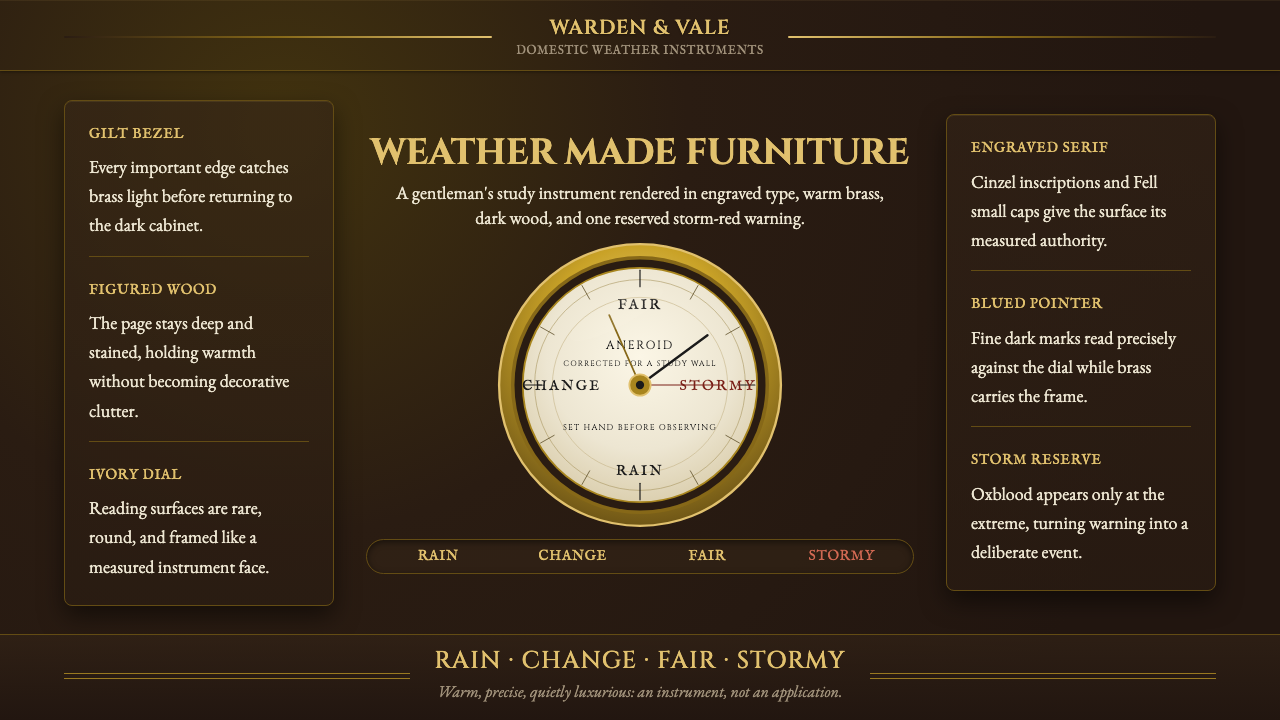 Aneroid BarometerMeasures weather as furniture. Gilt rings and Cinzel engraving glow on dark w…
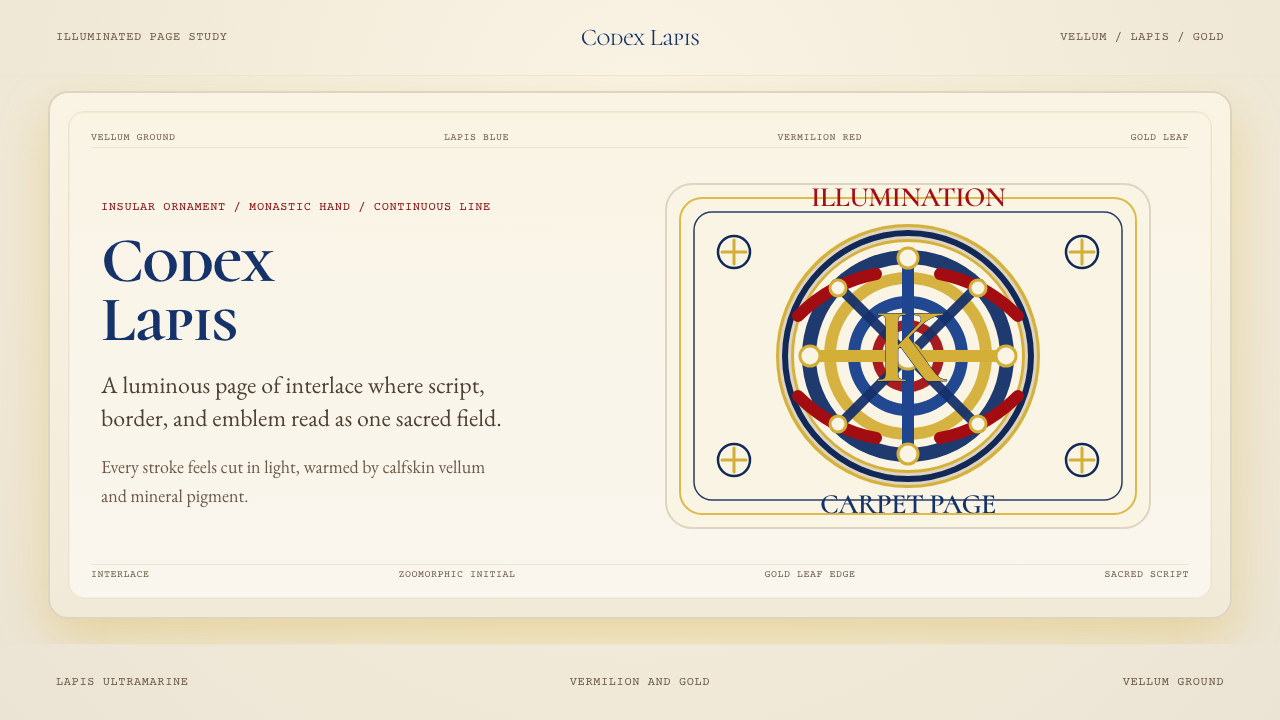 Book of Kells Celtic (800)Sacred and precise. Vellum cream, lapis, vermilion, and gold knotwork.
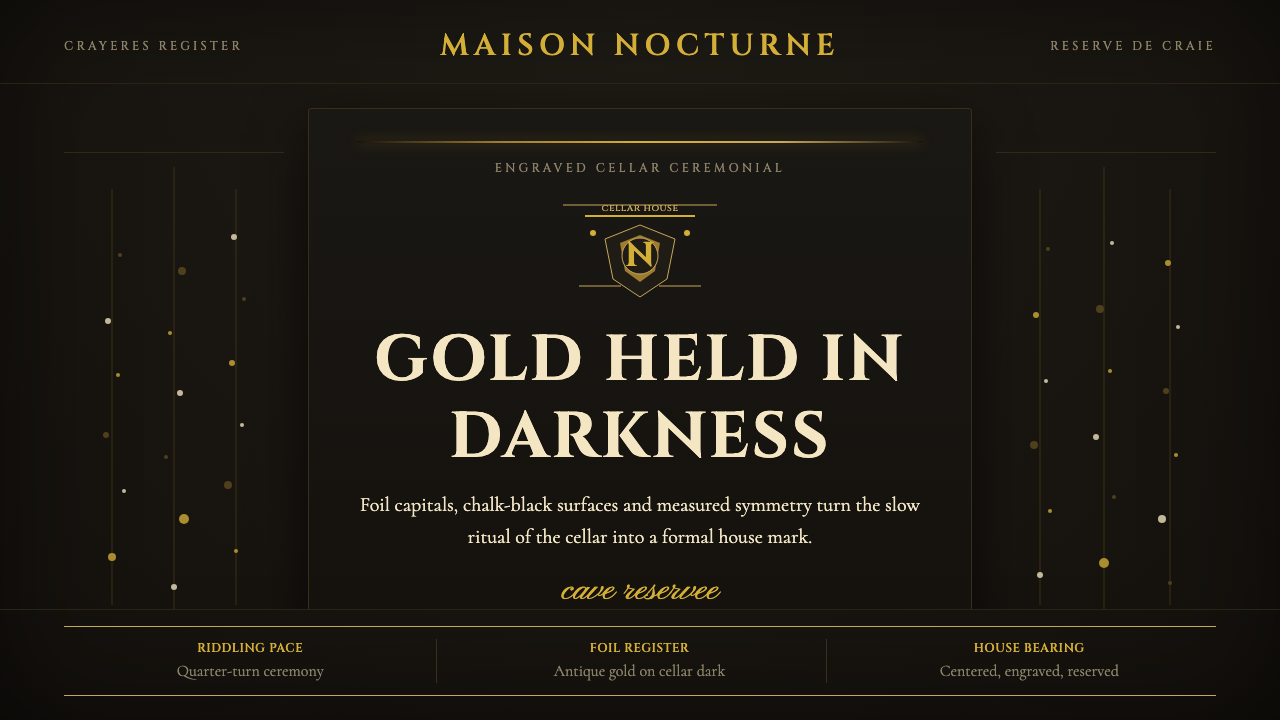 Champagne MaisonGrandeur without glitter. Cinzel capitals and gold foil rules glow in cellar…
 Crown Royal Purple Velvet (1939)Ceremony, not spectacle. Deep purple velvet, gold hairlines, and cream stock…
 English Afternoon TeaOrnament is the ritual. Old-rose porcelain, gilt rims, and script rest on ros…
 Lindt Swiss ChocolateOld-world luxury, softened. Gold foil, cocoa brown, and cream paper carry the…