What is Crown Royal Purple Velvet (1939)?
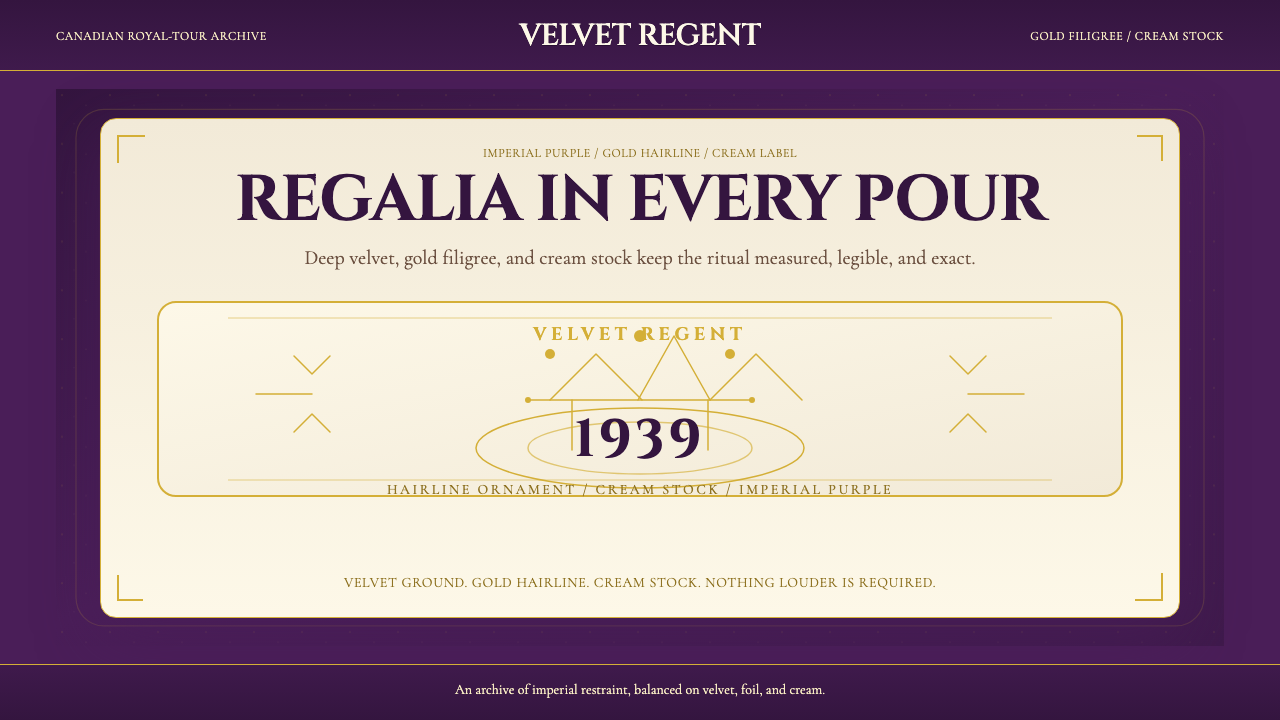
In 1939, a bottle of Canadian whisky dressed itself in deep purple velvet and gold filigree for a king — and never changed.
Crown Royal Purple Velvet (1939) in brief
Crown Royal Purple Velvet (1939) is the visual identity system originating from one of the most deliberate acts of royal gifting in North American brand history. The aesthetic is built on three material references held in careful tension: deep purple velvet as the primary ground, giving the system its sense of ceremonial weight; gold filigree and hairline ornament as the decorative register, suggesting engraved regalia rather than printed label; and warm cream as the content surface, evoking the ivory of fine stationery and the paper of letters addressed to courts.
The system is not luxe in the contemporary sense — it does not chase shine or maximalist abundance. It is imperial in the older sense: every element earns its place through ritual significance. The velvet ground is not decoration; it is the pillow on which a crown sits. The gold hairline is not flourish; it is the stamp of authority. Cream is not softness; it is the dignity of fine paper. This hierarchy of materials, translated into visual language, produces a style that reads as ceremonial restraint — opulent without excess, formal without stiffness.
Designers working within this system must internalize the logic of the original object: a whisky bottle that functions as regalia, a cloth bag that functions as a jewel case. Every digital element — a card border, a section divider, a headline typeface — should answer the question of what material it is meant to evoke and whether it earns its ceremonial weight.

Where does Crown Royal Purple Velvet (1939) come from?
The commission was unprecedented in Canadian spirits history. In 1939, Samuel Bronfman, the founder of Seagram, learned that King George VI and Queen Elizabeth would visit Canada — the first reigning British monarch to do so. Bronfman directed the Seagram design team to create a whisky of exceptional quality that could be presented as a gift from Canada to the Crown. The whisky was blended from fifty selected whiskies sourced from Seagram's distillery in Gimli, Manitoba, and its production facility in Montreal, Quebec. The number fifty was itself a gesture: excess as tribute.
The packaging was designed to be the gift as much as the liquid it contained. The Seagram designers of 1939 reached not toward the conventions of spirit labeling — the crests, the certificates of age, the stippled portraits of founders — but toward the language of the royal wardrobe and the jeweler's cabinet. A cloth bag of deep purple velvet, trimmed with gold-colored cord, encased the bottle entirely. The bottle itself bore a crowned label with gold-stamped lettering. The effect was of an object that belonged in a vitrine alongside medals and orders of chivalry, not on a back-bar shelf.
The royal tour completed, the gift was received, and Bronfman recognized what the packaging had achieved: it had elevated whisky from a product to a ceremony. Crown Royal was released commercially in Canada beginning in 1964, retaining every element of the original 1939 design — the purple velvet bag, the gold cord, the crowned label, the cream ground. The decision to not modernize the packaging has proven to be one of the most durable brand commitments in North American spirits history. The bag became an artifact in its own right; generations of consumers saved and repurposed the velvet pouches, creating an unplanned tradition of Crown Royal bag collecting and reuse that further embedded the object in cultural memory.
The brand passed through Seagram's portfolio until Diageo acquired it in 2000 as part of the breakup of the Seagram empire. Under Diageo, Crown Royal expanded its product line significantly — new expressions, limited editions, collaborations — but the core visual identity established in 1939 remained the fixed reference point for every extension. The purple velvet and gold filigree, now legible as a design system rather than simply a packaging choice, have been interpreted across bottle formats, gift sets, promotional materials, and, more recently, digital and experiential contexts. The original commission for a king has outlasted the empire it honored.
What defines the Crown Royal Purple Velvet (1939) look?
Color Ground
The dominant ground is a deep, saturated purple — not the bright violet of heraldic tradition nor the cooler lavender of Art Nouveau, but a velvet purple that absorbs light rather than reflecting it. This quality of absorption gives the system its weight. Against this ground, all other elements read as though illuminated from within rather than lit from outside. The secondary ground, used for content surfaces, is a warm cream that evokes fine laid paper and the color of aged ivory, providing a resting point within the system's ceremonial gravity.
Gold Ornament
Gold functions not as fill but as line — a hairline filigree that traces borders, frames, and typographic embellishments with the precision of engraved metalwork. The character of this gold is warm and slightly matte, closer to the surface of stamped foil or antique gilding than to bright metallic paint. It reads as crafted rather than printed. The weight of gold lines is deliberate: thin enough to be understood as fine work, present enough to be seen at reading distance. Where gold appears as a broader element — a rule, a divider, an emblem — it still reads as drawn rather than flooded.
Typography
The typographic register draws from the tradition of Roman-imperial engraving — the carved letterforms of monuments and official proclamations — filtered through nineteenth-century British commercial typography and the fine spirits labeling conventions that followed from it. Serifs are essential to the system: they carry the weight of historical authority that sans-serif letterforms cannot. Headlines are set with deliberate formality, often capitalized, with generous letterspacing that gives each word the presence of a title carved in stone. Body text, where it appears, is set in smaller serif type on cream grounds, readable and dignified without competing with the ceremonial headline register.
Texture and Material Reference
Unlike minimal or flat design systems that insist on the denial of material illusion, this system is rooted in the presence of material. The velvet ground is not merely a color; it is a surface with implied pile and depth. Gold ornament implies the resistance of metal under a graving tool. Cream implies the weight of heavy paper stock. In digital or print translations of the system, this material language is honored through surface treatments, printing effects, and rendering choices that amplify rather than suppress the sense of physical substrate. The system should never read as flat — it should read as though the materials are present beneath the surface.
Proportion and Framing
The system uses framing as a primary compositional device — nested rectangles, borders within borders, labels within panels — derived from the anatomy of the original bottle: a crowned label within a velvet bag within a gift box. This layering of containers gives every element a sense of having been placed and presented rather than simply positioned. White space within frames is treated as the silence of ceremony — necessary, deliberate, and not to be filled. The proportion of ornamental frame to content area is calibrated so that the frame is assertive but does not compete with what it contains.
Ceremonial Restraint
The system achieves opulence through restraint, not excess. A common misreading of the style treats the velvet-and-gold combination as license to layer, embellish, and accumulate. The authentic logic is the opposite: because each element carries ceremonial weight, fewer elements are needed. A single gold hairline border on a cream field is more powerful than three borders stacked. One crowned emblem is more authoritative than a pattern of repeated emblems. This principle — that maximum ceremony is achieved through minimum elements correctly weighted — is the defining discipline of the system.
Symmetry and Axial Balance
Where Bauhaus prized asymmetric tension and Swiss International Style developed the rational grid, Crown Royal Purple Velvet works from axial symmetry — the compositional logic of medals, royal warrants, and formal proclamations. Layouts are centered, elements are mirrored, and the visual hierarchy flows from the crown at the apex downward through headline, sub-heading, and body in a formal cascade. This axial symmetry is not the rigidity of bureaucratic form; it is the deliberate staging of ceremony, the arrangement of a table set for a formal dinner rather than an office workspace.

Who shaped Crown Royal Purple Velvet (1939)?
The founder of Seagram and the man who commissioned Crown Royal for the 1939 royal visit. Bronfman built Seagram into the largest distilling operation in North America through a combination of aggressive acquisition and relentless quality investment. His decision to create a gift whisky of exceptional standard for King George VI was both an act of personal ambition — Bronfman was acutely aware of his outsider status as a Jewish immigrant in Canadian society — and a calculated assertion of Canadian distilling on the world stage. The Crown Royal commission was the crowning expression of his belief that Canadian whisky could achieve the dignity of the finest spirits anywhere.
The anonymous designers of Seagram's 1939 Crown Royal packaging made decisions that have proven essentially permanent for over eighty years. Their choice to foreground the bag as the primary experience — to make the unveiling of the bottle from its velvet pouch a ceremony in itself — was a remarkable inversion of conventional spirits packaging logic, which treats the bottle and label as the primary object and any additional packaging as secondary. The visual vocabulary they established: the purple velvet ground, the gold cord closure, the cream crowned label, the filigree border — became fixed reference points that no subsequent redesign has dared to substantially alter.
The occasion of the 1939 Canadian royal tour — the first visit by a reigning British monarch to Canada — directly commissioned the creation of Crown Royal. George VI and Queen Elizabeth's visit was itself a diplomatic gesture of considerable importance, as Britain was preparing for the likelihood of war with Germany and sought to strengthen bonds with Commonwealth nations. The king did not design anything, but his symbolic presence as the intended recipient shaped every decision the Seagram team made: the scale of the commission, the choice of materials, the deliberate elevation of packaging to the level of royal presentation. The brand has carried his visit as its founding myth ever since.
The global spirits conglomerate that acquired Crown Royal in 2000 as part of the dissolution of Seagram. Under Diageo's stewardship, Crown Royal has expanded from a single product into a wide range of expressions — flavored whiskies, higher-age-statement releases, limited editions, and collaborations — while maintaining the 1939 visual identity as the fixed anchor. Diageo's decision to extend the range without altering the core visual system has been commercially shrewd: the purple velvet and gold filigree function as a recognizable frame within which new expressions can be introduced without disrupting brand recognition. The tension between the static identity and the expanding product range has made Crown Royal one of the more studied cases in brand extension strategy.
How do you use Crown Royal Purple Velvet (1939) today?
The Crown Royal Purple Velvet system transfers to contemporary design contexts most naturally when the subject calls for ceremony, legacy, or institutional distinction — rather than approachability, informality, or technical neutrality. Applied correctly, it signals that whatever it adorns is of established quality and formal significance. Applied incorrectly, it reads as costume: the visual equivalent of wearing a crown to a casual gathering.
For presentation slides, the system works with particular force on cover pages and section dividers. A cover built on the deep purple ground, with the title set in formal centered serif type at generous scale, a gold hairline border framing the content area, and a cream-ground credential block at the bottom, achieves an immediate impression of gravity and occasion. Content slides should shift to the cream ground with the purple used sparingly — a left-margin rule in gold, a section label in deep purple — to prevent the dominant color from overwhelming legible content. Data slides within this system should be treated as formal charts rather than casual infographics: axis labels in small serif type, data bars or segments in a restrained palette drawing from the system's established hues, no decorative chart junk.
For web interfaces, this visual language is well-matched to premium product pages, membership program landing pages, gift configurators, and any context where the user is being invited into an experience of distinction. The system does not suit high-frequency transactional interfaces — checkout flows, search results, dense data tables — where the ceremonial weight slows rather than enhances. For a pricing or membership tier page, the approach works elegantly: each tier presented as a framed panel on cream ground, the highest tier distinguished by the full purple ground with gold typographic accent, creating a natural visual hierarchy that mirrors the product's actual value structure.
For editorial and marketing work, this style supports long-form feature content, brand heritage storytelling, and anniversary or commemorative publications. A feature article layout places the headline in a centered, capitalized serif at large scale on the purple ground, transitions to cream for the body text column with a narrow measure and generous margins, and uses gold ruled lines as section breaks. Marketing materials — print advertisements, digital display, out-of-home — work best when they resist the temptation to crowd the velvet ground with multiple competing elements. A single strong headline, a restrained gold ornament, and the branded bottle or emblem on the purple field will outperform a cluttered composition every time.
A common mistake when applying this system is treating the gold and purple as a color palette to be applied broadly, rather than as material references to be honored selectively. Designers who fill large interface areas with the full deep purple, use gold as a general highlight color across all interactive states, and multiply filigree ornament across every section will produce work that reads as themed rather than authoritative — the difference between a Halloween costume and dress uniform. The system's power comes from the considered use of the velvet ground as a moment of ceremony, cream as the working surface, and gold as the mark of authority applied only where it is truly earned.

Crown Royal Purple Velvet (1939) — FAQ
How is Crown Royal Purple Velvet different from other luxury or premium design styles?
Most contemporary luxury design styles operate through one of two modes: the sparse minimalism of high-fashion houses (vast negative space, thin typography, near-absence of color) or the maximalist abundance of legacy jewelry and couture brands (gold fills, dense pattern, layered richness). Crown Royal Purple Velvet occupies neither position. Its foundation is material ceremony rather than visual scarcity or visual abundance. It uses a single dominant ground color at full depth, a single accent material (gold as line), and a single secondary surface (cream). The opulence comes from the weight and specificity of each element, not from their multiplicity. It is a system of three materials in disciplined relationship, which makes it more legible — and more transferable — than either of the dominant luxury modes.
Can this style work on a light background, or is the deep purple ground essential?
The cream ground is a legitimate and frequently used surface within the system — it is not a compromise but a designed part of the original packaging vocabulary, representing the bottle label within the velvet bag. Work built primarily on cream with gold and purple used as accent reads as the label idiom rather than the velvet idiom; it is lighter, more legible for body text, and appropriate for contexts where the velvet ground would be too heavy. What does not work is a neutral grey, off-white, or white ground substituted for cream: these backgrounds lack the warmth and material suggestion that connect them to the system's material logic. The choice is between the velvet ground (deep purple, for ceremonial moments) and the label ground (warm cream, for content-heavy surfaces) — not an open selection of any light background.
Does the style's association with alcohol limit where it can be applied?
The style's source material is a spirit brand, but the visual language it employs predates that application by centuries. Deep purple, gold filigree, and cream are the materials of royal ceremony, ecclesiastical vestments, and aristocratic portraiture — all of which long predate any association with whisky. In contemporary practice, the style works naturally for: luxury goods of any category, financial services positioning themselves as established and trusted, membership programs with tiered distinction, hospitality and travel at the premium end, and any cultural institution (museum, opera, heritage organization) communicating longevity and authority. The association with spirits becomes a constraint only if the designer is working in a context where that association is culturally sensitive — children's educational contexts, certain health or wellness applications — in which case the style is simply the wrong choice.
How should photography be handled within this system?
Photography enters this system most successfully when it is treated as an object of presentation rather than a window into a scene. Product photography placed on the velvet ground works when the product is lit to emphasize material quality — the refraction of glass, the surface of precious metal, the texture of fine fabric — rather than set in a lifestyle context. Portrait photography, where it appears, should be treated formally: centered framing, dignified lighting, and a presentation that suggests the photographic tradition of official portraiture rather than casual documentary. Photography that implies informality, spontaneity, or everyday casualness will undermine the system's ceremonial register. When in doubt, a single well-chosen product image on the velvet ground will serve better than multiple lifestyle images competing for attention.
What is the most important discipline to maintain when working with this system over time?
The most important discipline is resisting the accumulation of elements. Over the lifecycle of a design system in active use — across presentations, campaigns, product pages, social content — there is consistent pressure to add: a new accent color, a secondary ornament, an additional typographic register, a looser interpretation of the gold treatment. Each individual addition may seem minor, but collectively they erode the system's primary quality, which is the power of restraint. The velvet ground should feel rare when it appears. The gold hairline should feel precise and earned. Cream should feel like a deliberate choice rather than a default. A periodic audit that removes recent accretions and returns the system to its three essential materials is more valuable than almost any new addition.
Related design styles
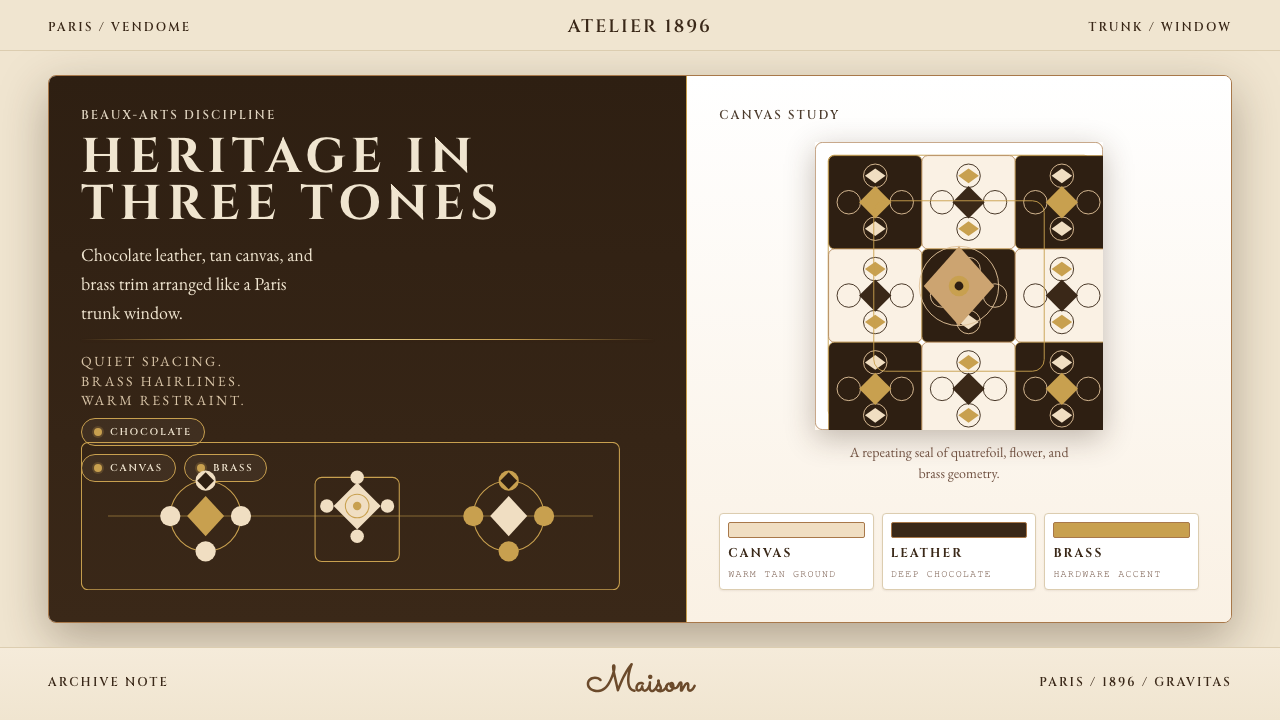 Louis Vuitton MonogramHeritage stays luminous. Chocolate, tan, and brass stage a Paris trunk window.
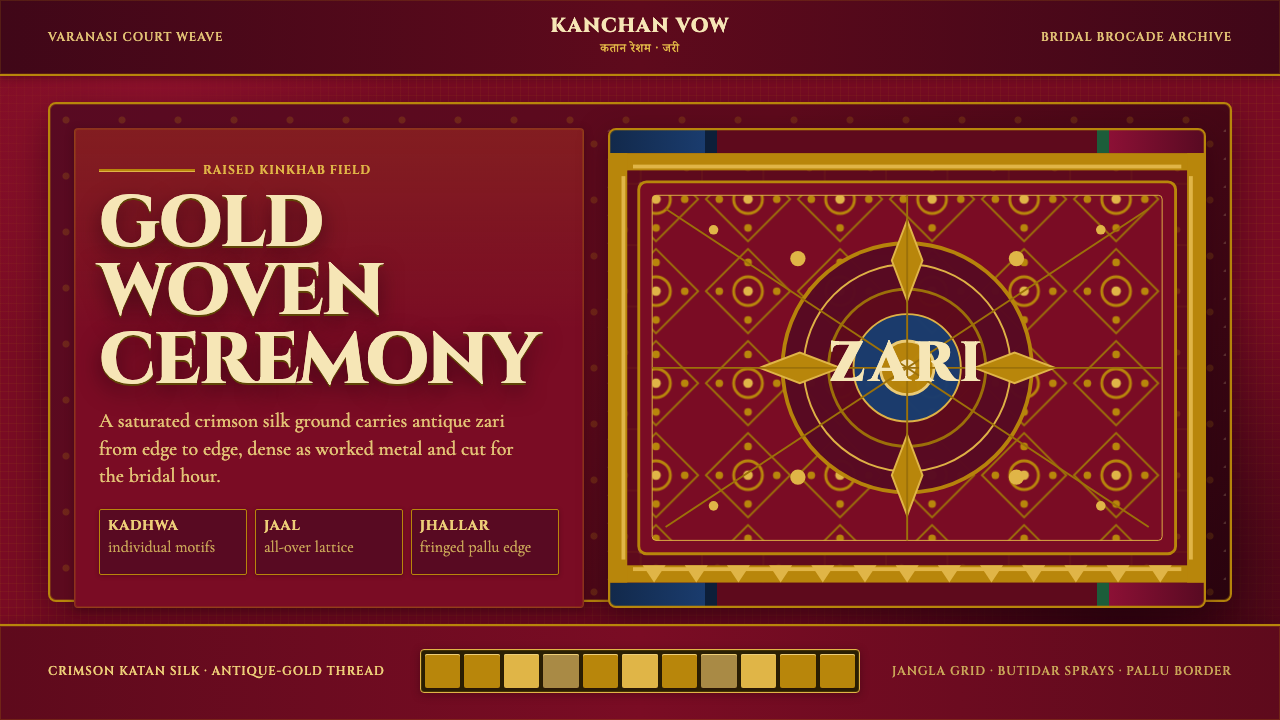 Banarasi Brocade SareeBridal maximalism, woven dense. Crimson silk grid carries raised antique-gold…
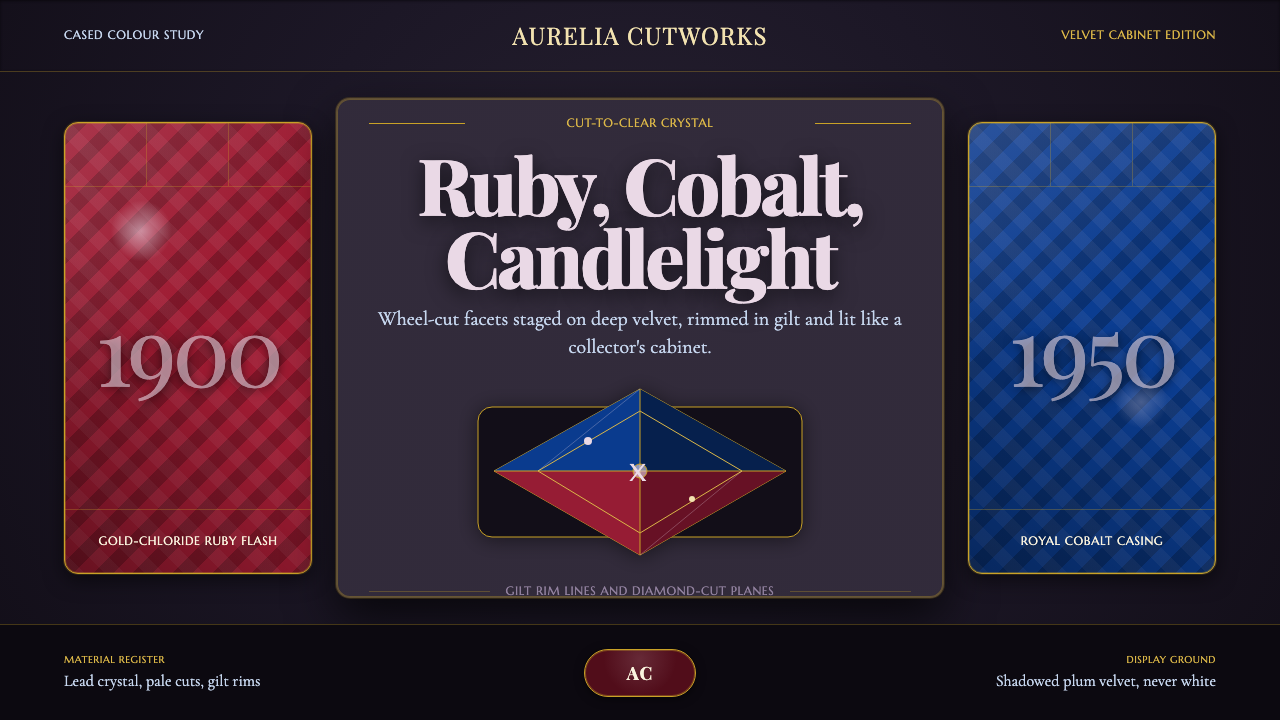 Bohemian Cut CrystalOpulence glows in shadow. Ruby and cobalt facets sit on velvet under gilt rim…
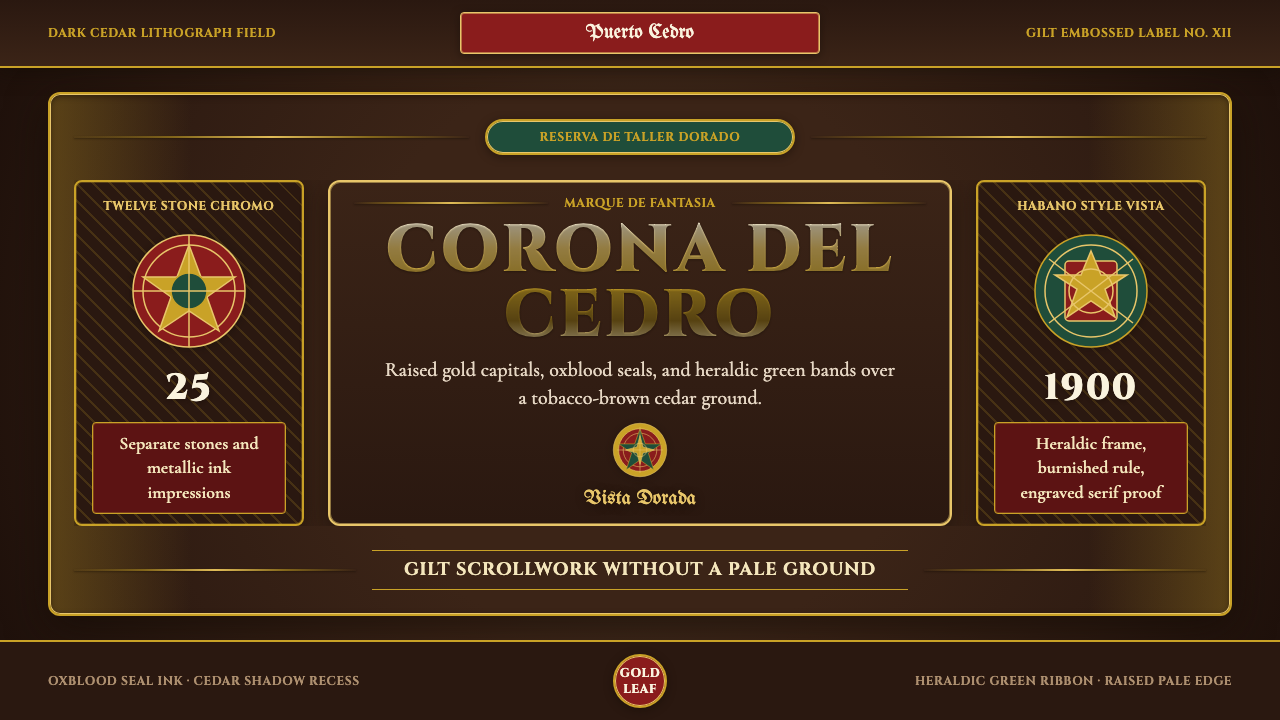 Cigar Box LabelGilt maximalism glows. Gold Cinzel capitals lock into a tobacco-brown framed…
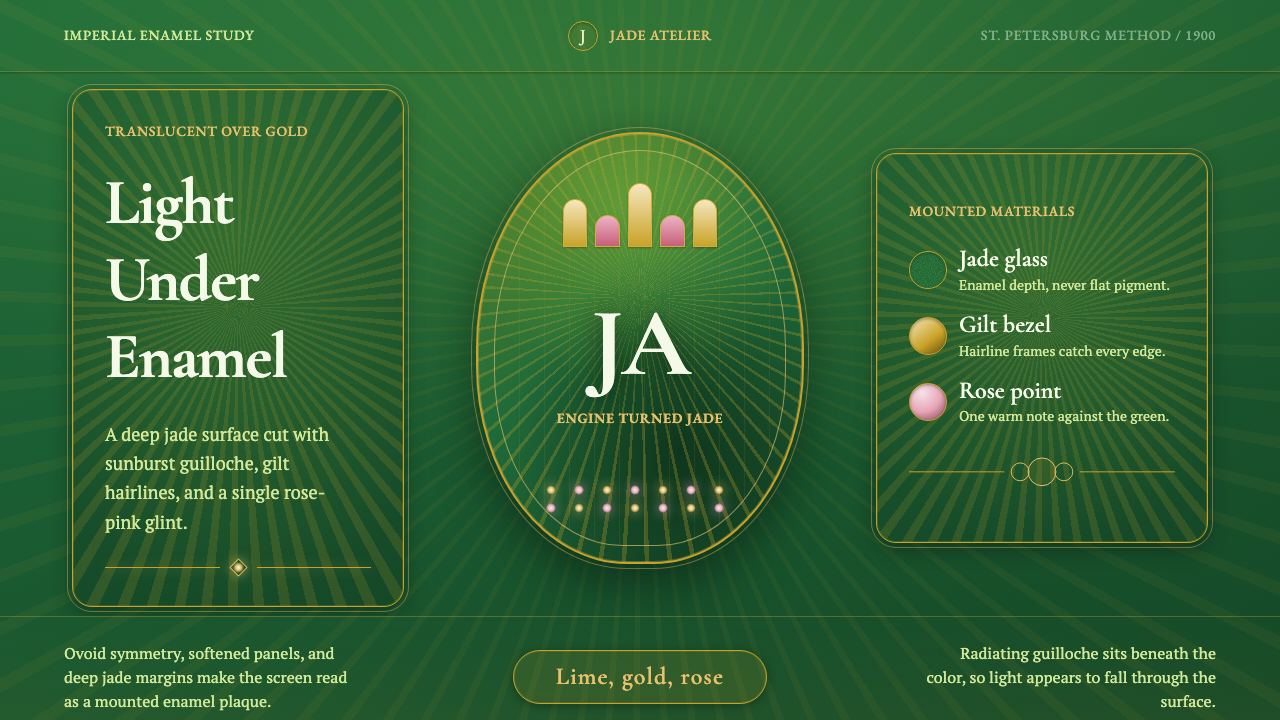 Faberge Guilloche EnamelImperial enamel glows. Jade guilloche, gilt hairlines, rose-pink points.
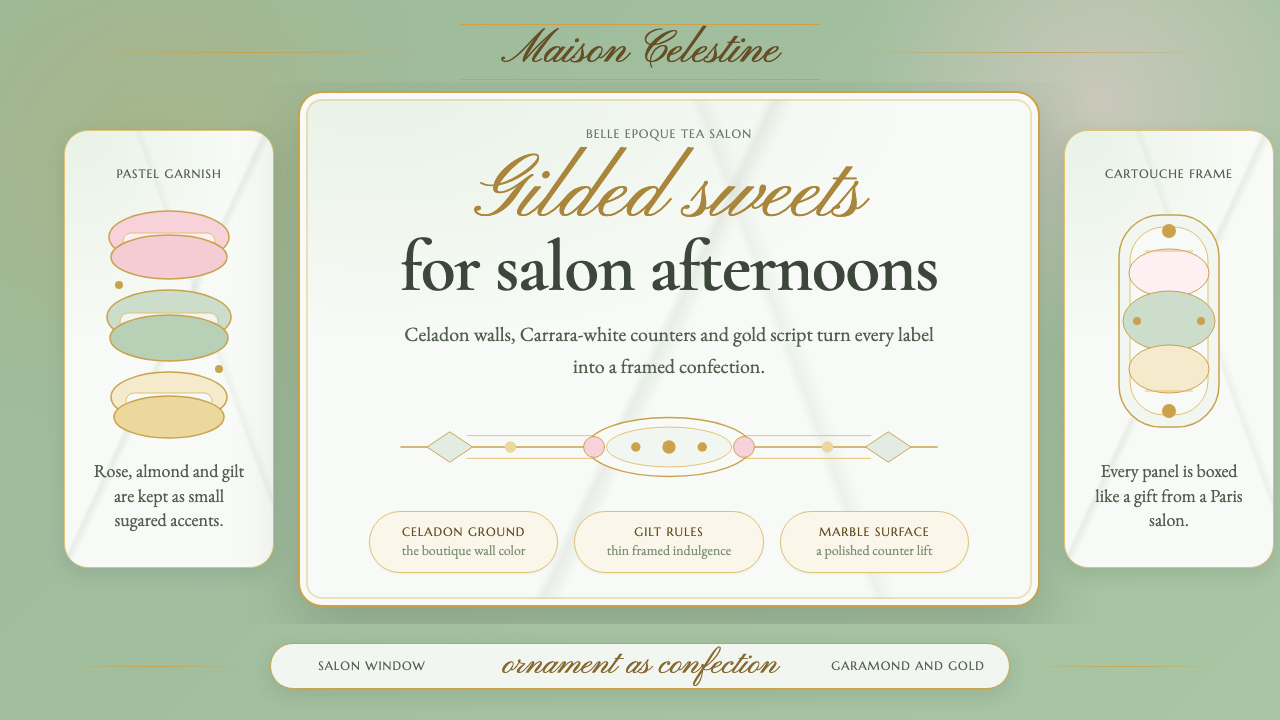 French PâtisserieOrnament is the luxury. Celadon ground, gilt cartouches, Garamond and script…