What is Veuve Clicquot (Yellow-Label)?
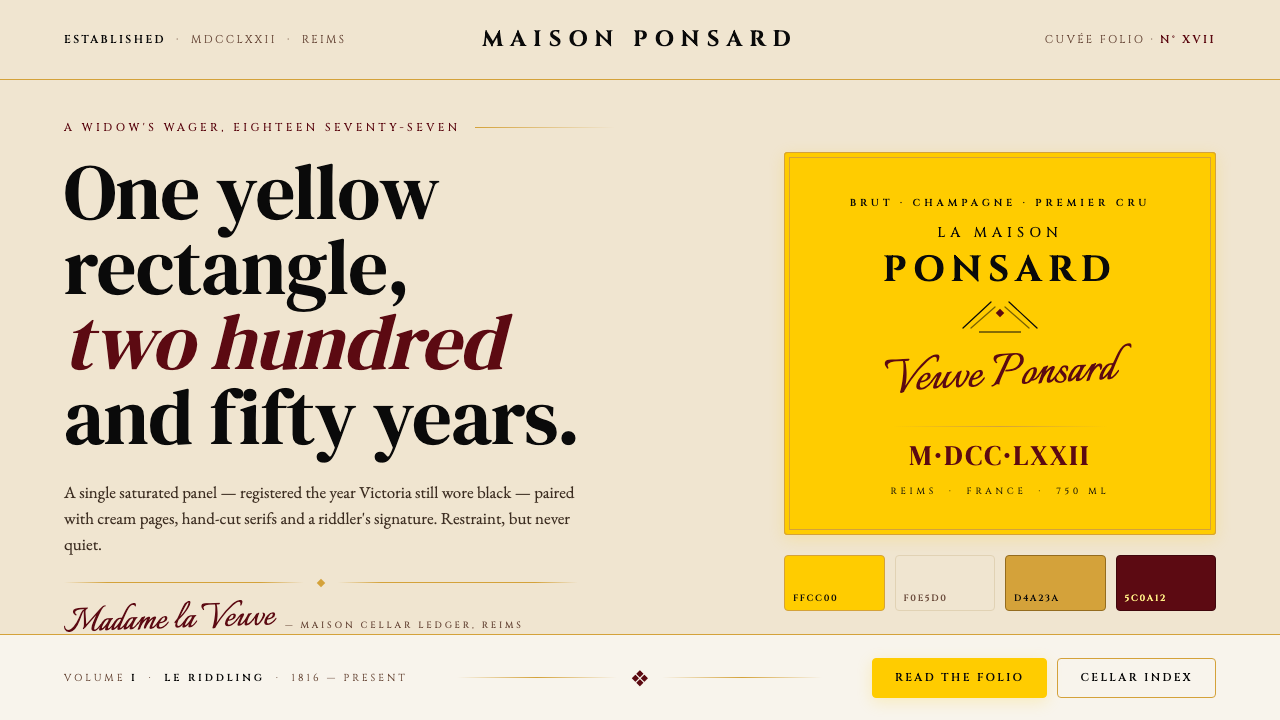
One audacious yellow rectangle anchored 250 years of Champagne royalty — Veuve Clicquot's Yellow Label is perhaps the most recognizable single color decision in luxury branding history.
Veuve Clicquot (Yellow-Label) in brief
Veuve Clicquot's visual identity rests on one of the boldest chromatic commitments in the history of luxury branding: a single saturated yellow, registered as the house's signature since the 1877 Yellow-Label release, that functions simultaneously as background, signature, and worldview. The system pairs that dominant yellow with warm cream, deep black, and occasional warm gold — a palette of four tones held in classical restraint. No brand in Champagne, and few in luxury at large, have staked so much on a single color's legibility across two and a half centuries.
The typographic voice of the house is unambiguously classical. The wordmark lives in an upright Roman serif — the kind of letterform that carries the authority of engraved stone and academic tradition. Body text follows in a humanist old-style serif that breathes warmth and readability into the formality. Set against these upright, authoritative forms, a flowing script flourish — evoking Madame Clicquot's own signature — appears as a counterpoint: it is the widow's handwriting in a house otherwise built from Roman capitals. This contrast between the institutional and the personal is the emotional core of the system.
Where most luxury fashion houses build identity around surface richness — embossed leather, gilded monograms, layered ornament — Veuve Clicquot builds identity around chromatic immediacy. The yellow label is not decoration; it is structure. Everything else on the bottle, the capsule, the shipping box, the advertising page is organized in relation to that rectangle. This approach gives the house an unusual visual clarity: it is recognizable at a distance, in thumbnail, in a crowded bar shelf, in a decade-old photograph. The identity does not depend on proximity or detail — it depends on one irreducible decision made in 1877 and honored ever since.

Where does Veuve Clicquot (Yellow-Label) come from?
The house of Veuve Clicquot traces its founding to 1772, when Philippe Clicquot-Muiron established a wine trading business in Reims, the cathedral city at the heart of France's Champagne region. The Clicquot family had prospered as textile merchants and wool traders; wine was a natural extension of their mercantile ambitions in a region whose chalky subsoils had produced sparkling wine of growing European renown. The early house was a trading concern as much as a production cellar, and Reims's position on the old Roman road made it a natural hub for distributing Champagne's prestige bottles to northern Europe.
The transformation of the house into a dynasty belongs entirely to Barbe-Nicole Ponsardin, who married Philippe's son François Clicquot in 1798 and became a widow — veuve — just six years later, at the age of twenty-seven. Rather than retiring from the business, as convention would have demanded, she took control of the cellars in 1805 and began what would become the most consequential single career in Champagne history. Her commercial instincts were extraordinary: she famously smuggled the first post-Napoleonic shipment of Champagne into Russia in 1814, outmaneuvering a British naval blockade to capture the tsarist market before any competitor. She built distribution networks across Prussia, Austria, and the German states. By the time of her death in 1866, the house bore her title — Veuve, widow — as a mark of honor, and the brand was known in every court in Europe.
Technically, Madame Clicquot's most lasting contribution was the invention of the riddling rack — the pupitre — a slanted wooden board pierced with holes that allowed sparkling wine bottles to be gradually tilted and rotated over weeks, causing the sediment from secondary fermentation to collect in the neck of the bottle for easy removal. Before riddling, Champagne was cloudy, sweetened to mask the sediment, and highly variable in quality. Her technique, developed in the cellars around 1816, made clear, consistent Champagne commercially viable at scale. The method remains standard practice — albeit now often mechanized — in houses across Reims and Épernay to this day.
The famous yellow label itself arrived in 1877, over a decade after Madame Clicquot's death, under the stewardship of Edouard Werlé, who had managed the house since 1821 and worked to codify and extend her legacy. The choice of a saturated yellow for the label was unusual — most Champagne houses favored cream, white, or pale gold, echoing the color of the wine itself or the restrained palette of aristocratic stationery. Veuve Clicquot's yellow declared itself immediately, loudly, and without apology. The label became legally registered as the house's brand color, and subsequent decades — through two World Wars, the Great Depression, and the eventual acquisition by LVMH in the late twentieth century — only deepened the association between that yellow and Champagne prestige. Under LVMH's creative direction, the current visual identity, refined around 2022 to 2024, modernized the typography and tightened the system while preserving the yellow's centrality absolutely.
What defines the Veuve Clicquot (Yellow-Label) look?
Signature Yellow
The defining characteristic of the Veuve Clicquot system is a single warm, saturated yellow — the same tone registered as the brand's legal color since the 1877 Yellow-Label launch. It reads as neither pale nor orange, but as a full-bodied, declarative yellow that sits confidently at the warm end of the spectrum. On packaging and print, it occupies large fields without any gradation, shadow, or texture. Its power comes not from variation but from repetition: the same tone, unchanged, across every surface, every decade, every market.
Classical Serif Wordmark
The house name is set in an upright, high-contrast classical serif — the kind of letterform historically associated with Roman inscriptions, academic printing, and the engraved copper plates of eighteenth-century European luxury trade. The serifs are sharp and bracketed; the stroke contrast between thick and thin is pronounced. This typographic register conveys institutional gravity and historical legitimacy. It does not attempt modernity; it makes modernity irrelevant by standing entirely outside the contemporary moment.
Script Flourish
Set against the upright authority of the Roman wordmark, a flowing italic or script element — evoking Madame Clicquot's personal hand — introduces warmth, humanity, and narrative. It functions as a counterpoint: where the Roman capitals say 'institution,' the script says 'person.' This duality of the formal and the personal is rare in luxury branding, and it is the reason the Veuve Clicquot identity reads as both authoritative and intimate. The script appears at controlled scale, never overwhelming the system, but always reminding the viewer of the widow at its origin.
Warm Cream Ground
Where the yellow does not cover, warm cream functions as the system's second ground. It is not pure white — it carries a slight warmth that harmonizes with the yellow's own warmth and prevents the black typography from reading as harsh. Cream contextualizes the yellow as a luxury choice rather than a purely commercial signal. It also references the color of Champagne itself, the aged paper of historical documents, and the ivory of aristocratic stationery — all associations that reinforce the house's positioning at the intersection of history, agriculture, and refinement.
Deep Black for Structure
Black in the Veuve Clicquot system is not a neutral; it is a deliberate contrast element that anchors the yellow and prevents the palette from reading as purely celebratory. Used for all primary typography, for ruled lines and dividers, and for the ink of official seals and legal text on labels, black introduces a gravity that keeps the warmth of the yellow from tipping into frivolity. The proportion matters: black is used sparingly, at typographic weight, never as large fields. The yellow must always dominate.
Gold as Restrained Accent
A warm, muted gold — closer to antique brass than to bright metallic — appears at key moments as a tertiary accent: the cage wire on the bottle, the foil of the capsule, the occasional decorative stroke in premium communications. Gold is used sparingly precisely because the yellow already performs the role of warmth and prestige; gold overdone would compete with and dilute that yellow rather than reinforce it. Used at small scale and in physical materials where it catches light differently from the flat yellow, gold adds tactile dimension without disturbing the chromatic hierarchy.
Label as Architectural Object
Unlike brands that treat their bottle label as a framed picture to be viewed frontally, Veuve Clicquot treats the label as an architectural surface — a flat, bold plane of color that wraps and commands the bottle's form. The yellow field is typically left unadorned at its edges: no decorative border, no embossed frame, no ornamental surround. The label begins and ends precisely, with clean cuts. This architectural confidence — the color standing without apology, requiring no ornamental justification — is a key reason the identity has survived two centuries of changing tastes without requiring fundamental revision.

Who shaped Veuve Clicquot (Yellow-Label)?
Widowed at twenty-seven, Madame Clicquot took control of the family Champagne cellars in 1805 and built what became the foremost Champagne house of the nineteenth century. Her commercial achievements were matched by her technical innovation: the riddling rack she developed around 1816 solved the central production problem of clear, stable sparkling wine and established the method that the entire industry adopted. Her personal story — the widow who refused convention and built an empire — became inseparable from the brand's identity, and the house's very name, Veuve Clicquot (Widow Clicquot), perpetuates her legacy as a founding gesture.
The founder of the house in 1772, Philippe Clicquot-Muiron established the mercantile and regional foundations that his daughter-in-law would transform into a Champagne dynasty. His background in textile and wool trading gave the early house its commercial orientation — it was always as much a trading business as a wine production operation — and his establishment in Reims placed the family at the geographic and logistical center of the Champagne region's export economy.
Werlé joined the house as a partner in 1821, just fifteen years after Madame Clicquot took control, and served as its chief administrator for decades. It was under his stewardship that the famous yellow label was introduced in 1877, codifying what had been a house visual custom into a registered brand identity. Werlé's long tenure represented the transition from the widow's personal enterprise to a structured, institutionalized business — the moment at which the house began systematically managing its image as a luxury brand rather than merely selling wine.
Veuve Clicquot was acquired by LVMH — Moët Hennessy Louis Vuitton — as part of the conglomerate's assembly of prestige Champagne houses. Under LVMH's brand architecture, the house has benefited from significant investment in global marketing, retail presence, and creative direction. The most recent significant evolution of the visual identity, undertaken in the 2022 to 2024 period, refined the typography and tightened the supporting graphic system while maintaining the yellow's absolute primacy. LVMH's stewardship illustrates both the opportunity and the constraint of luxury conglomerate ownership: the scale to invest globally, and the discipline to resist the temptation to over-refresh an identity whose power lies in its consistency.
How do you use Veuve Clicquot (Yellow-Label) today?
The Veuve Clicquot Yellow-Label style is one of the most transferable prestige design systems for contemporary work because its logic is chromatic rather than ornamental. Applying it correctly means understanding what the yellow is actually doing: it is not accent or highlight — it is ground, structure, and primary signal simultaneously. Before placing a single element, establish whether the yellow will dominate the composition or serve as a contained block. The answer to that question determines everything else.
For presentation slides, the style works exceptionally well on cover pages conceived as large-format label compositions. A cover in this system functions like a Champagne label at room scale: the yellow occupies a dominant portion of the frame, the house name or presentation title sits in classical serif type at high contrast, and one line of script or italic subtext introduces the personal counterpoint. Content slides should be treated as typographic layouts on cream grounds: two or three scale-differentiated text hierarchies, black ruling lines as structural dividers, and data visualizations — bar charts, timelines, comparative tables — rendered with the same chromatic restraint as the palette: yellow for primary data, cream for background fields, black for labels and axes. The style supports premium and finance presentations, vintage and hospitality brands, and any context where the claim being made is one of authority and longevity.
For web interfaces, the system translates well to dashboards, pricing pages, and editorial-style landing pages where hierarchy is absolute and scannability matters. The approach: define a strict typographic grid with generous margins, use cream or near-white as the default background tone, reserve deep black for all body text and navigation labels, and deploy yellow as the primary interactive and accent color — call-to-action buttons, active navigation states, tier highlights in pricing tables. Card components should carry hard-edged borders or subtle inset shadows rather than the diffuse soft shadows of contemporary material design, which would conflict with the system's classical gravity. In dark-mode contexts, the yellow must be handled with care: at full saturation against a very dark background it can overpower everything, and the system works better when the dark surface takes a very warm near-black tone to harmonize with the yellow's warmth rather than conflict with it.
For editorial and marketing work — campaign pages, brand lookbooks, event invitations, email headers — the style operates at its most natural. The core move is the same as the Champagne label itself: a bold yellow field bearing classical serif type. A full-bleed yellow hero section with the brand name in deep black, followed by cream-ground body copy, is the canonical structure. Marketing materials can introduce the script accent for campaign headlines or event subheadings, bringing warmth and human narrative into what would otherwise be a purely institutional presentation. Print applications, where the yellow can be matched to a consistent Pantone spot color and the cream can be the physical paper stock itself, are an especially natural fit — the label was designed in the era of letterpress, and the system retains an affinity for physical, tactile production.
A common mistake when applying this style is treating the yellow as one element among several equally weighted elements — as an accent rather than a dominant. Authentic Veuve Clicquot visual logic requires the yellow to be the largest, loudest, most spatially dominant element in any composition. When the yellow is reduced to buttons, small chips, or decorative borders, the system loses its identity and reads as generic luxury branding rather than a specific chromatic commitment. A second common mistake is introducing additional colors — blush, champagne gold used at large scale, or contemporary pastels — in an attempt to soften or modernize the palette. The power of the system comes from its constraint: yellow, cream, black, and a whisper of gold. Adding a fourth or fifth color dissolves the chromatic authority that two and a half centuries of repetition have built.

Veuve Clicquot (Yellow-Label) — FAQ
Is the Veuve Clicquot yellow a standard design color, or is it a legally protected brand color?
It is a legally registered brand color, which makes it one of the relatively rare cases in design where a specific chromatic identity is protected by trademark law. The house registered the yellow associated with the Yellow-Label in the nineteenth century, and subsequent legal decisions in multiple jurisdictions have affirmed the house's exclusive right to use that yellow in the context of sparkling wine and luxury goods. For designers working in adjacent categories — lifestyle, hospitality, editorial — the color is freely usable, but in any context that touches sparkling wine, Champagne, or luxury food and beverage branding, using a close equivalent invites legal scrutiny. The practical design lesson is that the yellow's power in the system comes not from its specific technical coordinates but from two centuries of consistent use — a lesson about repetition that any design system can apply.
How does this style differ from general French luxury branding?
Most French luxury branding — particularly in fashion, leather goods, and cosmetics — favors a palette of near-neutral tones: cream, ivory, warm grey, muted gold, and black. Color, when it appears, tends to be used for seasonal campaigns or special editions rather than as the permanent primary identity. Veuve Clicquot inverts this convention: the house's primary identity is not neutral but chromatic, and the yellow is not seasonal but permanent. This makes the Veuve Clicquot system more immediately graphic and internationally legible than most French luxury branding, which tends to rely on fine typographic detail and material quality — subtleties that require proximity and familiarity to read. The yellow works at a distance, across cultures, and in reproduction contexts where typographic refinement would be lost.
Can this visual style be applied to categories outside wine and luxury?
Yes, and it is especially effective in categories that want to claim heritage, expertise, and premium positioning without the coldness of contemporary minimalism. Financial services, insurance, high-end hospitality, rare book publishing, classic auction houses, and professional services — law, architecture, private banking — all have natural affinities with this style. The classical serif, the cream and black palette, and the bold chromatic signature translate well to brand identities that need to signal long-term reliability and institutional authority. What does not translate well: categories built on freshness, accessibility, youth culture, or technological novelty. The style's very strengths — historical depth, chromatic confidence, typographic gravitas — become liabilities in contexts where those associations read as stuffy, inaccessible, or out of touch.
Why does the style use both a serif wordmark and a script element rather than committing to one?
Because the brand's founding story requires both registers. The Roman serif speaks to the institution — Reims, 1772, the Champagne grand cru tradition, the gravity of two hundred and fifty years. The script speaks to the founder — a specific woman, Barbe-Nicole, whose personal handwriting and individual courage are inseparable from why the house exists. Using only the Roman serif would produce a brand that reads as merely old and institutional, with no human story. Using only the script would sacrifice the authority and historical depth that distinguish Veuve Clicquot from a boutique or artisan producer. The combination is not an aesthetic accident — it is the visual expression of a brand built simultaneously on institutional achievement and personal legend.
How should this style handle photography and imagery?
Photography in the Veuve Clicquot system is always subordinate to the chromatic identity — the yellow must remain the primary visual event. This means photography is typically used in controlled doses: either as a contained inset element within a yellow or cream field, or as a full-bleed image that has itself been art-directed to include strong yellow, cream, and black tones — golden afternoon light, white marble, dark shadow. Photographic color grading should warm toward the palette rather than introduce cool blues, greens, or highly saturated competing tones. Still-life and product photography of the bottle and label are natural anchors — the bottle and its yellow label become the primary image. Lifestyle photography works when it captures the specific social and sensory world of Champagne: celebration, elegance, intimacy, the moment of the pop. Abstract or conceptual photography that moves away from this world tends to dilute the system's specificity.
Related design styles
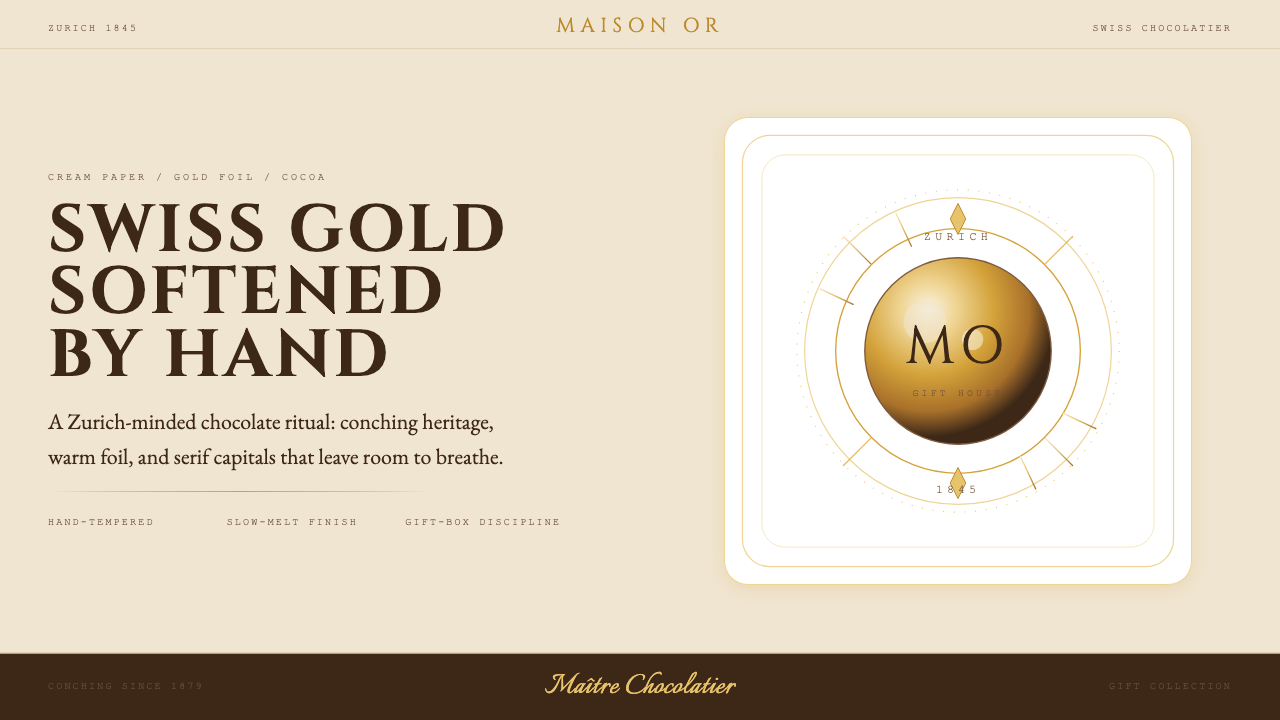 Lindt Swiss ChocolateOld-world luxury, softened. Gold foil, cocoa brown, and cream paper carry the…
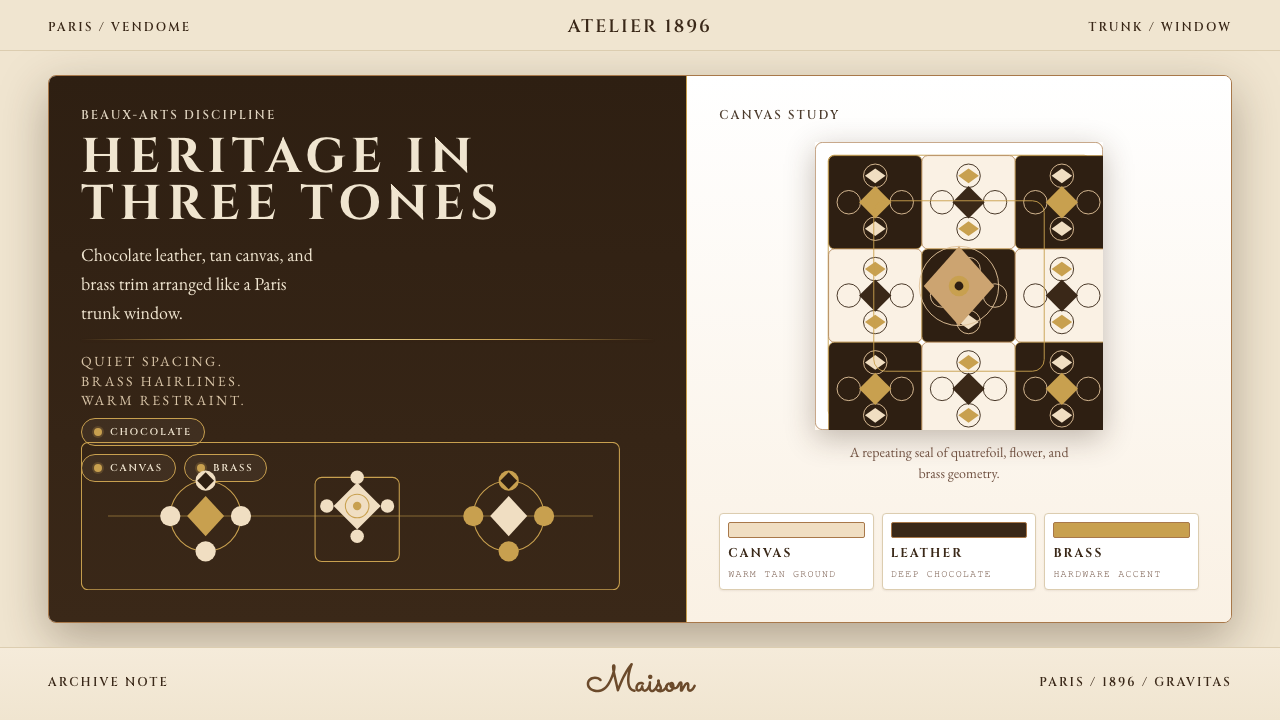 Louis Vuitton MonogramHeritage stays luminous. Chocolate, tan, and brass stage a Paris trunk window.
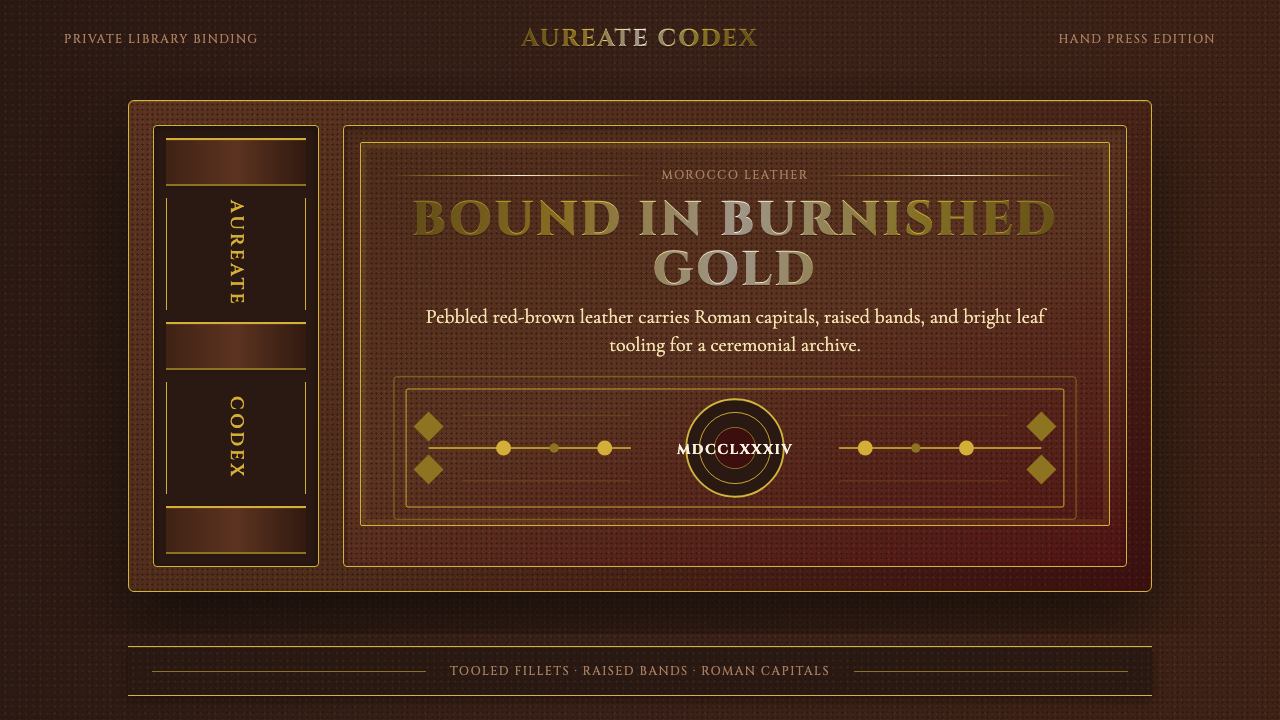 Gilt Leather BindingWeight without noise. Deep Morocco leather, Cinzel capitals, and burnished gi…
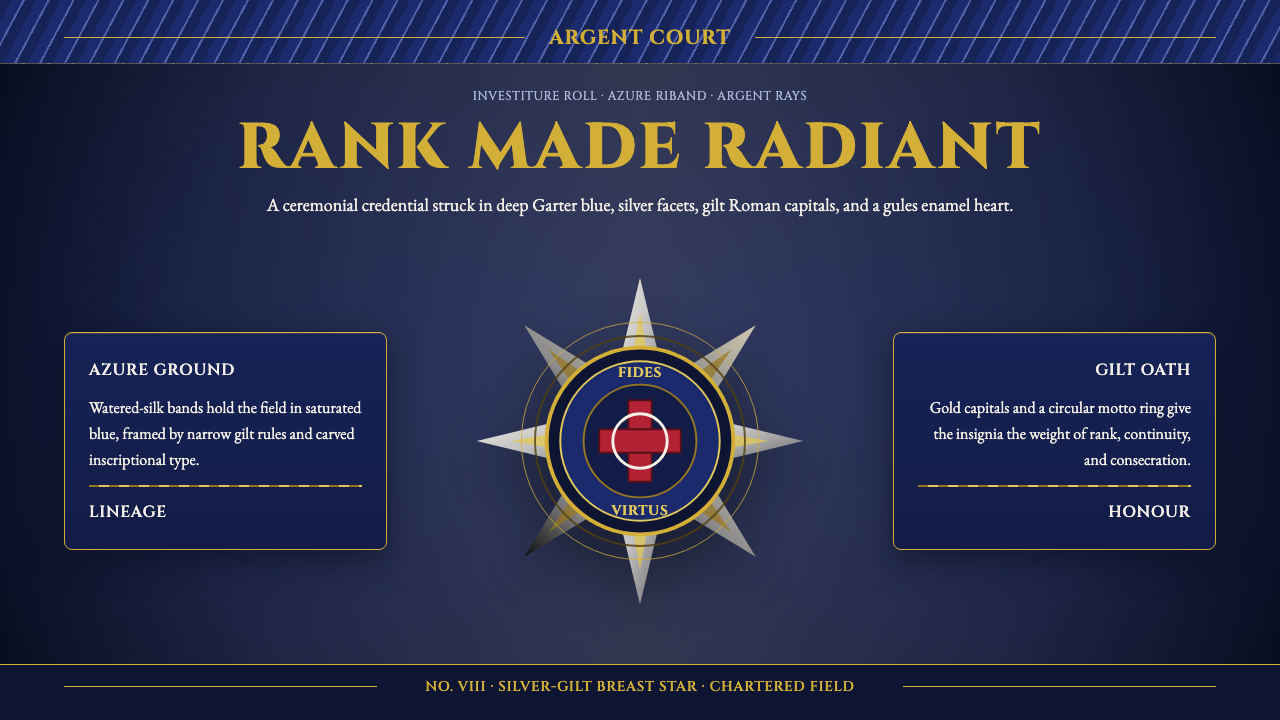 Order of Chivalry StarCeremony made metal. Garter blue, gilt Cinzel, and argent rays form a ranked…
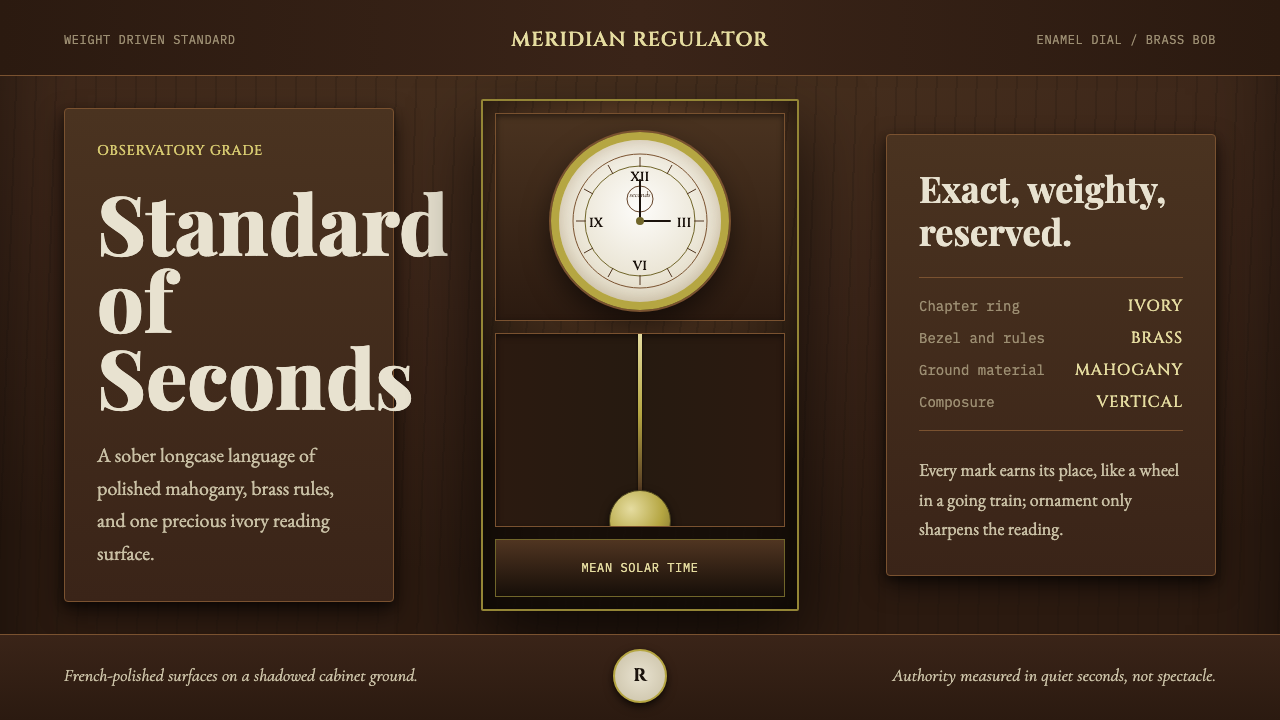 Regulator ClockSober authority. Brass rings and ivory dial lock mahogany into symmetry.
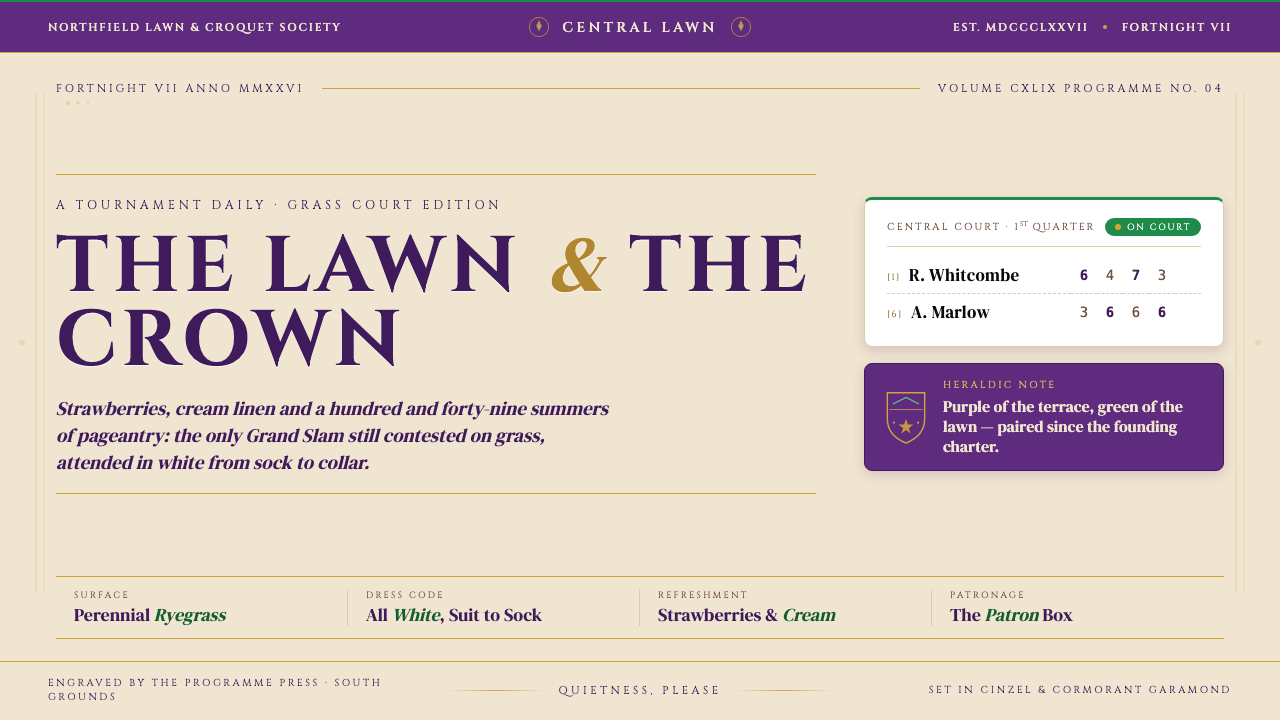 Wimbledon (Purple-Green)Centre Court in tokens. Regal purple and grass-green crest, cream linen, Cinz…