What is Romanian Orthodox Modern Revival?
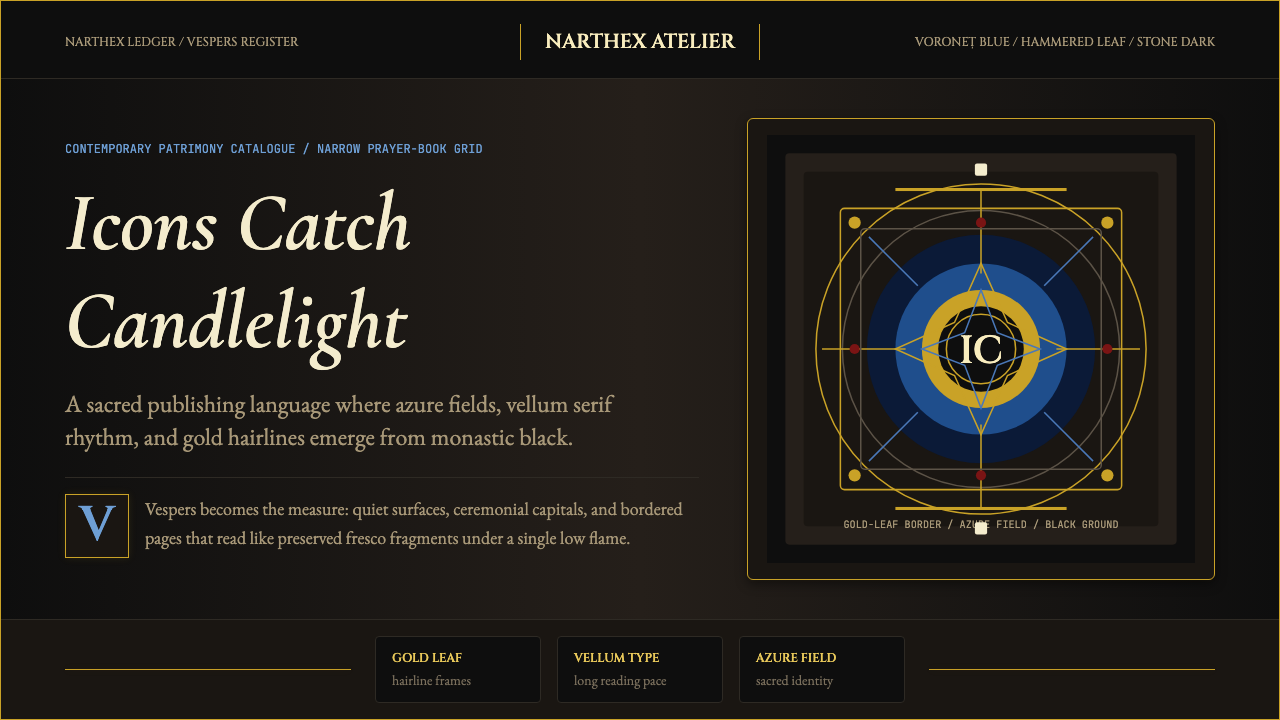
Romanian Orthodox Modern Revival summons five centuries of candlelit Bukovina monastery walls into contemporary dark-ground design, where sacred azure halos and hammered gold hairlines emerge from a monastic depth of black.
Romanian Orthodox Modern Revival in brief
Romanian Orthodox Modern Revival is a contemporary design aesthetic rooted in the iconographic and architectural traditions of Romanian Eastern Christianity. It draws directly from the painted monasteries of Bukovina — most famously Voroneț, Sucevița, and Moldovița — whose exterior frescoes have survived outdoors since the fifteenth and sixteenth centuries, and from the stone-carved ornament of the Brâncoveanu style developed in Wallachia during the late seventeenth and early eighteenth centuries. The result is a visual language that is simultaneously ancient and deliberately contemporary: dark grounds, restrained sacred chroma, gold as a structural rather than decorative element, and a compositional order borrowed from iconostasis arrangement.
Unlike many historical revival movements that merely borrow surface motifs, this aesthetic is grounded in a theology of image. Eastern Orthodox visual tradition holds that an icon is not a picture of a holy figure but a window into a spiritual reality — the image participates in what it depicts. This gives Romanian Orthodox-derived design its characteristic intensity: nothing in the composition is casual or purely decorative. Gold halos are theological statements about divine light; the deep-blue grounds of Voroneț reference the heavenly realm rather than a earthly sky; the hierarchical arrangement of figures from center outward follows liturgical logic, not compositional preference.
The modern revival emerged after 1989, when Romania's transition away from communism enabled a broad recovery of Orthodox patrimony. Churches were restored, iconographic workshops reopened, and a generation of artists trained in traditional egg-tempera techniques while also working in digital media. Designers and visual artists began drawing on this recovered tradition not as nostalgia but as a living aesthetic resource — one with sufficient visual richness, symbolic depth, and cultural specificity to stand against the homogeneity of global digital design.
Where does Romanian Orthodox Modern Revival come from?
The deepest root of this aesthetic lies in the painted monastery tradition of Bukovina, a region in northeastern Romania. Between 1488 and 1547, Moldavian princes — most notably Stephen the Great and his successors — commissioned the painting of entire exterior walls of monastery churches. At Voroneț, founded in 1488, a vivid azure was applied across the south-facing exterior wall to depict the Last Judgment on a scale impossible to execute inside the nave. This blue, produced from lapis lazuli and azurite minerals ground into Byzantine-recipe binders, achieved a depth and luminosity that no later restoration has fully replicated. It became known simply as Voroneț blue — a specific chromatic identity so singular that it functions as a cultural landmark the way Yves Klein blue does in Western modern art, but with five centuries more institutional weight.
The second major historical current is the Brâncoveanu style, named after Constantin Brâncoveanu, Prince of Wallachia from 1688 to 1714. Brâncoveanu patronized a hybrid architectural and ornamental language that fused Byzantine iconographic tradition with Italian Renaissance stone-carving techniques, Ottoman decorative motifs, and local Romanian folk patterns. The result was an extraordinarily rich vocabulary of interlaced vine scrolls, trefoil arches, acanthus capitals, and foliated column shafts — all rendered in limestone with a precision that gives even the most elaborate carvings a quality of controlled clarity. Brâncoveanu himself was eventually executed by the Ottomans in 1714, making him a martyr-figure in Romanian Orthodox memory, and his stylistic legacy was formally preserved by the Romanian Orthodox Church as an emblem of both spiritual and national continuity.
The monastic context for this aesthetic deepened through the influence of the Stavropoleos Monastery in Bucharest, founded in 1724 and surviving as one of the most complete examples of Brâncoveanu-influenced urban religious architecture. Its courtyard, carved portico, and interior fresco program established an experiential template for what Romanian sacred space looks like: enclosed and intimate in scale, richly carved at eye level, dark and candlelit within, with gold and deep color emerging from shadow rather than being illuminated by ambient light. Contemporary designers working in this tradition consistently reference the Stavropoleos atmosphere — the sensation of visual richness revealing itself slowly from darkness — as the intended experiential register.
After 1989, the post-communist recovery of Romanian Orthodox identity accelerated the development of a self-conscious modern revival. The Prodromu workshop on Mount Athos — the monastic community on the Greek peninsula where Romanian monks have maintained a continuous presence since the medieval period — became a center for rigorous training in traditional Byzantine iconography, producing painters who returned to Romania and opened workshops in Bucharest and other cities. Artists such as Sorin Dumitrescu and Father Iustin Marchiș contributed to theoretical frameworks for understanding how iconographic principles could be applied beyond the church context. By the 2010s, a distinct aesthetic had emerged in Romanian graphic design, typography, and digital product design that drew on this vocabulary while operating entirely outside ecclesiastical commissions — dark grounds, gold hairlines, the specific azure of Bukovina, and a compositional gravity borrowed from the iconostasis.
What defines the Romanian Orthodox Modern Revival look?
Dark Ground
The defining structural choice of this aesthetic is the ground: a deep, near-black that functions not as absence but as a field of potential sacred depth. In Byzantine iconographic practice, the gold ground behind a figure represents the divine uncreated light of eternity — the background is not empty space but the most theologically charged element of the composition. The Romanian Orthodox modern revival translates this into a very deep, near-lightless dark ground that gives all other elements their luminous charge. Nothing on this ground is casually placed; everything that appears against the darkness must justify its presence by radiating visual light.
Sacred Azure
The specific blue drawn from the Voroneț monastery tradition occupies a narrow chromatic register — deep, slightly muted, carrying the visual weight of mineral pigments rather than synthetic brightness. It is not the vivid blue of a screen at full saturation, nor the pale blue of a corporate interface, but a dense, slightly oxidized azure that reads as ancient even on a contemporary display. In the modern revival, this blue is deployed with restraint — typically reserved for halos, architectural highlights, or the most significant structural divisions in a layout — treating it as a color of theological rather than decorative significance.
Gold as Light
Gold in the Byzantine tradition is not a color of luxury or wealth in the secular sense — it is the material representation of uncreated divine light, a radiance that does not come from a natural light source but from the sacred reality it depicts. In Romanian Orthodox modern revival design, gold is deployed as hairlines, thin rules, accent marks, and halo rings rather than as filled areas or background washes. Its restraint is essential: gold used sparingly against deep black produces the visual effect of light emerging from darkness — the very phenomenon it was chosen to represent. Gold used generously becomes mere gilding.
Liturgical Typography
Text in this tradition moves at the pace of a lectionary — the slow, measured rhythm of liturgical reading rather than the scanning speed of a web interface. Typography is set with generous line spacing, a narrow measure that enforces deliberate reading, and strong vertical rhythm. The preferred letterforms are serifs with roots in calligraphic or stone-carved traditions, carrying the visual weight of inscription rather than printing. Hierarchy is established through measured variation in weight and size rather than contrasting families. The reading experience is meant to feel like moving through a space of textual depth, not processing information efficiently.
Iconostasis Composition
The iconostasis — the carved and icon-laden screen that separates the nave from the sanctuary in Orthodox churches — provides the compositional logic for this aesthetic. It is not a free arrangement but a rigidly hierarchical one: the most sacred figures occupy the center and upper registers, lesser sacred figures descend outward and downward, and the architectural frame organizes everything according to theological rather than visual priority. Contemporary designs in this tradition inherit this logic: the central visual element carries maximum weight, surrounding elements diminish in visual authority proportionally, and the overall frame — borders, rules, margins — is a structural actor, not a passive container.
Chiaroscuro Depth
Romanian Orthodox sacred art is an art of emergence: figures, inscriptions, and ornamental detail are meant to appear as if they are surfacing from darkness rather than being placed on a neutral ground. This is not the dramatic chiaroscuro of Baroque painting — it is more restrained, more architectural, more about revealed depth than theatrical contrast. In the modern revival, this translates into a compositional approach where the brightest elements — gold accents, azure highlights, pale lettering — appear to float slightly above a ground that recedes into depth. Gradations are not literal gradients but rather the visual logic of candlelight: things seen from a slight distance in low light.
Ornament as Theology
Ornament in the Brâncoveanu tradition is not merely decorative — it is a visual argument about the ordered beauty of creation. The interlaced vine scrolls that run along column shafts and portal frames reference the Vine of Life from the Gospel of John; the acanthus capitals that top every column echo the ancient symbol of immortality; the trefoil arch above every doorway is a Trinitarian form. In the modern revival, ornamental elements derived from this tradition are used sparingly but with full awareness of their symbolic genealogy. A vine-scroll border on a layout is not a flourish — it is a claim about the nature of the work's subject. Designers working in this register do not reach for ornament casually.

Who shaped Romanian Orthodox Modern Revival?
Prince of Wallachia from 1688 to 1714, Brâncoveanu was both the political patron and symbolic martyr of the aesthetic tradition bearing his name. He commissioned an extraordinary program of church building, monastery construction, and manuscript illumination that synthesized Byzantine, Renaissance, and Ottoman decorative vocabularies into a distinctively Romanian visual language. His execution by the Ottomans in 1714 — along with his four sons and his advisor, all of whom refused to convert to Islam — was canonized by the Romanian Orthodox Church in 1992, making him simultaneously a historical design patron and a recognized saint. The style he patronized carries this dual weight: it is both a historical aesthetic and a sacred emblem.
A painter, theorist, and public intellectual who became one of the most visible advocates for a rigorous contemporary application of Orthodox iconographic principles in Romanian visual culture. Dumitrescu argued that the icon's visual grammar — its rejection of perspectival illusionism, its use of inverse perspective to draw the viewer into rather than through the image, its insistence on flat gold ground as divine reality — offered a genuine alternative to both Western modernism and the kitschy religious eclecticism of post-communist Romania. His published writings and his work as a painter provided a theoretical armature that subsequent designers and artists could draw on without having to defend the tradition from first principles.
A monastic painter and theologian who worked at the intersection of traditional iconographic technique and contemporary visual inquiry. Father Iustin's significance lies in his insistence that traditional Byzantine iconography is not an archaeological pursuit but a living practice with its own internal logic of development — that the tradition evolves not by absorbing contemporary styles but by deepening its own formal principles. His workshop practice and his writings on the theology of beauty have been influential for a generation of Romanian artists navigating the tension between iconographic fidelity and contemporary relevance.
The Prodromu workshop, based at the Romanian Skete of Prodromu on Mount Athos, represents the most rigorous institutional continuity of traditional Byzantine iconographic training accessible to contemporary Romanian painters. Mount Athos, the monastic peninsula in northern Greece, has maintained Romanian monastic communities since at least the fourteenth century, preserving craft traditions — egg-tempera technique, gilding with gold leaf, the specific color relationships and hierarchical compositional logic of Byzantine painting — in a continuous line of practice. Painters trained at Prodromu returned to Romanian cities with both technical mastery and a theological framework for understanding what they were making and why, providing the revival movement with its most technically credible practitioners.
Prince of Moldova from 1457 to 1504 and one of the most prolific patrons of religious architecture in Romanian history, Stephen commissioned over forty churches and monasteries during his reign — including the foundation of Voroneț in 1488, built after his victory over the Ottomans at the Battle of Vaslui. The painted-monastery tradition of Bukovina — which later generations would experience as the defining historical aesthetic of Romanian Orthodox visual culture — is substantially his creation. He was canonized by the Romanian Orthodox Church in 1992, the same year as Brâncoveanu, giving both the historical originator and the later refiner of the tradition the status of saints whose legacy carries spiritual as well as aesthetic authority.
How do you use Romanian Orthodox Modern Revival today?
Romanian Orthodox Modern Revival is among the most contextually specific design aesthetics available — applying it well requires understanding not just its surface appearance but its underlying logic of sacred chiaroscuro and hierarchical composition. The core challenge for contemporary designers is translating a tradition built around illuminated manuscripts, exterior fresco programs, and architectural stone carving into digital surfaces without stripping out the gravitas that makes the tradition meaningful. The aesthetic rewards restraint and patience; it does not compress well into rapid consumer-facing interactions.
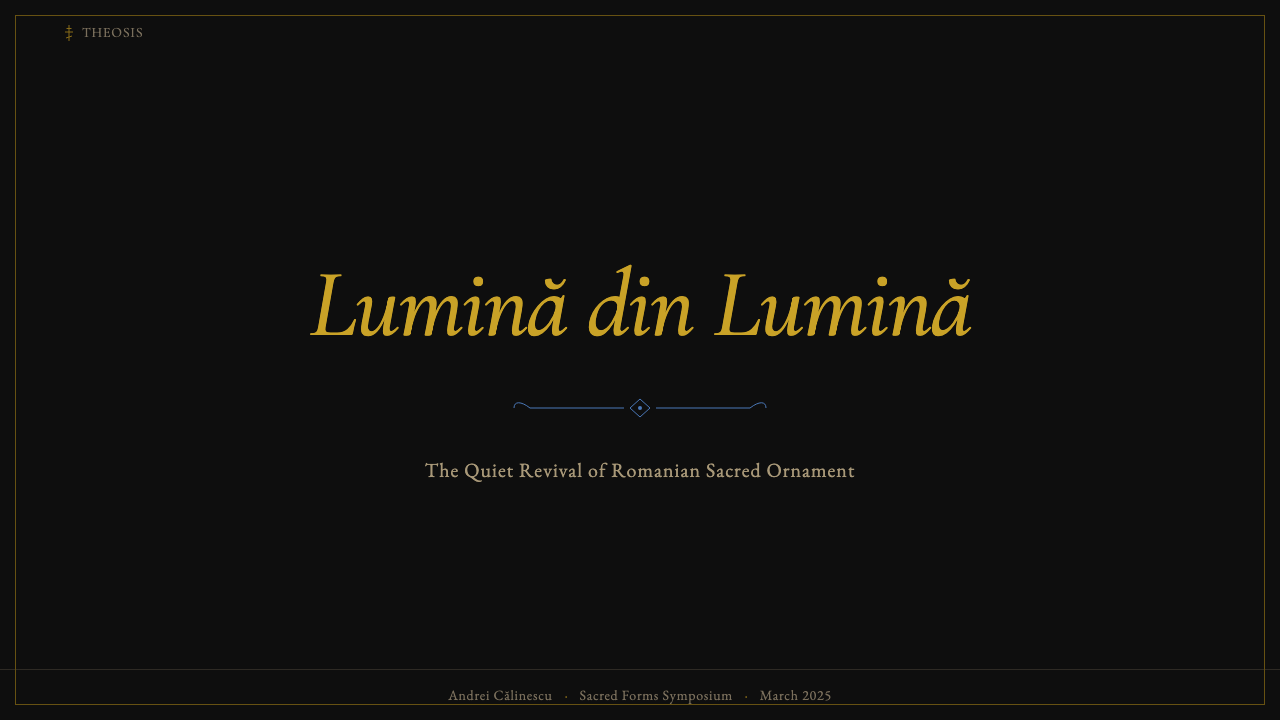
For presentation slides, this aesthetic is most powerful in contexts where the subject matter has genuine weight — cultural institutions, memorial or historical presentations, significant organizational announcements, premium brand identity reveals. A cover built in this tradition will use a very deep background, a single gold hairline or ornamental motif to establish the frame, and lettering in a serif with calligraphic roots set at a scale that commands the page. The title is not a quick scan point but an inscription. Content slides should resist the temptation to lighten the palette for readability; instead, text set in warm near-white against deep near-black produces the candlelit legibility that is the aesthetic's characteristic register. Data, if present, should be treated as inscription rather than infographic — presented in precise tabular form with gold rules as structural dividers, avoiding chart types that imply casual accessibility.
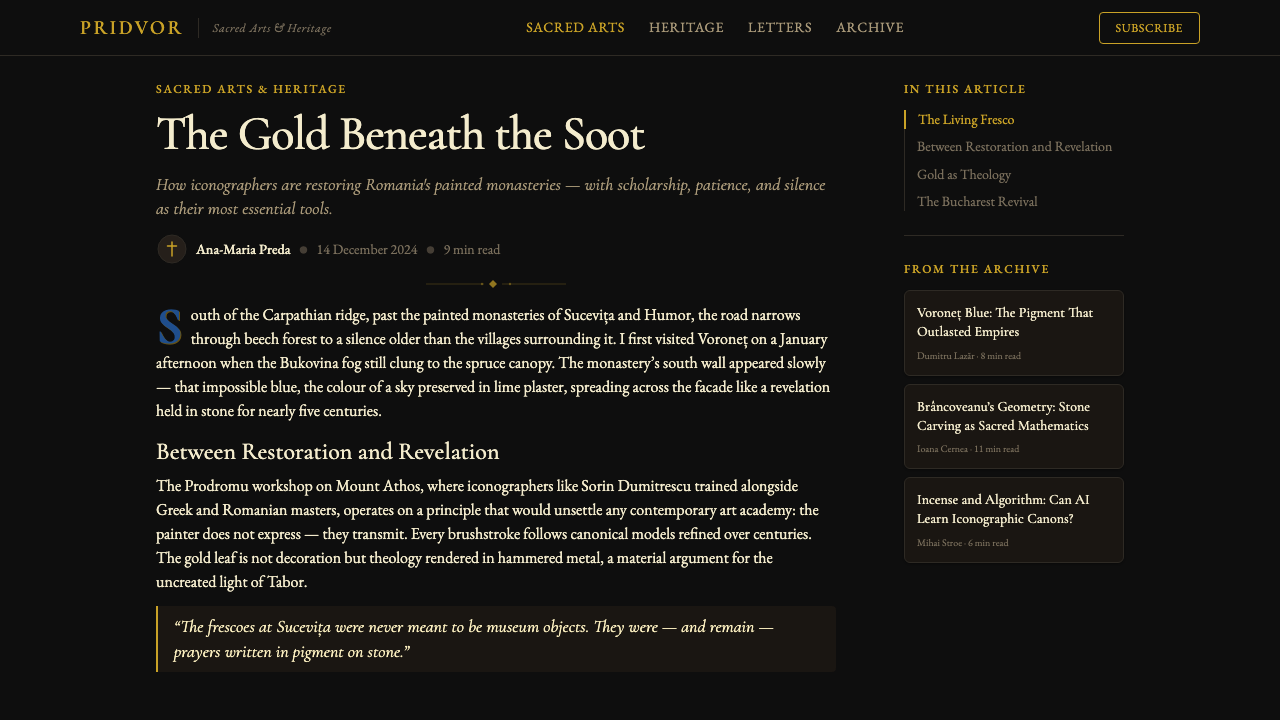
For web interfaces, the style is best suited to long-form reading experiences, premium cultural institutions, liturgical or theological digital publishing, and high-end hospitality brands with genuine heritage claims. The compositional logic favors single-column layouts with generous vertical rhythm, deep backgrounds broken only by the most necessary structural elements, and navigation that is sparse — almost deliberately difficult to find — because the content is meant to reward focused attention rather than browsing. Interactive states should use the gold accent sparingly: a gold underline on hover, a gold border on a focused input, rather than color fills that overwhelm the dark ground.
For editorial and marketing work, the aesthetic supports long-form storytelling and cultural authority claims better than conversion-focused marketing. An editorial layout in this tradition will carry a single large image — treated as an icon rather than a photograph, cropped to isolate its subject against a near-black ground — with body text set in a measured column below or alongside. Pull quotes, if used, should feel like illuminated inscriptions rather than highlighted excerpts: isolated on the page, surrounded by generous space, and ornamented with a single gold rule above or below. The aesthetic is poorly suited to promotional contexts emphasizing discounts, urgency, or casual approachability; it implies that the content is worth sustained attention, and the design should support that claim rather than undercut it.
The most common mistake in applying this aesthetic is treating the gold and azure as mere color choices decorating an otherwise conventional layout. The style's power comes from the relationship between those colors and the deep ground — from the logic of emergence rather than placement. Gold hairlines that appear to glow against near-black produce a completely different effect from the same color used as a fill against a neutral grey. Similarly, the sacred azure derives its power from its density and restraint; diluting it into a generic corporate blue or expanding it beyond its traditional role as a field of theological significance immediately collapses the visual logic. A layout in this tradition should feel as if its visual elements have been revealed rather than designed.
A common practical error is overcrowding the composition. Orthodox sacred composition depends on hierarchical emptiness — much of the space around a central figure is held deliberately, not because the painter ran out of content but because the surrounding space is itself a theological statement about divine transcendence. Contemporary designers accustomed to filling every pixel of a layout will find this hard to honor; the temptation to add secondary graphics, supporting imagery, or navigational elements to unused space should be resisted. The deep, near-empty surround is doing essential work.
Romanian Orthodox Modern Revival — FAQ
How does this aesthetic differ from general Byzantine or Eastern Orthodox design?
Byzantine and Eastern Orthodox design encompasses an enormous range of national and regional traditions — Greek, Russian, Serbian, Bulgarian, Georgian, Coptic, and others — each with distinct chromatic registers, ornamental vocabularies, and compositional conventions. Romanian Orthodox Modern Revival is specifically rooted in the Moldavian painted-monastery tradition of exterior fresco programs (most visibly at Voroneț, Sucevița, and Humor), in the Brâncoveanu architectural ornament of Wallachia, and in the post-1989 recovery of these traditions within a contemporary Romanian context. It is darker in ground than most Greek or Russian Byzantine traditions, more specific in its azure reference, and more heavily inflected by the Brâncoveanu ornamental vocabulary than a generically pan-Orthodox approach would be.
Can this aesthetic work for secular brands and products?
Yes, but only where the brand has genuine claims to depth, heritage, cultural seriousness, or premium positioning that the aesthetic's weight can honestly represent. The visual language carries with it associations of sacred seriousness and ancient authority — these are powerful communicative assets, but they are also demanding. A brand that applies this aesthetic without the substance to back it up will appear pretentious rather than distinguished. Where it works well: premium wine, spirits, or food brands with genuine regional heritage; cultural institutions such as museums, concert halls, or publishing houses; luxury hospitality brands with authentic historical properties; memorial or commemorative design projects. Where it does not work: consumer technology, startup brands emphasizing accessibility and friendliness, healthcare products requiring approachability, or any context where the user needs to feel in control rather than in the presence of something larger than themselves.
How should ornamental elements be sourced and used responsibly?
This is one of the most important questions for designers working in this tradition. The ornamental vocabulary — vine scrolls, trefoil arches, acanthus capitals, specific mandorla and halo forms — carries specific iconographic and theological meaning within its source tradition. Using these elements purely as surface decoration without awareness of their symbolic content is possible but produces a superficial result that practitioners within the tradition will recognize as empty. The responsible approach is to understand what each ornamental form means in its original context and to use it only where that meaning is either relevant or honestly set aside — not obscured by ignorance. Designers who engage seriously with this tradition typically study its iconographic grammar, consult with practitioners, and make deliberate choices about which elements to adopt and why, rather than treating the vocabulary as a clip-art library.
What is the relationship between this style and Romanian national identity?
The relationship is deep but not simple. The painted monasteries of Bukovina, the Brâncoveanu style, and the Orthodox iconographic tradition are all central to Romanian national cultural memory — they survived periods of Ottoman suzerainty, Habsburg administration, and communist suppression, and emerged in the post-1989 period as touchstones of cultural continuity. The Romanian Orthodox Church itself is a major institutional carrier of national identity, which gives this visual tradition a political and cultural freight beyond its purely aesthetic dimensions. Designers working in this tradition outside Romania should be aware of this weight and consider whether their use of the aesthetic is in dialogue with or indifferent to its national and religious context. Within Romania, the visual tradition is contested as well as revered — there are ongoing debates about the relationship between authentic iconographic practice and nationalist appropriation, and thoughtful designers engage with this complexity rather than resolving it prematurely.
How does the dark ground of this style affect accessibility and readability?
A well-executed dark-ground layout in this tradition achieves high contrast between the very dark background and near-white or gold text, which can satisfy accessibility contrast requirements if the specific tonal values are chosen carefully. The challenge is that the aesthetic's characteristic palette — warm near-white text, gold hairlines, and deep azure accents — requires precise calibration to achieve both the visual atmosphere and the technical contrast thresholds required for legibility. The greater readability risk is not contrast but density: long-form text set in a calligraphic serif at generous leading on a dark ground requires careful optical-size adjustment to remain readable at body text sizes, particularly on lower-resolution displays. The tradition itself was not concerned with rapid information processing; the reading pace it implies is measured and deliberate. Designers who want to apply the aesthetic in genuinely accessible contexts will need to honor the aesthetic's tonal relationships while ensuring that the practical legibility requirements of diverse audiences are met.
Related design styles
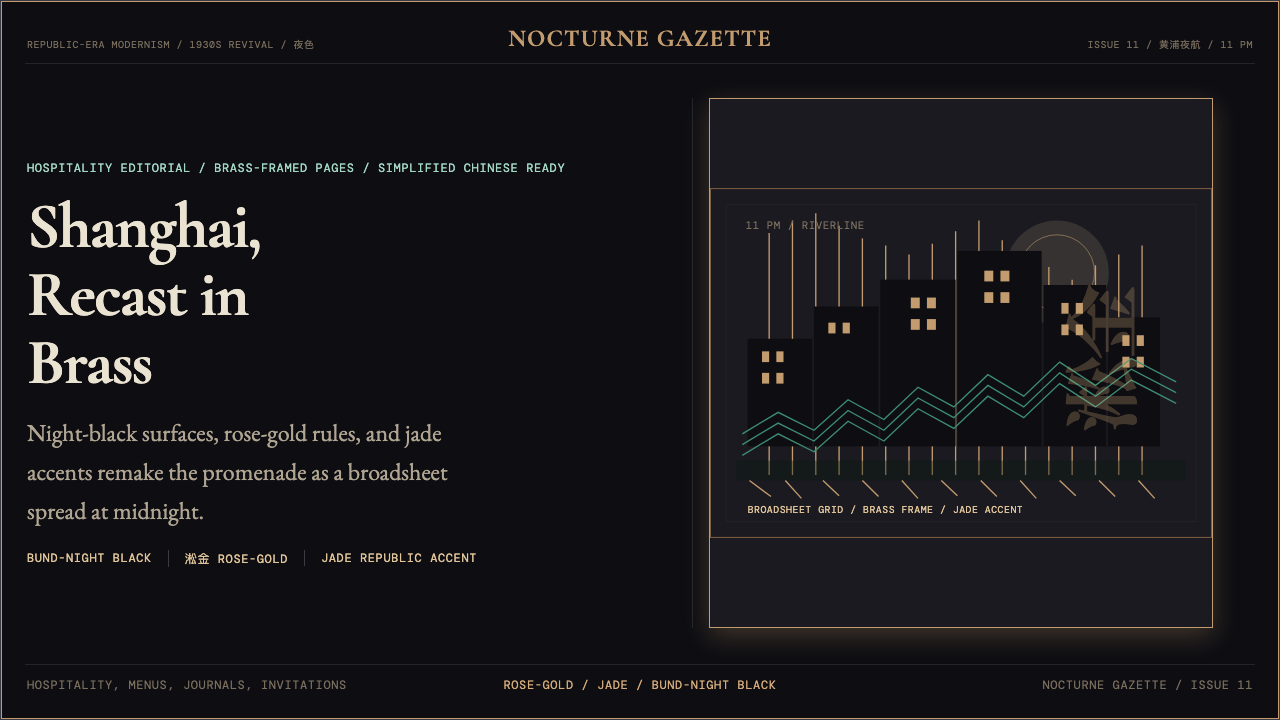 Shanghai Bund Art Deco RevivalNight-black Deco luxury. Rose-gold lines, jade accents, and broadsheet type s…
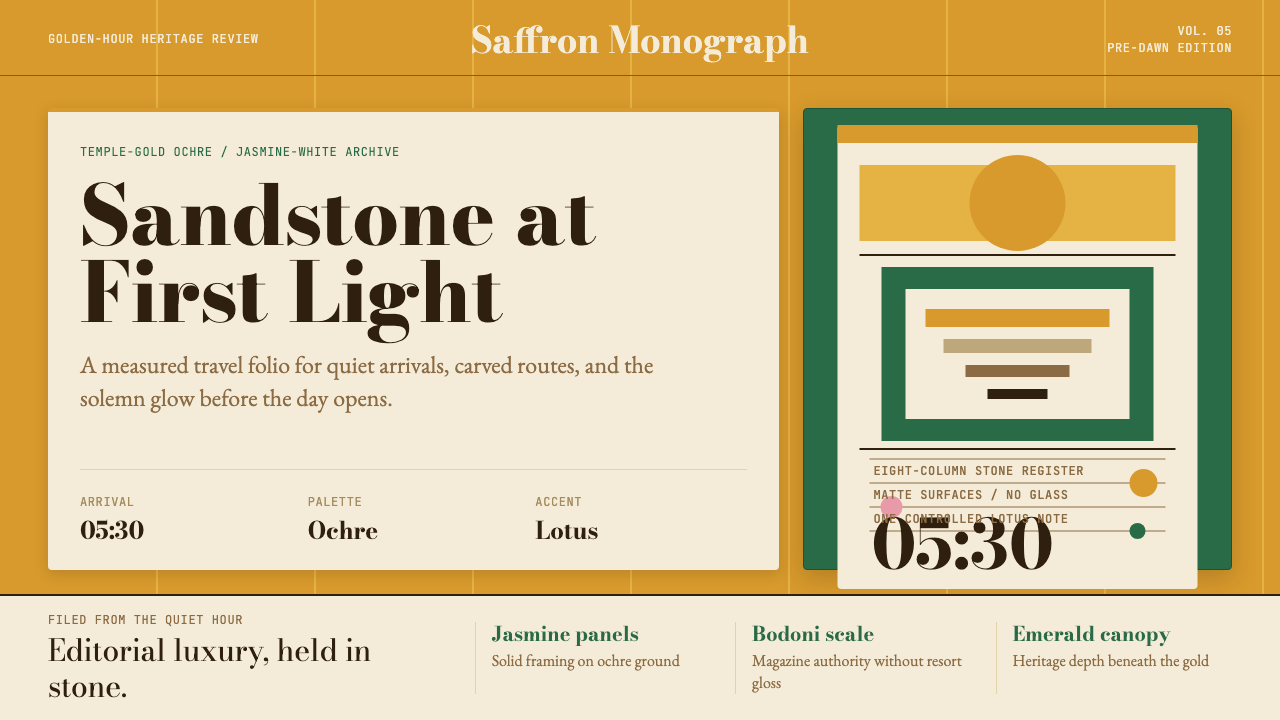 Cambodian Angkor Tourism ModernQuiet authority at dawn. Ochre ground, Bodoni serif, jasmine panels, one lotu…
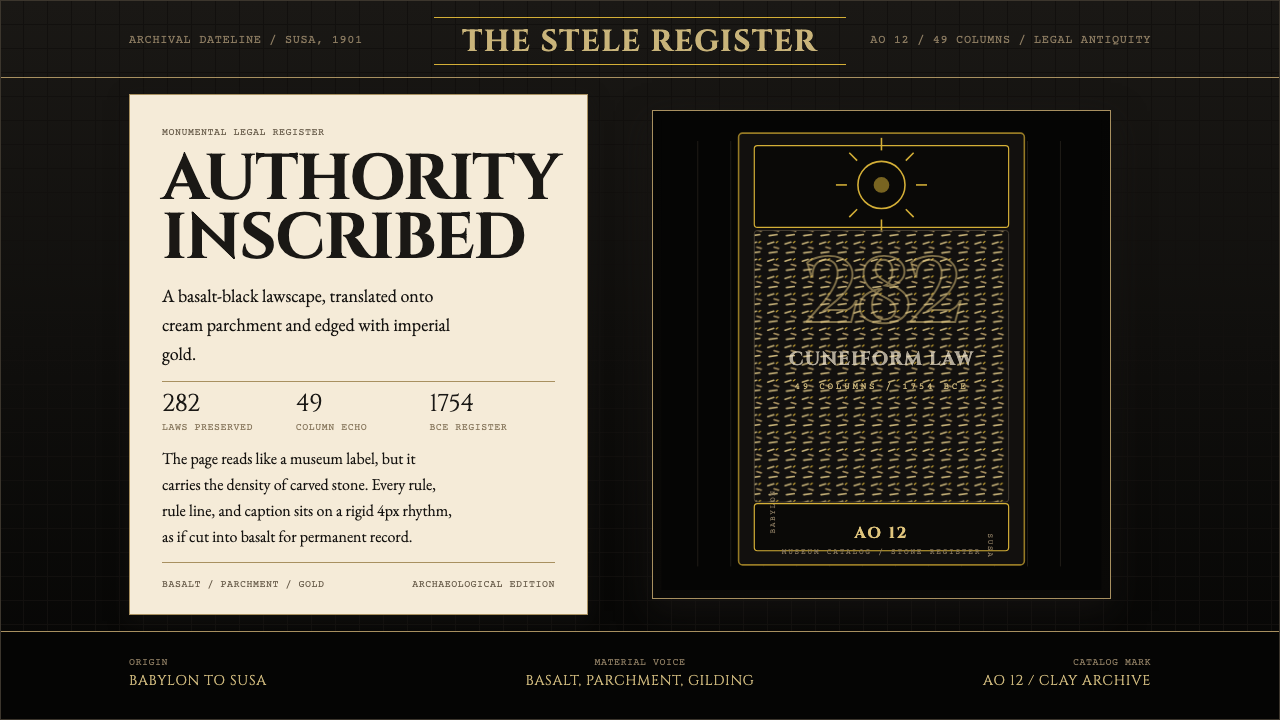 Babylonian Hammurabi SteleAuthority carved in stone. Basalt-black grids, parchment panels, and imperial…
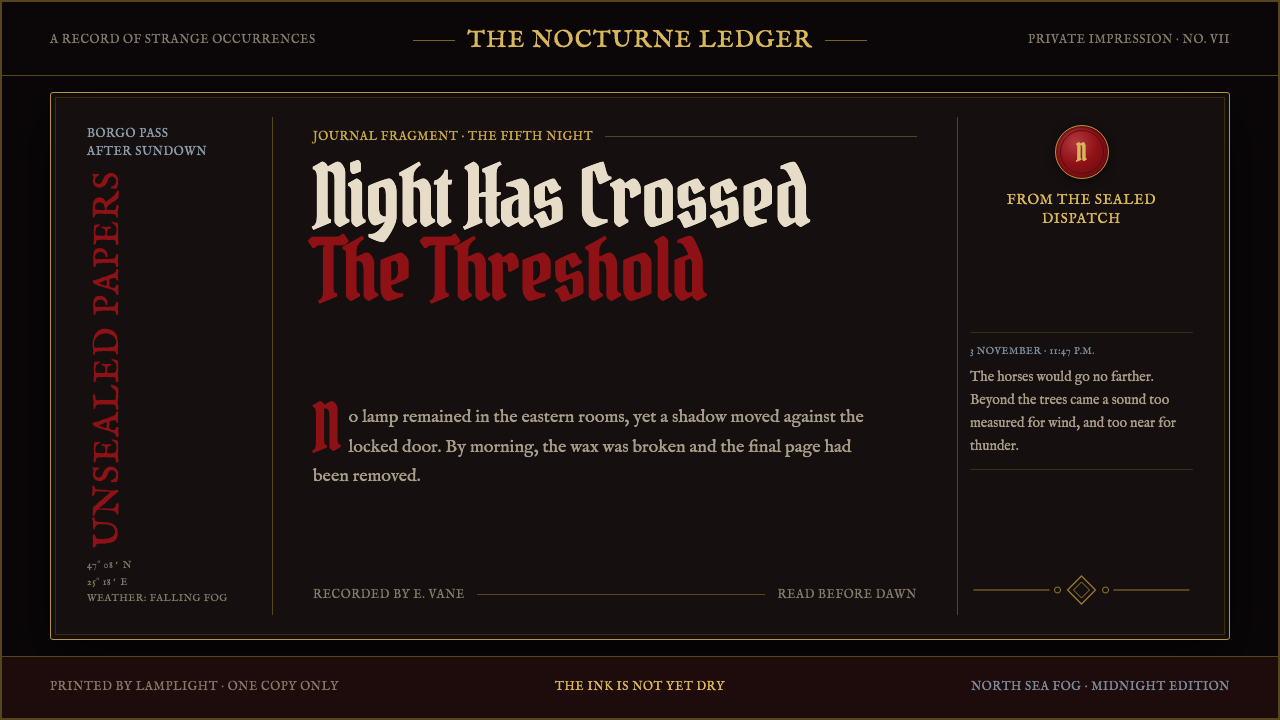 Dracula Gothic (1897)Victorian dread after dark. Blood-red initials and tarnished gilt haunt coffi…
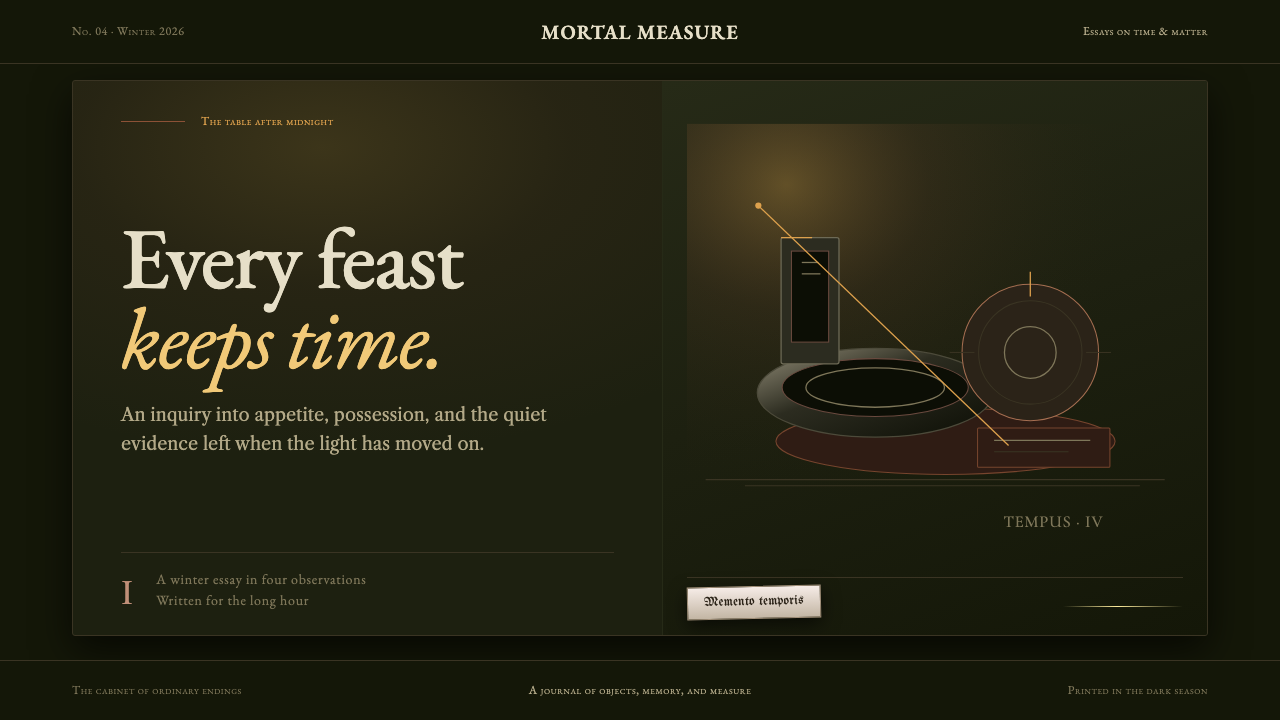 Dutch VanitasTime waits at the table. Olive-black depths, earth-brown type, and one candle…
 Ex Libris BookplateScholarly ownership, cut in ivory. Cinzel caps and crosshatch rules rise from…