What is Cambodian Angkor Tourism Modern?
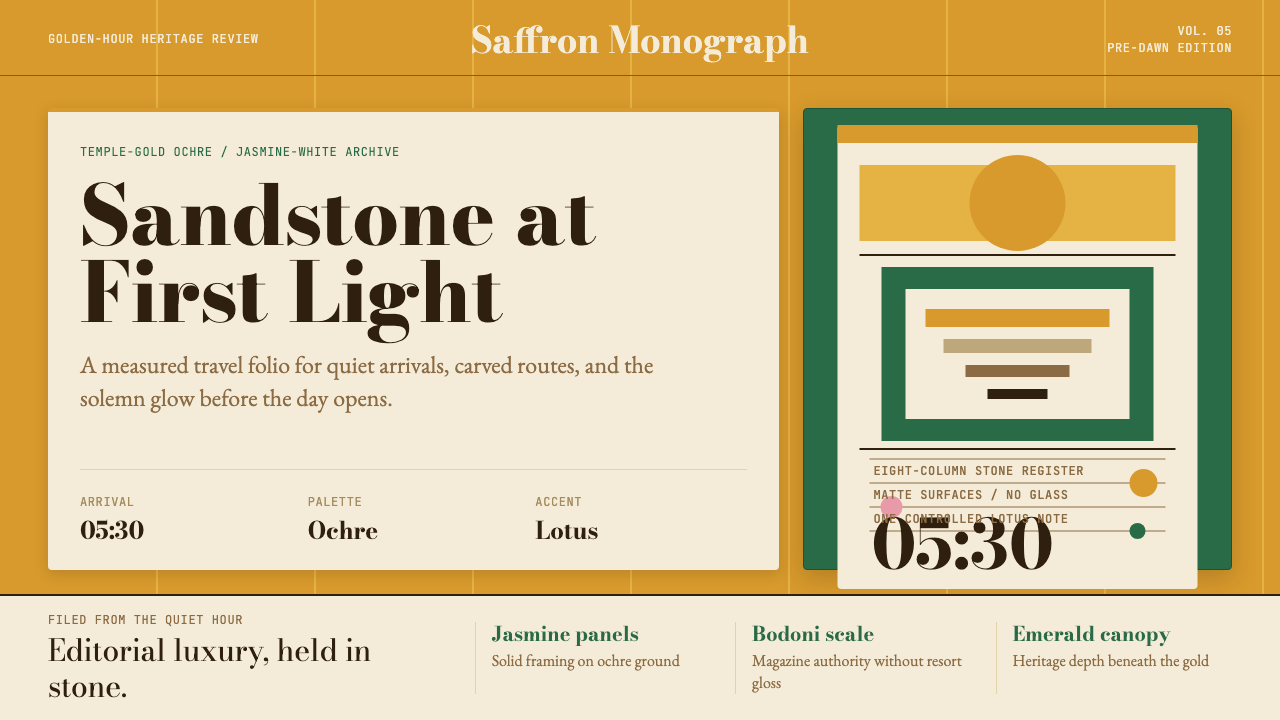
Temple-gold ochre, heritage serif type, and the hushed grandeur of Angkor at dawn — Cambodia's luxury tourism design language turns ancient wonder into editorial authority.
Cambodian Angkor Tourism Modern in brief
Cambodian Angkor Tourism Modern is the visual system that emerged from Cambodia's luxury hospitality and national branding sector, crystallized across the boutique hotels and heritage lodges of Siem Reap, the promotional campaigns of the Cambodia Tourism Federation, and the editorial photography that has defined how the world pictures Angkor Wat since the temple complex received UNESCO World Heritage status in 1992. It is not a folk aesthetic or an archaeological pastiche — it is a contemporary design language that uses historical material with editorial precision.
At its core, the style pairs a warm ochre ground — the color of Angkor's sandstone at the first light of morning — with high-contrast serif type that carries the measured authority of a heritage travel magazine. Pale panels the color of jasmine blossoms break the ochre field, providing breathing room for text and imagery. A single lotus-pink accent, used sparingly, evokes the sacred flower central to Khmer iconography without sliding into decorative excess. The result reads simultaneously as ancient and modern: the palette is rooted in the temple stones, but the compositional discipline is firmly contemporary.
This is a system built for trust and aspiration. Its visual weight communicates that what is being described — a destination, a property, a cultural experience — merits serious attention. It is the design language of a country that has moved from post-conflict reconstruction into a position of genuine cultural confidence, and that confidence is legible in every layout that applies the system correctly.

Where does Cambodian Angkor Tourism Modern come from?
The roots of this visual language reach back to 1992, when UNESCO inscribed Angkor on its World Heritage List, triggering an international reappraisal of Cambodia as a destination of profound cultural significance rather than merely a country recovering from the Khmer Rouge era. The inscription did not immediately produce a coherent visual identity — the early tourism materials of the 1990s were uneven and largely generic — but it established the cultural authority that later designers would draw upon. The physical architecture of Angkor became the raw material: the warm honey-gold of its laterite and sandstone, the delicate bas-relief patterns of devatas and apsaras, the proportional grandeur of the central towers reflected in the reservoir pools at sunrise.
The decisive turn came in the 2000s and especially the 2010s, as Siem Reap developed into a fully formed luxury hospitality destination. Hotel designers and art directors — most notably the Bangkok-based architect Bill Bensley, whose properties across Southeast Asia deploy historical material with theatrical confidence — began developing visual identities for properties that needed to communicate both Cambodian authenticity and international luxury standards simultaneously. These identities required a design language that could carry weight in the pages of Condé Nast Traveller and on the walls of a hotel lobby: editorial-grade type, a palette anchored in the specific light of the Angkor plain, and a compositional approach refined enough to hold its own against any global luxury brand.
Parallel to this hospitality design movement, the Cambodian government invested in the Kingdom of Wonder national branding campaign, which sought to position Cambodia in regional tourism competition against Thailand, Vietnam, and Myanmar. The campaign's visual identity drew on many of the same materials — temple imagery, warm-ground palettes, high-contrast serif type — but adapted them for mass-market tourism communications: airport signage, airline seat-back screens, travel trade fair materials. This public-sector work helped standardize certain visual conventions that the private luxury sector had been developing independently.
The Khmer-script revival design movement contributed another layer of cultural authenticity. Khmer script — one of the world's oldest living writing systems, dating to the seventh century CE — had been systematically suppressed and nearly destroyed under the Khmer Rouge. Its revival as a designed element in contemporary signage, menus, hotel collateral, and brand identities became an assertion of cultural continuity. When Khmer script appears alongside Bodoni-weight Latin serif type, the pairing is not decorative bilingualism — it is a statement about a civilization that predates most European institutions and has survived into confident modernity.
What defines the Cambodian Angkor Tourism Modern look?
Palette
The palette is anchored by a deep, warm ochre that reads as sandstone in morning light — the color of Angkor's central towers photographed at the hour before full sunrise. Against this ground, panels of near-white with a faint warm undertone (the color of jasmine or aged parchment) provide contrast without the severity of pure white. A single accent in muted lotus pink appears rarely but purposefully — on a decorative rule, a highlighted quote, or a subtle border — and reads as a cultural marker rather than a branding color. Deep ink-brown replaces black for type and structural elements, softening the contrast while maintaining full legibility.
Typography
High-contrast serif type in the tradition of Bodoni and classical Garamond defines the editorial register of the system. The contrast between the thick strokes and hairline-thin serifs echoes the deep carving of Angkor's stone inscriptions while situating the design firmly in the vocabulary of heritage magazine publishing. Headlines are set generously large, with wide tracking and ample surrounding space — nothing is crowded. Body text adopts a narrower measure with slightly open line spacing, prioritizing reading comfort in long-form travel narrative. Decorative calligraphic forms appear only as accent motifs, never as functional type.
Structural Ornamentation
Unlike strictly modernist systems, this style permits a narrow category of ornamentation — but only when that ornamentation is structurally motivated. Thin horizontal rules derived from the banded moldings of Khmer temple architecture divide sections with quiet authority. A repeated geometric border — sourced from the interlocking lotus petal patterns found in Angkor's ceiling reliefs — may appear as a frame element at the edge of a layout. These motifs are never applied freely or as fill; they mark boundaries and transitions, the same role they perform in stone.
Photography and Image Treatment
Photography is the system's primary illustrative mode, and it is treated with editorial restraint. Images are selected for atmospheric light — the golden-hour glow on stone, the soft diffusion of morning mist over the moat, the deep shadow that pools between carved figures. They are never heavily processed; the goal is to reveal the subject's own color and texture rather than impose a filter. Images bleed to the edge of the layout field or are given generous white borders that function like a matted frame — nothing in between. Tight crops on architectural detail are equally valid as wide atmospheric establishing shots.
Spatial Generosity
The system is not dense. Cambodian luxury hospitality, at its best, communicates through what is withheld as much as through what is shown — the long corridor that makes arrival feel ceremonial, the silence before the guide speaks. The same logic governs the layouts: generous margins, unhurried white space between sections, and a refusal to crowd the page with multiple competing elements. A spread with a single large photograph and four lines of type has more authority than one filled with callouts and supporting graphics. Restraint is the primary signal of quality.
Cultural Bilingualism
The system is designed from the ground up to accommodate both Khmer script and Latin type as co-equal visual elements, not as a translation afterthought. When Khmer appears alongside Latin serif, the two scripts are treated with consistent optical weight and vertical alignment — neither subordinated to the other. This bilingual integrity reflects the destination's self-confidence: Angkor does not need to translate itself into a Western visual register to command international respect. The co-presence of both scripts is itself a design statement.
Material Warmth
Where texture appears in the system, it is the texture of actual materials: the grain of handmade paper in a hotel collateral piece, the woven surface visible in a menu cover, the fine tooth of watercolor stock in a printed map. These textures are never simulated digitally — they arrive through physical substrate or through the faithful reproduction of a physically textured original. In digital contexts, the material warmth is achieved through the ochre palette and generous image treatment rather than through applied texture overlays, which the system treats as a form of fakery unworthy of the heritage it channels.

Who shaped Cambodian Angkor Tourism Modern?
The Bangkok-based architect and designer Bill Bensley has shaped the visual and spatial identity of luxury heritage hospitality across Southeast Asia more than any single figure of his generation. His properties in the Angkor region — including the Shinta Mani properties in Siem Reap — deploy historical Khmer visual material with theatrical confidence, integrating stone textures, temple proportions, and botanical motifs into fully realized luxury identities. Bensley's approach established the benchmark against which subsequent Cambodian luxury design is measured: that historical material should be engaged with scholarly depth and then expressed with joyful abundance rather than timid restraint.
As a key creative force behind some of Siem Reap's most refined boutique property identities, Olivier Piollet brought the sensibility of French editorial design into conversation with Khmer visual culture. His work demonstrates how the warmth of the Angkor palette and the architectural logic of Khmer spatial organization can be adapted for contemporary luxury communications without reducing either tradition to surface decoration. Piollet's output helped define what editorial-grade Cambodian tourism design looks like when it refuses both generic luxury minimalism and tourist-market kitsch.
Cherian Pothan contributed to shaping the hospitality design identity of the Angkor corridor through his work on property branding and experiential design that foregrounds the relationship between Cambodian craft traditions and international luxury hospitality standards. His approach treats Khmer material culture — weaving, lacquerwork, silversmithing — not as decorative add-ons but as the conceptual foundation from which visual identities are built outward. This inside-out methodology distinguishes the most authentic expressions of the Cambodian Angkor Tourism Modern style from those that apply Khmer visual elements as surface quotations.
Working alongside Cherian Pothan, Sangam Pothan contributed a curatorial sensibility to the development of Cambodian luxury hospitality identities that draws on deep knowledge of regional art history and contemporary international design practice in equal measure. His work reflects the dual demands placed on any serious designer working within the Angkor context: to be rigorous enough about Khmer visual history to avoid misrepresentation, and contemporary enough in design method to produce work that functions in global luxury communication without apology.
The creative teams behind Cambodia's Kingdom of Wonder national tourism campaign — developed across multiple iterations from the early 2000s through the 2010s — made decisions that standardized the visual conventions now recognized as the Cambodian Angkor Tourism Modern style for mass-market application. Their work on the campaign's color logic, type hierarchy, and use of Angkor as a primary image anchor was influential not because any single execution was exceptional, but because the campaign's ubiquitous presence in regional travel media trained a generation of audiences and subsequent designers to associate these specific visual conventions with Cambodian cultural authority.
How do you use Cambodian Angkor Tourism Modern today?
Cambodian Angkor Tourism Modern is a style that rewards restraint and punishes density. Before applying it to any project, the fundamental question is whether the content calls for the same qualities the style embodies: warmth, authority, cultural depth, and the kind of unhurried confidence that signals genuine heritage rather than manufactured prestige. It works naturally for destination tourism, cultural institution communications, heritage hospitality branding, and premium editorial work. It requires more careful adaptation for SaaS products, consumer apps, or fast-paced e-commerce contexts where its deliberate pace can work against the user's expectations.
For presentation decks, the style translates with particular elegance to cover pages and section-opening slides. A cover built in this system places a full-bleed atmospheric photograph — golden-hour stone, misted water, carved relief detail — behind a title block set in a large high-contrast serif, with the organization name or subtitle in a noticeably smaller weight and size beneath. Section dividers work well as near-full-bleed ochre or deep-shadow backgrounds with the section title alone in large type. Content slides should follow the spatial generosity principle: one idea per slide, a single supporting image or data element, and enough margin to let both breathe. Data slides become quiet and authoritative when bar charts and summary figures are rendered in the ochre and lotus-pink palette against the near-white ground, with the ink-brown type carrying all annotation.
For web interfaces — dashboards, pricing pages, product landing pages — the system adapts naturally to a layout that uses the near-white as the primary background, reserves the ochre for header regions, hero sections, or featured content blocks, and deploys the lotus-pink accent strictly for calls to action or interactive state indicators. Navigation should be typographic and spacious: the wordmark in serif type, primary navigation links with generous spacing and no decorative icons, a clear vertical rhythm throughout. Card components work well with visible borders in a warm mid-tone rather than drop shadows; the slight border weight gives the layout tactility without adding visual noise. For pricing tiers or feature comparisons, the ochre backgrounds on featured tiers communicate premium status without requiring additional iconography.
For editorial and marketing work — travel magazines, annual reports, brand lookbooks, hotel collateral — the style is at its most natural. Full-spread photography with generous white or warm-ground borders anchors the reader in a specific place and light. Body text in the classical serif at a comfortable reading size, set with slightly open leading, supports the long-form narrative that this kind of destination deserves. Pull quotes in a larger weight with a lotus-pink rule beneath add hierarchy without requiring additional graphic elements. Marketing single pages work well with a clear three-zone structure: a photographic upper zone, an ochre middle zone for the primary message in large serif type, and a near-white lower zone for supporting detail and the call to action.
A common mistake when applying this style is conflating cultural richness with visual density. Designers unfamiliar with the system's logic sometimes respond to Angkor's extraordinary carved surface detail by adding more visual elements — more texture overlays, more border ornamentation, more competing typefaces — reasoning that a visually complex subject deserves a visually complex treatment. The opposite is true. The system's authority comes precisely from the discipline of showing less than the subject contains: one strong image over a large ochre field communicates the scale and mystery of Angkor far more effectively than a grid of five images with decorative borders. The stone carvings of Angkor Wat are themselves an exercise in disciplined repetition and hierarchical order — the design system that interprets them should honor that structural intelligence rather than mirror the surface exuberance.

Cambodian Angkor Tourism Modern — FAQ
How is this style different from a generic luxury travel aesthetic?
Generic luxury travel design tends to reach for universally legible signals of high-end status: cool neutrals, ultra-thin type, abundant white space, and imagery that could belong to any aspirational destination from the Maldives to the Amalfi Coast. Cambodian Angkor Tourism Modern is rooted in a specific place and light — the ochre palette is not a neutral warm tone but the precise color of Angkor sandstone, and the typographic choices are calibrated to evoke the tradition of heritage travel journalism rather than resort marketing. The result has a particular cultural gravity that generic luxury aesthetics deliberately avoid, because cultural specificity is actually the product being communicated.
Can the style work for a brand that has no connection to Cambodia or Southeast Asia?
It can, but it requires care and honest intention. The ochre palette and structural ornamentation motifs are abstract enough to work in contexts unrelated to Cambodia — they communicate warmth, heritage, and cultural seriousness without necessarily declaring a specific geographic origin. However, if Khmer script is incorporated without authentic connection to Cambodian content, that becomes cultural appropriation rather than design inspiration. The safe approach: use the color logic, the typographic register, and the spatial principles freely; use Khmer script only in contexts where it carries genuine communicative purpose rather than decorative exoticism.
How should the style handle digital interfaces where the ochre background feels heavy?
The ochre ground is most powerful used selectively rather than as a global background. In digital interfaces, treating the near-white as the default canvas and deploying ochre for hero sections, featured content areas, navigation backgrounds, or emphasized card states preserves the palette's warmth and authority without creating visual fatigue across long reading sessions. The ochre works especially well at full-width at the top of a page — as a header or hero background — where it immediately establishes the system's register before the user transitions into the lighter content area below. Using ochre at ten percent of the screen area can deliver eighty percent of the visual character.
What is the right way to incorporate photography of people in this style?
People photography in this system should follow the same atmospheric logic as architectural photography: prioritize natural light, avoid heavily produced studio setups, and select images where the human presence feels unhurried and dignified rather than performatively posed. For tourism and hospitality contexts, images of staff should communicate genuine warmth and competence rather than servility; images of guests should feel like documentary observation rather than advertising performance. Tight portraits work well when the lighting quality matches the warm, directional quality of the Angkor palette — faces lit by late afternoon sun against a softly out-of-focus architectural background are the system's natural register for portraiture.
Does the style work for dark-mode or dark-background applications?
A dark inversion is possible and has historical precedent in the deep-shadow photography of the Angkor interior spaces — the dimly lit gallery corridors and the silhouetted apsara carvings against evening sky. A dark variant commits to a very deep warm brown or near-black ground rather than a cool dark gray, preserving the system's warmth even in inversion. The ochre becomes an accent in this context rather than the ground, used for highlights and active typographic elements. The lotus pink retains its function as a punctuation note. The principal risk in the dark variant is losing the typographic legibility that the high-contrast serif type depends on — body text must be set at a weight and size that remains fully readable against the deep ground without requiring purely white type, which would read as too stark.
Related design styles
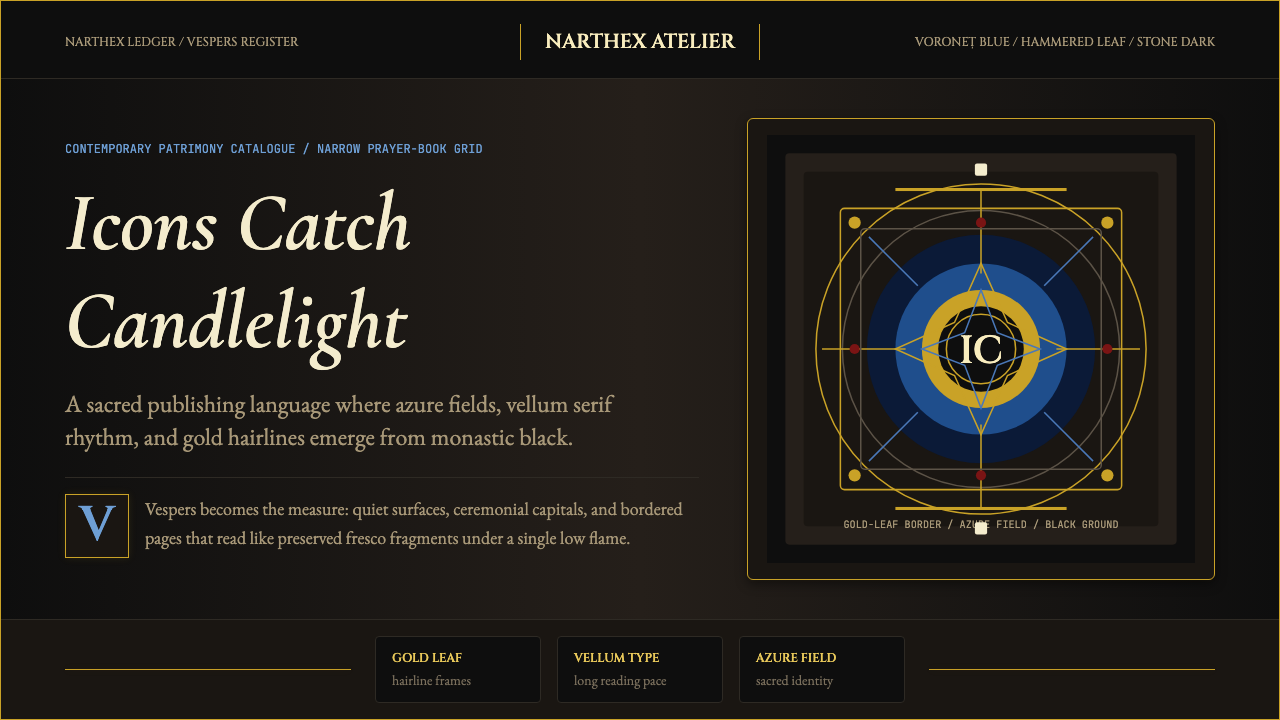 Romanian Orthodox Modern RevivalSacred dark refuses sparkle. Voroneț blue halos and gold hairlines rise from…
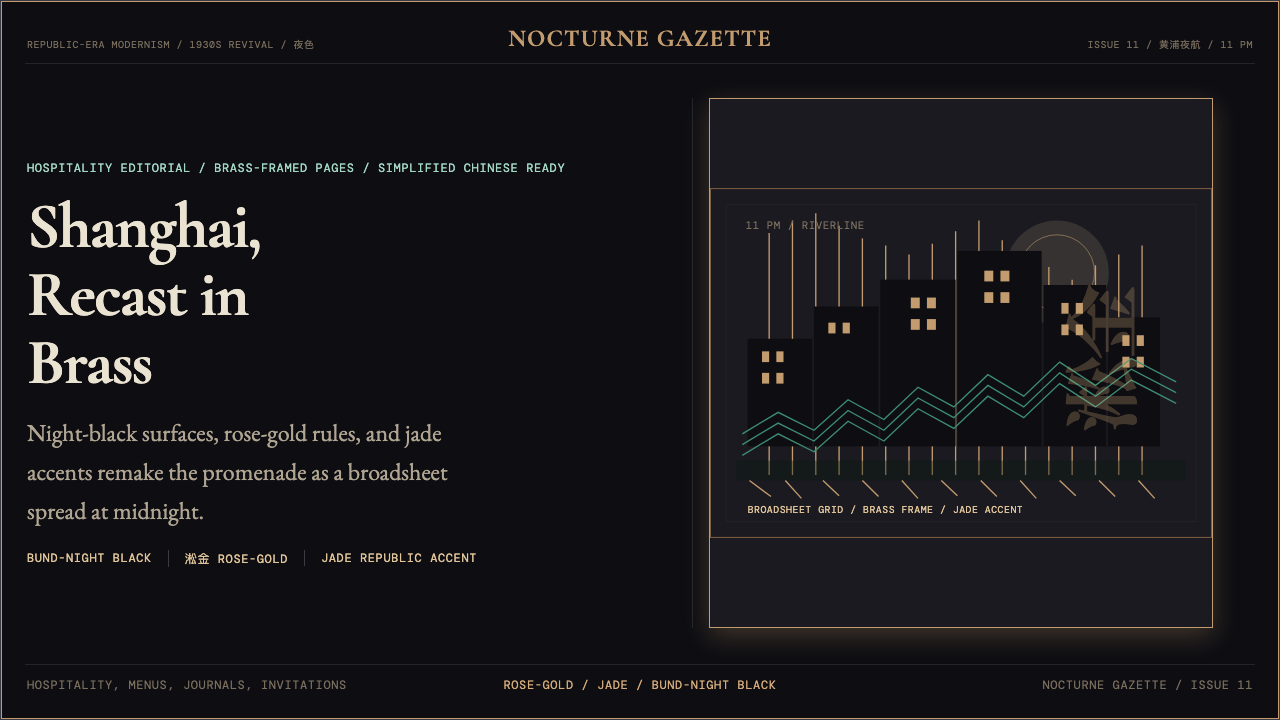 Shanghai Bund Art Deco RevivalNight-black Deco luxury. Rose-gold lines, jade accents, and broadsheet type s…
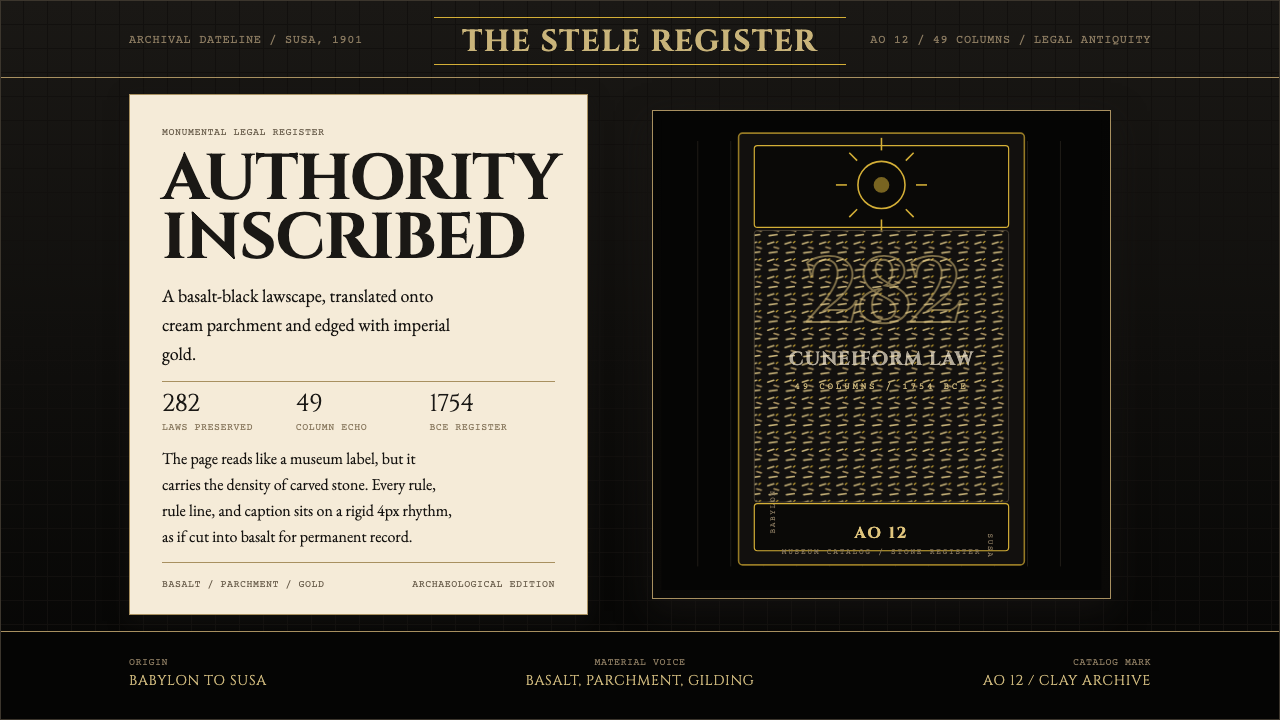 Babylonian Hammurabi SteleAuthority carved in stone. Basalt-black grids, parchment panels, and imperial…
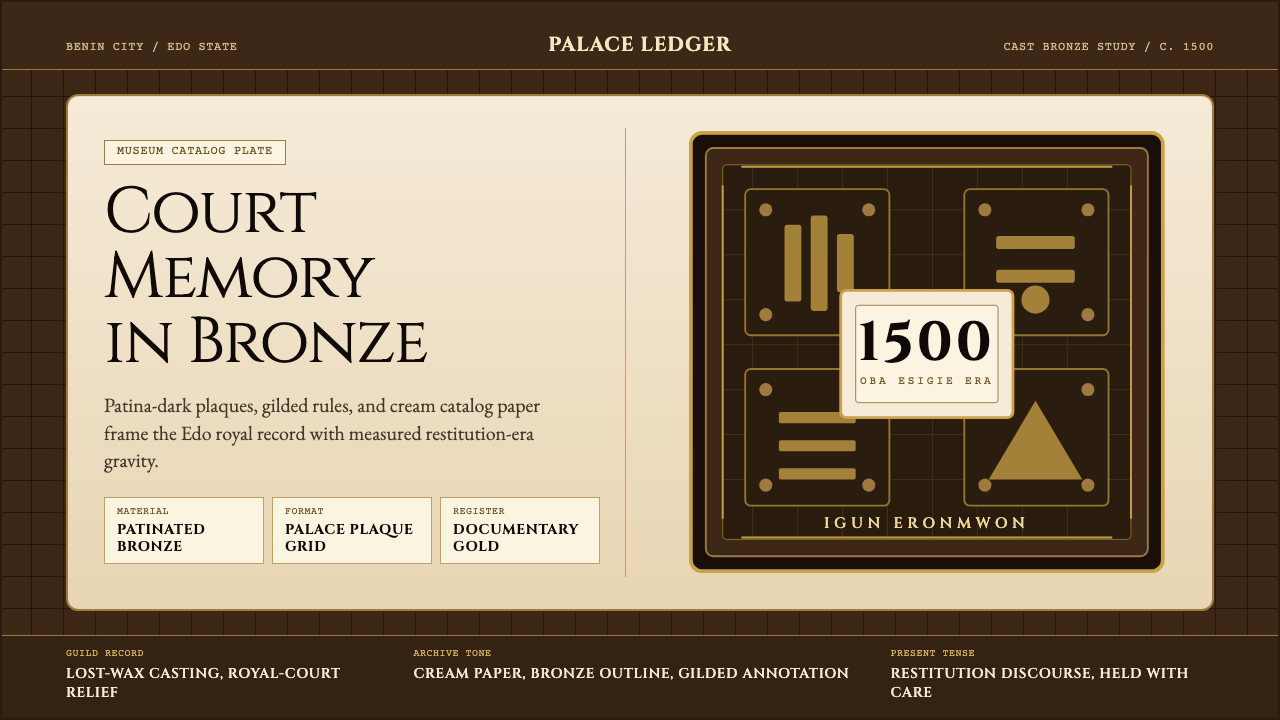 Benin Bronze (Edo, 1500)Royal memory, cast in bronze. Cream plaques and gilded lines carry museum gra…
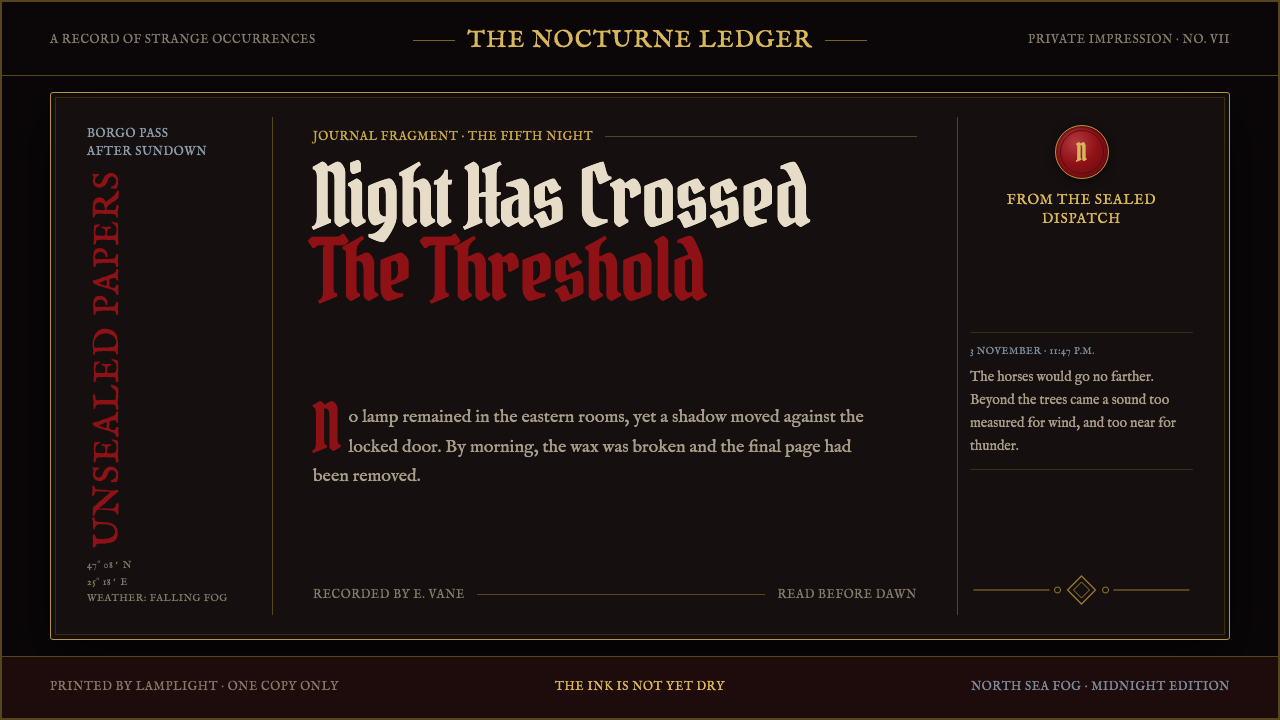 Dracula Gothic (1897)Victorian dread after dark. Blood-red initials and tarnished gilt haunt coffi…
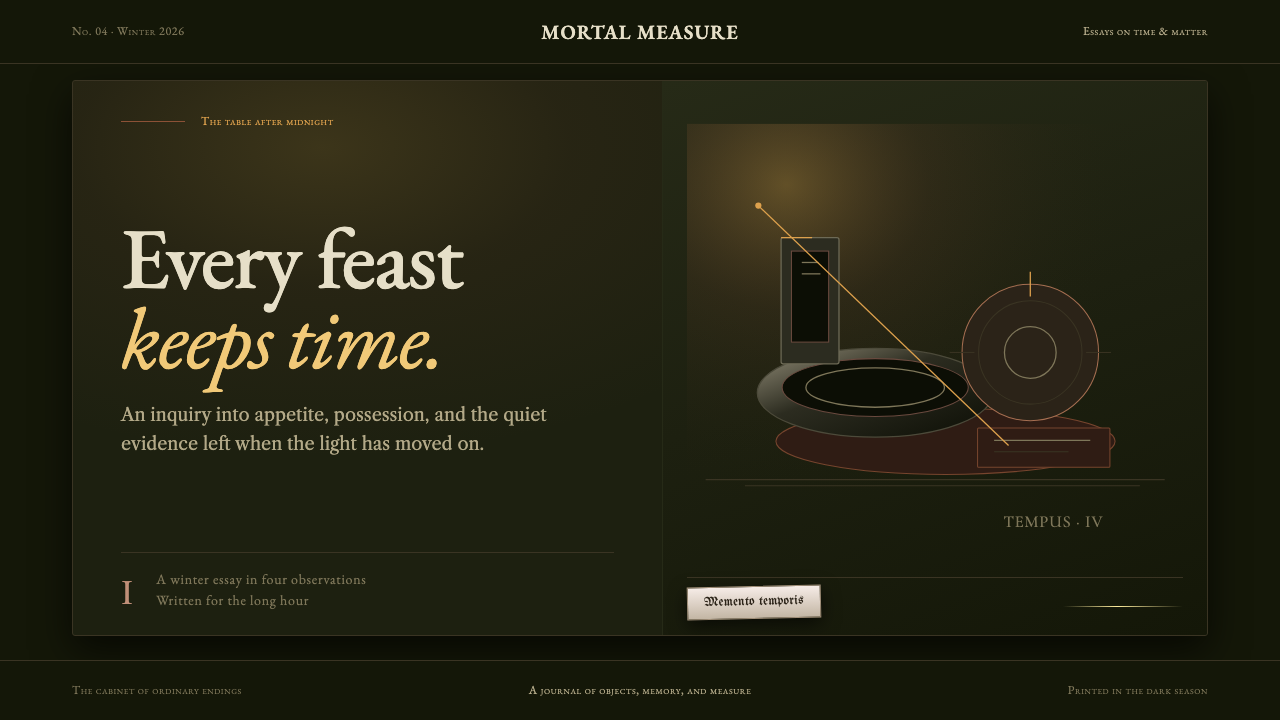 Dutch VanitasTime waits at the table. Olive-black depths, earth-brown type, and one candle…