What is Luang Prabang Temple Tourism?
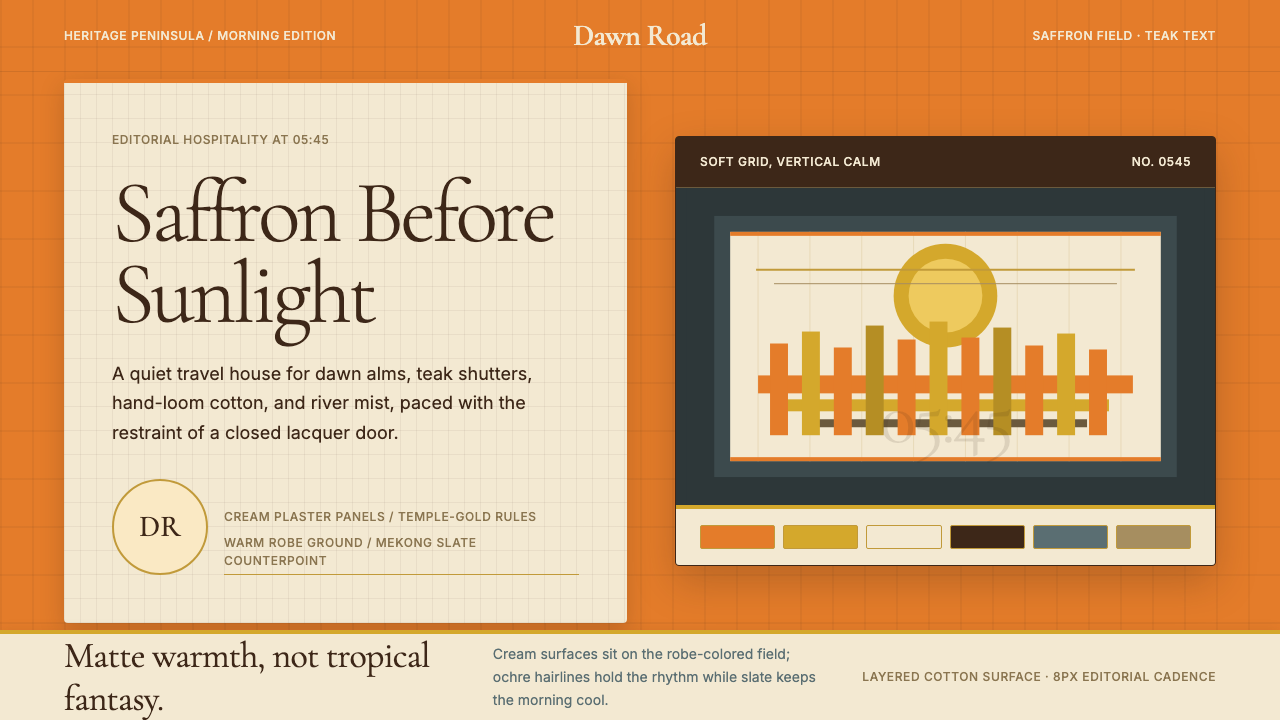
Luang Prabang temple tourism design captures the precise visual hush of 5:45 AM on Sakkaline Road — saffron robes moving through gray dawn, lacquered shutters still closed, the Mekong mist not yet lifted.
Luang Prabang Temple Tourism in brief
Luang Prabang temple tourism is a design language born from the visual identity of one of Southeast Asia's most singular cities — a UNESCO World Heritage site where French colonial architecture and Theravada Buddhist temple culture have coexisted since the late nineteenth century. The style is most visible in the branding and interiors of the luxury heritage hospitality brands that settled in Luang Prabang after the UNESCO listing in 1995: Amantaka, Belmond La Résidence Phou Vao, and the cluster of boutique maisons along the Mekong peninsula. It carries the color and quietude of the alms-giving ceremony, the baci ritual, and the ochre-washed temple walls that define the city's morning light.
The palette is the system's most distinctive feature and its most radical decision. Where heritage tourism design elsewhere tends toward safe neutral grounds — stone, sand, taupe — Luang Prabang temple tourism goes directly to the robe itself. The background reads as the actual color of a Theravada monk's saffron fabric: warm, living, slightly orange-shifted, not gold and not amber. Against this charged ground, cream surfaces evoke hand-loom cotton and French-colonial plaster. Teak-brown text recalls the lacquered shutters and carved temple beams that shade every street in the historic quarter. Temple-gold ochre is the accent — the flash of gilded stupa finials, the edge of an alms bowl catching early sun.
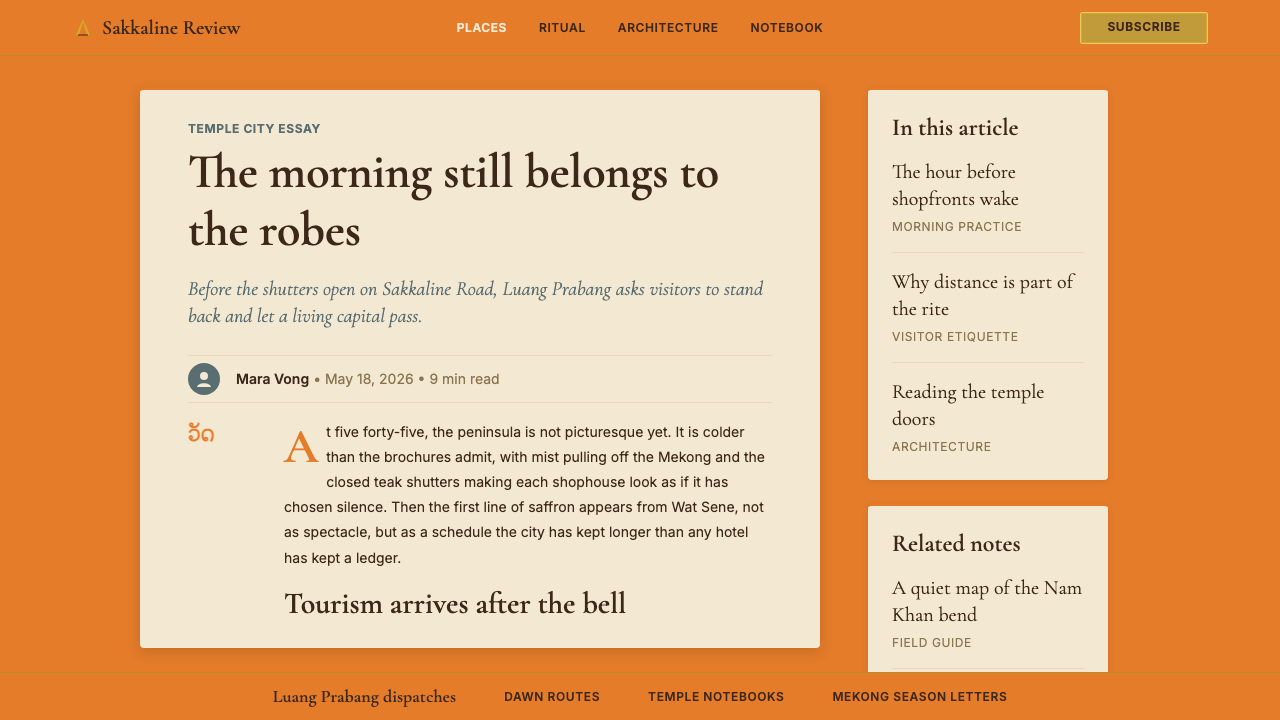
The typographic register is editorial and unhurried. Serif letterforms with bracketed strokes and moderate contrast carry the weight of the style, evoking the precision of mid-century French printing that the colonial publishing houses brought to Indochina. Headlines sit in generous leading; body text is set at a measure that invites reading rather than scanning. Nothing in the system rushes. The overall effect is that of a well-made destination magazine, or the printed menu of a restaurant where the cuisine warrants attention.
Where does Luang Prabang Temple Tourism come from?
Luang Prabang's design identity crystallized in the decade following its UNESCO World Heritage listing in December 1995. The listing — which recognized the city's exceptional fusion of Lao traditional architecture and European colonial urban planning built over several centuries of interaction — triggered an influx of international hospitality investment that had been largely absent during the preceding decades of political isolation. The Lao People's Democratic Republic had maintained tight restrictions on foreign tourism and investment since 1975; the UNESCO designation provided political cover and international legitimacy for a careful reopening.
The hospitality brands that arrived in the early 2000s faced a distinctive design problem. The city's appeal was explicitly monastic and vernacular — the thing tourists came to see was the alms-giving procession, the gilded wats, the French-Lao merchant houses with their shuttered facades — and any branding that leaned too heavily on conventional luxury signifiers (black, deep navy, sterile white) would jar against this visual environment. Adrian Zecha, founder of Aman Resorts, had already refined a philosophy of resort design that sourced its visual language from the host culture rather than imposing a global luxury standard. His team's work on Amantaka — a conversion of the former French colonial college on the Sakkaline Road — established the template: saffron fields, teak-toned typography, cream surfaces, and a restrained use of gilt as accent rather than dominant color.
Francis Engelmann and the Belmond design team approached the same brief at La Résidence Phou Vao from a different elevation — the hotel sits above the city, with views across the temple rooftops — but arrived at an adjacent visual language. Both properties drew on a shared archive of reference: the orange of Theravada robes, the ochre wash of temple walls, the teak and lacquer of historic Lao joinery, and the muted cream of French colonial plaster. By the mid-2000s, these shared references had cohered into a recognizable visual dialect that smaller boutique properties along the Nam Khan and Mekong riverbanks adopted and refined.
The movements that shaped this style — post-UNESCO heritage tourism, French-Indochinese revival hospitality, and Theravada Buddhist visitor design — each contributed distinct values. Heritage tourism introduced the discipline of restraint: the visual language must not compete with the site itself. French-Indochinese revival brought the editorial serif tradition and the comfortable relationship between cream grounds and warm accent colors. Theravada Buddhist visitor design contributed the most specific element: the saffron ground itself, treated not as decoration but as documentary fact — the color that defines the city's most iconic daily ritual, the tak bat alms-giving ceremony that takes place on Sakkaline Road every morning before sunrise.
What defines the Luang Prabang Temple Tourism look?
Color
The palette's defining move is placing saffron — the warm, slightly orange-shifted color of a Theravada monk's robe — at the page or surface level, as ground rather than accent. This is unusual in luxury hospitality design, where warm backgrounds typically read as dated or informal. Here it reads as documentary: the color that defines the city's most iconic daily ritual becomes the substrate of all visual communication. Against this ground, cream surfaces (recalling hand-loom cotton and colonial plaster) provide quiet relief, teak-brown anchors all typography and structural elements, and temple-gold ochre is applied sparingly as a true accent — the gleam of a stupa finial, the edge of an alms bowl, a headline underline.
Typography
Serif letterforms with visible bracketed serifs and deliberate stroke contrast anchor the typographic system. The editorial register draws from the tradition of mid-century French typography — the kind brought to Indochina by colonial publishing houses and preserved in the printed matter of Lao cultural institutions. Headlines are generously spaced and set at unhurried scale; subheadings use a lighter cut of the same family, maintaining tonal unity across hierarchy levels. Body text is set at a reading-friendly measure, never compressed. All-caps settings appear only in navigational or categorical labels, where they function as directional markers rather than decorative emphasis.
Surface and Texture
The visual texture of the style is matte, warm, and slightly tactile — evoking hand-loom cotton, aged plaster, and polished teak rather than glass, chrome, or lacquered surfaces at high gloss. In screen applications, this translates to backgrounds with a subtle warmth that reads as slightly off-white or aged-cream rather than pure neutral. Gradients do not appear; color transitions, where they occur, are blocked and deliberate. The overall surface temperature is the opposite of the cool, precision-engineered gloss associated with contemporary tech or minimal Scandinavian aesthetics.
Composition and Spacing
Layouts are generous and unhurried. Generous margins and vertical rhythm are treated as values in themselves — the negative space signals that neither the brand nor the guest is in a rush. A two-column structure frequently appears, with a narrower text column and a wider visual column, echoing the proportions of a heritage-travel editorial spread. Elements are never crowded against each other; even informational density is achieved through careful hierarchy rather than compression of space. The overall tempo of a well-executed page in this style reads like the cadence of the morning alms-giving procession: steady, deliberate, and full of unhurried pauses.
Imagery
Photography is used sparingly and treated with a warm color grading that leans into golden-hour and pre-dawn light — the two moments of day when Luang Prabang's visual character is most pronounced. Images are typically editorial in framing: a detail of carved teak, monks moving through mist, a breakfast tray on a colonial veranda. Wide-angle crowd or action shots are avoided; the camera is contemplative, not journalistic. In layouts, photography occupies discrete frames rather than bleeding to full-bleed backgrounds, preserving the typographic and color architecture of the surrounding system.
Ornament and Iconography
Ornamental elements, where they appear, are drawn from Lao temple craft rather than from generic Southeast Asian decorative vocabularies. A naga-scale border detail, the repeating flame motif of a stupa finial, or the geometric lattice of a temple window screen may appear as dividers or marginal marks — but always as precise quotations from a specific visual tradition, not as generic 'exotic' texture. This precision is essential to the style's credibility: the design must demonstrate that it has looked carefully at Luang Prabang specifically, not at a generalized idea of Buddhist Asia.
Hierarchy and Restraint
The system achieves hierarchy through restraint rather than emphasis. Rather than using multiple colors, weights, and sizes simultaneously to signal importance, Luang Prabang temple tourism design tends to use a single elevated element — a large heading in teak-brown, a single ochre rule beneath a section title — against a consistent, quiet ground. The effect is that everything of primary importance is already visible in the first reading of the page; nothing needs to compete for attention because the visual temperature is consistent enough that a small elevation reads clearly.
Who shaped Luang Prabang Temple Tourism?
Zecha founded Aman Resorts in 1988 with Amanpuri in Thailand and developed a design philosophy that became the template for the post-UNESCO Luang Prabang hospitality aesthetic. His core principle — that a luxury resort's visual identity should be derived from the host culture rather than imposed from outside — was the foundational brief that produced Amantaka's saffron-and-teak palette. Zecha's approach demonstrated that deep cultural specificity and commercial luxury were not in tension but mutually reinforcing: guests came precisely because the design looked, felt, and smelled like Luang Prabang and nowhere else.
Engelmann worked within the Belmond design team and was instrumental in developing the visual language for La Résidence Phou Vao. His contribution was the elevation perspective: rather than situating the design within the historic quarter's streetscape, he drew from the view across the valley — the ochre temple rooflines seen from above, the density of tropical canopy interspersed with gilded spires. This produced a slightly more panoramic and airy variation of the core style, with a stronger emphasis on open composition and a more restrained use of the saffron ground relative to cream and teak tones.
The Belmond group brought a sophisticated hotel-heritage design methodology that had been refined across properties in Venice, the Scottish Highlands, and Peru before reaching Laos. The team's approach was systematic: thorough archival research into the French-Lao colonial period (approximately 1893 to 1954), consultation with local craft traditions in teak joinery and silk weaving, and a commitment to sourcing materials and artisans within the region where possible. The resulting design language was not pastiche but an informed synthesis — a visual argument that the French-Lao colonial period produced a coherent aesthetic worth treating seriously as a source.
The committee's 1995 decision to list Luang Prabang as a World Heritage site was the single most consequential event in the formation of this design language. The listing created the conditions — international legitimacy, tourism infrastructure investment, a preservation mandate — under which the luxury hospitality industry arrived and commissioned the design work that defined the style. It also imposed a visual discipline on all commercial development within the heritage zone: new construction had to respect scale, material, and color standards derived from the existing built fabric. This constraint pushed designers toward the local material palette rather than international luxury conventions.
Strictly speaking not a named individual, but the monastic tradition of Luang Prabang — maintained across the city's thirty-three active wats by a continuous community of monks and novices — is the primary source of the style's defining color. The tak bat alms-giving ceremony, conducted every morning before sunrise along Sakkaline Road, produces the scene that all subsequent design work in this tradition references: hundreds of saffron robes against gray dawn light, lacquered teak, French-colonial facades, and the slow river beyond. No designer of the style chose the saffron ground arbitrarily — it is a direct visual quotation from this daily, centuries-old ritual.
How do you use Luang Prabang Temple Tourism today?
Applying Luang Prabang temple tourism design correctly requires understanding that its logic is atmospheric before it is decorative. The system is not a collection of motifs to be borrowed selectively — saffron background here, a teak-tone headline there — but a coherent environmental argument: everything in the frame should feel as if it belongs to the same unhurried morning. This means that misapplication is usually not a matter of using the wrong color but of using the right colors at the wrong pace or density. Crowded layouts, tight leading, or aggressive calls to action read as category errors in this system.
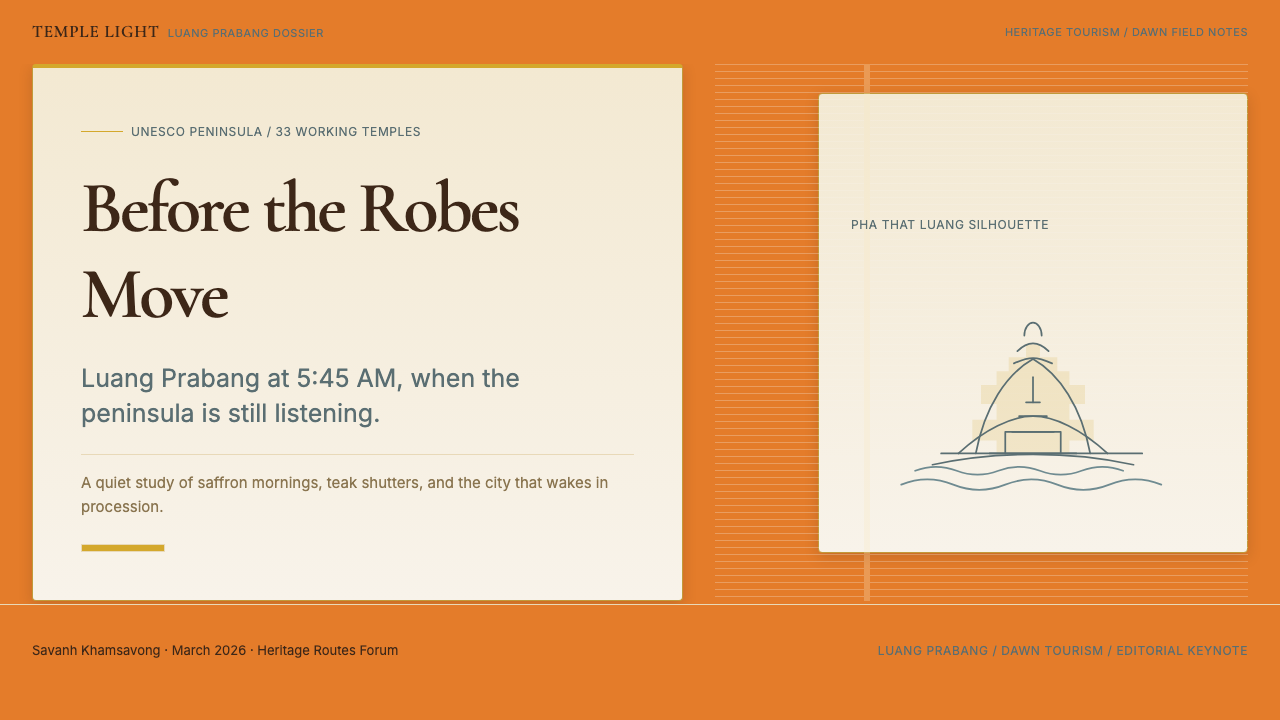
For presentation slides, the style works particularly well for destination briefings, cultural heritage reports, travel editorial decks, and hospitality brand reviews. A cover slide benefits from a full saffron ground with the title set in teak-brown and a single ochre accent line beneath — a composition that reads as composed and specific rather than generic warm-toned luxury. Content slides should use the saffron ground sparingly, reserving it for cover and section dividers; content body slides work better on cream or near-white grounds with teak-brown text. Data slides in this style treat charts as editorial objects: simple, unhurried, with bar fills in ochre or teak and sparse labeling that trusts the audience to read rather than scan.
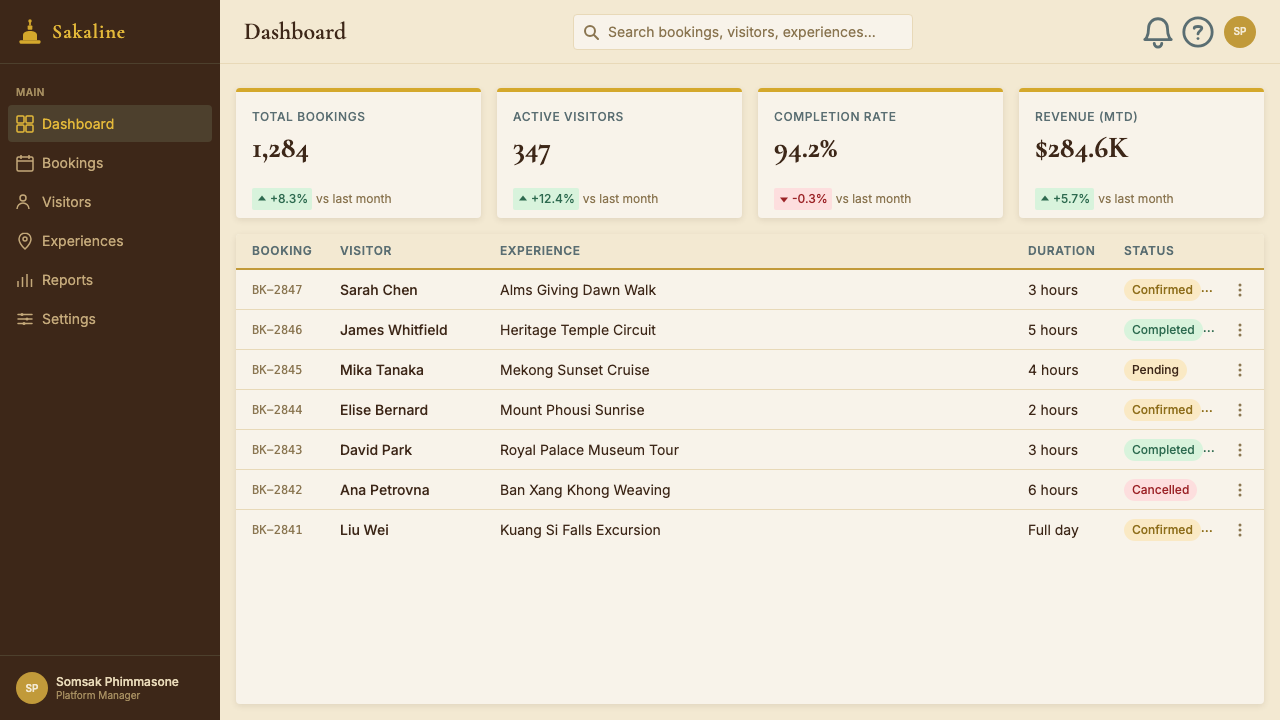
For web and digital interfaces, the style is best suited to contexts where deliberation and cultural depth are the product: cultural tourism platforms, heritage hotel booking experiences, museum collection interfaces, and destination editorial sites. A pricing or booking page in this system uses generous vertical spacing, avoids bright interactive-state colors in favor of teak-brown hover states, and treats the call-to-action button as a considered object — matte, unhurried, confident — rather than a bright object demanding immediate click. Dashboards should be avoided: the palette and spacing conventions do not lend themselves to information density.
For editorial and marketing contexts — printed travel editorial, destination brand identity systems, cultural institution communications — the style is highly transferable. A brand identity system for a heritage hotel or cultural tourism board can use this language across a wide range of touchpoints: printed stationery with cream grounds and teak-brown text, signage in matte-finished warm grounds, wayfinding in serif type with ochre accent rules. Marketing copy should match the visual register: unhurried, specific, observational. The worst marketing copy for this system tries to sell experiences through urgency or superlatives; the best sells them through precise, calm description of what is actually there.
A common failure mode when applying this style is substituting a generic warm-neutral palette for the specific saffron ground. Designers who are uncomfortable with the boldness of the robe color often reach for a safer beige or warm gray, but this drains the system of its most distinctive quality — the documentary specificity that makes it feel like it was designed in Luang Prabang rather than for a generalized idea of Southeast Asian heritage. Another frequent mistake is adding digital-native interaction patterns — drop shadows with high opacity, saturated hover states, bold notification badges — that introduce a visual temperature the system cannot absorb. Every addition should be tested against the question: would this look correct at 5:45 AM on Sakkaline Road?
Luang Prabang Temple Tourism — FAQ
How does this style differ from generic Southeast Asian luxury design?
Generic Southeast Asian luxury design tends to reach for a shortlist of shared signifiers — tropical green, dark wood, raw stone, and a warm-neutral ground — that apply equally to Bali, Phuket, and Siem Reap. Luang Prabang temple tourism design is specific in a way that generic approaches are not: the saffron ground is the actual color of the Theravada robe in the city's alms-giving ceremony, not a decorative choice. The editorial serif tradition traces to the French colonial publishing houses that operated in Laos specifically. The naga and flame motifs are Lao Buddhist, not pan-Buddhist. Specificity is not just an aesthetic preference here — it is the commercial logic of the style. The brands that built it were selling Luang Prabang, not 'Southeast Asia'.
Can this design language work for non-hospitality products?
Yes, with deliberate repositioning. The style works for any product where cultural depth, deliberation, and considered luxury are values the audience will recognize and trust: cultural institution publications, destination tourism boards, heritage brand identities, travel editorial, and high-end food or beverage brands with a specific provenance story. It works less well for products where the context requires speed, urgency, or technical authority — fintech, productivity software, or any context where users are task-oriented rather than exploratory. The operative question is whether the product's promise involves a pause — a moment of considered choice — or a workflow. Luang Prabang temple tourism design is a system built for the pause.
Is it appropriate for non-Lao brands to use this visual language?
The question is worth taking seriously. The style emerged from international hospitality brands applying cultural research carefully rather than appropriating carelessly — Aman and Belmond both invested in local craft, local materials, and local expertise before arriving at the visual language they published. For brands without that grounding, the risk is that the saffron ground and Lao temple ornament read as costume rather than as research. The test is specificity: if a brand can explain exactly which elements it is borrowing, from which tradition, and why they are appropriate to its product or context, the usage is defensible. If the connection is 'it looks warm and exotic,' it is not.
How does the style handle dark or night-mode contexts?
The canonical form of this style is light-ground and morning-lit — it is built around the pre-dawn and golden-hour light of a specific place at a specific time. A dark inversion is possible but requires rethinking the color relationships from the ground up rather than simply inverting values. On a deep teak-brown or near-black ground, saffron shifts from a ground color to a bright accent and risks reading as garish unless used with significant restraint. Cream becomes a lighter midtone. The most successful dark-mode adaptations in this style use a very deep warm-brown ground — the color of the interior of a Lao lacquered cabinet — with ochre and cream as the primary tonal range and saffron appearing only at the level of small detail or icon.
What is the single most common mistake when referencing this style?
Using the palette without the pace. Designers who encounter the saffron-teak-cream-ochre combination often apply it at a tempo that the palette cannot sustain — tight layouts, multiple calls to action, dense information hierarchies — which produces something that looks like warm-toned conventional design rather than Luang Prabang. The palette is not the system; the unhurried, contemplative pace is the system, and the palette expresses it. A well-spaced, generously leaded, single-focus page in muted taupe with one ochre accent line will feel more like this style than a busy saffron-background layout with ten competing elements. The rule is simple: if the page could not be read calmly over a breakfast table in a garden beside the Mekong, it has drifted from its source.
Related design styles
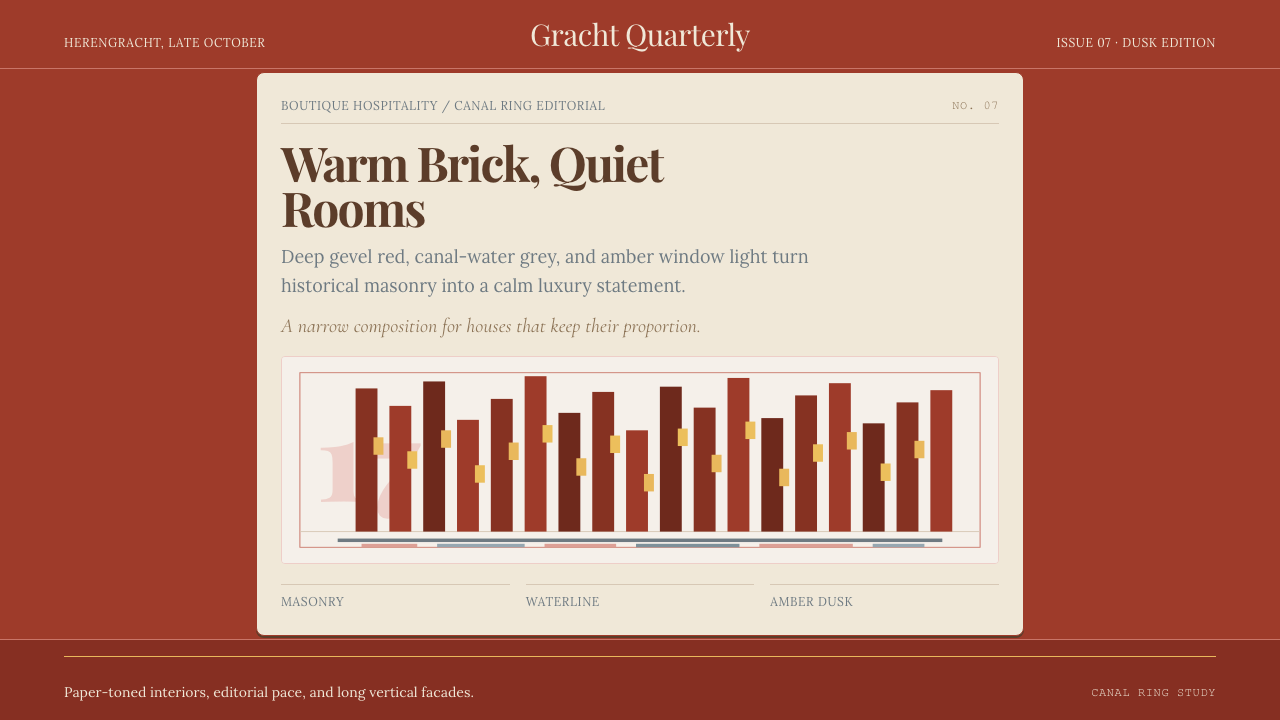 Amsterdam Canal HouseQuiet luxury in brick and cream. Playfair serif, narrow columns, amber window…
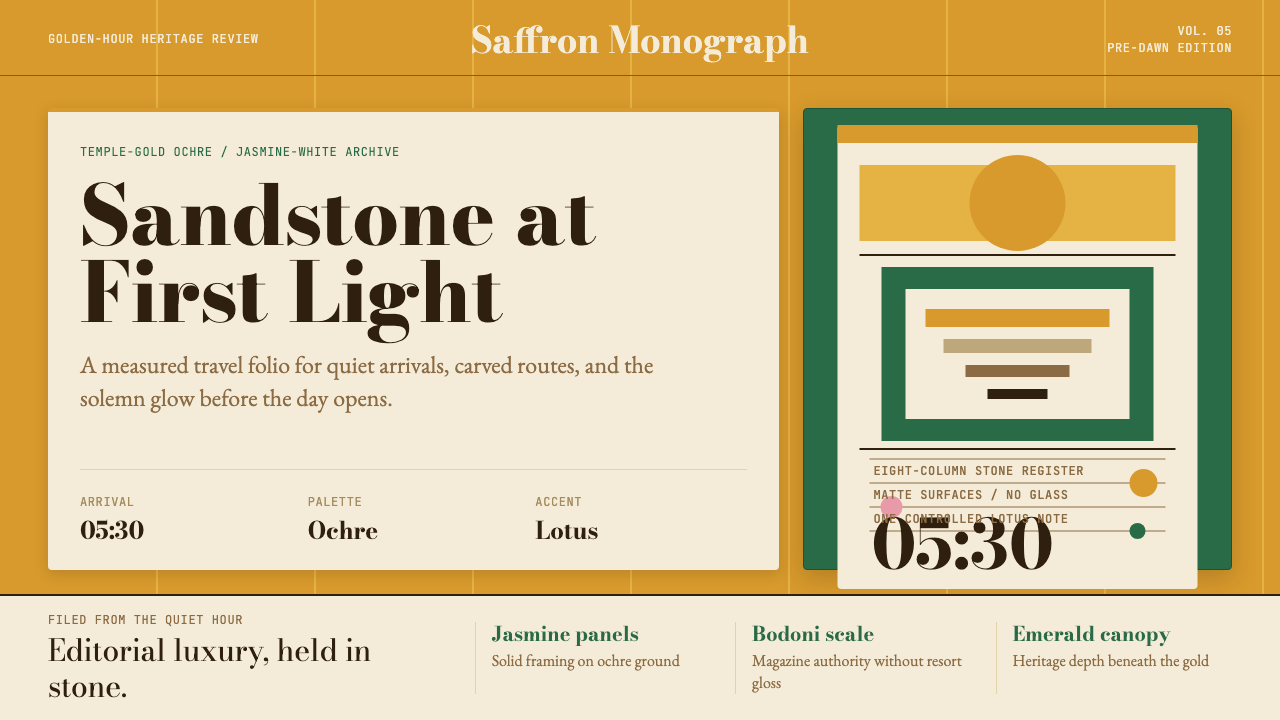 Cambodian Angkor Tourism ModernQuiet authority at dawn. Ochre ground, Bodoni serif, jasmine panels, one lotu…
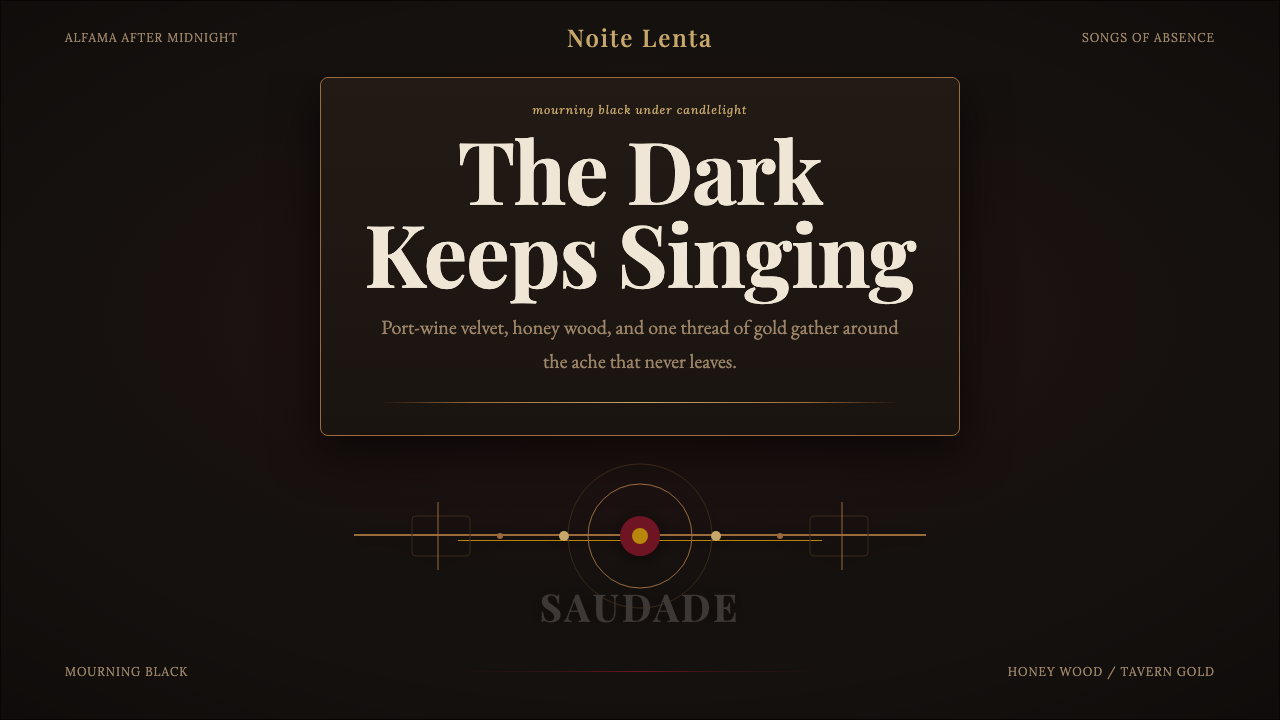 Fado SaudadeSaudade in shadow. Mourning black holds wine red, honey wood, and one gold li…
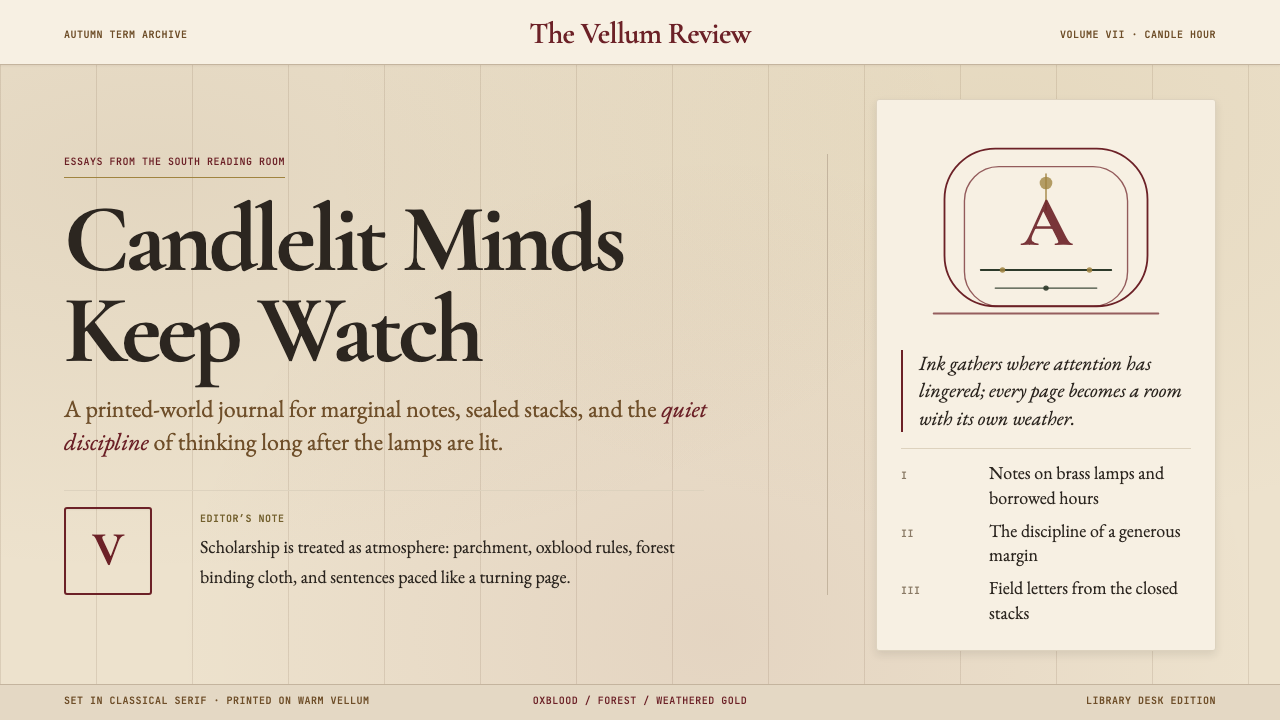 Dark AcademiaCandlelit nostalgia for old books. Parchment grounds, oxblood accents, classi…
 Gamelan BronzeCeremony in low light. Bronze circles glow inside red lacquer and gold-leaf f…
 Luang Prabang Saffron AlmsDawn has weight. Saffron bands cut through teak brown and smoke-gold editoria…