What is Luang Prabang Saffron Alms?
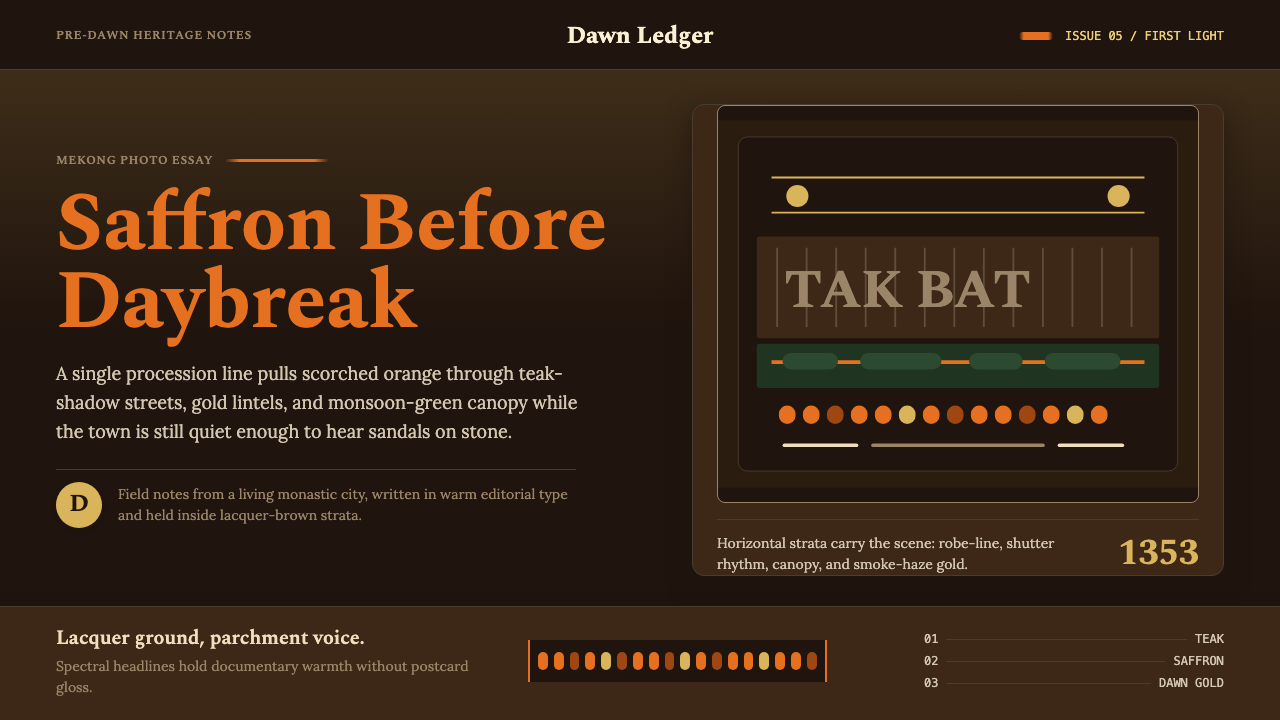
Each dawn in Luang Prabang, saffron-robed monks walk single-file past teak shopfronts and monsoon canopies — a procession that has painted this ancient royal city in scorched orange and lacquer brown for eight hundred years.
Luang Prabang Saffron Alms in brief
Luang Prabang Saffron Alms is a design aesthetic rooted in the tak bat ceremony — the daily pre-dawn alms round in which hundreds of Buddhist monks move in silence through the streets of Luang Prabang, Laos, accepting rice and offerings from the faithful. The visual event is arresting: a continuous band of deep saffron orange cuts through the dark, smoky atmosphere of early morning, set against surfaces of weathered teak, moss-covered stone, and the washed-out ochres of French colonial plaster.
The design language that emerges from this tradition is warm, solemn, and luminous in a restrained way. Scorched orange occupies the dominant role — not as a pure bright accent but as a deep, slightly burnished hue, closer to the shade of ancient lacquerware than to any modern safety signal. Against it, lacquer-brown and near-black grounds provide the weight and depth that keep the palette from tipping into cheerfulness. Smoke-tinted golden accents, the color of gilded stupa finials glimpsed through morning haze, add a precious quality without ostentation.
This is not a style of high contrast or graphic boldness in the contemporary sense. Its emotional register is closer to meditation: slow, deliberate, weighted with accumulated time. The editorial warmth of a long-exposure photograph taken at first light — soft detail in the shadows, intense color where light falls directly — defines the tonal quality that the system consistently pursues.
Where does Luang Prabang Saffron Alms come from?
Luang Prabang's identity as a sacred Buddhist city traces back to 1353, when King Fa Ngum unified the Lao principalities and founded the Lan Xang kingdom — the Land of a Million Elephants. He brought with him from the Khmer court a sacred Phra Bang Buddha image, which gave the city its name. From this founding moment, Luang Prabang was conceived not as a political capital alone but as a spiritual center, a place where royal authority and monastic life were understood to be mutually constitutive. The tak bat alms-round became institutionalized as a daily visible expression of that relationship: the sangha sustained by the laity, the laity blessed by the presence of the sangha.
Over the following centuries, Lan Xang Buddhist architecture evolved a distinctive visual vocabulary. Temples — called wats — feature sweeping, multi-tiered rooflines that cascade almost to the ground, covered in terracotta tile with gilt finials. Interior walls are decorated with gold stencil patterns on lacquer-red or dark grounds, depicting Jataka tales and celestial beings. Monk robes were dyed with jackfruit-root or saffron pigment to produce the characteristic deep orange that remains unchanged today. The color was not decorative choice but doctrinal expression: orange represents the fire of purification and the willingness to renounce worldly attachments.
French colonial presence from 1893 to 1953 added a second visual layer without erasing the first. French administrators and architects built along the peninsula between the Mekong and Nam Khan rivers, introducing lime-washed plaster facades, louvered wooden shutters, and arcaded colonnades alongside the existing wats and royal palace complex. The resulting hybrid — Indochina colonial vernacular layered over Lan Xang Buddhist architecture — defines Luang Prabang's street-level visual register today. The ochre and cream of colonial plaster against teak and gilded temple rooflines creates a color field that is uniquely warm, dense, and layered.
UNESCO World Heritage status in 1995, championed in part by scholar Anoulak Kittikhoun and conservation architect Henri Marchal's institutional legacy, formalized what had been an organic heritage: both the architectural fabric and the living monastic practices were recognized as inseparable. Conservation policy under the Heritage Charter has maintained the density and palette of the urban landscape, ensuring that the tak bat procession still moves through streets that look substantially as they did a century ago. The aesthetic that design practitioners reference today is therefore not a historical reconstruction but a still-living visual system, continuously renewed by daily ritual.
What defines the Luang Prabang Saffron Alms look?
Color
The palette is anchored by deep saffron orange — a burnished, slightly darkened hue with the warmth of aged lacquerware, not the brightness of a modern accent color. This anchoring orange sits against grounds of lacquer brown, near-black, or very deep teak-toned neutrals that prevent the warmth from becoming sweet. A secondary register of smoke-gold appears in smaller quantities — the color of gilded finials seen through morning haze — adding precious detail without overwhelming. Pale smoke or off-white appears only in supporting roles, providing the faint contrast needed for legibility in dense dark surfaces.
Luminosity and Depth
The system prizes a particular quality of light: not the even illumination of a studio or the high-key brightness of modern flat design, but the warm, directional light of pre-dawn, where shadows are deep and color is intensified precisely because the overall light level is low. This translates into surfaces that are predominantly dark, with the orange and gold elements appearing to glow from within rather than being lit from without. The effect is one of weight and presence — surfaces that hold attention rather than repelling it.
Texture and Surface
Authentic materials in Luang Prabang are aged and warm: teak darkened by decades of oil and smoke, terracotta tile weathered by monsoon cycles, hand-applied stucco showing the trace of the mason's tool, gold leaf applied over lacquer showing microscopic texture at close range. The aesthetic honors this quality of accumulated surface — not through the use of photographic textures but through an understanding that surfaces should feel dense and time-worn rather than smooth and pristine. Digital interpretations favor paper-weight or matte finishes that suggest substance.
Composition and Procession
The tak bat procession is linear and rhythmic — a horizontal band of repeating form, equally spaced, moving in a single direction. This compositional logic translates naturally into layouts that favor strong horizontal registers: wide image fields interrupted by narrow bands of color or type, repeated modular elements arranged with processional regularity, and a sense of left-to-right or top-to-bottom movement that never rushes. Vertical emphasis is reserved for stupa and doorway forms — tall, narrow, slightly tapered shapes that punctuate horizontal flow.
Ornament and Restraint
The system is not minimalist — the temple interiors that inform it are richly decorated with gold stencil, mirrored mosaic, and painted narrative friezes. But the ornament follows strict rules: it is always applied to surfaces rather than floating free, it is always patterned and repeating rather than figural and individual, and it never competes with the primary structural elements. In contemporary digital applications, this principle allows for the use of border patterns, gilded line details, or subtle ground textures, provided they remain subordinate to the hierarchy of color and form.
Typography Register
Text in this aesthetic belongs to the editorial tradition of magazine photojournalism and cultural heritage publication: measured, unshowy, and subordinate to image and color. Headline weight is generous but not aggressive. Body text maintains a calm, readable measure. There is no role for novelty typefaces or expressive fonts; the preference is for letterforms that feel timeless, neutral, and slightly warm — faces with a calligraphic quality in their curves that echoes the hand-applied gold-leaf stenciling of temple walls, without imitating it literally.
Sacred and Quotidian Balance
Perhaps the most distinctive quality of this aesthetic is that it holds the sacred and the everyday in a single frame without forcing a resolution. The tak bat procession happens against an entirely ordinary backdrop of shopkeepers setting out their goods and children heading to school; the extraordinary is not separated from the mundane. In design terms, this means the system can carry ceremonial weight without becoming stiff or ecclesiastical, and can address everyday content without losing its sense of depth and occasion.
Who shaped Luang Prabang Saffron Alms?
Fa Ngum unified the Lao principalities in 1353 and founded the Lan Xang kingdom, establishing Luang Prabang as both political capital and sacred Buddhist center. His act of bringing the Phra Bang image from the Khmer court — and naming the city after it — encoded the identity between royal authority and Buddhist practice that would define the city's visual culture for the next seven centuries. The distinctive features of Lao temple architecture, including the sweeping low rooflines and interior gold-on-lacquer decoration, developed within the institutional framework he created.
Henri Marchal was a French archaeologist and conservator who worked extensively throughout French Indochina in the first half of the twentieth century. His influence on Luang Prabang was institutional: the conservation methods and documentation practices he helped establish formed the foundation of the heritage management frameworks that would eventually support UNESCO designation. His work exemplifies the paradox at the center of Luang Prabang's aesthetic — a colonial enterprise that, in its documentation and preservation of Buddhist architectural traditions, inadvertently helped ensure their survival into the present.
A Lao diplomat and cultural heritage specialist, Anoulak Kittikhoun played a significant role in the political and institutional processes that led to UNESCO World Heritage designation in 1995. His advocacy helped frame Luang Prabang's heritage not as a static historical artifact but as a living urban ecosystem in which monastic and civic life remained intertwined. The distinction matters for the aesthetic: the tak bat procession that defines the saffron visual register is not a performance staged for heritage tourism but a continuation of a practice that has never stopped.
Patcharin Houngsaengkham represents the generation of Lao cultural practitioners and heritage professionals who have engaged critically with the tensions between heritage conservation, tourism development, and the lived realities of the monastic community. Her perspective — that the aesthetic identity of Luang Prabang must be understood as the product of an ongoing community, not merely an architectural inventory — informs a more nuanced application of the visual system: one that acknowledges the human practice behind the visual effect rather than reducing the saffron procession to a decorative motif.
The visual system of Luang Prabang was not the product of named individual designers but of generations of anonymous monastic craftsmen — painters, gilders, woodcarvers, and weavers working within a tradition of apprenticeship and devotional production. Their collective contribution established the color relationships, the proportional vocabulary of temple architecture, and the stencil-pattern grammar of interior decoration that define the aesthetic. The lack of individual authorship is itself significant: the system's visual authority comes from its cumulative depth and repetition across centuries, not from individual invention.
How do you use Luang Prabang Saffron Alms today?
Luang Prabang Saffron Alms is a style that carries genuine cultural weight, which means it applies most naturally where depth, ceremony, and accumulated time are relevant values — cultural institutions, hospitality brands, heritage experiences, documentary editorial work, and any context where the emotional register of the content is elevated rather than casual. It does not transfer well to products where speed, brightness, and novelty are the dominant values.
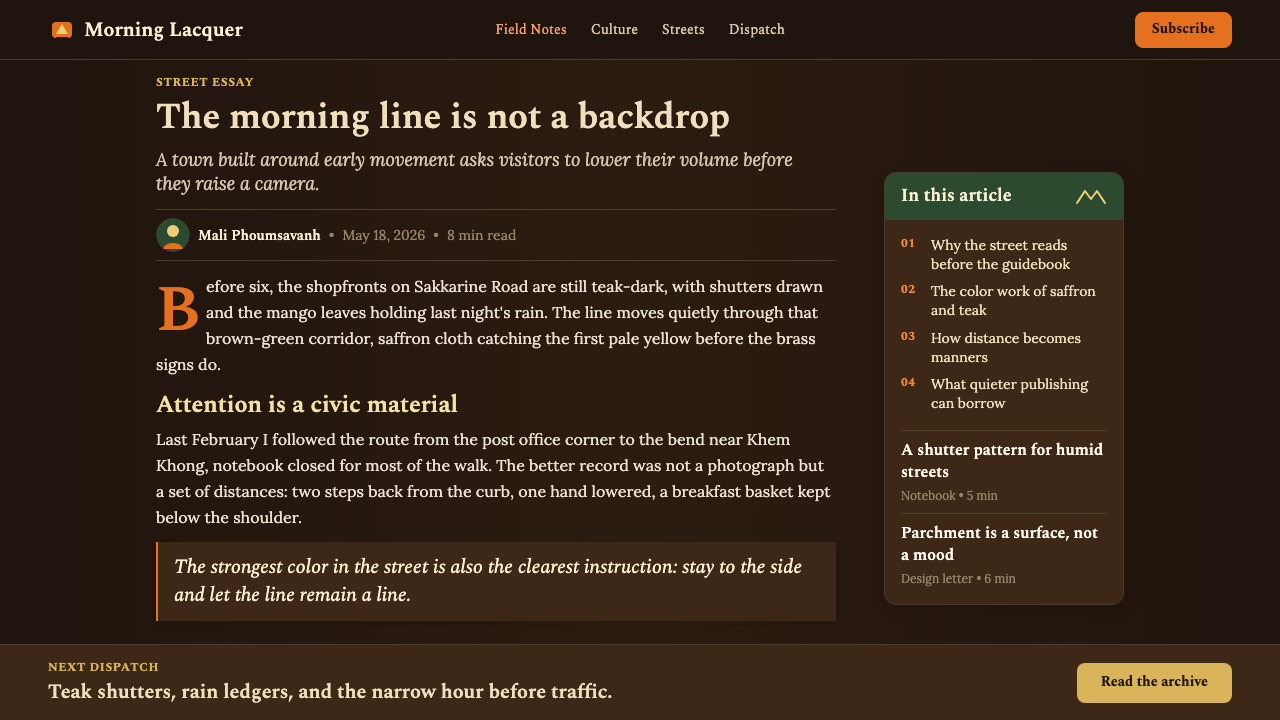
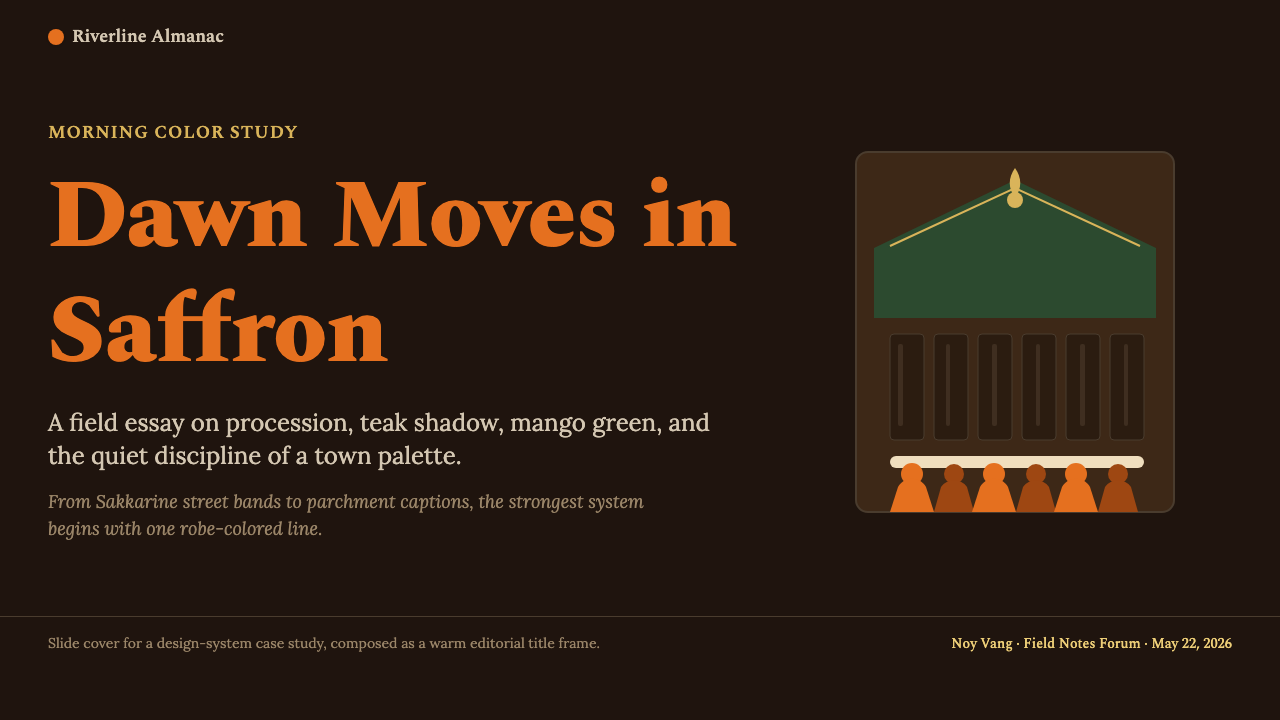
For presentation slides, the system works beautifully for cover and section-divider pages: a deep lacquer-brown or near-black full-bleed ground, with saffron as the single strong element — a horizontal band, a bold title, or a simple geometric form. Content slides should be treated with equal gravity: dark grounds, generous margins, and text set at a measured pace with strong size contrast between heading and body. Data slides deserve special attention — when charts and graphs are rendered in the saffron and smoke-gold palette against deep grounds, they take on a weight and seriousness that purely informational charts rarely achieve. Avoid using bright backgrounds on content slides, which will shatter the meditative atmosphere of the system.
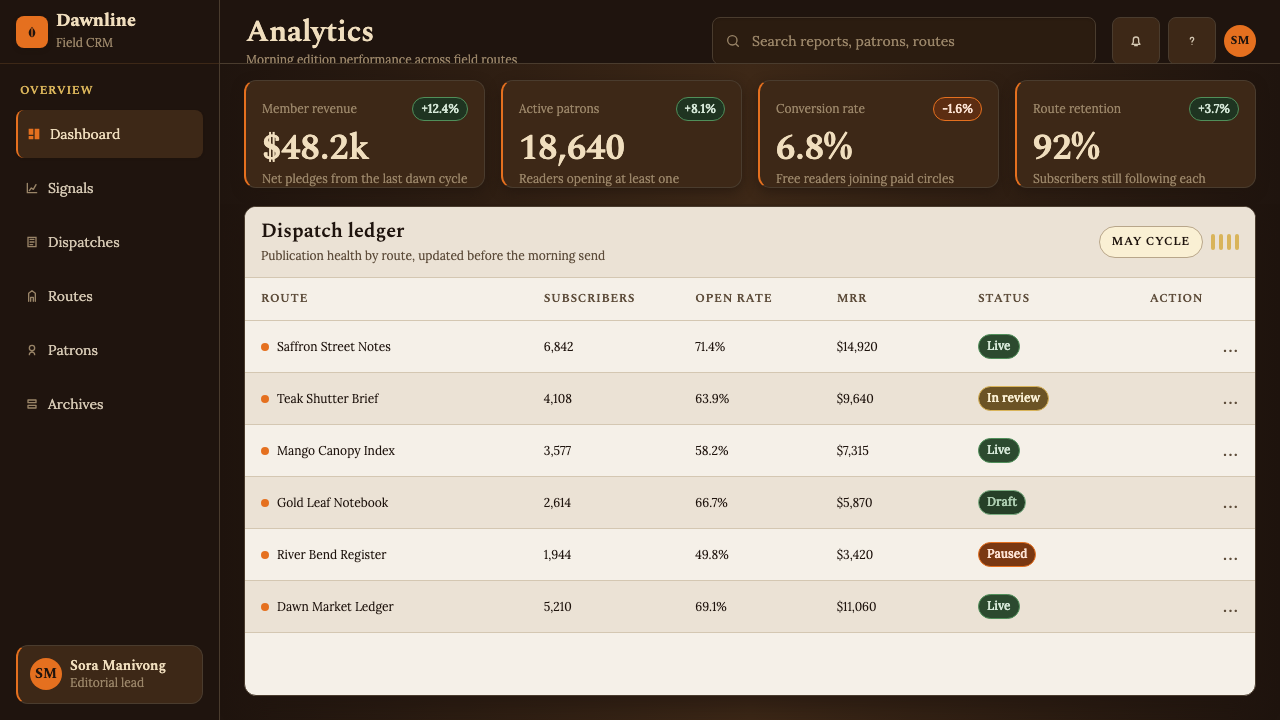
For web interfaces, the style suits editorial, cultural, and hospitality contexts most naturally. A homepage built in this register might use a near-black hero with a wide horizontal saffron element and sparse, generous type. Navigation should be minimal and wordmark-forward; icon use should be restricted to simple symbolic forms rather than detailed illustrations. Dashboards and data products are less natural fits — the dark, warm palette increases perceived formality and reduces the urgency-at-a-glance quality that dashboards typically require. If applied to a dashboard, reserve the saffron for the most important metric or state only.
For editorial and marketing work, the style excels at producing long-form content that feels worth reading: feature articles, destination guides, cultural essays, annual reports for organizations with a heritage dimension. The horizontal register of the procession translates into section breaks marked by full-width saffron rules or narrow band images. Pull quotes benefit from being set against a small saffron-ground panel. Photography should be treated warmly — slightly reduced contrast, shadows allowed to hold detail — rather than pushed to high contrast, which fights the meditative quality of the surrounding palette.
A common mistake when working with this aesthetic is reducing it to the saffron color alone, then combining it with white backgrounds and clean sans-serif typography in a way that erases the depth and gravitas of the source material. The saffron only has its full power when surrounded by dark grounds. Similarly, pairing the palette with the visual vocabulary of contemporary minimal design — paper-white backgrounds, thin lines, generous negative space in a bright key — produces a confusion of registers: the color says ancient and weighty while the surrounding system says contemporary and light. The style demands commitment to its tonal world, not just selective borrowing of its most visible element.
Luang Prabang Saffron Alms — FAQ
Is it appropriate for a non-Lao brand to use this aesthetic?
The question is worth asking carefully. Luang Prabang Saffron Alms draws on a living religious tradition — the tak bat ceremony is not a historical artifact but an ongoing daily practice with deep meaning for the monastic community and the lay faithful. Using this aesthetic thoughtfully, with awareness of its origins and without reducing its sacred dimensions to surface decoration, is different from appropriating iconography without acknowledgment. The system is most appropriate for contexts where cultural depth, heritage, or contemplative experience is genuinely relevant to the product or message — not for contexts where the saffron and dark grounds are merely a novel color combination.
How does this style differ from other warm Southeast Asian aesthetics?
Southeast Asian design traditions are remarkably diverse, and conflating them is a significant error. Luang Prabang Saffron Alms is specifically Lao Buddhist and French Indochina colonial in its genealogy, and it has a particular tonal quality — the pre-dawn light level, the deep dark grounds, the burnished rather than bright orange — that distinguishes it from, say, Thai temple gold (brighter, more saturated), Balinese tropical warmth (greener, more verdant), or Vietnamese lacquer aesthetics (more saturated reds and deep greens). The procession-linear compositional logic, the smoke-haze quality of the gold accents, and the specifically French-colonial vernacular of the architectural backdrop are all distinctive to this tradition.
Can this style work for a light-background or high-brightness interface?
It can, but the transition requires care and a clear rationale. The light adaptation works best when the dominant structure of the page remains warm — off-white or aged-paper tones rather than clean white — and the saffron is used at full saturation against those warm grounds rather than diluted. A purely clean white background strips away the tonal richness that gives the saffron its ceremonial quality and risks making the palette look merely decorative. The most successful light adaptations tend to retain at least one major dark element — a full-width header band in deep brown, a sidebar in near-black — to maintain the contrast structure that the original system depends on.
What role does the French colonial influence play in the aesthetic, and is it optional?
The French Indochina colonial layer is not incidental to Luang Prabang's visual identity — it is structurally integrated into what the streetscape actually looks like. The ochre and cream of colonial plaster, the louvered wooden shutters, the arcaded facades, all contribute to the warm mid-tone ground against which the saffron of the monk robes and the gold of temple rooflines appear. Removing this layer in a design application is possible, but it changes the aesthetic from Luang Prabang specifically toward a more generic Theravada Buddhist or Southeast Asian register. The collision between the colonial vernacular and the Buddhist sacred is part of what gives the system its distinctive layered quality.
How should photography be selected and treated for this aesthetic?
Photography that fits this system shares a specific atmospheric quality: warm color temperatures, a preference for early-morning or late-afternoon light rather than noon brightness, subjects that include aged surfaces, textile details, or human figures in relation to architectural context. High-key studio photography, brightly lit e-commerce style imagery, or photographs with strong cool casts will all sit uneasily within the palette. In terms of treatment, the goal is to preserve the warmth of the original rather than push contrast. Slight warm-tone grading that deepens shadows and intensifies the orange-brown range without brightening highlights is appropriate. The aesthetic resists the high-contrast treatment common in contemporary editorial photography, where shadows are crushed to near-black — here, shadow detail matters because the interplay of low light across textured surfaces is part of the system's visual identity.
Related design styles
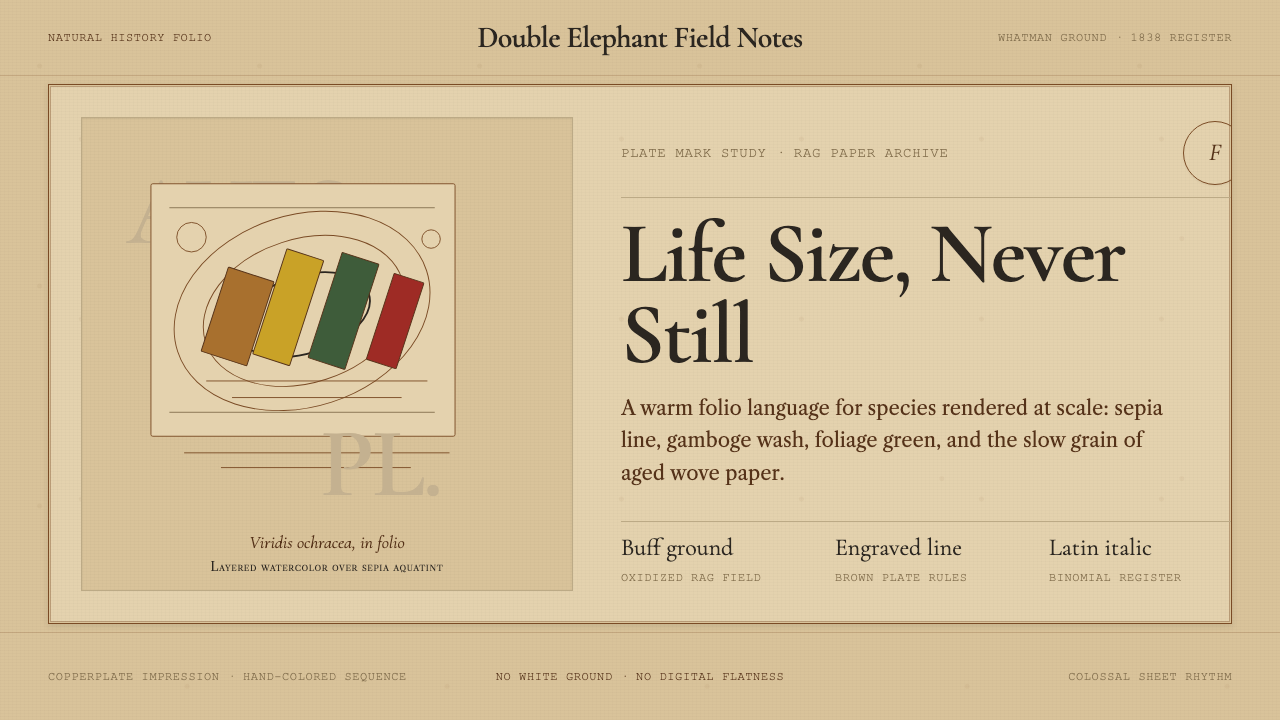 Audubon Birds of AmericaAged natural history breathes. Buff rag paper, sepia rules, and italic binomi…
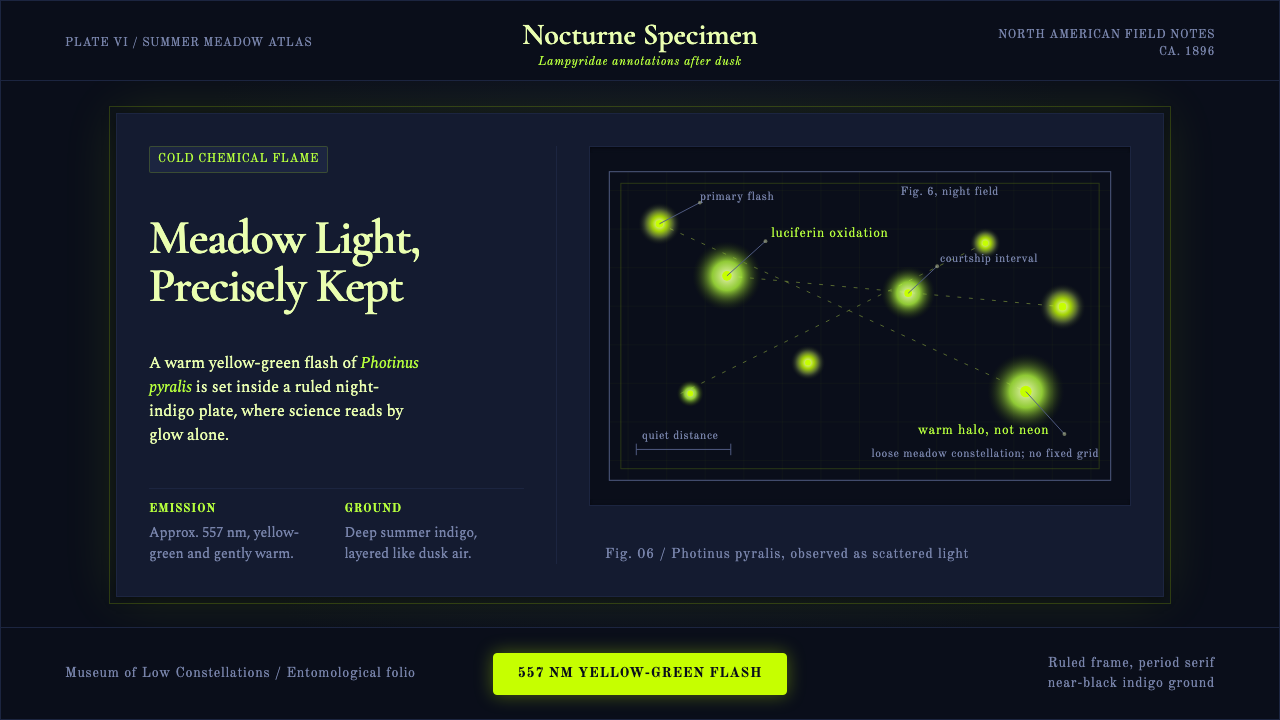 Firefly BioluminescenceQuietly luminous. Yellow-green 557 nm sparks drift through ruled indigo plate…
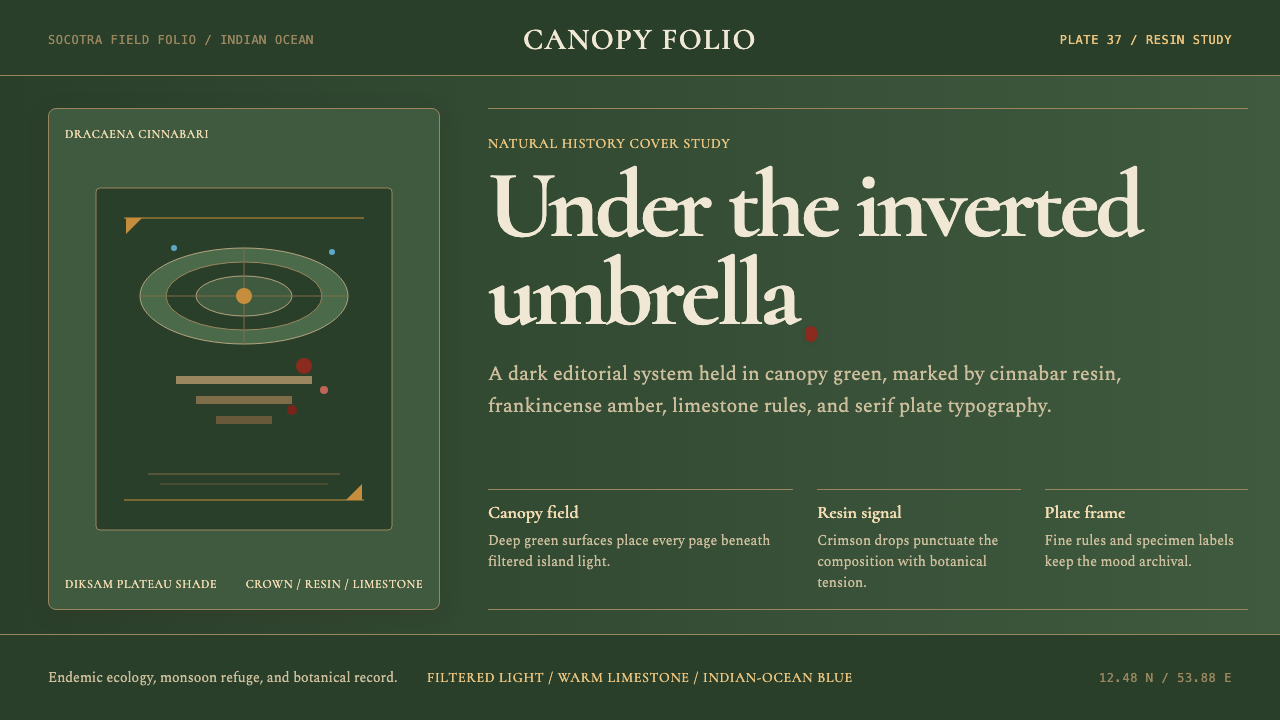 Yemeni Socotra Dragon's Blood TreeCanopy shade holds the page. Resin red, amber rules, and serif specimen frami…
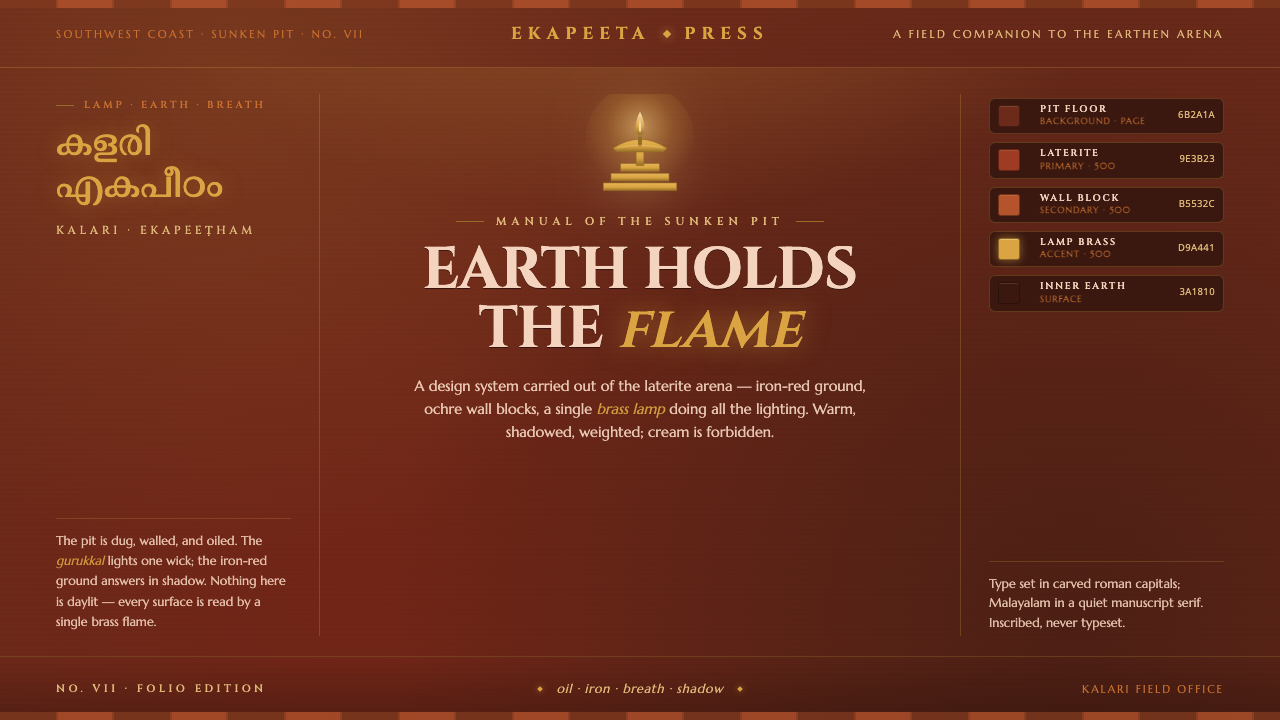 Kalaripayattu Kalari ArenaEarth holds the flame. Iron-red laterite, ochre wall blocks, a single brass l…
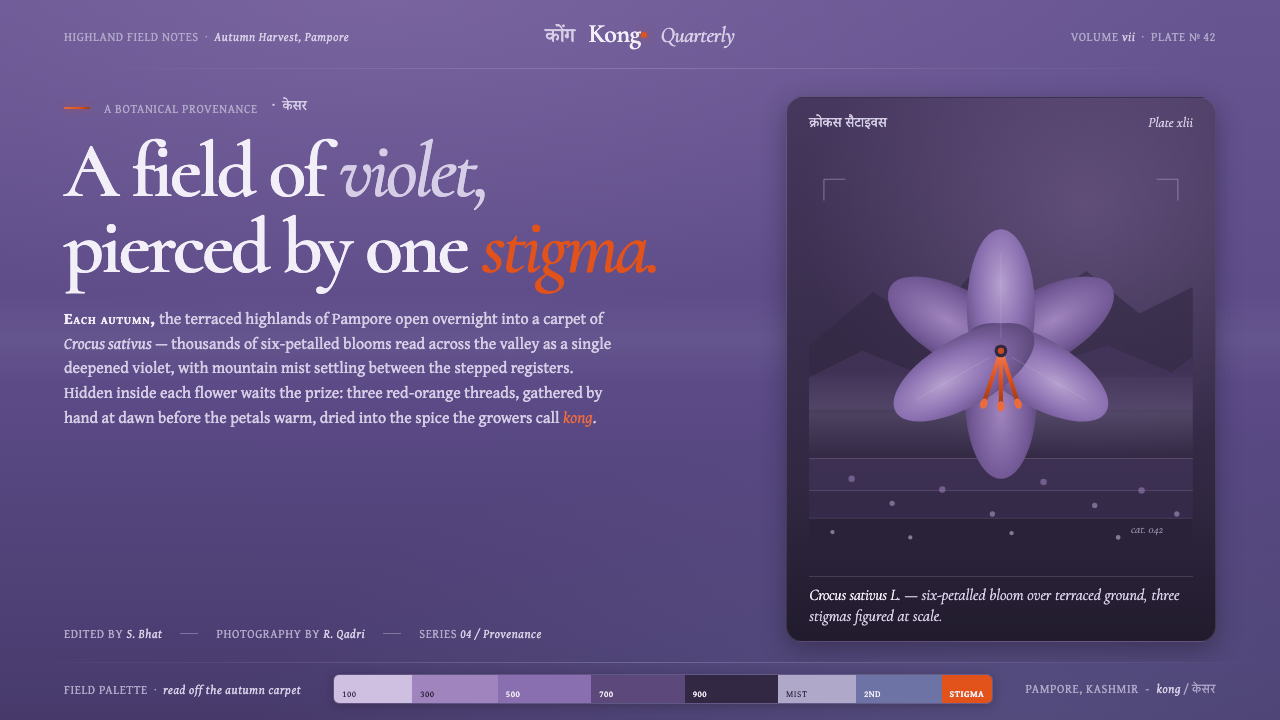 Kashmiri Crocus PurpleAbundance of one hue, scarcity of its complement. Crocus violet under mist, o…
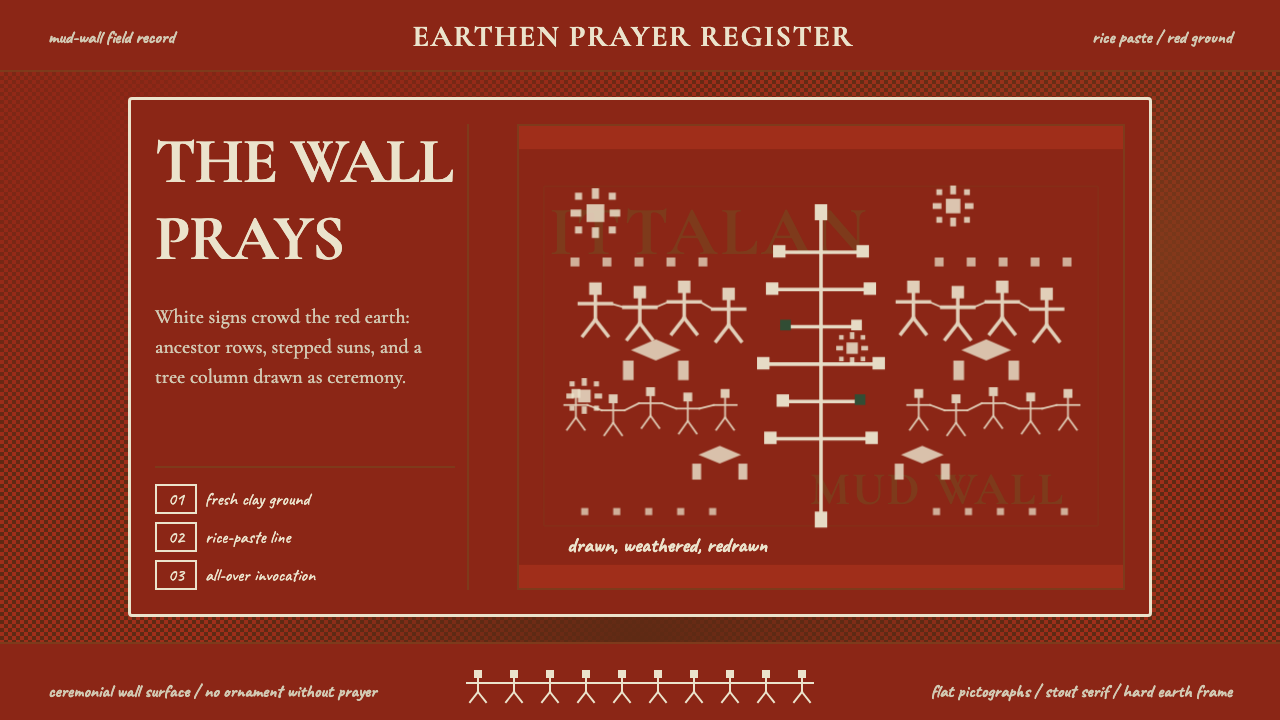 Odisha Saura Tribal MuralSacred density. Rice-white pictographs crowd a red-earth wall in ritual rhyth…