What is Shanghai Bund Art Deco Revival?
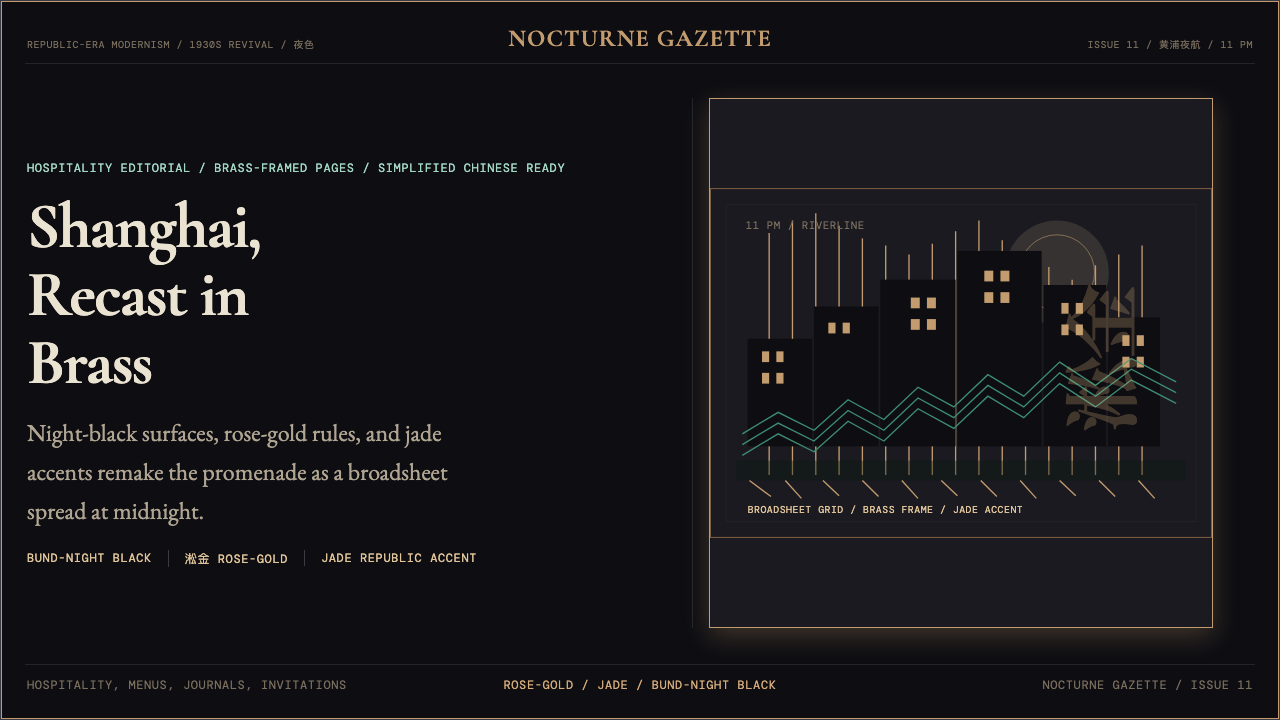
Shanghai's Bund distilled the world's most concentrated Art Deco mile into a language of midnight black, rose-gold metallic warmth, and jade-green Republic accents — and the 2010s revival recodified that heritage into a modern editorial voice that reads as luxury without apology.
Shanghai Bund Art Deco Revival in brief
Shanghai Bund Art Deco Revival is a design system rooted in the interwar architectural golden age of Shanghai's Bund district, reinterpreted through the lens of contemporary luxury hospitality and editorial culture. The visual language draws on the defining elements of Bund Deco — the stepped massing of tower facades, the gilded metalwork of hotel lobbies, the broadsheet grid of 1930s pictorial magazines — and distills them into a digital and print aesthetic that carries the weight of that history while remaining fully functional in modern interfaces.
At its center is a chromatic logic built around three poles: night-black as the dominant ground, rose-gold as the metallic accent that threads through every surface, and jade green as the Republican-era counterweight that prevents the palette from reading as purely contemporary. This triadic system is not decorative arbitrariness — each color carries specific historical memory. The black is the Huangpu River at eleven in the evening, lit by the neon and lantern glow of the opposite shore. The rose-gold is the brass of Peace Hotel elevator grilles and cocktail-menu foil stamps. The jade green is the Republic-era ceramic tile and interior lacquerwork of buildings erected between 1925 and 1937.
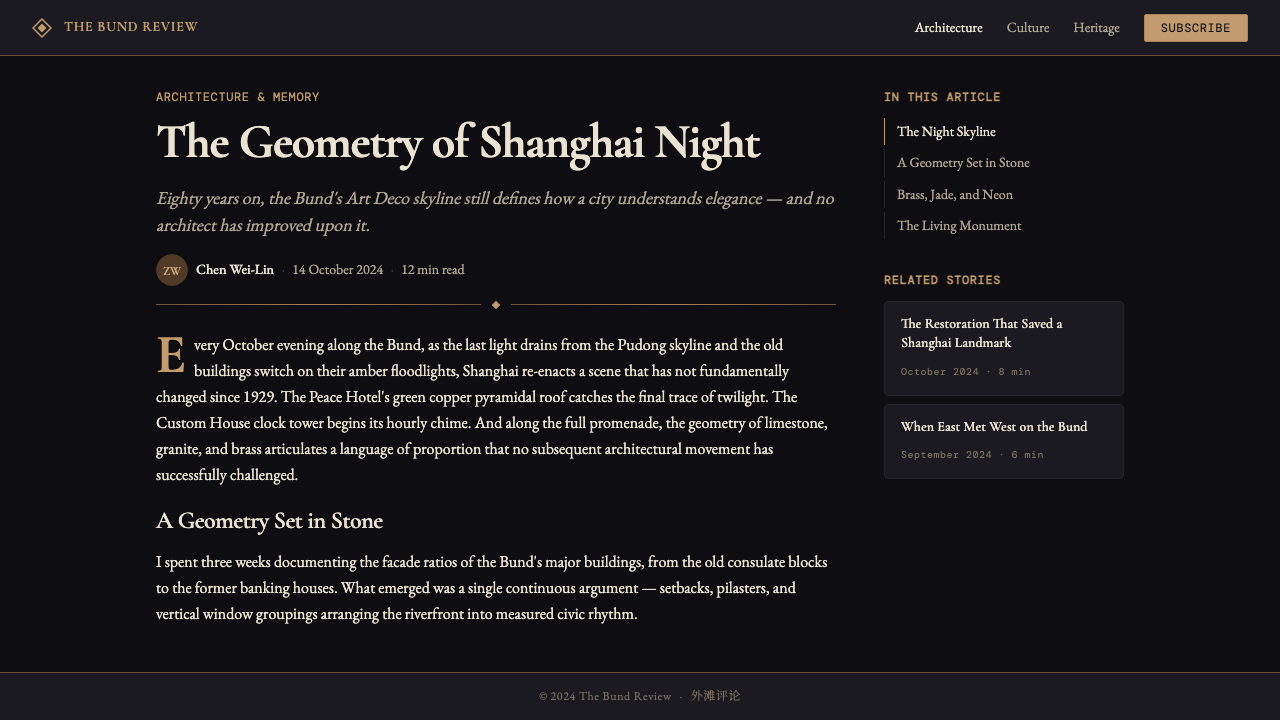
The typographic foundation is equally grounded in a specific cultural moment: the broadsheet layout of 1930s Shanghai pictorial magazines such as Liangyou and Shidai Manhua, where bold display type in both Western roman and Chinese script coexisted on the same page, creating a bilingual visual rhythm unlike anything in European or American Deco. The revival system preserves this bilingual confidence, treating headline type as a primary structural element rather than a label, and allowing the natural weight of dense Chinese characters to anchor compositions where Western type would feel lightweight.
Where does Shanghai Bund Art Deco Revival come from?
The original Bund Art Deco moment spans roughly 1920 to 1937, a period in which Shanghai became one of the most architecturally ambitious cities on earth. The Bund's mile of neoclassical and Deco buildings along the western bank of the Huangpu River was not the product of a single patron or aesthetic vision but of intense commercial competition among international banking houses, shipping companies, and hotel groups — British, American, French, and Shanghainese — each commissioning buildings intended to outshine their neighbors. The dominant architectural language that emerged from this competition was Art Deco, partly because the style's vertically aspirational grammar suited the tower typology and partly because its relative abstraction could absorb Chinese decorative motifs without incoherence.
Three architects define the original era. László Hudec, a Hungarian-Slovak who arrived in Shanghai in 1914 as a prisoner of war and never left, designed the Park Hotel on Nanjing Road — which opened in 1934 and held the record as Asia's tallest building for decades. Palmer and Turner, the Hong Kong-based British firm responsible for more than thirty buildings on or near the Bund, defined the stately horizontal register of institutions like the Hong Kong and Shanghai Banking Corporation building, whose colonnaded facade and mosaic-domed interior became a template for civic dignity in colonial Asia. Lu Qianshou, the first Chinese-trained architect to work at the Bund's international scale, designed the Bank of China building (1937) — notable for incorporating traditional Chinese roof forms and jade-green ceramic elements into an otherwise Deco tower frame, establishing the Sino-Deco hybrid that would become the revival's most distinctive signature.
The movement's collapse came with the Japanese occupation of Shanghai in 1937 and the ensuing decades of war, political upheaval, and socialist construction that followed. The Bund's great hotels and banks were repurposed as government offices, their lobbies closed to the public, their decorative metalwork stripped or painted over. For nearly fifty years the district existed as institutional infrastructure rather than living culture.
The revival began in the late 1990s with the transformation of the Bund's waterfront into a pedestrian promenade and the reopening of the Peace Hotel, originally the Cathay Hotel, built by Victor Sassoon in 1929. Restaurateur Michelle Garnaut — Australian-born, Shanghai-adopted — opened M on the Bund in 1999, the first fine-dining establishment to use the original Deco architecture as a deliberate aesthetic statement rather than an incidental backdrop. Throughout the 2000s and into the 2010s, a wave of luxury hotel restorations and editorial commissions followed: Bulgari, Fairmont, and L'Hotel de Chine all opened properties on or near the Bund, each deploying restored Deco architectural details as a premium differentiator. By 2020, the revival had reached full maturation as a graphic language — not just an interior style but a complete visual system exported into branding, packaging, editorial, and digital product design.
What defines the Shanghai Bund Art Deco Revival look?
Night-Black Ground
The dominant ground tone is a deep, absolute black — not the warm charcoal of some Art Deco palettes but the cold luminous black of the Huangpu River at midnight, reflecting neon signage from the Pudong shore. This darkness gives all other elements their intensity: the rose-gold reads as genuinely metallic rather than merely warm, and the jade-green acquires an almost phosphorescent quality against the void. Using this ground correctly means committing to it as the primary surface, not treating it as a dramatic accent — it should feel like the natural state of the space, from which other elements emerge rather than sit upon.
Rose-Gold Metallic Thread
Rose-gold — the Shanghai-specific inflection of the 1930s metallic palette — functions as the system's connective tissue. It appears on borders, dividing lines, button frames, initial capitals, and the hairlines that separate columns in tabular layouts. Its warmth prevents the night-black ground from reading as tech-minimal or futurist; it anchors the composition in a tradition of handcraft — gilded lobby details, foil-stamped menus, inlaid brass room numbers. The critical discipline is to use this accent sparingly: it earns its luxury connotation precisely because it is not everywhere, only where the eye needs to be guided or where a surface needs to signal premium quality.
Jade-Green Counterweight
Jade green is the palette's Republican-era marker — the color of the ceramic tiles and interior lacquerwork that distinguished Sino-Deco buildings from their purely Western counterparts. In the revival system, jade functions as a tertiary accent reserved for cultural depth signals: heritage badges, secondary metadata, traditional-format dates, the occasional pull-quote border. Used at lower saturation and slightly muted, it avoids competing with the rose-gold for attention while providing a chromatic signature that separates this system from generic luxury palettes. Its presence is an argument about cultural specificity: this is not Deco as imported Western style but Deco as absorbed and reinvented by Shanghai.
Broadsheet Typography
The typographic system draws on the visual culture of 1930s Shanghai pictorial magazines, where the challenge of integrating Western display type and dense Chinese characters on the same spread produced a distinctive approach to scale and weight. Headlines are set large enough to carry the page — the natural weight of dense Han characters means Chinese headlines anchor compositions that a purely Western type approach would struggle to stabilize. Body text is set at a moderate measure with generous leading, recalling the readability standards of broadsheet journalism rather than the compressed elegance of European luxury editorial. Vertical text elements — column heads, running titles, folios — reference the traditional Chinese reading direction without abandoning horizontal legibility.
Stepped and Layered Depth
Unlike Bauhaus flatness, the Bund Deco revival embraces a controlled layering — but it is architectural rather than atmospheric. Depth is created through stepped recession: foreground elements overlap background planes at hard edges, producing a silhouette effect that echoes the stepped massing of Deco tower facades and the relief carving of lobby decorative panels. Shadows, where used, have directionality and hard edges; they read as cast light rather than ambient glow. This layering gives layouts a tactile, almost sculptural quality — the sense that elements have thickness and material presence rather than simply existing as pixels on a flat surface.
Controlled Ornament
Where Bauhaus eliminates ornament entirely, Bund Deco revival uses it selectively and structurally. The key discipline is that every ornamental element must earn its place by reinforcing spatial organization or marking cultural significance — a gilded border demarcates a premium section, a geometric rosette marks a section heading, a chevron motif guides reading direction. Ornament is never freestanding decoration; it is always load-bearing in the compositional sense. This distinction is subtle but critical: the difference between an authentic Deco revival and a pastiche is whether the ornamental elements are doing structural work or simply providing historical costume.
Bilingual Visual Syntax
Perhaps the most historically specific characteristic of the Bund Deco revival is its comfort with bilingual visual composition. The 1930s source material — magazine spreads, hotel menus, nightclub programs — routinely set English and Chinese on the same page with the confidence of a culture that genuinely inhabited both languages rather than translating between them. In contemporary application, this means designing bilingual layouts where neither language is subordinated typographically — Chinese is not a translation footnote beneath English, and English is not an exotic accent on a predominantly Chinese layout. Both languages are present at full typographic weight, navigating shared space through hierarchy and placement rather than size reduction.
Who shaped Shanghai Bund Art Deco Revival?
Born in Slovakia, trained in Budapest, captured by Russian forces in the First World War and transported via Siberia to the Pacific — Hudec escaped his prisoner-of-war convoy in Vladivostok and made his way to Shanghai in 1914, eventually becoming the city's most productive architect. His Park Hotel on Nanjing Road (1934) held the record as Asia's tallest building for nearly three decades and demonstrated that Art Deco's vertical ambition could be realized at a scale matching New York or Chicago. His work is the primary architectural source for the Bund revival's understanding of tower composition, setback massing, and the integration of European decorative vocabulary with Chinese craft traditions.
Lu Qianshou studied architecture in the United States and returned to practice in Shanghai at the moment when the city's architectural establishment was beginning to question whether Western Deco vocabulary alone could express a distinctively Chinese institutional identity. His Bank of China building (completed 1937), facing the Bund on the Zhongshan Road East, is the canonical example of Sino-Deco synthesis: a straightforwardly Deco tower in its vertically organized facade and ornamental metalwork, but crowned by a traditional hip-and-gable roof form in jade-green glazed tile. This formal integration — Western structural logic, Chinese symbolic crown — established the precedent that the contemporary revival draws on most directly when it incorporates jade-green elements and traditional roof silhouettes into otherwise modern compositions.
The Hong Kong-based British architectural partnership of Palmer and Turner designed more buildings on or near the Bund than any other single firm, defining the institutional register of the district across three decades. Their HSBC building (1923), Chartered Bank building, and Custom House (1927) established the civic grammar of the waterfront — colonnaded facades, mosaic-domed banking halls, and the particular relationship between a monumental ground floor and the restrained Deco articulation of upper stories. For the contemporary revival, Palmer and Turner represent the horizontal institutional tier of Bund Deco — a counterweight to Hudec's vertical tower ambition — and their work is the source for the system's treatment of wide, anchor-weight headers and the integration of civic motifs into commercial compositions.
Not an architect but a restaurateur, Garnaut's significance to the revival is cultural and curatorial: by opening M on the Bund in 1999, she made the argument — physical, programmatic, and commercial — that the Deco architecture of the Bund could be inhabited rather than merely preserved, used as the setting for a living cultural practice rather than treated as a museum interior. Her restaurant occupied a colonial-era floor of the Nissin Building, and her approach to decoration — restored original metalwork, period furniture, editorial photography of 1930s Shanghai — modeled what the revival would look like when implemented with genuine historical commitment rather than superficial period costume. Subsequent luxury hotel restorations and brand identity projects across the Bund followed the template she established.
From the early 2010s onward, a generation of Shanghai-based graphic designers and art directors — working for luxury hotels, fashion brands, and cultural institutions — began systematically translating the Bund's architectural language into contemporary visual communication. Shao Fan, one of the most cited among them, developed a graphic vocabulary that treated Deco structural elements — stepped borders, gilded hairlines, the particular weight relationship between display type and decorative rule — as modular components for brand identity systems, wedding stationery, and cultural institution materials. His work, and that of the broader Shanghai design revival, is the proximate source for how the Bund Deco system reaches contemporary digital applications: not through direct architectural translation but through the intermediate layer of this graphic practice.
How do you use Shanghai Bund Art Deco Revival today?
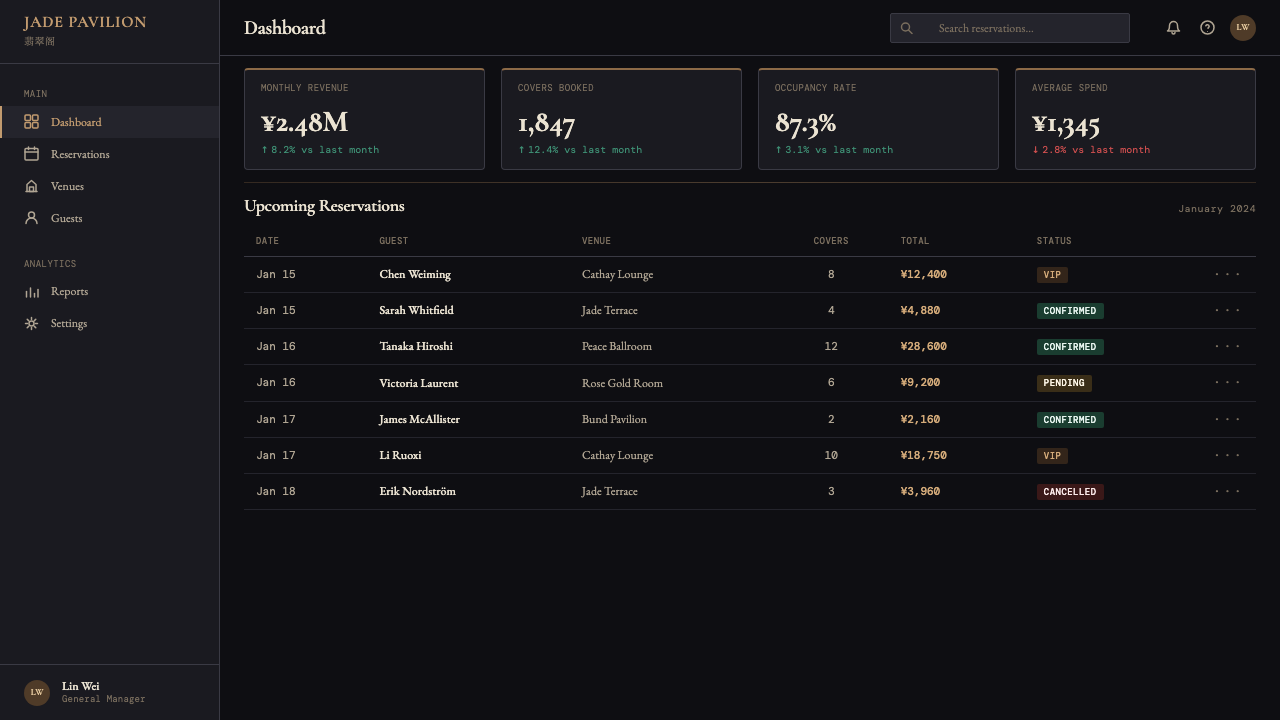
The Bund Deco revival is a high-commitment aesthetic: its defining elements — night-black ground, rose-gold metallic accents, bilingual typographic confidence — require deliberate implementation to succeed. Applied superficially, the system produces pastiche; applied with historical understanding, it delivers a sense of occasion and cultural depth that few contemporary design systems can match. The critical first decision is whether the product's content and audience genuinely support this register. The system works for luxury hospitality, premium editorial, cultural institutions, and high-end retail — it is not suited to consumer apps seeking approachability or to services emphasizing clarity over atmosphere.
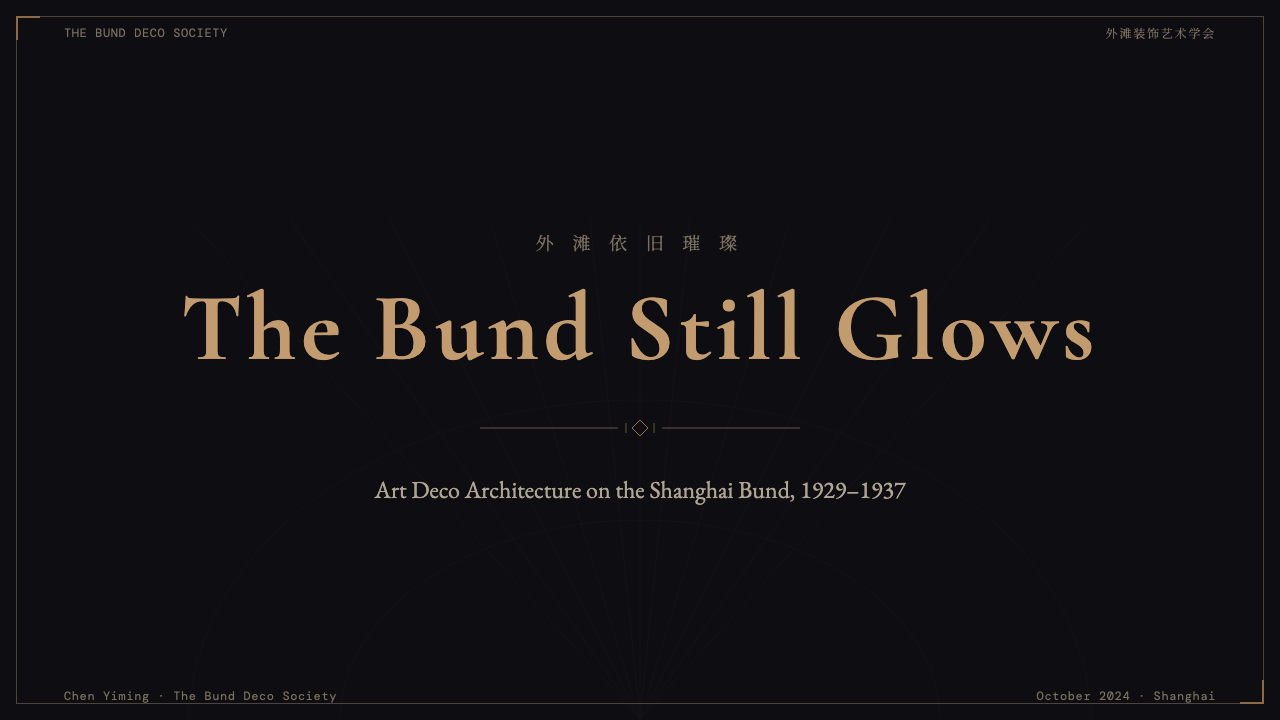
For presentation slides, the system is most effective when used for high-stakes communications — annual reports, brand launches, investor materials — where the sense of occasion justifies the visual weight. A cover slide built on a night-black ground with a rose-gold headline and a stepped border frame reads as an event, not a file. Content slides require discipline: the dark ground means all secondary text must be carefully lightened to remain legible, data visualizations should be built on simplified scales with metallic accent coloring for key values, and the bilingual potential of the system should be realized wherever the audience permits — a Chinese subhead beneath an English headline is not a translation note but a design decision.
For web interfaces, the system is best deployed in experiences where dwell time and atmosphere matter more than functional efficiency: boutique hotel booking flows, luxury product detail pages, cultural institution landing pages, premium membership portals. Navigation should be structured as a broadsheet masthead — horizontal, typographic, with hairline rules rather than filled containers — and the main content area should commit to the dark ground throughout rather than mixing light and dark sections, which fragments the atmospheric unity. Interactive elements — buttons, form inputs, tab markers — use rose-gold borders and state changes rather than filled backgrounds, keeping the metallic thread consistent through the interaction layer.
For editorial and marketing work, the Bund Deco system excels in long-form contexts where the design can breathe across multiple pages or sections. Magazine layouts built on a broadsheet grid with generous white (or black) space between columns, section breaks marked by stepped ornamental rules, and pull-quotes set in oversized display type with jade-green borders create the specific register of 1930s Shanghai pictorial culture transposed into contemporary reading. Marketing campaign materials — event posters, direct mail, packaging — benefit from the system's poster-level compositional boldness: a single dominant visual element (typically typographic rather than photographic) on a night-black ground, with rose-gold as the only color accent, creates immediate premium signal without requiring complex image production.
A common failure mode when applying this system is treating the rose-gold accent as a license for warmth across the entire palette — adding amber tones, golden photography filters, or candlelight lighting simulation to create a generalized vintage luxury atmosphere. The Bund Deco revival is not warm: its black is cold and absolute, its rose-gold is metallic and precise, its jade is mineral rather than organic. The luxury it projects is architectural and civic rather than domestic and sensory. Designs that drift toward warmth, candlelight, or aged-paper textures are producing something closer to Art Nouveau nostalgia or Orientalist pastiche — both of which are structurally different from the crisp, cosmopolitan, commercially ambitious Deco language the Bund represents.
Shanghai Bund Art Deco Revival — FAQ
How does Bund Deco differ from generic Art Deco?
Generic Art Deco — as it appears in American and European applications — typically uses a warm cream or ivory ground, symmetrical compositions, and a palette centered on gold, black, and deep jewel tones. Bund Deco is distinguished by three specific inflections: the cold, absolute black ground (the night-Huangpu reference rather than the warm velvet of Parisian Deco), the rose-gold metallic accent rather than pure gold, and the jade-green Republican-era counter-accent that introduces a specifically Chinese material reference absent from Western Deco. Most importantly, Bund Deco is a bilingual visual tradition — it was designed, from the beginning, to hold both Chinese and Western type on the same page with equal compositional weight. Generic Deco applied to Chinese contexts tends to look like Western Deco with Chinese content inserted; authentic Bund Deco treats both languages as native inhabitants of the visual space.
Can this system work in a light-ground version?
A light-ground variant is possible but requires careful recalibration. The night-black ground is not merely a color choice but a specific historical reference — the Huangpu River at midnight — and the metallic qualities of the rose-gold accent only fully register against a dark field. On a cream or white ground, rose-gold loses its metallic character and reads as warm beige; jade-green without the dark contrast reads as merely pastel. A light-ground Bund Deco is feasible if the black is reintroduced as the dominant typographic and structural color, the rose-gold is reserved exclusively for metallic-finish physical elements or print applications where foil stamping is available, and the overall palette is shifted toward the ink-and-paper register of 1930s printed ephemera rather than the nightlife register of the lit waterfront. This produces a daytime reading of the Bund — the commerce and journalism of the 1930s — rather than the nighttime event-culture reading that is the system's primary register.
Is the bilingual composition approach only relevant for Chinese-language audiences?
Not at all. The bilingual visual syntax of Bund Deco is historically significant and aesthetically distinctive regardless of the audience's linguistic ability to read both languages. For a monolingual English-speaking audience, Chinese display type in a Bund Deco layout functions as a visual element with specific cultural weight — it signals cosmopolitan Shanghai rather than generic Asian exoticism, and it is compositionally functional because the density of Han characters creates visual anchors that Latin type at the same point size cannot. The critical discipline is to use Chinese type with the same confidence and scale as the English — setting it as a subordinate caption or translation note defeats the historical logic of the system, which was never a case of one language translating for another but of two languages sharing compositional space as equals.
What is the biggest mistake when applying the rose-gold accent?
The most common mistake is overuse — treating rose-gold as the system's primary color rather than its connective accent. In the historical source material, the rose-gold of elevator grilles, door frames, and menu stamps is visible precisely because it appears at moments of transition and emphasis against a dominant black surround. When rose-gold is applied to large surface areas — full-width header backgrounds, broad dividing bands, prominent fill colors for content blocks — it loses its metallic specificity and begins to read as generic warm orange. The system's luxury register depends on the rose-gold being used at the weight of a metal thread rather than a paint color: hairlines, borders, small text emphasis, and occasional single-word display accents rather than filled areas or dominant background tones.
How does the system handle photography and imagery?
Photography in the Bund Deco revival is treated as a period-press artifact rather than a contemporary production value. The reference is the high-contrast black-and-white photography of 1930s pictorial magazines — images that were reproduced in limited color ranges and designed to hold their visual impact at reduced scale on newsprint. In contemporary application, this means photography should be used sparingly and treated: high-contrast desaturation, duotone processing in the system's primary colors rather than naturalistic full-color, or period-style cropping to isolate architectural and figural silhouettes against clean grounds. Full-color lifestyle photography — the ambient, warm-lit interiors typical of contemporary luxury hospitality marketing — works against the system's precise, cold, architecturally grounded visual language and should be avoided or substantially processed before integration.
Related design styles
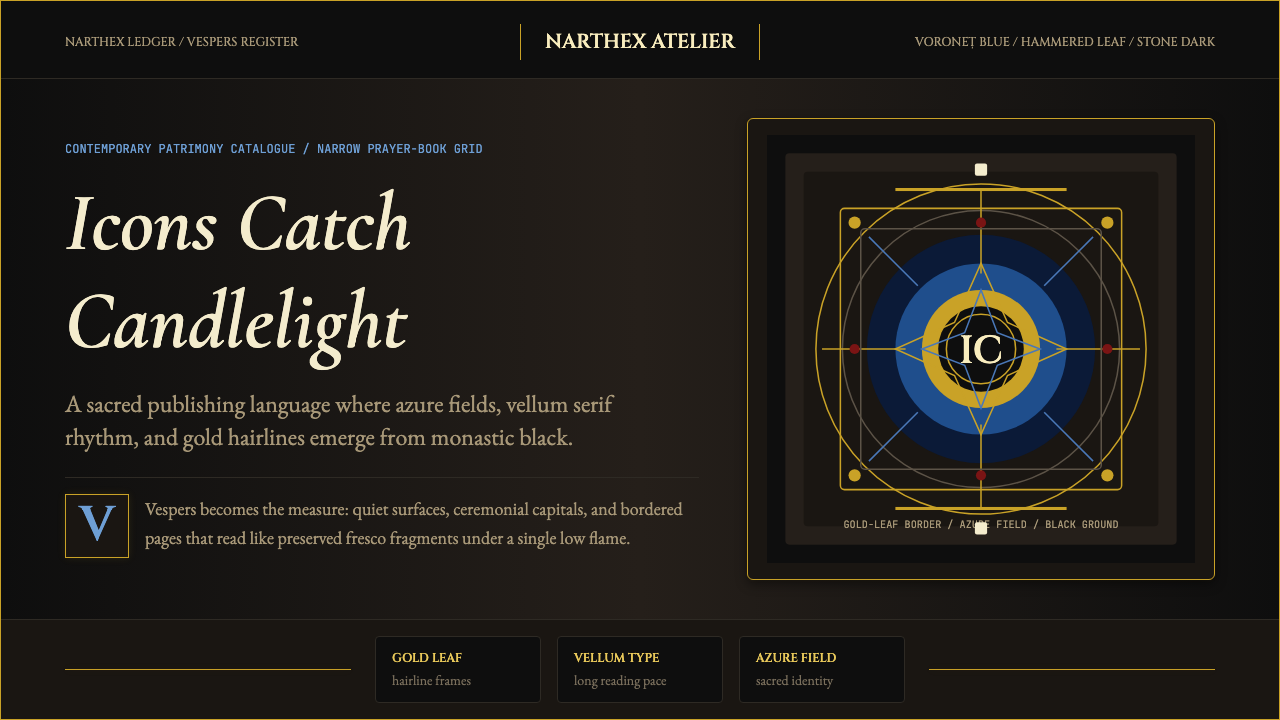 Romanian Orthodox Modern RevivalSacred dark refuses sparkle. Voroneț blue halos and gold hairlines rise from…
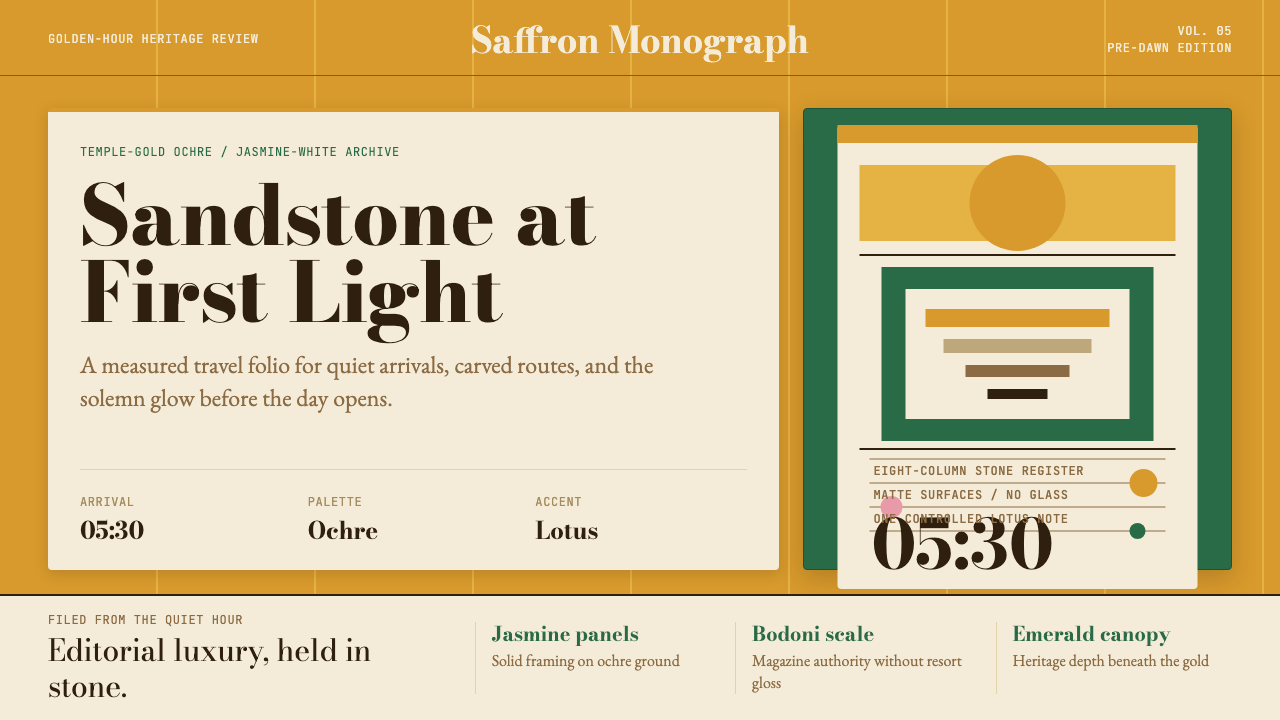 Cambodian Angkor Tourism ModernQuiet authority at dawn. Ochre ground, Bodoni serif, jasmine panels, one lotu…
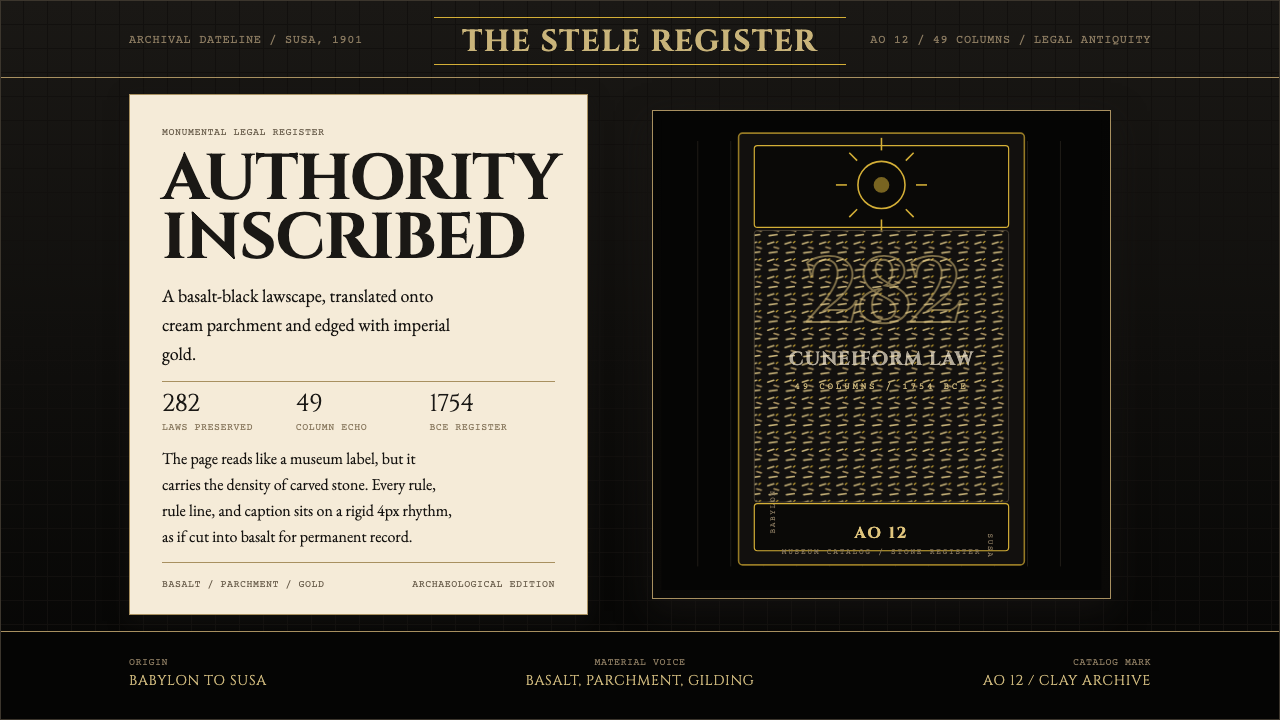 Babylonian Hammurabi SteleAuthority carved in stone. Basalt-black grids, parchment panels, and imperial…
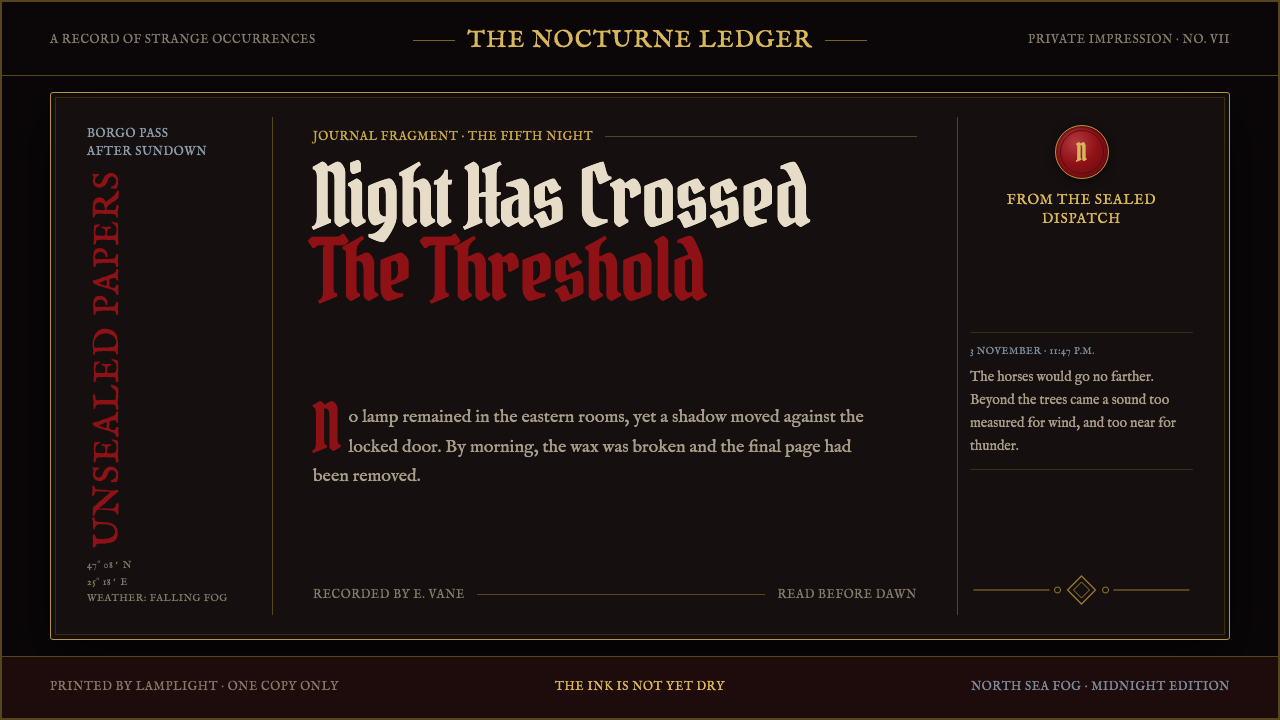 Dracula Gothic (1897)Victorian dread after dark. Blood-red initials and tarnished gilt haunt coffi…
 Dutch VanitasTime waits at the table. Olive-black depths, earth-brown type, and one candle…
 Ex Libris BookplateScholarly ownership, cut in ivory. Cinzel caps and crosshatch rules rise from…