What is Dark Academia?
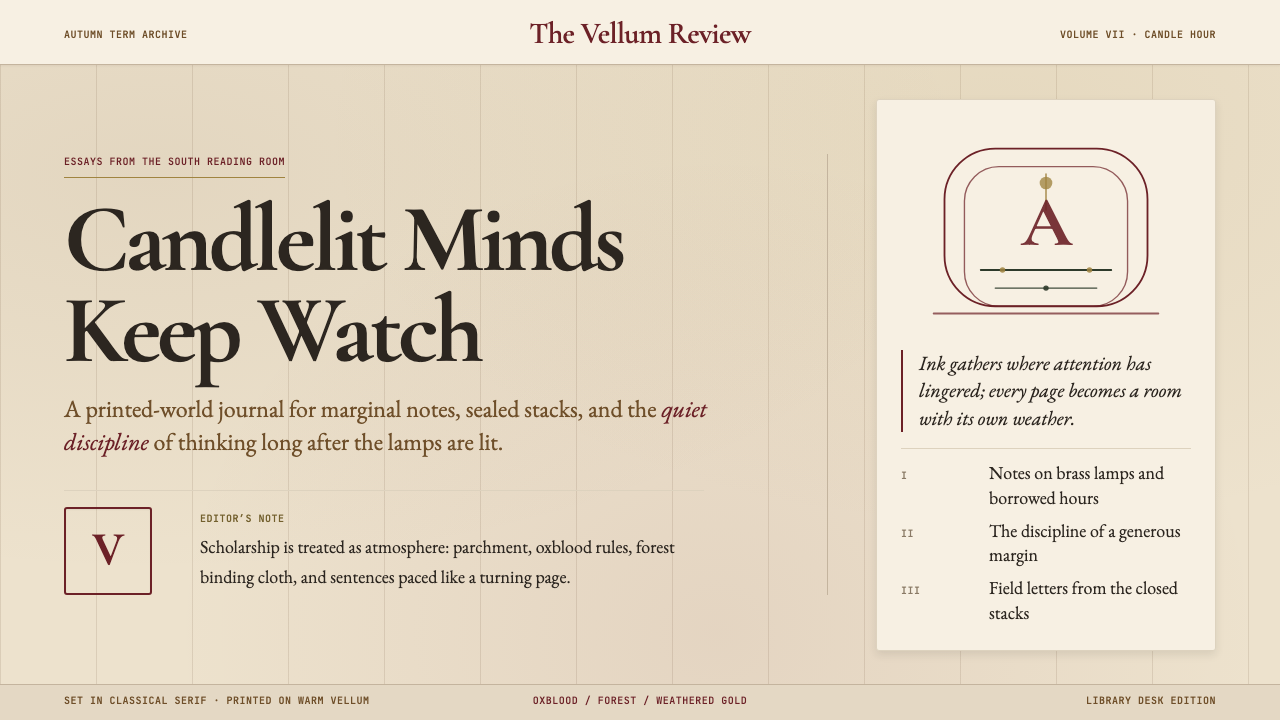
Dark Academia translates candlelit library nostalgia into warm parchment grounds, oxblood accents, and classical serif type that feels like a well-loved book spread open on a mahogany desk.
Dark Academia in brief
Dark Academia is an internet-born aesthetic that romanticizes the atmosphere of Western classical education — candlelit reading rooms, leather-bound volumes stacked on oak shelves, fountain-pen marginalia, the smell of old paper, and the moody collegiate drama of 1990s prep-school cinema. As a visual design system, it translates that literary nostalgia into a palette of warm, slightly aged neutrals anchored by a deep oxblood or burgundy accent, a typographic hierarchy built around classical serif letterforms, and layouts that feel generous, column-based, and deliberately unhurried.
The style is fundamentally about evoking a sense of accumulated knowledge and refined taste without ostentation. Where Bauhaus strips ornament away to reveal structural logic, Dark Academia layers on just enough ornamentation — a subtle texture, a ruled divider, a drop capital — to suggest that the designed object has a history, that it belongs to an ongoing scholarly tradition rather than a moment of trend. The result is rich without being baroque: controlled, legible, and emotionally warm.
Visually, Dark Academia work is recognizable through its restraint in color and its generosity in space. Backgrounds evoke aged paper rather than clinical white — warm off-whites, tawny creams, soft sepia tones. Text is set in classical serifs with careful attention to line-length and leading that supports sustained reading. Ornamental detail is present but purposeful: horizontal rules, initial capitals, subtle vignettes at section breaks. Nothing is garish; everything aspires to the dignity of a printed scholarly monograph.

Where does Dark Academia come from?
Dark Academia as a named aesthetic crystallized on Tumblr around 2015, where users assembled mood boards combining photographs of Gothic university architecture, candlelit study scenes, handwritten Latin passages, and stills from films such as Dead Poets Society (1989) and The Secret History's spiritual cinematic cousins. The emotional palette — melancholy, intellectual longing, the bittersweet pleasure of obsessive study — found a ready audience among readers and students who felt that contemporary visual culture offered them no adequate representation of the inner life of the serious reader.
The style's literary anchor is Donna Tartt's 1992 debut novel The Secret History, which follows a group of classics students at a small Vermont college whose devotion to ancient Greek thought tips into moral catastrophe. Tartt's descriptions of autumnal New England landscapes, firelit common rooms, and the physical texture of scholarly objects — monogrammed notebooks, heavy wooden furniture, tweed and wool — gave the aesthetic its emotional vocabulary before the internet gave it its name. Evelyn Waugh's Brideshead Revisited (1945) and its television adaptation provided a British Oxbridge counterpart: punting on the river, stone quadrangles, the sad glamour of aristocratic academic decline.
The style exploded in visibility during 2020 and 2021. The global pandemic, which closed universities and confined students to home, produced a widespread longing for the physical experience of institutional learning — the library as sanctuary, the seminar room as social world. TikTok's BookTok community and YouTube study-with-me videos gave Dark Academia its second life, now as an aspirational lifestyle aesthetic as much as a purely visual one. Users dressed in tweed and corduroys, filmed themselves studying by lamplight, and built vast archives of recommended reading lists under the hashtag.
The visual roots of Dark Academia reach back further than Tumblr, drawing on a long tradition of Gothic Revival architecture, Victorian print culture, and the early twentieth-century Arts and Crafts movement's reverence for handcraft and natural materials. Oxford and Cambridge's medieval college buildings, the Bodleian Library's Jacobean interior, the engraved frontispieces of eighteenth-century scholarly editions — these are the aesthetic ancestors the style is consciously invoking. As a design system it translates that inheritance into contemporary digital contexts, making it one of the few internet-born aesthetics with a genuinely deep historical root system.
What defines the Dark Academia look?
Color
The palette centers on a family of warm neutrals — aged parchment, tawny cream, soft sepia — that function as the background register, evoking old paper and worn linen. Against these grounds, a deep oxblood or burgundy red serves as the primary accent, used for headings, ruled lines, initial capitals, and occasional borders. Near-black or very dark brown replaces pure black for body text, softening the contrast to something closer to iron-gall ink on laid paper. Secondary accents — a muted forest green or a dusty gold — appear rarely, used to differentiate navigational elements or secondary information tiers. The overall effect is warm, slightly aged, and entirely free of the cool grays and pure whites that dominate contemporary digital interfaces.
Typography
Classical serif letterforms are the typographic foundation — specifically the kind associated with scholarly publishing: old-style proportions, moderate stroke contrast, and bracketed serifs that give each character a sense of hand-cut individuality. Headlines are set large and with deliberate gravity, often in a weight that reads as authoritative rather than merely decorative. Body text is set at a generous measure — the column width of a well-formatted academic paper — with leading that invites slow reading. Small capitals appear in section headers and running titles, recalling the conventions of traditional book typography. Italics are used liberally for emphasis and for titles of works cited, as convention in scholarly writing demands.
Texture and Surface
Where Bauhaus insists on flat, textureless surfaces, Dark Academia embraces subtle texture as an expressive tool. Paper grain, faint linen weave, the ghost of a watermark, a very light vignette darkening the edges of a field — these textures are never loud enough to interfere with readability, but they are present enough to suggest that the surface has a material history. The effect is the difference between a freshly minted coin and one that has passed through many hands: both are readable, but only one has depth. Digital implementations translate this through very low-contrast noise layers or subtly warm gradients that stop well short of obvious visual effects.
Ornament and Detail
Dark Academia permits — and encourages — a degree of decorative detail that would be anathema in strictly functionalist styles. Horizontal rules separating sections, decorative initial capitals beginning chapters, small fleurons or asterisms marking paragraph breaks, thin borders framing pull quotes — these elements are drawn from the vocabulary of traditional book design and used with the restraint of a practiced editor. The test is always whether the ornament serves the reading experience: does it clarify structure, signal transition, or give the eye a moment of rest? Ornament that merely decorates without orienting is still excess, even within this style.
Layout and Measure
Layouts are column-based and generous with white space — or more precisely, warm off-white space — in a way that foregrounds the reading experience rather than information density. The dominant organizational metaphor is the book spread: a primary text column accompanied by a narrower margin column for notes, dates, or annotations. Hierarchy is established through typographic scale and the strategic use of rules, not through color blocking or heavy graphical containers. Headers sit closer to the text they introduce than to the text above, following classical book conventions. Breathing room is built into every transition: between headline and body, between section and section, between image and caption.
Imagery and Illustration
Photography in Dark Academia contexts is heavily filtered toward mood: high contrast, slightly desaturated or warm-toned, with a compositional preference for intimate scale, shallow focus, and the presence of books, writing instruments, architectural stone, or natural materials. Candlelight, overcast window light, and the amber glow of a reading lamp are the preferred light sources. Illustration, when it appears, draws on the vocabulary of copperplate engraving and botanical or anatomical print traditions — precise, fine-lined, and emphatically hand-made in appearance. Maps, heraldic devices, and cartouches are referenced ornamentally rather than functionally, lending a sense of historical depth to otherwise contemporary layouts.
Mood and Register
The tonal register of Dark Academia is melancholic, intellectual, and aspirational without being cold. It is the aesthetic of the person who would rather spend a Sunday afternoon with a difficult book than with a trending content feed — and who wants their digital tools to acknowledge that preference. This emotional orientation shapes design decisions that might otherwise seem arbitrary: the choice of warm over cool backgrounds, the preference for slow typographic rhythms over dynamic layouts, the use of literary quotation as interface text rather than actionable microcopy. Dark Academia design speaks to the user as a reader and thinker, not as a consumer to be converted.

Who shaped Dark Academia?
Tartt's 1992 debut novel The Secret History is the single most cited source text for Dark Academia as both a literary genre and a visual aesthetic. Its precise, sensory descriptions of autumnal Vermont, Greek texts studied by firelight, and the physical objects of scholarly life — leather satchels, bone-handled penknives, editions of Plato — gave the aesthetic its emotional and material vocabulary years before social media codified it into a visual category. Tartt's 2013 Pulitzer Prize-winning novel The Goldfinch extended the style's range into art history and object obsession, reinforcing the connection between Dark Academia and the romantic attachment to beautiful, meaningful things.
Australian director Peter Weir's Dead Poets Society (1989) is perhaps the most visually influential film in the Dark Academia canon. Shot in warm, low-contrast autumn light against the stone and wood interiors of an American boarding school, the film established the cinematic grammar that later mood boards would perpetually sample: the circle of boys reading poetry by torch-light in a cave, the wood-paneled classroom hung with photographs of alumni, the headmaster's study lined with leather-bound volumes. Weir's visual approach — intimate, temporally displaced, saturated with the melancholy of institutions — became a template that countless Dark Academia designers return to without necessarily knowing its source.
Waugh's 1945 novel Brideshead Revisited and its celebrated 1981 ITV television adaptation supplied Dark Academia with its British Oxbridge reference frame: punting on the River Cherwell, stone quadrangles golden in late summer light, the sad glamour of aristocratic intellectual life, and the particular melancholy of looking back on a period of beauty that cannot be recovered. The novel's narrator, Charles Ryder, is himself an aspiring artist shaped by his encounter with the Flyte family and their ancestral home — a figure of aesthetic longing that maps almost exactly onto the Dark Academia reader's self-image. The adaptation's lush production design, full of chintz, oil paintings, and the burnished light of country houses, is a primary visual source for the style.
The fictional English teacher portrayed by Robin Williams in Dead Poets Society has become a shorthand figure within Dark Academia for the ideal of passionate, humanistic teaching — the educator who treats literature as a matter of life and death rather than a curriculum to be administered. The character's famous 'O Captain! My Captain!' scene, in which students stand on their desks in defiance of institutional conformity, gave Dark Academia one of its most replicated visual motifs: the individual act of intellectual courage performed within the physical space of an institution. As a symbolic figure rather than a historical one, Keating represents the style's emotional core — the belief that rigorous study and emotional intensity are not opposites but complements.
Although the Harry Potter series (1997–2007) predates the explicit naming of Dark Academia, Rowling's visual world — Hogwarts' torchlit stone corridors, the Great Hall with its floating candles, the library's restricted section, house colors worn as identity markers — provided an extraordinarily influential template for millions of readers before any of them encountered the term. The Warner Bros. film adaptations, with their warm practical lighting, aged prop libraries, and carefully crafted Gothic architecture, gave Dark Academia much of its popular visual grammar. The style's widespread legibility today is partly a function of the films having trained an entire generation to find warmly lit stone interiors and candlelit study scenes aesthetically compelling.
How do you use Dark Academia today?
Dark Academia is among the most emotionally specific aesthetics available to a designer: it does not merely look a certain way but evokes a certain kind of relationship between the reader and the page. Applying it successfully requires internalizing that relationship — the unhurried intimacy of reading by lamplight, the sense that the content being presented has weight and consequence — and then making every design decision in service of that feeling rather than in service of trend.
For presentation slides, Dark Academia functions best as a complete system rather than a surface treatment. A cover slide benefits from a single strong typographic statement — a title in a classical serif at generous scale against a warm parchment ground — with a thin horizontal rule and a subtitle set in small capitals below. Content slides should preserve wide margins and avoid filling every available area: the negative space is not wasted but is part of the reading experience. Data visualizations take on a different quality in this style — bar charts rendered with restrained color use and careful axis labeling, tables set in the style of a well-formatted reference work, diagrams that feel more like architectural drawings than dashboard widgets. The overall deck should feel like a beautifully produced monograph, not a slide deck competing for attention at high speed.
For web interfaces, Dark Academia is ideally suited to contexts where the user is expected to read carefully rather than scan quickly: editorial publications, long-form journalism, digital humanities platforms, online course materials, personal essay blogs, and subscription products that position themselves around depth and curation. Dashboard applications can employ the style selectively — using the color palette and typographic hierarchy while adopting a more structured grid for data density. Pricing pages benefit from the style's natural authority: a simple two or three-column table with typographic hierarchy and no gradient button styles communicates honest value better than heavily styled contemporary alternatives.
For editorial and marketing work, Dark Academia excels at contexts that need to signal intellectual seriousness and cultural ambition. A book launch campaign, a university admissions communication, an arts organization's season brochure, a cultural magazine's feature spread — all of these are natural homes for the style. Marketing pages work well with a vertical rhythm that recalls book chapter structure: a wide introductory section, a testimonial area set in the style of a pull quote in an academic journal, a features section with ruled dividers rather than card containers. Email newsletters in this style are among the most readable in contemporary digital communication — the combination of generous measure, classical serif, warm background, and restrained decoration produces an experience closer to opening a letter than a promotional email.
A common mistake when applying Dark Academia is conflating darkness of mood with darkness of palette. The authentic style is not typically a dark-background design — it is warm and cream-grounded, with deep accents rather than inverted color values. Filling the screen with black or very dark brown and calling it Dark Academia produces something closer to gothic horror than academic nostalgia. A second mistake is over-ornamenting: adding every available flourish — watermarks, ink textures, wax seal motifs, dramatic vignettes — simultaneously produces visual noise rather than atmosphere. Restraint is as important here as in any minimalist style; the difference is that here the restraint operates on ornament rather than on structure.
A third and subtler error is neglecting typographic rhythm. The emotional experience of this style depends almost entirely on reading being comfortable and pleasurable: if the body text is too small, the line-height too tight, or the measure too wide or too narrow, the spell breaks instantly. Before refining any surface detail, ensure that the core typographic system — a well-chosen classical serif at a reading-friendly size, set with generous leading and a measure that allows comfortable line completion — is working. Everything else is elaboration of a foundation that must first be sound.

Dark Academia — FAQ
Is Dark Academia the same as gothic design?
They overlap but are distinct. Gothic design draws on medieval ecclesiastical architecture and Victorian-era horror illustration — pointed arches, gargoyles, dramatic high-contrast black-and-white palettes, and a theatricality that courts the transgressive and the macabre. Dark Academia, by contrast, is warm and scholarly: its references are the university library rather than the cathedral crypt, the antiquarian bookshop rather than the ruined abbey. The mood is melancholy rather than threatening. Where gothic design often deploys darkness aggressively, Dark Academia uses warmth and depth to create a sense of protected interiority — the feeling of being safely enclosed in a world of books and ideas.
Can Dark Academia work for a brand that is not directly related to education or books?
Yes, but the brand's values must be compatible. The style works well for any product or service that can credibly claim depth, curation, and sustained attention as core values: specialty food and beverage brands, luxury goods, long-form journalism, personal finance tools positioning themselves around thoughtful decision-making, premium software for creative professionals, travel experiences emphasizing cultural immersion. It works poorly for products that depend on speed, volume, and impulse — e-commerce with high transaction rates, social media tools, casual gaming, fast fashion. The test is not category but value alignment: does this product want the user to slow down and pay attention? If yes, Dark Academia is worth considering.
How does Dark Academia differ from vintage or retro design?
Vintage and retro design are primarily about period-accurate surface reproduction — the color palette, illustration style, typeface fashions, and printing artifacts of a specific decade are replicated to evoke nostalgia for that era. Dark Academia is not period-specific in the same way: it does not aim to reproduce any particular decade but instead synthesizes a timeless scholarly atmosphere drawn from multiple centuries of European academic culture. A Dark Academia layout should not feel like it was made in the 1890s or the 1950s; it should feel like it could have been made at any point during a long tradition of careful scholarly publishing. The reference is institutional and cultural continuity, not temporal specificity.
Does Dark Academia require actual aged or textured backgrounds, or can it work on a clean flat surface?
It can work on a flat surface, but texture is a genuine asset rather than an optional extra. On a clean flat warm-cream background with no texture, the style relies entirely on typography and color to carry the atmosphere — which is achievable with rigorous typographic craft but harder than it sounds. The subtlest possible texture — barely-there paper grain that is invisible at a glance but present under close inspection — adds a layer of sensory depth that reinforces the literary reference without calling attention to itself. The practical recommendation: use texture, but keep it so subtle that most users will not consciously notice it. Its job is to prevent the background from feeling like a digital surface, not to become a design statement in itself.
Is Dark Academia suitable for mobile interfaces, or does it work better at larger screen sizes?
The style adapts to mobile, but requires deliberate adjustment. The wide-measure reading column and margin-annotation structure that define the style at desktop scale cannot be preserved at mobile width — the measure must narrow, the margin column must collapse into the main flow, and the generous spacing that creates the book-like feel requires careful calibration to remain present without producing a layout that is impractically long. The typographic foundation — classical serif, warm background, restrained color use — translates without difficulty. The ornamental details — rules, initial capitals, fleurons — must be used more sparingly on small screens, where they can easily overwhelm rather than accent. The style works well for long-form reading applications at mobile scale; it is harder to justify for task-oriented interfaces where the decorative overhead competes with efficiency.
Related design styles
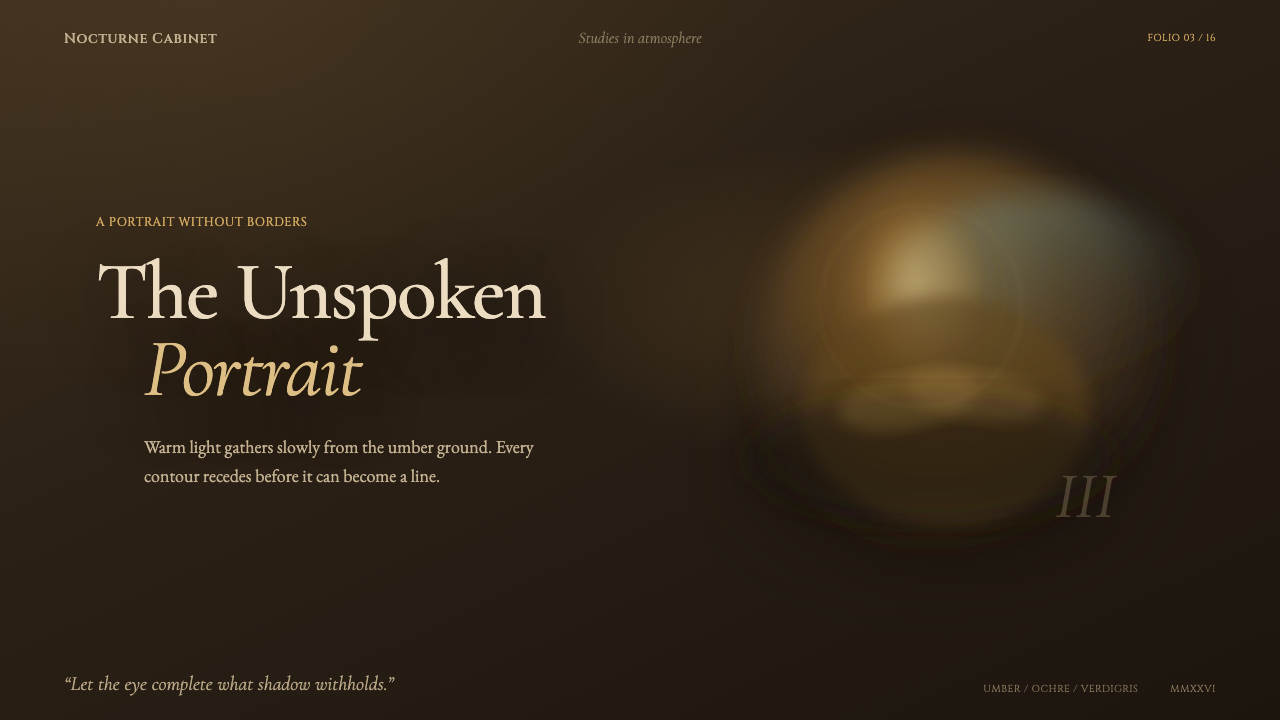 Leonardo — Mona Lisa (1503)Form emerges without edges. Ochre light dissolves into umber shadow and blue-…
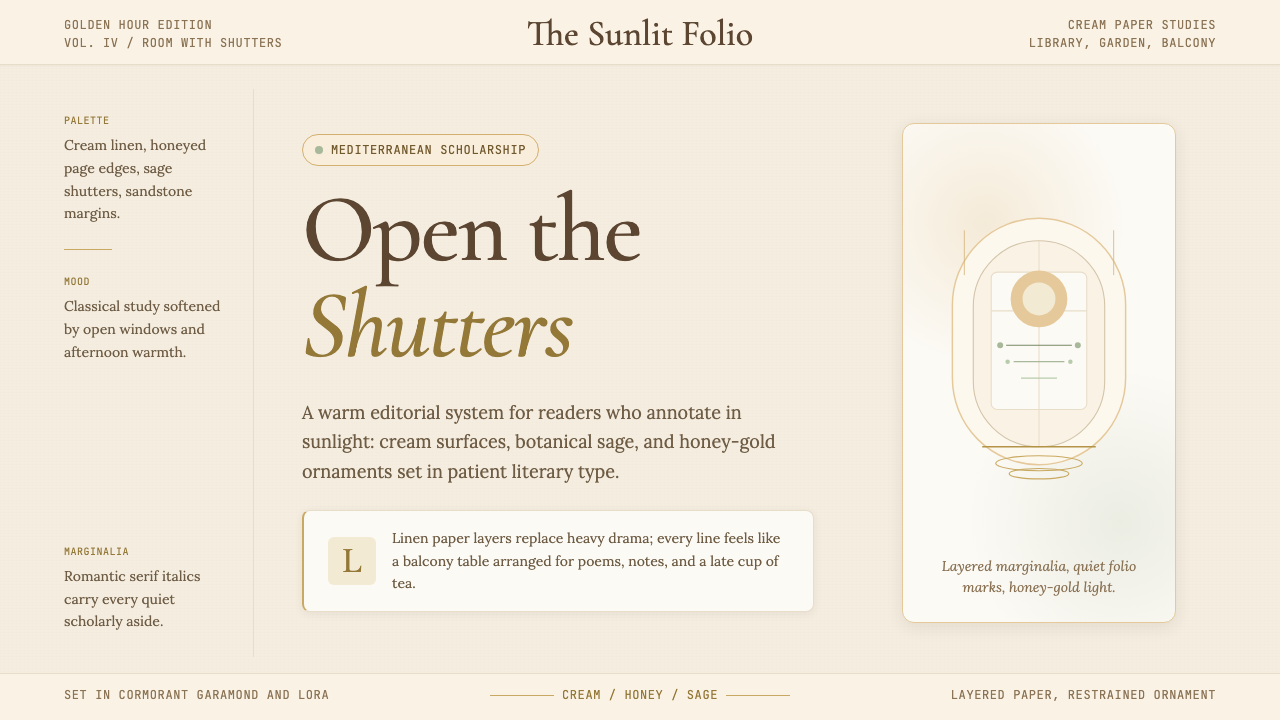 Light AcademiaScholarship turns sunlit. Cream linen, honey gold, sage botanicals, and roman…
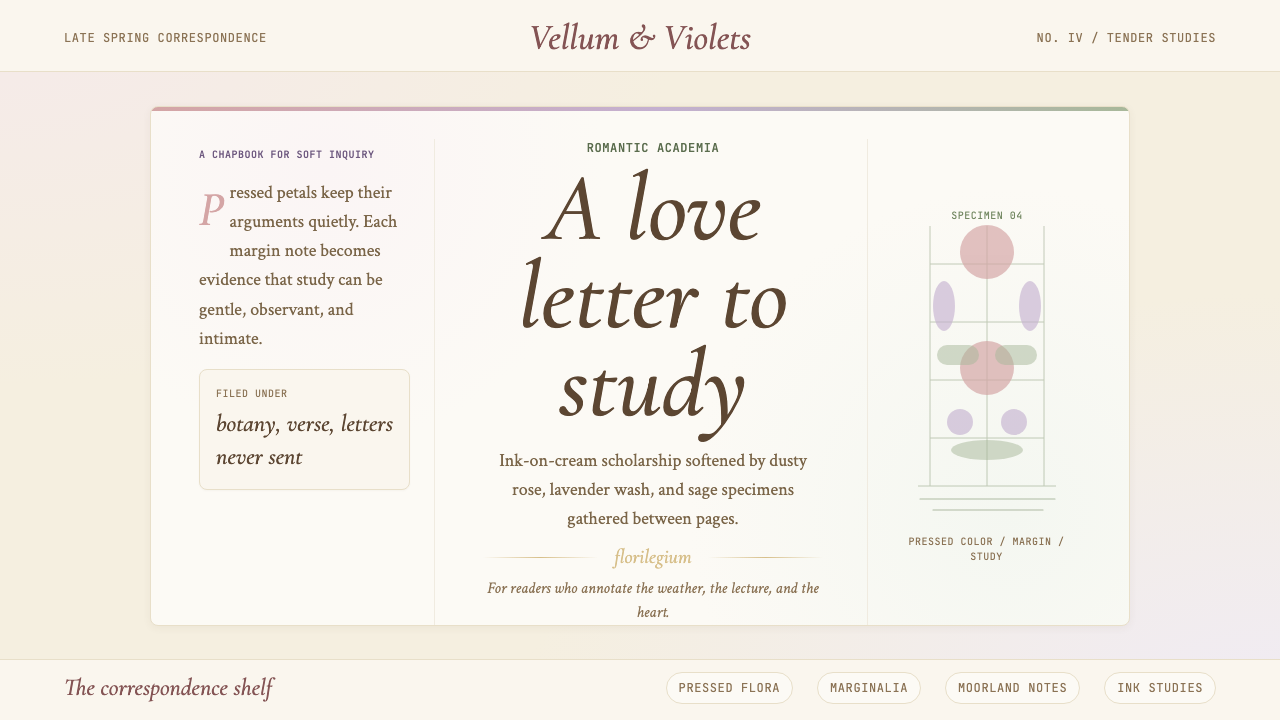 Romantic AcademiaScholarship turns tender. Dusty rose and lavender frame ink-on-cream poetry w…
 Dior New Look (1947)Couture speaks softly. Cream ground, navy Didot capitals, and gold hairlines…
 Engraved SundialStone refuses haste. Grey-beige hour lines and verdigris gnomon carve silence.
 Gin BotanicalHerbarium precision. Dark green frames, Playfair serif, and copper rules hold…