What is Light Academia?
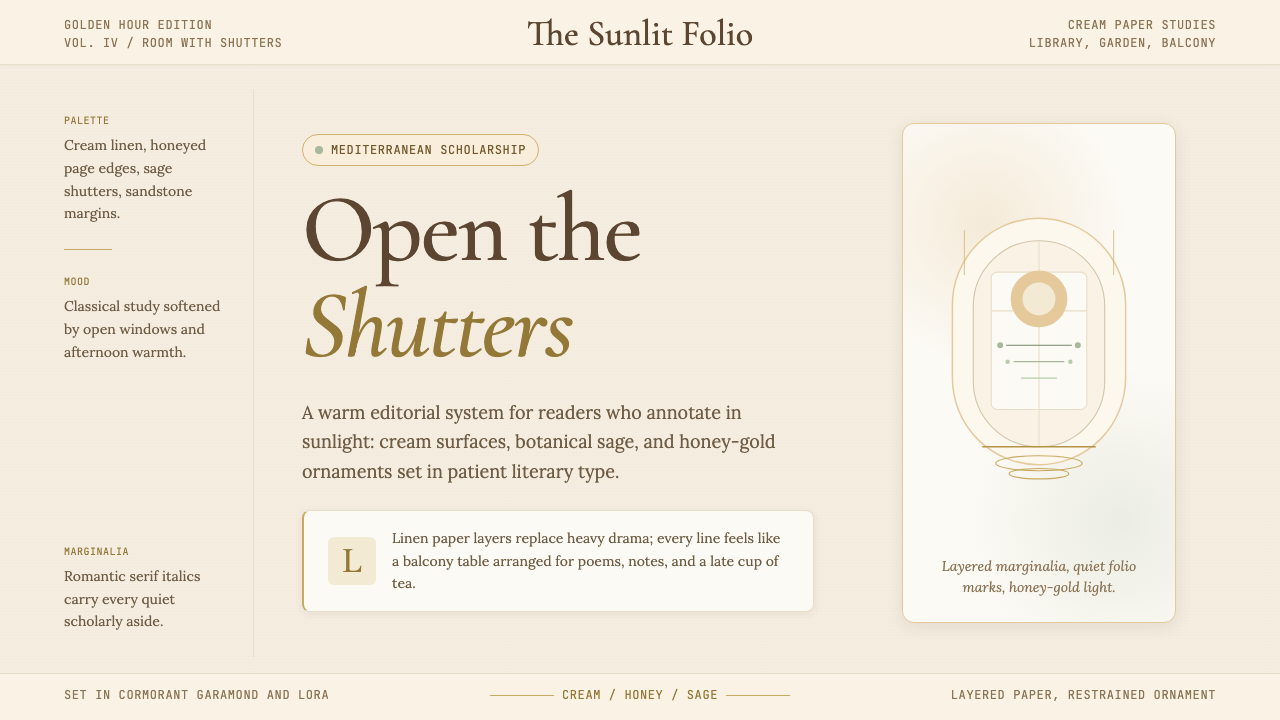
Light Academia bathes scholarly romanticism in golden-hour warmth — cream linen, honey-toned grounds, sage botanical accents, and generous serif italics that feel lifted from a sunlit Mediterranean library.
Light Academia in brief
Light Academia is a design aesthetic that translates the mood of sunlit classical scholarship into a visual language: warm cream and parchment backgrounds, honey-gold accents, dusty sage and muted olive botanical notes, romantic serif typography used with generous italics and deliberate white space, and an overall sense of softness and cultivated ease. Where its counterpart Dark Academia favors candlelit gloom and Gothic severity, Light Academia reaches for the golden afternoon of a Tuscan reading room or a Greek island balcony stacked with dog-eared paperbacks.
As a design system, the style draws on the visual grammar of Edwardian stationery, Renaissance botanical illustration, and the warm materiality of linen, aged vellum, and hand-pressed paper. Ornamentation is permitted — even welcomed — but it must feel earned and organic: a delicate vine border, a pressed-flower motif, a pull-quote set in an italic of unusual elegance. The palette is warm throughout, avoiding cool grays and stark whites in favor of tones that suggest paper aged by sunlight rather than bleached by fluorescence.
Light Academia occupies a specific emotional register: it is aspirational without being cold, intellectual without being austere, and decorative without tipping into maximalism. It suits content that wants to feel learned, considered, and gently beautiful — and it performs especially well when the subject matter itself carries associations of literature, travel, history, or the pleasures of slow reading.

Where does Light Academia come from?
Light Academia did not emerge from a design school or a publishing house — it was named and defined entirely within internet culture. The broader Dark Academia aesthetic had circulated on Tumblr since approximately 2015, built around Oxford gothic imagery, Latin phrases, and the romanticism of rain-soaked libraries. By 2019 and into 2020, a counter-aesthetic began to crystallize: lighter in palette, Mediterranean rather than Northern European in reference, more attuned to warmth and open-air scholarship than to brooding interiors. Tumblr's aesthetic-classification community gave it the name Light Academia, distinguishing it from its sibling by temperament and color rather than by subject matter — both aesthetics share the same love of classical literature, antiquity, and the figure of the devoted student.
TikTok became the primary amplification engine between 2020 and 2024. Under hashtags such as #lightacademia, creators assembled mood boards pairing cream linen clothing, vintage poetry collections, golden-hour outdoor reading scenes, and sketches of Grecian urns. The visual grammar that emerged from tens of thousands of such posts was remarkably consistent: warm grounds, dusty botanical palettes, romantic type, and the suggestion of leisurely intellectual pleasure. Unlike many microaesthetics that fragment quickly into sub-niches, Light Academia maintained its coherence, partly because its source references — Mediterranean light, Renaissance illustration, Edwardian pastoral — are themselves so visually stable.
The movement drew its visual references from several well-established traditions. The palette and material warmth connect directly to the golden-age illustration of the late nineteenth and early twentieth centuries — the botanical watercolors, the illuminated poetry anthologies, the hand-lettered correspondence that typified Edwardian print culture. The romanticization of antiquity references the Grand Tour aesthetic: the eighteenth-century tradition in which wealthy Europeans traveled to Greece and Italy and returned with sketchbooks full of ruins, landscapes, and classical statuary. These are not coincidental associations — Light Academia actively cultivates them as cultural credentials.
The post-pandemic timing of the aesthetic's peak growth (2021–2024) is significant. During a period of physical restriction, Light Academia offered a form of imaginative travel: the warm balcony in Sorrento, the dusty Florentine archive, the Greek island reading nook. The aesthetic became, in part, a comfort culture — a way of inhabiting a sunlit scholarly life through images and objects when actual travel or library access was limited. This origin in comfort and longing gives Light Academia its characteristic warmth, which distinguishes it structurally from aesthetics rooted in irony or shock.
What defines the Light Academia look?
Palette
The foundational colors are warm creams and parchment tones — backgrounds that suggest aged paper rather than freshly printed stock. Honey gold and burnished amber serve as accent tones, appearing in ruled lines, pull-quote markers, and ornamental details. Sage green and dusty olive provide botanical counterpoints, and muted terracotta or rose tones appear sparingly as warmth accents. The palette avoids cool neutrals entirely: every tone leans warm, and even the near-blacks carry a slight sepia quality. Contrast is soft rather than stark.
Typography
Serif typefaces are the foundation, chosen for their warmth and historical association with scholarship — letterforms with pronounced thick-thin contrast, elegant bracketed serifs, and italics that feel genuinely calligraphic rather than merely slanted. Italics are used liberally: for subheadings, pull quotes, captions, and any text that requires a tone of reflective emphasis. Display type may be large and ornamental, with fine inline or engraved detailing. Body text is set at a comfortable, generous measure with ample leading, evoking the unhurried pace of a well-typeset book rather than a dense digital document.
Ornamentation
Unlike styles that treat ornamentation as a defect, Light Academia welcomes considered decorative detail. Thin line borders, delicate botanical engravings, pressed-flower motifs, and ornamental dividers are all at home in this aesthetic — provided they remain restrained in weight and consistent in mood. The key test is whether an ornamental element feels discovered (as if it belonged to an old book) rather than designed (as if it was added for visual richness). Antiquarian illustration details — the single vignette, the marginal vine, the classical medallion — are characteristic choices.
Texture and Materiality
Light Academia is one of the few contemporary design aesthetics that actively invites the simulation of physical texture. Linen grain, watercolor paper tooth, the soft bleed of ink into absorbent stock — these textural references reinforce the style's association with handcraft and pre-digital scholarship. In digital applications, this texture is typically applied with a light hand: a barely-visible grain overlay on a background, a slightly rough edge on an ornamental element. The goal is to make surfaces feel tactile and warm rather than glassy and frictionless.
Botanical and Natural Motifs
Botanical imagery — drawn in the manner of scientific illustration, with careful line work and a muted, naturalistic palette — is the most distinctive recurring motif in Light Academia. Ferns, pressed wildflowers, laurel branches, ivy, and classical architectural plant detail (acanthus, vine scroll) appear as borders, background elements, and standalone decorative marks. The scientific illustration tradition is preferred over more stylized florals: the goal is scholarly accuracy filtered through romantic feeling, not the exuberant pattern-making of Victorian wallpaper.
Soft, Diffused Light
If Bauhaus uses hard shadows as geometric decisions, Light Academia uses soft, luminous glow as its atmospheric equivalent. Backgrounds may shade very gently from a warmer center to cooler edges, evoking the quality of afternoon sunlight falling through a gauze curtain. Imagery, when used, is treated with warm tonal adjustments that bring it into the palette's temperature register. Shadows, when present, are soft and low-contrast, suggesting ambient room light rather than a single overhead source. The overall effect should feel like looking at something in natural, warm daylight.
Compositional Generosity
Light Academia layouts breathe. Generous margins, wide leading, ample space between ornamental elements and text — the composition is never crowded or anxious. This spaciousness is partly aesthetic (it evokes the well-designed book) and partly philosophical: the style is about the pleasures of taking one's time, and a cramped layout contradicts that ethos. Section breaks are marked with small ornaments or ruled lines rather than abrupt cuts. The reading experience — even in a slide deck or a web page — should feel unhurried.

Who shaped Light Academia?
The anonymous collective of Tumblr curators who developed the taxonomy of internet aesthetics — including Dark Academia and its lighter counterpart — between approximately 2015 and 2021 were the foundational authors of Light Academia as a named, defined visual category. Their practice of assembling mood boards, defining visual rules, and naming microaesthetics created a new form of collective design criticism that operated entirely outside institutional design culture. Without their taxonomic work, Light Academia would have remained a diffuse mood rather than a coherent system.
The wave of TikTok creators who translated Light Academia from a Tumblr taxonomy into a living visual culture between 2020 and 2024 were responsible for the aesthetic's mainstream reach and its remarkable visual consistency. By combining outfit composition, reading atmosphere, stationery styling, and ambient sound into short-form video, they demonstrated that Light Academia was not merely a static mood board but a complete lifestyle aesthetic with defined rules for color, material, spatial arrangement, and pace. Their collective output constitutes the largest body of Light Academia primary material in existence.
Among the most influential individual voices in the Light Academia community, Notes by Anna represents the editorial and stationery dimension of the aesthetic — carefully composed flat lays of handwritten notes, vintage pens, botanical specimens, and aged paper that served as reference images for thousands of practitioners. This type of content creator, bridging study-culture productivity aesthetics with the historical and romantic dimensions of Light Academia, helped define how the style translates into physical objects and analog practice, not just digital imagery.
The anonymous and named botanical illustrators working in the late nineteenth and early twentieth centuries — producing the meticulous watercolor plates for natural history publications, the engraved headpieces for poetry anthologies, and the hand-lettered correspondence cards that typified the era — are the primary visual ancestors of Light Academia's ornamental vocabulary. Their work established the combination of scientific precision and romantic warmth, muted naturalistic palette, and material intimacy that Light Academia consciously revives. The style is, in a real sense, a digital homage to this pre-photographic illustration tradition.
The eighteenth-century tradition of the Grand Tour — in which educated Europeans traveled to Italy and Greece to sketch ruins, study classical antiquity, and collect artifacts — produced a body of visual material that Light Academia draws on directly: the warm-toned landscape watercolor, the architectural sketchbook, the engraved souvenir print of a Roman forum or a Grecian temple. This tradition established the combination of scholarly purpose and sensory pleasure, of learning as an aesthetic experience, that sits at the heart of both Dark and Light Academia. The specific Mediterranean warmth of Light Academia's palette is a direct inheritance from this eighteenth-century visual record.
How do you use Light Academia today?
Light Academia is among the more immediately evocative styles available for presentation design, because its mood is so consistently legible. A cover slide benefits from restraint: a warm cream background, a single centered or elegantly offset title set in a large romantic serif, a thin ornamental rule or a small botanical vignette beneath the subtitle, and nothing else. The warmth of the ground does the atmospheric work; the cover need not be busy to feel considered. The risk to avoid is overcrowding the cover with multiple botanical elements, multiple type treatments, and a texture layer — the style reads as refined when spare and as fussy when loaded.
Content slides in Light Academia should establish a consistent typographic hierarchy: a heading set in a large, optionally italic serif; a subheading in a smaller, roman weight of the same face; body text at a comfortable size with generous leading. Section dividers work well as thin horizontal rules with a small centered ornament, or as a single botanical detail marking the transition. Data slides require a conscious decision: Light Academia's warmth does not naturally suit hard-edged bar charts. The most effective approach is to render data as area fills with soft edges, or to use the warm accent tones — honey gold, muted terracotta — for bars and segments, and let the surrounding whitespace do the visual work of separation.
For web interfaces, Light Academia is best applied to contexts where the product itself wants to evoke considered, unhurried quality: editorial publications, course or education platforms, literary subscription services, premium stationery or gift brands, and hospitality brands with a cultural or heritage positioning. The approach: a warm off-white or parchment background throughout; all body text in a dark sepia or near-black tone; headings in a serif of character, not a default system font; accent colors drawn from the honey-gold and sage-green range used only for links, hover states, and selected states. Navigation should be typographic and spacious — word-spaced, not icon-dense. Pricing pages and feature lists benefit from thin-ruled tables rather than card grids, and pull-quotes styled in large italics break up long-form content naturally.
In editorial and marketing contexts, Light Academia supports long-form content especially well. An article or report layout might use a wide left margin for botanical marginalia or running pull-quotes, a centered body text column with generous line spacing, and section breaks marked by a thin rule and a small ornamental detail. Marketing pages work with the style's inherent warmth and sense of quality: hero sections with warm-toned photography (golden-hour light, outdoor reading, library interiors) paired with serif headlines in a cream-on-warm-dark combination. Email newsletters translate extremely well into this style — a parchment-toned header band, a botanical header illustration, typeset content with visible hierarchy, and a text-based call-to-action in a honey-gold accent are all the ingredients needed for a newsletter that feels genuinely distinctive.
A common mistake when applying Light Academia is confusing warmth with softness to the point of losing legibility and structure. The style permits and welcomes decorative detail, but it still requires clear typographic hierarchy, sufficient contrast between text and ground, and purposeful use of space. Another frequent error is applying a general vintage-brown filter to everything — authentic Light Academia uses a range of specifically warm tones (cream, honey, sage, rose, parchment) rather than a uniform sepia wash. A third mistake is using too many competing ornamental elements: a vine border, a pressed-flower motif, a watercolor wash, and a decorative initial all in the same composition produces visual noise rather than scholarly elegance. Restraint in the number of ornamental types — choosing one or two and using them consistently — preserves the aesthetic's characteristic sense of cultivation.

Light Academia — FAQ
What is the difference between Light Academia and Dark Academia as design systems?
The subject matter is nearly identical — classical literature, antiquity, scholarly romanticism, botanical detail — but the temperature and emotional register are opposite. Dark Academia draws its palette from candlelight, aged wood, and Gothic stone: deep sepia, charcoal, forest green, burgundy, against near-black grounds. Its emotional register is brooding, melancholic, and intense. Light Academia draws its palette from Mediterranean afternoon light, linen, and watercolor paper: cream, honey gold, sage, rose, against warm off-white grounds. Its emotional register is aspirational, serene, and gently joyful. In practical terms, Dark Academia suits products that want to convey depth, mystery, or intellectual gravity, while Light Academia suits products that want to convey warmth, quality, and cultivated pleasure.
Is Light Academia too feminine or niche for professional design contexts?
The aesthetic does have a demographic skew in its internet origins — the TikTok and Tumblr communities that named it were predominantly young women. But as a design system, Light Academia's principles (warm palette, serif typography, botanical ornamentation, generous spacing) are not inherently gendered. The eighteenth-century Grand Tour tradition, the Edwardian literary press, and the nineteenth-century botanical illustration industry were all substantially male-dominated fields that shared the same visual vocabulary. Whether a design feels appropriately professional depends far more on how the principles are applied — the degree of ornamental restraint, the clarity of typographic hierarchy, the quality of spatial decisions — than on the style's internet cultural associations. Applied with discipline, Light Academia is fully appropriate for premium editorial, cultural institutions, education, and hospitality brands.
How does Light Academia handle digital interfaces without feeling anachronistic?
The key is to treat the aesthetic's historical references as a temperature and mood — not as a literal reproduction of historical artifacts. A Light Academia web interface should not attempt to simulate a nineteenth-century book; it should use a warm parchment background, a carefully chosen serif typeface, and restrained botanical detail to create an atmosphere of considered quality. Interactive elements (buttons, links, hover states) work perfectly well within this vocabulary when styled in honey-gold or sage-green against warm grounds — they simply need to look purposeful rather than ornamental. The greatest anachronism risk is in loading states, modals, and system UI components: keeping these typographically clean rather than over-ornamented prevents the design from reading as costume rather than style.
Can Light Academia work for data-heavy or technical products?
With deliberate adaptation, yes. The style's warm palette and generous spacing actually make data more readable than many cooler, denser alternatives, because the visual environment is calm and the contrast is soft enough to avoid visual fatigue. The main challenge is that Light Academia's ornamental details are incompatible with the kind of information density that technical dashboards require — a botanical border has no place on a real-time analytics panel. The solution is to apply the palette and typographic principles (warm background, serif headings, generous spacing, honey-gold or sage accent) while setting aside the ornamental vocabulary entirely. The result is something closer to a refined, warm minimal style than to classic Light Academia, but it retains the distinctive temperature of the aesthetic without its decorative excess.
What makes Light Academia feel authentic rather than generic vintage?
Three things separate authentic Light Academia from generic warm-vintage pastiche. First, specificity of reference: the style draws on particular traditions — Edwardian botanical illustration, Grand Tour watercolor, classical antiquarian engraving — rather than a vague notion of 'old.' Using references with genuine historical specificity rather than generic sepia-toned textures gives the work credibility. Second, typographic discipline: Light Academia uses serif type with real character and intentional italic application — not a default serif at a comfortable size, but a typeface chosen for its historical associations and deployed with awareness of its rhythm and weight. Third, restraint in ornamentation: the style allows more decoration than most contemporary design systems, but it requires that decoration to feel discovered rather than assembled. One well-chosen botanical detail used consistently throughout a project reads as cultivated; ten botanical details used inconsistently reads as collage.
Related design styles
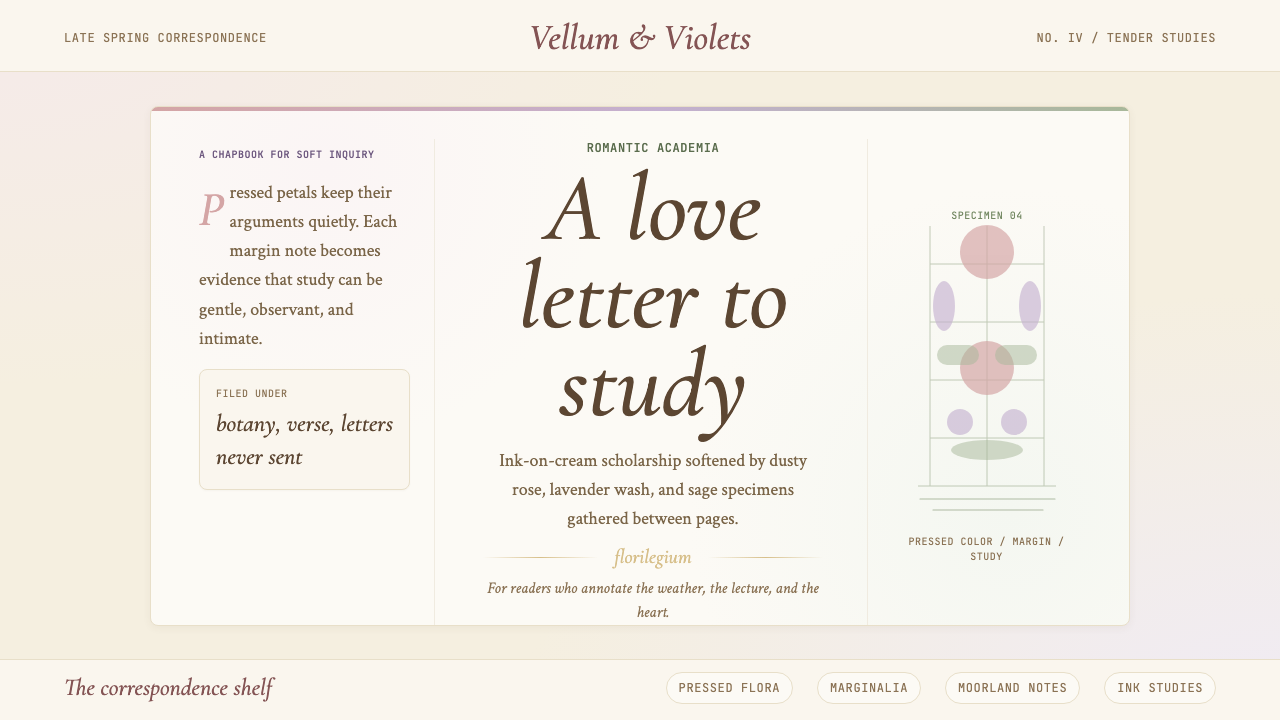 Romantic AcademiaScholarship turns tender. Dusty rose and lavender frame ink-on-cream poetry w…
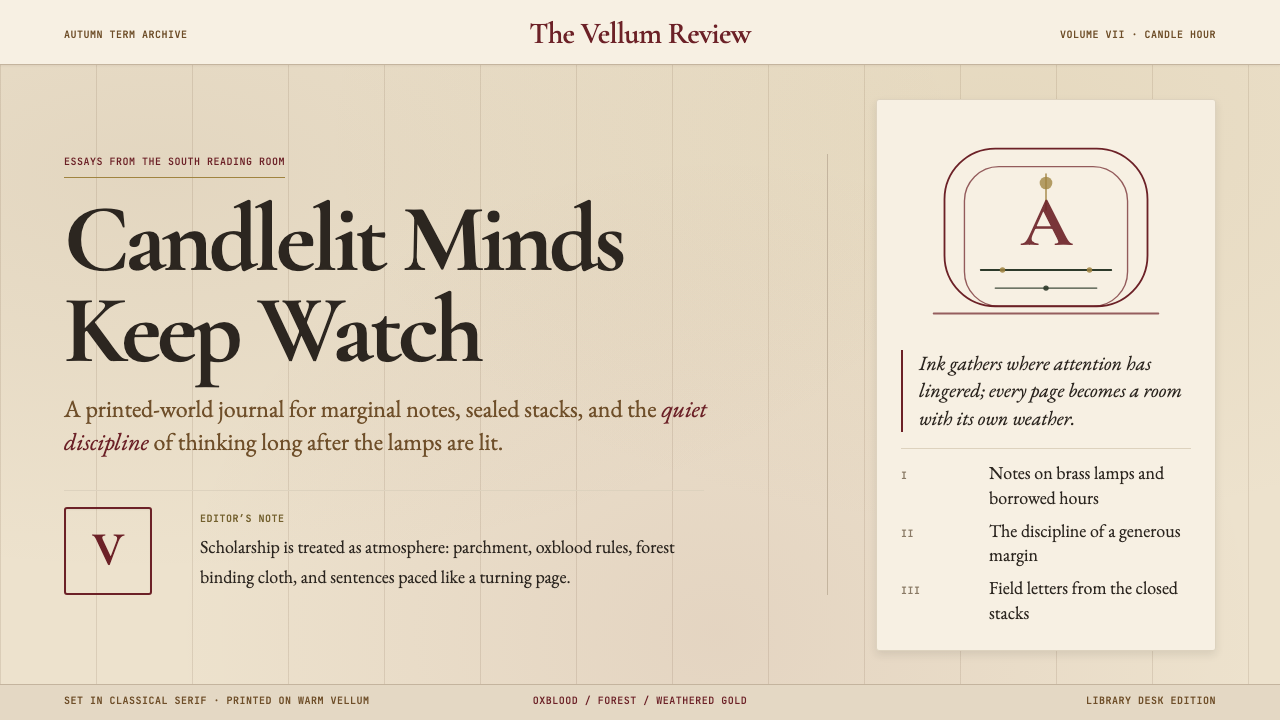 Dark AcademiaCandlelit nostalgia for old books. Parchment grounds, oxblood accents, classi…
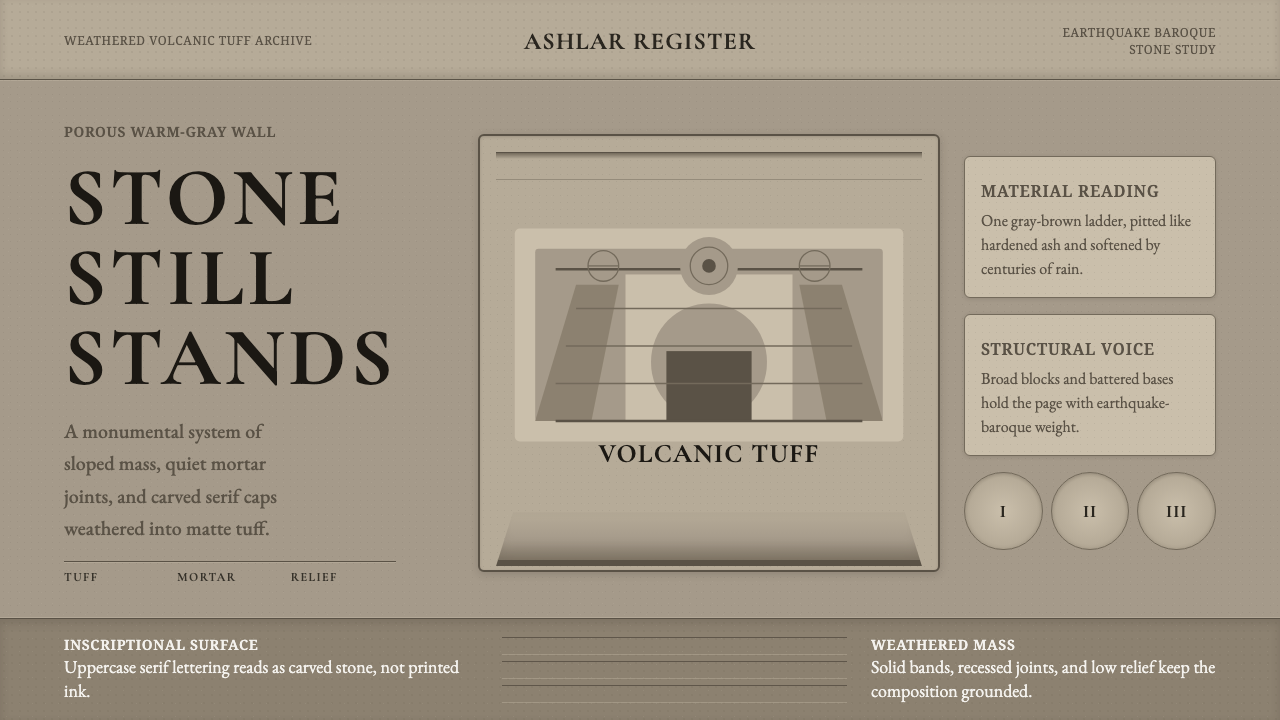 Philippine Adobe TuffStone refuses polish. Warm tuff gray, incised serif caps, and buttress-heavy…
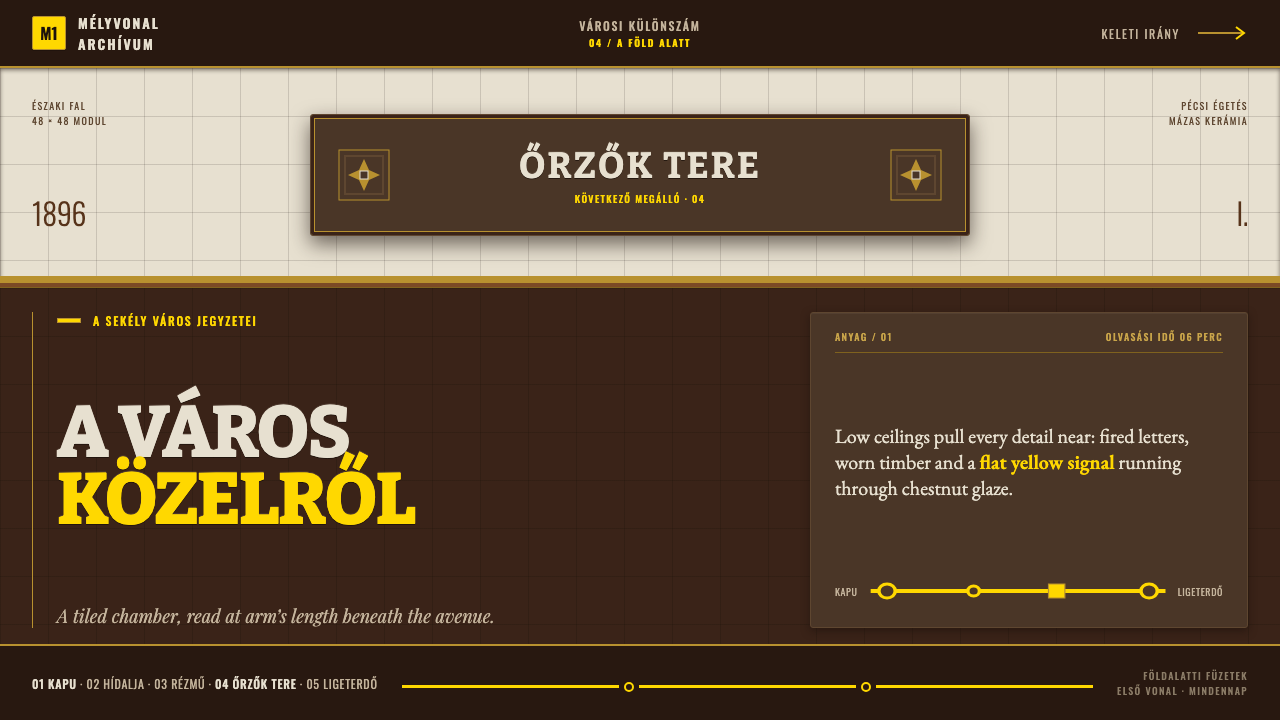 Budapest Millennium LineChestnut glaze turns transit into a room. Fired slab type and flat yellow run…
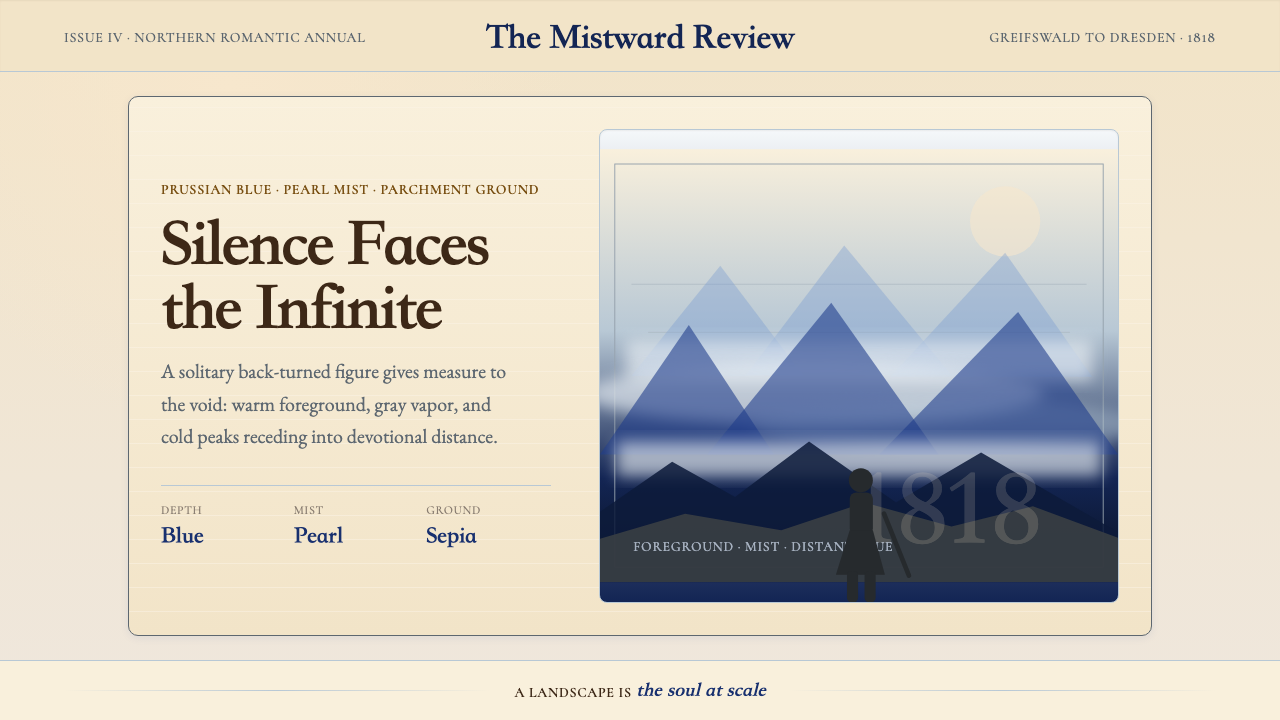 Caspar David FriedrichSilence becomes vast. Prussian blue depth, pearl mist, and parchment framing…
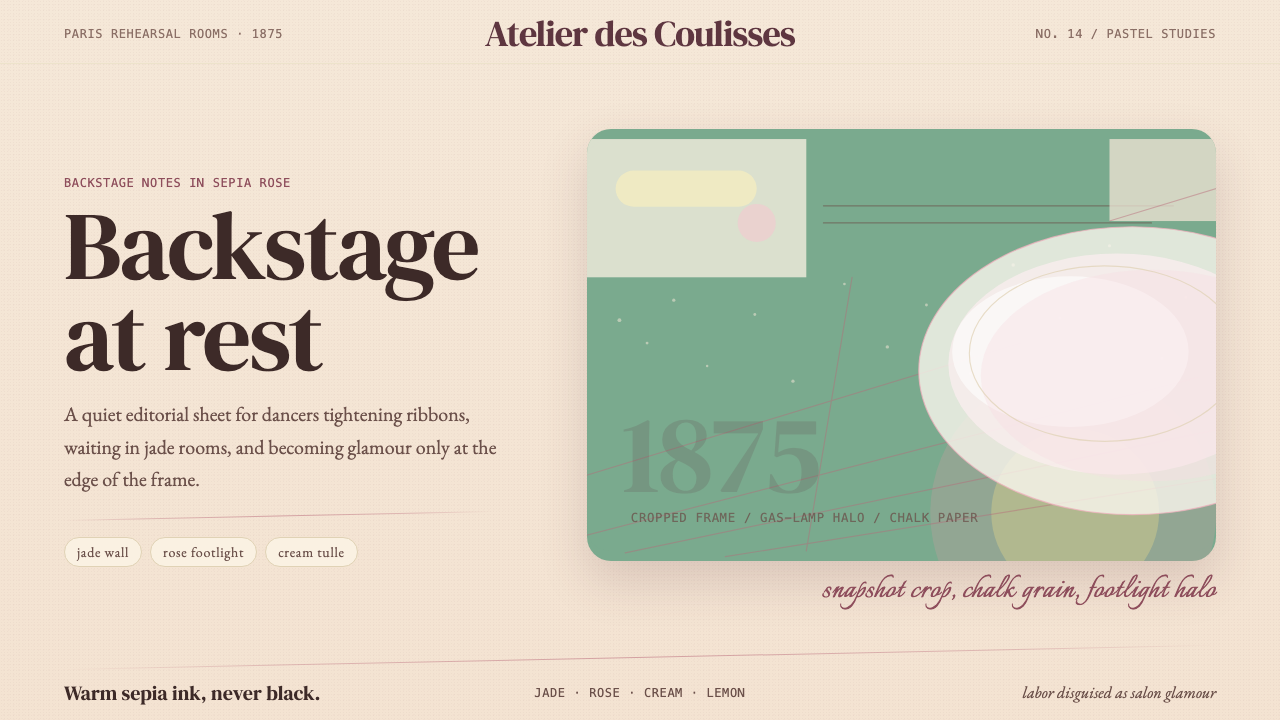 Degas Ballet PastelsBackstage glamour is labor. Jade walls, rose footlights, cropped serifs on cr…