What is Romantic Academia?
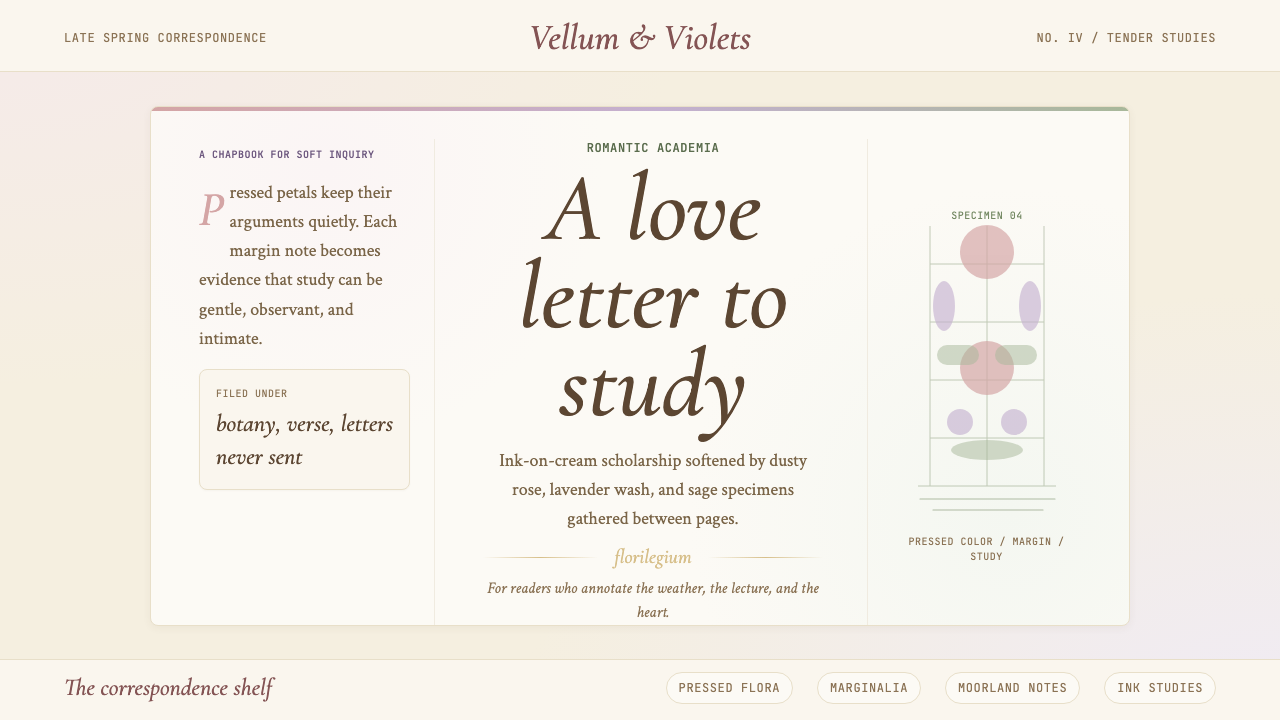
Romantic Academia turns scholarship into a love letter — dusty rose and lavender wrapping ink-on-cream poetry with pressed botanicals and the tender longing of the English Romantic tradition.
Romantic Academia in brief
Romantic Academia is a design aesthetic rooted in the visual vocabulary of English Romantic poetry, Pre-Raphaelite painting, and Edwardian botanical illustration. It is the poetic-tender counterpart to Dark Academia — where that style reaches for gothic shadows and the amber gravity of old libraries, Romantic Academia reaches instead for the soft luminosity of a pressed-flower herbarium, a handwritten letter on cream stationery, a watercolor wash drying at the edge of a botanical drawing.
The palette is built from muted, powdery hues: dusty rose, warm lavender, sage green, and the off-white of aged letter paper, with ink-dark type anchoring the composition. Color is never saturated to the point of boldness — it is always a little faded, a little dream-worn, as if seen through gauze or recalled from memory. Texture is implicit rather than literal: the suggestion of paper grain, the ghost of a watercolor edge, the slight imperfection of hand-lettering.
Typography in this system leans toward serif letterforms with calligraphic character — the kind that recalls copperplate correspondence or the title pages of nineteenth-century poetry collections. Layouts favor narrow columns with generous margins, the proportions of a slim volume of verse rather than a reference book. White space is used emotionally as well as structurally: it is the pause before the next stanza, the breath between lines.

Where does Romantic Academia come from?
Romantic Academia was named and disseminated primarily through Tumblr and TikTok's aesthetic-classification movement, reaching its peak cultural visibility between 2021 and 2024. Unlike design movements born in studios or schools, it emerged from the practice of internet users curating mood boards — gathering images of handwritten letters, botanical prints, Pre-Raphaelite portraits, and lakeside landscapes into visual collections that expressed a longing for a particular quality of feeling: scholarly yet tender, introspective yet romantic.
The deeper historical roots reach back to the English Romantic movement of 1798 to 1830. The poets of this era — Keats, Shelley, Byron, Wordsworth, and Coleridge — established a sensibility in which learning and feeling were not opposites but inseparable companions. Keats wrote about reading Homer with the same emotional register as writing about a nightingale. Byron wandered the Swiss Alps and the Greek ruins, treating landscape as a philosophical text. The Romantics believed that beauty, scholarship, and emotion were facets of a single human capacity, and this conviction is legible in every element of the aesthetic that now bears their name.
The Pre-Raphaelite Brotherhood, founded in London in 1848, provided the visual register. Dante Gabriel Rossetti, John Everett Millais, and their circle rejected the conventions of academic painting in favor of intense color, elaborate detail, and subjects drawn from medieval legend and Romantic poetry. Their canvases — rich with botanical specificity, melancholy women in elaborate dress, and the luminous surfaces of objects given loving attention — became a primary image bank for the aesthetic. Pre-Raphaelite painting is characterized by a quality of heightened seeing: ordinary things — a strand of hair, a petal, a reflection in water — rendered with the care usually reserved for sacred subjects.
The third tributary is Edwardian botanical illustration: the tradition of scientific plant drawing at its most exquisite, where accuracy and beauty were considered the same virtue. Illustrators working for botanical journals and natural history societies produced drawings of extraordinary delicacy — watercolor washes over precise pencil lines, color notes in the margins, pressed specimens mounted beside their painted counterparts. This combination of scientific rigor and artistic tenderness is precisely the quality that Romantic Academia aspires to: knowledge expressed with care, scholarship rendered beautiful.
What defines the Romantic Academia look?
Palette
The color palette is built from powdery, desaturated hues that feel faded and soft rather than vivid: dusty rose, warm lavender, sage green, muted gold, and the off-white of aged letter paper. These are colors that seem to have absorbed a century of light — tender, slightly melancholy, never aggressive. Ink dark (close to black but warmer) anchors text and structural elements. The overall effect is of a color world that has been gently washed, like a watercolor left in afternoon sun.
Typography
Letterforms carry calligraphic memory — serifs with bracketed curves and slight variation in stroke width, the kind that recalls copperplate correspondence, poetry collections, and nineteenth-century title pages. Display type is used with restraint: a single headline in an elegant weight, set with loose letter-spacing so the words breathe. Body text is set at a comfortable measure, in a column width that recalls a page of prose poetry rather than a reference document. Decorative initials, poetic line-breaks, and small typographic ornaments such as fleurons or asterisms appear sparingly as accent punctuation.
Botanical Motifs
Pressed flowers, botanical line drawings, and watercolor plant studies are the signature decorative vocabulary of the style. They appear as background washes, as marginal ornaments, or as stand-alone compositional anchors. The botanical motif carries layers of meaning: scientific curiosity, Victorian feminine craft, the transience of natural things, and the tenderness of preservation. Even when reduced to a simple outline, a sprig of lavender or a few pressed petals transforms a composition from generic to atmospheric.
Layout and Proportion
Layouts favor the proportions of handwritten correspondence and slim poetry volumes: tall formats, narrow text columns, wide margins used for annotations or decorative elements. Composition is gentle and centered rather than bold and asymmetric — poetry tends toward the middle of the page, margins breathe equally on both sides. Horizontal space is treated as a medium for meaning: a wide blank margin is not wasted space but contemplative space, the visual equivalent of the pause before the final line of a poem.
Texture and Surface
Surface quality is central to the aesthetic. Paper grain, watercolor blooms, the slight roughness of hand-pressed botanical specimens, the faint foxing on old pages — these textures are evoked rather than reproduced literally. In digital and print applications, texture is suggested through slightly irregular elements, soft-edged shapes, gentle tonal variations within flat areas, and the deliberate avoidance of the perfectly sharp, perfectly clean surfaces that signal digital production. The goal is warmth and handmadeness, the sense that a human hand was involved.
Emotional Register
Unlike many design styles, Romantic Academia makes emotional atmosphere a deliberate design value rather than a byproduct. The mood target is scholarly tenderness — the feeling of reading a beloved book on a rainy afternoon, or of finding a pressed flower tucked into correspondence from someone who cared. Melancholy and longing are present but not heavy; the dominant note is wistful rather than sad, romantic rather than mournful. This emotional precision distinguishes the style from generic 'vintage' aesthetics: it is aiming at a specific feeling, not a historical period.
Ornament and Restraint
Romantic Academia permits — even requires — decorative elements, but governs them by the same logic as the overall aesthetic: restraint in quantity, intentionality in placement. A single pressed-flower motif in a corner, a thin ruled line beneath a heading, a small calligraphic ornament at the end of a section — these are used with the precision of a poet choosing a single word over several. Decoration is not absent but it is never excessive; it is always in service of the atmospheric whole rather than competing for attention. Over-ornamentation is the style's most common failure mode.

Who shaped Romantic Academia?
Keats is the presiding spirit of Romantic Academia. His odes — particularly 'Ode to a Nightingale,' 'Ode on a Grecian Urn,' and 'To Autumn' — established the template of beauty observed with scholarly attention and emotional depth. His letters, which blend literary criticism, personal confession, and philosophical musing with extraordinary fluency, model precisely the aesthetic the style aspires to: learning as an act of feeling. His early death from tuberculosis, his handwritten manuscripts, his friendship with Shelley, and his request to be buried in Rome under an unmarked stone all contributed to a biographical mythology that the aesthetic feeds on.
Co-founder of the Pre-Raphaelite Brotherhood, Rossetti was both a painter and a poet — a combination that made him central to the visual vocabulary of Romantic Academia. His paintings of women with abundant copper hair, heavy-lidded eyes, and elaborate botanical detail established a chromatic and compositional register that the aesthetic directly inherits. Works such as 'Proserpine,' 'Lady Lilith,' and 'Beata Beatrix' display the characteristic combination of scholarly attention to botanical and textile detail and an overwhelming emotional atmosphere. His translation work on Dante and the Italian sonnet tradition also contributed to the style's sense of scholarship as a form of devotion.
Byron contributes the wandering, world-bearing dimension of Romantic Academia — the sensibility that treats landscape, ruin, and exile as philosophical material. His life, as much as his writing, shaped the image: the self-imposed exile from England, the pilgrimages to Greece and the Alps, the death fighting for Greek independence. His long poems — 'Childe Harold's Pilgrimage' and 'Don Juan' — brought an ironic wit to Romantic feeling that prevents the aesthetic from collapsing into pure sentiment. In design terms, Byron is the source of the style's preference for melancholy grandeur over cloying sweetness.
The anonymous and semi-anonymous curators who built Romantic Academia as an internet aesthetic deserve recognition as genuine creative contributors. Working through Tumblr's reblogging infrastructure, they assembled the mood boards that defined the style — drawing connections between Keats letters, Pre-Raphaelite paintings, vintage botanical illustrations, and contemporary creative writing, all unified by a consistent emotional register. These curators established the style's characteristic combination of sources across centuries and disciplines, creating the synthetic aesthetic sensibility that TikTok then named and disseminated to a mass audience after 2020.
Botanical illustration as practiced in the nineteenth and early twentieth centuries — by figures including Priscilla Susan Bury, whose 'A Selection of Hexandrian Plants' (1831–1834) remains a landmark of the form, and the illustrators working for institutions such as Kew Gardens — established the visual grammar that Romantic Academia borrows most directly. Their work combined scientific precision with artistic beauty: a watercolor technique that rendered translucency and texture with extraordinary fidelity, a compositional sensibility that treated each plant as both specimen and subject. The tradition is not merely decorative but carries epistemological weight: it represents knowledge made visible through the patient attention of a skilled hand.
How do you use Romantic Academia today?
Romantic Academia is most effective when the emotional register of the design needs to communicate warmth, intellectual depth, and a sense of care — when the product or content wants to feel like something made by a person who genuinely loves the subject. It is well-suited to editorial contexts, educational platforms, book-adjacent brands, wellness applications with a literary sensibility, and any presentation or marketing material where the goal is to inspire trust through beauty and attentiveness rather than through efficiency and authority.
For presentation slides, the style rewards a careful approach to both cover and content pages. A cover page works best with a centered or near-centered composition: a botanical watercolor element occupying one quadrant, a title in an elegant serif typeface with generous letter-spacing, and a muted background in one of the palette's softer tones. Content slides should resist the urge to fill space — narrow the text column, allow wide margins, and let the proportions of the slide breathe like a page in a poetry collection. Data slides are the style's most challenging territory: charts should be rendered in the desaturated palette, with delicate line weights and subdued fills, and accompanied by enough white space that the data reads as considered rather than dense. A small botanical ornament in the corner of a data slide can anchor the aesthetic without undermining legibility.
For web interfaces, Romantic Academia suits editorial-forward experiences: literary journals, independent publishing platforms, portfolio sites for artists and writers, course landing pages for humanities subjects, and wellness or journaling applications. Dashboard and pricing applications can work, but require discipline — the palette's softness can undermine hierarchy if not offset by clear typographic scale. The approach for web: use a warm off-white as the primary background, reserve the dusty rose and lavender for accent states and hover interactions, maintain a clear typographic hierarchy with a calligraphic display face at large scale and a more neutral serif for body text, and use botanical motifs sparingly as section dividers or background watermarks rather than foreground elements.
For editorial and marketing work — social cards, campaign visuals, event materials, newsletters — the style is particularly powerful when it can occupy the full frame with a single atmospheric image. A social card might be a cream ground with a single ink-dark title in an elegant typeface, a pressed-botanical element in one corner, and nothing else: all meaning concentrated in the restraint. Campaign visuals benefit from consistency in palette and motif across the series, because the style's emotional effect accumulates with repetition. Marketing copy in this aesthetic should avoid the language of efficiency and performance in favor of warmth, invitation, and sensory description — the words should feel as considered as the images.
The most common mistake in applying Romantic Academia is mistaking sentimentality for romance. The style is not about being sweet or soft-focus in an undiscriminating way — it is about achieving a specific emotional precision. Over-saturating the palette removes the faded, memory-worn quality that gives the style its atmosphere. Overcrowding with botanical motifs undermines the restraint that makes each element meaningful. Using a generic sans-serif typeface in a layout that otherwise attempts the style produces an immediate tonal inconsistency. And applying the aesthetic to contexts that require directness, urgency, or functional clarity — error states, transaction confirmations, navigation systems — will produce designs that feel precious and hard to use. The style's power comes from its emotional focus; that focus becomes a liability the moment the user needs information fast.

Romantic Academia — FAQ
What distinguishes Romantic Academia from Dark Academia visually?
The most immediate difference is the palette. Dark Academia operates in ambers, deep browns, forest greens, and near-blacks — colors associated with candlelight, leather-bound books, and Oxford stone. Romantic Academia works in dusty rose, lavender, sage, and aged cream — colors associated with pressed flowers, watercolor paper, and handwritten correspondence. The emotional register shifts accordingly: Dark Academia carries a quality of gothic intensity and mortal weight, while Romantic Academia carries tenderness, longing, and the gentle melancholy of beautiful, transient things. Typographically, Dark Academia tends toward heavier, more authoritative letterforms; Romantic Academia prefers more delicate, calligraphic serifs. Both draw on nineteenth-century visual culture, but from different chambers of it.
Can this style work for digital products, or is it only suited to print and editorial?
It can absolutely work for digital products, but it requires translation rather than direct application. The style's origins are in physical materials — watercolor, paper, pressed botanicals — and the challenge in digital contexts is to evoke those qualities without over-literalizing them. Heavy use of texture overlays, for instance, can make a UI feel muddy and slow; the better approach is to imply texture through slight tonal variation, soft-edged shapes, and generous spacing rather than applying a literal paper grain to every surface. The style works best for digital products where the experience is meant to be unhurried — journaling apps, reading platforms, creative portfolios, wellness applications — and struggles in contexts requiring rapid scanning, dense information, or high interaction throughput.
How do I use botanical motifs without making the design look cluttered?
The principle is one prominent botanical element per composition, not several competing for attention. A single pressed-flower illustration in a corner, a delicate botanical line drawing as a section divider, or a faint watercolor plant wash as a background — any one of these works; all three simultaneously will almost always produce visual noise. The botanical element should be chosen for scale and value relationships: it should sit in dialogue with the surrounding space rather than demanding attention. Light-valued elements on light grounds, positioned in corners or edges rather than centers, tend to integrate without dominating. If the composition already carries expressive typographic weight — a large display heading, a decorative initial — the botanical element should be smaller and quieter than you instinctively want it to be.
Is there a risk that this style reads as feminine or niche in a way that limits its professional applicability?
The risk is real and worth understanding clearly. The style's palette and motifs are culturally coded in ways that many audiences will immediately associate with a specific gender and sensibility. Whether this is a limitation or an asset depends entirely on the product and audience. For brands and products whose audience and values genuinely align with the aesthetic — literary, creative, humanistic, care-oriented — the style can be exactly the right signal of intent. For products where the audience skews toward contexts that reward visual authority, technical rigor, or competitive edge, the style is likely to underperform regardless of execution quality. The answer is not to avoid the style when it fits, but to be clear-eyed about when it fits and when another approach better serves the communication goal.
How does Romantic Academia handle photography and imagery?
Photography in this style is almost always treated with a warm, slightly muted processing that removes digital crispness and introduces a quality of gentle age. Subjects lean toward the still and contemplative: a stack of handwritten letters, a windowsill with an open book and a cup of tea, hands holding botanical specimens, close details of paper and ink and pressed flowers. Portraits, when used, tend toward soft natural light and downward or middle-distance gazes rather than direct confrontation with the camera. In terms of processing, photographs are often desaturated slightly, shifted toward warm amber or rose tones, and vignette-softened at edges. Contemporary photographs that appear too sharp and too vividly colored undermine the atmospheric distance the style depends on — the image should feel like a memory, not a product shot.
Related design styles
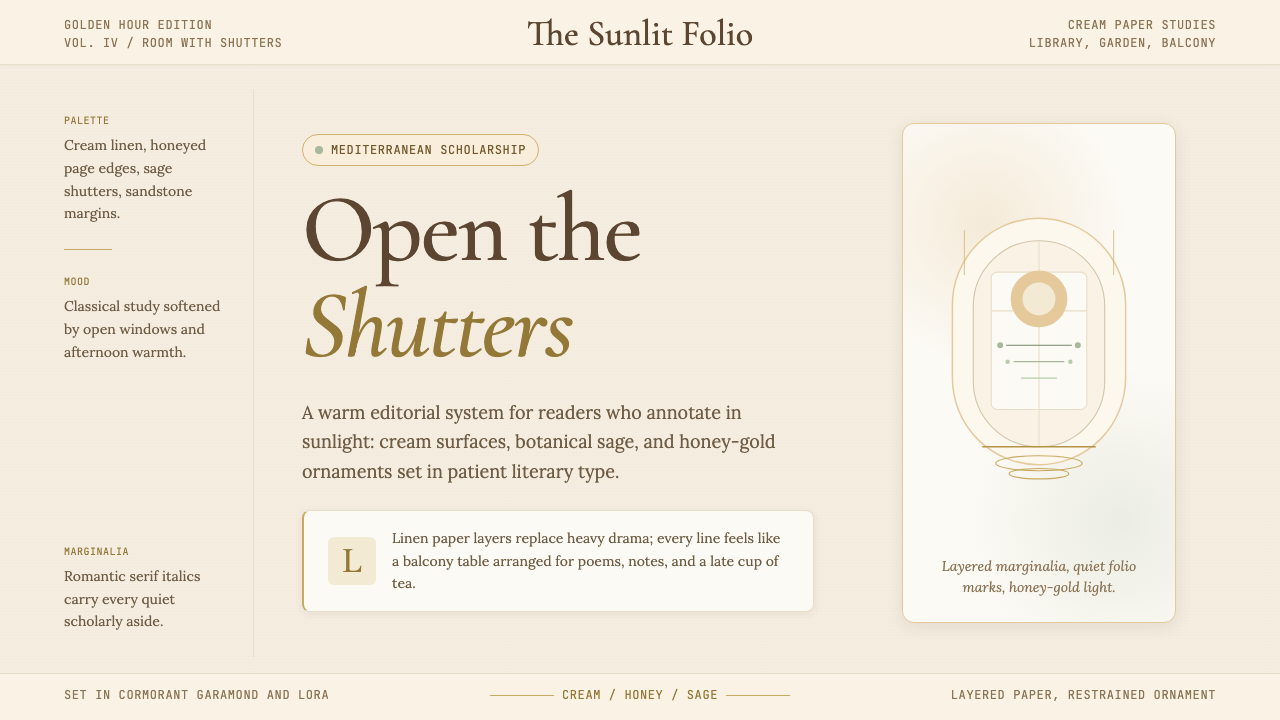 Light AcademiaScholarship turns sunlit. Cream linen, honey gold, sage botanicals, and roman…
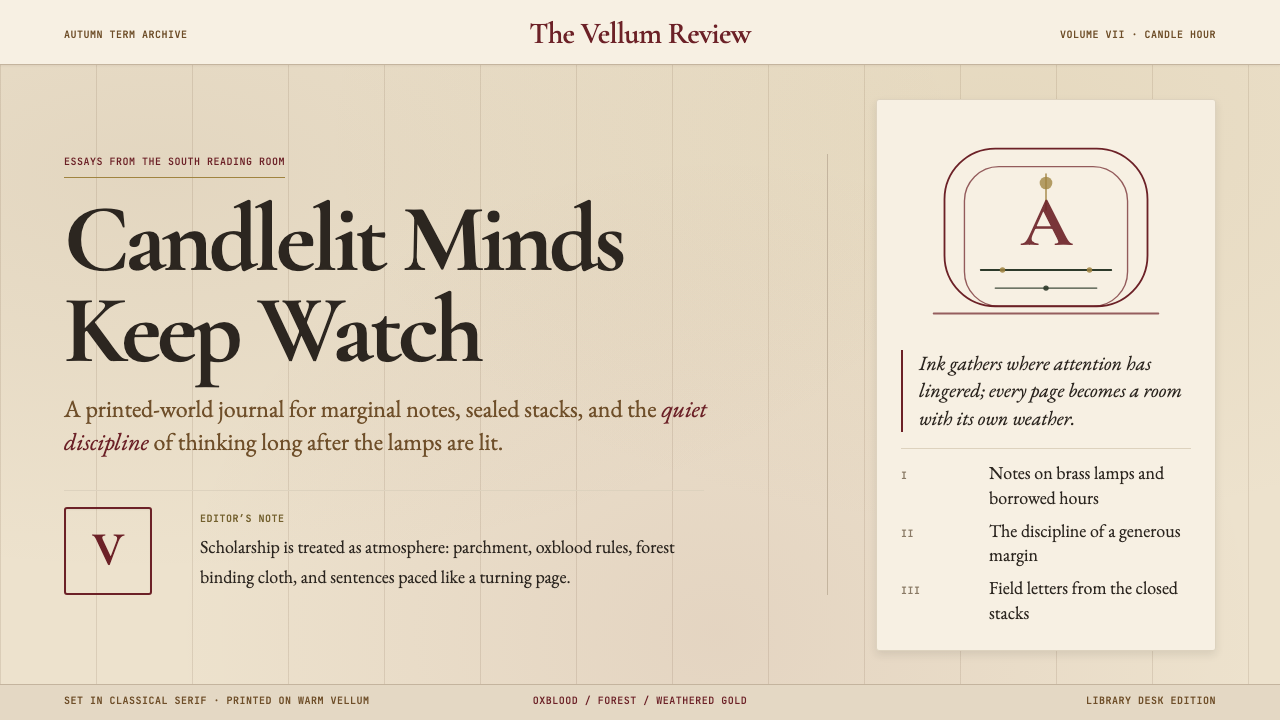 Dark AcademiaCandlelit nostalgia for old books. Parchment grounds, oxblood accents, classi…
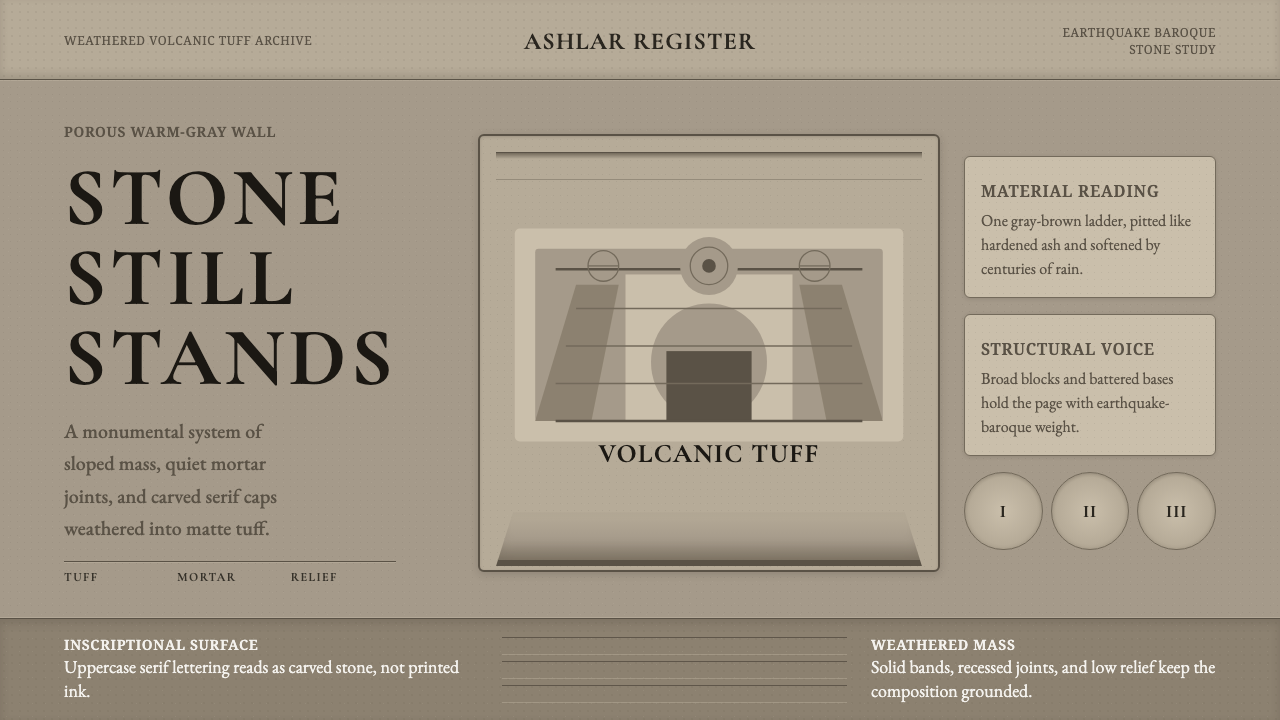 Philippine Adobe TuffStone refuses polish. Warm tuff gray, incised serif caps, and buttress-heavy…
 Budapest Millennium LineChestnut glaze turns transit into a room. Fired slab type and flat yellow run…
 Caspar David FriedrichSilence becomes vast. Prussian blue depth, pearl mist, and parchment framing…
 Degas Ballet PastelsBackstage glamour is labor. Jade walls, rose footlights, cropped serifs on cr…