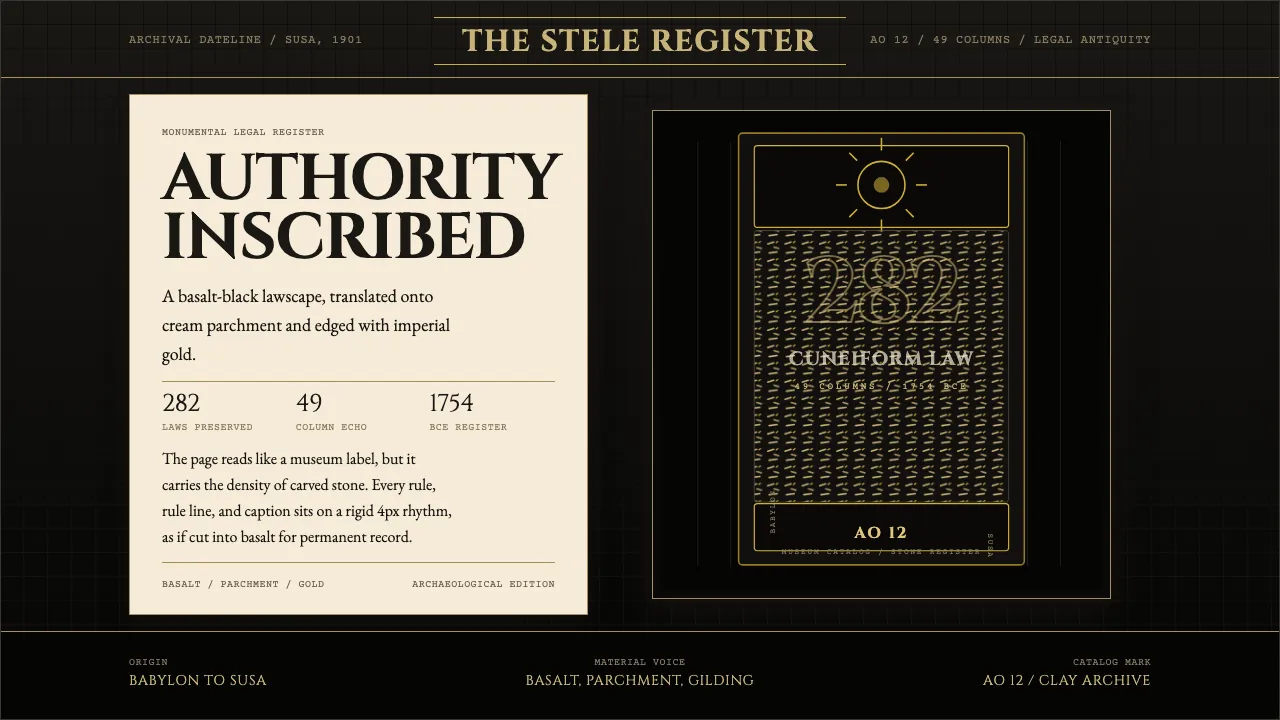
About Babylonian Hammurabi Stele
The Stele of Hammurabi is a 7-foot basalt monument bearing 282 laws in Akkadian cuneiform — the oldest near-complete legal code. This design system channels its monumental authority: warm basalt-black grounds, imperial gold accents, cream parchment content panels, and classical inscription typography that treats every surface as carved stone.
The aesthetic is scholarly and archaeological, not fantasy. Vertical stele proportions, 49-column grid echoes, and stone-sharp 2px radii give interfaces the permanence of carved law. Gold ornament is restrained — reserved for emphasis the way gilding appears on ancient cylinder seals.
- Origin
- Babylon (modern Iraq); Louvre Museum, Paris
- Era
- c. 1754 BCE (inscription); rediscovered 1901 Susa
- Key figures
- Hammurabi · Shamash · Jacques de Morgan · Jean-Vincent Scheil
- Movements
- Old Babylonian civilization · Mesopotamian cuneiform legal tradition · 19th-century Mesopotamian archaeology
Babylonian Hammurabi Stele design spec
Colors
Typography
The other 11 sections — buttons, cards, spacing, motion, techniques and more — open once you unlock. Download the DESIGN.md or send it to your AI in one click. Unlock once, yours forever.
Sign up nowStyles similar to Babylonian Hammurabi Stele
Also inspired by art & artists, with a close feel.
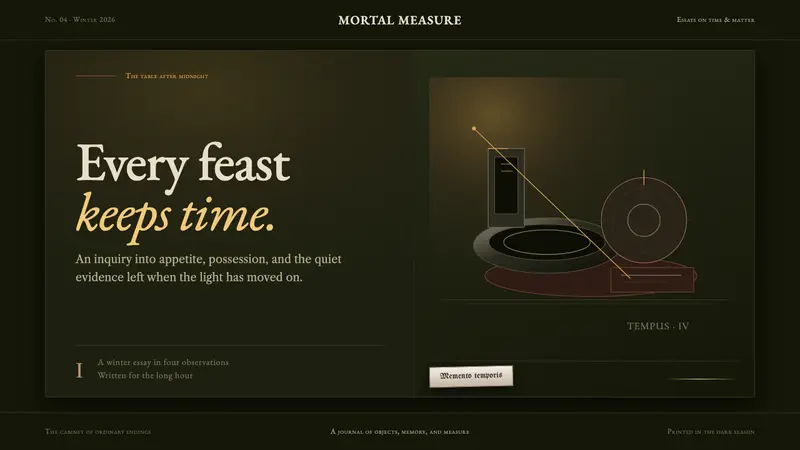 Dutch VanitasTime waits at the table. Olive-black depths, earth-brown type, and one candle-hot edge.
 Rembrandt BaroqueDarkness becomes theatre. Honey-gold spotlight and blackletter rise from Van Dyke brown.
 Bird of Paradise MonographTheatrical plate-book darkness. Flame plumes blaze from a bordered forest-black monograph.
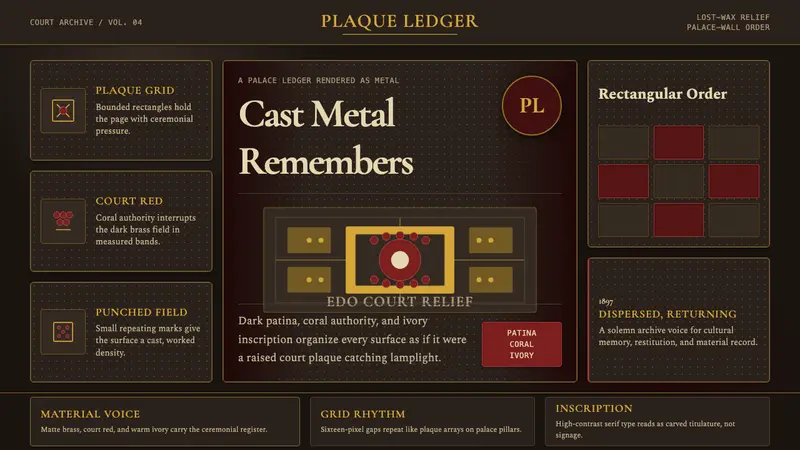 Benin Bronze Oba CourtCourt gravity in cast metal. Patinated brass grid, coral red panels, ivory serif relief.