What is Balinese Canang Sari (Daily Offering)?
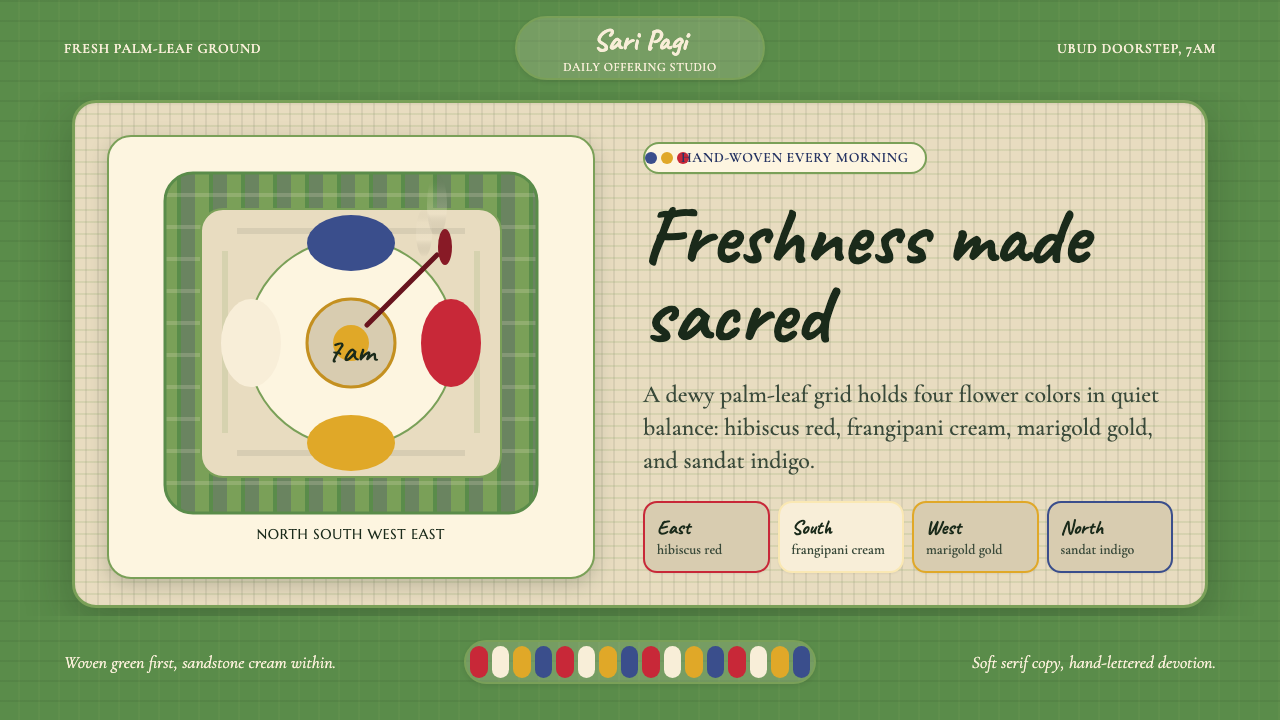
The canang sari — a palm-leaf tray filled each morning with flowers in four sacred colors — is arguably the most-produced artwork in human history, and one of the most quietly complex design systems ever to emerge from daily ritual.
Balinese Canang Sari (Daily Offering) in brief
The Balinese Canang Sari is a daily offering — a small, hand-woven palm-leaf tray no larger than an open hand, filled with flowers arranged according to the four cardinal directions. Hibiscus anchors the east, frangipani the south, marigold the west, and champaca the north. A sliver of betel nut, a coin, and a stick of incense complete each tray. Millions are assembled every morning across Bali and placed on doorsteps, beside motorbike seats, at temple gates, and at the feet of roadside shrines. By midday, most will have been stepped over, rained on, or absorbed back into the ground. By the following dawn, the cycle begins again.
As a visual system, canang sari is built on a logic of cardinal color — four hues assigned not by aesthetic preference but by directional cosmology. The colors are not decorative; they are locational. Each one marks a quadrant of sacred space, and together they create a complete, balanced field. The ground beneath the flowers is the pale, fibrous weave of split palm leaf: a warm, textured neutral that reads as neither white nor beige but as something specific to the tropical island where it grows. Against this ground, the flower colors sit with an almost shocking directness — saturated, perishable, and entirely free of shadow or gradient.
What distinguishes canang sari as a design language is its combination of strict formal rule and intensely material warmth. The arrangement follows a law — cardinal directions, specific species, prescribed colors — yet every completed tray is slightly different because every hand is different, every leaf yields differently to the fold, and every morning's flowers are slightly richer or paler than yesterday's. The system enforces repetition while celebrating variation within that repetition. This is not ornament for ornament's sake; it is ritual given a visual form, and the visual form has been refined daily for at least a thousand years.
Where does Balinese Canang Sari (Daily Offering) come from?
The practice of canang sari is rooted in the syncretic religious tradition of Bali — a form of Hinduism that absorbed animist and Buddhist elements over many centuries of contact between South Asian traders, Javanese court culture, and the island's own indigenous beliefs. The word canang refers to the palm-leaf tray itself, while sari means essence or flower. Together the name designates the offering as the essential thing — the concentrated expression of gratitude and acknowledgment to the divine forces that sustain daily life. The Tri Hita Karana philosophy, central to Balinese life, identifies three relationships that must remain in harmony: between humans and the divine, between humans and each other, and between humans and the natural environment. The canang sari enacts all three simultaneously — it requires the weaver's labor, uses materials from the natural world, and is directed toward spiritual beings.
The specific assignment of flower colors to the cardinal directions reflects a broader Hindu cosmological map in which colors, deities, elements, and compass points are bound together in a coherent sacred geography. The eastern direction corresponds to Iswara and carries the color white in some traditions or the warm red of the hibiscus in the canang sari convention. The south corresponds to Brahma and the warm range; the west to Mahadewa and the golden or yellow register; the north to Wisnu and the deep indigo-adjacent tones. These associations are not arbitrary decorative decisions — they are mnemonic keys to a complete worldview in which every visual choice is simultaneously spatial, theological, and practical.
Margaret Mead and Gregory Bateson, who conducted extensive fieldwork in Bali in the 1930s, documented canang sari practice in photographs and ethnographic writing that introduced the form to Western audiences. Their collaborator, the Balinese painter and cultural scholar Ida Bagus Sutarja, helped translate Balinese aesthetic categories into terms that Western observers could engage with. Later, anthropologist Hildred Geertz's work deepened scholarly understanding of the relationship between Balinese visual culture and its ritual context, arguing that Balinese art should not be understood as a discrete category separated from religious and social life but as an integrated practice.
Despite Bali's rapid development as a global tourist destination over the past half century, canang sari practice has not diminished — if anything, it has intensified. The economics of tourism created both the wealth to sustain daily offerings on a massive scale and, paradoxically, new spiritual anxieties that the ritual addresses. Balinese women — the primary makers of canang sari — weave the trays before dawn, a task that can take between thirty minutes and two hours depending on the complexity of the day's ceremony. The practice is considered a form of active meditation as much as a religious obligation. The aesthetic character of the finished offering — perishable, handmade, color-coded, and placed with spatial precision — is inseparable from its meaning.
What defines the Balinese Canang Sari (Daily Offering) look?
Cardinal Color Field
The defining visual logic is the assignment of four distinct flower colors to the four compass points. Rather than a palette chosen for visual harmony, the colors carry directional and cosmological meaning — each hue is a marker of sacred orientation. Used together, they do not compete; they divide and complete a whole. The visual effect is one of organized abundance: saturated botanical color placed with deliberate spatial intention against a neutral woven ground.
Palm-Leaf Weave as Ground
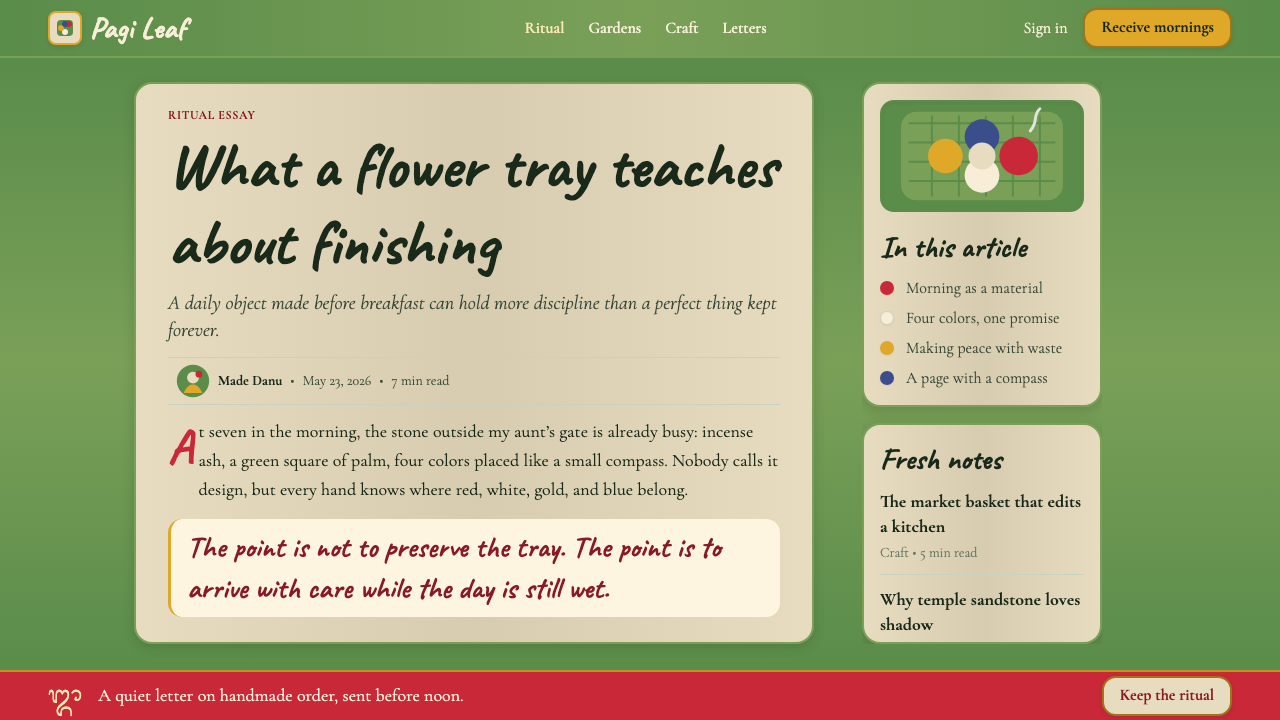
The base material — split and folded green palm leaf — provides the dominant ground texture. It is neither flat nor uniform: the weave creates a subtle diagonal grid of light and shadow, and the green carries a slight natural variation in tone. This woven ground sets canang sari apart from any design system that uses painted or printed surfaces. The base is active, organic, and slightly impermanent, and every visual element placed on it inherits that quality.
Temple Cream as Content Surface
Where the offering rests against the stone and stucco of Balinese temple walls or doorstep pavers, a warm sandstone cream serves as the secondary ground — the surface onto which the palm-leaf tray is placed and from which it is read. This warm, aged-stone tone is neither white nor yellow but something between, carrying the quality of sunlit masonry. Applied as a content surface in contemporary design, it softens the contrast between the botanical colors and the woven green without neutralizing either.
Perishability as Aesthetic Principle
No canang sari is meant to last more than a day. The flowers wilt, the palm leaf dries and curls, the incense burns to ash. This built-in impermanence is not a defect but a feature: the offering is meaningful precisely because it was made fresh, used once, and released. Translated into design terms, this suggests an aesthetic that favors the dewy, the just-made, and the moment of peak vitality — surfaces that look freshly touched rather than permanently polished, colors that carry the warmth of a flower at full bloom rather than the flatness of a printed swatch.
Hand-Lettered, Serif Typography
The script traditions associated with Balinese sacred practice — from inscriptions on lontar palm-leaf manuscripts to ceremonial banners — favor letterforms that are flowing, weighted, and warm rather than geometric or mechanical. Applied to contemporary design, canang sari calls for typography that carries a hand-drawn quality: slightly irregular in rhythm, with visible variation in stroke weight, warm in color, and never clinically precise. Serifs are appropriate; they carry the calligraphic weight of a tradition that sees writing as a sacred act.
Organic Grid, Not Geometric Grid
The arrangement within a canang sari tray is structured but not mechanically precise. The four quadrants are defined by the compass points, but within each quadrant, the flowers are loosely gathered rather than rigidly placed. This is a composed order rather than a calculated one — the kind of layout that emerges from skilled hands working quickly and confidently, not from a ruler and a grid. Applied to design, this suggests compositional structures that feel organized without feeling rigid: loose columns, breathing margins, and a sense that every element has been placed by someone who knows exactly where it belongs.
Sacred Incense as Atmosphere
The smoke of the incense stick — rising in a thin, curling column from the completed tray — is itself a visual element in the canang sari experience. It demarcates the offering as active, as present, as in the process of being received. In design terms, this translates to an attention to atmospheric quality: gentle graduated light effects that suggest softness without becoming gradient fills, or layered translucent elements that carry a sense of something rising, opening, or being offered. The mood is quietly reverent, never loud.
Who shaped Balinese Canang Sari (Daily Offering)?
The American cultural anthropologist conducted extensive fieldwork in Bali during the 1930s alongside Gregory Bateson, producing an influential body of photographic and ethnographic documentation of Balinese ritual life. Her work helped establish canang sari and related Balinese aesthetic practices as subjects of serious scholarly attention in the West. Mead's interest in the relationship between culture, personality, and visual practice shaped how subsequent researchers approached the study of Balinese design culture.
Bateson was a British anthropologist and theorist who collaborated with Mead on the Bali project, producing the landmark photographic study Balinese Character (1942). His interest in cybernetics, communication, and pattern led him to analyze canang sari and related visual practices not as art in the Western sense but as information systems — structured messages addressed to spiritual receivers. Bateson's systems-thinking approach to Balinese visual culture remains influential in design theory and cultural analysis.
A Balinese painter and cultural scholar who worked with Mead and Bateson during their Bali fieldwork, Sutarja served as both interpreter and informant, helping Western researchers understand the cosmological logic underlying Balinese aesthetic choices. His role was not merely translational; he actively shaped how the visual grammar of offerings and ceremonies was articulated in cross-cultural terms, ensuring that the sacred geometry of practices like canang sari was not reduced to mere decoration in outside accounts.
American anthropologist Hildred Geertz, working in Bali in the latter half of the twentieth century, produced scholarship that resisted the aestheticization of Balinese ritual objects by Western observers. Her work argued that canang sari and related practices could only be understood within their full social, religious, and ecological context — that separating the visual form from its meaning was itself a form of misreading. Her insistence on contextual integrity remains relevant to designers working with culturally specific visual traditions.
Not an individual but the institutionalized form of Balinese Hinduism formally recognized by the Indonesian state in 1958, Agama Hindu Dharma codified the daily ritual obligations — including canang sari — that had previously been transmitted through village and family practice. By providing a doctrinal framework, it helped preserve the design practice through rapid modernization. The movement also articulated the Tri Hita Karana philosophy, which remains the closest Balinese equivalent to a design philosophy: the idea that good life — and by extension, good making — depends on maintaining balance between human, divine, and natural worlds.
How do you use Balinese Canang Sari (Daily Offering) today?
The canang sari visual language is best understood not as a color palette to be sampled but as a relational system — four colors that mean something only in relation to each other and to a spatial structure. Applying it correctly begins with grasping that logic: the four flower colors must be deployed with spatial intentionality, and the woven-green ground must be present as the unifying base. Without that ground, the colors read as random botanical cheerfulness rather than as structured ritual. The system rewards restraint — it does not benefit from being supplemented with additional colors or textures.
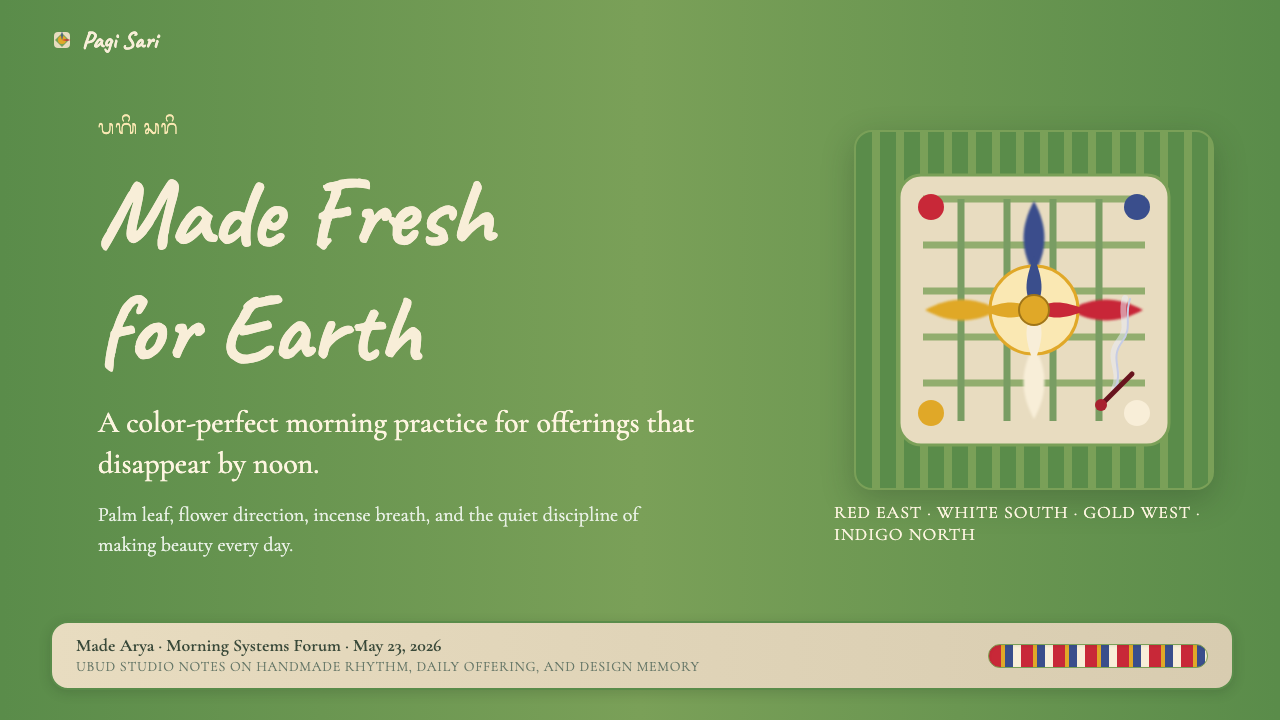
For presentation slides, canang sari works exceptionally well on covers and thematic divider pages. A cover that uses the woven-palm texture as the primary background, with the four directional flower colors appearing in a deliberate spatial arrangement — one per quadrant, or used sequentially to mark a four-part structure — will feel both grounded and alive. Content slides should be simpler: warm temple cream as the background, one accent from the flower palette for emphasis, and hand-weighted serif typography for all text. Data slides can carry light botanical motifs as decorative elements in margins without allowing them to compete with the information itself.
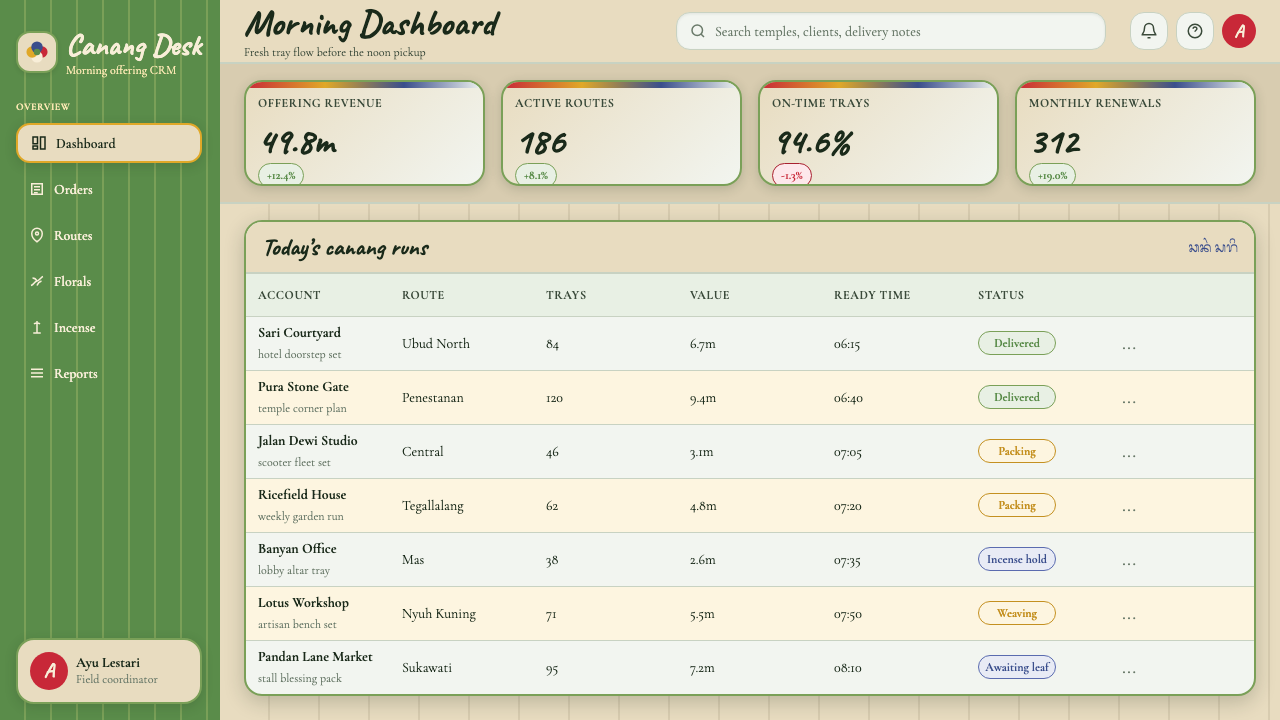
For web interfaces, the style is most at home in wellness, hospitality, cultural, and editorial contexts. A dashboard or pricing page in the canang sari register would use the palm-green as a subtle section background, temple cream as the dominant content surface, and the four flower colors as categorical markers — one per plan tier, one per content type, one per navigational zone. Components should feel tactile rather than technical: gently rounded rather than sharp-cornered, with soft warmth rather than clinical precision. Avoid applying the style to products where authority and machine-like efficiency are the primary value signals; the style's warmth will undercut those messages.
For editorial and marketing work, the style supports sensory richness. An editorial layout that uses a full-width palm-woven texture band as a section break, with the body text sitting on warm cream, will carry the reader through a long piece with visual continuity and calm. Marketing pages benefit from the style's poster-like botanical directness: full-page flower-color sections alternate with the palm-ground background, and headlines are set in warm, weighted serif type. The rhythm should feel like something assembled by hand — not random, but also not mechanical.
A common mistake when applying the canang sari palette is treating it as a generic tropical or floral theme. The system is not about tropical cheerfulness; it is about sacred orientation. Using the four flower colors interchangeably or adding additional warm tropical hues dilutes the directional logic entirely. Similarly, replacing the woven-palm ground with a clean white or pale grey background removes the material specificity that gives the palette its character. The style also does not benefit from hard geometric grids or tight modular spacing — the organic grid of the offering tray, with its slight variations and breathing room, is as integral to the aesthetic as the colors themselves.
Balinese Canang Sari (Daily Offering) — FAQ
Is this a religious style, and does using it require cultural sensitivity?
The canang sari visual system is derived from living religious practice, which means cultural sensitivity is genuinely important — not as a legal matter but as a design matter. The system's power comes from the specificity of its meaning: the four colors are not arbitrary; the spatial arrangement is not decorative. Designers who treat it as a generic tropical palette will produce work that misrepresents the source and will look hollow to anyone familiar with the tradition. Using the style with fidelity — understanding that the colors mean something, that the ground is not just a texture, that the arrangement carries spatial logic — is both more respectful and more effective. Avoid using the system for products or messages that would contradict the values of Tri Hita Karana: environmental destruction, social division, or purely extractive commerce.
How does this style differ from other Southeast Asian or tropical design traditions?
The canang sari system is distinct from other tropical visual traditions in several ways. Unlike Thai or Cambodian ceremonial aesthetics, which often feature gold leaf and lacquer in deep jewel tones, canang sari is built around botanical perishability — the freshness of a flower at peak bloom, not the permanence of precious materials. Unlike Indonesian batik, whose visual richness comes from dense, intricate patterning on cloth, canang sari's visual language is one of open space and deliberate placement within a simple structure. And unlike generic tropical design vocabularies, which tend toward loose organic forms and uniformly warm color, canang sari is spatially structured around a directional cosmological logic that gives it a rigorous internal order.
Can the four directional colors be used independently, or do all four need to appear together?
In the ritual context, all four colors appear together because completeness is the point — a canang sari with only three directional colors would be an incomplete offering. In design application, the answer is more flexible, but the logic should be respected. Using one or two of the colors in isolation is possible and can be effective, but the directional meaning is lost. If the goal is to invoke the full canang sari system — the sense of sacred balance, spatial completeness, and ritual wholeness — all four should be present. If the goal is simply to draw on the warmth and botanical quality of the palette, individual colors can be used, but the designer should be aware that doing so produces something closer to a floral reference than a canang sari reference.
How does the style handle dark mode or high-contrast digital environments?
The canang sari palette was conceived in full tropical daylight — the offering is made at dawn and read in morning sun, not under artificial light or against a dark ground. A strict dark-mode inversion is therefore slightly contrary to the system's nature. That said, a dark variant is possible if handled carefully. The deep green of a palm leaf in night shadow — rather than the bright, fresh weave of a morning offering — can serve as a dark ground, and against it, the saturated flower colors remain legible and warm. The temple cream shifts to a warm, amber-tinged mid-tone for secondary content. The key is to retain the botanical warmth; a cold, grey-black dark ground will strip the system of the quality that makes it distinct.
What does it mean for a design to feel “hand-woven” rather than digitally precise?
In the context of canang sari, hand-woven means that the structure is evident but the execution is organic. A hand-woven tray has a regular underlying grid — the weave pattern — but within that grid, each individual intersection is slightly different. Applied to digital design, this means: use consistent proportional systems but allow visible micro-variation in sizing and spacing; choose type that has subtle ink-trap or optical compensation rather than mathematically perfect uniformity; prefer textures that show grain over surfaces that show none; and keep backgrounds warm and slightly varied rather than flat and neutral. The goal is not to simulate handicraft artificially but to achieve a quality of presence — the sense that something was made with attention, by a person, in a specific moment — that digital precision alone cannot produce.
Related design styles
 Barbadian Chattel HouseJoy made portable. Coral pink timber, mint shutters, sky-blue space, modular…
 Bengali Jamdani MuslinBreathes like woven air. Indigo ground, ivory butis, and threadline borders s…
 Bengali Jamdani WeavingLuxury whispers. Pearl cream, tonal buta, and one gold hairline make woven ai…
 Burmese Shan Thanaka (Bark Paste)Handmade warmth on dark bark. Thanaka cream roundels soften rose, jade, and g…
 Celtic KnotworkEverything is connected. Gold Cinzel interlace frames forest-green vellum.
 Indian Block PrintPattern claims every inch. Madder, indigo and turmeric stamp dense bordered c…