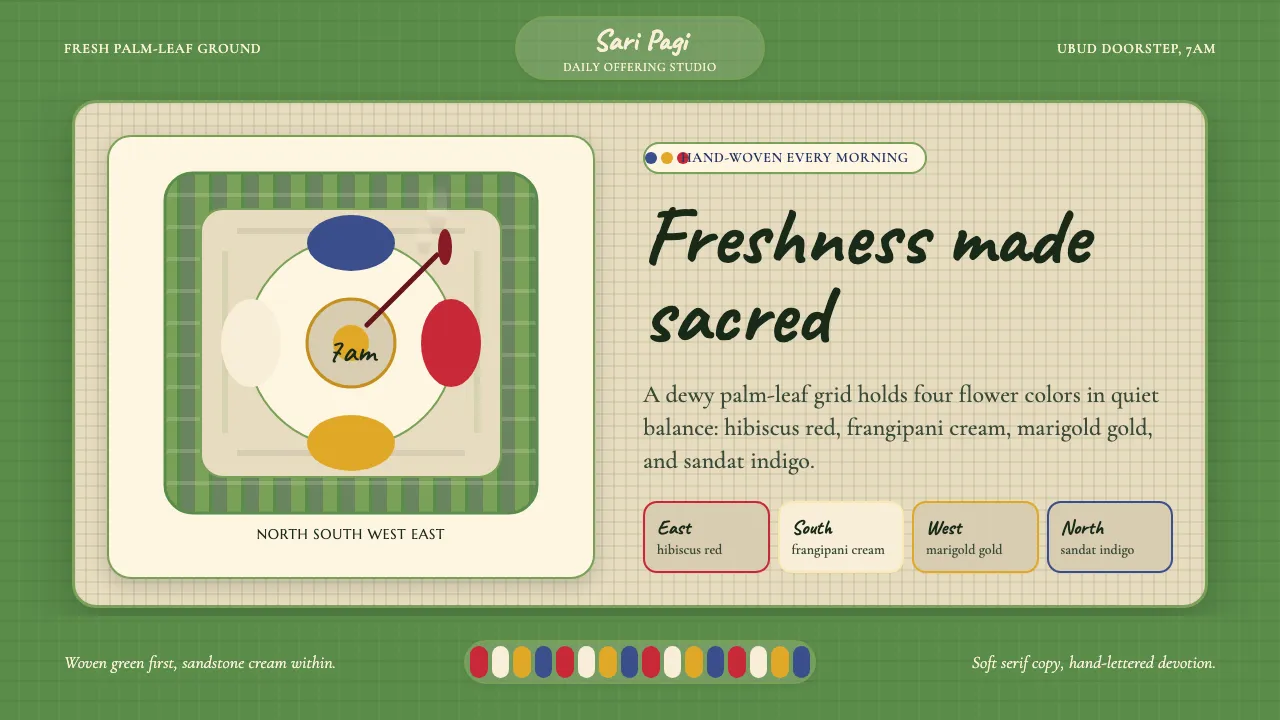
About Balinese Canang Sari (Daily Offering)
The canang sari is a palm-leaf tray no bigger than a hand, woven fresh each morning and filled with flowers aligned to the four cardinal directions — hibiscus for east, frangipani for south, marigold for west, champaca for north. Billions are offered and discarded each year across Bali, making it arguably the most-produced artwork in human history.
This design system captures the dewy, just-assembled quality of a 7am offering on an Ubud doorstep: green palm-leaf weave as the dominant ground, sandstone temple cream for content surfaces, and the four cardinal-direction flower colors as the functional palette. Typography is hand-lettered and serif, never clinical. Every element should feel hand-woven, petal-soft, and quietly sacred.
Learn more about the Balinese Canang Sari (Daily Offering) style
- Origin
- Indonesia, Bali island-wide; Hindu enclaves in Lombok and Java
- Era
- pre-Hindu syncretic origin; codified in Agama Hindu Dharma daily ritual; continuous to today
- Key figures
- Margaret Mead · Gregory Bateson · Ida Bagus Sutarja · Hildred Geertz
- Movements
- Bali Agama Hindu Dharma daily ritual · Tri Hita Karana philosophy
Balinese Canang Sari (Daily Offering) design spec
Colors
Typography
The other 11 sections — buttons, cards, spacing, motion, techniques and more — open once you unlock. Download the DESIGN.md or send it to your AI in one click. Unlock once, yours forever.
Sign up nowStyles similar to Balinese Canang Sari (Daily Offering)
Also inspired by crafts & folk art, with a close feel.
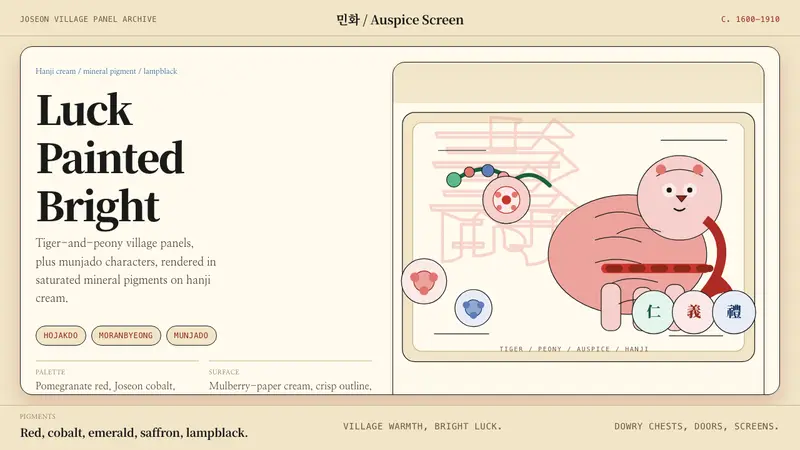 Korean Minhwa (Joseon Folk Painting)Cheerful prosperity over restraint. Mineral reds, cobalt, and lampblack on hanji cream.
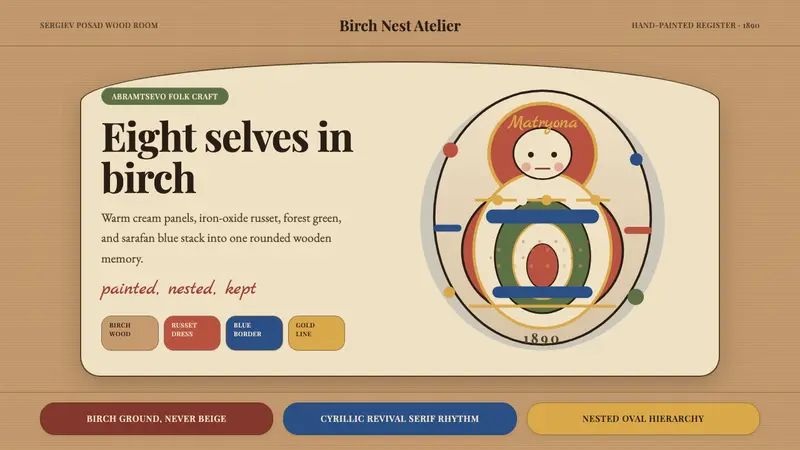 Russian Matryoshka 1890Warmth nests inward. Birch, cream, russet, and egg-oval type stage handmade depth.
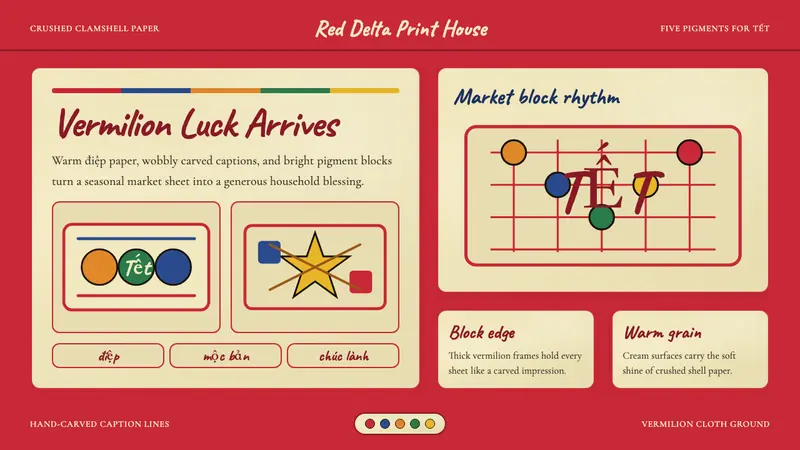 Vietnamese Đông Hồ Folk PrintFestive craft stays handmade. Vermilion frames, Caveat captions, cream paper panels.
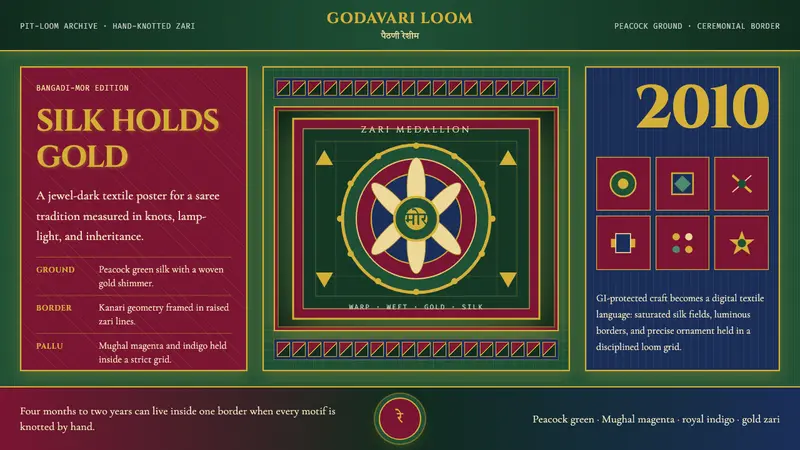 Maharashtra Paithani Peacock SareeSilk carries ceremony. Peacock green, Mughal magenta, and gold grids shimmer like zari.