What is Burmese Shan Thanaka (Bark Paste)?
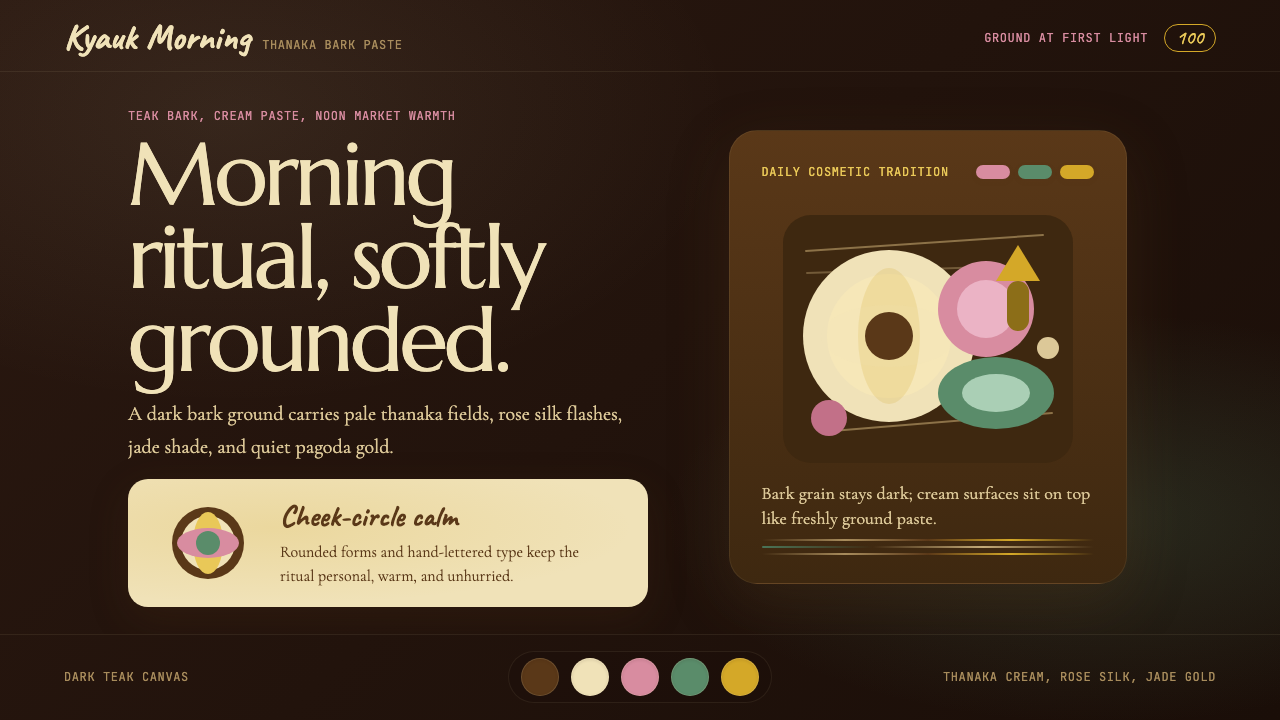
Thanaka — the pale cream bark paste pressed onto Burmese cheeks each morning for two thousand years — is not just cosmetic ritual; it is a complete visual language of warmth, organic roundness, and deep-rooted belonging.
Burmese Shan Thanaka (Bark Paste) in brief
The Burmese Shan Thanaka (Bark Paste) design system draws its entire visual grammar from a single daily act: the grinding of thanaka wood — typically from the Hesperethusa crenulata tree — on a flat wet stone slab called a kyauk pyin, then the brushing of the resulting pale yellow-cream paste onto cheeks in circular patches and delicate leaf-stencil shapes. Every design decision in this system refers back to that ritual: its color, its texture, its forms, and its mood.
The dominant ground is a deep teak-bark darkness — the color of the source wood before it is ground, rich and warm like aged heartwood. Against this depth, thanaka-cream typography and highlight fields glow with a softness that feels applied rather than printed, handmade rather than mechanical. Rose-pink accents drawn from the silk of traditional Burmese htamein skirts punctuate the palette, while jade-gold ornamental elements invoke the gilded pagoda spires of Bagan and Mandalay.
What sets this system apart from other dark, warm aesthetics is its commitment to the organic over the geometric. Shapes are rounded like cheek-circles — cartouche-like in their completeness. Surfaces carry the subtle impression of bark grain rather than the hard flatness of modernist minimalism. The overall mood is tropical-fresh and sun-warm, the visual equivalent of a Bagan market at noon: generous, unhurried, rooted in handcraft and two millennia of Burmese womanhood.
Where does Burmese Shan Thanaka (Bark Paste) come from?
Thanaka has been in continuous daily use across Myanmar for more than two millennia. The earliest recorded references appear in Pyu and Mon court documents from around the first century CE, describing cosmetic use of ground bark among royal attendants. By the eleventh century, when the Bagan empire was at the height of its architectural ambition, thanaka use was visible in temple murals — women depicted with the characteristic circular patches on their cheeks, confirming that the practice had long since moved from court to common life.
The practice is rooted not in vanity but in a practical wisdom that has been verified by modern dermatological research: thanaka bark contains compounds that protect skin from ultraviolet radiation, act as mild antifungals, and keep the complexion cool in tropical heat. In a country where the sun is harsh and skincare as a commercial category did not exist for most of history, grinding wood on stone each morning was the rational solution to a physiological need. The ritual absorbed into daily identity so thoroughly that it ceased to be understood as utility and became culture.
Across Myanmar's many ethnic groups — Bamar, Shan, Mon, Rakhine, Karen — thanaka appears in distinct regional variations. The Shan people of eastern Myanmar and the Thai-Shan border regions have their own parallel tradition, using local thanaka varieties and applying the paste in patterns that differ subtly from lowland Bamar practice. This regional diversity within a shared cosmetic tradition mirrors the country's broader cultural texture: common thread, many weaves.
The design system named for thanaka translates this layered cultural history into visual form. The choice of dark ground over light reflects the bark source rather than the finished paste — honoring the whole process, not just its result. The leaf-stencil motifs that appear as ornamental cartouches in the system echo the traditional thanaka application tools: small wooden stamps or rolled leaves pressed against the cheek to create patterned patches. In this way, the design system encodes not just the cosmetic's appearance but its making.
What defines the Burmese Shan Thanaka (Bark Paste) look?
Color Palette
The palette is built around the full arc of the thanaka process: the deep warm darkness of teak bark before grinding forms the primary ground, while the pale yellow-cream of the finished paste provides the dominant foreground tone used for type and key highlights. Rose-pink drawn from htamein silk accents add warmth and femininity, and jade-gold pagoda ornament introduces a luminous focal point. The combination reads as simultaneously earthy and precious — the organic and the ceremonial held in one register.
Surface and Texture
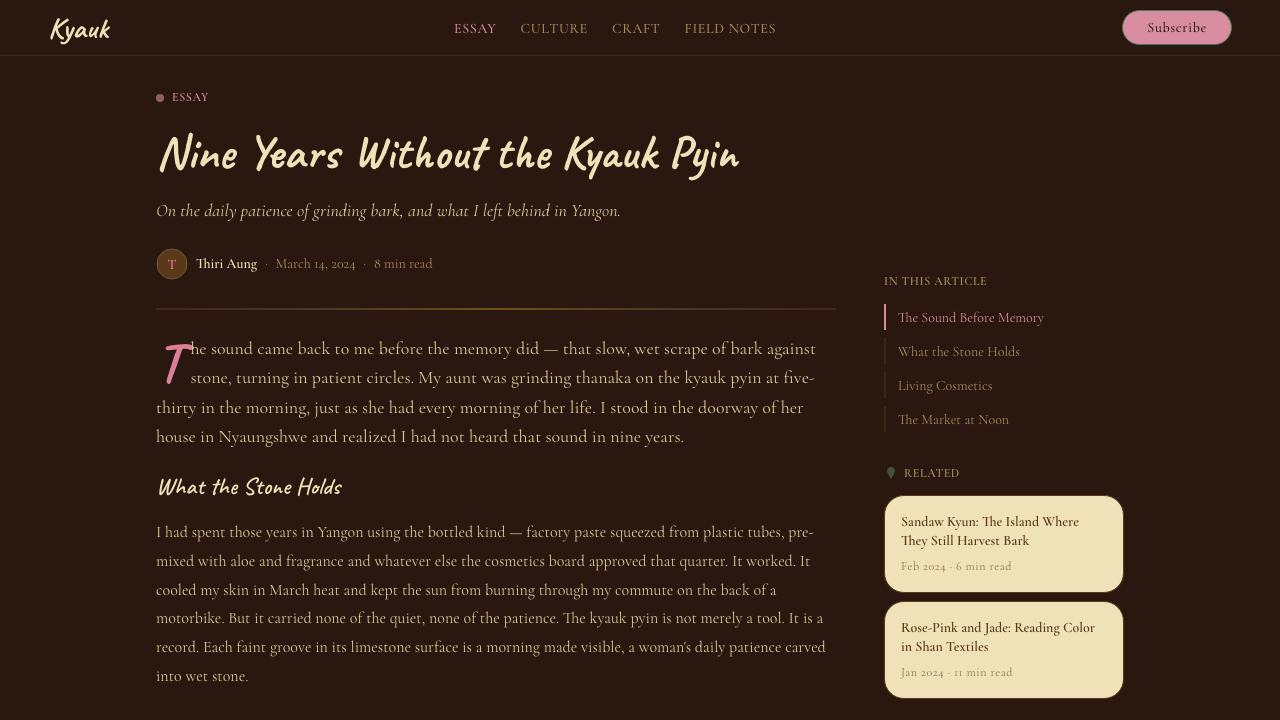
Unlike modernist systems that insist on perfect flatness, this design language gives every surface a subtle bark-grain quality — a fine, directional texture that evokes the kyauk pyin grinding stone and the rough-smooth bark of the thanaka tree. This texture is never aggressive; it anchors surfaces in the physical world, preventing the palette's warmth from floating into abstraction. Cards, backgrounds, and containers all carry this tactile undertone.
Form Language
Circular and oval forms — derived directly from the cheek-roundel application of thanaka paste — define the system's shape vocabulary. Buttons echo the leaf-stencil cartouche: slightly elongated, softly curved at the corners, never sharply rectangular. Cards take the form of circular or rounded-rectangular containers. This organic roundness distinguishes the system from both the hard geometry of Bauhaus-derived aesthetics and the rigid rectangularity of most contemporary interface design.
Typography
Typography in this system is warm and legible against dark grounds, favoring letterforms with a hand-applied quality — a slight softness in stroke weight rather than mechanical perfection. Thanaka-cream type on dark teak ground is the primary mode. Headlines carry weight through generous size and the inherent contrast of the palette rather than through extreme boldness or condensed cuts. The typographic register is unhurried: wide leading, comfortable measure, no aggressive compression.
Ornamentation
Unlike zero-ornament systems, thanaka design makes deliberate space for cultural ornament — but ornament that carries meaning rather than mere decoration. Pagoda silhouettes, lotus motifs, and leaf-cartouche borders are drawn from the iconographic tradition of Burmese Buddhist art and applied as accent elements at structural junctions: section dividers, card borders, and icon treatments. Each ornamental choice is legible as a cultural reference rather than arbitrary surface decoration.
Depth and Layering
Depth in this system is achieved through warm-toned layering rather than hard geometric shadow. Overlapping surfaces in close tonal steps — slightly lighter or darker variants of the same bark-brown — create a sense of gentle relief, like the subtle three-dimensionality of a bark surface itself. This soft layering approach stands in deliberate contrast to the hard drop-shadows of Swiss or Bauhaus-derived systems; the light here is diffused and tropical, not directional and architectural.
Iconography and Illustration
Icons and illustrative elements are drawn with the same round, hand-crafted quality as the stencil forms of thanaka application: slightly organic outlines, fills in the key palette tones, a suggestion of the imperfect beauty of a hand-painted edge. Representational elements — faces, figures, market scenes — appear as warm, soft-outlined silhouettes rather than hard vector shapes. The illustration register is gentle and human, consistent with the tradition's origin in a daily act of quiet self-care.
Who shaped Burmese Shan Thanaka (Bark Paste)?
One of Myanmar's most celebrated twentieth-century writers, Khin Myo Chit documented everyday Burmese life and material culture with scholarly warmth. Her essays on thanaka and other traditional practices remain foundational texts for understanding how cosmetic ritual functions as cultural continuity in Myanmar — how the daily act of grinding bark on stone transmits identity across generations without a single word being spoken.
A historian and folklorist, Maung Htin Aung catalogued the ritual dimensions of Burmese daily life including cosmetic traditions, providing the historical scaffolding that connects modern thanaka practice to its Pyu and Mon antecedents. His work demonstrated that thanaka was never merely functional — even in its earliest documented forms, it was entangled with ideas of beauty, status, and spiritual protection.
An art historian specializing in Burmese religious and cultural heritage, Stadtner's research on Bagan temple murals and material culture provided critical visual evidence that thanaka appeared in Burmese artistic representation as early as the eleventh century. His archaeological and iconographic work grounds what might seem like living folk tradition in a continuously documented history of more than a thousand years of artistic witness.
While not a single individual, the collective tradition of Shan textile weavers — whose silk and cotton weaving practices run parallel to and intertwined with thanaka culture — provides the rose-pink and jade-gold palette of this design system. Shan weavers in eastern Myanmar and across the Thai border have maintained geometric and floral pattern vocabularies for centuries that directly inform the ornamental language of thanaka-derived design.
The flat grinding stone on which thanaka is prepared is not a designer but a design object — perhaps the most important material object in this visual system's lineage. Its rough-smooth surface, the circular motion of grinding, the residue of cream left on stone — all of these physical facts translate directly into the system's texture, roundness, and color. Crediting the kyauk pyin is crediting the process over the maker: a form of design attribution that the tradition itself would recognize.
How do you use Burmese Shan Thanaka (Bark Paste) today?
The Burmese Shan Thanaka design system is exceptionally well-suited to projects that need warmth, cultural depth, and handcrafted authenticity — qualities that most contemporary interface design intentionally strips away. Applying it correctly means committing to its organic roundness, its layered depth, and its specific palette rather than borrowing one element while keeping everything else in a default digital register.
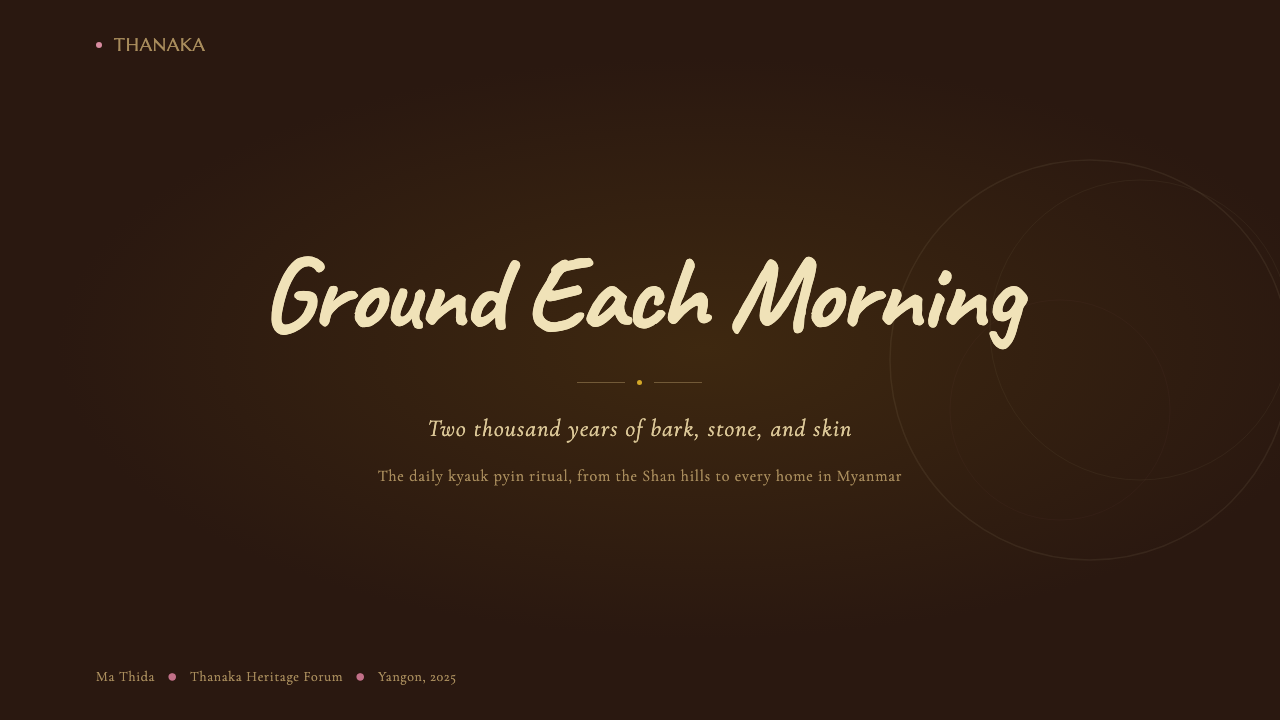
For presentation slides, the system rewards courage on the cover: a deep teak-bark ground, thanaka-cream headline in generous size, and a single leaf-cartouche ornament placed at a structural corner creates an immediate atmospheric impact unlike anything in the standard template library. Content slides work best when the organic roundness extends to every container — section labels in rounded pill shapes, data pulled into soft-edged cards rather than hard-bordered tables. Avoid the impulse to switch to a white background for content slides; the depth of the dark ground is precisely what makes the cream type feel warm rather than merely light.
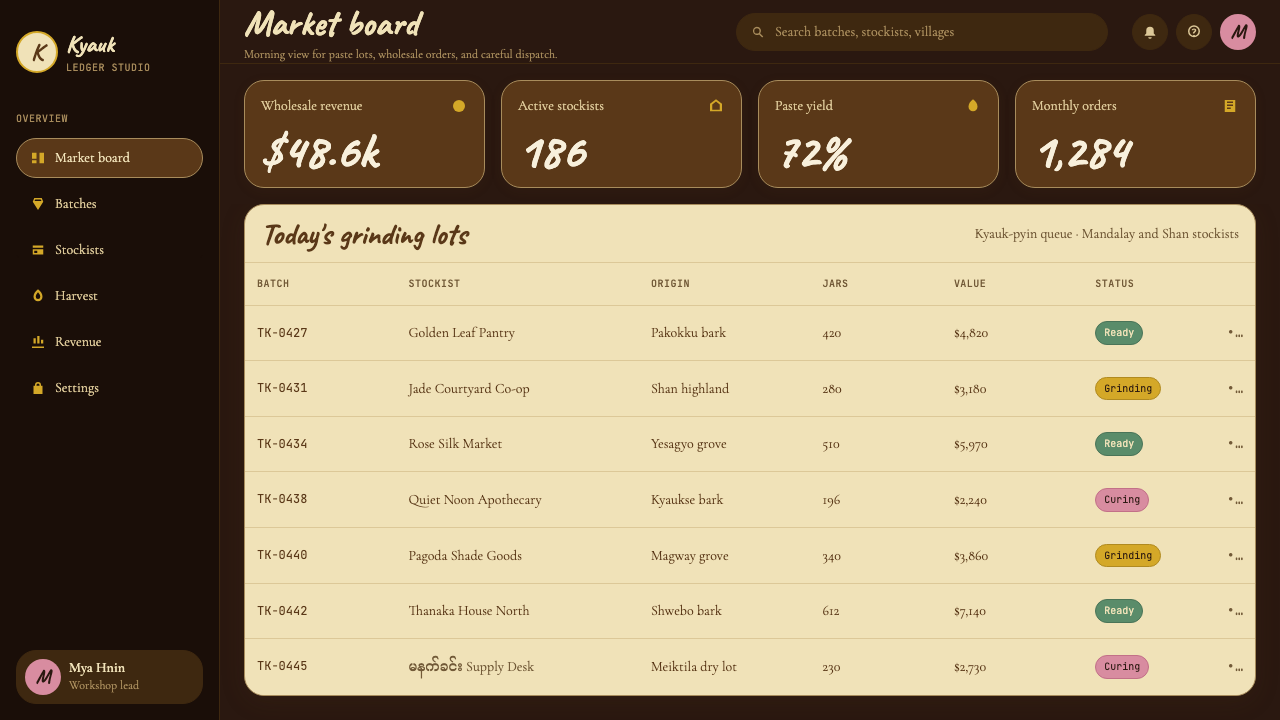
For web interfaces, this system finds its strongest application in pages that need to feel culturally grounded and human rather than frictionless and corporate. A landing page for a wellness brand, a cultural institution, a craft marketplace, or an artisanal product line will benefit from the system's bark-warm depth and roundel forms. Navigation elements should use the leaf-cartouche button shape consistently; card components should carry the subtle bark-grain texture on their surfaces. The rose-pink accent is most effective used sparingly — for a single call-to-action or a key status indicator — rather than deployed across multiple elements simultaneously.
For editorial and marketing work, the system's rich dark ground creates immediate poster-quality impact. Feature sections that alternate between teak-dark and a slightly lighter bark-brown layer produce a sense of depth that purely flat layouts cannot achieve. Thanaka-cream pull quotes on dark grounds function as natural anchors in long-form editorial. The jade-gold accent, when used for section headers or iconography, ties individual pages back to the pagoda-ornament tradition that runs through the system's decorative DNA.
A common mistake when applying this system is importing too much from familiar dark-mode conventions — specifically, the tendency to use pure near-black or near-white backgrounds instead of committing to the specific warm teak-bark and cream tones. Another error is placing the rose-pink accent too frequently, which destabilizes the dark-ground warmth and pulls the composition toward a generic tropical palette. The system's integrity depends on the cream remaining the dominant light tone and the rose-pink staying rare enough to register as a genuine accent when it appears.
Burmese Shan Thanaka (Bark Paste) — FAQ
Is this system appropriate for digital interfaces, or is it primarily a print and branding aesthetic?
It works well in digital contexts but requires deliberate adaptation. The dark teak ground renders beautifully on screens — warm tones at depth have less of the harshness that pure dark-mode blacks carry — and the cream typography reads clearly across device types. The key challenge is the bark-grain texture: applied at full fidelity on small screens it can read as visual noise rather than warmth, so a reduced or more subtle application is advisable for mobile contexts. The system is strongest for editorial web design, culture-facing landing pages, and rich media interfaces where visual atmosphere contributes to the user experience rather than being stripped for efficiency.
How does the Shan regional tradition differ from the broader Burmese practice, and does that distinction appear in the design system?
The Shan thanaka tradition, practiced across the highlands of eastern Myanmar and the Thai border regions, uses locally sourced tree varieties and applies the paste in patterns that have their own geometric distinctiveness — often more angular and pattern-dense than the circular roundels common in lowland Bamar practice. The design system absorbs both traditions: the circular cheek-roundel form is the primary shape vocabulary, while the leaf-cartouche borders carry the geometric pattern density associated with Shan textile and thanaka traditions. The jade-gold tone specifically references Shan pagoda ornamentation, distinct from the hotter gold of central Myanmar Bamar Buddhist art.
Can this system be used for brands outside the beauty and wellness category?
Yes, and some of the most interesting applications lie outside those obvious categories. The system's core values — warmth, handcraft, cultural rootedness, generous depth — are transferable to any brand that wants to signal authentic, non-corporate quality. A craft food brand, a cultural travel platform, a heritage textile retailer, an artisanal architecture firm, or an independent publishing house could each adopt the system with full conviction. What does not transfer well: brands where immediacy, frictionlessness, or technological neutrality are primary values. The system carries cultural weight; it will always read as coming from somewhere specific and handmade.
How should the ornamental elements be used without the result feeling costume-y or theme-park cultural?
The rule is: ornament at structure, not ornament everywhere. Pagoda silhouettes and leaf-cartouche borders are most effective when placed at genuine structural junctions — the meeting point of two sections, the container edge of a key card, the header zone of a document. When they appear in these load-bearing positions they read as design decisions; when scattered across a composition they read as decoration for its own sake, which is precisely the costume-y effect to avoid. The other principle is restraint in quantity: one ornamental motif used consistently throughout a layout at two or three specific positions will produce far more cultural coherence than five different motifs distributed loosely.
How does this system handle light-background applications — is it possible to invert it?
An inversion is possible but changes the character of the system significantly. On a thanaka-cream or warm off-white ground, dark teak-bark type reads clearly, and the rose-pink and jade-gold accents retain their warmth. However, the system's most distinctive quality — the sense of depth and glow that thanaka-cream elements have against dark grounds — is entirely absent in the inverted version. What remains is a warm, organic light palette that reads more like a general artisanal aesthetic than the specific night-market depth of the dark version. The light inversion works well for long-form editorial contexts where reading comfort over extended sessions matters, but it should be understood as a different use of the palette, not a full expression of the system.
Related design styles
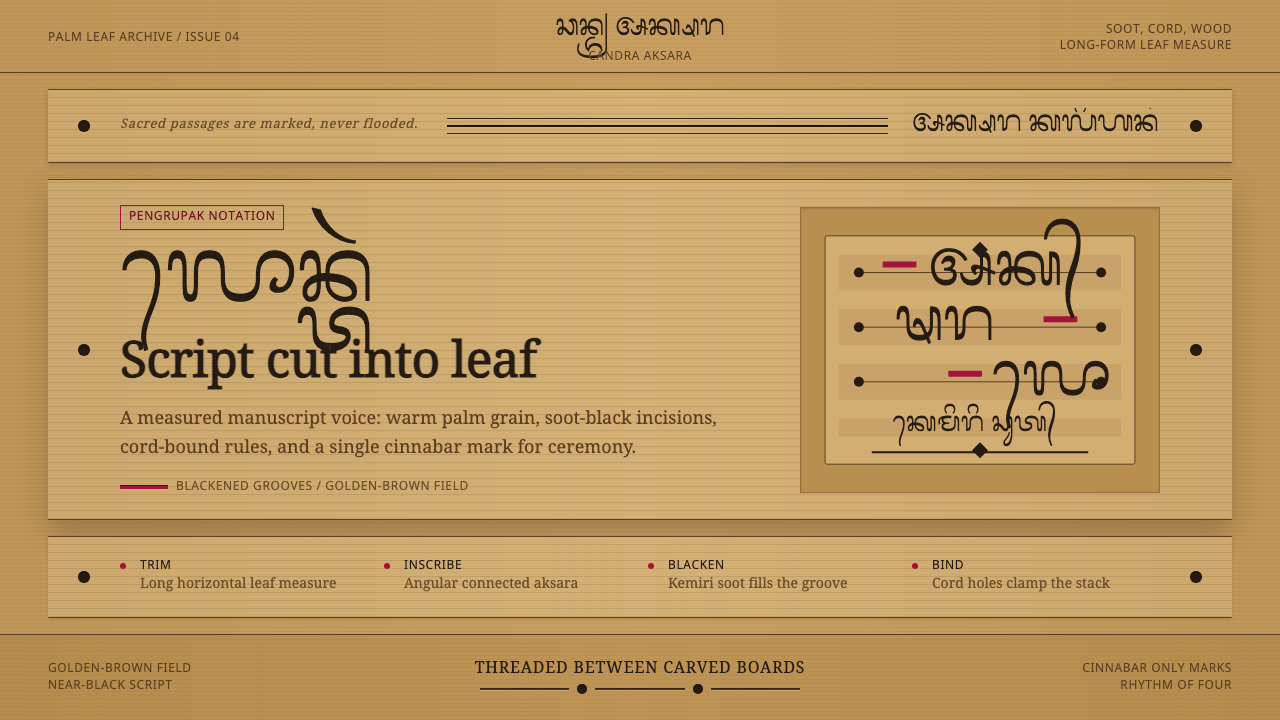 Balinese LontarHandmade memory, incised. Golden leaf strips carry soot script and spare cinn…
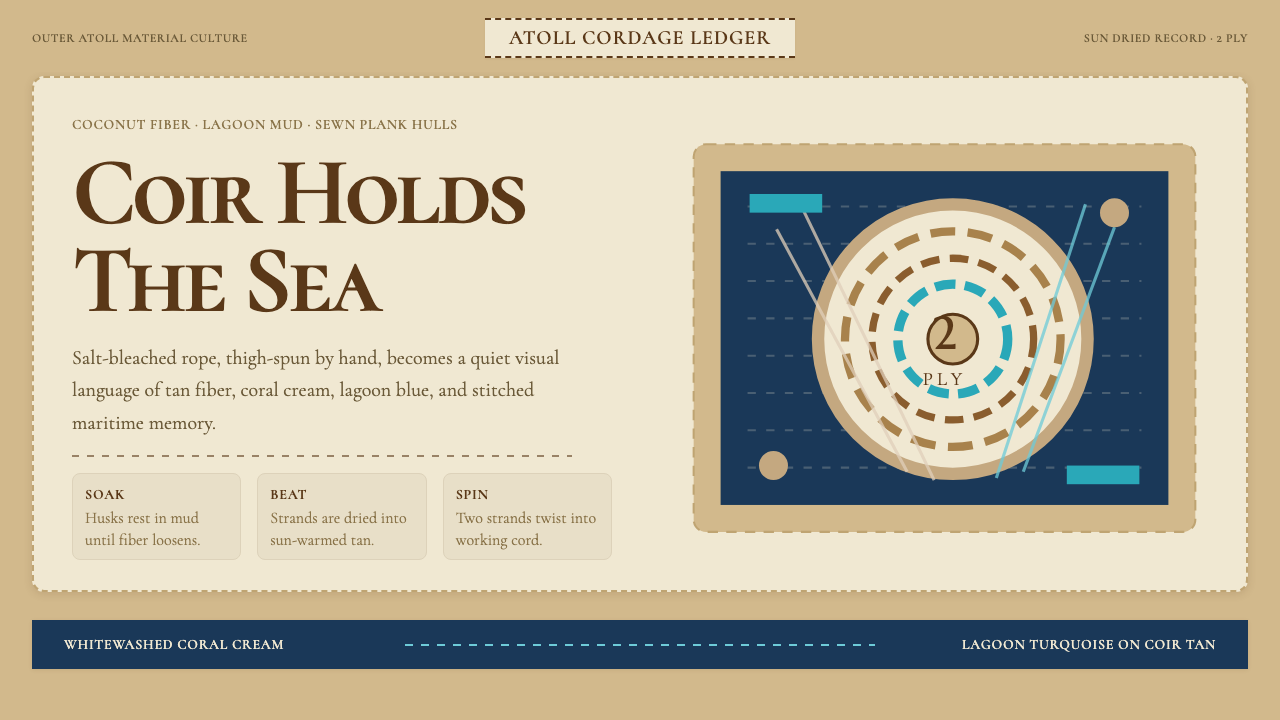 Maldivian Coir (Coconut Rope)Ocean-tested craft. Coir tan, coral cream, Cormorant type, and dashed seam ge…
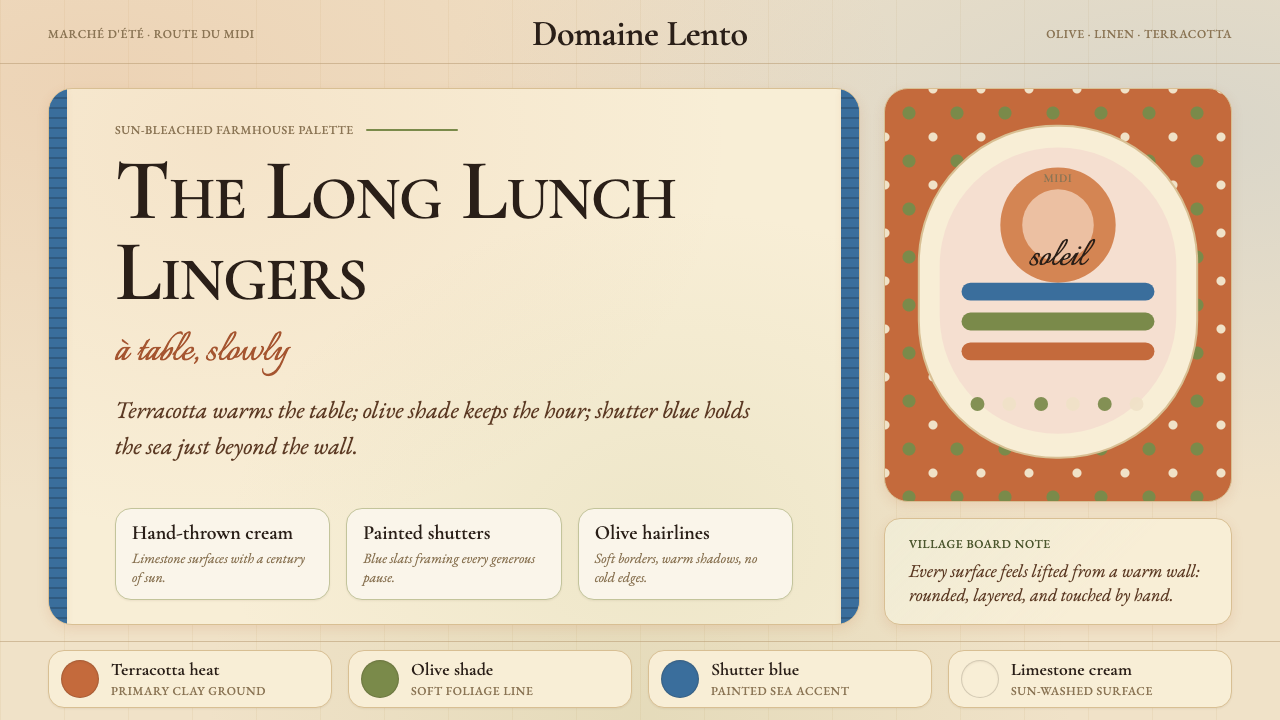 Provençal MediterraneanWarmth refuses the clock. Terracotta, olive lines, and shutter blue frame slo…
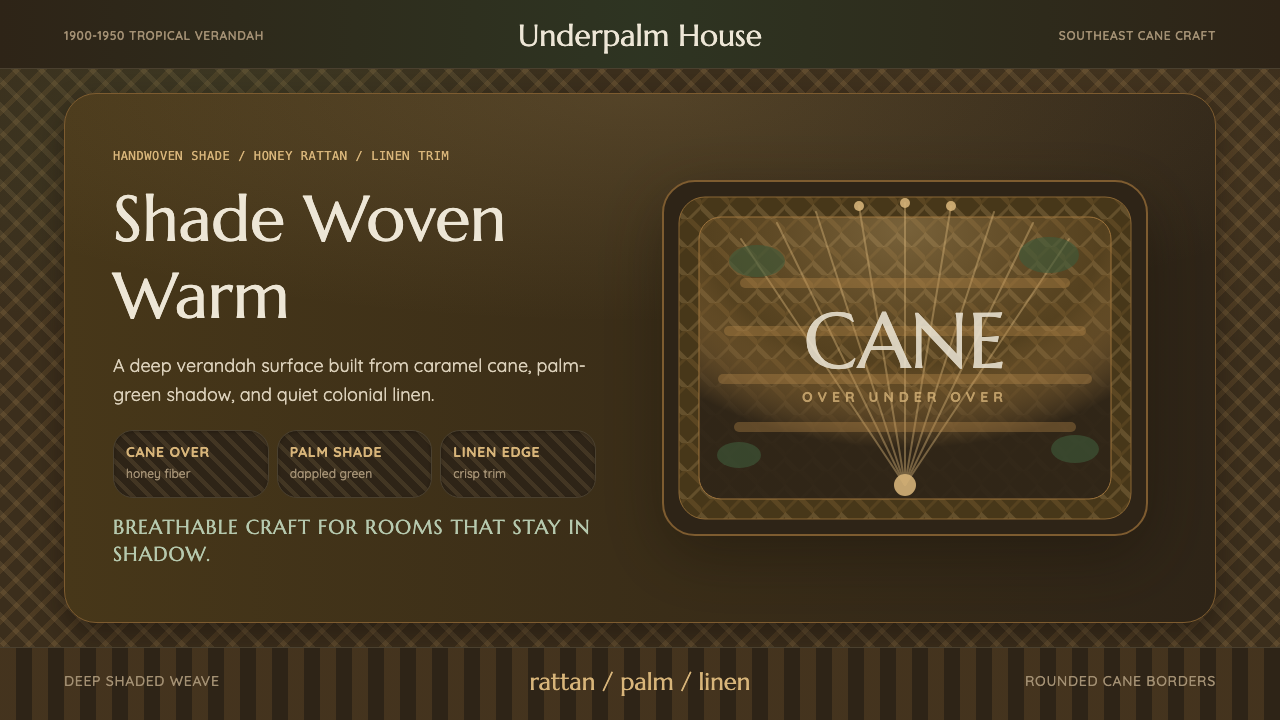 Rattan & WickerWarm shade has texture. Honey cane and palm green weave across a dark veranda…
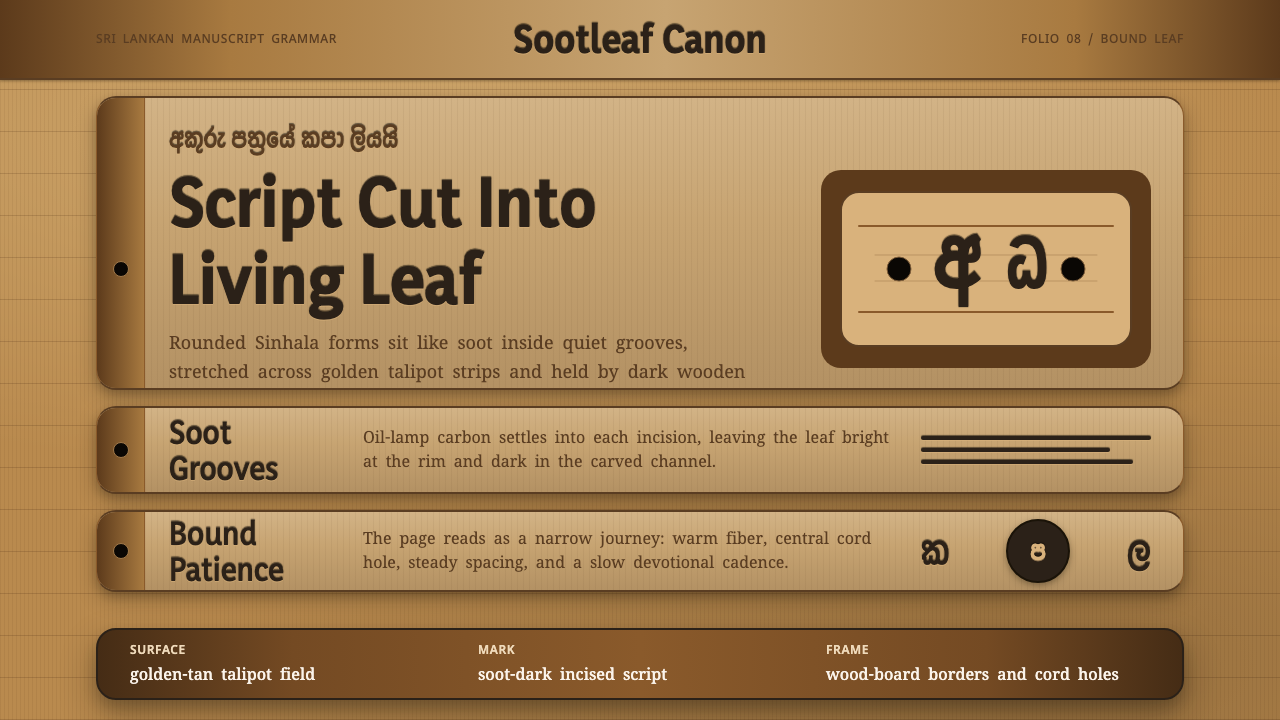 Sinhala Ola-LeafDevotion turns tactile. Soot text, Yaldevi curves, and palm-brown strips bind…
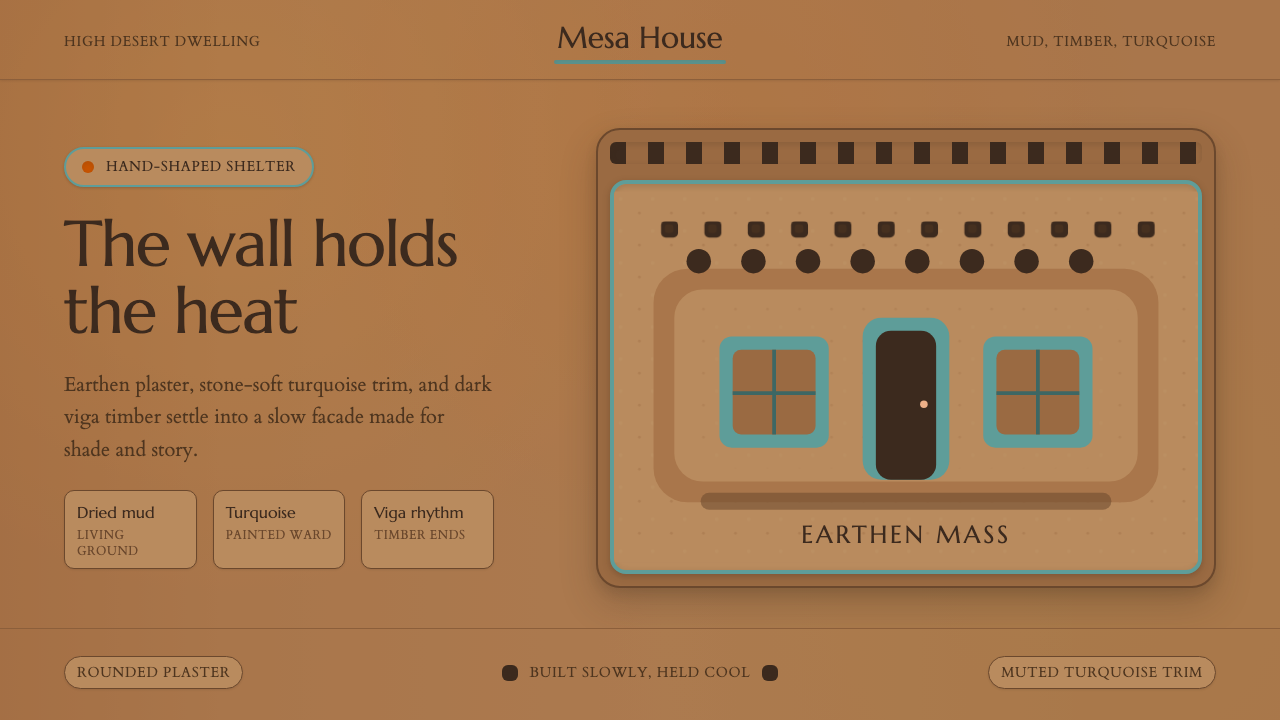 Adobe Pueblo SouthwestFeels made by hand. Earthen tan, turquoise trim, and viga rhythm shape the fr…