What is Provençal Mediterranean?
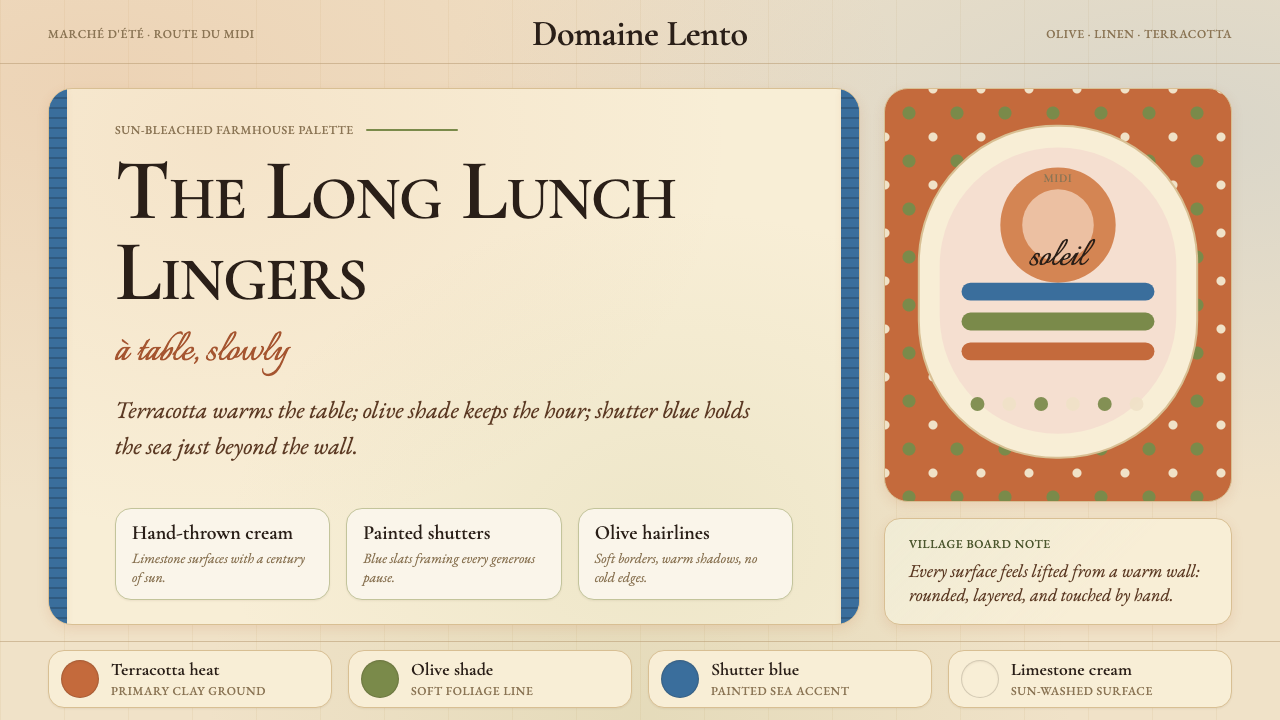
Provençal Mediterranean turns the afternoon light of southern France, Tuscany, and the Greek islands into a design language — warm terracotta, sun-washed cream, olive shadow, and the particular blue of a painted shutter.
Provençal Mediterranean in brief
Provençal Mediterranean is a design style rooted in the vernacular material culture of the warm-climate Mediterranean basin — the farmhouses of Provence, the hill towns of Tuscany, the whitewashed villages of the Cyclades. Its palette is drawn directly from what the sun does to humble materials over long years: terracotta roof tiles bleached and deepened by alternating rain and heat, limestone walls washed to a soft cream, shutters painted in the dusty blue-grey that Provençal craftsmen called 'bleu des volets', olive foliage catching light on one side and falling to near-black on the other, lavender fields fading toward silver at the edge of summer.
The style carries a strong sensory argument about time and making. Every canonical material — hand-thrown ceramic, woven straw, rough linen, uneven plaster — is marked by the process that produced it. The slight asymmetry of a thrown bowl, the irregular warp of a hand-loom, the color variation across a lime-washed wall are not defects to be corrected; they are evidence that a human hand was present. Typography in this style echoes the same logic: classical serif and italic letterforms borrowed from the blackboard menus of village markets, where chalk on slate has a weight and warmth that no printed typeface quite captures. Geometry is rounded and organic rather than precise, and compositional decisions favor the lived-in over the perfectly resolved.
What distinguishes Provençal Mediterranean from other warm or rustic aesthetics is specificity of place and light. This is not generic 'Mediterranean' — it is the particular quality of light that flattens in the afternoon heat, the specific warmth of a Roussillon ochre, the weight of silence in a stone farmhouse at noon. Applied to contemporary design, this specificity translates into palette restraint, material texture expressed through surface treatment, and a compositional ease that feels unhurried without being careless.

Where does Provençal Mediterranean come from?
The materials that define this style have been in continuous use across the Mediterranean basin for millennia. Roman amphorae were fired from the same Provençal clay that would later produce the region's distinctive roof tiles. Lime washing was a practical measure against damp and insects long before it became an aesthetic choice. Olive cultivation shaped the landscape — the gnarled trunk, the silvery canopy, the deep-green oil — and the indigo blue of shutters was partly functional, keeping interiors cool by reflecting the afternoon glare. These were survival technologies first; their beauty accrued through centuries of use.
The aesthetic codification of this vernacular tradition into something recognizable as a style began in earnest in the nineteenth century, when northern European painters — particularly the Impressionists and Post-Impressionists — traveled south in search of light. Paul Cézanne painted Mont Sainte-Victoire obsessively from his Aix-en-Provence studio, finding in the Provençal landscape a structure of planes and ochres that would become foundational to modern painting. Vincent van Gogh's eighteen months in Arles and Saint-Rémy produced a concentrated study of the region's particular color relationships — the chrome yellows of harvested wheat, the viridian-touched shadows of olive groves, the Prussian blue of a night sky over a terracotta roof. These paintings did not merely document the landscape; they translated it into a transferable palette.
The mid-twentieth century saw the lifestyle dimension of the style elaborated through travel writing, interior design, and fashion. The French Riviera became a destination for modernist artists — Matisse settled in Nice, Picasso worked at Vallauris — and the easy cosmopolitanism of that milieu shaped the style's association with an intelligent, unhurried good life. Pierre Deux, the American company founded in 1967, began importing Souleiado Provençal printed fabrics to the United States, introducing the characteristic flower-and-paisley printed cotton to a wide American audience and establishing a commercial template for Provençal style that would persist for decades.
The contemporary form of the style — the version that circulates on mood boards and in interior design studios today — was substantially shaped by two books and a body of photography. Peter Mayle's 'A Year in Provence' (1989) described the sensory textures of Luberon farmhouse life with such precise appetite that it became a defining cultural document, generating a wave of British and American emigration to the region. Frances Mayes's 'Under the Tuscan Sun' (1996) performed the same function for Tuscany, extending the aesthetic into the hill-town ochres and cypress silhouettes of central Italy. Slim Aarons's poolside and terrace photography — shot across the south of France and the Italian coast from the 1950s through the 1980s — supplied the visual archive: wicker furniture, stone balustrades, linen dresses, the long afternoon light that defines the style's color temperature. The Instagram era from around 2010 onward gave the aesthetic a new distribution channel, reframing it through the lens of slow living and artisan food culture.
What defines the Provençal Mediterranean look?
Color Palette
The palette is organized around a warm, sun-bleached core: terracotta ranging from pale dusty rose to deep fired clay, cream and off-white limestone tones, the muted sage and silvery olive of Mediterranean foliage, and the characteristic shutter blue — a grey-tinged, somewhat chalky blue that sits closer to slate than to sky. Lavender provides a secondary accent, appearing as a washed mauve rather than a vivid violet. The overall effect is of colors that have been long outdoors — faded, softened, and harmonized by the same light source. Saturated or synthetic-looking tones have no place in this palette; every color reads as if it has been aged.
Texture and Surface
Surface texture is the style's primary carrier of warmth. The reference surfaces are all deliberately imperfect: the slightly uneven finish of lime plaster, the color variation of hand-thrown terracotta, the irregular weave of a linen cloth, the roughness of a stone wall whose individual blocks remain visible. In two-dimensional design work, this principle translates to paper stocks, grain overlays, and surface treatments that avoid the flat perfection of digital screens. Gradients, where they appear, are extremely subtle — the kind of tonal shift that happens when daylight moves across a white wall over an hour, not the kind that signals user interaction.
Typography
Type in this style is rooted in the classical serif tradition, with a preference for letterforms that carry optical weight and a sense of being drawn rather than constructed — old-style proportions, slightly variable stroke width, bracketed serifs. Italics are used more freely than in most design systems, evoking handwritten chalk on market blackboards. Where a contrasting typeface appears, it leans toward a loose, slightly casual script that reads as handwritten without becoming illegible. Size contrast is used with restraint: hierarchies are established gently rather than through dramatic scale jumps. All-caps settings are rare and used mainly for location names or category labels.
Composition and Space
Layouts breathe. Generous white or cream space surrounds content without the deliberate tension of modernist asymmetry or the crowded richness of maximalist styles. The compositional logic is closer to a well-set table or a thoughtfully arranged shelf — objects placed with intention but not anxiety, with room for the eye to rest between them. Natural asymmetry is welcome: a block of text offset to one side, a single image placed with apparent casualness, a detail cropped just short of perfect centering. Borders, when used, are thin and often hand-drawn in character rather than mechanically precise.
Imagery and Materiality
Photographic imagery in this style favors natural light, unposed arrangements, and surfaces that show their age or origin. The visual reference is the documentary photography of still life and place rather than the high-production food or interior photography of commercial catalogs. Objects are photographed in context rather than against neutral backgrounds: a ceramic bowl on a worn stone surface, a glass of wine on a faded linen cloth, a bundle of lavender against a whitewashed wall. Illustration, when it appears, tends toward botanical drawing, hand-rendered maps, or loose ink sketch — forms that carry the warmth of the human hand.
Restraint and Slowness
The style's emotional register is deliberately unhurried. It does not optimize for attention capture — it rewards attention that lingers. Layouts avoid the stacking of multiple competing calls to action; a single, clearly stated invitation is more in character than a cascade of buttons and banners. Motion, where it enters digital applications, is slow and gentle — a cross-fade rather than a slide, a subtle shift rather than a bounce. The overriding principle is that nothing should feel urgent. Provençal Mediterranean design says that what is good is already here, and there is plenty of time to appreciate it.
Color Harmony Over Contrast
Unlike design systems that use color primarily as a signal or differentiator, Provençal Mediterranean uses color to create cohesion. Tones are chosen to sit together comfortably rather than to create maximum contrast or legibility. Even the accent colors — the shutter blue, the lavender — are desaturated enough to read as part of the same natural family. Text is typically set in a deep warm brown or dark terracotta rather than pure black, softening the type-to-background contrast while maintaining readability. The result is a palette that feels as though all its elements have been found in the same landscape.

Who shaped Provençal Mediterranean?
Mayle's 'A Year in Provence' (1989) is arguably the most consequential single document in the style's cultural formation. An advertising copywriter turned author, Mayle moved to the Luberon region of Provence and wrote a memoir of his first year with a sensory precision that made the region's textures — the crumble of local cheese, the smell of lavender at cutting, the particular light of a September afternoon — feel physically present to readers thousands of miles away. The book sold millions of copies, generated multiple sequels, and directly triggered a wave of British and American emigration to rural Provence. In doing so, it transformed a regional vernacular into a globally recognized lifestyle aesthetic, giving the style its first widely shared visual and sensory vocabulary.
Where Mayle fixed the style in Provence, Mayes extended it to Tuscany. 'Under the Tuscan Sun' (1996), her memoir of restoring a farmhouse near Cortona, became an international bestseller and a cultural document of comparable influence to Mayle's. Mayes brought a poet's attention to the material details of Tuscan rural life — the color of the local stone, the structure of pergola vine, the way a kitchen is arranged around the harvest cycle — and her writing established Tuscany as an equal chapter in the same visual story. The 2003 film adaptation introduced the aesthetic to audiences who had not read the book, broadening its reach still further.
Aarons was a photographer who spent four decades documenting the leisure lives of the wealthy and creative across the south of France, the Italian coast, and the Greek islands. His photographs — shot for magazines including 'Town and Country' and 'Holiday' from the 1950s onward — established the visual grammar of the style: stone terraces with low walls, wicker chairs casting afternoon shadows, linen tablecloths on outdoor tables, the particular blue of a pool against terracotta. Aarons himself described his work as 'attractive people doing attractive things in attractive places,' and the formula, as superficial as it sounds, proved inexhaustibly generative. His images now function as a definitive color and compositional reference for anyone working in the style.
Pierre Deux was an American home furnishings company founded in New York in 1967 by Pierre Moulin and Pierre LeVec, two Frenchmen who began importing Souleiado printed Provençal fabrics — the characteristic cotton prints featuring small-scale repeating patterns of flowers, paisley, and geometric motifs in terracotta, olive, and gold — to American consumers. At its peak in the 1970s and 1980s, Pierre Deux had flagship stores in major American cities and supplied the visual language of Provençal style to an entire generation of American interiors. Its catalogues and store designs codified the domestic expression of the style — the pairing of printed fabric with hand-thrown pottery, rush-seated chairs, and warm stone surfaces — in a way that remained commercially influential for decades.
How do you use Provençal Mediterranean today?
Provençal Mediterranean transfers most naturally to design contexts where warmth, trust, and a sense of unhurried quality are the primary values the product or brand wishes to communicate. Unlike structural or geometric styles that lead with authority and precision, this style leads with ease and pleasure — it is best deployed when the audience should feel welcomed rather than impressed. That distinction should govern all application decisions.
For presentation slides, the style works well on both cover and content pages when the subject matter warrants warmth over urgency. A cover slide benefits from a full-bleed photograph of appropriate character — warm stone, linen, organic texture — with the title set in a classical italic over a semi-transparent cream overlay. Alternatively, a flat terracotta or cream ground with a centered typographic treatment in a deep warm serif makes a strong, quiet statement. Content slides should resist the temptation to fill space: generous margins, one or two focal images, and type set in a clear hierarchy using scale rather than decoration. Data slides work well with softened chart palettes — warm ochre bars, sage accents — and should avoid the neon or primary-color contrast of more assertive styles. Charts benefit from thin, light ruling lines rather than heavy grid lines, and from labeling that is integrated rather than added as an afterthought.
For web interfaces, the style is well suited to hospitality, food and beverage, travel, wellness, home and garden, artisan goods, and any brand whose proposition centers on quality, craftsmanship, or place. Pricing pages and product listing pages work especially well because the style's generous spacing and warm palette invite browsing rather than demanding decision. Navigation should be typographic and unhurried — a horizontal bar with generous letter-spacing in small caps or a classical serif, no icon clutter. Background fields alternate between off-white and pale cream rather than between white and grey, maintaining warmth throughout. Interactive states — hover, active, selected — are communicated through subtle tonal shifts rather than color inversions or harsh outlines.
For editorial and marketing work, the style supports long-form reading and the kind of brand narrative that unfolds over several paragraphs rather than a single headline. Feature article layouts pair a wide, atmospheric photograph with a drop-cap opening and generous leading in the body text. Pull quotes are set in italic, indented, and surrounded by space — not boxed or highlighted. Marketing pages for seasonal campaigns or product launches benefit from the style's poster-like simplicity at full width: a single strong image, a short line of type, and a call to action that is stated once, clearly, and not repeated in multiple button variations across the page.
The most common mistake when applying this style is importing the palette without the pace. A terracotta background color applied to a layout that is otherwise dense with information, competing buttons, and animated notifications does not become Provençal Mediterranean — it becomes a confused signal. The style's warmth depends entirely on its restraint. A second common mistake is pushing the 'rustic' quality into illegibility: over-distressed type, textures so heavy they compete with content, grain overlays applied at the wrong density. The reference point should always be a well-preserved, well-lit farmhouse room — worn but clean, imperfect but composed.
A third pitfall worth naming is scale inconsistency. The style relies on generous space, which means it is genuinely harder to apply at small screen sizes or in information-dense contexts. Rather than cramming the full palette and texture vocabulary into a mobile interface, designers working at small scale should commit to one or two signature elements — the warm background field, the single serif headline — and let those carry the style while the rest of the layout becomes more functional. Attempting to reproduce the full register of the style at every breakpoint typically results in an interface that feels heavy rather than warm.

Provençal Mediterranean — FAQ
How is Provençal Mediterranean different from generic 'Mediterranean' or 'coastal' style?
Generic Mediterranean and coastal styles tend toward brightness and clarity — saturated turquoise, bright white, cobalt blue, the visual shorthand of a tourist poster. Provençal Mediterranean is slower, warmer, and more specifically located. Its blues are chalky and greyed rather than saturated; its whites lean toward cream and limestone rather than optical white; its reference is the interior of a stone farmhouse rather than a harbor view. The style is also specifically tied to the material culture of hand production — thrown pottery, woven fabric, plaster walls — in a way that coastal styles, which tend toward the nautical and the pictographic, are not.
Can this style work for a technology or SaaS product, or is it too 'lifestyle'?
It can work, but the fit depends entirely on the product's positioning. A technology product that is competing on efficiency, speed, or technical authority will find the style's warmth and restraint working against it — the audience will read slow and warm as unprofessional or insufficiently rigorous. However, a technology product that is positioning around quality, calm, and the reduction of stress — a writing tool, a scheduling application, a personal finance product aimed at long-term wellbeing rather than growth hacking — can use the style effectively. The key question is: does your product want users to feel productive and powerful, or thoughtful and at ease? Provençal Mediterranean only fits the second.
What is the biggest risk when using this style for a brand, and how do you avoid it?
The biggest risk is genericness. Because the style has been so widely adopted in the hospitality, food, and lifestyle sectors, it is easy to produce work that reads as competent but undifferentiated — another warm-cream-and-terracotta brand that looks like twelve others in the same category. The way to avoid this is through specificity of detail rather than palette substitution. Do not try to escape the style's conventions by reaching for unusual colors; instead, find the one detail — a specific typeface decision, an unexpected use of botanical illustration, a compositional signature — that anchors the brand within the style while making it distinct. The warmth and quality signals of the style are assets; the genericness is the execution risk.
How does the style handle dark mode or low-light viewing contexts?
Provençal Mediterranean is a light-ground style by nature, and dark mode is genuinely at odds with its core logic. The style's warmth depends on the behavior of light on pale surfaces — cream reflects warmth, stone filters it, linen diffuses it — and these qualities do not simply invert. A pure dark inversion produces something that reads more as a Gothic or moody aesthetic than as Provençal. The most viable approach for dark contexts is to shift toward deep warm earth tones — a very deep terracotta brown or a dark warm charcoal — as the ground, with cream and pale ochre as the foreground type and accent colors. Shutter blue becomes more prominent in this treatment and can serve as a useful structural accent. The result will read as a different register of the style rather than a faithful inversion.
Is there a right way to use illustration in this style, and what should be avoided?
Illustration fits the style naturally when it is rooted in drawing traditions that predate digital production: botanical illustration, engraving-style line work, hand-drawn cartographic elements, loose ink or watercolor sketches. These forms carry the warmth of the human hand and reinforce the style's narrative about material production and slow craft. What should be avoided is any illustration style that reads as clean-vector or screen-native — geometric icons, flat-color pictograms, digital isometric illustration. These carry a different visual logic that conflicts with the style's handmade sensibility. Similarly, the heavily blended digital painting approach popular in contemporary character illustration reads as too polished and too technically accomplished for a style that values the evidence of process over the erasure of effort.
Related design styles
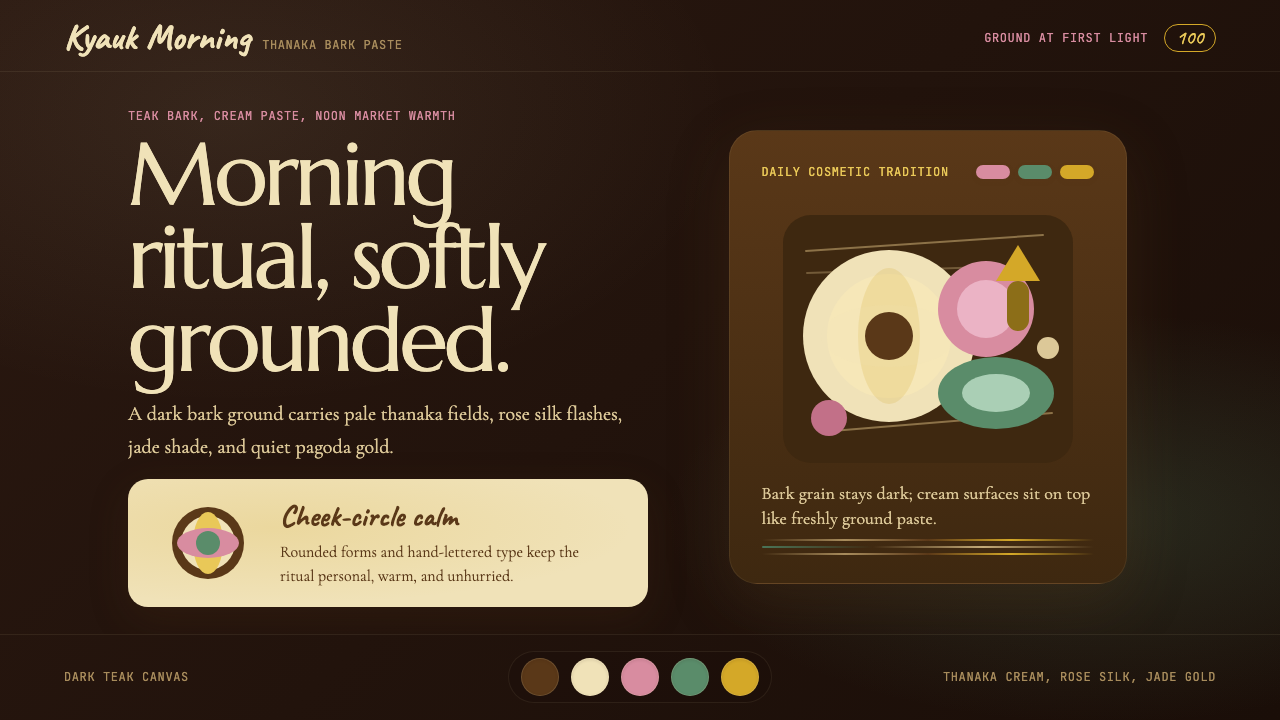 Burmese Shan Thanaka (Bark Paste)Handmade warmth on dark bark. Thanaka cream roundels soften rose, jade, and g…
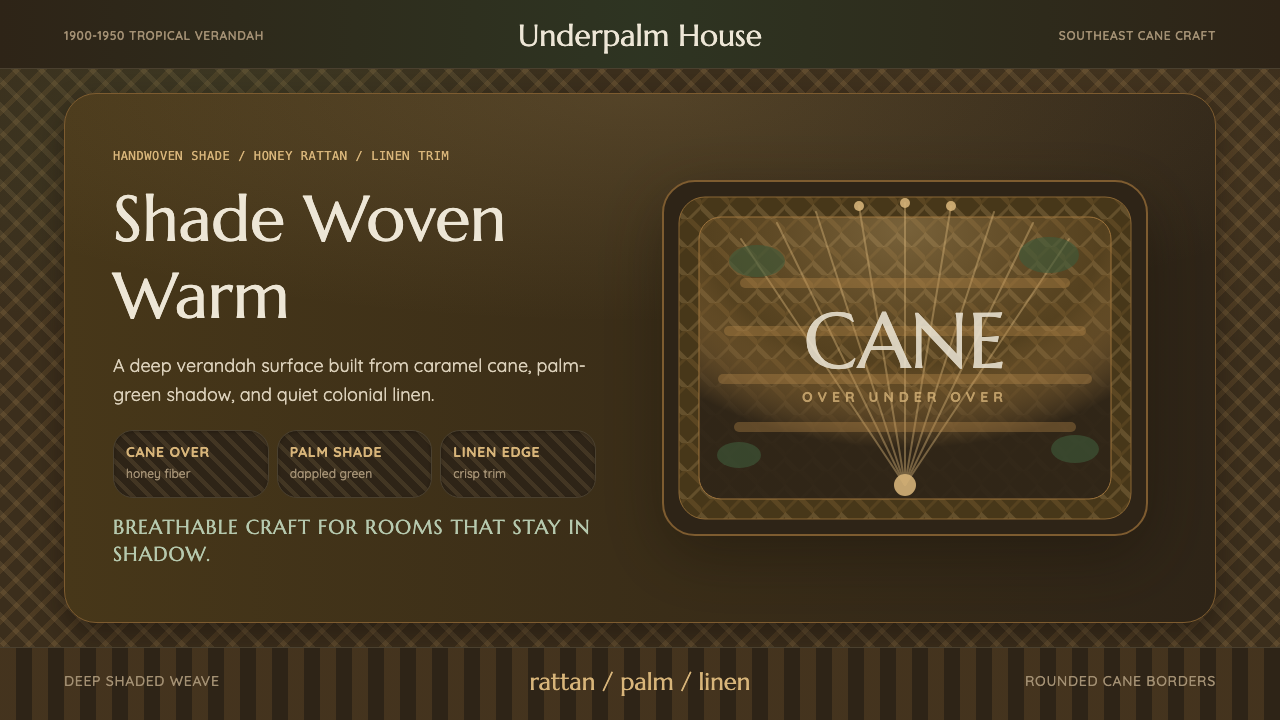 Rattan & WickerWarm shade has texture. Honey cane and palm green weave across a dark veranda…
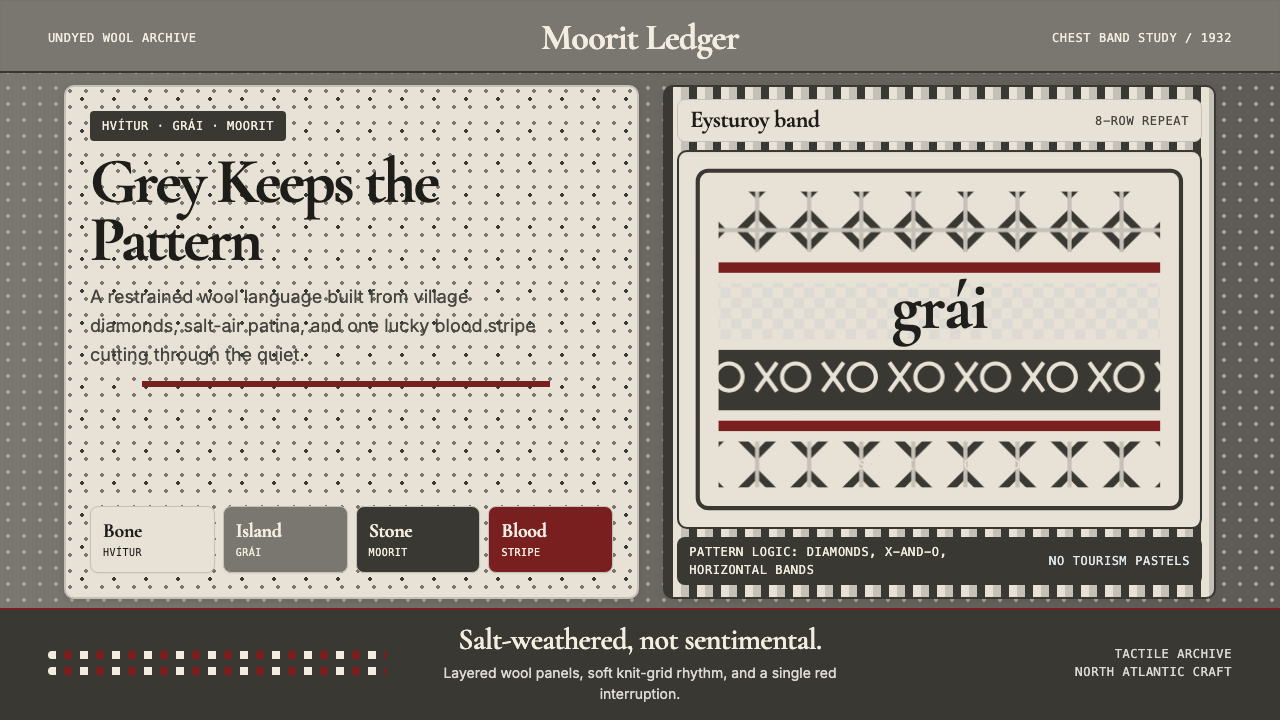 Faroese Knit Pattern Island GreyWeathered wool, not cozy kitsch. Island greys, Cormorant serif, one blood-red…
 Finnish RyijyWool holds its ground. Lamb's-grey centres meet stepped madder and indigo ban…
 Irish Aran Island Cable KnitMaterial honesty raised in wool. Bone ground, moss ink, and cable columns cas…
 Knossos Minoan FrescoColour becomes wall. Six mineral fields meet swift contours and honest fragme…