What is Renoir Impressionism?
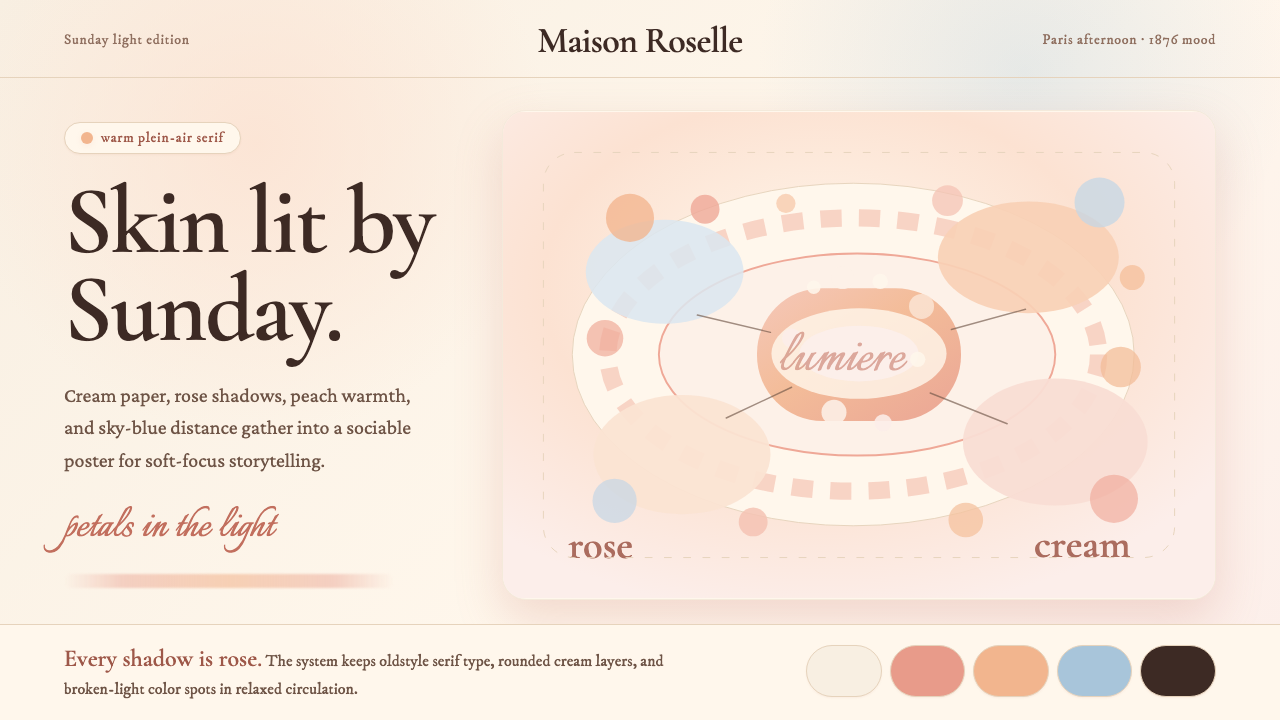
Renoir turned the Parisian Sunday afternoon into a visual language — rose shadows, cream highlights, and brushwork soft as petals wherever the light landed on skin.
Renoir Impressionism in brief
Renoir Impressionism names the warm, sociable branch of French Impressionism associated above all with Pierre-Auguste Renoir during the 1870s and 1880s. Where Monet's eye followed water and atmosphere and Degas mapped the indoor world of dancers and café-goers, Renoir anchored his gaze on the outdoor figure in light — the cheek catching afternoon sun, the hand holding a glass, the crowd at a garden dance losing itself in dappled shade. His two most studied works, Bal du moulin de la Galette (1876) and Luncheon of the Boating Party (1880–81), are less paintings of events than paintings of a feeling: the relaxed, slightly unfocused warmth of being among people on a good afternoon.
As a design system, Renoir Impressionism borrows this chromatic and textural sensibility. The palette is built from warm creams and off-whites as grounds, layered with blush pinks, peachy corals, and dusty roses — the full register of the warm skin and petal tones Renoir mixed directly from the tube. Shadows are never cool or grey; they tip into rose or lavender. Highlights are not pure white but warm cream. Typography in this register favors the curved, humanist serif letterforms that were standard in French printing of the 1880s — forms with optical warmth, bracketed serifs, and slightly irregular stroke contrast that recall handcraft rather than machine precision. The overall effect is unhurried, inviting, and luminous without being garish.
The style is distinct from both the tighter linearity of Ingres-influenced academic painting and the colder atmospheric dissolve of Monet's series works. It occupies a middle position: recognizably representational, emotionally warm, technically dazzling in its handling of broken color, yet always organized around a social center of gravity. In design application, this translates to compositions that feel inhabited — never stark, never clinical — with a persistent undercurrent of pleasure.

Where does Renoir Impressionism come from?
Pierre-Auguste Renoir was born in Limoges in 1841 and trained as a porcelain painter before entering the École des Beaux-Arts in Paris in 1862. His early formation was technical in the old sense: he learned to mix colors for ceramic glazes, to handle fine brushes with precision, and to work with materials whose optical warmth was built into their chemistry. These habits of hand never left him. When he turned to canvas, he brought the porcelain painter's instinct for luminous surface — a preference for warm grounds, translucent layering, and colors that seem to glow from within rather than sit opaquely on top.
The Impressionist movement in Paris coalesced around a shared rejection of the French Salon's academic conventions. Renoir, Monet, Degas, Alfred Sisley, and Berthe Morisot formed the nucleus of a group that, beginning with their first independent exhibition in 1874, presented work painted in front of actual subjects rather than composed in the studio from preparatory drawings. The name 'Impressionist' was initially a critic's insult — derived from Monet's Impression, Sunrise (1872) — that the group eventually adopted with ironic pride. The critical reception was hostile for years: the 1874 exhibition was widely mocked, and sales were negligible. It was the dealer Paul Durand-Ruel, who had begun buying Impressionist canvases as early as 1871, who sustained the movement financially through its most uncertain years.
Renoir's distinctive warmth within the Impressionist group crystallized during the mid-1870s in Montmartre, the hilly neighborhood on Paris's northern edge that mixed working-class Parisians, artists, and the bourgeoisie seeking weekend pleasure. The Moulin de la Galette — an outdoor dance garden that occupied the grounds of a former windmill — was one of the neighborhood's social centers. Renoir set up to paint there on Sundays, working from life in the shifting outdoor light, completing Bal du moulin de la Galette in 1876. The painting is technically extraordinary: dappled blue-grey shadows fall across white shirts and pink cheeks with a flickering, unstable quality that academic techniques could not produce. It was acquired by the collector Gustave Caillebotte and is now in the Musée d'Orsay, Paris.
By the 1880s, Renoir had begun to question the looser edges of high Impressionism, undertaking a 'dry' or 'Ingresque' period in which he tightened contours and experimented with more classical figure construction. Luncheon of the Boating Party (1880–81), painted at a restaurant terrace at Bougival on the Seine, represents a moment of balance between the dissolving light of his 1870s work and this more structured attention. The figures — friends, models, and the woman who would become his wife, Aline Charigot — retain the warm flesh tones and sociable ease of his mature Impressionist style while being more fully resolved as individual presences. Renoir moved eventually to Cagnes-sur-Mer in the south of France, where he painted until his death in 1919, his hand increasingly affected by rheumatoid arthritis — in later years he painted with the brush attached to his wrist.
What defines the Renoir Impressionism look?
Warm Ground and Palette
The entire system rests on a warm off-white or cream ground — not the cool stark white of clinical modernism, but the slightly yellowed surface of aged paper or ivory. Against this ground, the active palette layers blush pinks, peachy corals, dusty roses, and soft terracottas. These are the tones Renoir identified in skin, petals, and afternoon light, and they share a family warmth regardless of value or saturation. There are no cool neutrals; even passages that read as grey or beige are actually warm-shifted.
Rose and Lavender Shadows
The defining color innovation of Renoir's outdoor painting is his treatment of shadows. Academic painters used brown or black to darken; the Impressionists understood that shadows in nature are not the absence of light but the presence of reflected sky and ambient color. Renoir's shadows are rose, lavender, or warm violet — chromatically rich rather than tonally inert. In design application, this means shadow states, hover conditions, and secondary surfaces should be tinted with a warm rose or soft violet rather than grey or black, preserving the luminous quality that makes the palette feel inhabited.
Soft and Feathered Brushwork
Renoir's characteristic mark in paint is a short, feathered stroke that blurs into its neighbor at the edges — not the disciplined comma-stroke of some Impressionists but something closer to a gentle press and lift. Translated into design, this quality appears as soft-edged elements: blurred glows rather than hard shadows, gradients that dissolve at their periphery rather than cutting to a clean edge, photography treated with a slight luminous haze. The effect suggests atmosphere rather than precision. Edges are present but never harsh.
Humanist Serif Typography
The typographic correlate of Renoir Impressionism is the humanist serif — letterforms whose proportions and stroke contrast derive from calligraphic handwriting rather than geometric construction. These forms, dominant in French book printing during the 1870s and 1880s, have slightly bracketed serifs, moderate stroke variation, and a visual warmth that optical geometrical typefaces lack. They sit naturally in cream-ground compositions and read as cultured rather than authoritative. Headline type can carry more weight and scale, but it should remain within the serif humanist family — weight and size are the hierarchy tools, not categorical shifts in style.
Dappled Light and Texture
Renoir was preoccupied with dappled light — sunlight filtered through leaves, broken by movement, arriving on surfaces in shifting patches rather than uniform washes. This quality of interrupted, variegated illumination gives his canvases their sense of aliveness. In design, its equivalent is subtle surface texture and layered tonal variation: backgrounds that are not flat fills but carry a slight linen or paper grain, image treatments that introduce warm luminous patches, layout zones that differentiate through overlapping tints rather than hard boundary lines.
Sociable Composition
Unlike the rigorous geometric or grid logic of movements such as Bauhaus, Renoir's compositional structure is organized around social gravity — clusters of figures and objects that suggest conversation, proximity, and ease. There is always a sense that the elements in a painting are comfortable near one another. In design application, this translates to layouts that avoid severe isolation of components. Elements relate to each other through spatial proximity and tonal family rather than through hard alignment to a strict grid. Whitespace is generous but soft-edged, not the emphatic negative space of austere modernism.
Luminosity Over Contrast
Where many design systems use high contrast — sharp value differences between foreground and background — to create hierarchy and readability, Renoir Impressionism achieves these goals through luminosity. The light in Renoir's paintings is diffuse and even; nothing is so bright it dominates harshly, nothing is so dark it becomes an anchor. In design terms, this means avoiding deeply saturated darks as primary backgrounds and instead building hierarchy through tonal temperature shifts, scale differences, and the strategic placement of the palette's warmest and most saturated tones as focal signals.

Who shaped Renoir Impressionism?
Renoir (1841–1919) remains the defining figure of warm-toned Impressionism. His career spans the movement's formation in the 1870s, its commercial breakthrough in the 1880s via Durand-Ruel's New York and London exhibitions, and a late phase at Cagnes-sur-Mer where he continued to paint large figurative compositions despite severe arthritis. His contribution to design thinking is less stylistic than sensory: he demonstrated that light falling on the human figure could be the entire subject of an image, and that warmth and pleasure were as legitimate aesthetic values as rigor and precision.
Monet (1840–1926) was Renoir's closest friend and artistic ally during the formative years of Impressionism. The two painters worked alongside each other at La Grenouillère on the Seine in 1869, producing nearly simultaneous paintings of the same subject from adjacent positions — a unique document of how two very different sensibilities operated within the same visual problem. Monet's cooler, more atmospheric approach to broken color provides the essential contrast that defines Renoir's warmth by opposition. Understanding Monet is necessary for understanding what Renoir chose not to do.
Durand-Ruel (1831–1922) was the dealer who transformed Impressionism from a scandal into a market. He began purchasing Renoir, Monet, Degas, and Sisley in the early 1870s, sustaining the group through years of critical rejection by advancing money against future sales. His 1886 exhibition in New York — mounted over the opposition of the American art establishment — was the decisive commercial breakthrough: American collectors responded enthusiastically where French bourgeois taste had been slow to follow. Durand-Ruel's role demonstrates that aesthetic movements require institutional infrastructure to survive.
Degas (1834–1917) exhibited with the Impressionists but never fully embraced plein-air painting. His indoor figures — ballet dancers, café women, bathers — were observed with a precision and psychological detachment that contrasts sharply with Renoir's warmth. Yet the two painters were part of the same social milieu and attended the same Thursday dinners at the Café Riche. Comparing their treatments of the same subjects — women, crowds, leisure — illuminates how Renoir's chromatic warmth was a deliberate affective choice, not merely a technical habit.
Aline Charigot (1859–1915), who became Renoir's wife in 1890, appears in numerous canvases from the early 1880s including Luncheon of the Boating Party, where she holds a small dog at the table's edge. Her recurring presence in his work makes her an unlikely collaborator in the Renoir visual system: she embodied the type of natural ease and unaffected warmth that Renoir sought in all his models. Her background — she came from a modest Burgundian family and was working as a seamstress when they met — was consistent with Renoir's democratic view of beauty as something found in ordinary life rather than constructed from idealized types.
How do you use Renoir Impressionism today?
Renoir Impressionism translates into contemporary design most naturally in contexts where warmth, approachability, and sensory pleasure are primary values. The system does not impose geometric rigor or structural severity; it succeeds through tonal harmony, soft light, and the persistent suggestion of human presence. Applying it requires leaning into these qualities rather than trying to systematize them the way a grid-based or typographic style would be systematized.
For presentation slides, the style works best on covers and transitional pages where a single strong impression is needed. A cover built in this register might place a full-bleed warm cream field behind a large humanist serif title, with a blush or coral accent element — a rule, a framing shape, an image vignette — positioned asymmetrically to create gentle visual tension. Avoid exact geometric alignment; elements should feel placed by eye rather than snapped to a grid. Content slides benefit from generous whitespace, a consistent warm neutral ground, and the use of the palette's rose and terracotta tones to highlight key data points or call-out quotes. Data visualizations — charts, timelines, comparison tables — should replace hard-edge outlines with soft fills and warm tints, so that even analytical content retains the palette's luminous character.
For web interfaces, the style suits editorial platforms, lifestyle brands, cultural institutions, and premium consumer products where the emotional register is more important than efficiency signaling. A homepage built in this register uses a warm off-white body, humanist serif headlines, and photography treated to emphasize warm skin tones and natural light. Interactive states — hover, active, focus — shift through tonal temperature rather than contrast flips: a button that shifts from cream to blush on hover, a card that develops a warm rose shadow on focus. Navigation should be typographic and light-handed; heavy dark headers break the palette's luminous quality. For pricing or feature comparison pages, the warm palette works well when tiers are differentiated by tonal warmth — the premium tier glowing slightly warmer — rather than by hard color coding.
For editorial and marketing work, Renoir Impressionism supports magazine layouts, exhibition catalogues, seasonal brand campaigns, and any communication where the audience is being invited into an experience rather than confronted with information. Article layouts use a warm body, generous margins for pull quotes, and soft image placements that bleed into the ground rather than sitting within hard frames. Photography should be selected and treated to emphasize the palette: images shot in warm afternoon light, close-up textures of fabric or botanicals, portraits that favor natural expression over studio formality. Marketing materials for food, hospitality, wellness, fashion, and cultural events translate particularly well, since the style's emotional temperature aligns with these sectors' core values.
A persistent mistake when applying Renoir Impressionism is importing the visual vocabulary without the underlying warmth logic — using pink and cream colors over a fundamentally cold or high-contrast compositional structure. The result reads as superficially decorative rather than genuinely Impressionist. A related error is pushing the palette into high saturation: Renoir's tones are characteristically soft and slightly dusty, not candy-bright. Saturated pinks and vivid corals shift the register toward something more contemporary and commercial, losing the period's characteristic sense of diffuse afternoon light. When in doubt, lower the saturation and raise the warmth — the palette should always feel as if it is lit from within rather than illuminated from outside.

Renoir Impressionism — FAQ
How does Renoir Impressionism differ from other Impressionist styles like Monet or Degas?
The three painters represent three distinct emphases within the same movement. Monet is primarily concerned with atmospheric light and its effect on large-scale subjects — haystacks, cathedrals, water surfaces — where the figure is secondary or absent. His palette is cooler, his edges more dissolved, his compositions more expansive. Degas is an indoor painter of precise observation: his figures are caught in moments of unconscious posture, and his draughtsmanship is closer to academic tradition than either Renoir or Monet. Renoir is the warmest and most sociable of the three: his subjects are people in pleasure, his shadows are rose rather than grey, and his brushwork dissolves edges not into atmosphere but into warmth. For design, the choice between these registers depends on the emotional temperature required — Monet for expansive and contemplative, Degas for analytical and precise, Renoir for welcoming and sensory.
Can Renoir Impressionism work in a dark or night-mode interface?
The style's core logic is built on warm light — the system assumes illumination from a warm source and reads shadow as chromatically warm, not dark. A strict dark inversion is therefore at odds with the palette's fundamental premise. However, a dusk or evening variant is possible: a deep warm brown or desaturated burgundy as ground, with cream and rose as foreground elements, allows the palette's warmth to persist without relying on a light ground. This variant works best for interfaces where mood is paramount — a restaurant booking app in evening mode, a cultural event program, a reading application. The key constraint is that even on a dark ground, shadows should never tip toward cool grey or blue; they must remain in the warm violet and rose family.
Is Renoir Impressionism appropriate for data-heavy or analytical products?
It is appropriate in limited applications but requires deliberate adaptation. The style's warmth and soft-edge quality can make dense data feel less clinical and more approachable — a genuine advantage in contexts like health dashboards, personal finance summaries, or educational analytics where user anxiety is a real design problem. However, the style's resistance to hard contrast and sharp edges can reduce the legibility of complex tables or small-scale data labels. The practical approach is to reserve the full Impressionist palette for the compositional frame — headers, background zones, decorative elements — while using a neutral or near-neutral treatment for the data layer itself, with the warm accent tones applied selectively to the most important figures. This creates warmth in context without sacrificing the precision that data display requires.
What photography style pairs naturally with this design system?
Photography that pairs naturally with Renoir Impressionism shares three qualities with his painted surfaces: warm light, soft focus at the periphery, and subjects that suggest ease rather than performance. Images shot in late afternoon or golden-hour light — where shadows are long and warm rather than harsh and cool — align most closely with the palette. Close crops of natural textures (fabric, botanicals, food, skin) work better than wide architectural shots. Portraiture should favor candid or softly directed expressions over formal studio poses. In post-processing, images benefit from a warm grade that lifts shadows toward amber or rose and slightly desaturates the coolest tones; high-contrast black-and-white or teal-orange color grading breaks the system entirely. The goal is photography that feels as if it was lit by a window in an 1880s Paris apartment rather than a contemporary studio.
How do I avoid making a Renoir-inspired design feel merely nostalgic or period-costume?
The risk of period pastiche arises when design borrows the surface signals — blush pink, serif type, soft texture — without internalizing the underlying logic. Renoir's warmth was not decorative; it was a claim about what painting should care about and what visual experience should feel like. To avoid pastiche in contemporary application, treat the palette and texture as a light-and-color system rather than a historical costume: ask what this warmth is doing communicatively, not what it looks like historically. Use contemporary layout conventions — responsive grids, accessible type scales, modern interaction patterns — and apply the Impressionist palette as a chromatic and tonal layer on top, rather than reconstructing a nineteenth-century magazine page. The distinction between an Impressionist-informed design and a period reproduction is that the former is structurally modern and chromatically warm; the latter is structurally antique and only accidentally warm.
Related design styles
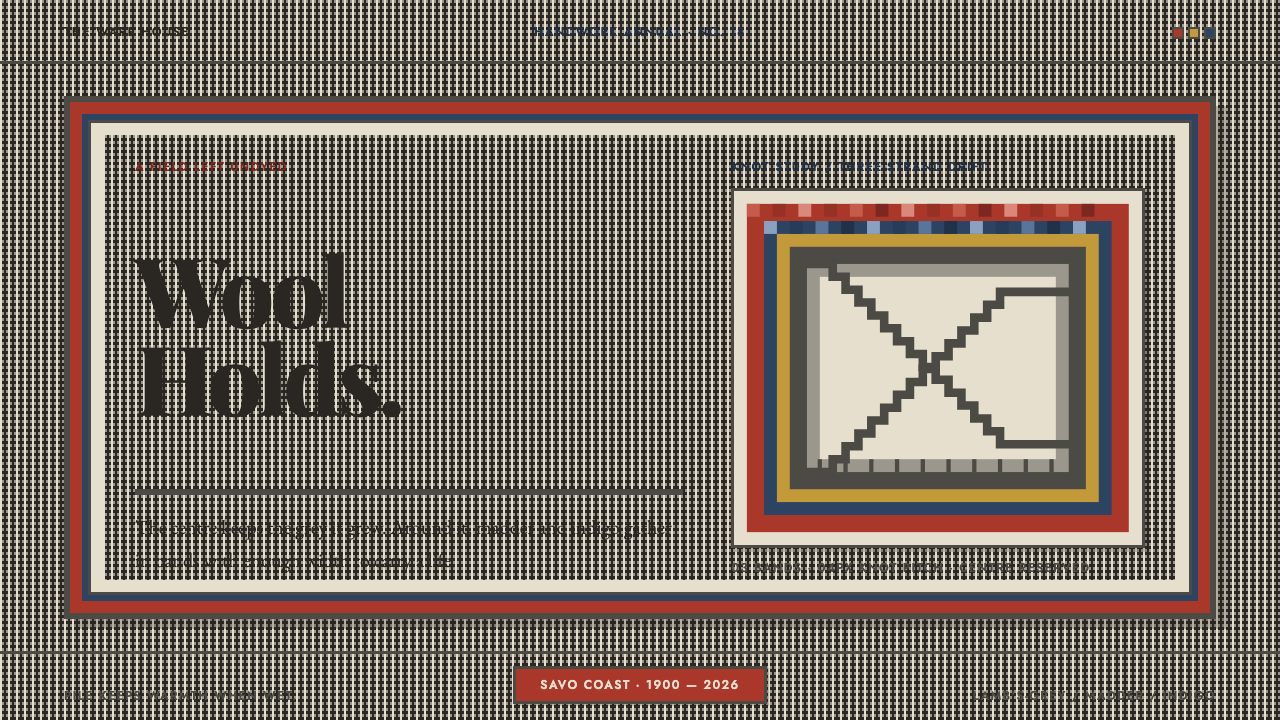 Finnish RyijyWool holds its ground. Lamb's-grey centres meet stepped madder and indigo ban…
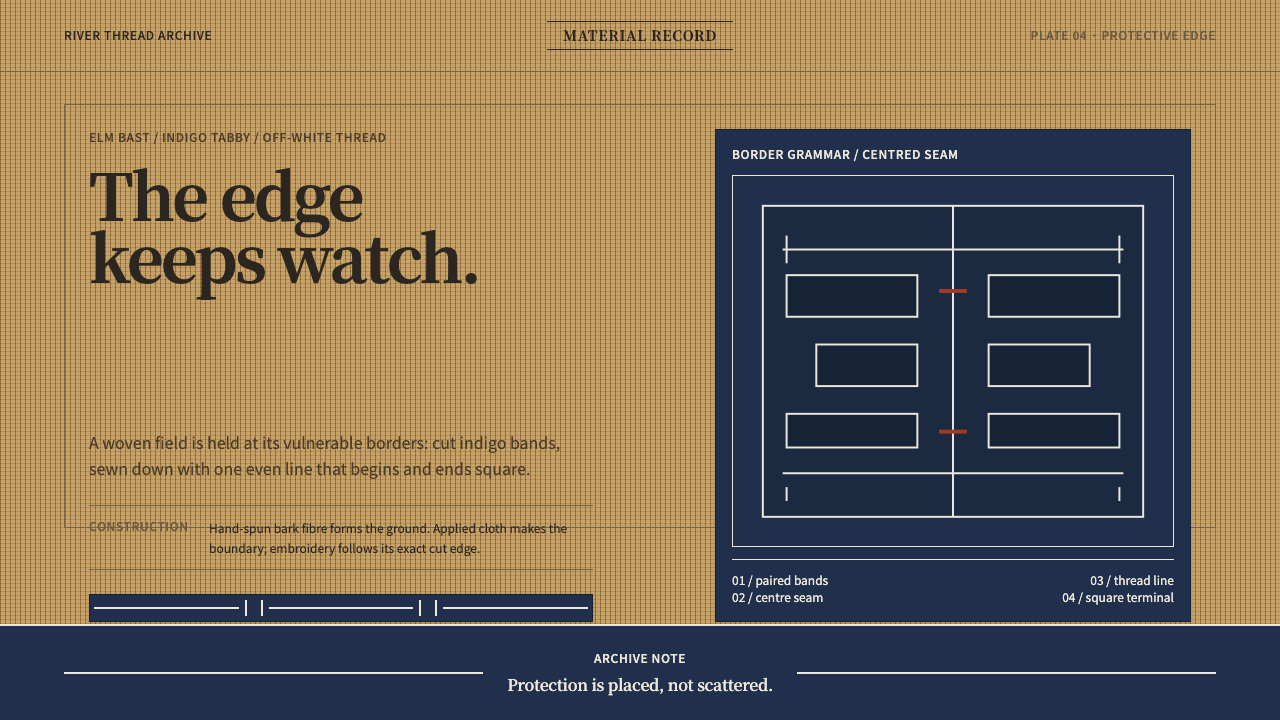 Ainu Attus RobeProtection is cut, not painted. Indigo bands and square-ended thread hold elm…
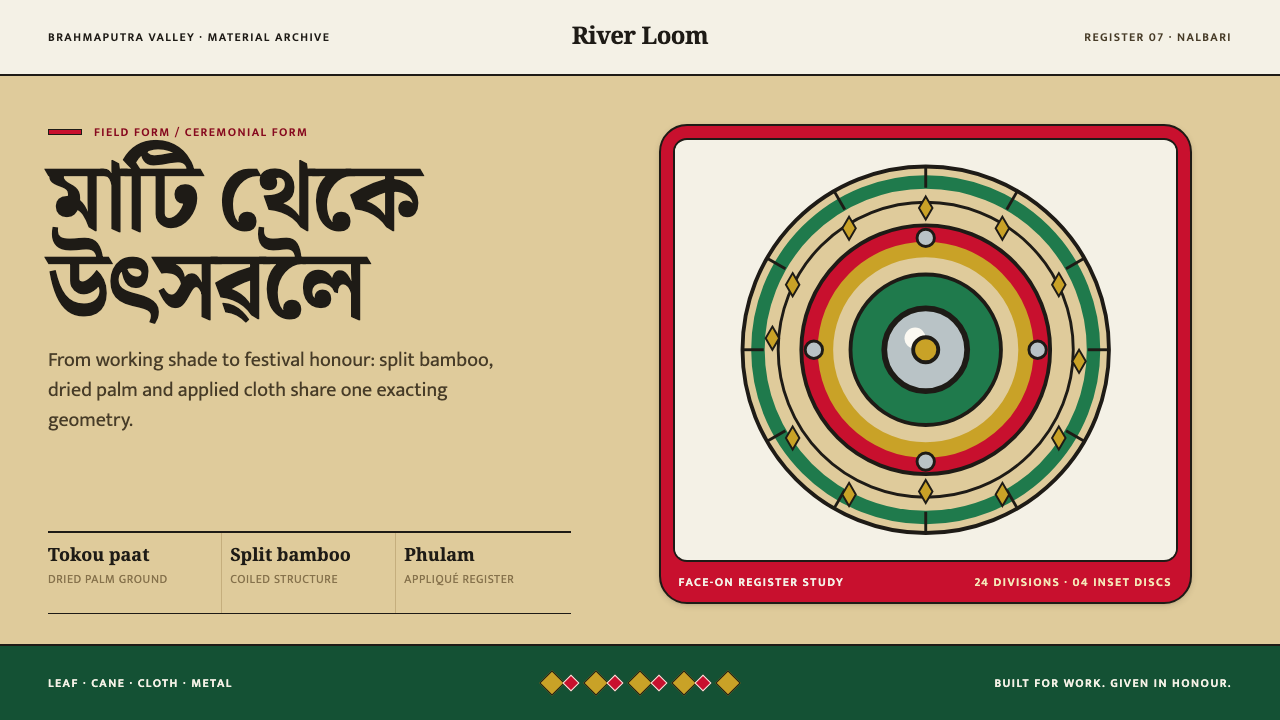 Assamese JapiWork becomes ceremony. Straw-gold rings carry green appliqué, festival red an…
 Basra ShanasheelClimate craft becomes ornament. Dark timber lattice projects over sun-paled I…
 Burmese Shan Thanaka (Bark Paste)Handmade warmth on dark bark. Thanaka cream roundels soften rose, jade, and g…
 Erzya PangaDensity is the ornament. Madder and black stepped stitches crowd unbleached l…