What is Persian Windcatcher?
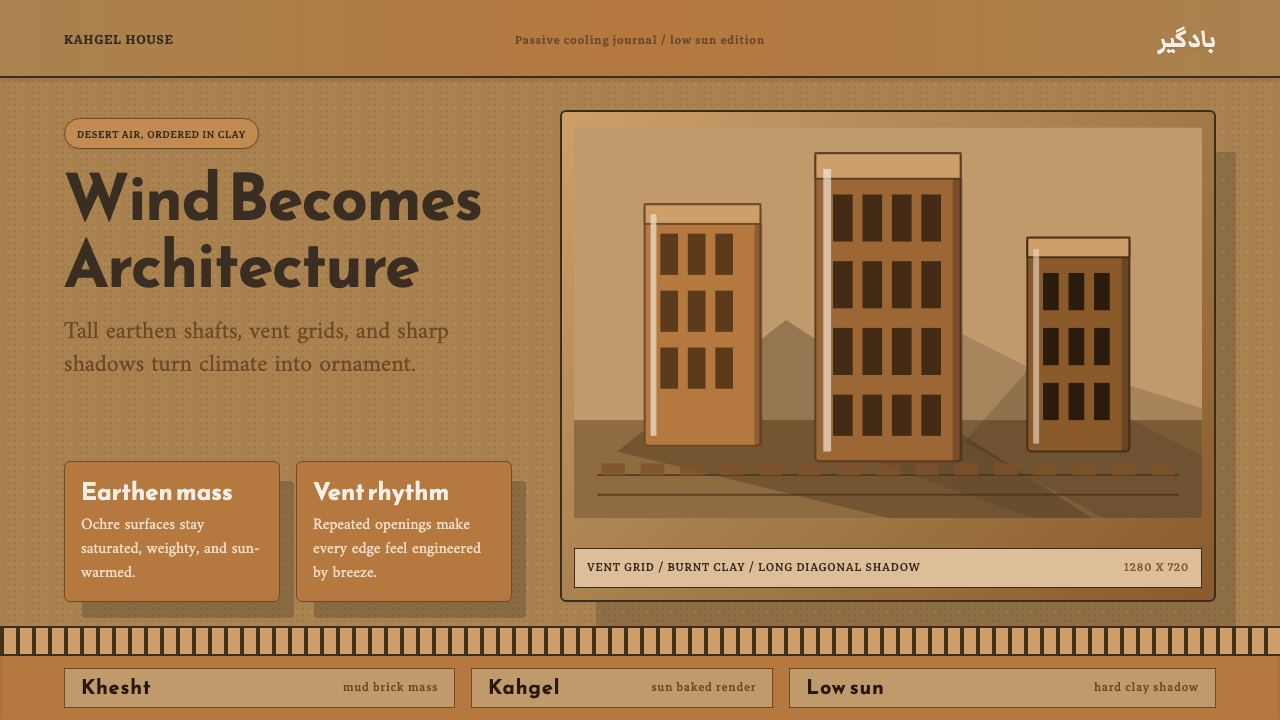
Persian Windcatcher turns a desert survival strategy into geometry — thick sun-baked clay, repeating vent grids, and hard shadows cast by a sun with nowhere to hide.
Persian Windcatcher in brief
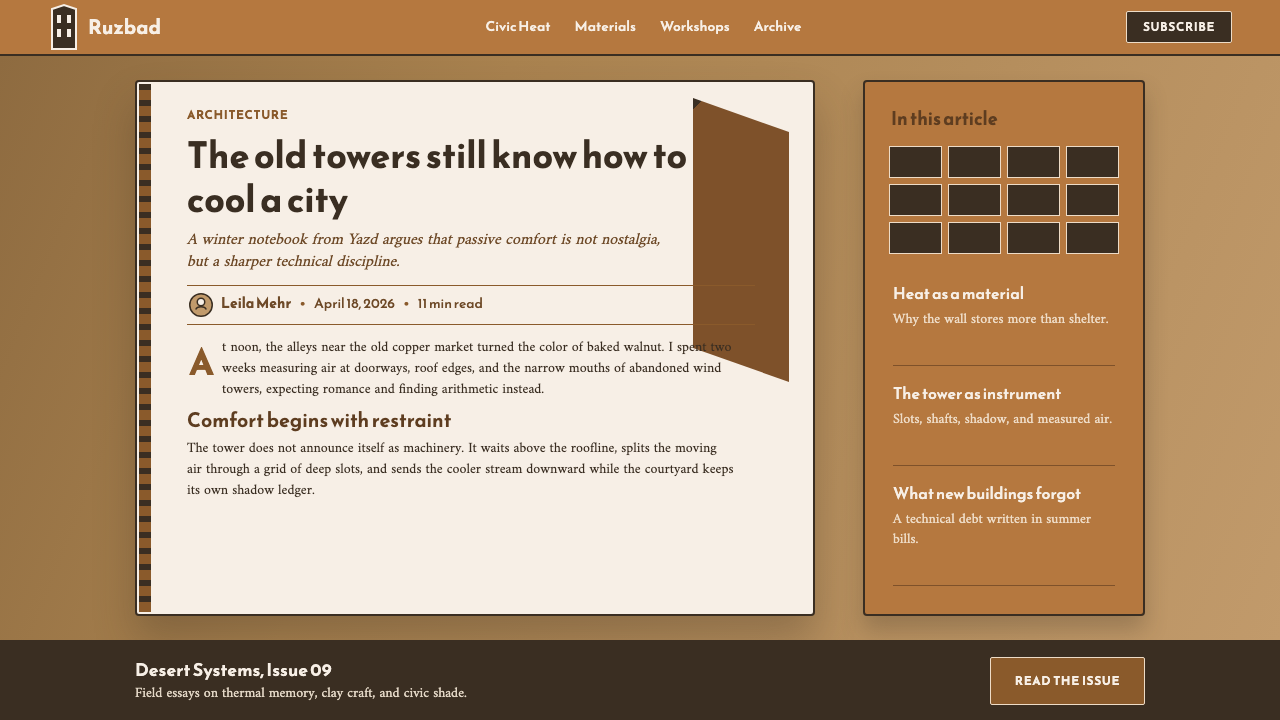
Persian Windcatcher is a design system drawn from the bâdgir — the towering passive-cooling structures found across the desert cities of the Iranian plateau, most famously Yazd, a city so dense with them it is often called the City of Windcatchers. A bâdgir is, functionally, a chimney in reverse: a tall shaft rising above a building's roofline, open to the sky, built to catch even a faint breeze and drive it down into the rooms below, while warm air inside is drawn up and out through the same structure.
Visually, the system is built from the material logic of the tower itself. The ground is not the pale sand one might expect from a desert palette, but a warm, saturated adobe clay — the color of sun-dried kahgel brick, glowing golden-brown when raked by low afternoon light. Surfaces are read as thick, load-bearing mass rather than thin decorative planes: heavy vertical towers, deeply recessed vent openings, and walls that feel built up by hand rather than drawn by a ruler.
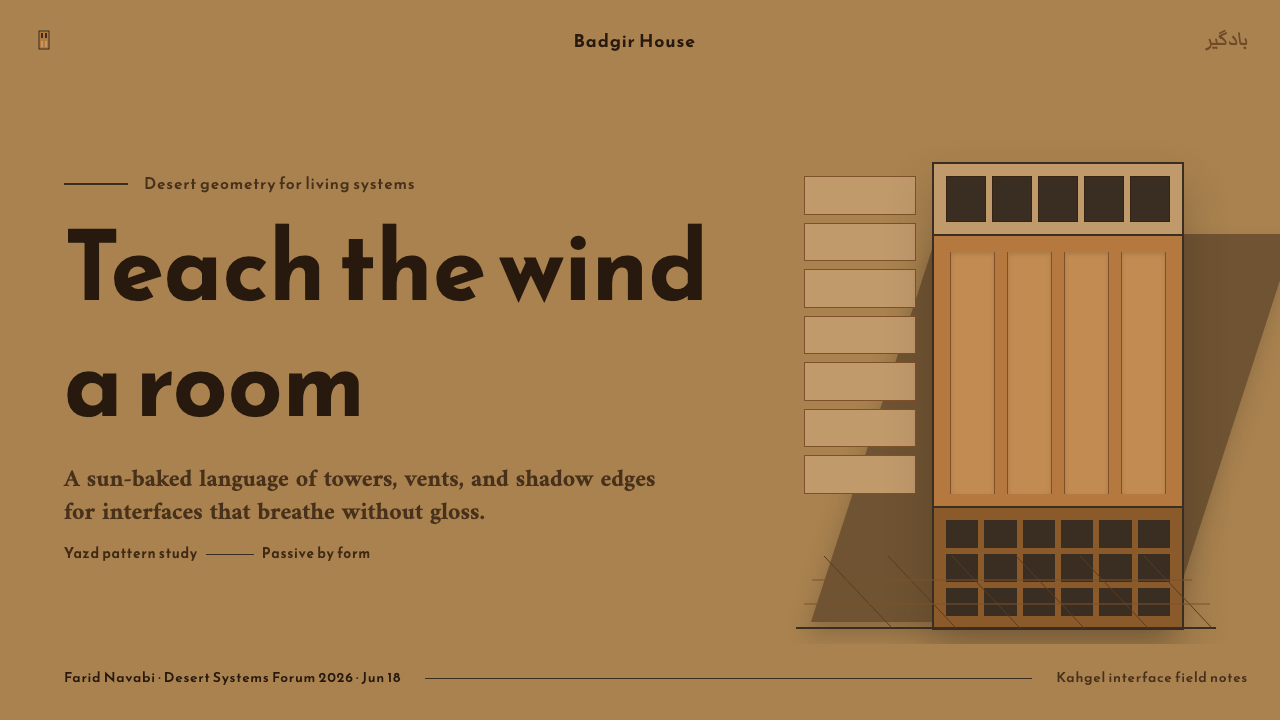
The defining visual event of the style is shadow. Because a bâdgir's power depends entirely on catching wind, its openings are geometric, repeating, and vertically stacked — and a desert sun at a low angle throws those repeating openings into long, sharp, parallel diagonal shadows across the tower face and the rooftop below. The system treats that shadow pattern as its primary ornament: an order that reads as both climate-driven and architectural at once.
Where does Persian Windcatcher come from?
The bâdgir belongs to a vernacular architectural tradition developed over centuries on the Iranian central plateau, in the ring of desert cities that includes Yazd, Kashan, and Kerman. These cities sit in one of the hottest, driest inhabited regions on earth, with almost no natural shade and summer temperatures that make unassisted indoor life unbearable. Long before mechanical air conditioning, local builders — known as memar, master-builders working within an inherited craft tradition rather than named individual architects in the modern sense — solved the cooling problem architecturally, using the physics of moving air rather than any external energy source.
The core material of this tradition is khesht, sun-dried mud brick, and the specific mixture known as kahgel — clay blended with straw and water, then dried in the sun rather than fired in a kiln. Kahgel walls are thick, which gives them enormous thermal mass: they absorb heat slowly through the day and release it slowly at night, keeping interiors many degrees cooler than the air outside. The bâdgir tower itself is built from the same material, its vent openings shaped to catch prevailing wind from whichever direction it happens to blow, sometimes with internal partitions dividing the shaft into separate channels for incoming and outgoing air.
Yazd's concentration of windcatchers — some rising well over the height of a modern multi-story building — made it a functioning laboratory for this technology for centuries, refined gradually rather than invented at a single point. The tallest and most elaborate examples, often attached to gardens, water reservoirs, or wealthy residences, sometimes worked in tandem with qanats — underground water channels bringing meltwater from distant mountains — so that air drawn down the tower passed over cool water or through a subterranean chamber before entering living spaces, compounding the cooling effect.
This tradition is now recognized, in Yazd's UNESCO World Heritage designation among other things, as one of the most complete surviving examples of pre-industrial climate-responsive design — architecture that solved an environmental problem entirely through geometry, material, and orientation, without a single moving part or external power source. That is the lineage this design system draws from: not ornament applied to a building, but a building whose ornament is its function made visible.
What defines the Persian Windcatcher look?
Color
The ground tone is warm, saturated adobe ochre — the color of sun-dried clay, not pale desert sand. It shifts golden-brown under low light and reads as a solid, massive material rather than a flat backdrop hue. Contrast comes from deep shadow rather than a second bright color.
Typography
Lettering draws on Reem Kufi, a contemporary geometric typeface with squared, architectural proportions that echo the tower's own vertical bays and vent grids. Letterforms sit heavy and structural rather than light and flowing, functioning as another block in the composition.
Vent Grid Geometry
Repeating rectangular or slotted vent openings, stacked in vertical rows, are the system's core structural motif. These grids are functional in origin — each opening exists to catch or release air — and the system preserves that logic, using the grid as a load-bearing organizing device rather than a decorative pattern applied after the fact.
Hard Directional Shadow
Shadow is long, sharp-edged, and strongly diagonal, cast by a low desert sun across repeating vent openings and tower faces. It is never soft or ambient. Shadow is the system's primary decorative device — where other styles add pattern, this one lets the sun draw it.
Massing and Thickness
Elements read as thick and load-bearing rather than thin and applied. Walls, towers, and frames should feel like they carry weight — deep reveals at openings, heavy corners, and a sense of built-up material rather than a printed or laser-cut surface.
Hand-Worked Texture
Surfaces carry the faint irregularity of sun-dried mud brick worked by hand rather than machine-cast concrete: slightly uneven edges, subtle variation in tone across a single wall plane, a sense of patient, repeated craft rather than mass production.

Who shaped Persian Windcatcher?
Yazd's skyline is defined by dozens of bâdgir towers rising above its old city, the densest surviving concentration of the form anywhere. Its inclusion on the UNESCO World Heritage list recognizes this as one of the most complete surviving examples of pre-industrial climate-responsive urban architecture.
The bâdgir tradition was refined not by named individual architects but by generations of memar working within an inherited craft — builders who passed down proportions, vent orientations, and material recipes as accumulated practical knowledge rather than published theory.
Kahgel — sun-dried clay mixed with straw — is the material foundation of the entire style. Its thermal mass, low cost, and local availability made large-scale passive cooling architecture possible across an entire region without imported materials or fuel.
In the most elaborate bâdgir installations, the tower worked alongside qanats — underground channels carrying meltwater from distant mountains — routing incoming air over cool water or through a subterranean chamber before it reached living spaces, compounding the cooling effect beyond what the tower alone could achieve.
How do you use Persian Windcatcher today?
Persian Windcatcher works best wherever a design needs to feel grounded, climate-honest, and architecturally serious rather than lightweight or ornamental. Applying it well starts from the same principle the original architecture followed: every visual element should earn its place by doing structural or functional work, with shadow and material texture carrying most of the visual interest rather than applied surface pattern.
On a presentation cover slide, a tall vertical block in adobe ochre, deeply recessed with a repeating vent-grid pattern and raked by a hard diagonal shadow, makes an immediately recognizable, weighty opener. Content slides should use the vent-grid rhythm as a literal layout grid — repeating vertical columns of similar width, punctuated by strong horizontal shadow lines rather than thin dividers. Data visualizations benefit from being rendered as if carved into the same material: bars and columns as extruded blocks with directional shadow rather than flat filled rectangles.
For web interfaces, the style suits products that want to communicate durability, regional authenticity, or sustainability — climate and energy dashboards are an especially natural fit given the architecture's original purpose. A dashboard can use the adobe ground tone as its base surface, vent-grid motifs as card borders or section dividers, and hard diagonal shadow as the primary depth cue instead of soft box-shadow blur. Pricing pages read well with tiers presented as separate 'towers' — vertical blocks of consistent width, differentiated by height or shadow intensity rather than color.
In editorial and marketing contexts, the style supports travel, heritage, and sustainable-design storytelling particularly well. Long-form articles benefit from generous vertical whitespace echoing the tower's own proportions, with pull-quotes or section breaks marked by a vent-grid motif rather than a decorative rule. Marketing pages can use the hard shadow motif directionally across a hero section to suggest time of day and place without needing photography.
A common mistake is treating this as a generic 'desert' or 'Middle Eastern' palette and defaulting to pale sand tones with soft, ambient lighting — this erases the two things that actually define the style: saturated, mass-like adobe color and hard, geometric, sun-cast shadow. Another frequent error is using the vent-grid pattern purely decoratively, scattered as texture, rather than as a structural grid that organizes the layout the way it organizes airflow in the original towers.
Persian Windcatcher — FAQ
Why is the ground color adobe ochre rather than pale sand?
Because the real material is sun-dried clay brick, not sand — kahgel is a saturated, warm-toned earth material that darkens and glows under low sunlight rather than staying pale and flat. Using a pale sand tone would describe a beach, not the architecture this system is drawn from.
What role does shadow play, and why is it always hard-edged?
Shadow is the system's primary ornament. Because the bâdgir's vent openings are geometric and repeating, and desert sunlight is strong and direct with almost no atmospheric haze to soften it, the resulting shadows are long, sharp, and parallel rather than soft or diffuse. Softening the shadow removes the visual signature the style depends on.
Is Reem Kufi historically accurate to Persian architecture?
Reem Kufi is a contemporary typeface, not a historical artifact — it is chosen for this system because its squared, geometric proportions visually echo the tower's own vertical bays and vent grids, not because it appeared on any historic bâdgir. Think of it as a typographic translation of the architecture's geometry rather than a literal historical reference.
Does this style suit dark-mode interfaces?
It can, but carefully. The historic palette is fundamentally daylight-driven — its identity comes from strong sun and warm clay, not from darkness. A dark-mode variant should keep the saturated adobe tone as its accent or structural color against a deep neutral ground, and preserve hard, directional shadow logic rather than switching to soft ambient glow, which belongs to a different visual language entirely.
What's a common mistake when applying this style to a product?
Treating the vent-grid motif as surface decoration rather than structure. In the original architecture, every vent opening exists because it does functional work — catching or releasing air. If the grid is scattered as background texture instead of used as the layout's actual organizing structure, the design loses the logic that makes the style feel authentic rather than merely 'desert-themed.'
Related design styles
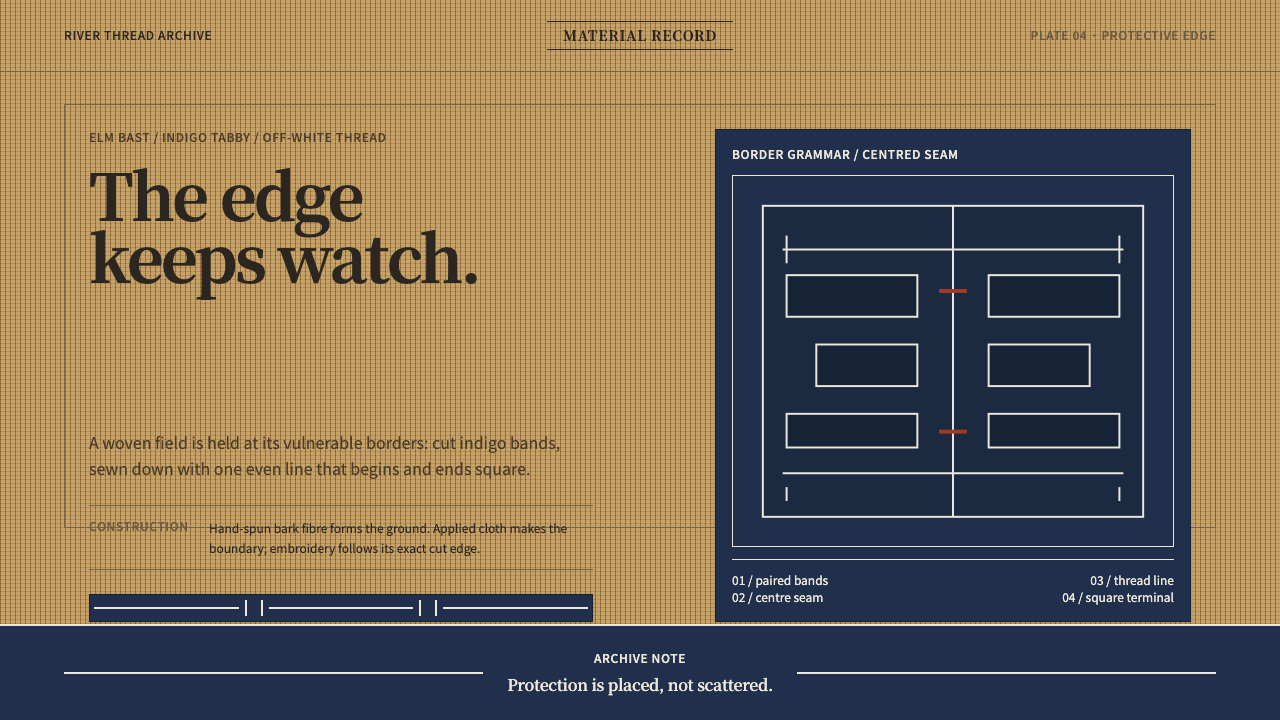 Ainu Attus RobeProtection is cut, not painted. Indigo bands and square-ended thread hold elm…
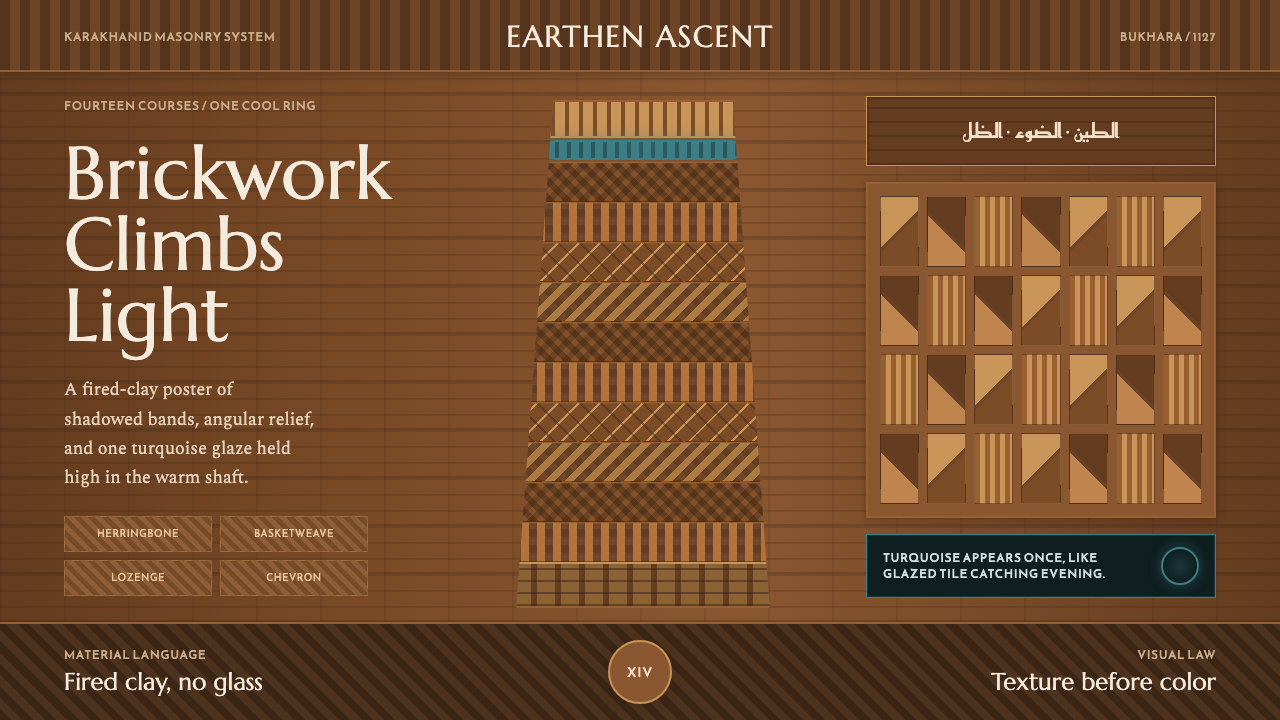 Bukhara Kalon Minaret BrickworkMonumental warmth. Ochre brick bands climb toward one turquoise ring.
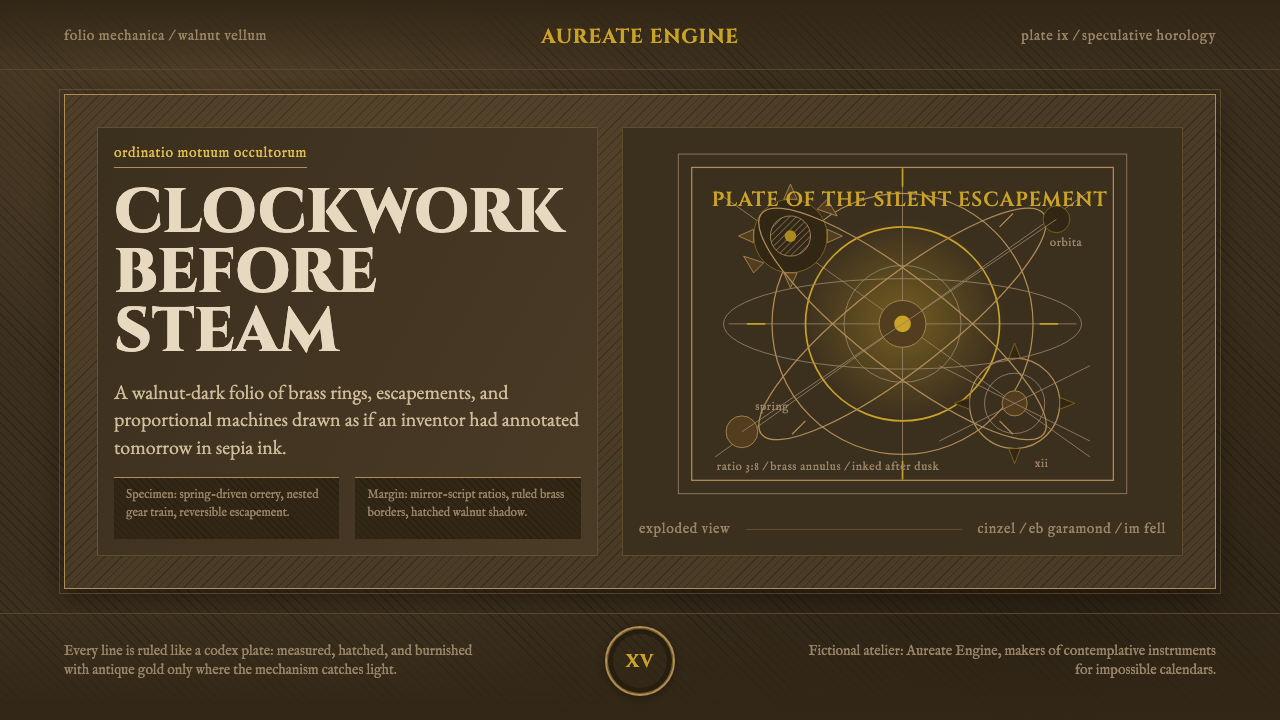 ClockpunkInventive antiquity. Walnut vellum, Cinzel capitals, brass orrery rings, and…
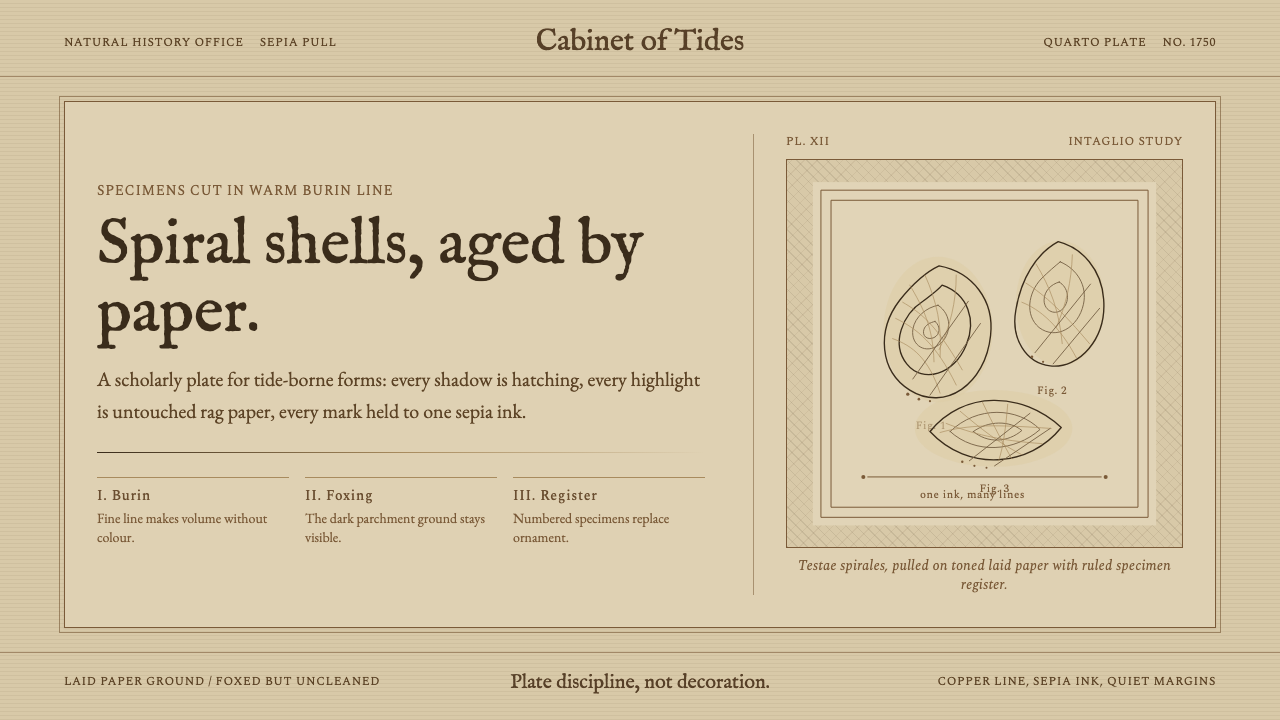 Conchology Shell PlateAged paper is the hero. Sepia Fell type and burin spirals make science feel a…
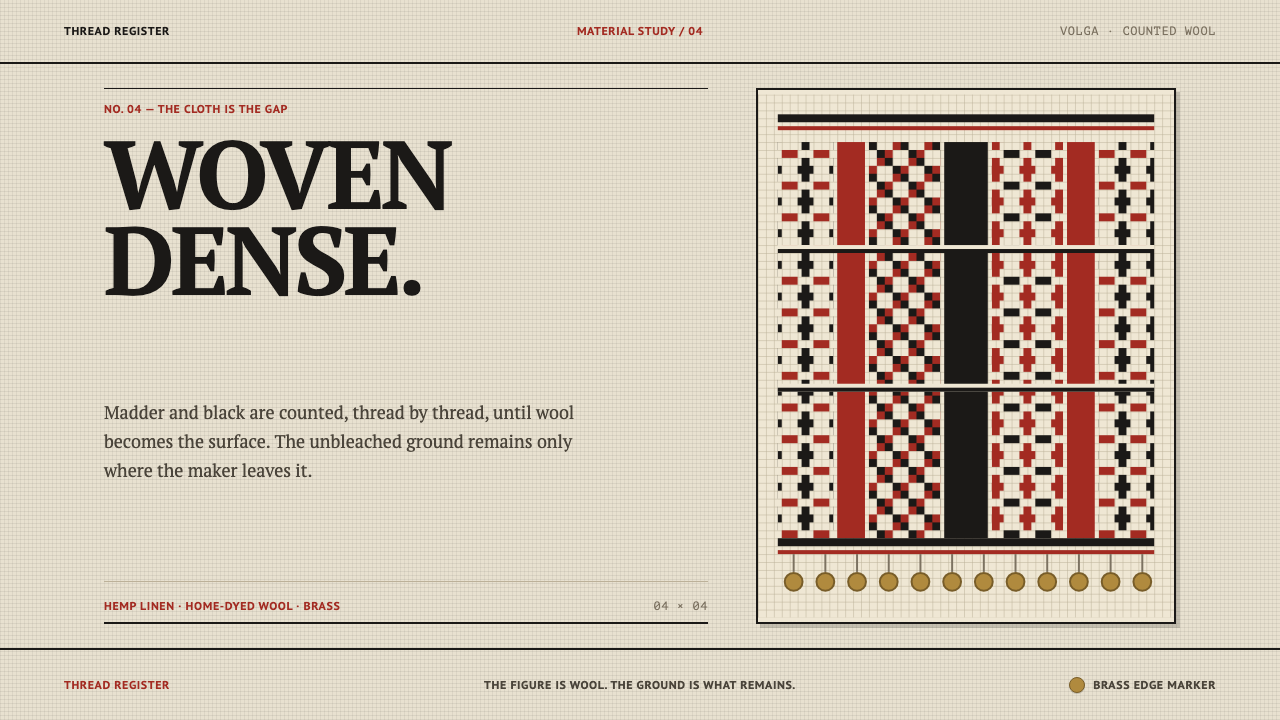 Erzya PangaDensity is the ornament. Madder and black stepped stitches crowd unbleached l…
 Fijian Masi Tapa StencilGeometry keeps ceremony. Soot-black diamonds repeat on bark beige with rust-r…