What is Cottagecore?
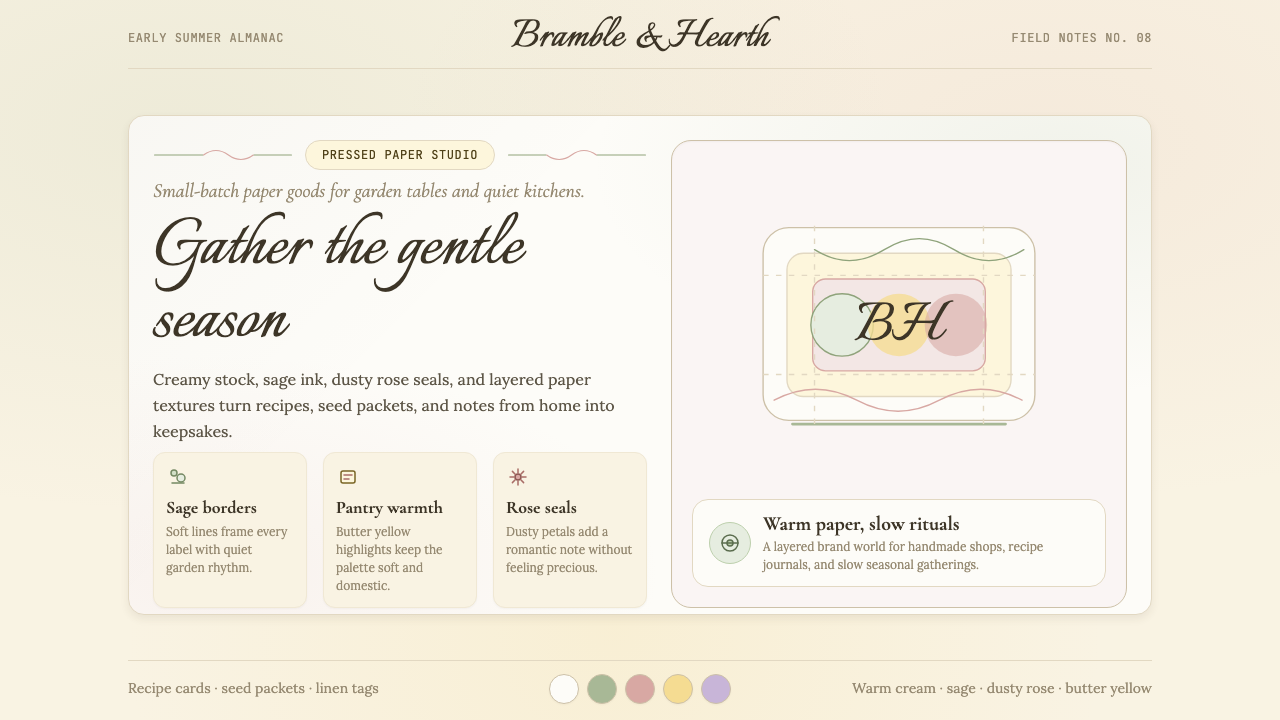
Cottagecore turns the pre-industrial countryside into a design language — warm cream grounds, pressed-flower borders, hand-script type, and the unhurried beauty of things made by hand.
Cottagecore in brief
Cottagecore is an internet-native aesthetic that romanticizes rural, pre-industrial life — herb gardens, wildflower meadows, linen aprons, candlelit kitchens, and the slow, deliberate pace of homesteading. As a design system it translates that pastoral warmth into a coherent visual vocabulary: warm cream and off-white backgrounds, a palette drawn from sage greens, dusty roses, muted lavenders and soft ochres, generous rounded corners, serif body type set in a relaxed measure, and hand-script accents that feel personally inscribed rather than typeset.
What distinguishes Cottagecore from broader vintage or botanical aesthetics is its emotional posture. The style is not nostalgic in a sentimental, backward-looking way — it is aspirational. It imagines a version of rural simplicity that is warm, abundant, and unhurried, borrowing selectively from Romanticism, the Arts and Crafts movement, and the illustrated worlds of Beatrix Potter and early-twentieth-century nature writing. Texture is central: linen weaves, watercolor washes, pressed-flower overlays, and paper-grain backgrounds all work to suggest the handmade over the machine-manufactured.
In practical terms, Cottagecore design is defined by softness at every level. Corners round rather than square off. Type sits in generous leading. Illustrative botanical motifs — sprigs of chamomile, fern fronds, wildflower clusters — serve as structural dividers and decorative borders. Color never shouts; it blooms slowly across a warm, slightly muted ground. The overall effect is one of intimate legibility rather than arresting contrast, of being welcomed into a space rather than confronted by it.

Where does Cottagecore come from?
Cottagecore as a named aesthetic crystallized on Tumblr around 2018, when communities of users began tagging posts of rural imagery, cottage interiors, foraging photography, and hand-crafted objects under a shared sensibility. The word itself fuses the English domestic ideal of the cottage — small, garden-surrounded, impractical by modern standards but emotionally resonant — with the internet suffix '-core' that signals a fully committed subculture. Unlike many internet micro-aesthetics that vanish within months, Cottagecore had roots deep enough in existing cultural formations to outlast its initial Tumblr moment.
Those roots run through Romanticism, which in the late eighteenth and early nineteenth centuries elevated rural life as a moral and spiritual corrective to industrialization. The British Romantics — Wordsworth walking the Lake District, Keats writing in the garden — established the template of the countryside as a site of authentic feeling. The Arts and Crafts movement of the 1880s and 1890s, led by William Morris and his contemporaries, translated that Romantic longing into material practice: handwoven textiles, hand-printed wallpapers with botanical motifs, furniture made by craftsmen who knew the name of the wood. These movements established the visual and ethical vocabulary that Cottagecore would later digitize.
The aesthetic also draws directly from a tradition of illustrated nature writing and children's literature. Beatrix Potter's watercolors — rendered with meticulous botanical accuracy and suffused with the warmth of a English Lake District cottage — established a visual grammar of small animals in domestic settings, herbs and wildflowers as supporting cast, and handmade domestic objects treated with affectionate attention. L.M. Montgomery's Anne of Green Gables built a comparable literary world, one in which the observation of natural beauty — morning light on an orchard, a field of violets — is itself a form of moral and aesthetic education. These works provided Cottagecore with ready-made reference points that felt both personal and culturally legible.
In 2020, the COVID-19 pandemic lockdowns gave the aesthetic its mass-cultural moment. Confined to cities and suburban interiors, millions of people found in Cottagecore an idealized counter-image: a life of homemade bread, kitchen gardens, and unhurried afternoons. Taylor Swift's surprise album Folklore, released in July 2020, reinforced the moment — its cabin-in-the-woods imagery, hand-lettered aesthetic, and wistful pastoral themes aligned so naturally with the Cottagecore sensibility that the two became culturally entangled. By the time lockdowns lifted, Cottagecore had established itself not just as an internet aesthetic but as a commercially viable visual language, appearing in brand identity work, packaging design, editorial illustration, and web UI across a range of industries.
What defines the Cottagecore look?
Color Palette
The Cottagecore palette is built on warmth and restraint rather than saturation and contrast. Backgrounds are warm cream, parchment, or soft off-white — never stark white. The accent colors are drawn from a muted garden: sage green, dusty rose, soft lavender, faded ochre, and warm terracotta. These are colors that appear to have aged gently in sunlight — never fully vivid, always slightly desaturated, as though seen through gauze or watercolor wash. Deep, dark tones like forest green or warm chocolate brown anchor the composition when needed, but never dominate. The palette is generous but never loud.
Typography
Cottagecore typography pairs a warm, humanist serif for body text with a flowing hand-script for accents, headings, and decorative labels. The serif should feel like it belongs in a nineteenth-century botanical journal — slightly condensed, with bracketed serifs and moderate stroke contrast that recalls letterpress printing. The hand-script element is crucial: it signals personal inscription, the note passed through a garden gate, the recipe written in a grandmother's hand. Type is set with generous leading and comfortable measure, never compressed. All-caps settings are used sparingly and with wide letter-spacing, suggesting an embossed label or a dried-herb sachet tag rather than a shout.
Botanical Illustration
Botanical motifs are the signature visual element of Cottagecore design — not as mere decoration but as a structural vocabulary. Sprigs of chamomile, lavender stems, fern fronds, pressed flower silhouettes, clusters of wild berries, and trailing ivy serve as dividers, borders, corner ornaments, and background texture. The illustrative style references nineteenth-century scientific botanical engraving: accurate in its observation, delicate in its line work, but rendered with the warmth of hand-drawing rather than the precision of mechanical reproduction. Watercolor washes behind or around these illustrations add depth and the suggestion of natural variation.
Texture and Surface
Cottagecore design consistently implies physical texture even in purely digital contexts. Linen-weave grain overlays soften backgrounds that would otherwise read as flat. Paper textures give backgrounds the depth of aged stock. Watercolor bleed effects at the edges of color blocks suggest hand-applied pigment. These textural layers are never so prominent that they obscure legibility — they operate subtly, as atmosphere rather than substance. The cumulative effect is that the design feels tactile and materially warm, as though it could be touched and would yield slightly to the touch.
Softness and Roundness
Hard edges are largely absent from Cottagecore design. Corners are generously rounded on containers, cards, and buttons. Borders, when present, are thin and often dashed or dotted in a way that suggests a stitched seam rather than a printed rule. Shapes — badges, tags, frames — tend toward the oval and the wreath rather than the rectangle. Even photographic imagery, when used, benefits from soft vignetting at the edges that blurs the frame's boundary. This pervasive softness communicates approachability, gentleness, and the organic irregularity of natural forms over the imposed regularity of manufactured ones.
Handmade Warmth
Cottagecore actively resists the appearance of perfection. Slight variations in line weight, irregular botanical silhouettes, type that sits with a gentle imprecision rather than machine-tight registration, watercolor fills that bleed slightly beyond their outlines — these imperfections are not failures of craft but evidence of hand. A perfectly mechanically rendered Cottagecore composition misses the point entirely; the warmth of the aesthetic depends on signals that a human being, not a machine, made these marks. This is the design equivalent of a hand-stitched hem or a handwritten address on an envelope: the imprecision is the intimacy.
Narrative and Quietude
More than most design aesthetics, Cottagecore tells a small story in every composition. A label suggests the jar it belongs on; a card header suggests the letter it introduces; a recipe illustration suggests the kitchen it was drawn in. This narrative quality is achieved through the accumulation of detail — the botanical sprig in the corner, the hand-script subtitle, the warm cream ground that implies afternoon light rather than studio lighting — rather than through explicit illustration. The effect is one of quietude: the design is not trying to arrest attention but to sustain it, to reward the reader who lingers.

Who shaped Cottagecore?
Potter is the single most important visual reference for Cottagecore design. Her watercolor illustrations — created between the 1890s and 1940s, initially for her own entertainment and later published as picture books for children — combined meticulous scientific accuracy in the rendering of plants, fungi, and animals with a warmth of domestic setting that placed those natural subjects in recognizably human contexts. Her palette of sage greens, dusty blues, and warm ochres; her use of botanical specimens as background and framing devices; and her integration of hand-lettered text into illustrated pages all established templates that Cottagecore designers continue to reference.
Swift's 2020 album Folklore and its companion record Evermore catalyzed Cottagecore's transition from an internet subculture to a mainstream aesthetic moment. Released during COVID-19 lockdowns, the albums' visual identity — hand-lettered typography on rough natural paper, cabin-in-the-woods photography by Beth Garrabrant, a palette of warm grays and forest greens, and wistful, pastoral lyrical themes — aligned precisely with the Cottagecore sensibility at the moment when millions of people were seeking that exact imaginative escape. The albums demonstrated that the aesthetic could operate at full commercial scale without losing its sense of intimacy.
Miyazaki's films — particularly My Neighbor Totoro (1988), Kiki's Delivery Service (1989), and Nausicaä of the Valley of the Wind (1984) — created a visual and emotional grammar of pastoral warmth that has deeply shaped Cottagecore's sensibility. The detailed rendering of domestic interiors filled with handmade objects, the treatment of natural landscapes as alive and morally significant, the palette of warm greens and earth tones, and the recurring figure of the self-sufficient young woman in a rural setting are all Miyazaki signatures that Cottagecore imagery consistently echoes.
Montgomery's Anne of Green Gables (1908) and its sequels established a literary template for Cottagecore's emotional register: the intense, almost devotional observation of natural beauty as a form of daily spiritual practice; the transformative power of a domestic space made beautiful and personally meaningful; and the social value of handcraft, homemaking, and the sharing of food. Montgomery's prose — rich with the sensory details of Prince Edward Island's landscape, seasons, and domestic life — gave Cottagecore much of its characteristic vocabulary of longing, belonging, and the small sacredness of ordinary beautiful things.
Morris, the central figure of the British Arts and Crafts movement (1880s–1900s), established the moral and aesthetic framework that Cottagecore unconsciously inherits. His argument — that industrialization had degraded both the objects people lived with and the workers who made them, and that the remedy lay in handcraft, natural materials, and designs drawn from the organic forms of plants and animals — reads like a nineteenth-century manifesto for many Cottagecore values. Morris's textile and wallpaper patterns, with their dense interlocking botanical motifs in warm, slightly muted colorways, remain among the most direct visual ancestors of the Cottagecore design language.
How do you use Cottagecore today?
Cottagecore is one of the most context-specific aesthetics in contemporary design — its warmth and intimacy are powerful assets in the right setting and liabilities in the wrong one. Before applying it, the key question is whether the product or communication benefits from feeling personal, handcrafted, and gentle rather than authoritative, precise, or corporate. Food and beverage brands, wellness and self-care products, stationery and journaling tools, independent retail, herbal and botanical categories, and any platform oriented toward slow living, crafting, or domestic creativity are natural homes for the style. Enterprise software, financial services, and platforms where technical authority matters are not.
For presentation slides, Cottagecore works best when the subject itself has warmth — a brand story, a creative pitch, an editorial proposal, or an educational overview of something people genuinely care about. A cover slide benefits from a single strong botanical illustration centered or set asymmetrically, a hand-script title, and a warm cream ground. Content slides should be clean enough to be legible at a distance: two or three text levels differentiated by size and weight rather than color, botanical motifs used as section headers or margin ornaments rather than scattered throughout. Data slides can incorporate the palette without sacrificing clarity — soft sage bars on a cream ground, with a single warm accent for the featured data point — but avoid overlaying texture on charts, where legibility must come first.
For web and digital interfaces, the style suits e-commerce storefronts, editorial blogs, portfolio sites, booking platforms for small artisan businesses, and wellness or subscription platforms where brand warmth is a differentiator. The practical approach: use a warm off-white as the base background, restrict primary interactions to one botanical-palette accent color used consistently, set body text in a humanist serif with generous leading, and reserve hand-script for display headings and decorative labels only. UI components should have noticeably rounded corners, light borders rather than heavy shadows, and subtle paper or linen texture overlays on cards and panels. Navigation should be understated — small, well-spaced, in the same humanist serif as body text — allowing the illustrative content to carry visual weight.
For editorial and marketing work, Cottagecore supports long-form content particularly well. An article layout that uses a slightly narrowed measure for body text, botanical drop-caps or section ornaments, a pull-quote set in hand-script, and a warm-toned hero photograph with a soft vignette at the edges will feel cohesive and distinctively atmospheric. Marketing campaigns benefit from the style's poster quality: a single strong botanical illustration paired with a confident hand-script headline on a warm ground reads clearly at any scale, from a social card to a printed broadside. Packaging design is perhaps the style's strongest application — labels for preserves, teas, candles, skincare, and dried herbs are natural fits, as are gift wrap patterns and stationery suites.
The most common mistake when applying Cottagecore is mistaking abundance for clutter. The style's warmth comes from the accumulation of carefully chosen details — the right sprig in the right corner — not from covering every surface with botanical elements. A Cottagecore composition should have breathing room: generous margins, deliberate white space (or, more accurately, warm-cream space) around type, and botanical motifs used as punctuation rather than wallpaper. A related mistake is choosing typefaces that are excessively ornate or difficult to read — the hand-script element should feel warm and personal, not illegible. Test all type at small sizes and against the textured backgrounds you intend to use before committing.

Cottagecore — FAQ
Is Cottagecore the same as a vintage or rustic aesthetic?
They overlap but are distinct. Vintage aesthetics draw broadly from any past era and often lean into the specific visual codes of that era — mid-century typography, Art Nouveau ornament, Victorian print conventions. Rustic aesthetics tend toward raw, unfinished surfaces, bold natural materials, and a roughness that reads as authentically rural. Cottagecore is more selective and more aspirational: it curates a soft, idealized version of pre-industrial rural life, with an emphasis on botanical nature, handcraft, gentleness, and domestic abundance. Where rustic is rough, Cottagecore is delicate. Where vintage references a specific historical period, Cottagecore blurs history into a timeless pastoral fantasy.
Can Cottagecore work in a digital product beyond marketing surfaces?
Yes, but it requires care in distinguishing decorative from functional elements. The botanical illustrations, textured backgrounds, and hand-script typography that define the style can apply richly to marketing pages, onboarding flows, and editorial surfaces within an app. For core functional UI — forms, data tables, navigation, input states — the style must simplify: warm palette, rounded corners, and humanist serif type can carry the aesthetic without texture overlays or illustrative decoration that would impede task completion. Think of it as a gradient of application: full Cottagecore on hero and marketing surfaces, distilled Cottagecore warmth on functional screens. The transition should feel seamless rather than jarring.
How do I stop Cottagecore from looking overdone or clichéd?
The style's worst versions pile every signifier simultaneously — hand-script on every heading, botanical borders on every element, paper texture on every surface, muted palettes pushed into muddy territory. The antidote is restraint and hierarchy. Commit to one or two signature elements that will define this particular application of the style — perhaps a botanical border system and a hand-script display typeface, with everything else simplified — and let those elements carry the aesthetic weight. Resist the impulse to add more; Cottagecore's warmth comes from selective accumulation, not comprehensive decoration. Using the palette with confidence also helps: a small number of genuinely warm, well-matched colors beats a wide range of imprecisely muted ones.
Does Cottagecore work for dark-mode or dark-background designs?
It is possible but unusual, and it requires rethinking the palette entirely. The canonical Cottagecore palette is built around warm light grounds — the warmth and softness of the aesthetic depends heavily on the luminosity of that cream or parchment background. A dark inversion tends to shift the mood from warm and inviting to something more gothic or moody — which can work for specific applications like a dark-season editorial or a night-market brand, but is no longer purely Cottagecore. If a dark variant is needed, anchor it with deep forest green or warm deep brown rather than cold black, keep the botanical and hand-script elements, and use a much lighter and more selective hand with texture overlays.
What distinguishes authentic Cottagecore from a surface-level imitation?
The distinction is usually legible in the botanical illustration quality and in the typographic choices. Authentic Cottagecore treats botanical motifs as a craft tradition — the illustration style references scientific botanical engraving, each plant is rendered with some specificity and care, the placement is considered rather than scattered. Surface imitations tend to use generic floral clip-art applied at random, with no internal logic to the botanical vocabulary. On the typographic side, the pairing of a genuinely warm humanist serif with a hand-script that has real calligraphic DNA is what elevates the style; substituting generic rounded fonts for both degrades it to a craft-store greeting card. The quality of the warmth — specific, considered, rooted in actual reference — is what separates the thing from the simulacrum.
Related design styles
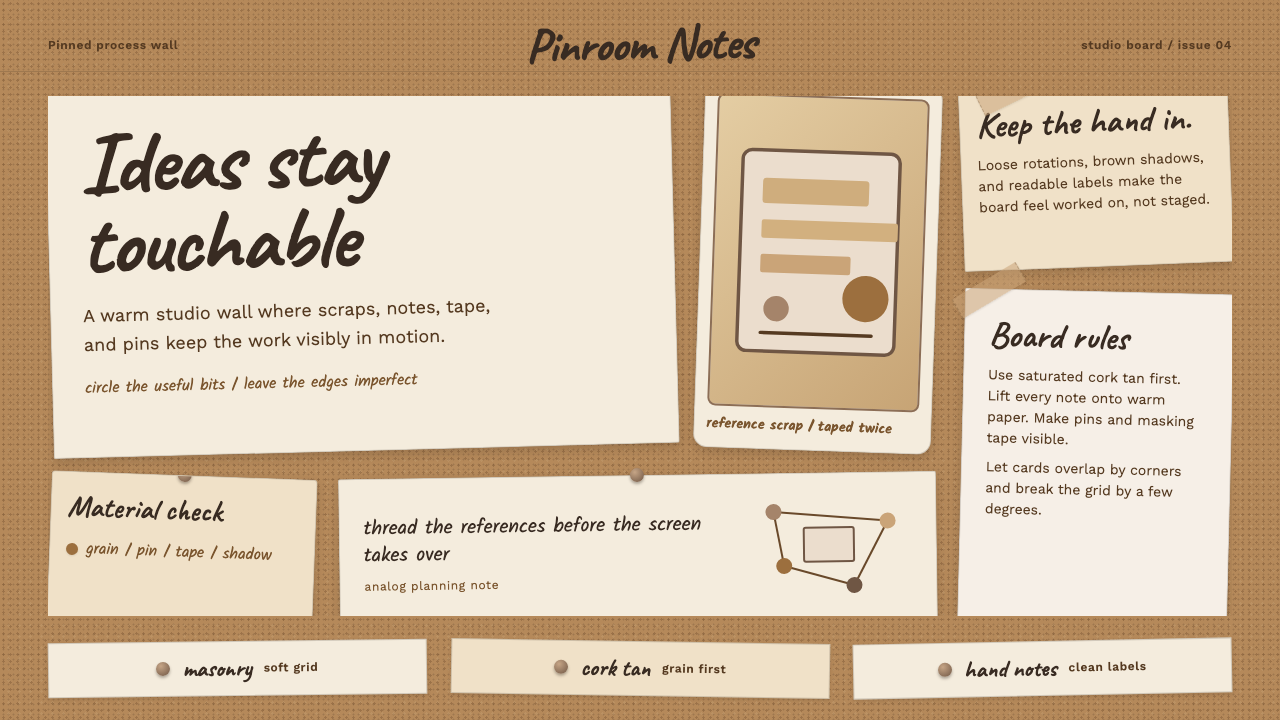 Cork Board StudioWarm ideas stay tactile. Cork tan, Caveat handwriting, pinned paper, and tape…
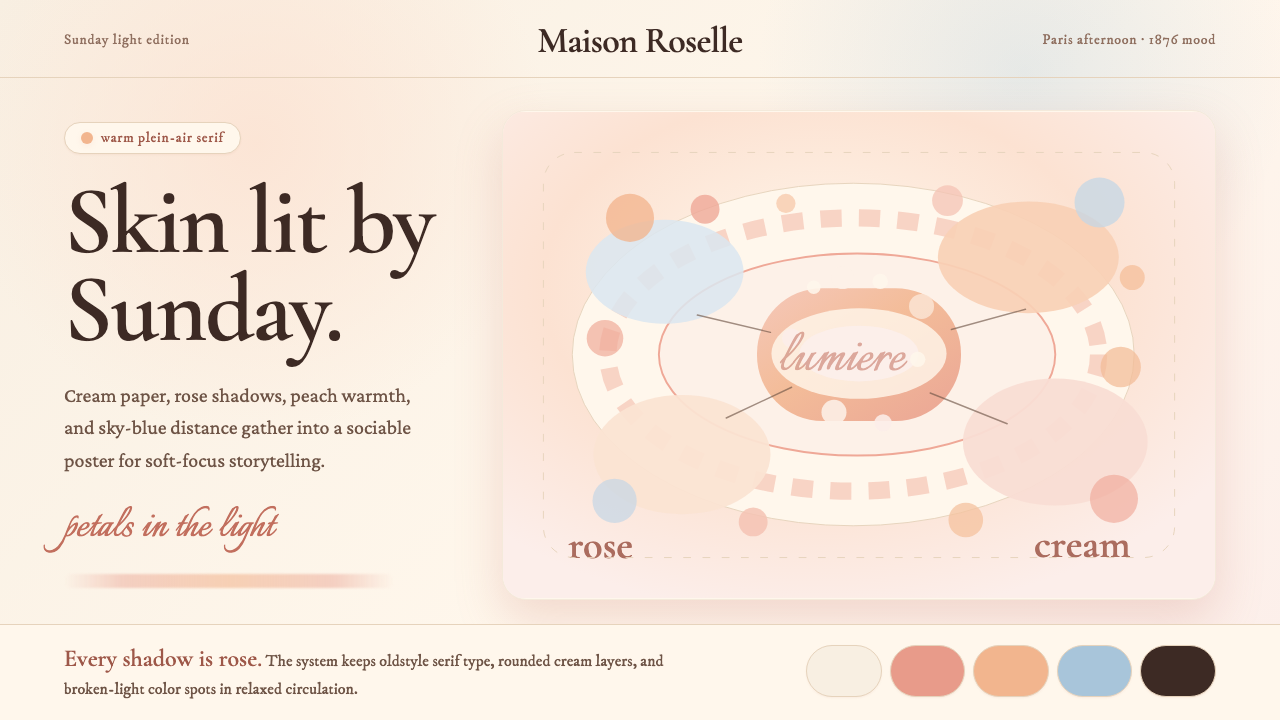 Renoir ImpressionismWarmth refuses haste. Rose shadows and Cormorant curves drift across cream.
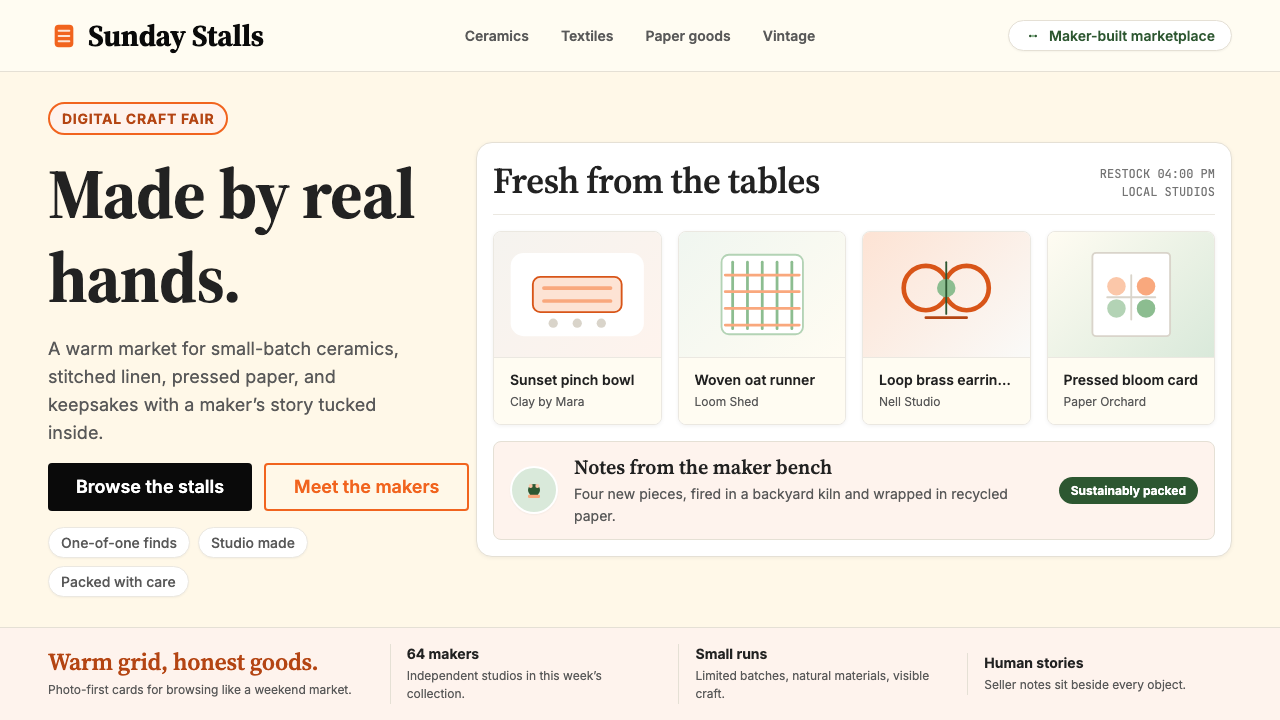 Etsy HandmadeA digital craft fair, in orange. Hand-drawn accents, cream backgrounds, delib…
 Light AcademiaScholarship turns sunlit. Cream linen, honey gold, sage botanicals, and roman…
 Romantic AcademiaScholarship turns tender. Dusty rose and lavender frame ink-on-cream poetry w…
 Solarpunk GreenhouseA grown future, not a sterile one. Deep canopy green, solar gold, and glassy…