What is Irish Aran Island Cable Knit?
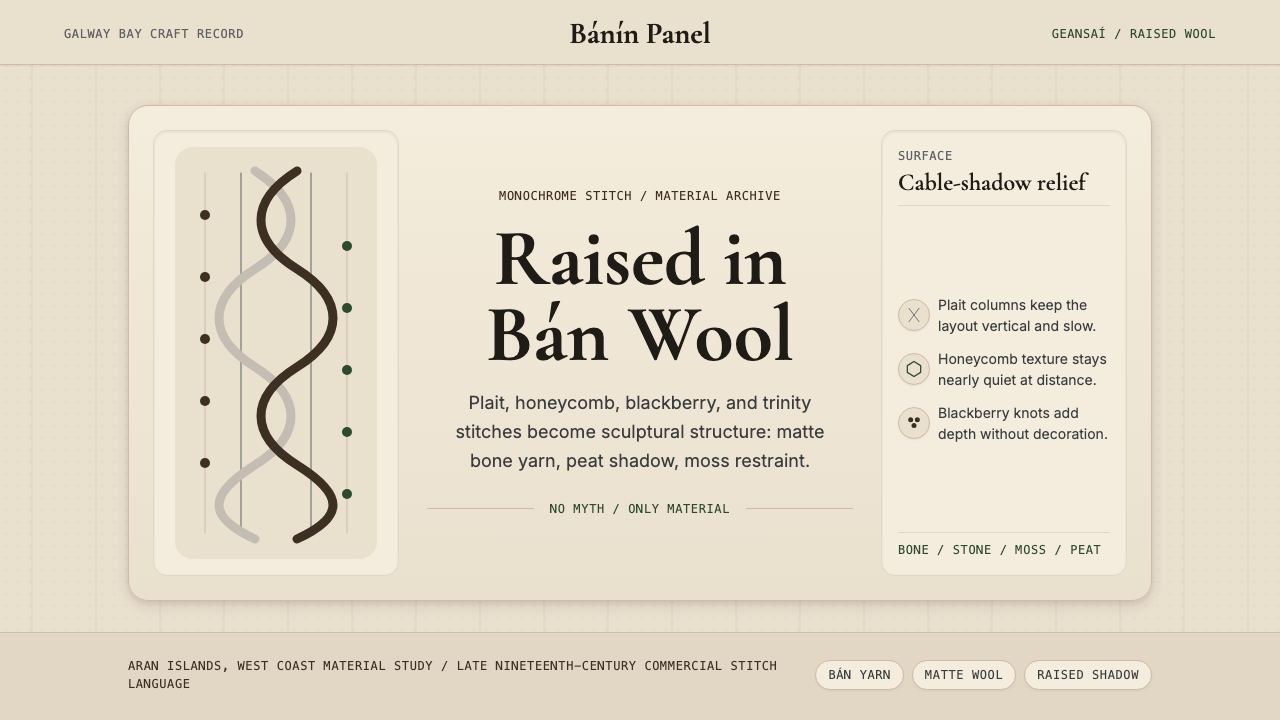
Born from Atlantic wool and islanders' hands, Irish Aran cable knit transforms the act of weaving into a three-dimensional visual language of raised texture, quiet shadow, and material honesty.
Irish Aran Island Cable Knit in brief
Irish Aran Island cable knit is a textile tradition from the three small islands — Inis Mór, Inis Meáin, and Inis Oírr — perched at the mouth of Galway Bay on Ireland's rugged Atlantic coast. It transforms undyed cream or off-white wool, called bánín, into sculpted fabric through interlocking stitch families: cable twists that mimic rope, honeycomb cells that echo beehive geometry, blackberry clusters that read as dense nodes, and trinity stitches that repeat in tight triangular rhythm. The result is a surface with genuine topography — not a pattern printed on cloth, but depth pressed outward through the labor of two needles.
As a design system, Aran cable knit operates on principles of structured repetition and tactile depth. Every visual element references the physical act of knitting: borders read like bound edges, column structures mirror the vertical run of a cable repeat, and surface variation is achieved not by changing color but by changing stitch — shifting from a raised cable to a recessed purl ground, from tight braid to open lattice. The palette is intentionally monochrome, drawn from the five natural colors that undyed Atlantic wool and the island landscape provide: bone white, warm oat, muted sage, soft peat brown, and slate grey. No dye, no ornament added from outside the material itself.
This design language values restraint and textural richness equally. Where other traditions reach for color contrast or geometric boldness, Aran knit achieves visual complexity entirely through surface modulation — the way a stitch catches or releases light, the depth of a cable shadow, the rhythm of a repeat at scale. The effect is quiet, deeply craft-rooted, and carries an unmistakable sense of handmade labor that mass reproduction can approximate but never fully erase.
Where does Irish Aran Island Cable Knit come from?
The Aran Islands are three limestone outcroppings swept by Atlantic gales, separated from the Connemara coast by a narrow but often treacherous strait. For the small fishing and farming communities who made their lives there, wool was not a luxury — it was structural material. Fishermen's ganseys (tight-knit work jerseys) were worn at sea not for their appearance but for their warmth, water resistance, and durability under physical strain. The intricate stitch patterns that became commercially recognized as distinctly 'Aran' emerged gradually from this functional base, with knitters on each island, and even each family, developing particular pattern combinations as signature vocabulary. The craft existed in the community long before it became internationally visible.
The story of Aran as a recognizable global style is inseparable from two external forces that arrived in the twentieth century. The first was Robert Flaherty's 1934 documentary film Man of Aran, which brought the islands' austere life — and the distinctive knitwear worn on screen — to international audiences. The film's visual power, however romanticized, fixed the image of the cable-knit sweater as an emblem of rugged Atlantic identity. The second force was Heinz Kiewe, an Oxford-based textile historian who in his 1967 book The Sacred History of Knitting made the romantic and largely unsubstantiated claim that specific cable patterns carried codified family meanings — that a cable represented a fisherman's rope, a diamond pattern his fields, a honeycomb the bees of a good harvest. Though historians have since challenged this reading as largely invented folklore, the story proved commercially irresistible and became embedded in how Aran knitwear was marketed worldwide.
The commercial emergence of Aran knitwear as an export product gathered force from the late nineteenth century onward, particularly through the Congested Districts Board, a British agency tasked with developing cottage industries in Ireland's most economically marginal western regions. Women on the islands were organized into cooperative knitting groups and paid for their output, which was then sold to buyers in Dublin and London. This economic structure ensured the tradition's survival through periods when emigration might otherwise have hollowed out the skilled knitting population entirely.
The revival of Aran craft in a contemporary design register is most closely associated with the Inis Meáin Knitting Company, founded on the middle island in 1976 by Tarlach de Blacam and his wife Áine. Rather than marketing Aran knitwear as heritage souvenir, de Blacam repositioned it as slow luxury — island-made, naturally dyed where color was used, and designed to be worn by people who valued craft quality and material origin over fashion novelty. The company's aesthetic approach influenced a broader international conversation about the meaning of artisan textiles and authentic place-based production, and remains the defining contemporary authority on what Aran as a design and craft tradition can be outside its historical context.
What defines the Irish Aran Island Cable Knit look?
Cable and Rope Structures
The defining characteristic of Aran design is the cable column: groups of stitches that are periodically crossed over each other to produce a twisted, rope-like braid standing above the fabric surface. Cable repeats establish strong vertical rhythms that structure the overall composition, analogous to columns in classical architecture but rendered in wool and shadow. The visual weight of a cable is determined by how many stitches are included in the crossing and how frequently the cross recurs — a tight four-stitch cable creates dense, urgent rhythm; a wide twelve-stitch cable reads as slow and monumental. Cables are never merely decorative; their structural logic mirrors the function of rope in the island's fishing economy.
Monochrome Natural Palette
Aran's palette is built from the natural colors of undyed wool rather than from dye choices. Bone white and warm oat are the most prevalent grounds, reflecting the cream of raw Atlantic fleece. Muted sage, soft peat brown, and cool slate grey appear as accent tones derived from the island's own landscape — cliff lichen, bog earth, and winter sea. Because all these tones share a matte, fiber-softened quality and stay within a narrow value range, the eye reads the surface as essentially tonal, not colorful. Visual richness comes entirely from texture modulation, not hue contrast. This constraint transforms the monochrome palette from limitation into principle.
Tactile Surface Depth
What distinguishes Aran from flat-pattern textiles is genuine physical relief: the fabric has topography. Raised cable columns cast soft lateral shadows on the purl grounds between them; honeycomb cells create rhythmic depressions that catch and release light as the fabric moves. This play of highlight and shadow generates visual complexity without color, relying instead on the angle of light and the depth of stitch relief. In design applications, this tactile depth is translated through careful use of subtle shadow systems — soft consistent drop shadows, layered card surfaces, and textured backgrounds that approximate the fabric's tonal variation without literal imitation.
Structural Repetition and Pattern Rhythm
Aran knitwear achieves its visual coherence through disciplined repetition of stitch families within a clearly defined vertical column structure. A traditional sweater might contain three or five vertical panels, each carrying a distinct stitch pattern — cables, lattice, blackberry — but the panels relate through shared ground texture and consistent height of stitch relief. The rhythm of a pattern repeat within a panel creates reading pace: a tight repeat feels dense and active, a wide repeat feels expansive and slow. Mixing rhythms within the same field is managed carefully through separating panels with narrow rope or seed stitch dividers, ensuring adjacent rhythms do not compete but rather modulate against each other.
Material Honesty
Aran's aesthetic does not simulate anything it is not. The surface signals its own process: every raised stitch is there because two needles crossed behind or in front, not because of a print or an embossing tool. The undyed wool color is the color of the animal and the wash, not of a dye vat. The borders and edges are formed by cast-on and bind-off techniques, not by cutting and hemming. This total material transparency — which has been compared to the Modernist principle that a building's structure should be readable on its surface — gives the tradition its moral weight. It is a design language that refuses to pretend to be something easier or cheaper to make.
Geometric Stitch Vocabulary
Beneath the organic texture, Aran's stitch vocabulary is fundamentally geometric. Honeycomb patterns are built from regular diamond or hexagonal cell structures; lattice patterns create diagonal grid overlays; the blackberry stitch organizes small bobbles into consistent square modules. Even the irregular-seeming cable braids follow precise mathematical rules about crossing intervals and stitch counts. This hidden geometry gives the surface its underlying order — the reason that complex Aran fabric reads as organized rather than chaotic despite its visual richness. When Aran principles are applied to interface or print design, this geometric discipline is the structural logic that prevents the approach from becoming mere decoration.
Atlantic Regional Character
Aran carries an unmistakable sense of geographic origin. The palette is the color of limestone pavement, Atlantic fog, and coastal lichen. The stitch patterns reference the daily economy of island life — ropes and nets, fields and bees, the blessed trinity of weather, sea, and soil. This rootedness in place is not nostalgic or decorative but structural: the tradition developed in response to real environmental and economic conditions, and those conditions are legible in every design decision. Applying Aran in contemporary work without acknowledging its Atlantic, Irish, and working-class roots risks reducing a living craft tradition to surface texture — aesthetically coherent but culturally hollow.
Who shaped Irish Aran Island Cable Knit?
Flaherty's 1934 documentary Man of Aran was the primary vehicle that brought Aran knitwear to international attention. Though the film has been criticized for staging and romanticizing island hardship, its visual documentation of the garments worn by islanders — particularly the cream-colored cable-knit sweaters — fixed the aesthetic in the international imagination. Flaherty's work was less about fashion than about survival and landscape, but the film's wide distribution created the first global market for Aran goods, transforming a local craft into an exportable cultural product.
De Blacam co-founded the Inis Meáin Knitting Company in 1976 on the middle island, repositioning Aran knitwear not as a cottage souvenir but as contemporary artisan luxury. His approach emphasized slow production, natural materials, and design integrity — insisting that garments be shaped and finished with as much care as a tailored piece. Under his direction, the company became a reference point for the international slow-fashion movement and proved that a regional craft tradition could be economically viable in the global marketplace without sacrificing its material and cultural specificity.
Kiewe was the Oxford-based textile historian whose 1967 book The Sacred History of Knitting popularized the claim that Aran stitch patterns carry encoded family meanings — that specific cables and diamonds were heraldic identifiers passed down through generations. Historians have largely disputed this account as romantic invention, finding no evidence that such a system existed before commercial interest in the tradition arose. Yet Kiewe's narrative proved commercially powerful, providing the story that marketing needed. His influence demonstrates how a designed tradition's public meaning can be shaped more by written interpretation than by the practice of its makers.
Ó Síocháin was an Irish lawyer and writer whose popular guides to Aran knitwear helped codify the symbolism narrative for a mid-twentieth-century tourist audience. His writings translated Kiewe's scholarly romanticism into accessible consumer storytelling, particularly for the North American market during the Irish heritage tourism boom of the 1960s and 1970s. Though his accounts sit firmly in the popular rather than the scholarly tradition, they were instrumental in establishing the emotional and cultural framing through which millions of buyers first encountered Aran knitwear.
How do you use Irish Aran Island Cable Knit today?
Aran cable knit is among the most texturally specific historical styles in design, which means its strengths and limitations are unusually well defined. The style excels when the goal is to communicate warmth, craft heritage, material authenticity, and slow-made quality. It struggles when the context demands clinical clarity, sharp geometric precision, or high-contrast visual impact. Understanding this alignment is more important than any technical decision about how to apply the texture.
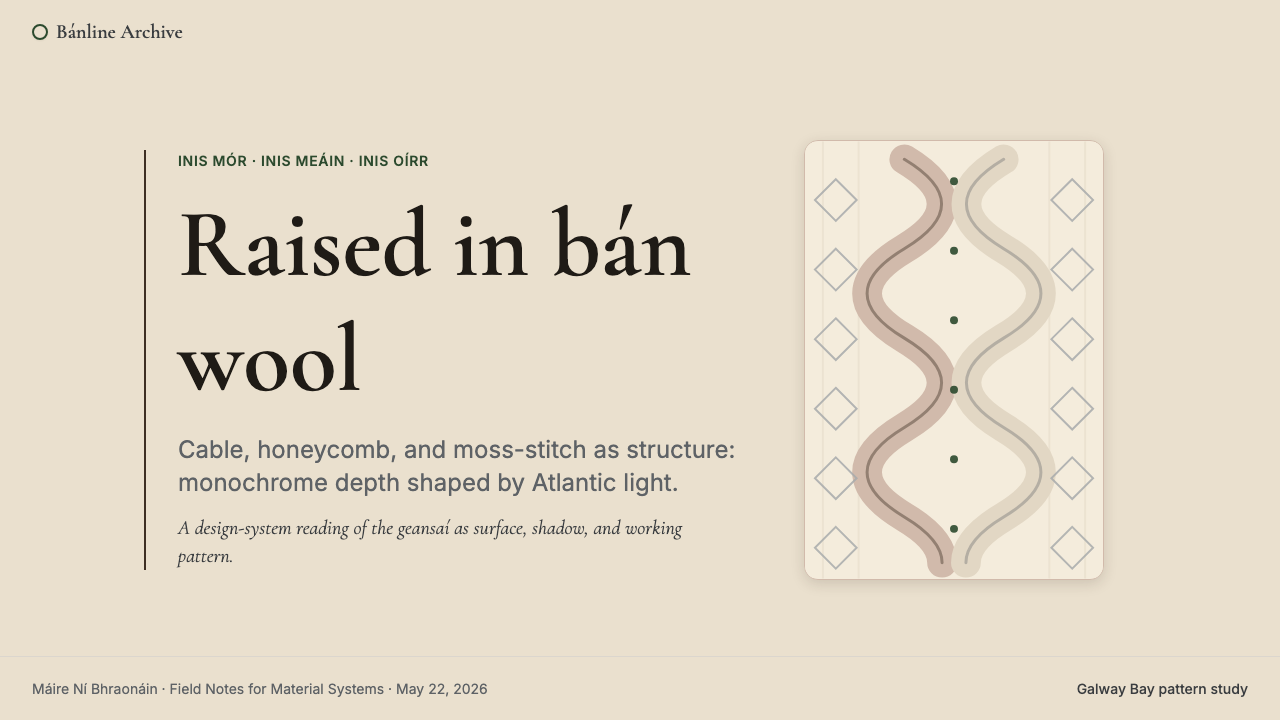
For presentation slides, the Aran register works best on covers and section dividers where atmosphere matters more than information density. A cover built on the style uses the bone-white or warm oat ground as the slide field, sets the title in a sturdy serif or slab-serif typeface with genuine weight, and introduces textural depth through a subtle woven-surface background pattern. The cable column motif — a series of vertical raised braids — can anchor a left or right panel without competing with the text. Content slides should be restrained: one or two tones from the natural palette, generous white space, no decorative borders. Data slides benefit from the style's tonal approach — bars and areas rendered in the natural palette's range of oat to slate, with distinctions achieved through value rather than hue.
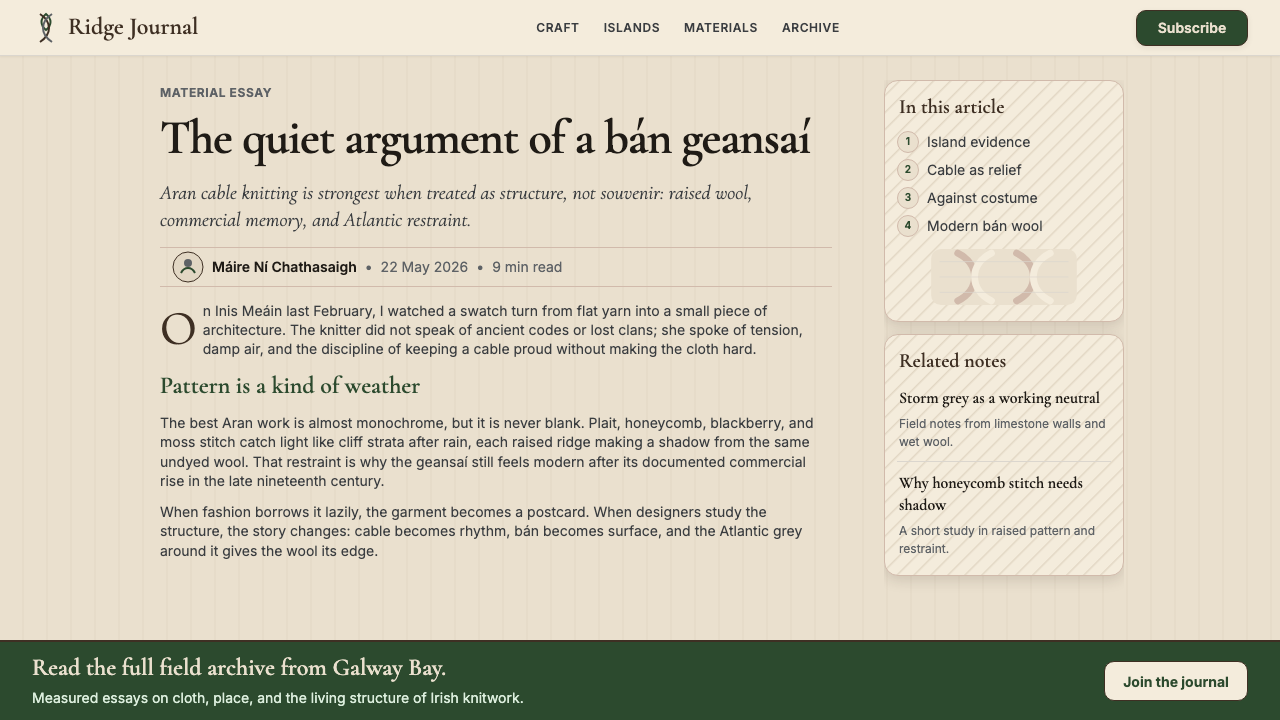
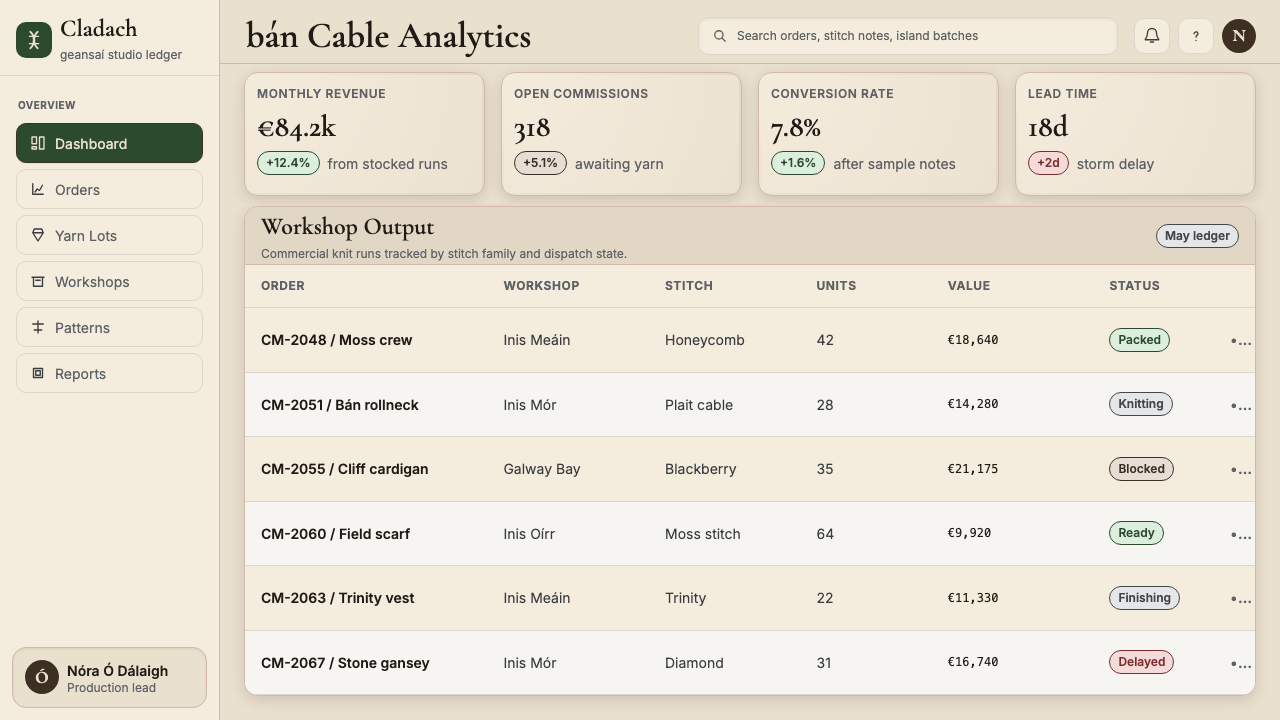
For web interfaces, the Aran system adapts well to artisan retail, wellness, heritage hospitality, and editorial platforms where the brand promise involves genuine craft, provenance, or slow production values. The approach: use the bone-white or warm oat as the primary background, introduce the muted sage or peat as secondary surface tones, and reserve the slate grey for text hierarchy. Card components should use subtle but consistent drop shadows — not borders — to create the sense of layered surface depth that references the fabric's physical relief. Navigation and typographic elements should have weight and presence; fine, airy type undermines the style's handcraft gravity.
For editorial and marketing work, Aran references translate powerfully into mood-board-adjacent content: brand storytelling pages, origin narratives, craftsmanship spotlights, and seasonal lookbooks. The key is restraint in color and generosity in space — large breathing margins, unhurried paragraph rhythm, images that emphasize material texture over styled composition. Marketing headlines should carry weight in the typographic sense: a solid, well-spaced word set against a warm field communicates the brand's deliberateness. Abstract cable motifs — used as section markers or dividing elements — should remain geometric and structural, never decorative flourishes.
The most common mistake in applying Aran aesthetics is conflating texture with busyness. Authentic Aran fabric achieves its richness through the disciplined repetition of a few stitch families within a clear vertical structure — not by layering many different patterns in close proximity without organizing logic. The design equivalent is using too many textural elements simultaneously: rough background, patterned border, embossed type, and layered shadows all competing for attention. Aran's principle is depth through discipline, not through accumulation. If a layout feels cluttered with texture, remove layers until the structure beneath becomes legible again.
Irish Aran Island Cable Knit — FAQ
Is every Aran pattern a family crest with encoded meaning?
This is the most persistent myth about Aran knitwear, and the answer is: almost certainly not, at least not in the way the story is usually told. The claim that specific stitch patterns identified particular island families — and could be used to identify drowned fishermen washed ashore — was popularized by Heinz Kiewe in 1967 and by subsequent travel writers and knitwear marketers. Textile historians and folklorists have searched the documentary record and found no evidence of this system predating the commercial tourist era. The patterns were real, the skill was real, but the heraldic coding appears to be a romantic invention that proved commercially irresistible. This does not diminish the tradition's value; it simply locates that value where it actually lives — in the craft itself, not in a back-story.
Can the Aran palette work in digital interfaces, or is it too warm and muted?
It can work, but it requires discipline and the right product context. The bone-white and warm-oat tones read well on screen because they are not pure white — the slight warmth reduces eye fatigue on long reading sessions, which makes them particularly effective for editorial, wellness, and heritage retail interfaces. The muted sage and peat tones provide sufficient contrast for secondary text and interactive states when used carefully. Where the palette struggles is in high-competition digital contexts — SaaS dashboards, financial tools, anything where contrast ratios must meet strict accessibility standards and the interface requires immediate hierarchy legibility. In those contexts, the muted tones need to be pushed toward higher contrast pairs or supplemented with a darker neutral. The palette is not too warm; it is too subtle for contexts that demand urgency.
How do you reference Aran textile depth in a flat digital medium without making it look like a stock-photo sweater background?
The key is abstraction over representation. A literal photograph of Aran knitwear used as a background imports the craft but also imports dated visual clichés — it reads as a 1990s heritage brand catalog page, not as a considered design decision. The better approach is to extract structural principles rather than surfaces: use subtle vertical rhythm (the shadow of a cable column) as a layout organizing device, apply tonal variation in backgrounds by shifting between the natural palette's close values rather than adding photographic texture, and use shadow depth on card components to suggest tactile relief without any fiber texture present. The goal is that a viewer familiar with the tradition recognizes the reference, while a viewer who is not simply experiences a warm, structured, quietly complex visual system.
Is Aran appropriate for brands that have no connection to Irish or Atlantic heritage?
It can be used respectfully by brands with no geographic connection to the islands, provided the values alignment is genuine rather than superficial. Aran's core values — material honesty, craft depth, slow quality, restrained palette — are transferable to any context where those values are real and not merely claimed. A small-batch ceramics studio, a natural-fiber clothing brand, a heritage bookseller, or a farm-to-table restaurant can draw on the Aran visual register because their production ethos genuinely rhymes with it. What the style cannot support is being used as decorative heritage wallpaper by a brand whose actual values are speed, volume, and low cost — the dissonance between the reference and the reality becomes legible to attentive audiences. Use the tradition because its principles match your work, not because the aesthetic is attractive in isolation.
What separates Aran-influenced design from generic 'cozy' or 'rustic' aesthetics?
The distinction lies in structural discipline. Generic cozy or rustic aesthetics reach for warmth through soft, organic, irregular elements — rounded shapes, imperfect textures, hand-lettered type, warm amber tones. Aran-derived design achieves warmth through an entirely different route: through the vertical logic of the cable column, the mathematical regularity of the stitch repeat, and the tonal restraint of the natural undyed palette. The result is warm but ordered, tactile but disciplined. It does not look hand-lettered or irregular — it looks handmade but precise. This is the crucial difference: Aran is a craft tradition with geometric rigor at its core, not a loosely rural visual mood. Designs that drift into rustic informality have lost the structural spine that makes the reference meaningful.
Related design styles
 Vietnamese Bamboo BasketryThe basket remembers the smoke. Tan-brown woven ground, concentric splint rin…
 Faroese Knit Pattern Island GreyWeathered wool, not cozy kitsch. Island greys, Cormorant serif, one blood-red…
 Indian Jamun Violet HandloomHandspun, never glossy. Jamun-violet dyed cotton figured with pale natural-th…
 Kibbutz HaggadahHandmade harvest page. Olive stencil stock, wheat serif, deckled linocut geom…
 Knossos Minoan FrescoColour becomes wall. Six mineral fields meet swift contours and honest fragme…
 Adobe Pueblo SouthwestFeels made by hand. Earthen tan, turquoise trim, and viga rhythm shape the fr…