What is Mexican Mezcal Craft?
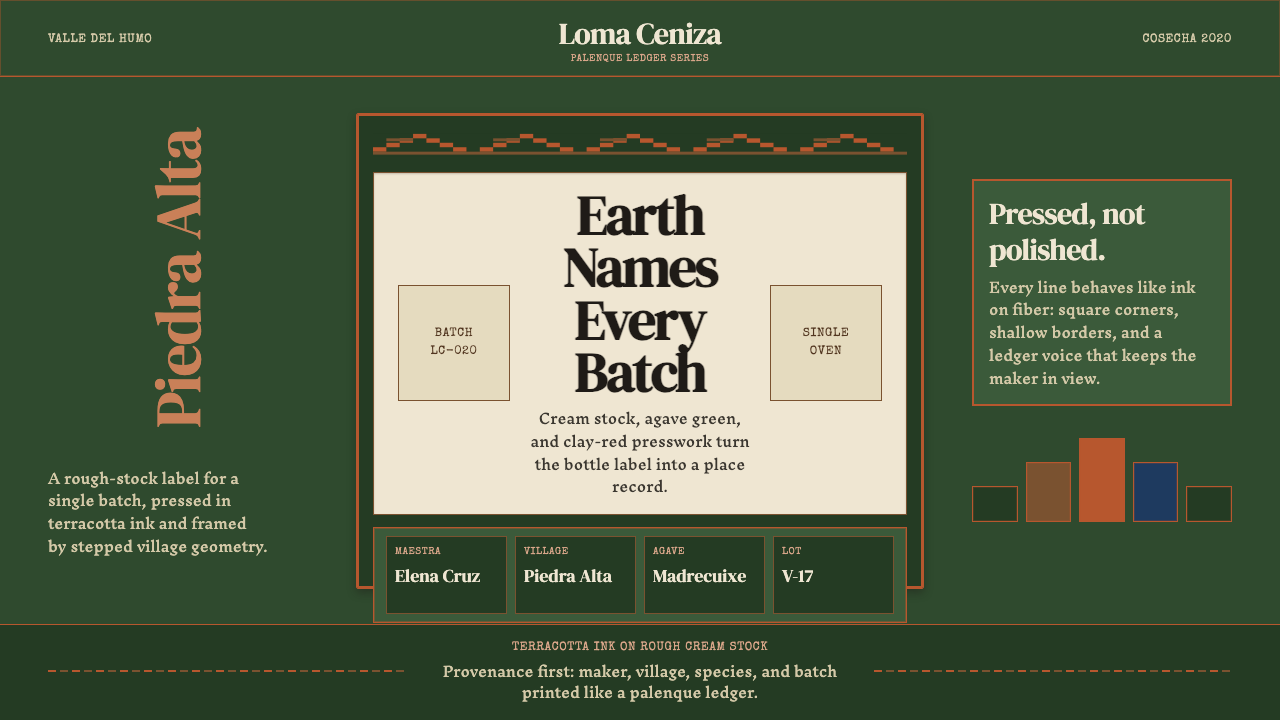
Mexican craft mezcal bottle design transformed the humble spirits label into a provenance document — part field record, part village portrait, part declaration of ancestral craft.
Mexican Mezcal Craft in brief
Mexican craft mezcal bottle design is a visual system born from a renaissance in artisanal spirits production centered in Oaxaca, Mexico. Beginning in earnest around 2010 and accelerating through the early 2020s, a generation of small-batch producers, maestros mezcaleros, and independent bottlers developed a label language that prioritized specificity over marketing gloss. Each bottle became a document: the agave species, the maestro's name, the village of distillation, the batch number, and the harvest year all appear as primary information rather than fine-print afterthoughts.
The aesthetic vocabulary draws from several layered sources. Letterpress printing on rough, unbleached cream stock gives labels their characteristic tactile depth. Terracotta tones — the warm, fired-clay ochres and reds of Oaxacan ceramics — appear as border treatments and background fields. Deep, muted greens derived from the agave plant itself establish the palette's most distinctive note. Geometric patterns derived from Zapotec stepped-fret motifs, known as greca, weave through many labels as framing devices, connecting the commercial object to pre-Columbian visual tradition.
The result is a style that reads as simultaneously archaic and precisely contemporary. It rejects the slick gradient-and-photo language of mass spirits marketing in favor of hand-drawn letterforms, stamp-like insignia, and a deliberate roughness that signals authenticity without performing rustic nostalgia. The mezcal label at its best is a piece of functional typography that earns its weight through specificity.
Where does Mexican Mezcal Craft come from?
Mezcal — distilled from the cooked hearts, or piñas, of various agave species — has been produced in Oaxaca for centuries, with roots reaching into pre-Columbian fermented agave beverages and the colonial-era introduction of distillation technology. For most of the twentieth century, mezcal occupied a marginal commercial position relative to tequila, produced by village palenqueros — small operators working with clay or copper pot stills — and sold locally with minimal labeling. The visual identity of mezcal, where it existed at all, borrowed from the generic spirits vocabulary: sombreros, cactus silhouettes, and hand-lettered product names.
The turning point came with a combination of regulatory reform and cultural re-evaluation. In 1994, Mexico established the Denominación de Origen Mezcal, creating a protected designation that confined legal mezcal production to defined regions and began distinguishing it formally from tequila. More consequentially for the visual language, the 2016 revision of the NOM-070-SCFI standard introduced a formal classification system — Mezcal, Artesanal, and Ancestral — that required producers to specify agave species, production method, and geographic origin. This regulatory specificity demanded a label language capable of carrying that information legibly and credibly.
The craft revival accelerated around producers and advocates who understood that the label was itself a marketing and cultural argument. Figures like Aquilino García López, working with traditional tobalá and espadín agaves in the villages of the Central Valleys, and Romeo Sánchez Reyes, whose work helped champion single-village, single-species bottlings, brought a documentary ethos to production that the best designers then translated into graphic form. Asis Cortés and Joel Santiago represent a generation of maestros whose names now appear on labels as guarantors of method and provenance, in the same way a single-estate wine might credit its winemaker.
The influence of Oaxacan material culture — particularly the black clay ceramics of San Bartolo Coyotepec, the woven textiles of Teotitlán del Valle, and the carved wooden alebrijes of Arrazola — permeated the graphic vocabulary of the revival. Designers working on mezcal packaging during the 2010s drew explicitly from regional craft traditions, creating a visual ecosystem where terracotta border treatments, hand-carved woodblock-style illustration, and Zapotec stepped-fret geometry became the shared grammar of authenticity. This was not appropriation but integration: Oaxacan designers and producers were themselves the authors of the revival aesthetic.
What defines the Mexican Mezcal Craft look?
Color Palette
The palette is earthy and restrained. Agave-field greens — deep, slightly grey-shifted, the tone of a mature espadín plant at dusk — anchor many labels as primary grounds or dominant border colors. Terracotta ochres and warm fired-clay reds provide secondary structure, evoking Oaxacan ceramics and sun-baked adobe. Cream and unbleached natural paper tones serve as the baseline field on which everything sits. Black is used sparingly and functionally, primarily for type and key graphic elements. High-saturation accent colors, metallic foils, and cool blues are conspicuously absent — the palette communicates soil, fire, and plant rather than luxury or novelty.
Typography and Lettering
Labels typically combine two or three typographic registers. A primary display letterform — often drawn from classical serif faces with strong ink-trap characteristics that read well when letterpress-printed on rough stock — carries the brand name or agave species. Secondary information (batch number, village, maestro name) appears in smaller, tighter-set type that reads as a data field. Hand-lettered or brush-script elements appear in some labels as personal signatures from the maestro, reinforcing the artisanal provenance claim. Type is set in tight, high-contrast hierarchies: the agave species name might be given prominence rivaling the brand name itself, a hierarchy that would be unusual in any other spirits category.
Geometric Ornament
Zapotec stepped-fret patterns — known in Spanish as greca — appear on borders, dividers, and background textures throughout craft mezcal packaging. Unlike purely decorative border treatments in other spirits categories, these patterns carry genuine cultural weight: the stepped-fret motif is one of the most widely distributed symbols in Mesoamerican visual culture, appearing in the archaeological record from Mitla and Monte Albán. Their presence on a label signals geographic and cultural specificity rather than generic exoticism. The patterns are typically rendered in a single tonal register against the ground — they frame rather than dominate, offering texture without visual noise.
Texture and Print Materiality
The physical substrate matters as much as the graphic content. Labels are printed on uncoated, often slightly rough paper stocks that retain ink in ways smooth coated papers do not — ink bleeds slightly at letterpress impression, leaving a halo of pigment at the edges of strokes that signals hand-production. Some labels incorporate embossing, debossing, or tactile varnish to emphasize dimensional elements without adding color. The overall tactile register communicates that something has been made with hands, not extruded from a digital production pipeline. This is not accidental: the materiality of the label is a direct argument for the materiality of the liquid inside.
Provenance as Layout Logic
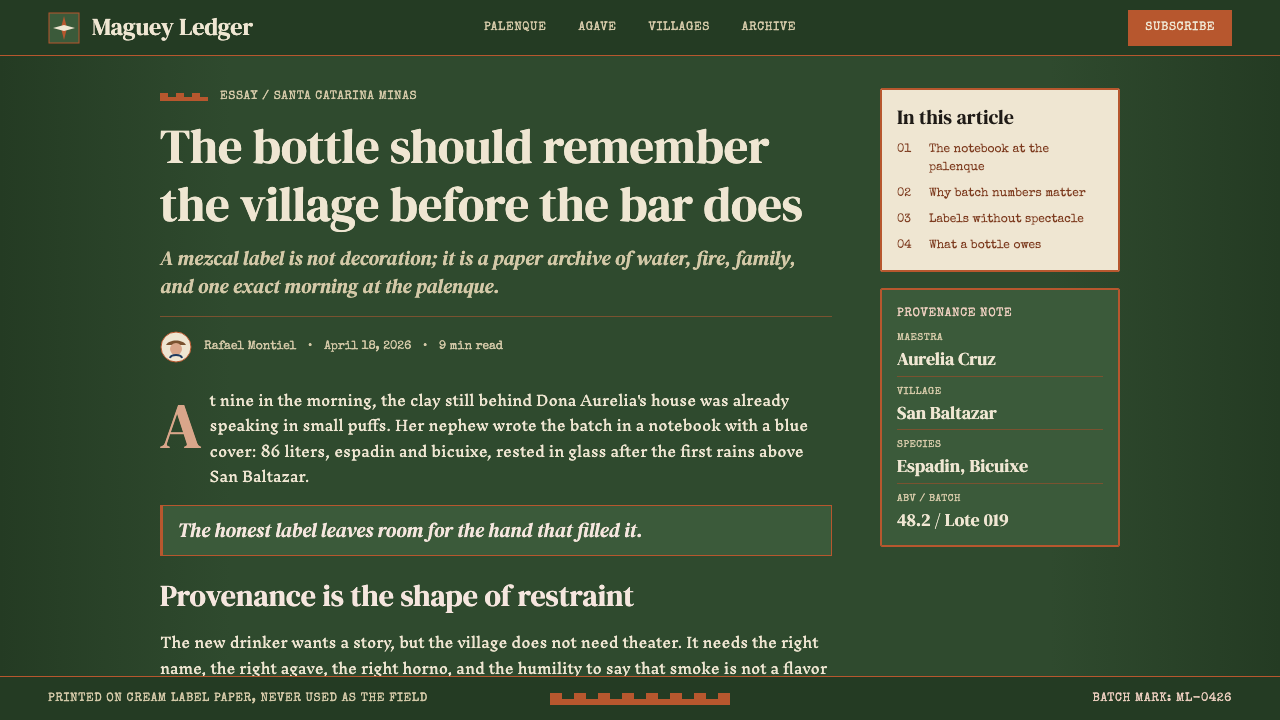
What distinguishes craft mezcal labels from other artisan spirits packaging is the systematic elevation of provenance data to first-tier visual prominence. The agave species (espadín, tobalá, tepextate, arroqueño, cirial, and dozens more) often appears at near-headline scale. The village of production — Santiago Matatlán, Santa Catarina Minas, San Luis del Río — is given geographic and cultural dignity rather than tucked into regulatory fine print. Batch numbers, distillation dates, and maestro names are treated as signatures rather than codes. The layout performs the argument that origin is the product, not merely an attribute of it.
Illustration Register
When illustration appears on craft mezcal labels, it favors two registers: botanical and architectural. Botanical illustration — the agave plant rendered in the naturalist tradition, with careful attention to the rosette form, leaf spine detail, and piña cross-section — appears frequently, echoing the scientific documentation of Oaxacan flora. Architectural or topographic elements — palenque structures, mountain profiles, village maps — appear on more narrative labels, situating the liquid in its physical landscape. Both registers are rendered in a slightly worn, woodblock-adjacent idiom that reinforces the letterpress-and-rough-stock aesthetic rather than competing with it through photo-realistic rendering.
Restraint and Negative Space
Despite the richness of available cultural material, the most resolved craft mezcal labels practice deliberate restraint. Not every label uses every element — the great ones typically commit to one or two visual strategies and execute them with precision. Generous negative space on cream or natural-paper grounds allows typographic and illustrative elements to breathe. The restraint is what separates the documentary aesthetic from craft-tourism pastiche: a label trying to signal everything at once reads as anxious; a label that trusts a single strong element reads as confident and real.
Who shaped Mexican Mezcal Craft?
Aquilino García López is among the most respected ancestral mezcal maestros working in the Central Valleys of Oaxaca, producing small-batch mezcal from wild and semi-cultivated tobalá and other non-espadín agave species using purely ancestral methods — clay pot distillation, in-ground roasting, and mule-powered stone tahona milling. His work became central to international advocacy for the ancestral classification, and his name on a label came to function as a certification of method as much as a signature. The detailed production documentation that serious importers required of producers like García López directly shaped the information-forward label language of the craft revival.
Joel Santiago is a maestro mezcalero whose work with wild agave species in remote Oaxacan communities has been particularly influential in demonstrating the ecological and cultural stakes of the craft mezcal category. His production, which emphasizes the slow maturation cycles of wild plants (tobalá matures over twelve to fifteen years before harvest), made the single-agave-species label a statement not merely of flavor profile but of land stewardship and temporal patience. This added a conservationist dimension to the visual language: labels bearing wild-agave designations carry an implicit argument about sustainability that their aesthetic register reinforces.
Asis Cortés represents the intersection of deep traditional knowledge and contemporary export awareness. Working with multiple agave varieties and production methods, Cortés became known for a documentary approach to production that saw every batch as a distinct event to be recorded — a philosophy that map onto the design language of craft mezcal with particular precision. His collaboration with importers and distributors who understood international spirits markets helped establish the vocabulary of what authentic, premium Oaxacan mezcal labeling should communicate, shaping expectations for typography, information hierarchy, and material presentation across the category.
Romeo Sánchez Reyes was instrumental in the advocacy and international recognition of single-village, single-agave-species bottlings as a distinct category of quality and provenance. His work helped establish the principle that the village of production is not administrative information but a genuine determinant of character — a position that fundamentally shaped how designers and producers thought about what a mezcal label was obligated to communicate. The village-as-primary-identity framework that now characterizes the best craft mezcal labels owes much to his advocacy in both production and export channels.
How do you use Mexican Mezcal Craft today?
Mexican craft mezcal bottle design is among the most transferable artisan-spirits aesthetics to adjacent creative contexts because its underlying logic is documentary rather than decorative. Applying it effectively means understanding what the style is actually arguing: that specificity is the product, that materials tell the truth about process, and that restraint in the graphic register signals confidence in the underlying substance. Any project that benefits from those arguments — a small-batch food brand, an independent publishing imprint, a cultural institution, a professional services firm emphasizing depth over breadth — can draw on this vocabulary productively.
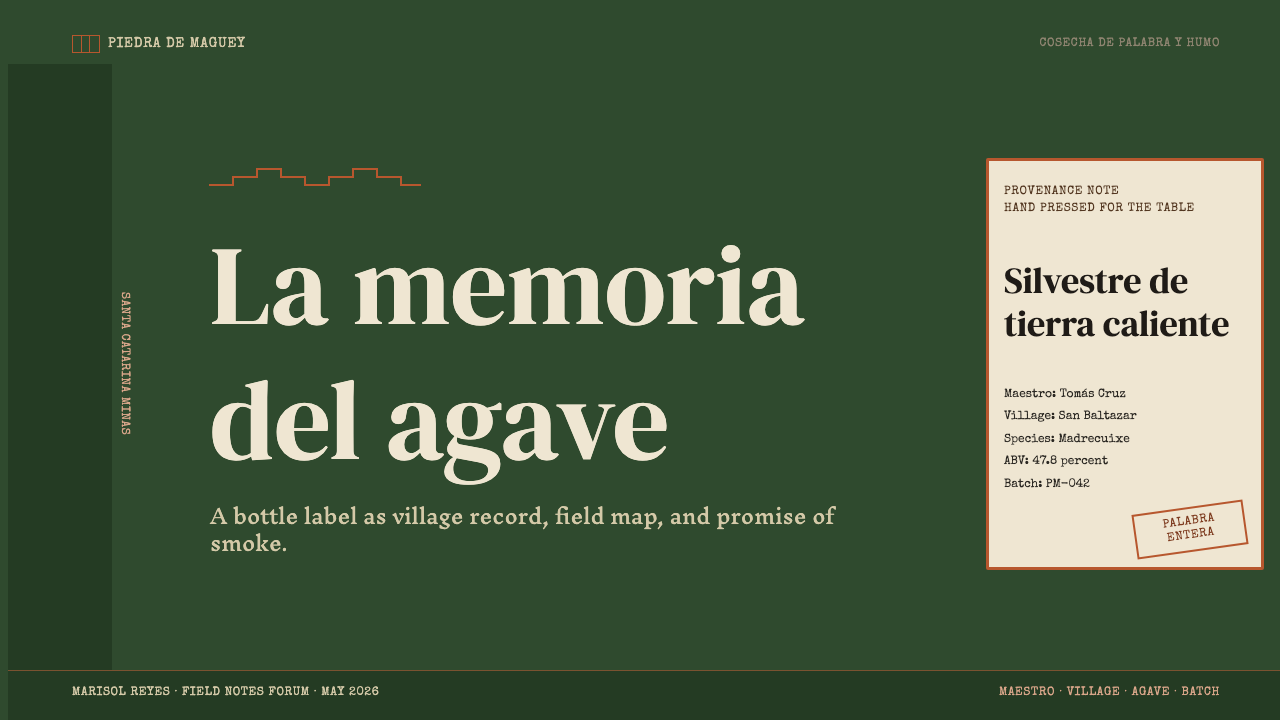
For presentation slides, the style works especially well on covers and section-opening pages where a strong identity statement is needed. A cover treated with agave-green as the dominant ground, terracotta as a border treatment, and a headline set in a high-contrast serif at generous scale achieves the distinctive warmth and authority of the style immediately. Content slides should lean into the information-as-hierarchy principle: present provenance data (author, date, methodology, source) with the same visual dignity as headline findings, using scale and weight to communicate what matters most. Data slides benefit from the palette's earth tones applied to chart elements — bar and area charts in the agave-green and terracotta register read as warm and authoritative rather than generic.
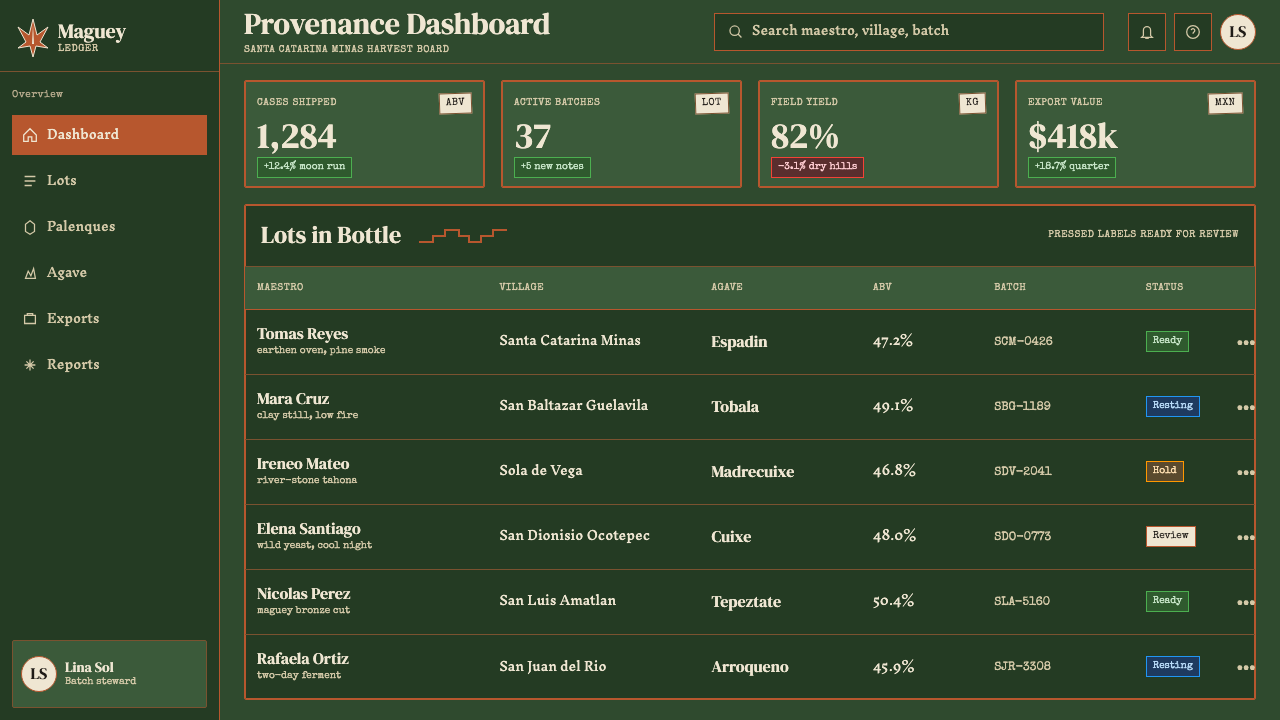
For web interfaces, this aesthetic suits contexts that want to communicate craft, depth, and trustworthiness rather than speed, innovation, or scalability. A portfolio site, a small-press platform, a cultural archive, or a specialist consultancy can use the terracotta-and-cream palette, rough-edged typographic elements, and stepped-fret geometric borders to differentiate from the generic startup UI. Applied to dashboards, the earth-tone palette creates a distinctive and legible data environment — avoid high-contrast saturated accent colors in favor of desaturated warm tones for non-critical states. Navigation should be typographic, with generous sizing for labels and minimal use of icons.
For editorial and marketing work, the style's strength is its directorial confidence. A print or digital publication using this aesthetic commits to serif type, generous margins, and a layout that treats provenance information (byline, date, publication, context) as primary rather than subsidiary. Pull quotes and callouts should be set in a complementary weight and size, not in a contrasting color or decorative border. Marketing materials for products or services with genuine craft credentials benefit from resisting the impulse to add more: a single strong illustration in the botanical-naturalist register, a carefully set hierarchy of specificity-first copy, and a palette that refuses metallic or neon supplements will communicate authenticity more effectively than a busier approach.
The most common mistake when applying this aesthetic is conflating roughness with sloppiness. The craft mezcal label works because its apparent roughness is precisely controlled — the letterpress impression is deliberate, the paper choice is researched, the stepped-fret border is geometrically exact despite its hand-drawn affect. Designers who apply this aesthetic by simply choosing a distressed brush font, adding a sepia filter, or layering unrelated folk motifs produce work that reads as costume rather than character. The discipline the style demands is invisible when executed well: the label looks like something that could only have come from one place at one time.
Mexican Mezcal Craft — FAQ
What makes craft mezcal label design distinct from other artisan spirits categories?
The primary distinction is the systematic elevation of production data to first-tier visual prominence. In most spirits categories, provenance information — distillery location, grain variety, cask type — is secondary text buried in fine print. Craft mezcal labels treat the agave species, the village, and the maestro's name as headline information. This is partly regulatory (the NOM-070-SCFI standard mandates disclosure) and partly cultural: the mezcal revival was explicitly an argument that origin is value, and the label is the place where that argument is made most visibly. No other mainstream spirits category makes production methodology this central to the graphic identity.
Is the roughness and hand-made quality of these labels authentic or a marketing strategy?
Both, and the honest answer is that this ambiguity is part of what makes the aesthetic interesting. Many early craft mezcal labels were printed on actual letterpress equipment and used genuinely uncoated stock because letterpress was accessible, economical, and suited to small-run production. As the category attracted premium-market interest, some producers adopted the letterpress aesthetic using digital printing processes that simulate the impression and ink spread of the original technology. The question is whether the simulation is honest: a label that deploys letterpress aesthetics on a product genuinely made by a named maestro using a documented ancestral method is making a coherent argument. A label that borrows the roughness without the underlying authenticity is making a different kind of claim entirely.
How does the Zapotec stepped-fret pattern function in this design system?
The stepped-fret, or greca, functions simultaneously as a geographic signal and a framing device. As a signal, it tells the viewer that this product comes from a specific cultural geography — Oaxacan Mesoamerican tradition — not from a generically exoticized version of Mexico. The stepped-fret appears at Mitla, at Monte Albán, in Zapotec textile and ceramic traditions; its presence on a label from Santiago Matatlán is geographically coherent in a way that a sombrero or a cactus is not. As a framing device, it creates visual structure at the label's borders without adding figuration or color weight — it is geometric pattern used in the way architectural molding functions, defining edges and providing rhythm. The best craft mezcal labels use it with precision, not as wallpaper.
Can this aesthetic work for products that have nothing to do with mezcal or Oaxaca?
Yes, but with an important condition: the transfer works when a project shares the underlying values, not merely the surface markers. The craft mezcal aesthetic is fundamentally about provenance specificity, artisanal process, and the documentary function of packaging. Applied to a small-batch hot sauce from a named farm, a single-origin coffee from a specific cooperative, an independent publisher's edition of a specific historical text, or a cultural archive documenting a particular community's visual heritage — the vocabulary is coherent because the argument is coherent. Applied to a mass-produced product or a company with no genuine craft credentials, the same visual language reads as costume. The question to ask before reaching for these elements is: does my project actually have the provenance story this aesthetic promises?
How should this aesthetic handle digital-first contexts where paper texture and letterpress impression can't be reproduced?
The typographic and compositional principles translate more directly to digital contexts than the material qualities, and that is where to focus. The earth-tone palette, the information hierarchy that elevates provenance data, the stepped-fret geometric border, and the commitment to serif type with high-contrast scale variation all work on screen without requiring simulated texture. What does not translate well is adding digital filters that simulate aged paper or letterpress impression — this tends to read as nostalgic affectation rather than authentic reference on digital surfaces. The better approach is to commit to the underlying values in medium-appropriate terms: generous whitespace on a warm near-white ground, a serif display typeface set with confidence, provenance information presented at genuine visual prominence, and geometric border elements drawn with precision rather than simulated roughness.
Related design styles
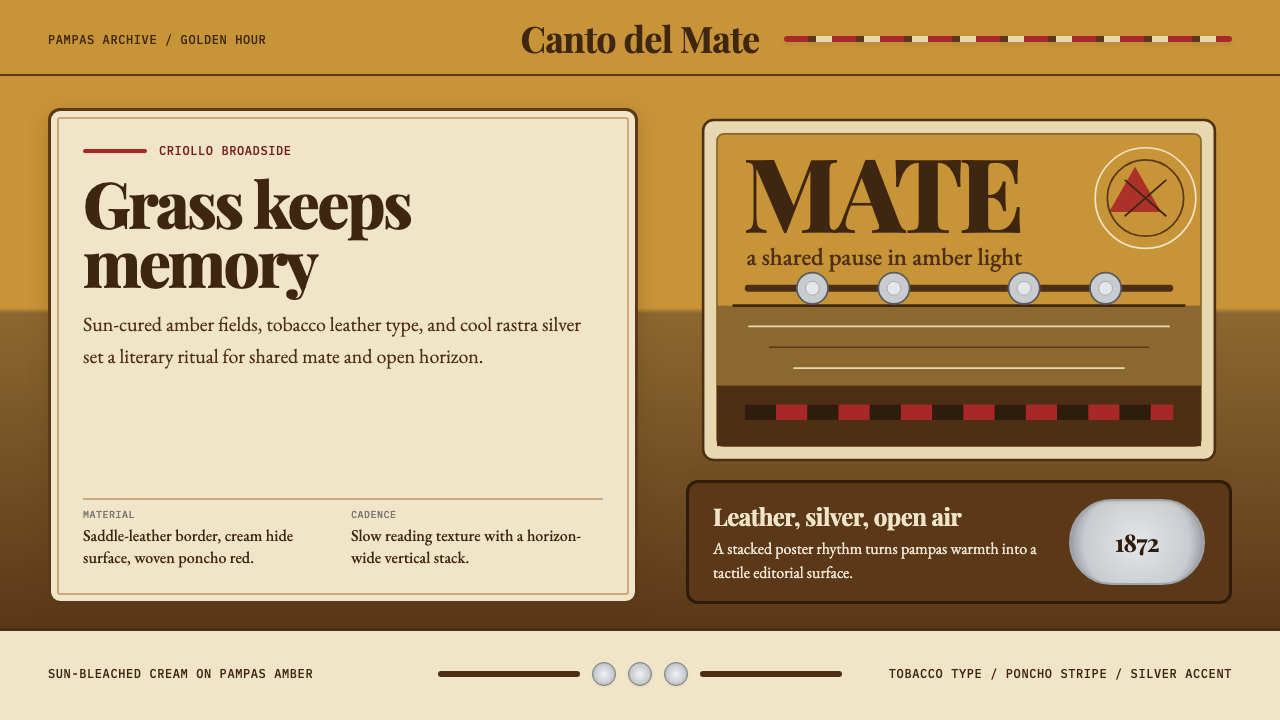 Argentine Gaucho (Pampas Mate Culture)Open grassland, printed warm. Amber fields, Playfair serif, and silver rastra…
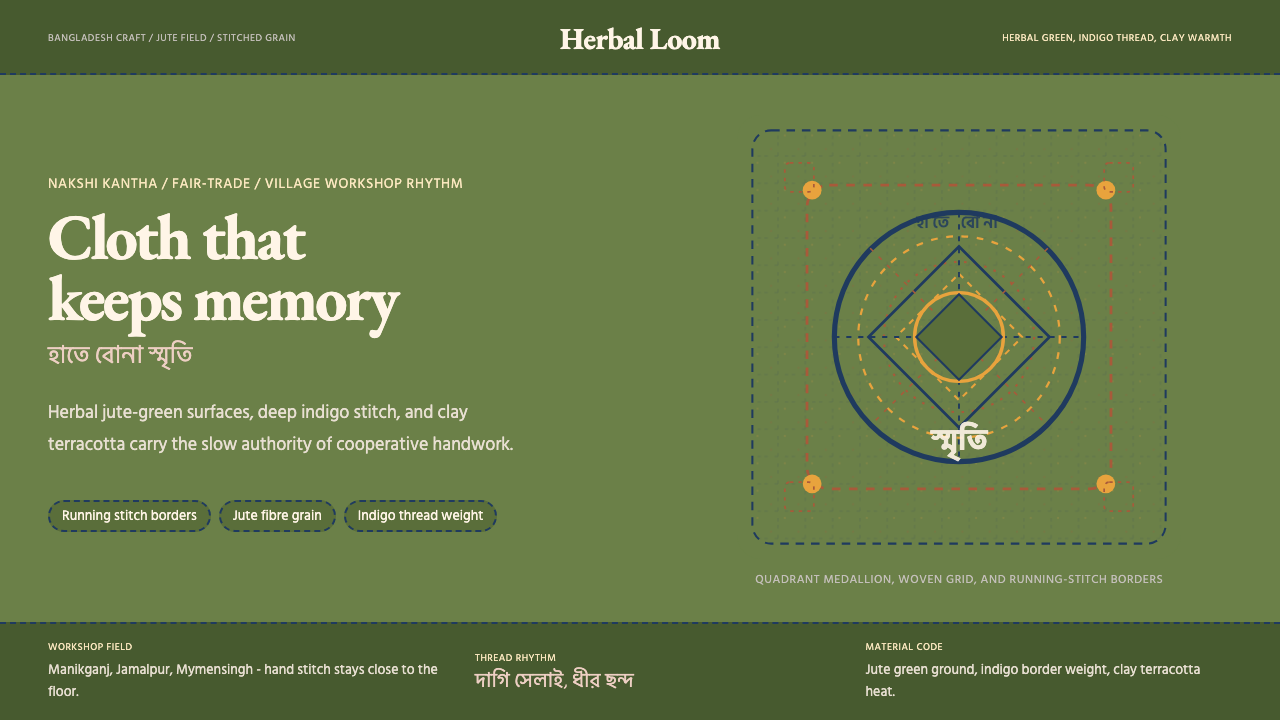 Bangladeshi Jute CraftMemory stays stitched. Jute green, indigo borders, terracotta warmth.
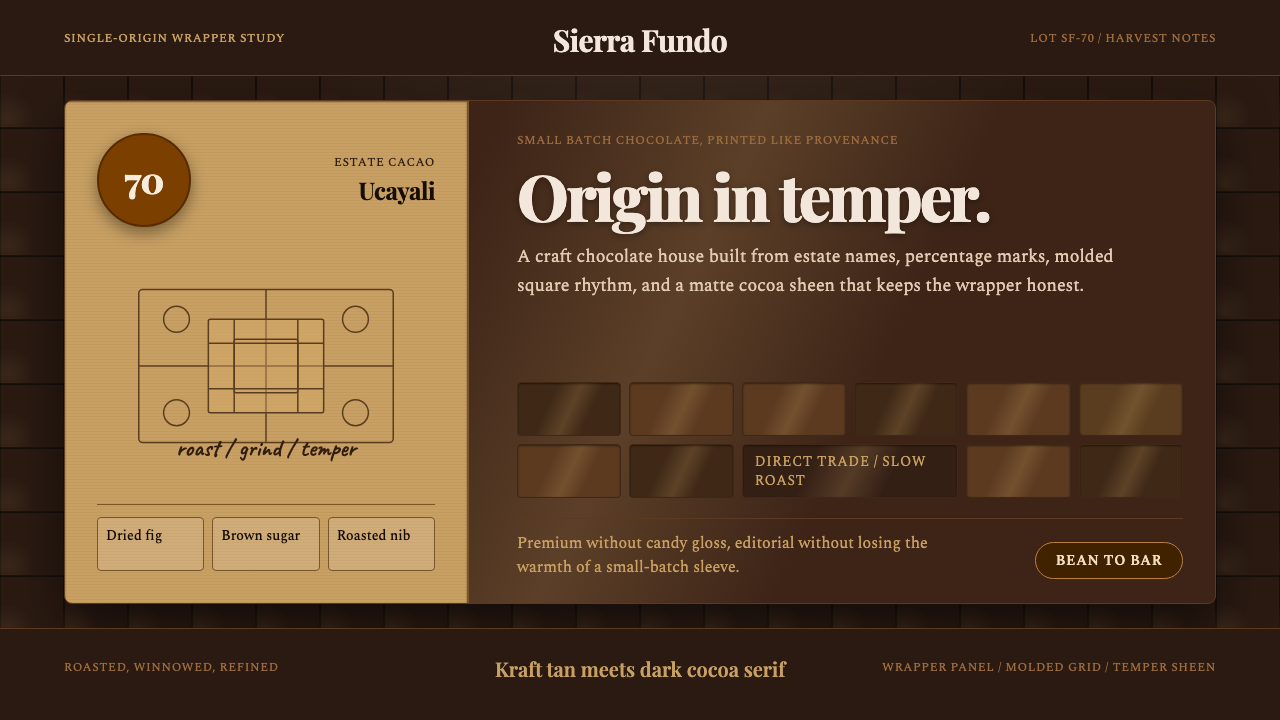 Bean-to-Bar ChocolateOrigin tastes tactile. Cocoa serif, kraft panel, and molded squares carry the…
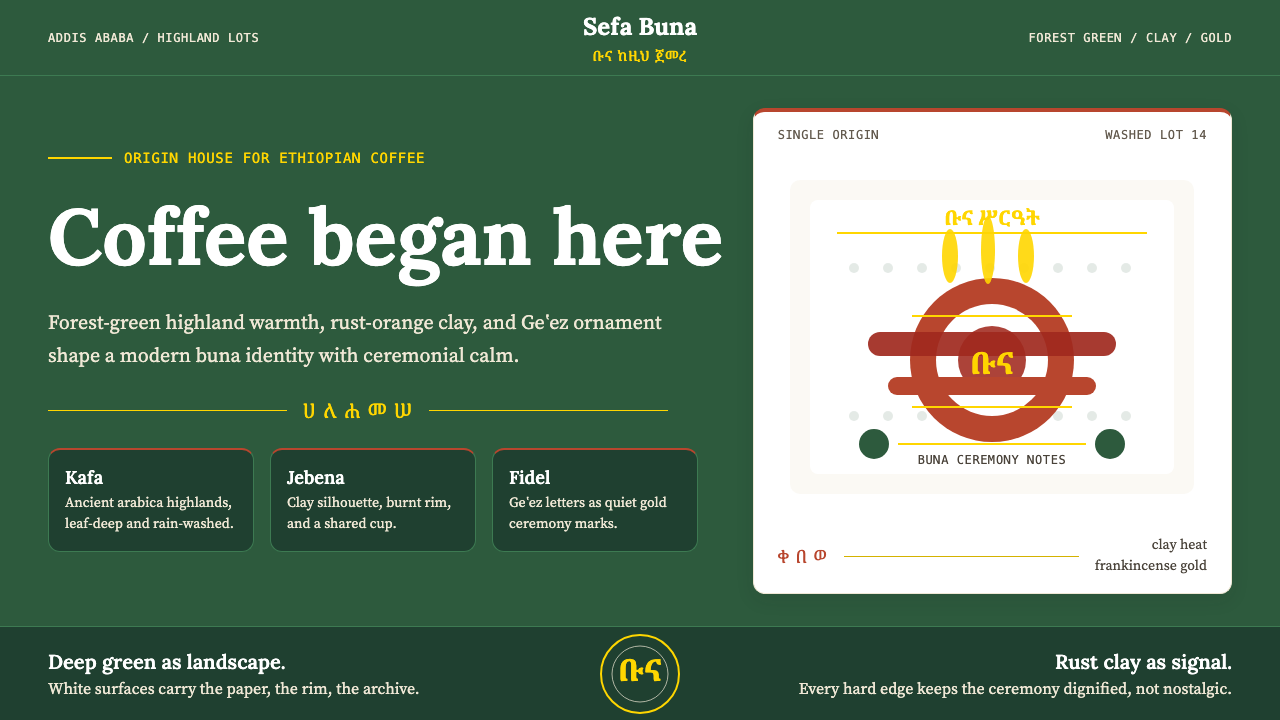 Ethiopian Coffee BunaOrigin feels ceremonial. Forest green, rust clay, Lora serif, and Geʽez gold…
 Icelandic Turf HouseThe hillside becomes shelter. Peat coursing surrounds one narrow line of yell…
 Kibbutz HaggadahHandmade harvest page. Olive stencil stock, wheat serif, deckled linocut geom…