What is Australian Outback Vernacular?
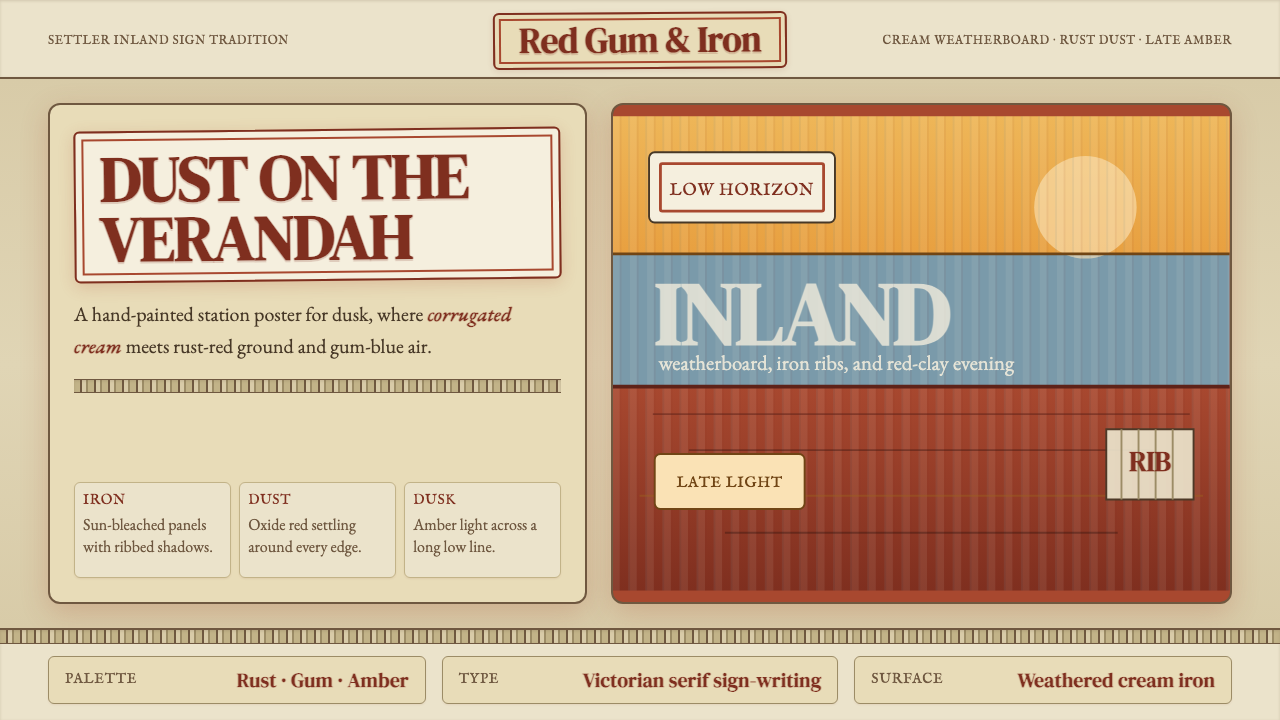
Rust, corrugated iron, and hand-painted Victorian serif signs conjure two centuries of sun-scorched settler life at the edge of the Australian inland.
Australian Outback Vernacular in brief
Australian Outback Vernacular is the visual culture that grew from two centuries of post-colonial settler life in the Australian inland — sheep-station woolsheds, country-pub facades hand-painted by itinerant sign-writers, drovers' weathered kit, corrugated-iron water tanks, and timber fenceposts silhouetted against an enormous low sky. Unlike a designed movement with a manifesto or a school, it is an accumulated aesthetic: the sum of material choices made under conditions of remoteness, heat, and limited supply.
The palette derives directly from the landscape — iron-oxide rust-red dust, the dusty blue-grey of eucalyptus canopies, the warm amber of an inland sunset, and the bleached cream of galvanized iron that has spent decades under a merciless sun. These colors are never vivid or saturated in a modern sense; they are faded, layered, and aged by the environment itself, as though the design has been collaborating with the weather for a hundred years.
Typographically, the tradition is anchored in Victorian-era serif lettering — the hand-painted pub signs, the stenciled station names on timber posts, the block-letter announcements on shed walls. The letterforms are confident and upright but slightly imperfect: the imprecision of the human hand in harsh conditions is part of the message. Ornamental detail is modest — a ruled border, a simple drop shadow on the sign letters, a thin dividing line — never the lavish gilded excess of metropolitan Victorian design.

Where does Australian Outback Vernacular come from?
The roots of Outback Vernacular lie in the pastoral expansion of the 1820s through 1860s, when British and Irish settlers pushed the inland frontier of eastern Australia in search of grazing land. Vast sheep and cattle stations emerged across New South Wales, Queensland, South Australia, and later the Northern Territory and Western Australia. These stations were self-sufficient worlds — they had their own blacksmiths, carpenters, and sign-painters — and their visual culture developed in near-total isolation from metropolitan fashion. The aesthetic vocabulary was practical: bold lettering legible at distance, robust colors that would survive season after season of ultraviolet assault, corrugated iron that could be transported flat and assembled anywhere.
Two cultural forces gave the visual tradition its emotional resonance. The first was the bush-ballad poetry of the 1880s and 1890s, particularly the work of Banjo Paterson — whose 'The Man from Snowy River' (1890) and 'Waltzing Matilda' (1895) fixed the imagery of the drover, the swagman, and the vast inland plain in the Australian imagination — and his contemporary Henry Lawson, whose short stories portrayed bush life with unsentimental realism. These literary works created a shared mythology of the inland that designers, illustrators, and sign-painters were already giving shape to in the same decade.
The second force was the Heidelberg School of painting, which flourished from roughly 1885 to 1900. Tom Roberts, Arthur Streeton, Charles Conder, and Frederick McCubbin worked in the plein-air tradition, painting eucalyptus-filtered light, dusty paddocks, and the particular quality of Australian afternoon heat directly from observation. Their canvases established what an honest depiction of the Australian landscape actually looked like — ochre and blue-grey, bleached gold and rust, with long horizontal lines and an enormous luminous sky — and this chromatic truth became the reference point against which all subsequent Australian outdoor visual culture measured itself.
The aesthetic persisted with remarkable continuity through the twentieth century, surviving the Art Deco period and the postwar modernist wave largely intact in rural areas where metropolitan trends arrived slowly or not at all. A deliberate heritage revival gathered momentum from the 1990s onwards, and after 2010 it became an active reference for Australian brand design, craft food and beverage packaging, tourism graphics, and digital products seeking to signal authenticity, provenance, and connection to place. Today the style carries the full weight of its layered history: settler nostalgia, landscape reverence, material honesty, and the laconic directness that Australian culture values as its own kind of sophistication.
What defines the Australian Outback Vernacular look?
Color
The palette is governed by the desert and the station: iron-oxide rust-red, the dusty warm ochre of baked earth, the blue-grey of eucalyptus foliage, the bleached cream of weathered galvanized iron, and the deep amber of an inland sunset. These are never saturated primary colors — they are always muted, sun-worn, and slightly dusty, as if the pigment itself has spent years in the open. Black is used sparingly, for lettering and outlines rather than backgrounds. Pure white is rarely the ground; cream, bone, or a very pale ochre is preferred, evoking aged paper or unpainted timber.
Typography
Letterforms are drawn from the Victorian-era sign-painting tradition: upright serifs with strong stroke contrast, condensed proportions for fitting long station names into narrow sign boards, and occasional use of a bold slab-serif for maximum legibility at distance. The hallmarks are a slight irregularity of spacing and weight — evidence of the human hand rather than mechanical precision — and a preference for all-capitals in headlines, which reads as authoritative and unambiguous against complex outdoor backgrounds. Decorative typographic elements are present but modest: ruled borders, simple inline shadows, and the occasional swash initial.
Texture and Weathering
Texture is the style's most distinctive attribute, and it is always the texture of time and exposure rather than decoration applied from outside. Corrugated iron imposes its regular horizontal ribbing on any surface it covers; timber weathers to a silvery-grey split grain; paint peels and fades in layers that reveal earlier colors beneath. In two-dimensional design work, this translates to rough-edged shapes, halftone grain on areas of color, visible brushstroke variation in typography, and backgrounds that suggest aged paper or oxidized metal rather than clean digital surfaces.
Composition and Horizon
Compositions tend toward the horizontal, mirroring the low wide landscape of the inland plains. The horizon line — whether literal or implied — carries enormous compositional authority: it divides the ochre earth from the enormous sky, and everything else is measured against it. This gives layouts a characteristic calm and expansiveness rather than the vertically compressed energy of urban visual traditions. Imagery is often sparse within the frame — a single windmill, a lone tree, a distant homestead — with generous open space treated as part of the composition rather than as absence.
Material Honesty
Outback Vernacular never disguises what things are made of. Corrugated iron looks like corrugated iron; timber looks like timber; paint looks like paint applied by a brush, not a machine. This honesty extends to two-dimensional work: textures suggest real materials, shapes have the slight imprecision of handcraft, and nothing is rendered to look smoother or more refined than the tradition it references. Imitation of industrial slickness or digital perfection reads as inauthentic against this standard — the style specifically values evidence of the hand, of labor, and of time.
Ornament and Restraint
Decoration exists but is disciplined by function and available labor. A pub sign might have a ruled double border, a simple geometric motif in the corner, and a hand-drawn flourish on the station name — but these elements serve legibility and identity, not pure embellishment. The restraint is not the result of a minimalist philosophy but of practical economy: in the Outback, extra detail costs time and materials that were rarely available to spare. Contemporary work that draws on this tradition maintains the same ratio — decoration is present enough to feel warm and human, but never so dense that it feels metropolitan or overwrought.
Imagery and Iconography
The iconographic vocabulary is drawn directly from the inland landscape and its working culture: merino sheep and Hereford cattle, corrugated iron water tanks and windmills, akubra hats and oilskin coats, eucalyptus silhouettes and red kangaroos, the Southern Cross constellation, tin mugs and campfires. These icons are handled as silhouettes or simple line drawings rather than photographic representations — the same economy of means that shaped the tradition's typography also shapes its pictorial language. Color is applied in flat areas rather than shaded volumes, reinforcing the flat-craft quality of the whole system.

Who shaped Australian Outback Vernacular?
Andrew Barton 'Banjo' Paterson (1864–1941) is the literary father of the Outback visual mythology. His bush ballads — written for The Bulletin magazine in the 1880s and 1890s and collected in The Man from Snowy River and Other Verses (1895) — created the defining imagery of the Australian inland: the drover, the swagman, the vast unfenced plains, the distant homestead. 'Waltzing Matilda,' written in 1895, became Australia's most recognized cultural export. Paterson gave the Outback aesthetic its emotional register — laconic, stoic, deeply attached to a specific landscape — and every subsequent visual interpretation of that tradition implicitly responds to the world he described.
Tom Roberts (1856–1931) was the central figure of the Heidelberg School and the painter who most directly established the chromatic vocabulary of the Australian outdoor tradition. His large-scale pastoral canvases — including Shearing the Rams (1890) and Bailed Up (1895) — depicted the light, heat, and social life of the inland stations with an accuracy and dignity that was new in Australian painting. Roberts studied in Europe and brought the plein-air method back to Australia; applied to the specific conditions of the Australian bush, this produced a color language of ochres, dusty blues, bleached golds, and rust that became the shared visual language of the outback aesthetic for the next century.
Sir George Russell Drysdale (1912–1981) extended the Outback visual tradition into the mid-twentieth century with a bleaker, more psychologically intense interpretation than the Heidelberg School's pastoral warmth. Drysdale painted the drought-stricken inland of the 1940s and 1950s — gaunt figures against vast empty ochre plains, isolated townships baking under a white sky, the aftermath of ecological exhaustion. His palette leaned harder into the bone-whites and dusty purples that appear when the red earth is at its most desiccated, and his compositional emptiness was total. Drysdale's influence on the Outback aesthetic is the melancholy undercurrent that prevents the style from becoming mere nostalgia.
Henry Lawson (1867–1922) was the short-story writer and poet whose literary counterpart to Paterson's romanticism brought an unsentimental realism to the bush tradition. Where Paterson celebrated the freedom and romance of the inland, Lawson recorded its loneliness, poverty, and hardship — the isolation of women on remote selections, the futility of fighting drought, the solidarity of itinerant workers. His prose voice shaped the laconic, understated register that Australian rural visual culture inherited: no excess, no false comfort, no prettification of difficult conditions. The toughness and honesty that characterize authentic Outback design trace back in part to the emotional standard Lawson set.
How do you use Australian Outback Vernacular today?
Australian Outback Vernacular is not a purely historical reference — it is a live design language with genuine contemporary applications, provided you understand what it is actually communicating: provenance, handcraft, environmental honesty, and a particular kind of laconic authority. The style works best when the product or message has a legitimate connection to place, material culture, or long-form process. Applying it to contexts that contradict those values produces an incongruity the audience will feel even if they cannot name it.
For presentation slides, the style suits cover and section divider pages more readily than dense content pages. A cover treated in this register benefits from a wide horizontal composition: a rust-red or ochre ground, a strong cream or bone-white typographic treatment in an upright serif, and a minimal silhouette motif — a windmill, a horizon line, an akubra — set against generous open sky. Content slides should be kept structurally simple: two typographic weights, one accent color drawn from the rust-ochre-eucalyptus range, and a light texture on the background to maintain the aged-paper quality. Data visualizations gain considerable character when bar charts and line graphs are given the muted ochre-and-rust palette and a slightly roughened edge on their fill areas rather than clean digital precision.
For web interfaces, the style is most naturally suited to brands in food and beverage, agriculture, regional tourism, craft spirits, heritage goods, or any product where provenance and authenticity are core differentiators. Dashboard and product pages in this register should use a warm near-white or parchment ground, upright serif headings, and muted accent colors — rust for primary calls to action, eucalyptus blue-grey for secondary states. Photography should be treated with warmth and grain rather than cool high-key processing; borders and dividers should be ruled lines rather than box shadows. Avoid any interaction pattern that reads as fast, frictionless, or hyper-modern — the style's authority depends on the suggestion of time and deliberateness.
For editorial and marketing work, the style supports strong storytelling hierarchies. An editorial layout in this register uses wide outer margins — the horizontal breathing room mirrors the landscape — with a measured serif text column, pull-quotes set in a condensed face at generous scale, and section breaks marked by a simple ruled line rather than decorative ornaments. Marketing campaigns work well with the poster tradition the style inherits: one dominant image or silhouette, a bold condensed headline in the Victorian serif tradition, a limited supporting palette, and a sense that the whole composition has been assembled by hand rather than generated by algorithm. Heritage food and beverage packaging is perhaps the style's strongest contemporary application — the visual logic of the printed tin label, the hand-lettered front panel, the honest material name in a slab serif.
A common mistake when working in this aesthetic is treating age as the goal rather than as a byproduct. Indiscriminate texture layering, artificial distress applied at maximum opacity, and sepia toning across all image content produce a theatrical pastiche rather than a convincing vernacular. The style's authority comes from selectivity: texture where it is structurally appropriate, weathering that follows the logic of how materials actually degrade, and colors that reflect the landscape rather than a stylized memory of it. Similarly, mixing the inland palette with high-saturation contemporary colors or geometric forms borrowed from unrelated traditions destroys the coherence the style depends on — the visual language should feel as though it evolved from a single place and set of conditions, because it did.

Australian Outback Vernacular — FAQ
How is Australian Outback Vernacular different from general vintage or retro design?
Generic vintage design borrows aged aesthetics without specific geographic or cultural content — it might use distressed textures, muted palettes, and serif typography but anchor them to no particular tradition. Australian Outback Vernacular is regionally specific: its color palette derives from a specific landscape, its typographic tradition traces to Victorian-era Australian sign-painting, its iconography references actual working culture of the inland stations, and its emotional register reflects a distinct cultural mythology built over two centuries. When applied correctly it communicates a specific place and history, not a general feeling of oldness. The test is whether the references would be equally at home in a Tennessee whiskey label or a French provincial brand — if they would, you are in generic vintage territory, not Outback Vernacular.
Can this style work for digital products and apps, or is it only suitable for print and packaging?
It can work in digital contexts but requires careful translation. The style's physical-world qualities — texture, material honesty, weathering — need to be interpreted rather than literally reproduced on screen. For apps and web interfaces, this means using the color palette and typographic tradition (upright serifs, condensed headlines, modest ornamentation) without trying to simulate paper grain or corrugated iron in your UI components. The warm ground colors, ruled-line dividers, and unhurried compositional pacing translate well; excessive texture layering and simulated aging do not. The style is most coherent in digital contexts where the user base has a genuine connection to the cultural reference — agricultural management tools, regional tourism platforms, craft producer e-commerce — and breaks down when applied to products where speed and frictionlessness are the primary user values.
What is the right way to handle texture in this style without it looking overdone?
The principle is that texture should follow material logic, not be applied as a uniform filter. In the actual Outback tradition, corrugated iron has ribbing where it is structural material; timber has grain where it has weathered; paint has brush marks where someone applied it by hand. In designed work, this means applying texture selectively — to backgrounds that represent a physical surface (paper, timber, metal), to areas of type that simulate hand-lettering, to imagery that references the outdoor environment — while keeping type, data, and functional interface elements clean and legible. A useful test: if you removed the texture from a given element, would the design still work? If yes, the texture is probably decorative overreach. If no, it is doing real work.
How does the Outback Vernacular relate to the broader tradition of Australian graphic design?
Australian graphic design as a professional discipline was strongly influenced by British and European modernism through the mid-twentieth century, and its metropolitan work — particularly in Sydney and Melbourne — shares more with international Swiss-influenced typography than with the Outback tradition. The vernacular is a strand that ran parallel to, and largely outside, the formal design profession: it belonged to sign-painters, packaging designers for pastoral industries, and printers in regional towns rather than to the studio culture of the major cities. It became a conscious reference for professional designers primarily in the heritage branding and craft-product movements of the 1990s and 2000s, when Australian designers began mining domestic visual culture rather than defaulting to international modernist models. Today it sits alongside, and is sometimes combined with, Aboriginal Australian graphic traditions and the mid-century modernism of Sydney's commercial printing history as part of a broader conversation about what Australian design looks like when it takes its own landscape and history seriously.
Does this style risk cultural insensitivity given Australia's colonial history?
It is worth being clear-eyed about what the tradition represents. Australian Outback Vernacular is the visual culture of post-colonial European settler society in the inland — it is not Aboriginal Australian visual culture, and conflating the two would be a significant error. The style celebrates the experience of settlers, drovers, and pastoralists on land that was taken through a process of dispossession that caused profound harm to the Aboriginal and Torres Strait Islander peoples who had lived there for over sixty thousand years. Contemporary designers working in this tradition should be aware of this history, avoid representing it as a neutral or innocent idyll, and exercise particular care not to incorporate elements of Aboriginal Australian visual culture — dot painting, X-ray imagery, specific ceremonial motifs — which belong to living traditions with their own protocols. The Outback Vernacular and Aboriginal Australian design can exist in the same cultural landscape with honesty and respect; the condition is that each is understood on its own terms.
Related design styles
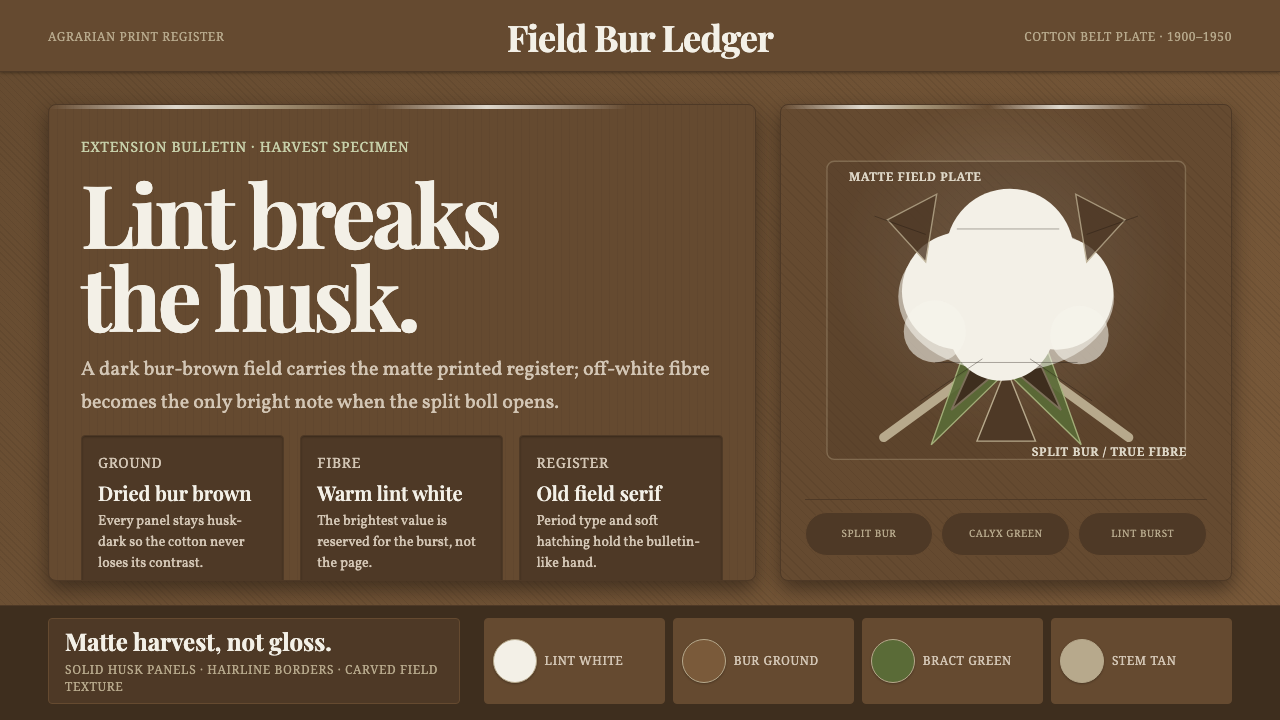 Cotton Boll HarvestHarvest contrast made matte. Off-white lint bursts from husk brown with field…
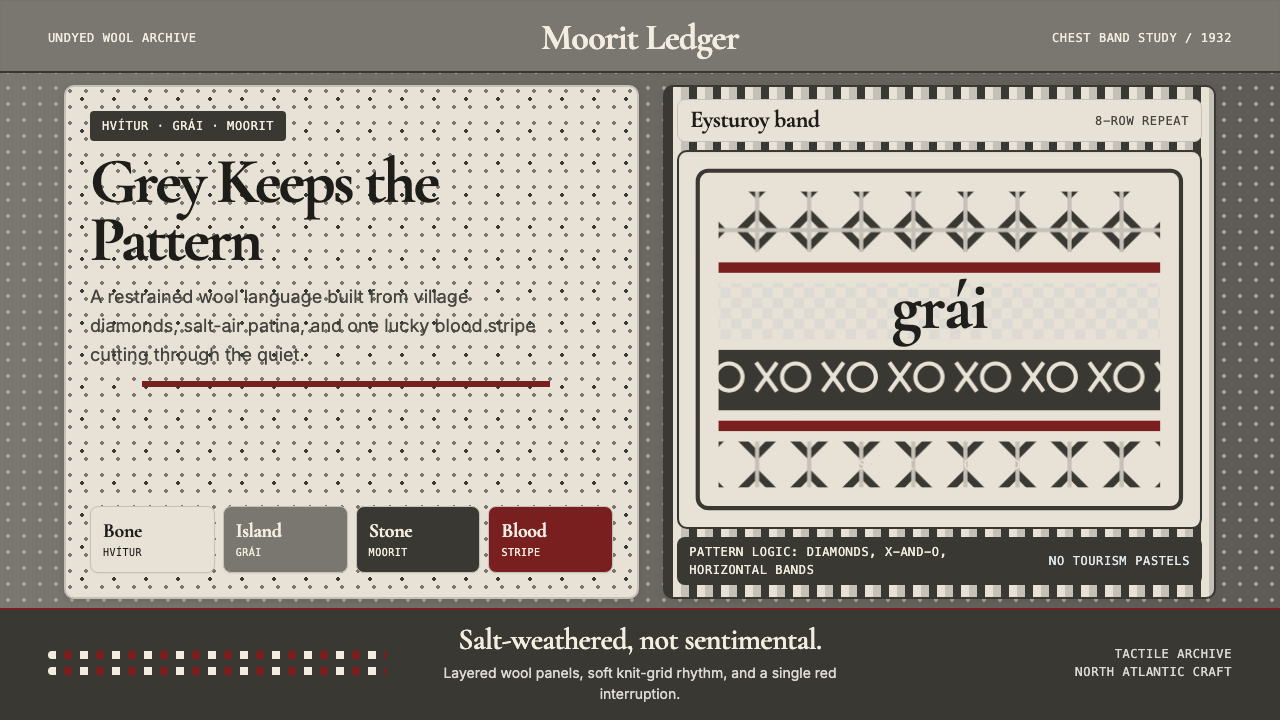 Faroese Knit Pattern Island GreyWeathered wool, not cozy kitsch. Island greys, Cormorant serif, one blood-red…
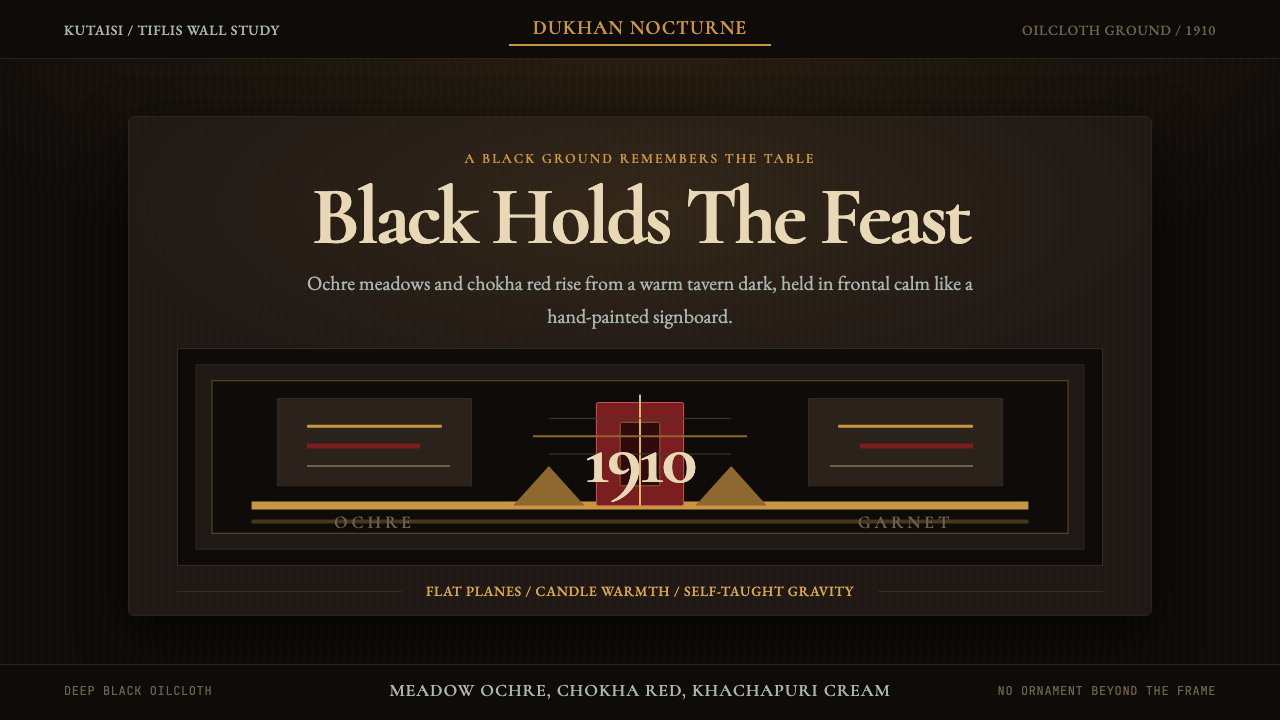 Georgian Pirosmani 1910Oilcloth black turns memory ceremonial. Ochre panels and Cormorant type hold…
 Jordanian Bedouin Black TentNight camp honesty. Goat-hair black, sadu crimson, brass lines.
 São Toméan Cocoa RoçaTropical ruin has weight. Faded pink, cocoa serif, and green edges frame the…
 Abyaneh Red VillageRed is material, not decoration. Stepped clay bands and dark timber apertures…