What is Jordanian Bedouin Black Tent?
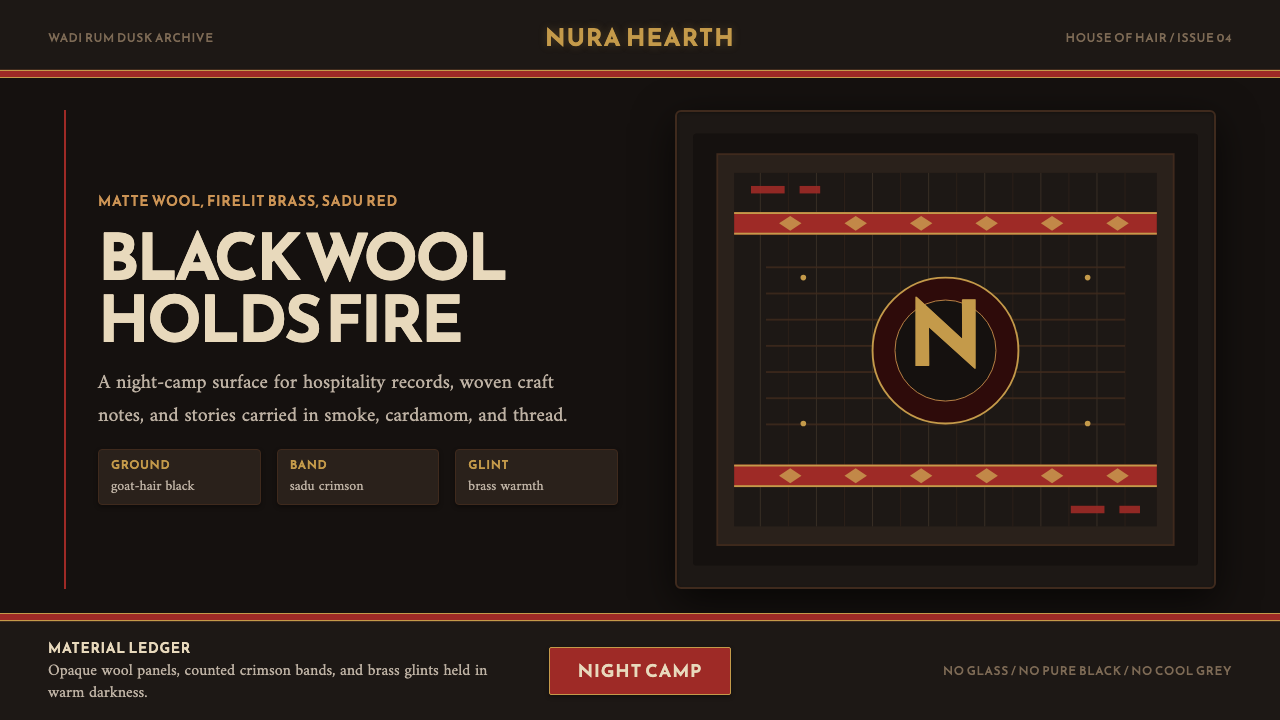
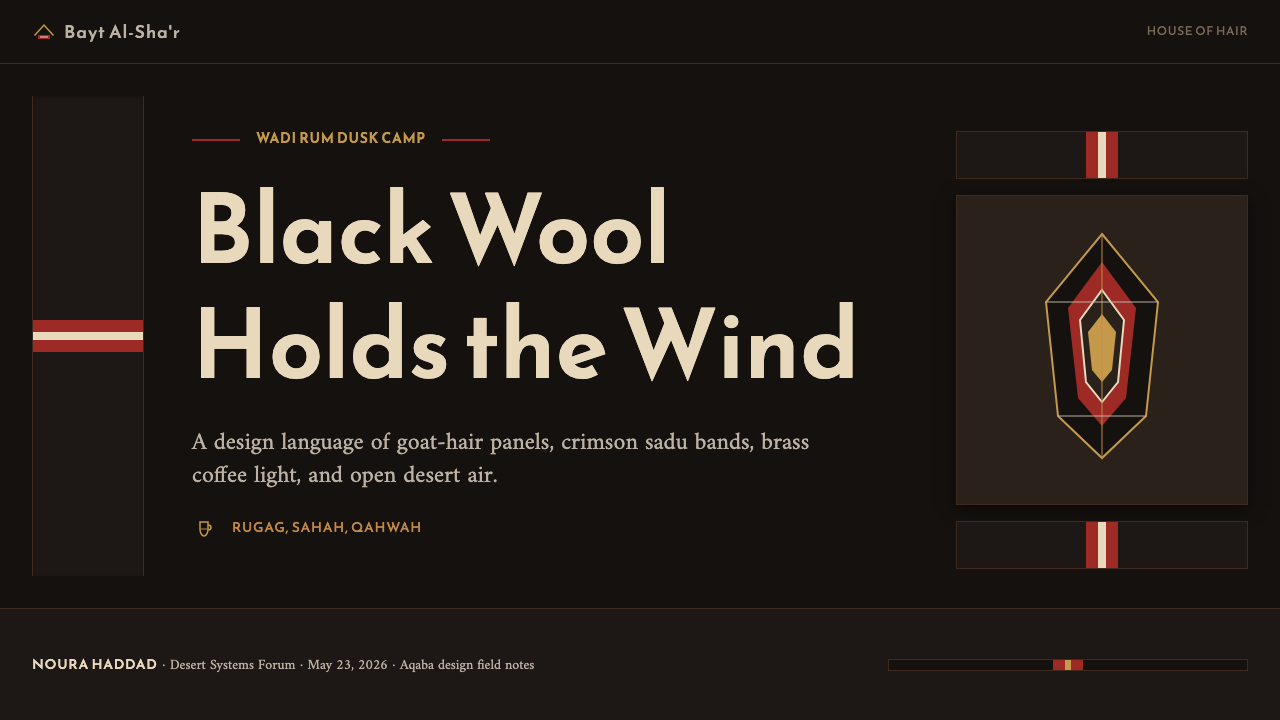
The bayt al-sha'r — the Bedouin house of hair — transforms a tradition of woven goat-hair tents and firelit night camps into a digital surface of matte black, sadu crimson, and warm brass.
Jordanian Bedouin Black Tent in brief
Jordanian Bedouin Black Tent is a design system rooted in the material culture of Jordan's nomadic Bedouin. Its palette derives directly from the bayt al-sha'r — the traditional black goat-hair tent woven by Bedouin women on ground looms — and the objects that surround it: the crimson and geometric bands of sadu carpet, the amber gleam of brass dallah coffee pots, the warm ochre of Wadi Rum sandstone at dusk. Every visual decision is an echo of that tent's uncompromising material honesty.
The style reads as dark luxury rooted in the desert rather than in contemporary minimalism. Where many dark-mode design languages reach for cool blue-grey undertones and weightless gradients, this system stays warm and tactile: the blacks carry the memory of dyed wool, the reds are saturated and earthbound, the brass accents feel hammered rather than polished. The overall mood is firelit night camp — smoke, wool, brass, cardamom — translated into interface.
This is not a decorative or ethnographic pastiche. It is a design system that takes the structural logic of Bedouin material culture — woven bands as dividers, tent poles as vertical rhythm, hospitality ritual as information hierarchy — and applies it to screens. The result is a dark aesthetic that feels both ancient and distinctly contemporary.
Where does Jordanian Bedouin Black Tent come from?
The bayt al-sha'r has sheltered the Bedouin of the Arabian Peninsula and the Levant for at least two thousand years. Its construction is both ancient and precise. Women spin the hair of black goats into yarn, then weave it on horizontal ground looms into long strips — the falaij — that are stitched together to form the roof and walls of the tent. Goat hair swells when wet, making the roof nearly waterproof in rain, and the loose weave allows air to circulate in desert heat. The black color is not dyed but inherent to the breed of goat; the tent's darkness is the darkness of the animal itself.
Sadu — the geometric weaving tradition that produces the tent's interior rugs, divider curtains, and camel trappings — is the visual language encoded into this design system. Sadu patterns are built from diamonds, triangles, chevrons, and interlocking bands in deep crimson, brick red, ivory, and black. The patterns are not merely decorative: they identify tribal affiliation, mark seasons and ceremonies, and record a weaver's personal vocabulary. UNESCO recognized sadu as Intangible Cultural Heritage in 2020, acknowledging its role as a living language of Bedouin identity. In Jordan, the tradition is concentrated in the Badia desert region, the Wadi Rum plateau, and the communities around Petra.
The dallah — the long-spouted brass or copper coffee pot — is the ritual object that anchors the system's accent color. Qahwah, the spiced cardamom coffee served to guests, is not merely a beverage in Bedouin culture: it is a formal declaration of hospitality, governed by precise ritual. The host pours from the dallah into small handleless cups, refilling until the guest signals they are satisfied by tilting the cup. The brass of the dallah, warmed by the fire, catches light in a way that is at once functional and ceremonial — this is the source of the system's brass glint, the single warm metallic note against the matte black field.
Sheikh Auda abu Tayi, the legendary Howeitat warrior and figure in the Arab Revolt of 1916 — made famous in the West through Lawrence of Arabia — personifies the culture of the black tent at its most historically consequential. Wilfred Thesiger, the British explorer who crossed the Empty Quarter in the 1940s, documented Bedouin tent culture with both anthropological precision and genuine admiration, producing some of the most detailed accounts of sadu weaving and qahwah ritual available in English. The Bani Hamida cooperative, established in the 1980s near Mukawwar in Jordan, gave Bedouin women an economic structure for their weaving, preserving sadu as a living practice rather than a museum artifact.
What defines the Jordanian Bedouin Black Tent look?
Ground Palette
The base of every surface is a deep, matte black that reads as dyed wool rather than void. It is warm rather than cool — closer to charcoal blackened by fire than to the blue-blacks of tech dark modes. This warmth is essential: it gives the system its material resonance, making the screen feel more like woven fabric than a lit panel.
Sadu Crimson Accent
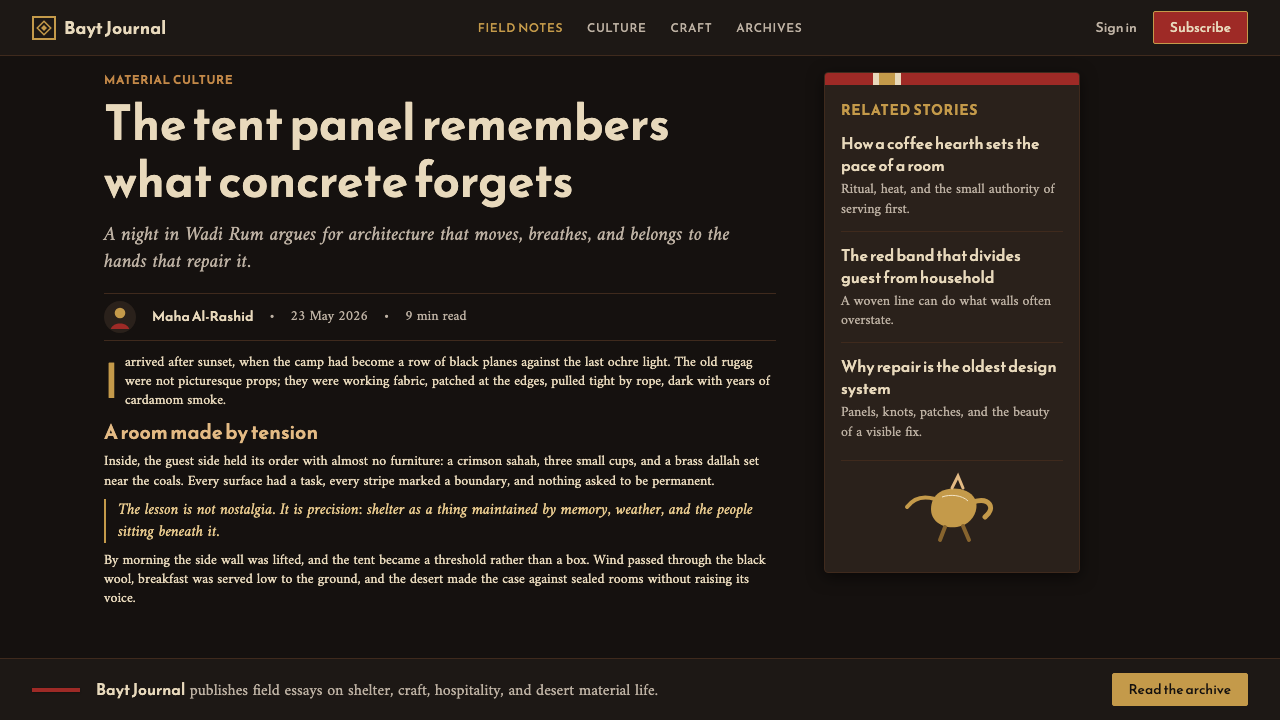
The primary accent color is a saturated, earthbound crimson — not the bright red of alerts or the cool red of corporate brands, but the deep, slightly brick-toned red of sadu carpets. It appears as woven bands across card headers, as active states in navigation, and as the key color for calls to action. This red carries cultural weight: in sadu weaving, crimson marks structure and boundary, which is precisely how it functions in the interface.
Brass Dallah Glint
A warm, hammered-gold accent — drawn from the color of firelit brass coffee pots — serves as the tertiary highlight. It appears sparingly: on premium badges, on key interactive icons, on the edges of selected states. The brass note is never applied broadly; it functions like the glint of metal in candlelight, drawing the eye to exactly one point at a time.
Wadi Rum Ochre
A warm sandstone ochre — the color of Wadi Rum at dusk, when the red desert rock holds the last of the sun — serves as the system's secondary background and muted text color. It is the hue that breathes between the deep black ground and the crimson bands, preventing the palette from feeling oppressive. On cards, it signals secondary or informational content; in text, it indicates metadata and supporting copy.
Woven Band Rhythm
The structural logic of sadu — long horizontal bands of color that divide and organize the tent interior — translates directly into the system's layout grammar. Content sections are separated by bands rather than lines, cards carry a top-edge color stripe that signals category or tier, and data tables treat alternating rows as woven strips. The visual rhythm is horizontal, measured, and geometric.
Geometric Textile Motifs
Sadu patterns — diamonds, chevrons, stepped triangles, interlocking parallelograms — appear as decorative but structurally purposeful elements: as divider ornaments at section breaks, as icon shapes, as loading indicators. They are never applied as wallpaper or surface texture; each motif marks a structural point in the layout, the way a sadu border marks the edge of a tent panel.
Typography: Geometric Tension and Calligraphic Warmth
The type system pairs a geometric display face — angular, confident, well-suited to Arabic script — with a calligraphic serif for extended reading. Headlines carry the visual weight of tent poles: upright, structural, load-bearing. Body text leans into warmth and legibility, echoing the flowing quality of Arabic calligraphy. The combination prevents the deep-black palette from reading as cold or severe.

Who shaped Jordanian Bedouin Black Tent?
The paramount chief of the Howeitat tribe and one of the most celebrated warriors of the Arab Revolt, Auda abu Tayi embodies the Bedouin values that animate this design system: fierce hospitality, material austerity, and an uncompromising relationship with the desert environment. His tent was his court, the dallah his protocol, and the sadu carpet his throne room. Lawrence of Arabia described his guest tent as a place where tribal authority and hospitality were performed with exact, unselfconscious ceremony.
The British explorer who crossed the Rub al-Khali (Empty Quarter) twice in the late 1940s was also among the most attentive foreign documenters of Bedouin material culture. His photographs and writings record sadu weaving techniques, the construction of the bayt al-sha'r, and the precise protocol of qahwah hospitality with an ethnographic fidelity rare in mid-twentieth-century travel literature. His work made Bedouin tent culture visible to designers and cultural historians in the West who would otherwise have had little access to primary material.
Founded in 1985 in the village of Mukawwar in central Jordan, the Bani Hamida cooperative organized Bedouin women weavers into a sustainable economic structure. Before the cooperative, sadu was practiced largely within domestic contexts, with limited visibility or market access. The cooperative preserved sadu patterns, maintained quality standards, and brought Bedouin weaving to international markets — ensuring that the visual vocabulary encoded in this design system remained a living tradition rather than a purely archival one.
The British officer who commanded Jordan's Arab Legion from 1939 to 1956 spent decades embedded in Bedouin communities in the Jordanian Badia, and wrote extensively about Bedouin tent culture, tribal law, and the material conditions of nomadic life. His accounts of the bayt al-sha'r — its construction, its spatial organization, the sadu textiles that divided its interior — are among the most detailed available from the mid-twentieth century, providing the kind of close material description that underpins the system's design decisions.
How do you use Jordanian Bedouin Black Tent today?
The Jordanian Bedouin Black Tent style is well-suited to any context where warmth, depth, and cultural distinctiveness are desirable alongside authority and clarity. It works best as a full commitment rather than a partial application: the palette's coherence depends on the interplay of its specific blacks, crimsons, ochres, and brass, and partial adoption tends to produce results that read as dark-mode generic rather than distinctively tent-derived.
For presentation slides, the style excels on cover pages built around a single powerful image or typographic statement — matte black ground, a sadu-crimson headline, and brass used to highlight one word or figure. Content slides work well with the woven-band logic: use a narrow top-edge crimson or ochre stripe to label each slide's section, keep body text in a warm off-white against the dark ground, and allow generous vertical breathing room. Data slides take on an unexpectedly strong character in this system — bar charts with crimson or brass fills against the dark field read as almost calligraphic, and the ochre provides a natural secondary series color.
For web interfaces, the style is strongest in dashboard and pricing contexts where dark surfaces signal premium or professional positioning. Apply the sadu band logic to card components: each card sits on the dark field with a top-edge color stripe that signals category. Navigation should be typographic and restrained — no icon clutter, just text labels and geometric indicators in ochre or crimson. Interactive states use brass as the active or hover color; destructive states use a lighter, more urgent crimson. Avoid applying the geometric sadu motifs as background textures — they are structural ornaments, not wallpaper.
For editorial and marketing work, the system's cultural distinctiveness makes it particularly effective for content about the Middle East, heritage brands, craft businesses, and any product where the source of materials or the authenticity of process is a selling point. Full-bleed feature blocks alternating between crimson-on-black and ochre-on-black create a strong magazine-like rhythm. Pull quotes and callouts work well in a card style with the brass top-edge stripe. For marketing pages, the tent-pole analogy works literally: use tall, vertical typographic blocks as structural anchors, separated by horizontal sadu-band dividers.
The most common mistake when applying this style is treating it as a generic dark luxury theme and reaching for cool greys, blue-tinged blacks, or generic gold accents. Each of those substitutions severs the system from its material source. The blacks must stay warm; the reds must stay earthy and saturated rather than corporate-bright; the gold must stay at the hammered-brass end of the spectrum rather than the jewellery-gold end. A second common error is overloading the sadu motifs — using geometric patterns as backgrounds or repeated surface textures rather than as precise structural markers. Restraint in the motifs makes them ceremonial; excess makes them noise.
Jordanian Bedouin Black Tent — FAQ
Is this style appropriate for non-Middle Eastern brands?
Yes, provided the adoption is respectful and purposeful rather than superficial. The system works well for any brand that values material authenticity, handcraft heritage, warm darkness, and a sense of deep time. The risk to avoid is reducing the style to surface exoticism — applying the geometric motifs as decoration while ignoring the structural logic underneath. Used well, the style communicates that a brand is rooted, serious about its materials, and uninterested in trend-chasing. Used poorly, it reads as costume.
How does this differ from other dark luxury design systems?
Most dark luxury systems are cool, smooth, and forward-looking — they use deep navy, charcoal with blue undertones, silver or chrome accents, and clean sans-serif type to signal modernity and technological sophistication. The Bedouin black tent system is deliberately the opposite: warm, textured in concept if not in pixel, backward-looking in the best sense, and grounded in craft rather than technology. Its darkness is the darkness of night camp, not of a cinema screen. This makes it unusually effective for brands where heritage, warmth, and handmade quality are selling points.
Can this style work in a light-mode version?
A light inversion is possible but loses much of the system's distinctive character. The style's power comes from the contrast between the deep warm black ground and the crimson and brass accents — the same relationship that makes the black goat-hair tent so visually striking against the Wadi Rum landscape. On a light ground, the crimson becomes a standard accent red and the brass reads as ordinary gold; the sense of firelit depth disappears. If a light mode is required, use the ochre as the primary background rather than pure white — it preserves more of the palette's warmth and still reads as related to the dark version.
How do I use the sadu geometric motifs without making the design feel cluttered?
The key is to treat each motif as a structural marker, not a decorative fill. In sadu weaving, the geometric bands mark the edges, junctions, and category breaks of the textile — they are never applied as an all-over pattern. Apply the same discipline in digital work: use a single diamond or chevron motif at a section break, not as a repeating tile across a card background. Reserve the most complex motifs — the interlocking parallelograms and stepped triangles — for the most architecturally significant moments, such as a hero section divider or a premium tier badge. Used sparingly, the motifs feel ceremonial; used broadly, they collapse into background noise.
What kind of imagery pairs best with this system?
Photography that is warm-toned, high-contrast, and material in subject: close-up textures of woven fabric, brass and copper surfaces, sandstone and desert rock, hands at work, fire and candlelight, architectural details in raked light. Avoid cool, blue-tinted photography; avoid the clean white-box product photography of tech and e-commerce; avoid lifestyle photography with heavy ambient softness. When used at full bleed, photographs should be treated with a warm tone overlay to harmonize with the palette rather than sitting as a neutral window. Illustration that draws on geometric abstraction in the sadu tradition works well as supplementary visual language.
Related design styles
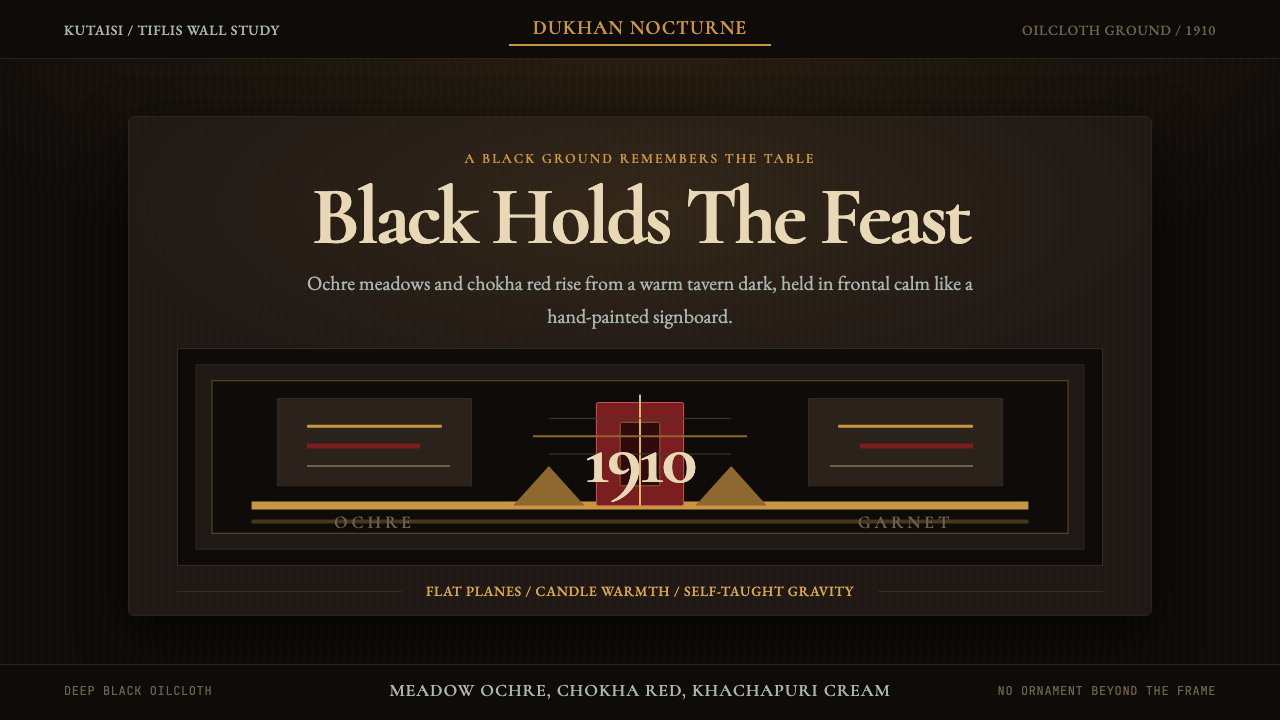 Georgian Pirosmani 1910Oilcloth black turns memory ceremonial. Ochre panels and Cormorant type hold…
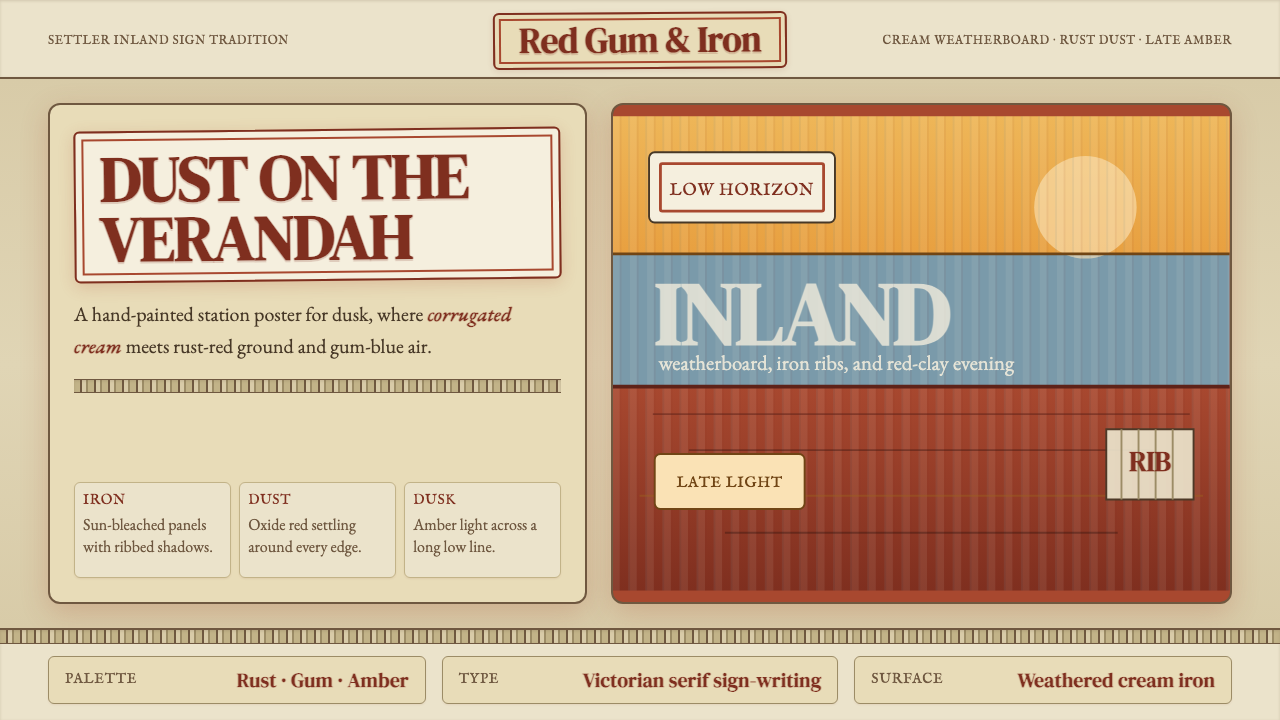 Australian Outback VernacularWeather is the voice. Rust dust, gum-blue bands, and serif sign-writing age t…
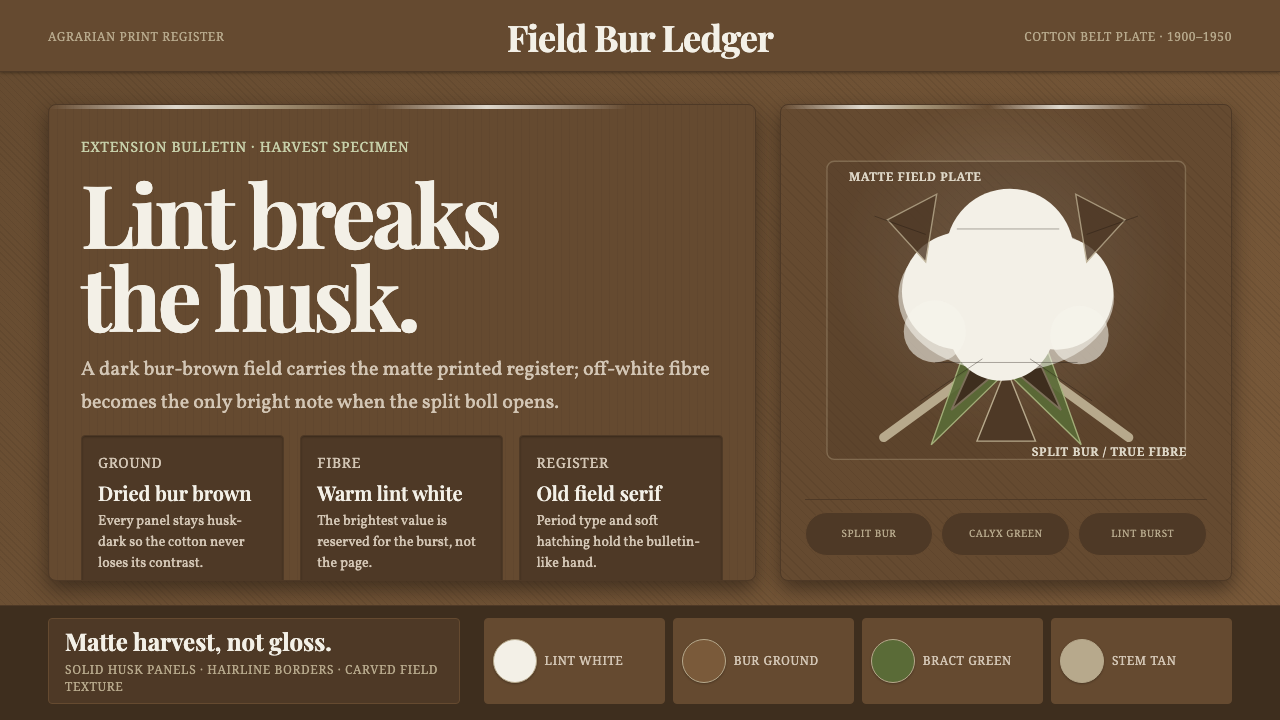 Cotton Boll HarvestHarvest contrast made matte. Off-white lint bursts from husk brown with field…
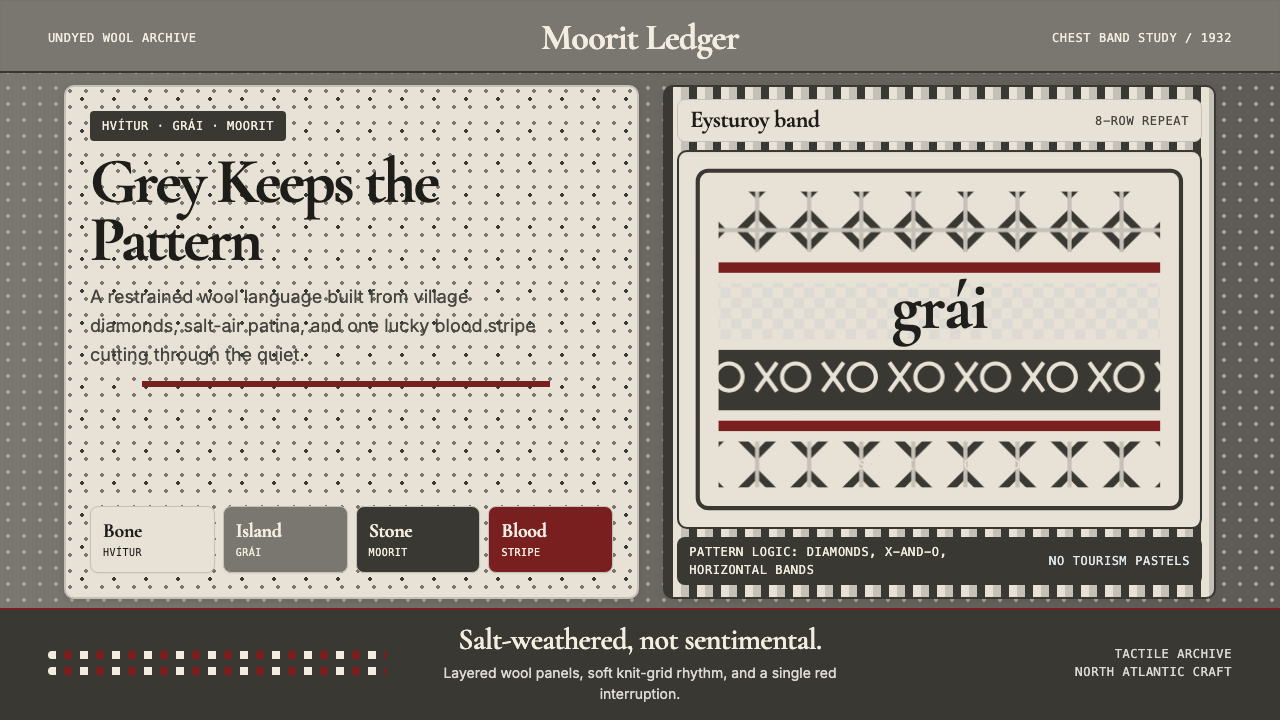 Faroese Knit Pattern Island GreyWeathered wool, not cozy kitsch. Island greys, Cormorant serif, one blood-red…
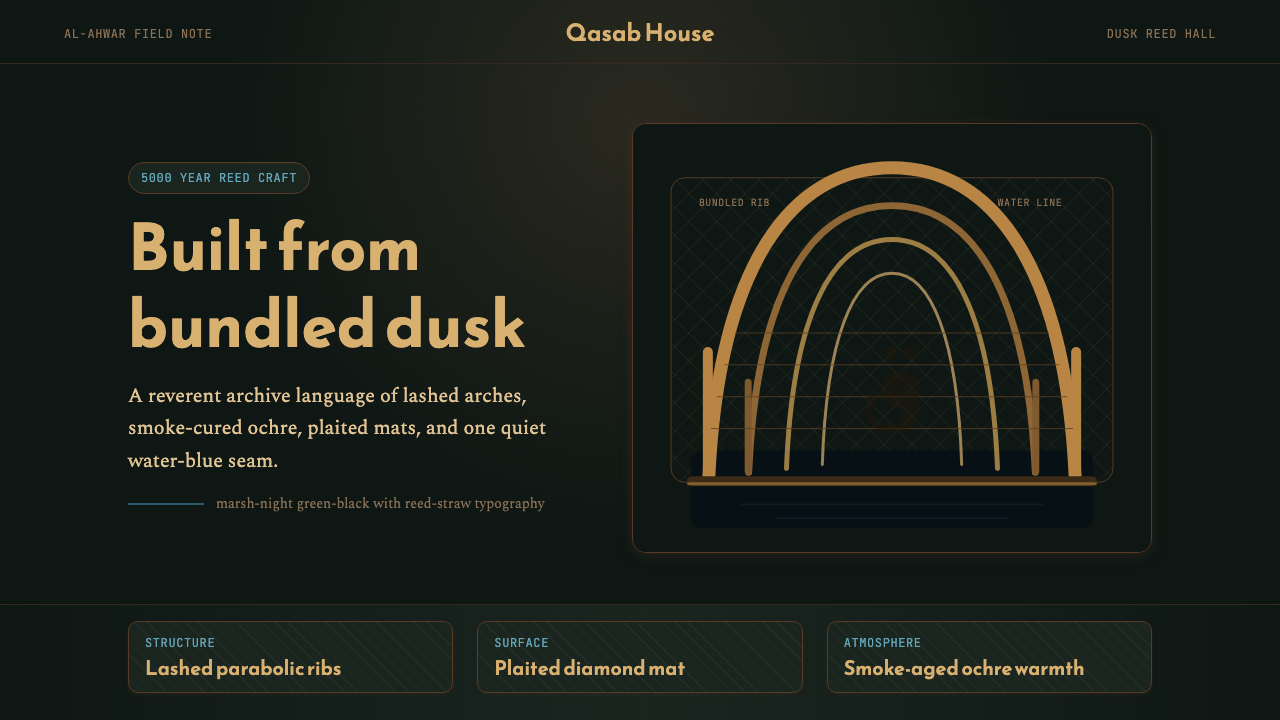 Iraqi Marsh Arab Mudhif ReedReverent reed darkness. Kufi arches, ochre lattice, and one water-blue line h…
 São Toméan Cocoa RoçaTropical ruin has weight. Faded pink, cocoa serif, and green edges frame the…