What is Hawaiian Hula Pahu Drum?
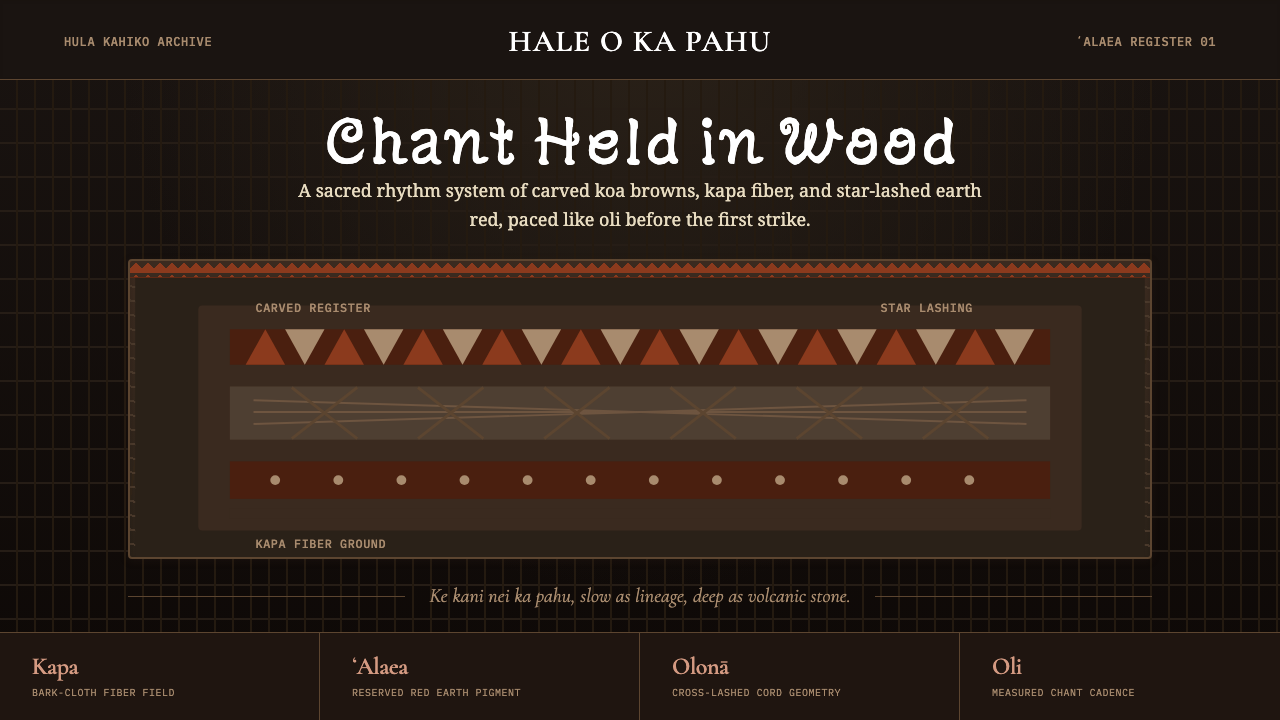
Carved from a single sacred log and lashed with sharkskin, the pahu drum gives Hawaiian hula its spiritual gravity — and its design vocabulary of layered registers, earth-pigment color, and the irreplaceable mark of the maker's hand.
Hawaiian Hula Pahu Drum in brief
Hawaiian Hula Pahu Drum is a design aesthetic rooted in the sacred material culture of hula kahiko — the ancient form of Hawaiian hula performed as prayer, genealogy chant, and living oral archive. The visual language derives from three physical sources: the stacked geometric registers carved into pahu drum bodies, the muted mineral pigments stamped into kapa (bark cloth), and the slow weighted rhythm of oli (chant) that governs the pace of every performance.
Where many design systems borrow from art movements or brand identities, this aesthetic draws from ceremonial objects whose every surface decision carries spiritual consequence. The drum is not merely decorated; it is encoded. The carved bands that ring its body mark sacred registers in the same way that genealogical chant marks lineage — each layer distinct, each connected to those above and below it. Applied to visual design, this translates into a system built on horizontal stratification, tactile surface memory, and deliberate asymmetries that feel weighted rather than accidental.
The result is a visual world that feels ancient without being archaic, hand-made without being crude. Surface irregularity is not a flaw — it is the evidence of human intent. Every edge that deviates slightly from the geometric ideal, every pigment wash that pools unevenly at a corner, is understood as the mark that distinguishes a made thing from a manufactured thing. This is, at its core, an aesthetic of sacred craft.
Where does Hawaiian Hula Pahu Drum come from?
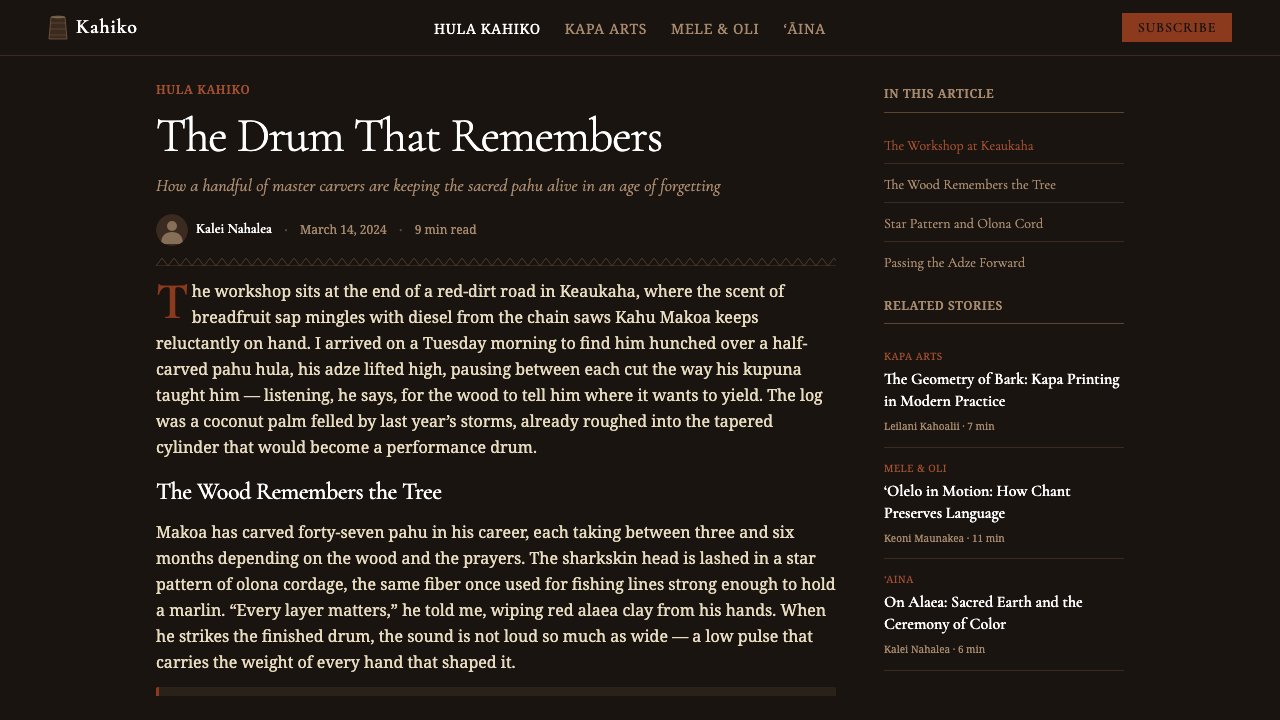
The pahu drum's origins on the Hawaiian archipelago are traced to Polynesian migrations from the Society Islands, likely arriving in the Hawaiian chain between 1000 and 1200 CE. The word pahu itself appears across Polynesia — in Tahitian, Māori, and Tongan traditions — always associated with sacred percussion. In Hawaiʻi, the pahu became the only drum considered kapu (sacred, restricted) enough to be used in the highest ceremonies of hula. Its fabrication was a priestly act: the log selected from a specific breadfruit or coconut palm tree, the hollowing done by ritual specialists, the sharkskin head lashed in the star-pattern configuration of olonā cordage that remains characteristic to this day.
Hula kahiko — the ancient practice in whose service the pahu functions — is inseparable from the concept of mele, the chant or poem that the dance embodies. Hawaiian culture preserved its history, cosmology, and genealogy not through written script but through mele: thousands of lines memorized and transmitted across generations with extraordinary precision. The hālau hula (hula school or academy) was the institutional structure through which this knowledge moved. Kumu hula (hula masters) held the role of cultural guardians, responsible not only for the correct transmission of movement but for the integrity of the text and the proper ceremonial conduct that surrounded each performance.
The arrival of Western missionaries in 1820 brought sustained pressure on Hawaiian traditional practices. By the mid-nineteenth century, hula was officially discouraged and in some contexts banned. The reign of King David Kalākaua (1874–1891) — who became known as the Merrie Monarch — marked the first major revival. Kalākaua openly celebrated hula, commissioned new mele, and insisted on the cultural dignity of Hawaiian practices at a moment when annexation was already politically visible on the horizon. His sister and successor, Queen Liliʻuokalani, composed some of the most enduring Hawaiian songs of the period, including Aloha ʻOe, before the monarchy was overthrown in 1893.
The twentieth century brought a second and more structurally deep revival. Figures such as Maiki Aiu Lake, Edith Kanakaʻole, and George Naʻope devoted their lives to recovering, documenting, and transmitting lineages of hula kahiko that had been nearly lost. The Merrie Monarch Festival, established in 1963 in Hilo on Hawaiʻi Island and named in honor of Kalākaua, became the annual event that gave the revival competitive structure, public visibility, and intergenerational urgency. By the 1970s and 1980s, the Hawaiian cultural renaissance was in full force — a movement that included language revitalization, the construction of traditional voyaging canoes, and the continued deepening of hula practice as a living tradition rather than a preserved artifact.
What defines the Hawaiian Hula Pahu Drum look?
Earth-Pigment Palette
The color vocabulary is drawn entirely from natural sources found in the Hawaiian archipelago. ʻAlaea — a volcanic red ochre clay used to consecrate salt, mark sacred boundaries, and dye kapa — provides the dominant warm red-earth tone. Alongside it sit the deep brown-blacks of charred kukui nut and the creamy off-whites and tans of undyed kapa itself. These are not bright or fully saturated hues; they carry the visual weight of materials that have been worked by hand, exposed to air and salt, and marked by use. Greens arrive through taro leaf and fern frond, muted rather than vivid.
Stacked Register Geometry
The pahu drum body is carved in distinct horizontal bands — each register separated from the next by a clean incised groove, each filled with a repeating geometric pattern: chevrons, diamonds, stepped triangles, interlocking spirals. This stacked horizontal structure is the dominant compositional logic of the aesthetic. Layouts built on this principle read from top to bottom in weighted bands rather than in free-floating elements. Each zone of content is complete in itself while contributing to the vertical rhythm of the whole.
Kapa Texture and Surface Memory
Kapa — bark cloth beaten from the inner bark of the wauke (paper mulberry) plant — is the textile soul of this aesthetic. Kapa carries the impressions of the tools used to make it: the grain of the wooden anvil, the ridges of the beater, the slight irregularity of each stamp applied by hand. Translated into visual design, this manifests as surface fields that are never perfectly flat: a slight grain across a background field, a stamp pattern that repeats with subtle variation, textures that imply a material history rather than a computational origin.
Weighted Asymmetry
Hula kahiko is performed with the body low and centered over the earth — the knees bent, the pelvis grounded. The visual equivalent of this posture is compositional weight distributed toward the lower register rather than centered or floated high. Layouts feel anchored rather than airy. Asymmetry, when it appears, arrives from the logic of the drum's carved surface: one register wider than the next, one motif slightly offset from its neighbor. The visual system does not seek balance through mirroring but through counter-weight.
The Mark of the Maker
In Hawaiian craft tradition, the kalo (taro) plant is considered the elder sibling of the human race — and human work carries this genealogical weight. Objects made by hand are understood to carry the mana (spiritual power) of their makers. The design implication: perfection is not the goal. What a tool, a hand, or a natural material does when allowed to behave according to its own nature is the goal. Woodgrain follows the tree's growth; pigment settles where physics allows it. The maker's role is to guide, not to override. In visual design, this principle opposes the impulse toward pixel-perfect uniformity.
Sacred Darkness
The pahu aesthetic is fundamentally dark-ground. The drum body is typically rendered in deep, warm browns and blacks — the natural tones of aged hardwood, charred finish, and shadow within the carved registers. Light does not flood these surfaces; it catches on ridges and recedes into grooves. This makes negative space in the carved registers — the shadow itself — as visually active as the raised form. In design terms, backgrounds are deep and warm rather than neutral grey or cool charcoal, and light elements emerge from that depth rather than sitting on top of a white field.
Rhythmic Repetition with Variation
Oli — Hawaiian chant — does not progress through linear argument but through cyclical return: a phrase recurs, slightly altered, charged with different meaning each time it reappears. The design parallel is a system of motifs that repeat across the composition with deliberate variation — not the mechanical repeat of a digital tile, but the hand-stamped repeat where each impression carries its own slight irregularity. Pattern is the organizing principle; variation within pattern is what makes the surface alive rather than static.

Who shaped Hawaiian Hula Pahu Drum?
Edith Kanakaʻole (1913–1979) was a kumu hula of the first order — a chanter, composer, teacher, and cultural guardian whose work fundamentally shaped the twentieth-century understanding of hula kahiko. She founded the Hālau o Kekuhi lineage on Hawaiʻi Island and spent decades recovering chants and protocols that Western influence had driven into dormancy. Her compositions are still central to the hula kahiko repertoire, and her insistence that chant, movement, and ceremony be taught as an integrated whole — not separated into folklore performance — remains the standard for serious hula pedagogy.
Maiki Aiu Lake (1920–1984) is often described as the teacher who returned hula kahiko from near extinction to living practice. Operating in Honolulu at a time when ancient hula had been largely displaced by the tourist-oriented hula ʻauana, she trained a generation of kumu hula who would go on to lead the cultural renaissance — among them Iolani Luahine, Robert Cazimero, and Vicky Holt Takamine. Her conviction that hula kahiko required not adaptation for modern audiences but restoration to its original rigor and spiritual context defined the terms of the entire revival.
George Naʻope (1928–2009) was among the principal architects of the Merrie Monarch Festival, co-founding the event in Hilo in 1963 and shaping it into the most prestigious hula competition in the world. The festival's insistence on rigorous standards — specific protocols for costume, chant, and performance — gave the revival a public structure and an annual focal point that sustained momentum across generations. Naʻope trained extensively in both hula kahiko and hula ʻauana and represented for many practitioners the living connection between the pre-missionary past and the contemporary revival.
Pualani Kanakaʻole Kanahele is the daughter of Edith Kanakaʻole and co-director of Hālau o Kekuhi, the lineage her mother founded. She has devoted her scholarly and creative work to the relationship between mele, hula, and the natural environment — particularly the volcanic landscapes of Hawaiʻi Island, which appear throughout the chant traditions she preserves and teaches. Her published analyses of Hawaiian chant structure provide one of the few rigorous academic frameworks for understanding how Hawaiian oral literature encodes environmental and genealogical knowledge.
King David Kalākaua (reigned 1874–1891) initiated the first sustained political defense of hula at a moment when it was actively suppressed. His patronage of hula was not simply cultural nostalgia but a deliberate assertion that Hawaiian identity, sovereignty, and oral tradition were inseparable. Kalākaua commissioned the creation of new mele, supported the performance of hula at royal functions, and brought traditional practitioners into public life. The Merrie Monarch Festival — named in his honor — is the enduring institutional legacy of his conviction that hula was not a relic but a living political and spiritual act.
How do you use Hawaiian Hula Pahu Drum today?
Applying the Hawaiian Hula Pahu Drum aesthetic requires understanding that every visual decision is meant to feel consequential — not decorative. The system asks the designer to think like a carver: each mark has a reason, each register has a purpose, and the accumulated effect of those decisions is what creates meaning. Slapping a dark background and some geometric borders onto a layout borrows the surface without understanding the structure.
For presentation slides, this aesthetic excels on cover pages and section dividers where visual weight and ceremony matter most. A cover built in this register uses a deep warm ground — the color of aged hardwood or dark kapa — with a central carved-register composition: stacked horizontal bands, each containing a simplified geometric motif, the title text set in a serif or slab typeface with visible weight. Content slides benefit from the horizontal-band logic applied to layout sections: a top band for the heading, a wide middle band for primary content, a narrower lower band for supporting data or citations. Avoid white backgrounds — the palette demands depth.
For web interfaces, the style is most effective in contexts that need to communicate gravitas and craft: premium product landing pages, cultural institution websites, editorial platforms for longform content. Dashboard and data-heavy interfaces can use the stacked-register structure to organize information into clear horizontal zones — a top navigation band, a primary metric band, a secondary detail band — with the pahu-derived palette providing warmth to what might otherwise read as a cold analytical interface. Avoid the style for e-commerce flows that require rapid scanning, or for utility tools where visual weight would impede task speed.
In editorial and marketing work, the aesthetic supports full-page feature layouts with strong section breaks. A feature article in this register opens with a full-width dark ground carrying only the title and a single kapa-texture field, then transitions into body text set against a warm off-white. Section breaks are marked by a carved-register motif — a thin horizontal band of geometric pattern — rather than a plain horizontal rule. Marketing materials gain from the style's poster-like density: a small number of large, weighted elements rather than a busy grid of many small items.
The most common mistake when working with this aesthetic is treating it as a generic dark-bohemian style — adding many earthy tones simultaneously at full saturation, scattering texture randomly across every surface, and confusing visual busyness with cultural richness. The pahu drum body is not randomly decorated; it is precisely organized into discrete registers. Each register has one pattern, repeated consistently. Restraint in the number of active visual registers — two or three at most on any given screen or slide — is what keeps the aesthetic readable rather than overwhelming.
Hawaiian Hula Pahu Drum — FAQ
Is it culturally appropriate to use this aesthetic outside a Hawaiian context?
This is a genuine question worth engaging seriously. The Hawaiian Hula Pahu Drum aesthetic draws from a living sacred tradition — not a historical style that exists only in archives. The pahu drum is still in active ceremonial use; hula kahiko is still performed, taught, and protected by practitioners who trace direct lineages to the figures described in this article. Using the aesthetic respectfully means engaging with it as a design philosophy — its structural logic of layered registers, its commitment to surface memory, its use of weighted asymmetry — rather than appropriating its specific ceremonial symbols (such as hula implements, sacred plant forms, or motifs tied to specific lineages). Borrowing structure and principle is design literacy; copying sacred iconography without understanding its context is appropriation. The distinction is not always simple, but it is always worth making.
How does this style handle light text on dark backgrounds — does it struggle with readability?
The pahu aesthetic is fundamentally dark-ground, and readability is not a casualty — it is built into the system's logic. The key is that the dark grounds used here are warm and mid-toned rather than pure black, and the light text used against them should be warm off-white rather than pure white. Pure white on pure black creates maximum contrast that can feel harsh and modern rather than weighted and ancient. Warm cream lettering on deep oiled-wood brown is both highly legible and consistent with the palette's material logic. The system also benefits from generous leading between lines of text — the carved register's clear separation between bands is the spatial analogy — and from not setting long body text against the deepest ground tones, reserving those for display headlines and section markers.
Can this style work for a digital product that needs to feel contemporary, not archaic?
Yes, but the application requires emphasizing the structural principles over the textural surface qualities. A contemporary digital product can draw on the stacked-register layout logic — clear horizontal bands of content, each with distinct visual weight — without leaning into heavy kapa texture or explicit drum-carving motifs. The palette can be deployed with restraint: one deep warm ground, one or two earth-derived accent tones, clean typography with appropriate weight. The hula kahiko aesthetic at its most portable is about weighted hierarchy, deliberate structure, and the sense that each design decision was made with intention — qualities that read as sophisticated and considered in any cultural context, including contemporary product design.
What distinguishes this style from other Polynesian or Pacific Islander aesthetics?
The pahu drum aesthetic is specifically Hawaiian rather than generically Polynesian. While it shares with broader Polynesian visual cultures the use of geometric repeat patterns, earth pigments, and surface tactility, its distinguishing features are particular: the stacked horizontal register structure of the carved drum body (which differs from Māori koru spiral work or Samoan pe'a tatau compositions); the specific ʻalaea earth-red and kapa warm-neutral palette (which differs from the brighter ochres of some Micronesian traditions); and the weight and groundedness derived from hula's physical relationship with the earth (which distinguishes it from the more open, sky-referencing aesthetics of some Pacific navigation cultures). Within Hawaiian material culture itself, the pahu aesthetic differs from the featherwork traditions of ʻahu ʻula (feather cloaks), which use saturated reds and yellows against black in a very different compositional register.
How should this style handle motion and animation in digital interfaces?
The hula kahiko aesthetic, transposed to motion, suggests slow, weighted, intentional movement — not quick micro-interactions or playful bounce physics. Transitions between states should feel like a new register of the drum beginning: a deliberate downward reveal, a horizontal slide that moves with gravity rather than against it, a fade that is unhurried. Fast interactions undermine the system's logic of weighted intention. If an interface built on this aesthetic needs to include faster functional animations — a loading state, a form validation flash — these should be implemented as brief and neutral as possible, so that the overall pace of the experience remains anchored in the slow, grounded rhythm of oli.
Related design styles
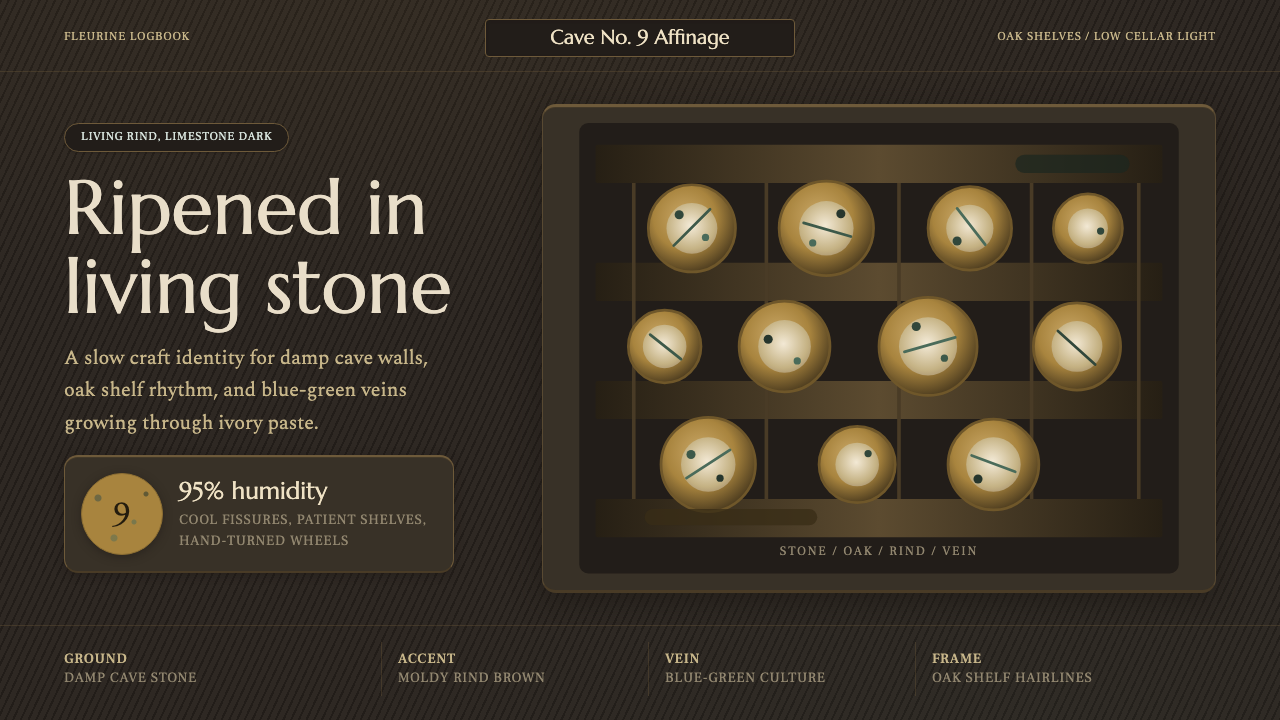 Cheese Affinage CavePatience reads as stone. Rind brown, mold green, and oak shelf grids glow in…
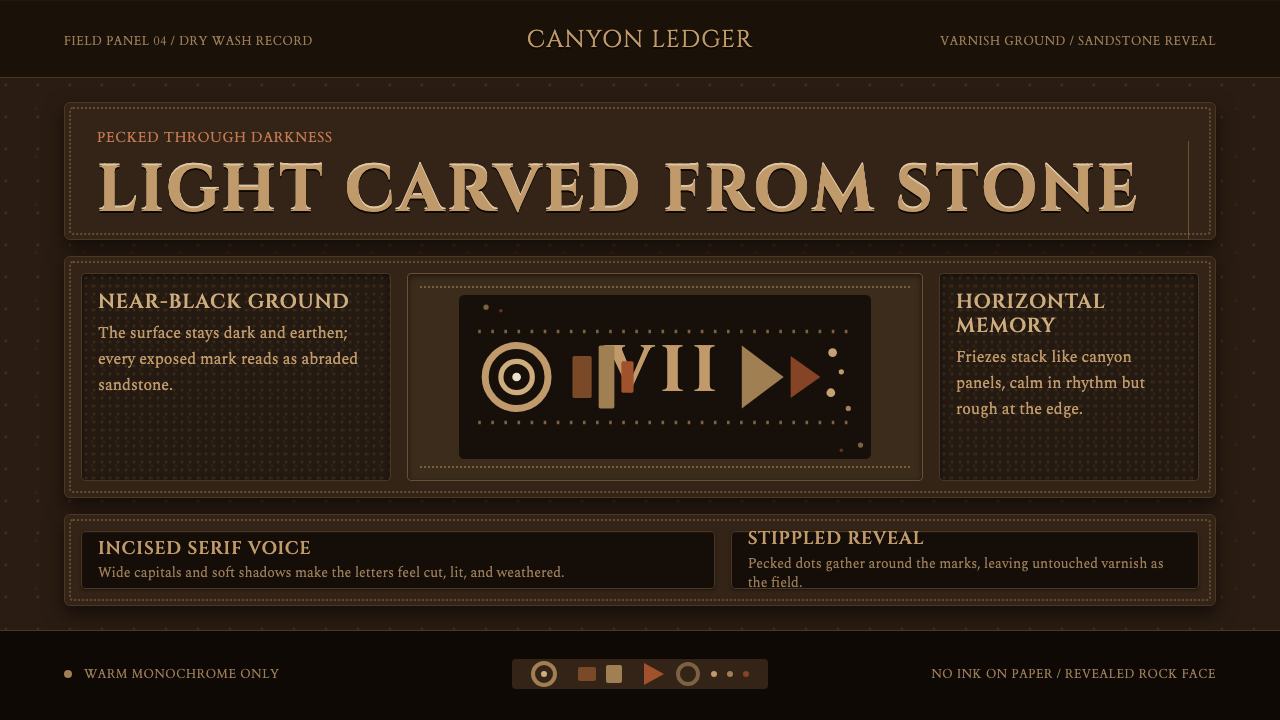 Desert VarnishStone remembers. Sandstone glyphs cut through near-black varnish in stacked f…
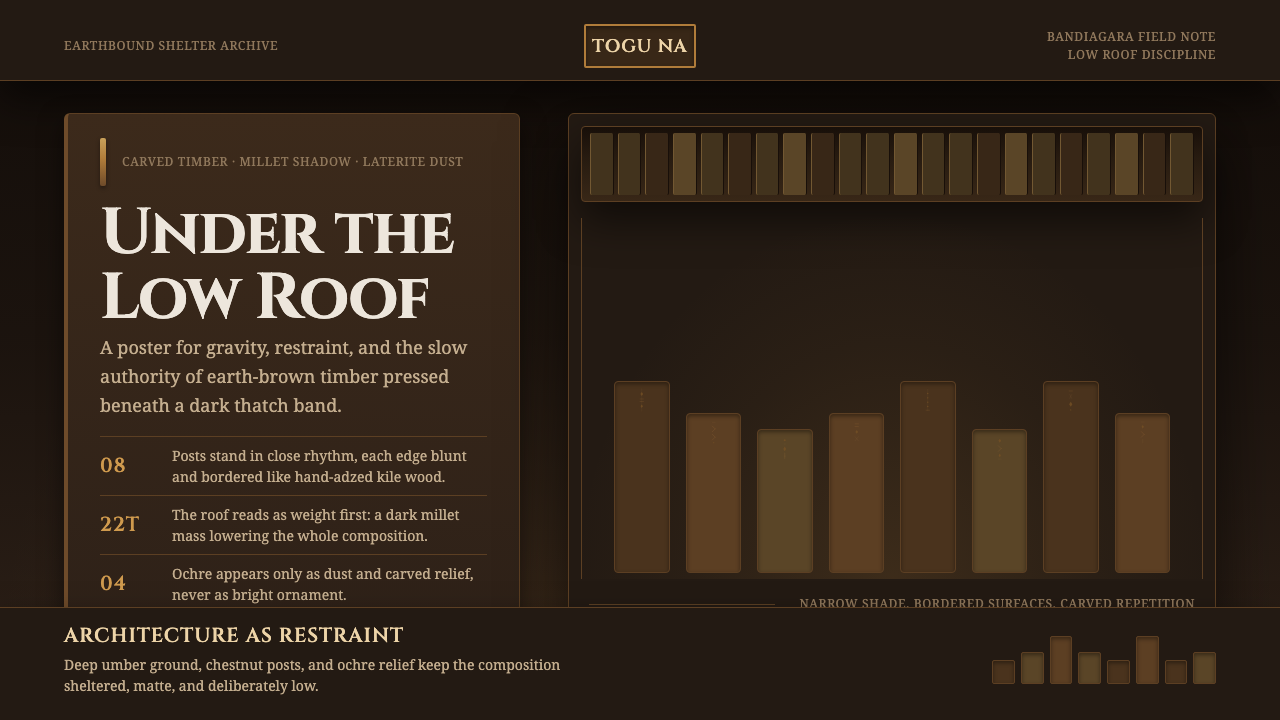 Dogon Toguna Shelter MaliGravity made visible. Deep umber ground, low roof band, chestnut posts in sha…
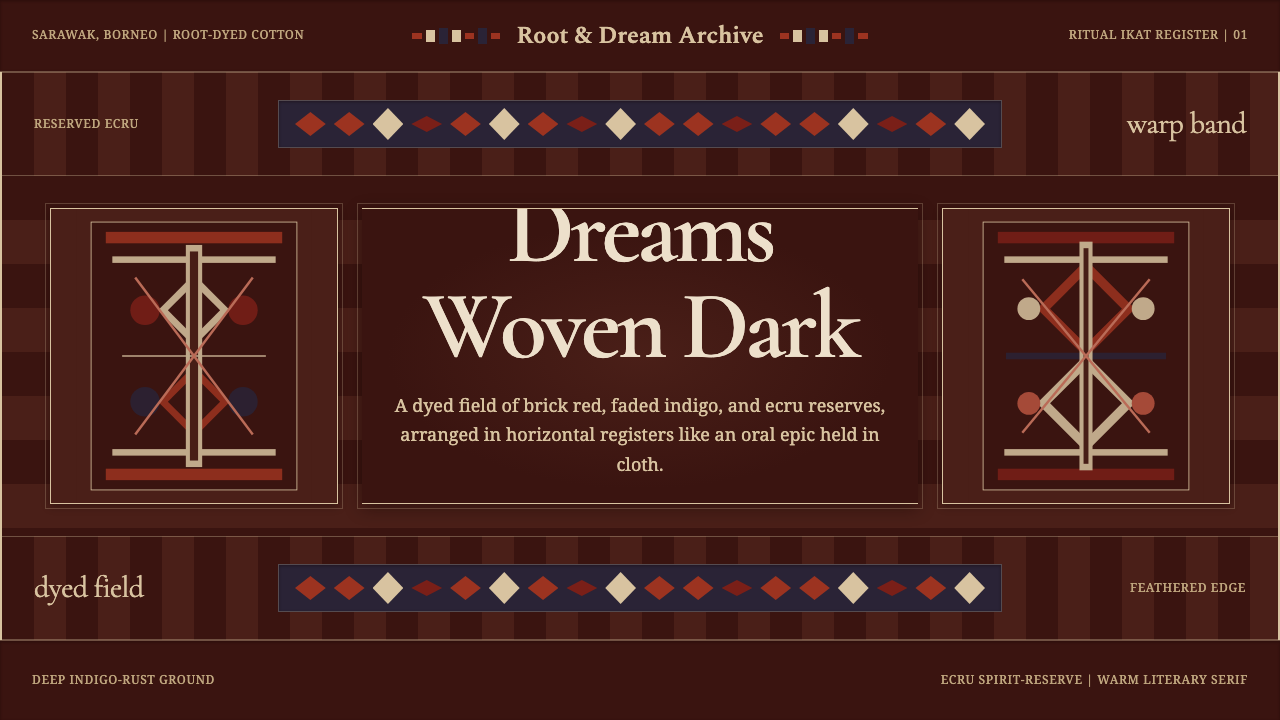 Iban Pua KumbuSacred cloth logic. Indigo-rust bands, ecru reserves, and blurred ikat edges…
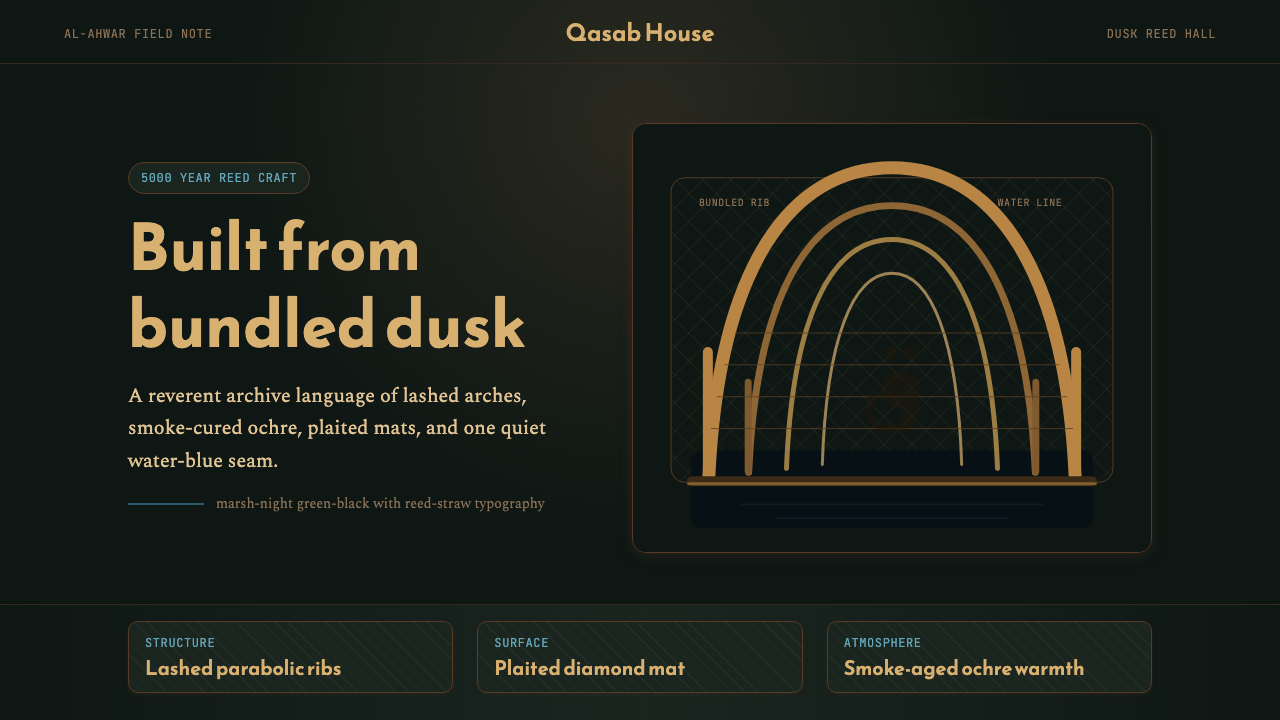 Iraqi Marsh Arab Mudhif ReedReverent reed darkness. Kufi arches, ochre lattice, and one water-blue line h…
 Nok Terracotta NigeriaAncient clay holds the dark. Russet grain, Cinzel labels, and pierced triangl…