What is Ugandan Mutuba Barkcloth?
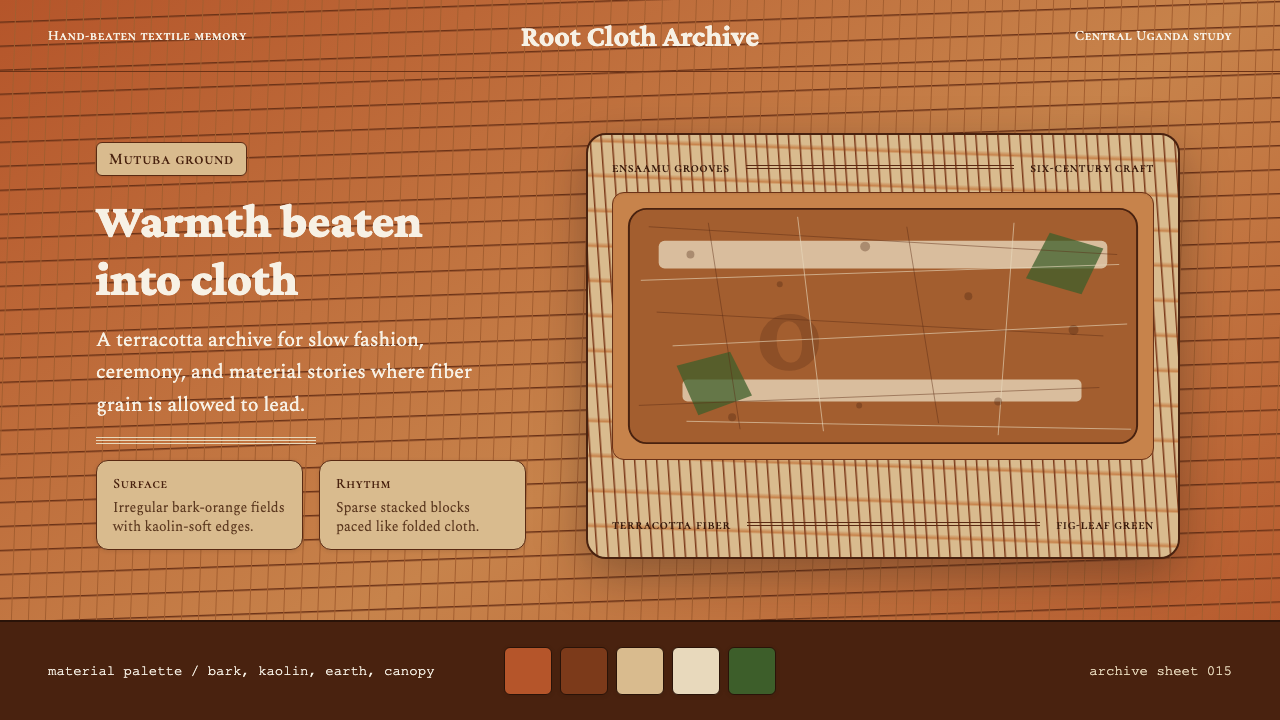
Beaten from the living bark of sacred fig trees, Ugandan mutuba barkcloth carries six centuries of Buganda royalty, ritual, and hand-worked warmth into every terracotta-orange sheet.
Ugandan Mutuba Barkcloth in brief
Ugandan mutuba barkcloth — known in Luganda as olubugo — is one of Africa's oldest continuously produced textiles, made not from woven fiber but from the pounded inner bark of the mutuba fig tree (Ficus natalensis). Craftsmen strip a section of bark from living trees, soak it, then beat it repeatedly with grooved wooden mallets until the fibrous mass stretches and thins into wide, supple sheets of a deep terracotta-orange hue. The material's surface carries the memory of every mallet stroke: a subtle, irregular texture that no mechanical process can replicate.
The resulting cloth is neither stiff nor fragile. It drapes softly, accepts natural dyes readily, and develops a warmer tone with age and handling. Historically it served every register of Buganda society — from the coronation robes of the Kabaka (king) to the wrapping cloths of the dead, from the formal dress of chiefs to the everyday garments of ordinary people. Its visual language is one of material honesty: the color comes from the bark itself, the pattern from the tool that shaped it, and the composition from the natural breadth of the tree.
As a contemporary design aesthetic, barkcloth translates into a visual system grounded in warm earth tones, organic surface variation, and a sparse compositional logic that trusts the material to carry meaning. Where synthetic design systems reach for effects, the barkcloth aesthetic reaches for essence — letting texture, tone, and restraint do the communicative work that other styles assign to color libraries and decorative flourishes.
Where does Ugandan Mutuba Barkcloth come from?
The Buganda kingdom of central Uganda — centered on the northern and western shores of Lake Victoria — had developed barkcloth production into a sophisticated court craft by at least the fourteenth or fifteenth century. The mutuba tree, which regenerates its bark after careful stripping if the inner cambium is left intact, made sustainable harvesting possible; a single tree could yield cloth for generations. This regenerative relationship between tree and maker became a model of craft stewardship that distinguished Buganda's barkcloth tradition from more extractive textile practices elsewhere.
At the height of the Buganda kingdom in the seventeenth through nineteenth centuries, barkcloth was a marker of political rank, ceremonial occasion, and spiritual status. The Kabaka and senior chiefs wore layered robes of the finest, most evenly beaten cloth; the color and drape of a garment announced its wearer's position without words. Barkcloth also played a central role in rites of passage: newborns were received in it, marriage gifts included it, and the dead were wrapped in it before burial. Clan lineages of specialist barkcloth makers — particularly those of the Ssemambo clan — held hereditary rights to produce cloth for the royal household, a status that conferred prestige across generations.
The Buganda kingdom's encounter with Arab traders in the early nineteenth century and British colonial administration from the 1890s onward brought cotton cloth into Uganda at industrial scale. Imported textiles, cheaper and more uniform than hand-beaten barkcloth, displaced olubugo from everyday use within a few decades. The craft retreated to ceremonial contexts — coronations, royal funerals, and cultural festivals — where its symbolic weight kept it alive even as its daily utility faded.
In 2005, UNESCO inscribed the barkcloth-making tradition of Buganda on its Representative List of Intangible Cultural Heritage, recognizing both the craft's technical sophistication and its living cultural significance. This recognition catalyzed a revival. Ugandan designers, academics, and diaspora entrepreneurs began positioning barkcloth as a sustainable luxury material for international fashion and design markets. The London-based designer José Hendo, a Ugandan-born creative, became the most visible face of this revival — presenting barkcloth garments at international fashion weeks and collaborating with craftspeople in Mukono and Mpigi to develop new treatments and finishes while preserving the hand-beating process at the heart of the tradition. Scholar Venny Nakazibwe's research provided crucial documentation of the craft's technical and social history, giving the revival a scholarly foundation.
What defines the Ugandan Mutuba Barkcloth look?
Color and Tone
The defining color of barkcloth is a warm terracotta orange — the natural pigment of the mutuba tree's inner bark, deepened by sun-drying and repeated beating. This base tone ranges from a pale sandstone to a rich burnt sienna depending on the tree's age, the beating duration, and any natural dye treatments applied afterward. Secondary hues in the palette are earth-anchored: warm ochre, deep umber, charcoal from vegetable dyes, and occasional accents of dark red or indigo from traditional Ugandan plant sources. There are no cool, synthetic, or high-saturation colors in an authentic barkcloth palette.
Surface Texture
The barkcloth surface is visibly worked: a network of fine, irregular striations left by the grooved mallet creates a texture that reads as both fabric weave and topographic map. This texture is the visual proof of process — it is never smooth, never uniform, and never flat in the photographic sense. In digital design systems inspired by barkcloth, texture is applied as an organic overlay that breaks the flatness of solid fills without introducing pattern in the conventional sense. The grain should breathe; areas of denser marking and areas of relative calm create a quiet visual rhythm.
Composition and Sparseness
Barkcloth garments and ceremonial objects are rarely decorated with applied ornament — the cloth itself is the composition. This aesthetic principle translates into layouts where generous negative space is not empty but active: the ground carries as much visual weight as the elements placed on it. Compositions tend toward asymmetric balance rather than centered symmetry, and they resist the impulse to fill. A single bold text block on a terracotta field, or a narrow column of content against a wide textured margin, embodies the style's compositional logic more faithfully than any busy arrangement.
Material Warmth
Where many design systems strive for precision and coolness, barkcloth communicates hand-made warmth. Edges in a barkcloth-inspired system are softened rather than hard — not vague, but humanly imprecise in the way that a natural material is imprecise. Corners have a slight give; boundaries between tone and ground are modulated rather than clipped. This warmth is not sentimentality; it is structural. The softness signals that something was made by a person, with care, in time.
Ceremonial Gravity
Barkcloth was never a casual material in Buganda — it carried weight at the most significant moments of human life. This gravitas translates into a design sensibility that avoids lightness, irony, or playfulness. Typography in a barkcloth-inspired system should feel deliberate: serifed or slab-serifed forms in warm ink tones, set with generous line spacing and unhurried rhythms. The overall register is dignified without being stiff, warm without being casual. It suits contexts where the audience should feel they are in the presence of something considered and enduring.
Organic Pattern Logic
When barkcloth is decorated — through stamping, block-printing with plant-based pigments, or regional dye techniques — the patterns are geometric but not mechanical. Diamonds, chevrons, and linear grids appear, but their repetition is hand-registered: slight shifts in alignment, variation in pressure, irregularity in the dye uptake. A barkcloth-inspired pattern should feel like it was made rather than generated. Digital interpretations that introduce too much mathematical regularity lose the spirit of the original; those that lean into subtle variation read as authentic.
Sustainable Restraint
The mutuba tree's regenerative harvesting model — take only what the tree can regrow — is not merely an ecological fact but an aesthetic philosophy. The barkcloth tradition asks the maker to work within natural limits: the width of the tree, the reach of the mallet, the capacity of the bark to stretch without tearing. Good barkcloth design does not exhaust its materials. Applied to screen or print, this translates into restraint: fewer elements, fewer colors, fewer decisions — each one made well rather than many made hastily.
Who shaped Ugandan Mutuba Barkcloth?
The Kabaka — the king of Buganda — was both the primary patron and the living embodiment of barkcloth's ceremonial significance. Royal barkcloth robes, produced by hereditary craftsmen, were among the most politically charged objects in the kingdom. The Kabaka's coronation, conducted at Naggalabi hill, required specific grades and quantities of olubugo; the cloth's presence marked the legitimacy of the kingship itself. The institution's continuity — the Buganda kingdom's cultural authority was partially restored in 1993 after abolition under Idi Amin — means that the Kabaka's court remains an active patron of the living barkcloth tradition today.
José Hendo is a London-based fashion designer of Ugandan origin whose work placed barkcloth on international runways and in museum collections. Beginning in the mid-2000s, she developed garment forms and finishing techniques that honored the cloth's hand-beaten origins while adapting it to contemporary silhouettes and international wear contexts. Her collections, shown at London Fashion Week and other major venues, introduced barkcloth to audiences with no prior knowledge of its history, demonstrating that a material of such deep cultural specificity could also carry universal aesthetic appeal. She has been a consistent advocate for fair-trade sourcing and for keeping the production process in the hands of Ugandan artisans.
The Ssemambo clan holds hereditary stewardship of barkcloth production for the Buganda royal household, a lineage of craft authority that stretches back centuries. Their workshops, concentrated in the Mukono, Mpigi, and Mityana districts of central Uganda, preserve the full technical sequence of the traditional process: selecting and stripping the mutuba bark, soaking, initial beating with coarser mallets, progressive refinement with finer grooved tools, sun-drying, and quality assessment. The clan's hereditary knowledge encompasses not only technique but the ritual protocols governing which grades of cloth are appropriate for which ceremonial purposes — knowledge that no UNESCO inscription or design revival can fully transfer to print.
Venny Nakazibwe is a Ugandan textile scholar whose academic research provided the first systematic documentation of barkcloth's technical processes, social functions, and historical development within the Buganda kingdom. Her work, produced at the intersection of material culture studies and African craft history, established a scholarly record that both supported the UNESCO inscription case and gave the contemporary revival movement a factual foundation. Her documentation of the craft's gendered labor divisions, its regional variations, and its ritual protocols has been foundational for researchers and designers who engage with olubugo from outside the living tradition.
The mutuba tree is not merely a raw material source but a living collaborator in the barkcloth tradition. Its biological capacity to regenerate stripped bark — provided the inner cambium layer is left intact and the wound is protected — transformed what could have been an extractive practice into a sustainable one. A well-tended mutuba grove can produce harvestable bark every two to three years indefinitely. The tree's specific botanical properties — the elasticity of its inner bark, its responsiveness to beating, the characteristic color it yields — are what make olubugo possible; no other tree produces cloth of comparable quality by the same method. The relationship between Buganda's craftspeople and their groves is one of custodial intimacy that has shaped both the landscape and the aesthetic of the tradition.
How do you use Ugandan Mutuba Barkcloth today?
Applying the barkcloth aesthetic in contemporary design work requires understanding that the style's power comes from restraint and materiality, not from decorative quotation. It is not sufficient to set text in a warm color and call the result barkcloth-inspired. The system demands that every design decision justify itself against the tradition's core values: hand-made warmth, earned simplicity, generous negative space, and the quiet authority of material integrity. When those values are present, the style reads; when they are absent, it reads as a warm color theme and nothing more.
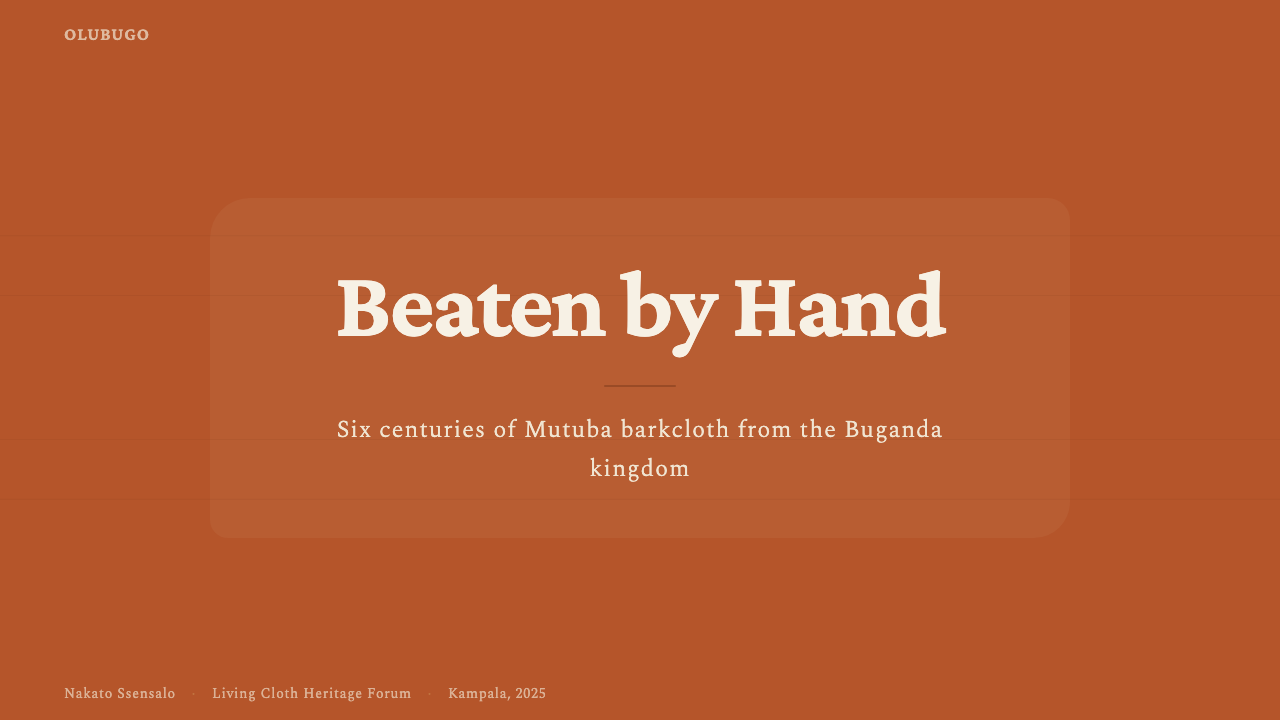
For presentation slides, the barkcloth aesthetic suits cover pages that need to communicate heritage, craft, or considered quality — brand retrospectives, cultural institution presentations, sustainability-forward annual reports, or any context where the subject matter warrants visual gravity. A cover in this style places a single line of large, serifed text against a warm terracotta or deep umber ground, with the texture of the background carrying visual complexity so the typography can remain spare. Content slides work best when treated as a single-column layout with wide margins: the earth-toned background continues, body text is set in a warm near-black, and the only color accent — if any — is a darker or lighter tone from the same earth family. Data slides adopt the diagrammatic spirit: charts rendered in the earth palette without decorative gridlines, letting the data forms speak as geometric shapes against the ground.
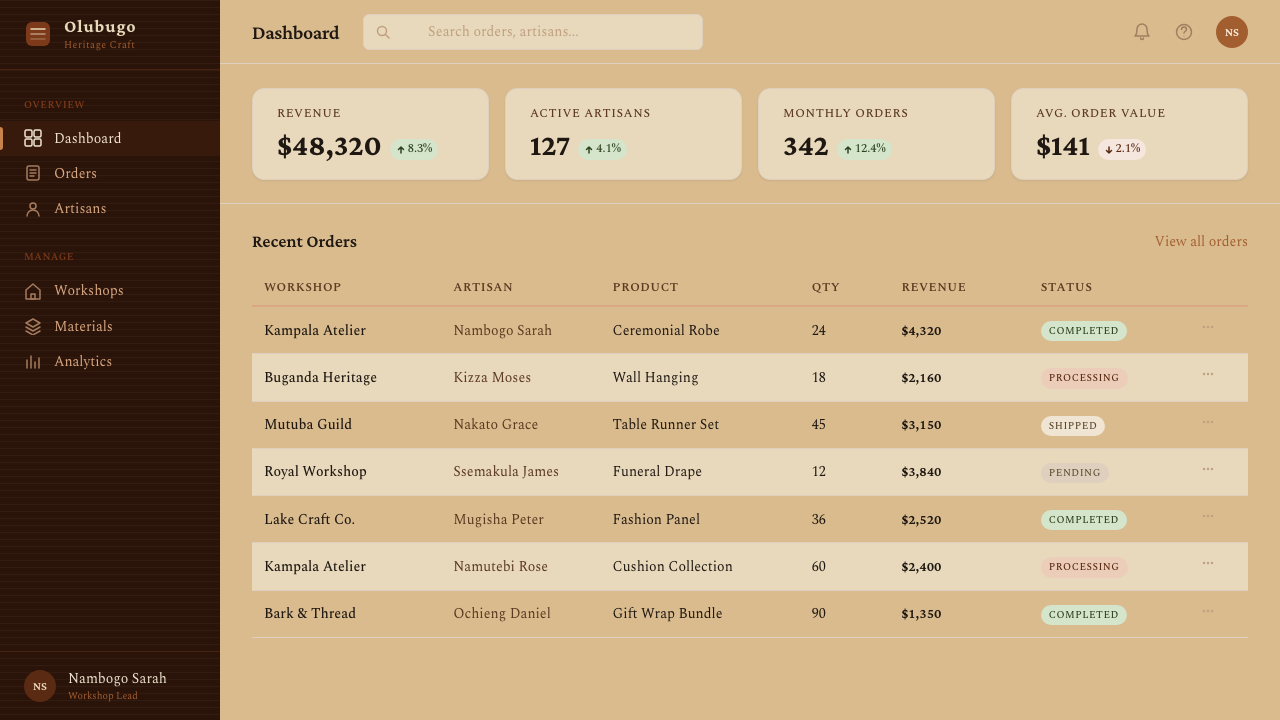
For web interfaces, the barkcloth aesthetic is particularly well-suited to dashboards and pricing pages for brands positioning around craft, sustainability, or cultural authenticity. The approach calls for a warm off-white or pale ochre background rather than a pure white; card components that use soft, warm shadows rather than crisp borders; and body text set in warm charcoal rather than pure black. Navigation should be typographically led, with generous spacing between items and no hover effects that introduce cool or synthetic colors. The terracotta accent color, used sparingly, works well for primary calls to action or tier differentiation — but should appear in one role only, not distributed across multiple UI elements simultaneously.
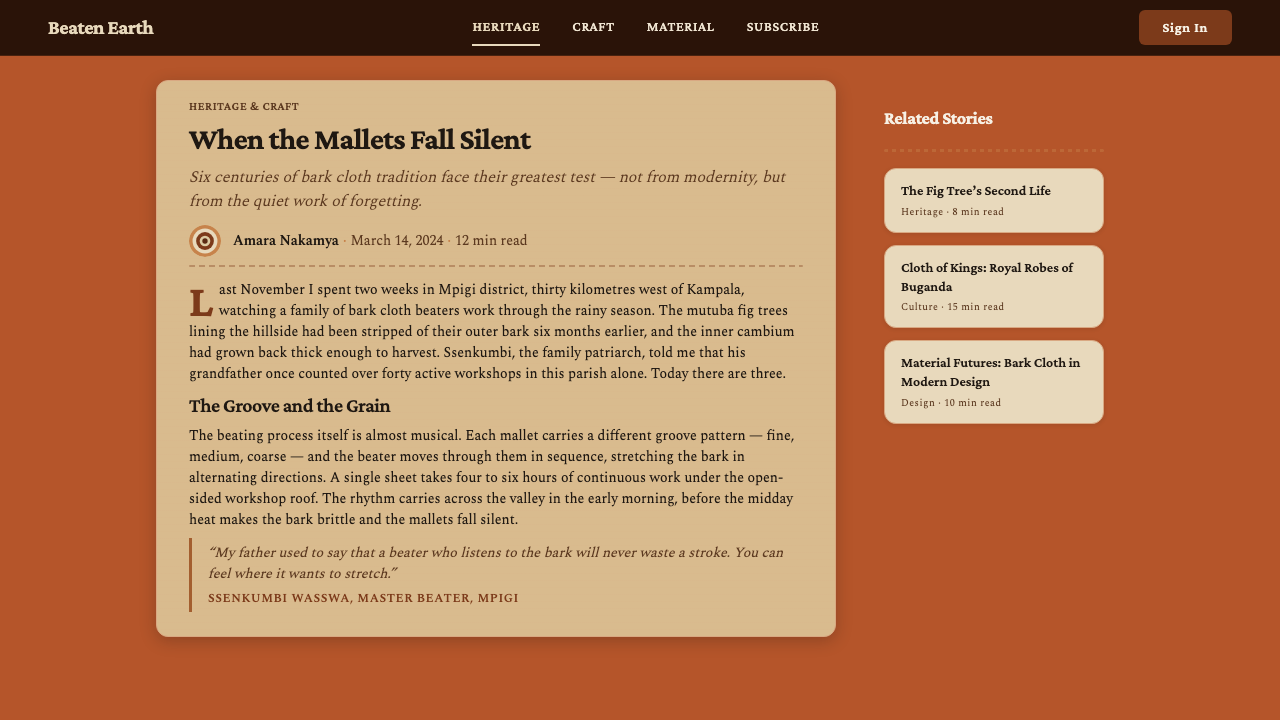
For editorial and marketing work, the barkcloth style supports long-form storytelling where the reader is invited to slow down rather than scan. Editorial layouts in this register use a moderate measure for body text, set at an unhurried line height, with pull quotes or marginalia in a slightly warmer or cooler earth tone to create gentle hierarchy. Section breaks are marked by thin horizontal rules in umber or terracotta rather than decorative ornaments. Marketing pages work well with the style's ceremonial gravity: hero sections that commit fully to the terracotta-and-umber palette, photography treated as warm-toned documentary rather than high-contrast commercial imagery, and headline typography that favors weight and deliberateness over size and urgency.
A common mistake when working with the barkcloth aesthetic is reaching for variety when the style calls for commitment. Designers accustomed to expansive palettes often dilute the earth tones with cooler neutrals — adding a blue-grey or a cool white — to make the layout feel more contemporary. This undermines the system entirely. The warmth is the point; neutralizing it produces a palette that belongs to no coherent aesthetic. Similarly, introducing multiple typeface families or mixing serifed headlines with geometric sans-serif body text breaks the textural consistency that the style depends on. One warm-ground background, one warm-ink text color, one serifed or slab-serifed typeface family across all type roles, and one accent tone drawn from the earth palette — that discipline, held consistently, produces a result that honors the tradition.
Ugandan Mutuba Barkcloth — FAQ
What makes barkcloth different from other African textile traditions?
Most textile traditions — including other African ones such as kente, kanga, or bogolanfini — are based on weaving, dyeing, or printing on woven cloth. Barkcloth is categorically different: it is not woven at all. The cloth is formed by mechanical transformation of a single piece of organic material, beaten until its fiber structure changes. This makes the final material non-repeating by nature — no two sheets are identical — and gives it properties that woven textiles lack, including a characteristic surface texture, a specific range of natural tones, and a physical memory of the making process. It is also one of the few African textiles with a continuous, documented production history stretching back more than six centuries in a single geographic region.
Can the barkcloth aesthetic work in digital-only contexts, without any physical texture?
Yes, but the digital translation requires conscious effort. The physicality of barkcloth — the literal texture of a beaten surface — is part of its meaning, and a flat digital design cannot replicate that directly. What a digital system can do is carry the structural logic: the warm earth palette, the organic-leaning color variation (using tones that feel sun-dyed rather than hex-precise), the sparse compositional approach, and the typographic register of deliberate weight and unhurried rhythm. Applied consistently, these qualities produce a digital aesthetic that reads as barkcloth-inspired without attempting to simulate the physical material. The worst approach is to add a low-opacity photograph of actual barkcloth as a background texture — this is illustrative quotation, not aesthetic translation, and it reads as costume rather than character.
Is this aesthetic appropriate for brands that have no connection to Uganda or East Africa?
This is a question designers should take seriously. The barkcloth tradition is not an abstract visual style that exists free of cultural origin — it is a living heritage with specific human custodians, an active royal patron, and contemporary practitioners who depend on it economically. A brand with no connection to Uganda that adopts the full iconographic language of olubugo — royal draping conventions, specific ceremonial color meanings, explicit references to Buganda court culture — risks cultural misappropriation. However, a design system that takes inspiration from the aesthetic qualities of barkcloth — earth tones, organic texture, generous space, material warmth — without making claims to the specific cultural content is working in a register that most traditions have accepted as legitimate design influence. The line lies in specificity of claim: drawing on the visual language is influence; performing the cultural context is appropriation.
How does barkcloth-inspired design differ from other warm, earthy aesthetics like wabi-sabi or cottagecore?
All three draw on warmth, organic material, and human imperfection, but their underlying logic is distinct. Wabi-sabi is a Japanese philosophical aesthetic organized around transience and incompleteness — the beauty of things that are wearing out, fading, or unfinished. Its visual language leans toward muted, cooled tones and a pervasive sense of quietude that approaches melancholy. Cottagecore is a romantic, nostalgic English pastoral — floral, soft, domestically abundant. Barkcloth is neither melancholy nor romantic: it is warm, grounded, and ceremonially weighted. Its dominant mood is dignity rather than wistfulness, presence rather than nostalgia. The terracotta tones are richer and more saturated than wabi-sabi's ashen palette; the composition is sparser and more formal than cottagecore's abundant floral arrangements. The tradition behind it is royal and ritual, not domestic and quaint.
What is the significance of UNESCO recognition for the barkcloth tradition?
The 2005 UNESCO inscription did several things simultaneously. It provided international legitimacy that helped craftspeople and cultural institutions argue for state support and preservation funding within Uganda. It gave the tradition visibility outside East Africa, enabling the design and fashion revival that followed. It created a documentary record — the nomination file and associated research — that captured technical processes and social protocols at a moment when knowledge transmission was under pressure from economic displacement of the craft. Practically, the inscription has helped sustain the communities in Mukono, Mpigi, and Mityana where the craft is concentrated, by creating tourism interest and international market demand. The recognition also influenced how designers and brands outside Uganda engage with the tradition — it signals that this is a documented, living heritage with identifiable human custodians, which raises the ethical bar for how it is referenced in commercial design work.
Related design styles
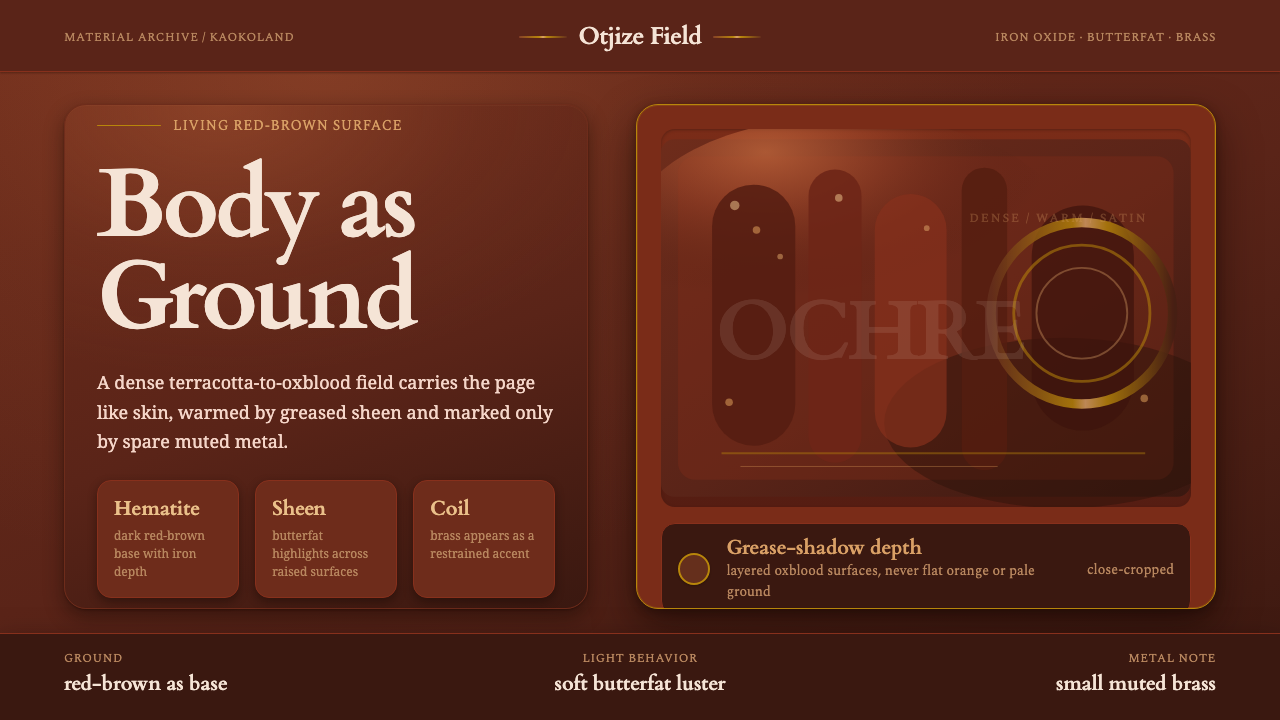 Himba Otjize Ochre NamibiaDense and ritual-warm. Oxblood ground, butterfat sheen, and sparse brass coil…
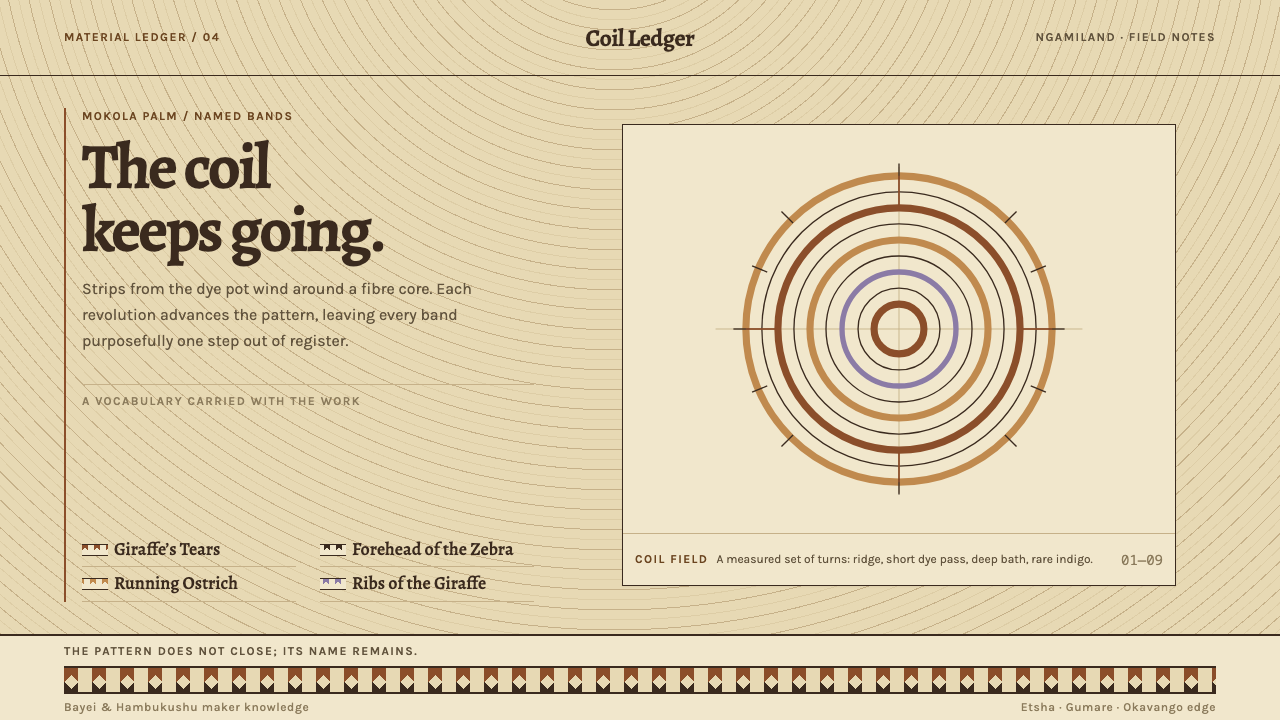 Botswana Coiled BasketThe pattern keeps travelling. Bark-brown stepped bands wind across a straw co…
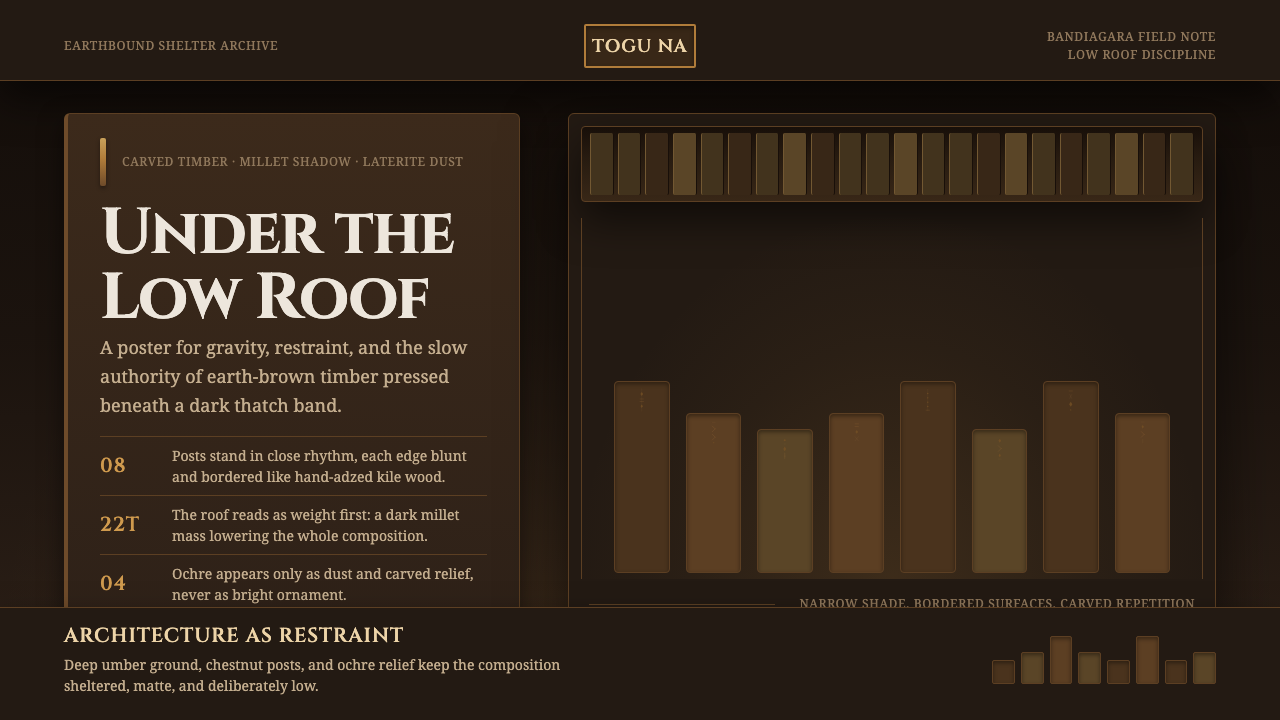 Dogon Toguna Shelter MaliGravity made visible. Deep umber ground, low roof band, chestnut posts in sha…
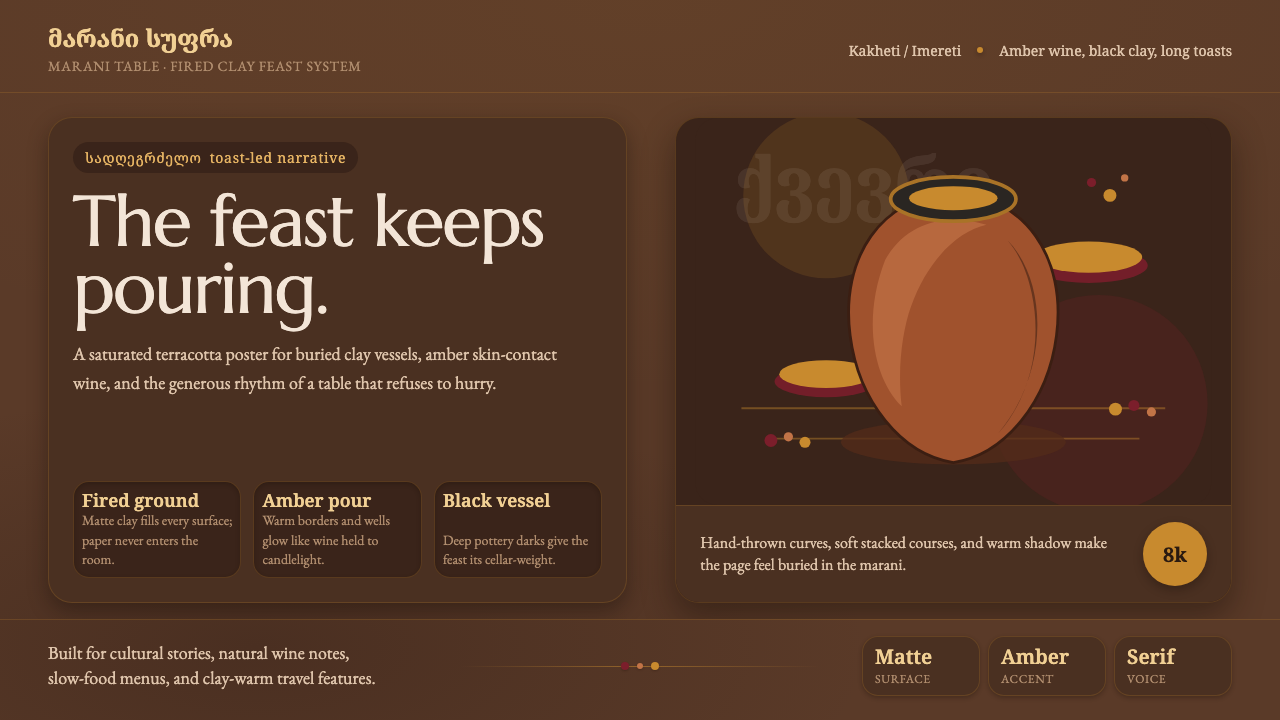 Georgian Qvevri Supra FeastHospitality made earthen. Terracotta ground, amber wine, Georgian serif curve…
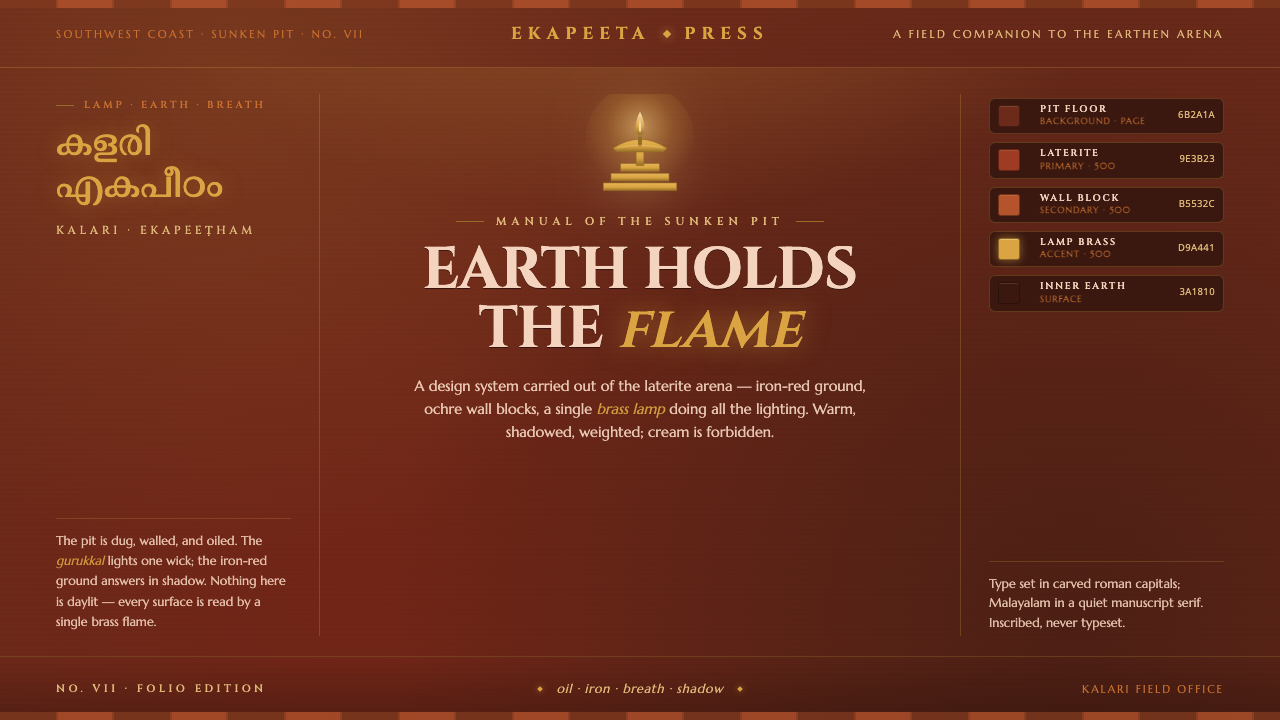 Kalaripayattu Kalari ArenaEarth holds the flame. Iron-red laterite, ochre wall blocks, a single brass l…
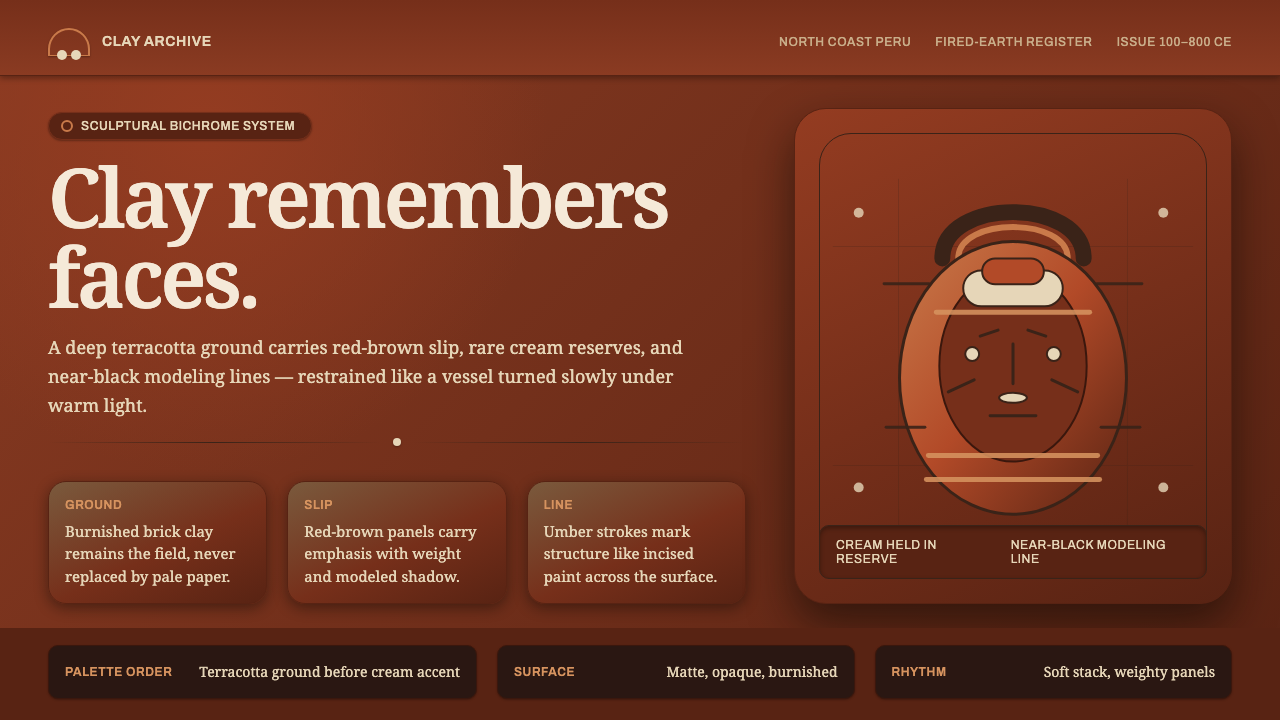 Moche Portrait VesselClay carries the likeness. Terracotta ground, red-brown slip, cream accents,…